Indications of new physics in the cosmic neutrino spectrum
−J. M. Carmona
−J. J. Relancio
−J. L. Cortés
−Maykoll A. Reyes TAE. September 19, 2019
Indications of new physics
Indications of new physics
Indications of new physics
Figure 2: IceCube events (log-scale)
Indications of new physics
Figure 3: IceCube events (log-scale)
Indications of new physics
We expect neutrinosin that range due to. . .
• . . .extrapolationof the espectrum at lower energies: Φ∼Ed−2.
• . . . we should see effects of theGlashow resonance
atE∼6.5 PeV. Figure 4: IceCube events (log-scale) and interpretation of the flux
Indications of new physics
It has been proposed, among other possibilites, that the cut-off is produced byintrinsic propagation effects.
This kinds of effects exist by the own nature of the neutrino and cause energy loss along the trayectory. If the influence of the effects are strong enough, this might explain the origin of the cut-off.
One intrinsic effect along the propagation is theuniverse
expansion. However, this is not enough to explain the cut-off, so we need to look for effects ofnew physics. For that, we use the Lorentz Invariance Violation.
Indications of new physics
The effects of theLorentz Invariance Violationmanifest, in the framework of the neutrino propagation, as amodified dispersion relationfor particles:
E2−p2=m2 → E2−p2=m2+p2+n
Λn , (1)
whereΛ is a scale of energy andnis the order of the correction.
Thepositive extra termdestabilize the neutrino, allowing two new methods of disintegration.
Indications of new physics
Figure 5:Vacumm Pair Emision. Figure 6:Neutrino Splitting.
Both effects, in addition to the expansion of the universe, produce energy lossin the neutrinos along their trajectories.
Indications of new physics
Steckeret al. have used this approach to perform Montecarlo simulations(for several values of the parameters).
Figure 7:IceCube events and Montecarlo simulations (Expansion + VPE)
A neutrino’s voyage
A neutrino’s voyage
We wil fix one neutrino, and analyse how its energy evolves since the emision (atze with energy Ee) to the detection (atz= 0 with energy Ed).
Figure 8: Trajectory of one neutrino
We use theredshift coordinate zto label the different positions along the trajectory.
A neutrino’s voyage
• Expansion of the universe
X(always present)
νd= νe
(1 +z) → dE
E = 1
(1 +z) dz . (2)
• Pair production
X(only if Eν > E∗)
dE
dt =−αnE6+3n → dE
E = αnE5+3n
H(z)(1 +z) dz . (3)
• Neutrino splitting
×
×
× (changes the number of neutrinos)
A neutrino’s voyage
• Expansion of the universe X(always present)
νd= νe
(1 +z) → dE
E = 1
(1 +z) dz . (2)
• Pair production
X(only if Eν > E∗)
dE
dt =−αnE6+3n → dE
E = αnE5+3n
H(z)(1 +z) dz . (3)
• Neutrino splitting
×
×
× (changes the number of neutrinos)
A neutrino’s voyage
• Expansion of the universe X(always present)
νd= νe
(1 +z) → dE
E = 1
(1 +z) dz . (2)
• Pair productionX(only if Eν > E∗)
dE
dt =−αnE6+3n → dE
E = αnE5+3n
H(z)(1 +z) dz . (3)
• Neutrino splitting
×
×
× (changes the number of neutrinos)
A neutrino’s voyage
• Expansion of the universe X(always present)
νd= νe
(1 +z) → dE
E = 1
(1 +z) dz . (2)
• Pair productionX(only if Eν > E∗)
dE
dt =−αnE6+3n → dE
E = αnE5+3n
H(z)(1 +z) dz . (3)
• Neutrino splitting××× (changes the number of neutrinos)
A neutrino’s voyage
Taking into account that pair emission only occurs ifEν > E∗, we need to distinguish three kinds of trayectories:
• Type 1: Ed< E∗ andEe< E∗ Ed
w
• Type 2: Ed> E∗ (so necessarilyEe> E∗) Ed
~ w
• Type 3: Ed< E∗ andEe> E∗ Ed
w
A neutrino’s voyage
•Type 1:
dE
E = 1
(1 +z) dz . (4)
Z Ee
Ed
dE E =
Z ze
zd
dz
(1 +z) . (5)
→ Ee =F1(ze, Ed) = (1 +ze)Ed. (6)
A neutrino’s voyage
•Type 2:
dE
E = 1
(1 +z) dz+ αnE5+3n
H(z)(1 +z) dz . (7)
Ee= E
1 +z ; t= (1 +z)3 → dEe
Ee6+3n = αn 3H0
t2/3+n
√Ωmt+ ΩΛ
dt . (8)
Z Eee
Eed
dEe
Ee6+3n = αn
3H0
Z (1+ze)3 (1+0)3
t2/3+n
√Ωmt+ ΩΛ
dt
| {z }
J(ze,0)
→ (9)
Ee=F2(ze, Ed) = (1 +ze)
Ed−(5+3n)−(5 + 3n) αn
3H J(ze,0)
−(5+3n)1
.
A neutrino’s voyage
•Type 3:
Ee= (1 +ze)
Ef∗−(5+3n)−(5 + 3n)3Hαn
0J(zi, z∗)
−(5+3n)1
E∗= (1 +z∗)Ed
. (11)
Ee=F3(ze, Ed) = (1+ze)
Ed−(5+3n)−(5 + 3n) αn 3H0
J(ze, z∗)
−(5+3n)1
.
(12)
Neutrinos do not travel alone
Neutrinos do not travel alone
We detect indivual neutrino detections, but we modelize it like a flux of neutrinos(no of neutrinos of energyEdper time & surface):
δΦ(Ed)
| {z }
Detected flux
= Z z2
z1
φEd(z)
| {z }
One source flux
· f(z)dz
| {z }
Number of sources
. (13)
We can express the detected flux from one source located atzas:
φEd(z) =dne(Ee)· 1
4πa20r2(z) · 1
dtd . (14)
Neutrinos do not travel alone
Substitutingk(z) =a0r(z) anddtd= (1 +z)dte we obtain:
φEd(z) = 1 4π
dne(Ee) dte
| {z }
δL(Ee)
1 (1 +z)
1
k2(z) . (15)
We can modelize the brightness as a power law ofEe:
δL(Ee) =E02/Ee2 → δL(Fi(ze, Ed)). (16)
The detected neutrino flux of energyEdis:
δΦ(E ) = 1 Z z2 δL(Fi(ze, Ed))f(z)
dz . (17)
Neutrinos do not travel alone
In order to compute the flux we need to split it in two cases:
Ed> E∗ and Ed< E∗. So, the flux is defined as a piecewise function ofEd:
δΦ2(Ed) = 1 4π
Z z2
z1
L(F2(ze, Ed))f(z)
k2(z)(1 +z) dz . (Ed > E∗) (18)
δΦ1(Ed) = 1 4π
Z z∗ z1
δL(F1(ze, Ed))f(z)
k2(z)(1 +z) dz + (19)
1 4π
Z z2
z∗
δL(F3(ze, Ed))f(z)
k2(z)(1 +z) dz . (Ed< E∗)
Bye, physics. Hi, computing
Bye, physics. Hi, computing
2 4 6 8 10
0 2.×10-90 4.×10-90 6.×10-90 8.×10-90 1.×10-89
EnergíaEd[PeV]
Φ1(Ed)/E02[Adim.]
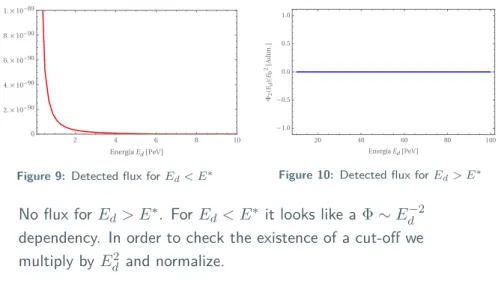
Figure 9:Detected flux forEd< E∗
20 40 60 80 100
-1.0 -0.5 0.0 0.5 1.0
EnergíaEd[PeV] Φ2(Ed)/E02[Adim.]
Figure 10: Detected flux forEd> E∗
No flux forEd> E∗. For Ed< E∗ it looks like aΦ∼Ed−2 dependency. In order to check the existence of a cut-off we multiply byEd2 and normalize.
Bye, physics. Hi, computing
Now the cut-off is visible. We use log-scale in order to compare with Steckeret al. plots.
0 5 10 15 20
0.0 0.2 0.4 0.6 0.8 1.0 1.2
EnergíaEd[PeV] Ed2·Φ(Ed)/Φ(1)[PeV2]
Figure 11: Analytic simulation of the flux
2 5 10
-1.5 -1.0 -0.5 0.0 0.5
EnergíaEd[PeV]
Log(Ed2·Φ(Ed)/Φ(1)[PeV2])
Figure 12:Logaritmic representation of the flux
Conclusion and discussion
Conclusion and discussion
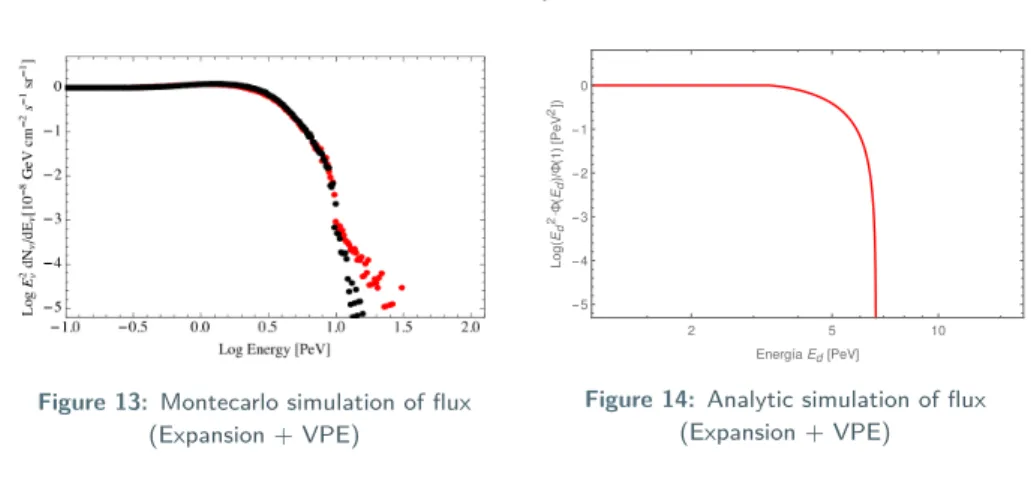
• We are able to recreate the expected cut-off:
Figure 13: Montecarlo simulation of flux (Expansion + VPE)
2 5 10
-5 -4 -3 -2 -1 0
EnergíaEd[PeV]
Log(Ed2·Φ(Ed)/Φ(1)[PeV2])
Figure 14: Analytic simulation of flux (Expansion + VPE)
Conclusion and discussion
• The cut-off is produced by the existence of a limiting source zc(Ed), which is the furthest source able to contribute to Φ(Ed).
1
(5 + 3n) Efd
−(5+3n)
−
∞ Eec−(5+3n)
!
= αn
3H0 J(zc, z∗)dt (20)
1 (5 + 3n)
1
Ed5+3n = αn
3H0
J(zc, z∗)dt
Equation forzc(Ed) (21)
This critical distancezcis closer as Ed increases, so the number of sources contributing to the flux decreases quickly.
Conclusion and discussion
• The cut-off happen before the threshold energy E∗, in a new scale energy which emerges naturally from the equations:
dEe
Ee6+3n = αn 3H0
t2/3+n
√Ωmt+ ΩΛ
dt → dEe
Ee = Ee5+3n 3H0
αn
j(t)dt ,
(22)
Defining the denominator as an energy:
En = 3H0
αn
5+3n1
→ dEe
Ee = Ee En
!5+3n
j(t)dt . (23)
Conclusion and discussion
• And this energy scale is always in the same order that the threshold energy.
E∗ =4m2eΛn
1
2+n ∝ m2eΛn
1
2+n ∼ PeV (24)
En= (3H0/αn)5+3n1 ∝ H0Λ3n/G2F
1
5+3n ∼ PeV. (25)
Thanks for your attention!
There exist three different ways to approach to the problem of the abscence of neutrinos above2 PeV:
The cut-off in the detection spectrum is due to. . .
• . . .a cut-off in the emision spectrum.
Problem: There is not a cut-off in other messenger particles.
• . . .extrinsic propagation effects.
Problem: We need to identify the external entity and explain its opacity dependency with the energy.
• . . .intrinsic propagation effects.
Problem: Only exist one classical intrinsic effect. May need new physics.
Why Lorentz Invariance Violation?
New physics
Quantum Gravity
Space-Time modifications
Lorentz Invari- ance Violation
• We look for new physics.
• Quantum Gravity looks like a natural way.
• Gravity is related to the space-time.
• Lorentz Invariance reflects the structure of the space-time.
• CPT violation implies Lorentz Invariance violation (not in the other way).
We should characterize the distribution of sources.
Figure 15: Conical-trunk of trajectories of neutrinos
When the distance is large enough, the conical-trunk tends to a one-dimensional line. So we can characterize the distribution of sources as a one-dimentional functionf(z).
Possible sources: Active Galactic Nuclei (AGN) andγ-Ray Bursts (GRB). They are distributed according to the Star Formation Rate:
Figure 16: Star formation rate as a function ofz
In the casen= 1 (CPT-violating) theν are superluminical and the
¯ν not (or viceversa), so we do not have any cut-off:
Figure 17: Montecarlo simulations forn= 1
We call Glashow Resonance to the resonant formation of aW boson in antineutrino-electron collisions: ν¯e+e− →W−.
Figure 18: Glashow resonance
Different diagrams for the Vacumm Pair Production.
The second one is only relevant 1/6 of all times. So theZ0 channel is the relevant one.
Figure 19: Vacumm Pair Production
Different diagrams for the Neutrino Splitting.
Figure 20: Neutrino Splitting
Figure 21: Screenshot of the script in Wolfram Mathematica
For more information you can google
“indicaciones de nueva física”: