
In this concluding section, we look at some of the main features of the internationalization of Spanish higher education in this global environment: a scenario full of opportunities. In addition, an important event on the international higher education calendar - the 29th annual conference of the European Council.
THE INTERNATIONALISATION OF EDUCATION
LUIS DELGADO
THE STRATEGY FOR THE
INTERNATIONALISATION OF SPANISH
UNIVERSITIES · EVALUATION TWO YEARS ON
Introduction
Participation also came from the Spanish autonomous communities and other actors within the Spanish university system, such as the Conference of Rectors, the Network of University-Business Partnerships and other public associations and agencies from the Quality and Internationalization sectors. The resulting strategy was presented for debate at a meeting held in September 2014 with all Spanish and foreign experts and actors.
The Strategy for the Internationalisation of Spanish Universities
In October 2013, the General Secretariat of Universities (SGU) established a working group for the internationalization of universities to develop its internationalization strategy. According to the 2015 Report on the Implementation of the Bologna Process, of the 48 EHEA countries, Spain is one of the 16 countries that have an official internationalization strategy (European Commission/EACEA/Eurydice, 2015).
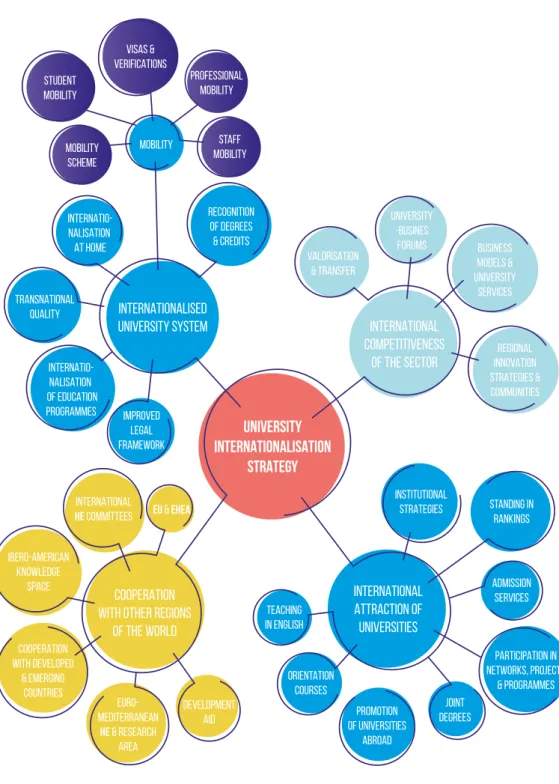
Evaluation of initiatives 2015-2016
Conclusions
The dynamics and working models of these initiatives are supported by the Internationalization Strategy Evaluation Commission to ensure that they work well and are launched in the current and future time frame. Retrieved from http://www.mecd.gob.es/educacion-mecd/dms/mecd/educacion-mecd/areas-educacion/universidades/politica-internacional/estrategia-internacionalizacion/.
ALFONSO GENTIL ÁLVAREZ-OSSORIO
THE INTERNATIONALISATION
OF THE SPANISH UNIVERSITY SYSTEM AS PUBLIC DIPLOMACY
I · Student mobility as a factor behind the internationalisation of universities
Spain is strongly committed to the Erasmus+ program and is co-financing the call with more than €30 million to strengthen student mobility. Furthermore, it can also be said that this mobility program is the most used by Spanish students to obtain credits outside their home university.
II · Initiatives to internationalise the Spanish university system brand
Furthermore, SEPIE collaborates with others involved in the Spanish university system (such as the Spanish Rectors' Conference) to develop transnational projects that take the Spanish system beyond our own borders (such as the Universidad Franco-Española project). Together with the Secretary General of Immigration and Emigration, SEPIE has promoted meetings with the universities to hear their views regarding the implementation of the directive in Spain. For example, it now collaborates with the Organization of Ibero-American States to organize seminars in Argentina and Paraguay and maintains a fluid flow of contact with the responsible bodies of the Ibero-American countries.
IV · Conclusions
Building on the rich experience gained through the Erasmus+ programme, which enables the annual funding of more than 10,000 internships in Spain, SEPIE promotes work experience that complements classroom learning, and as such students have been able to undertake teaching practice in Spain and even India through the BECAL program ( Paraguay). In addition, SEPIE and the General Secretariat for Immigration and Emigration (Ministry of Employment and Social Security) launched their work experience pilot program in 2016.
RAFAEL LLAVORI & OLGA AYUSO
INTERNATIONALISING QUALITY ASSURANCE
BUILDING BRIDGES IN HIGHER EDUCATION AREAS · THE CASE OF ANECA
International strategy
Together, these three main lines of action provide ANECA with a clear plan for its international cooperation, combining the necessary measures to maintain a balance between cooperation and the promotion of Spanish higher education institutions.
Moving forward: the role of the networks
Sharing good practices: international projects
Building regional bridges: The QACHE Project on Cross- border Higher Education
To that end, the main product of the project was the "Toolkit for QA agencies on cross-border higher education". Networks of QA agencies should facilitate inter-agency collaboration and the implementation of the QACHE Toolkit. The QACHE Toolkit works as a complementary tool for a more responsible cross-border higher education activity around the world that supports the initiatives of the higher education institutions.
The way forward
The QACHE Toolkit serves as a complementary tool for more responsible cross-border higher education activity around the world, supporting the initiatives of higher education institutions. for the internationalization of higher education, SEPIE. Only by combining efforts and synergies from all involved organizations can a successful strategy for the internationalization of higher education institutions be achieved. Spanish Service for the Internationalization of Higher Education (SEPIE). n.d.) Retrieved from http://internacionalizacion.sepie.es/index.html.
THE INTERNATIONALISATION OF RESEARCH
CHALLENGES FACING THE INTERNATIONALISATION OF
As an example, we can first mention the complexity of the vertical and horizontal distribution of jurisdiction. Having seen the essential features of the structural flaws of the system, we will now propose some basic elements needed to reform the system in the smallest possible way, in order to promote the internationalization of research from the ground up, taking into consideration researchers and groups research and allowing this initial approach to benefit the system as a whole. Despite the limitations of the system described above, Spain ranks tenth in the world ranking for scientific production, according to data provided by the Spanish Foundation for Science and Technology.
FERNANDO CASANI & JESÚS RODRÍGUEZ-POMEDA
THE IDEA OF A “FLAGSHIP UNIVERSITY”
IN THE NEW INTERNATIONAL CONTEXT OF HIGHER EDUCATION
Internationalisation and university rankings
These rankings gained currency in the early 2000s as the arena that hosted international competition for academic status (prestige and reputation). It is important to note that the rankings do not measure the degree of internationalization of a university, but rather the recognition enjoyed by its activities – especially research – in the international sphere. In the case of Spain, this can be demonstrated by analyzing the only ranking that specifically reflects the internationalization of universities, created by Times Higher Education (THE) and entitled "The World's Most International Universities".
Flagship vs. world-class universities
However, it came out as the top Spanish university in the internationalization ranking, due to a subjective reputation indicator formed by the expert opinions of those who took part in the survey. It therefore becomes clear that prestige has an important effect on the international image of universities, because the prestige achieved by their standing in the rankings also allows them to consolidate their strong image. The concept of a "flagship university" seems much more appropriate than the idea of a "world-class university" when analyzing the situation of Spanish universities.
Conclusion
INTERNATIONALISATION POLICIES & PRACTICES
DOROTHY KELLY
LANGUAGE POLICY FOR INTERNATIONALISATION
SPANISH AS AN ASSET
The case of Spain
Not English only
Furthermore, ETPs have not been without their detractors, who question the quality of teaching and learning, the political and social implications of not teaching in the local or national language, or the availability of sufficient qualified students and/or staff to produce the programmes. survival. In the bilingual autonomous communities, a lot of effort is invested in the promotion and development of their co-official languages. A central factor in the emergence of EMI in the Netherlands, the Nordic countries and the Baltic states was precisely the fact that their national languages were not widespread.
Spanish as an asset
Being able to open our degree programs, especially at the graduate level, to native Spanish speakers from most of Latin America, as well as to the growing population in the United States, is a great asset to our universities. It is also a great opportunity to attract students who want to learn or improve their knowledge of a language that is in increasing demand in the workplace due to the international importance of Spanish in international trade and international relations in general, making Spanish universities a prime destination to study in abroad. Our universities just have to take advantage of these opportunities and explicitly include them in their internationalization strategies.
MARINA CASALS
THE INTERNATIONALISATION OF NON-ACADEMIC STAFF
Mobility for administrative staff
Downsides to mobility
What about after?
Alternatives to mobility
However, most of these plans are aimed primarily at students and continue to overlook the backbone of universities: their non-academic staff.
Internationalisation at home for staff
Initial results
Changing mind-sets
Measuring impact
A comparison between pre- and post-measurements shows differences attributable to the internationalization training the participants received at the university. The survey itself will be reviewed and improved if necessary, and a third questionnaire will be added to the two existing questionnaires, which will be given to participants three months after the end of the training, in order to include impact measurement.
A picture is worth a thousand words
ANTONI LUNA GARCÍA & MAITE VIUDES
A SHORT HISTORY OF MARKETING
AND ATTRACTING INTERNATIONAL STUDENTS TO SPANISH UNIVERSITIES
Background
Professional meetings and conferences on international relations, such as the European Association for International Education (EAIE), have made this possible. In addition, in 1990, Spain approved its first private university licenses, and these institutions would act as a wake-up call when it came to attracting international degree-seeking and postgraduate students. Despite their best efforts, their ability to attract international students has been limited by the same bureaucratic obstacles that public universities face, such as the validation of qualifications, visas, etc.
Bolonia and international Marketing
The latest Facts and Figures of the Spanish Higher Education System (Datos y Cifras del Sistema Universitario Español) report from the Ministry of Education shows that a total of 85,973 foreign students chose to study at Spanish universities in the 2014-2015 academic year. Some of the leading universities in this regard have developed professional marketing and recruitment policies that are becoming increasingly effective. The Spanish Service for the Internationalization of Higher Education (SEPIE), part of the Ministry of Education, has now taken over the functions of Universidad.es.
Recent changes and future perspectives
Recuperado de https://sede.educacion.gob.es/publiventa/estrategia-para-la-internacionalizacion-de-las-universidades-espanolas-2015-2020/universidad/21475.
THE INTERNATIONALISATION OF HIGHER EDUCATION
IN SPAIN
A VIEW FROM THE OUTSIDE
THE INTERNATIONALISATION OF SPANISH HIGHER EDUCATION
How can we position the internationalization of Spanish higher education in this new international higher education arena. In this final section, we look at some of the main features of internationalization of Spanish higher education in that global environment: its position within the European Higher Education and Research Areas; its involvement in its former colonial domain, Latin America; and its relationship with the United States. Finally, we address some of the opportunities for the internationalization of Spanish higher education in the global context.
Spain in the European Higher Education and Research Areas
Against this background, the internationalization of higher education has taken enormous steps forward over the past three decades and has manifested itself in a wide range of initiatives, projects and programmes. This dynamic, in combination with the relatively low participation of Spanish research and researchers in EU research programs such as Horizon 2020, means that there is still some way to go for Spanish higher education to become more competitive within European higher education and research Areas. Nevertheless, the experience of Spanish students, faculty and administrators in Europe through the EU programs is a strong stimulus to a more competitive role, and has promoted the regionalization and internationalization of Spanish higher education in significant ways.
Challenges in the relationship between Spain and Latin America
Furthermore, the ranking positions of Spanish higher education institutions are, in general, lower than those of other European countries. Finally, the experience in collaborative activities gained by Latin American higher education institutions has transformed their perspective and they now seek to build relationships in which all parties benefit rather than participating in purely transactional alliances. There is a significant amount of unused infrastructure capacity for teaching and research in Spanish higher education institutions.
Spanish internationalisation and the United States
Spain can attract talent and generate income by developing agreements with public institutions in Latin American countries that have established mobility and training programs. Academic staff who have migrated to LA institutions can play a coordinating role for cooperation and project development. US outward mobility to the Spanish-speaking world has diversified in recent years, with 16% of study participants outside the US currently studying in Latin America and the Caribbean.
Opportunities
He has been Advisor to the President of the Council of Spanish Rectors and Director of Institutions and Relations of the Foundation for the Internationalization of Universities in the Spanish Government. She was a member of the Self-Assessment Commission for the first external review of ANECA by ENQA. Responsible for organizing several international and national events: ECA projects; ECA Annual Workshops; ENQA General Assembly; ANECA Summer Courses in Spain, etc.
ABOUT THE AUTHORS
Fernando Casani is currently the academic secretary of the Research Institute of Higher Education and Science (INAECU), a center founded by Universidad Carlos III and Universidad Autónoma de Madrid, coordinator of the research project of the International Academic Program (IAP) and director of the Association for the Development of the International Campus of Excellence, developed by the Universidad Autónoma de Madrid and the Spanish National Research Council (CEI UAM + CSIC). Alfonso Gentil Álvarez-Ossorio is Head of Internationalization of the Spanish Higher Education Unit at SEPIE (Spanish Service for the Internationalization of Education). Laura Howard is a former President of the European Association for International Education (EAIE).
