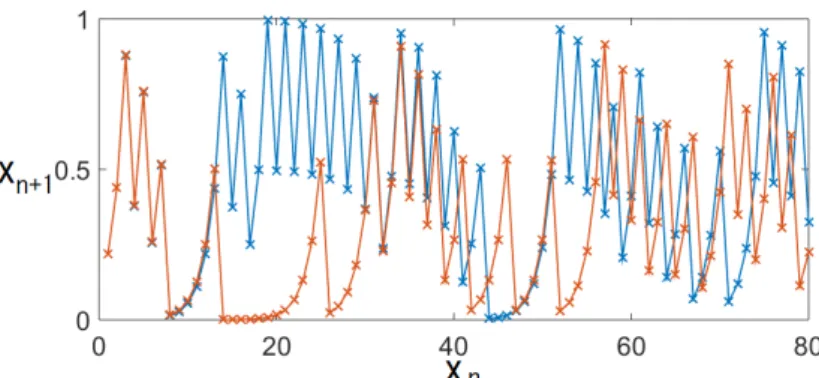
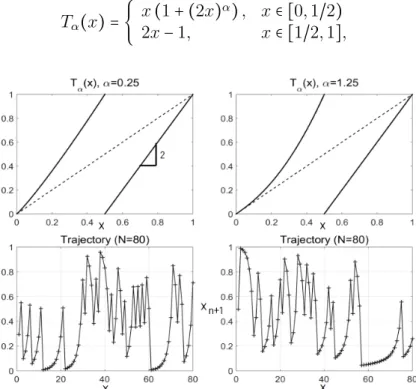
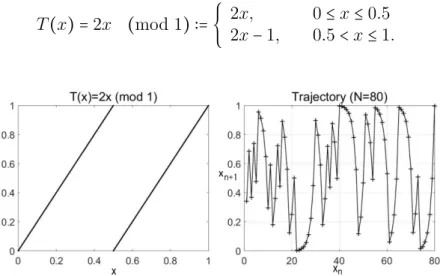
In this thesis our main focus is maps on the interval, specifically discrete time transformations of the unit interval[0,1], which is our state space. The existence of this invariant measure sets the starting point for the study of statistical properties of dynamical systems.
Maps in the interval
If x0 ∈X is the state of the system at time zero, then the state at the first time step x1 =T(x0), and more generally the state at time step n is recursively given by iteration xn=T(xn −1). In other words, if there is an inherent distribution of the points in the orbit whenn→.
Measure and measure spaces
Thus, a measurable function f is a measurable transformation from (X,Σ) to (R,B), where R is the set of real numbers and B a Borel-σ-algebra. One of the most important concepts in this thesis is absolutely continuous measures, which we define below.
L(µ) spaces
If some property related to the points in measure space is conserved except for a set of nulls, then this property is said to be true almost everywhere (a.e.). or simply a.e.) when µ is implicit, is sometimes used when the property holds almost everywhere with respect to the measure µ [6]. Sometimes one can write Lp instead of Lp(X,Σ, µ) if the measure space remains implicit, Lp(X), Lp(µ) or Lp(Σ) if the respective elements of the measure space are derived.
Bounded variation
The dual space, or simply, dual, by definition is the space of all bounded linear functionals [6]. Since it is a simple function, we can see that the maximum is achieved by choosing this set ofxi, otherwise some of the differences will be zero.
Compactness and quasi-compactness
In this thesis, one of the main tools we use for studying the evolution of density functions under the action of a transformation is the Perron-Frobenius operator, which is generally not compact in L1 [6]. As we shall see, this property is essential to prove the existence of a fixed point of the Perron-Frobenius operator, which in turn translates into the existence of an invariant density for the corresponding system associated with it.
Ergodicity and mixing
The following result is a well-known and powerful tool used to determine the convergence of a sequence of iterations of Markov operators P ∶L1→L1. Or, in other words, what is the probability that points in any given set will visit any other given set, given the system's invariant probability measure.
Perron-Frobenius operator
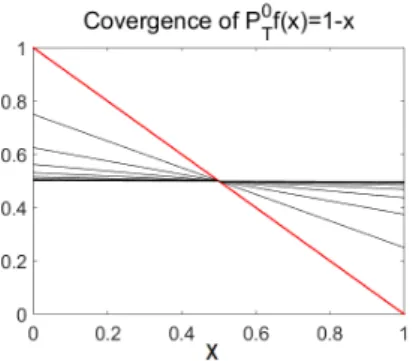
Recalling example 2.1 (equation (2.2)), we can observe the evolution of the densities according to the successive iteration of the Perron-Frobenius operator associated with the (partially monotonic and C2) transformation T(x) = 2x (mod 1 ). For the general case of expansive maps on the interval, we will discuss a classical result on the existence of an invariant density under the action of the Perron-Frobenius operator.
Decay of correlations
The exposition of the proof follows firstly from Theorem 2.3 (Ionescu-Tulcea and Marinescu), from which the quasi-compactness of the operator PT is given. By then applying Theorem 2.4 (Kakutani-Yosida), the existence of a fixed point f∗ ∈L1 such that PTf∗=f∗ is guaranteed. The rate of decay of correlations measures the speed at which the dynamics of the system, determined by T and µ, become independent of the initial conditions [6].
In practice, the measure is generally unknown, so the correlation coefficient cannot be determined analytically.
Lyapunov exponents
Our main interest is to study the set of conditions that lead to the manifestation of the phase transition phenomenon in random mappings in the interval. Therefore, in the following pages we will discuss some of the best-known deterministic systems in one dimension that are known to exhibit this phenomenon. In fact, there exists a sequence {µn} of period-doubling bifurcation values for the parameter µ, where µ0 =3 and µ1 =1+√.
Here we consider that the phenomenon of phase transition occurs at each value of µ for which a change in the typical distribution of trajectories means that the dynamics has passed from non-existence to existence of a.c.i.m (or vice versa).
![Figure 2.5: Coefficient of correlation for the map T ( x ) = 3x (mod 1), with f = g = χ [0,1/3] ( x )](https://thumb-us.123doks.com/thumbv2/123dok_es/5760218.5466685/35.892.318.539.147.316/figure-coefficient-correlation-map-t-x-mod-χ.webp)
W-maps
Thus, we will discuss the following two families of transformations that do not have contracting regions, but that also do not satisfy the conditions of the Lasota-Yorke theorem and nevertheless experience the phase transition phenomenon (as we imagine it) in an asymptotic manner. Their main result is the following theorem, which establishes the weak convergence of the invariant measure µa to the measure µ0 as a→0. The measure µ0 has the density function. Rather, this happened due to the existence of decreasing invariant neighborhoods of the critical point.
And the standard bounded variational methods for proving the quasi-compactness of the Perron-Frobenius operator cannot be applied to this family of maps, because the slopes are not uniformly bounded away from 2, and since this is a system with stochastic perturbations, the theory of the Lasot-Yorke theorem is not applicable.
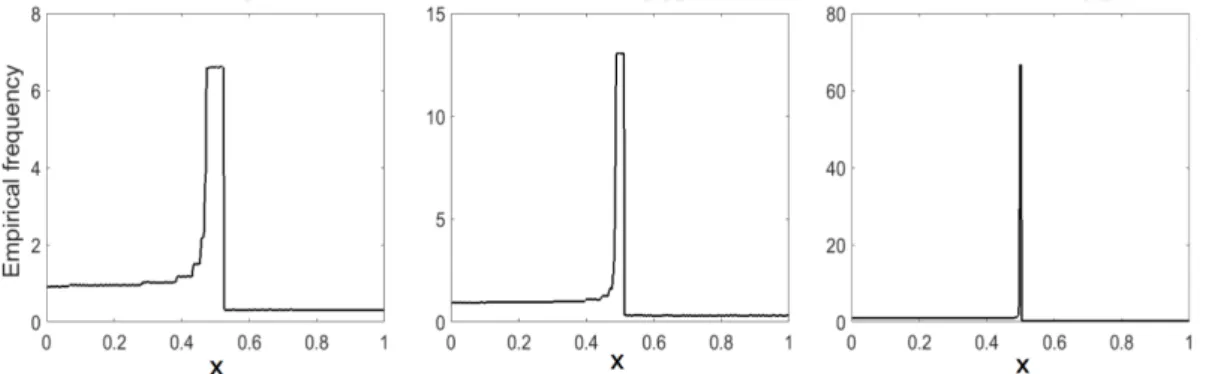
Manneville-Pomeau maps
We say that a sequence of random variables {Xn}n≥1 almost certainly converges to a random variable X if. We say that a set of random variables{Xn}n≥1 converges in probability to X if we have ϵ>0 for each. The weakest form of convergence of random variables, but also the most common in practice, is convergence in distribution (also called convergence in law); but it is also fundamentally relevant to the discussion of the central limit theorem (CLT).
In general, it is relatively easy to determine whether an event in this type of infinite sequence of random variables satisfies the conditions for these results.

Random maps
Random Perron-Frobenius operator
Then we say that the measure µ defined on I is invariant under the arbitrary map Tξ if we have it for every measurable set A. In the case where (Ω,F,P) is set as a continuous probability space (i.e. when the cardinality of Ω is uncountable), then the measure µdefined on I is said to be invariant under the arbitrary map Tξ if for any measurable set one has. Then, as we have done in the deterministic case, one can define the Perron-Frobenius operator associated with the arbitrary map Tξ.
Which, for the discrete case, has that for every f ∈L1(µ), the operator is given by.
Existence of invariant densities
- Position-dependent random maps
- Obtaining the invariant densities
- Random maps as a projection of skew-products
- Random maps with constant probabilities
- Existence of S.R.B. measures in random maps
- Random maps equipped with a continuum of transformations 46
Now, the method for computing invariant densities of random maps is specific to linear semi-Markov maps, and is a generalization of the matrix solution to the Perron-Frobenius inverse problem for the deterministic version of these maps proposed by the same authors in [35]. In [16], they predict skewed product placement and consider a class of random maps in the interval τt∶ X → X, endowed with a random parameter t∈W, whose space is allowed to have cardinality of continuity . Their main result is the theorem relating the minimality of the action and the uniqueness of the invariant measure for the corresponding system of the repeated function.
As we mentioned earlier, a setting related to random transformations in which the phenomenon of phase transition in the sense of the non-existence to the existence of an a.c.i.m.
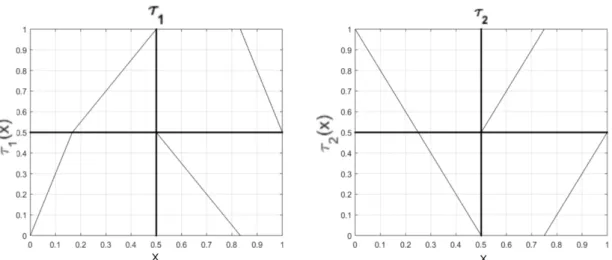
Random maps on the interval with spontaneous phase transition
- Numerical estimation of the invariant measure
- Lyapunov exponent
- An operator condition
- Empirical measure of I 2
- An expansiveness condition
- Decay of correlations
Using expression (4.8), we calculated the estimate of the Lyapunov exponent for the random map T2 with the accuracy of N = 2×10⁶ iterations. The spike in the data indicates the last negative value of the parameter for which the Lyapun exponent is negative. For this reason, we present here the definition of an estimator for the correlation coefficient as a function of the number of iterations.
For values of the parameter around the critical value, γ ≈ γc, the empirical estimator of the autocorrelation function shows a second level of decay.
![Figure 4.5: Representation of the random family with γ = 0. Here β is allowed by the value of γ to take values in the whole interval [ γ, 2 ] = [ 0, 2 ] .](https://thumb-us.123doks.com/thumbv2/123dok_es/5760218.5466685/64.892.319.544.163.401/figure-representation-random-family-allowed-value-values-interval.webp)
Lasota-Yorke’s approach
Existence theorem
It is known that the Perron-Frobenius operator for arbitrary images in the interval with #(Γ) = K < ∞ is expressed as. In this case, since the Γ is an uncountable set of transformations, we can prove that to define the discrete case βk = γ+Kk(θ−γ), we define asK→ ∞ for the classical definition of integrals, so, we can Express PTξ,Γf(x) as. By the definition of the conditions contained in Tξ,Γ and the construction of the Perron-Frobenius operator, it is necessary to point out that we do not assume any conditions on the derivative of any τ1.
Thus, under the assumptions stated in Theorem, and the random maps on the interval T(ξ,Γ)(x) have an a.c.i.m., as a standard consequence of an inequality of this type.
Probabilistic approach
Non-existence theorem
From this we have that (5.3) is the probability that the sum of the random variable Yk(β) is strictly less than zero. Given that the expected value of the sum of n independent random variables is equal to the sum of the expected values of these random variables [39]. Then the trajectories of T(ξ,Γ) will almost certainly converge to x∗, so the invariant density is a delta distribution centered on this point for each value of the parameter γ such that Eγ≤Eγ1.
Furthermore, we need to investigate the nature of the dynamics of the random map when there is more than one interval.
Existence theorem
Finally, given that Eγ1(Sn) <0, we have P(Sn<0) >0, then it is almost certainly 1, which means that the then composition of the random map almost certainly has a strictly absolute-valued derivative taken lower than 1 rated in its fixed point. For i ≠ 0, r this does not hold, and therefore the dynamics of the random map ends up lying outside the element of the partition Ii, and the almost sure convergence of the trajectories to x=x∗ is not guaranteed. Ii with one fixed point with b) and c) conditions, or a countable number of k fixed points in Ii which contain b) and c) conditions.
Examples
This work in progress deals with the topic of the phase transition phenomenon of an absolutely continuous measure of dynamical systems connected by a hole. We then investigated the change in the resulting dynamics for different values of the parameter α for T1(x). Whether it guarantees the existence of an a.c.i.m. other than for homeomorphisms of the unit circle)?.
On the existence of invariant measures for piecewise monotonic transformations. Transactions of the American Mathematical Society.

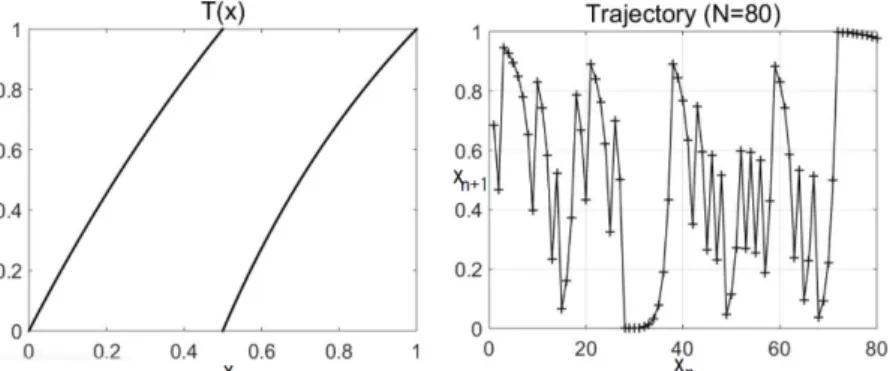
![Figure 2.3: Histograms for the transformation T ( x ) = 2x (mod 1), for 2 × 10 4 (left), 1 × 10 5 (center) and 1 × 10 7 iterations, where the interval [ 0, 1 ] being divided into j = 1000 bins](https://thumb-us.123doks.com/thumbv2/123dok_es/5760218.5466685/19.892.133.742.317.504/figure-histograms-transformation-left-center-iterations-interval-divided.webp)