
Band gap measurements of PDA synthesized at 1.5 mmol TRIS and 25, 40, and 55 °C from Kubelka–Munk transformed reflectance spectra. Similarly, the use of tuning radicals to control the size of PDA nanoparticles is reported by X.
BACKGROUND
Water
- Water pollution
The United Nations estimates that the amount of wastewater produced annually is approximately 1,500 km3, which is six times more than all the water in the rivers of the Earth [49]. Furthermore, nearly half of the estimated 1 million tons of oil entering marine environments each year comes not from tanker spills, but from land-based sources such as factories, farms, and cities.
Water treatment
- Photocatalysis
- Photocatalytic materials
- Photocatalysis based on organic semiconductors
TiO2 under UV light is one of the most common photocatalysts in heterogeneous photocatalysis (Figure 2). According to the description in which the generation of various charge carriers depends on the amount of light absorption by the material, the first and most important is the band gap energy of the semiconductor.
![Figure 1. Different Advanced Oxidation Processes [55].](https://thumb-us.123doks.com/thumbv2/123dok_es/5760223.5466690/21.918.295.639.325.714/figure-different-advanced-oxidation-processes.webp)
Eumelanin and polydopamine
- Eumelanin synthesis and structure
- Eumelanin as photocatalyst
- Polydopamine synthesis and structure
- Polydopamine as photocatalyst
According to the authors, the improved activity of the photocatalyst is due to the strong interaction between TiO2 and HHDM (microfibers derived from human hair), the formation of Ti-O-C bonds (enhanced by thermal treatment at 300 °C) and the high porosity of the fibers [86]. These can be found as part of the PDA structure, especially when L-DOPA is used as a precursor [91].
![Figure 4. Eumelanin pathways production in melanocytes [75].](https://thumb-us.123doks.com/thumbv2/123dok_es/5760223.5466690/30.918.205.709.110.576/figure-eumelanin-pathways-production-melanocytes.webp)
PROBLEM STATEMENT, HYPOTHESIS, OBJECTIVES, AND
- Justification
- Hypothesis
- Objectives
- General
- Particular
- Experimental procedure
- Materials and reagents
- Synthesis of PDA
- Characterization of PDA
- Absorption and photocatalytic test
The polymerization reaction was monitored by UV-Vis spectrometry in a quartz cell with a UV-Vis-NIR spectrometer, CARY 5000 (Agilent, USA). The morphology of synthesized material was observed by scanning electron microscopy in a Dual Beam Helios Nanolab 600 (FEI, USA) operated at 8.00 kV, a working distance of 5.0 mm and a secondary electron detector; the samples were supported on carbon tape. The thermal transitions were obtained by Differential Scanning Calorimetry (DSC) using a Q200 calorimeter (TA Instruments, USA) with a heating rate of 10 °C/min from −50 to 250 °C under a nitrogen atmosphere.
The thermogravimetric analysis (TGA) was performed using Q500 equipment (TA Instruments, USA) with a heating rate of 10 °C/min from room temperature to 700 °C under a nitrogen atmosphere. Simultaneously, the Raman spectroscopy was performed using a Micro Raman (Renishaw, UK), laser excitation at 532 nm, and a Raman shift range from 500 to 2000 cm-1. Aliquots were taken every hour for 8 hours and were analyzed by UV-Vis spectroscopy with a quartz cell in a UV-Vis-NIR spectrometer, CARY 5000 (Agilent, USA).
The photocatalytic activity assays were carried out under the same conditions for one hour in the dark, and then the reaction was carried out under stirring and visible light. The photocatalytic reaction was carried out under the same conditions and with PDA obtained at 25 °C and 1.5 mmol TRIS to determine the photocatalytic mechanism of PDA. Methanol and silver nitrate solutions (adjusted with 2 mmol) were used as holes and electron scavengers.
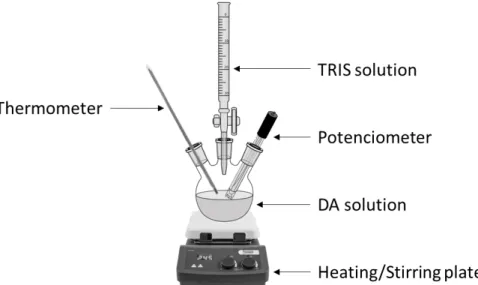
PDA SYNTHESIS
Synthesis of polydopamine
- Polymerization kinetics
Morphology and particle size
The synthesis of PDA with 1.5 mmol showed an increase in the reaction rate (Figure 13A) as the temperature increased, as expected (Table 2). The reaction order of the synthesis performed with 1.5 mmol TRIS was n ~ 1 for each temperature. In the same way, reactions performed at 4.5 mmol TRIS show a similar behavior with respect to 1.5 mmol as the temperature increases;
A TRIS concentration effect can be noted when comparing the rate constants of 1.5 and 4.5 mmol TRIS. We assume that due to a slower growth stage of PDA particles, the observed k at 55°C with 4.5 mmol TRIS may be lower than k with 1.5 mmol TRIS at the same temperature. Figures 13 C and D illustrate the change in DA concentration over time for reactions with 7.5 mmol TRIS.
As shown, for the reaction with 1.5 mmol TRIS, there is no sudden consumption of DA in the nucleation stage at the measurement's first time. From the results observed for DA polymerization with 7.5 mmol TRIS it was hypothesized that the reaction has two different rate constants. From the profiles obtained with 7.5 mmol TRIS shown in Figure 13D, the second rate constant, the reaction rate at 55.

Thermal analysis
Spectroscopic analysis
The spectra of the other reactions follow a similar trend; Consequently, we only show the spectra at 1.5 mmol tris and 25 °C. However, this increase in the k-value derived from hydroxyl ion concentration is limited to 25 and 40 °C since 55 °C is smaller than the k calculated with 1.5 mmol at the same temperature. A more spherical morphology is observed due to a higher concentration of TRIS than reactions at 1.5 mmol TRIS.
Thermograms of synthesis at 4.5 mmol TRIS ( Figure 18B ) show similar melting enthalpies compared to 1.5 and 7.5 mmol TRIS, but the melting points are lower (between 27 and 35 °C, Table 7 ). These results indicate that pH (TRIS concentration) and temperature have an essential effect on the conformation of PDA microstructure with a pronounced effect at 4.5 mmol TRIS concentration. However, if it is assumed that the PDA with the higher enthalpy value has the highest crystalline fraction (100%), obtained with 4.5 mmol TRIS at 40°C, then 7.5 mmol TRIS at 55 °C produces the PDA with the lower crystalline fraction , 67.98.
On the other hand, a minimal effect of TRIS concentration on the melting enthalpies is noted for 1.5, 4.5 and 7.5 mmol at 25 °C. As the temperature increases to 40 and 55 °C, the effect of the TRIS concentration is significant; for example, at 1.5 mmol, the temperature favors the formation of crystalline fractions in PDA, while at 40 °C the crystalline fractions are higher than those at 25 °C, at 4.5 and 7.5 mmol. Results for 4.5 mmol TRIS show a minimal effect of temperature on the melting point; it means greater homogeneity of the crystalline areas or a reduced number of crystal defects.
On the other hand, the higher presence of secondary amine in materials obtained at 1.5 and 7.5 mmol TRIS is associated with the promotion of DA cyclization (DHI monomers). In particular, the low positions of the G bands and the high ID / IG ratio for materials obtained at 4.5 mmol TRIS concentration compared to the other two concentrations could be explained due to the presence of DA monomers.
X-ray diffraction analysis
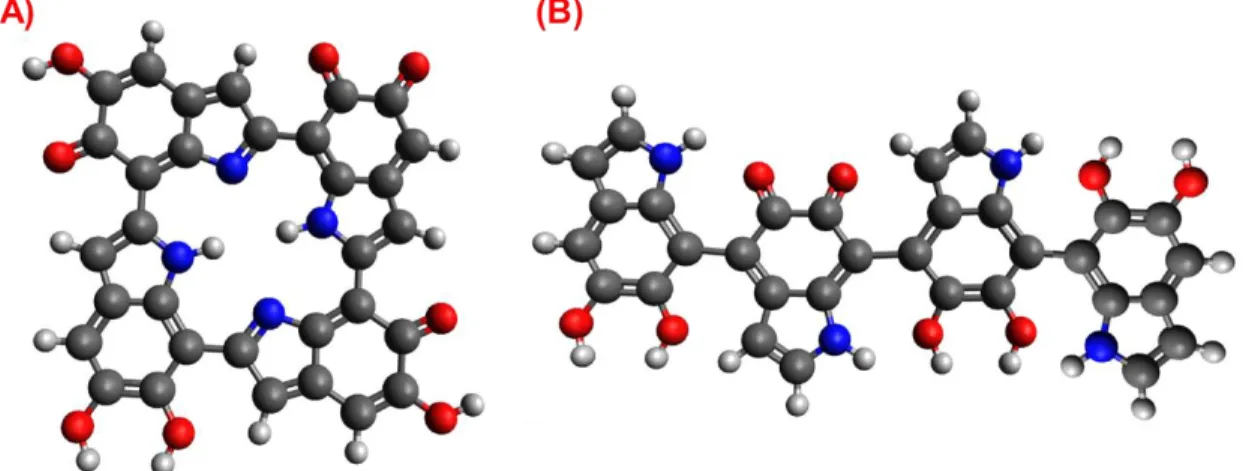
On the other hand, Figure 24B illustrates the PDA monomer structure based on spectroscopic and DFT results, the Liebscher model [131]. In this model, the composition of oligomers is formed by a mixture of indole units with different degrees of unsaturation (DHI and its oxidized forms) and open-chain dopamine (DA) units covalently united by carbon atoms at position 4 and 7; related results supporting the presence of this kind of PDA chains were also reported by P. According to the obtained results of the thermal and spectroscopic analysis, the presence of DA units in the PDA chains has been inferred; consequently, the noncyclic model fits and describes the observed properties of the PDA (Figure 24A).
Finally, Figure 24B shows the stacking structure of PDA chains with a d-spacing of ~3.4 Å supported by the π – π interactions.

PROPERTIES OF THE PDA FOR THE REMOVAL OF
Photocatalytic activity evaluation of polydopamine
RhB removal profiles by photolysis, adsorption and under visible light for materials obtained at 1.5 mmol Tris up to A) 25, B) 40 and C) 55 °C. The different percentages of adsorption between the materials obtained at 1.5 mmol and three different temperatures can be explained by the contribution of different factors. Eg can be obtained when a linear fit of the flat part of the graph is extrapolated towards 0, i.e. the Eg value is estimated at the intersection with the abscissa axis [148].
Several papers in the literature have reported the experimental HOMO and LUMO values of PDA where the LUMO potential is located at -1.4 eV which is sufficient for the photogeneration of O2●- species. It is important because the different chemical composition of PDA is important from the point of view of its optical and electronic properties. The photoactivity of PDA decreases according to the synthesis temperature at which the material is obtained; when PDA synthesized at 40 °C was evaluated, the increase in RhB removal under visible light was 6.80 %, while PDA at 55 °C did not present photoactivity.
It was not possible to make measurements of the HOMO and LUMO of the material evaluated here; however, based on the obtained results and literature on bv and LUMO calculated values, it is speculated herein that the reduction in photoactivity of PDA synthesized at 40 and 55 °C is due to the different monomers that make up the PDA as the LUMO is affected by its heterogeneity. If the LUMO in PDA is located below -0.33 eV—the reduction potential to O2●- photogeneration—oxidizing species will not be generated, which consequently causes RhB degradation to not occur. As mentioned above, four factors affect the adsorption capacity of PDA; from this, π – π interactions appear to have a higher effect due to the sp2 hybridization of PDA and RhB.

Polydopamine photoactivity mechanism
Ligonzo et al., 'Electrical and optical properties of natural and synthetic melanin biopolymer', J Non Cryst Solids, vol. Abbas et al., “Structural, electrical, electronic and optical properties of melanin films,” European Physical Journal E, vol. Dai et al., “Surface modification of polypropylene with porous polyacrylamide/polydopamine composite coatings,” Mater Lett, vol.
Jia et al., 'Polydopamine-assisted surface modification for orthopedic implants', Journal of Orthopedic Translation, vol. Tiwari et al., 'Polydopamine-based Implantable Multifunctional Nanocarpet for Highly Efficient Photothermal-chemo Therapy', Sci Rep, vol. Zhou et al., 'Dramatic visible light photocatalytic degradation due to the synergetic effects of TiO2 and PDA nanospheres', RSC Adv, vol.
Mao et al., 'Core-shell structured TiO2@polydopamine for very active visible-light photocatalysis', Chemical Communications, vol. Wang et al., 'Tunable, Metal-Loaded Polydopamine Nanoparticles Analyzed by Magnetometry', Chemistry of Materials, vol. Ribera et al., 'Scalable Biosynthesis of Melanin by the Basidiomycete Armillaria cepistipes', J Agric Food Chem, vol.
Li et al., 'Structure evolution and thermoelectric properties of carbonized polydopamine thin films', ACS Appl Mater Interfaces, vol. Simonovic et al., 'THERMOGRAVIMETRY AND DIFFERENTIAL SCANNING CALORIMETRY OF NATURAL AND SYNTHETIC MELANINS', Journal of Thermal Analysis, vol.

![Figure 2. Schematic photocatalytic mechanism representation of semiconductor (e - (CB) / h + (VB) pair formation) [55]](https://thumb-us.123doks.com/thumbv2/123dok_es/5760223.5466690/23.918.316.599.652.897/figure-schematic-photocatalytic-mechanism-representation-semiconductor-pair-formation.webp)
![Figure 3. VB and CB positions for several semiconductors in an aqueous media (pH = 1) [58]](https://thumb-us.123doks.com/thumbv2/123dok_es/5760223.5466690/25.918.267.687.209.529/figure-vb-cb-positions-semiconductors-aqueous-media-ph.webp)


![Figure 8. Chemical route of the DA auto-oxidation [89].](https://thumb-us.123doks.com/thumbv2/123dok_es/5760223.5466690/35.918.211.709.105.484/figure-chemical-route-da-auto-oxidation.webp)
