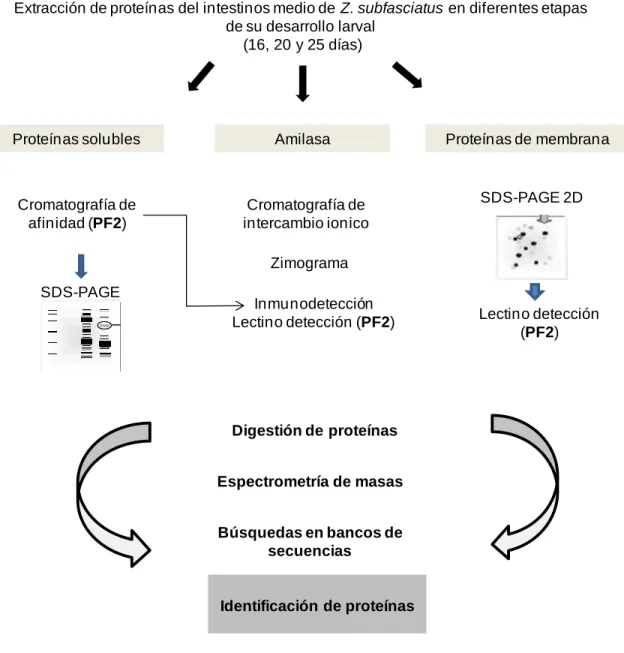
Bajo este escenario, se propuso que el presente estudio se centrara en la glicoproteómica en el intestino de Zabrotes subfasciatus (plaga del frijol) y la identificación de glicoproteínas involucradas en el mecanismo insecticida de la lectina PF2. En este estudio, se identificaron receptores potenciales para PF2 en el intestino del insecto. De acuerdo con lo anterior, la hipótesis propuesta para este trabajo fue que las glicoproteínas presentes en el intestino medio de Z.
Finalmente, la internalización de la lectina en las células epiteliales podría resultar en la unión de la lectina a las proteínas mitocondriales, que son actores clave en el metabolismo energético.
ANTECEDENTES
La presencia de lectinas en los ovarios se ha relacionado con efectos sobre la fecundidad de los insectos (Gatehouse et al., 1998). Tal unión sugiere que el mecanismo insecticida del GNA implica la interferencia de la lectina con el metabolismo del hierro del insecto (Du et al., 2000). Este polisacárido es el componente principal de la membrana peritrófica (PM) que se encuentra en la mayoría de los insectos, excepto en los homópteros (Tellam et al., 1999).
De manera similar, la lectina de Amaranthus caudatus (ACA) expresada en plantas de algodón transgénicas inhibe el desarrollo de Aphis gossypii (Wu et al., 2008). La lectina GNA se considera no tóxica para los mamíferos porque su unión al yeyuno es muy baja (Pusztai et al., 1990). Estudios posteriores han demostrado que la introducción de transgenes en plantas puede provocar cambios significativos en los niveles de expresión genética (Down et al., 2001).
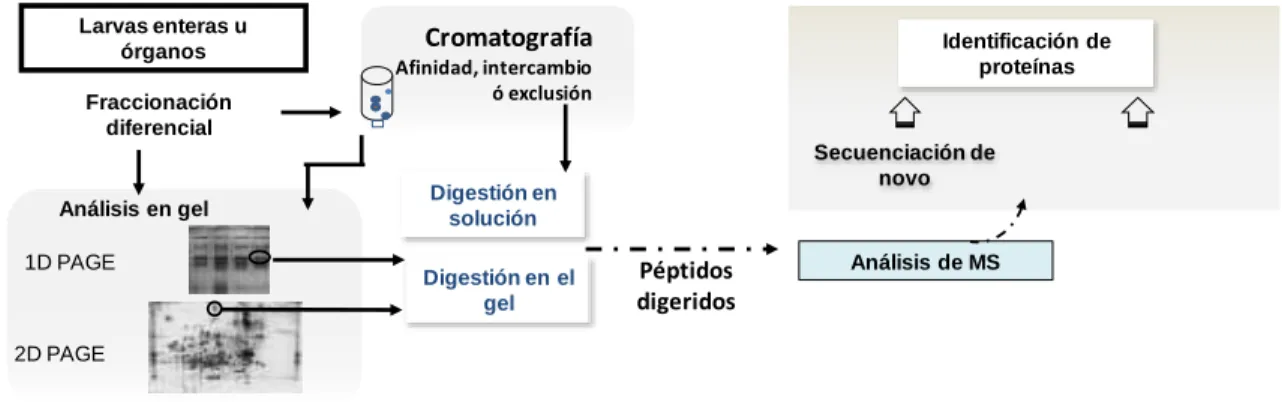
El término proteoma se utilizó por primera vez en 1994 para describir el conjunto completo de proteínas codificadas en un genoma (Wilkins et al., 1996). Diversos autores señalan que la proteómica se puede dividir en dos ramas: expresión y función (ChoudharyyGrant, 2004; Kocks et al., 2003). Luego, las proteínas se pueden digerir proteolíticamente y analizar mediante técnicas de espectrometría de masas (MS) (Yates et al., 2009).
Debido a su velocidad y alta sensibilidad, la EM se ha convertido en un elemento clave para la identificación de proteínas (Yates et al., 2009). Los espectros de fragmentación se comparan con masas teóricas de péptidos de proteínas que se encuentran en bases de datos para revelar la identidad de las proteínas (Yates et al., 2009). Por ejemplo, la identificación de proteínas receptoras en el intestino de insectos para las toxinas Cry de Bacillus thuringiensis fue posible gracias a la proteómica (Fernández-Luna et al., 2010).
En los insectos, como en otras especies, la glicosilación de proteínas varía según la etapa de desarrollo y el estado reproductivo (Li et al., 2007).
Binding of PF2 Lectin from Olneya tesota to Gut Proteins of Zabrotes subfasciatus Larvae Associated with the Insecticidal
Mechanism
Sodium dodecyl sulfate-polyacrylamide gel electrophoresis (SDS-PAGE) analysis of proteins retained in the gel revealed several putative glycoproteins, ranging in mass from 17 to 97 kDa. The potential of these proteins to serve as part of the mechanisms involved in the insecticidal activity of PF2 in Z. Coleopterans of the family Bruchidae are major pests of legume seeds; The relationship between bruchids and legumes is very specific.
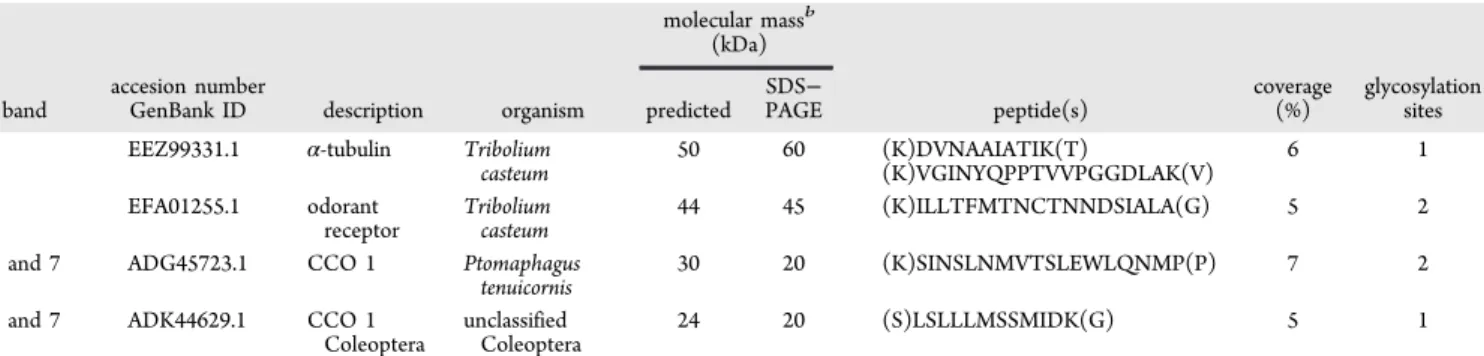
It is important to emphasize that this study is the first step in an exploratory analysis of potential receptors and ligands in the midgut tissues of Z. MS was scanned, followed by three MS/MS scans of the highest peak within the initial MS scan . Spectral analysis yielded a peptide sequence corresponding to each of the original bands identified by SDS-PAGE.
Identity comparison using BLAST analysis confirmed the presence of the peptide in CCO 1 and revealed links to CCO 1 from other organisms, including deduced amino acid sequence of Z. Another important factor influencing our analyzes is the quality of the available insect databases. Ferritin serves as a target site for the snowdrop lectin (GNA) in the midgut of the cotton bollworm Spodoptera littoralis.Insect Sci.
The effect of diet on the ultrastructure of the midgut cells of Nasonia vitripennis.Cell Tissue Res. Sequence characterization and expression patterns of defensin- and lysozyme-encoding genes from the gut of the reduviid bug Triatoma brasiliensis. Insect Biochem.
An amylase as a receptor for PF2 lectin binding in the midgut of Zabrotes subfasciatus
Materials and methods
Midguts of 400 larvae (20 days old), selected as described by Rodriguez-Quiroz et al., 2000 were cold-immobilized and dissected in cold 250 mM NaCl solution. The supernatant containing the gut lumen soluble proteins (crude extract) was kept at -80 °C, and the protein concentration was estimated using bovine serum albumin as a standard (Lowry et al., 1951). The α-amylase inhibitory activity was expressed as a relative α-amylase activity without pre-incubation with the PF2.
Purified PF2 was cross-linked to glycidol-activated Sepharose 4BCl (PF2-Sepharose) (Hermanson et al., 1992). The crude extract from intestinal tissue was adjusted to pH 7.0 for optimal binding to PF2 and applied to a 2 ml PF2-Sepharose column equilibrated with PBS. Glycoproteins retained on PF2-Sepharose were eluted with 0.02 M glycine-HCl buffer (pH 2.5) until the absorbance at 280 nm was baseline.
The precipitated protein was dialyzed extensively against 40mM Tris-HCL, pH 8.5, and applied to a HiTrap Q HP ion exchange column, on an AKTA chromatography system. Alpha-amylase activity was also detected in an 8% SDS-PAGE in semi-denaturing conditions using a Biorad Mini II apparatus. After electrophoresis, one half of the gel was used for the detection of α-amylase activity as follows; the gel was transferred to a 2.5% (w/v) solution of Triton X-100 for 20 min at room temperature, then incubated with 1% solution of soluble starch in 100mM acetate buffer, 20mM NaCl and 0.2mM CaCl2, pH 5.8 at 30 °C for 30 min, followed by 2 min wash with distilled water.
SDS-PAGE 2D separated proteins were transferred to a nitrocellulose membrane at 0.8 mA/cm2 for 45 minutes, using a semi-dry blotter (Labconco, USA). The results were also validated using XTandem, another search engine, and with Scaffold, a program that relies on results from various search engines (i.e., Sequest, XTandem, and MASCOT), which uses Bayesian statistics to identify reliability more spectra (Keller et al. , 2002).
Results and discussion
These findings also indicate that only a fraction of the amylases present are glycosylated with the carbohydrates recognized by PF2. Toxicity of insect enzyme activity by lectins has been observed previously. For example, GNA lectin reduces α-glucosidase activity in L. In contrast, lectins can also increase the activity of some enzymes by increasing the number of active enzyme sites by changing the substrate. accessibility or affinity (Erickson et al., 1985; You et al., 1992).
This was the case for BmoLL lectin which increased the in vitro α-amylase activity of Callosobruchus maculates (Macedo et al., 2007). The weakness of the signal of AmyAnti probably reflects that amylases are partially folded under semi-denaturing conditions, and their structural epitopes are not always accessible to the. PF2 recognized only one of the bands that showed amylase activity in the zymogram (α-3), and also recognized one more band that interestingly was not recognized by AmyAnti.
Glycosylation of α-amylases has only been observed for porcine pancreas, human saliva and some bacterial amylases (Matsushita et al., 2002). Recently, it was reported that the GNA lectin recognizes α-amylase from several insects, including Acyrthosiphon pisum, Tribollium castaneum, Apis mellifera, and Bombyx mori (Vandenborre et al., 2011). Molecular cloning of bruhid (Zabrotes subfasciatus) alpha-amylase cDNA and interactions of the expressed enzyme with bean amylase inhibitors.
Transgenic pea seeds expressing the common bean alpha-amylase inhibitor are resistant to Bruchid beetles. Membrane glycoproteins interacting with PF2 lectin from the midgut larva of Zabrotes subfasciatus related to the.
Membrane glycoproteins interacting with PF2 lectin of the midgut larval of Zabrotes subfasciatus associated to the
To evaluate the effect of insecticidal lectins on pests, it is important to know the intestinal composition, distribution and physiological role of the glycoconjugates. The intestines of insects, as well as those of other animals, are rich in glycoconjugates that are important for maintaining the normal function of the intestines (Peumans and van Damme, 1995). To evaluate the effect and mechanisms of insecticidal proteins, there is a great need to increase our understanding of the composition, distribution, and physiological roles of the glycoconjugates present in the insect intestinal tract.
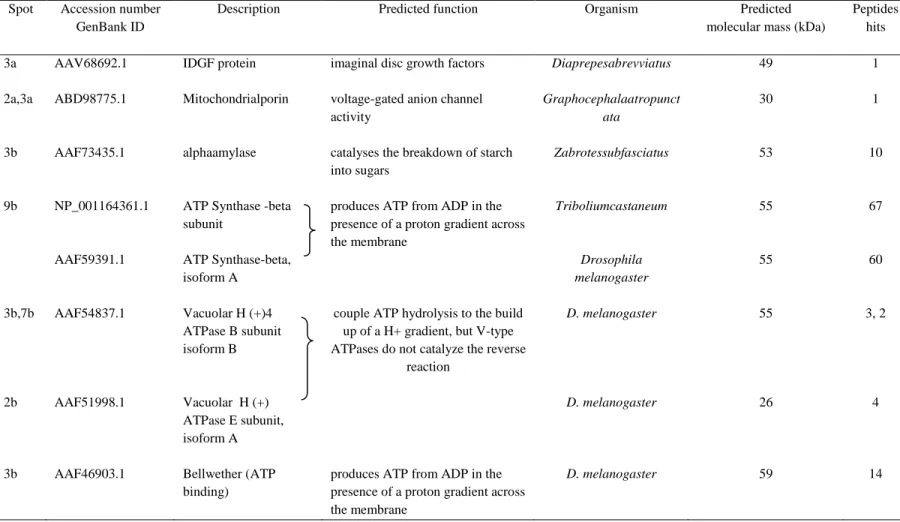
2D gel electrophoresis is an important tool for proteomic analysis, especially for the comparison of changes in protein expression during different stages of an organism's development. These results advance our understanding of the 2D profile of membrane proteins and provide the first comparison by 2D SDS-PAGE of the level of protein expression in different larval stages of Z. IDGF proteins are members of the family of growth-promoting glycoproteins, also called the imaginal disc growth factors.
The expression of these proteins can be variable during insect development; in Droshophila, IDGF was highly expressed in mid-larval stages (Kawamura et al., 1999). It has been suggested that in Bombyx wing disc cells, IDGF proteins help insulin bind to its receptor, and that disrupting critical developmental pathways, such as reducing insulin receptor signaling, may provide a means for developing methods of new management. to reduce insect growth and/or survival (Wang et al., 2009). Since most proteins were resolved with an acid pI (3–7) and because the insecticidal effect of PF2 was observed at very early stages, samples from 16-day-old larvae were further resolved on 7 cm IPG strips pH 4–7 .
In the larval midgut of the lepidoptera, Manduca sexta, the V-ATPases are located on the surface of the goblet cell membrane. These cells are the input for alkalinization of the intestinal lumen and play a crucial role in proton secretion as well as maintaining ion balance in the insect (Azuma et al., 1995). In addition, an extensively glycosylated V-ATPase was isolated from the midgut and malpighian tubules of the tobacco hornworm, Manduca sexta (Merzendorfer et al., 1999). Actin is one of the three main components of the cytoskeleton, and it is involved in important cellular processes such as cell motility, cell division, vesicle movement, differentiation and proliferation (Bayyareddy et al., 2009). The interaction of lectins (GNA) with actin has been reported by others in A.
2001) Functional mechanics of the plant defensive Griffonia simplicifolia lectin II: resistance to proteolysis is independent of glycoconjugate binding in the insect gut.