LFV Higgs decays
•
Introduction: Hints of LFV decays of the Higgs
•
SUSY explanation
•
Vector-like fermions explanation
•
Conclusions
Antonio Delgado
University of Notre Dame
arXiv:1602.08506
C. Alvarado, R. Capdelvilla, AD, A. Martin
Introduction
•
The LHC has searched for LFV Higgs decays and has reported a mild excess of the form:
ATLAS and CMS have set ~1% bounds* on .
Events excess (1.3 and 2.4 ) point out to a signal
New physics?
The excess
4
**Eur. Phys. J. C75, ‘15
* Phys. Lett. B738, ‘14
at best 2.4 σ
•
If interpreted as a LFV Yukawa this can be translated as:
• Limit on
sets bound on
•
Previous
limits* (<10%) set indirectly by null The excess
5
CMS, Eur. Phys. J. C75, ‘15
*Blankenburg, Ellis, Isidori ‘12
•
In the SM any LFV is necessarily proportional to neutrino masses which means that:
•
This observation implies that any LFV implies physics beyond the SM.
Can charged LFV be mediated by neutrinos?
Yes. But…
Massive -mediated charged LFV goes as
Charged LFV probes new physics if observed Lepton flavor violation
8
•
On the other hand one has to be very careful while model building since a LFV Higgs decay could
imply charge a LFV decay:
Add new fermions to the SM. Use the 6-dim
to generate
Model II — 4-fermion
25
H
l
il
jLFV
• from
• All
29
excluded Model II — 4-fermion
*Belle, BaBar collabs.
•
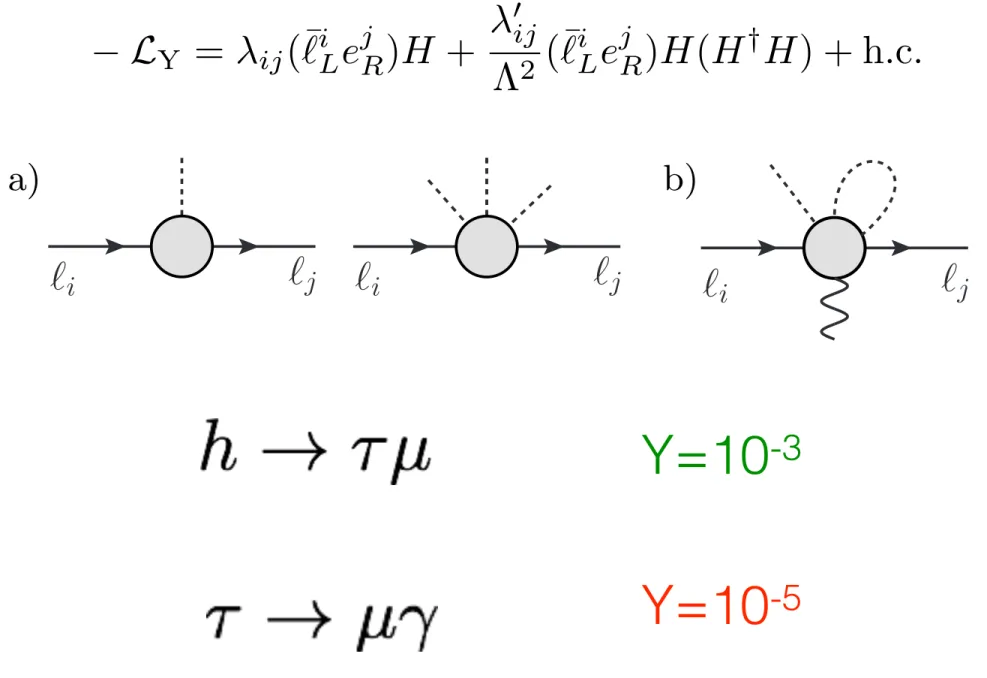
From an SM effective field theory point of view there is a tension:
Uncovering Mass Generation Through Higgs Flavor Violation
Wolfgang Altmannshofer,1, ⇤ Stefania Gori,1, † Alexander L. Kagan,2, ‡ Luca Silvestrini,3, § and Jure Zupan2, ¶
1Perimeter Institute for Theoretical Physics, 31 Caroline St. N, Waterloo, Ontario, Canada N2L 2Y5
2Department of Physics, University of Cincinnati, Cincinnati, Ohio 45221,USA
3INFN, Sezione di Roma, Piazzale A. Moro 2, I-00185 Roma, Italy
A discovery of the flavor violating decay h ! ⌧µ at the LHC would require extra sources of electroweak symmetry breaking (EWSB) beyond the Higgs in order to reconcile it with the bounds from ⌧ ! µ , barring fine-tuned cancellations. In fact, an h ! ⌧µ decay rate at a level indicated by the CMS measurement is easily realized if the muon and electron masses are due to a new source of EWSB, while the tau mass is due to the Higgs. We illustrate this with two examples: a two Higgs doublet model, and a model in which the Higgs is partially composite, with EWSB triggered by a technicolor sector. The 1st and 2nd generation quark masses and CKM mixing can also be assigned to the new EWSB source. Large deviations in the flavor diagonal lepton and quark Higgs Yukawa couplings are generic. If mµ is due to a rank 1 mass matrix contribution, a novel Yukawa coupling sum rule holds, providing a precision test of our framework. Flavor violating quark and lepton (pseudo)scalar couplings combine to yield a sizable Bs ! ⌧µ decay rate, which could be O(100) times larger than the SM Bs ! µµ decay rate.
Measurements of Higgs production and decay [1, 2]
have revealed that most of the electroweak symmetry breaking (EWSB) is due to the vacuum expectation value (vev) of the Higgs field. In the Standard Model (SM) the Higgs vev also sources the charged fermion masses.
Testing this assumption directly is possible for the third generation fermions by measuring the Higgs decays to b quarks and tau leptons, and by measuring the tth¯ cross section at the LHC. Present measurements indicate that the Higgs is at least partially responsible for the masses of the 3rd generation fermions. Much less is known about the origin of mass for the first two generations. There is experimental confirmation that the Higgs has a smaller Yukawa coupling to the muon than to the tau [3, 4], as expected in the SM. The SM also predicts that the Higgs should not have tree level flavor changing decays, e.g., h ! bs or h ! ⌧µ. The discovery of such decays would mean that there must be new physics (NP) near the elec- troweak scale [5–21]. In this Letter we point out that flavor violating Higgs decays can also be understood as a test of fermion mass generation, and we devise a sum rule that can be checked experimentally.
Intriguingly, the CMS collaboration has obtained the first bounds on Br(h ! ⌧µ) < 1.51% at 95% C.L., with a hint of a nonzero signal [22]. The best fit branching frac- tion is Br(h ! ⌧µ) = (0.84+0.390.37)%. We will show that the strength of this signal is naturally understood if a sec- ond source of EWSB is responsible for the muon mass.
This means that there is a whole family of NP models that can lead to large flavor violating Higgs decays. We also extend this possibility to the quark sector.
Let us first discuss h ! ⌧µ in models in which the Higgs is the only source of EWSB. In an e↵ective field theory, in which the NP particles are integrated out, the Higgs-lepton couplings are [8, 18]
LY = ij(¯`iLejR)H +
0ij
⇤2 (¯`iLejR)H(H†H) + h.c., (1)
a)
i j i j
b)
i j
Figure 1: Contributions to the lepton mass matrix and Yukawa interactions (a) and the electromagnetic dipole (b).
a)
⇥ ⇥
i E L j ⇥ ⇥
i E L E L j
b)
⇥ ⇥
i E L E L j
Figure 2: A realization of Fig. 1 with vectorlike leptons.
where ⇤ is the NP scale, and we have kept the two leading terms. In Fig. 1 a) the two operators are denoted with a blob corresponding to the exchange of NP states. For example, the latter could be vectorlike leptons of mass
⇤ which mix with the SM leptons, see Fig. 2 a) (Note that if the only NP states are scalars, then (1) implies the presence of additional EWSB vevs [23].).
A misalignment of ij and 0ij in flavor space leads to o↵-diagonal Higgs Yukawa couplings in the mass basis.
Using the normalization in [10], we find Y⌧µ = vW2
p2⇤2 h⌧L| 0|µRi, (2) and similarly for Yµ⌧ , with the Higgs vev vW = 246 GeV.
The CMS measurement [22] gives q
|Y⌧µ|2 + |Yµ⌧|2 = (2.6 ± 0.6) · 10 3 . (3) In the blobs of Fig. 1 at least one NP particle needs to carry electromagnetic charge. Thus, the electromagnetic dipole operators,
Le↵ = cL,R m⌧ e
8⇡2 µ¯R,L µ⌫⌧L,R Fµ⌫, (4)
arXiv:1507.07927v2 [hep-ph] 3 Feb 2016
Uncovering Mass Generation Through Higgs Flavor Violation
Wolfgang Altmannshofer,1, ⇤ Stefania Gori,1, † Alexander L. Kagan,2, ‡ Luca Silvestrini,3, § and Jure Zupan2, ¶
1Perimeter Institute for Theoretical Physics, 31 Caroline St. N, Waterloo, Ontario, Canada N2L 2Y5
2Department of Physics, University of Cincinnati, Cincinnati, Ohio 45221,USA
3INFN, Sezione di Roma, Piazzale A. Moro 2, I-00185 Roma, Italy
A discovery of the flavor violating decay h ! ⌧µ at the LHC would require extra sources of electroweak symmetry breaking (EWSB) beyond the Higgs in order to reconcile it with the bounds from ⌧ ! µ , barring fine-tuned cancellations. In fact, an h ! ⌧µ decay rate at a level indicated by the CMS measurement is easily realized if the muon and electron masses are due to a new source of EWSB, while the tau mass is due to the Higgs. We illustrate this with two examples: a two Higgs doublet model, and a model in which the Higgs is partially composite, with EWSB triggered by a technicolor sector. The 1st and 2nd generation quark masses and CKM mixing can also be assigned to the new EWSB source. Large deviations in the flavor diagonal lepton and quark Higgs Yukawa couplings are generic. If mµ is due to a rank 1 mass matrix contribution, a novel Yukawa coupling sum rule holds, providing a precision test of our framework. Flavor violating quark and lepton (pseudo)scalar couplings combine to yield a sizable Bs ! ⌧µ decay rate, which could be O(100) times larger than the SM Bs ! µµ decay rate.
Measurements of Higgs production and decay [1, 2]
have revealed that most of the electroweak symmetry breaking (EWSB) is due to the vacuum expectation value (vev) of the Higgs field. In the Standard Model (SM) the Higgs vev also sources the charged fermion masses.
Testing this assumption directly is possible for the third generation fermions by measuring the Higgs decays to b quarks and tau leptons, and by measuring the t¯th cross section at the LHC. Present measurements indicate that the Higgs is at least partially responsible for the masses of the 3rd generation fermions. Much less is known about the origin of mass for the first two generations. There is experimental confirmation that the Higgs has a smaller Yukawa coupling to the muon than to the tau [3, 4], as expected in the SM. The SM also predicts that the Higgs should not have tree level flavor changing decays, e.g., h ! bs or h ! ⌧µ. The discovery of such decays would mean that there must be new physics (NP) near the elec- troweak scale [5–21]. In this Letter we point out that flavor violating Higgs decays can also be understood as a test of fermion mass generation, and we devise a sum rule that can be checked experimentally.
Intriguingly, the CMS collaboration has obtained the first bounds on Br(h ! ⌧µ) < 1.51% at 95% C.L., with a hint of a nonzero signal [22]. The best fit branching frac- tion is Br(h ! ⌧µ) = (0.84+0.390.37)%. We will show that the strength of this signal is naturally understood if a sec- ond source of EWSB is responsible for the muon mass.
This means that there is a whole family of NP models that can lead to large flavor violating Higgs decays. We also extend this possibility to the quark sector.
Let us first discuss h ! ⌧µ in models in which the Higgs is the only source of EWSB. In an e↵ective field theory, in which the NP particles are integrated out, the Higgs-lepton couplings are [8, 18]
LY = ij(¯`iLejR)H +
0ij
⇤2 (¯`iLejR)H(H†H) + h.c., (1)
a)
i j i j
b)
i j
Figure 1: Contributions to the lepton mass matrix and Yukawa interactions (a) and the electromagnetic dipole (b).
a)
⇥ ⇥
i E L j ⇥ ⇥
i E L E L j
b)
⇥ ⇥
i E L E L j
Figure 2: A realization of Fig. 1 with vectorlike leptons.
where ⇤ is the NP scale, and we have kept the two leading terms. In Fig. 1 a) the two operators are denoted with a blob corresponding to the exchange of NP states. For example, the latter could be vectorlike leptons of mass
⇤ which mix with the SM leptons, see Fig. 2 a) (Note that if the only NP states are scalars, then (1) implies the presence of additional EWSB vevs [23].).
A misalignment of ij and 0ij in flavor space leads to o↵-diagonal Higgs Yukawa couplings in the mass basis.
Using the normalization in [10], we find Y⌧µ = vW2
p2⇤2 h⌧L| 0|µRi, (2) and similarly for Yµ⌧ , with the Higgs vev vW = 246 GeV.
The CMS measurement [22] gives q
|Y⌧µ|2 + |Yµ⌧|2 = (2.6 ± 0.6) · 10 3 . (3) In the blobs of Fig. 1 at least one NP particle needs to carry electromagnetic charge. Thus, the electromagnetic dipole operators,
Le↵ = cL,R m⌧ e
8⇡2 µ¯R,L µ⌫⌧L,R Fµ⌫, (4)
arXiv:1507.07927v2 [hep-ph] 3 Feb 2016
Model II
via 4-fermion operators LFV
• from
• All
29
excluded Model II — 4-fermion
*Belle, BaBar collabs.
Y=10
-3Y=10
-5•
That means one has to go a theory with at least two sources of EWSB:
•
MSSM with LFV soft terms
•
Vector like fermions
MSSM with LFV soft terms
•
Since the MSSM is a type-II 2HDM there is no LFV at the superpotential level.
•
We are going to add the following LFV soft lagrangian:
Flavor structure for leptons & sleptons ( )
LFV originated in SUSY-breaking terms
The SUSY framework
Yukawas
12
scalar masses
A-terms
•
We can calculate the contribution to LFV higgs decays in a simplified setup:
via tri-scalar interaction with coefficient
Model I — A-terms
Hd0
τ
µ B˜0
τ˜
µ˜
13
SM Higgs
Decay rate
Mass ratios only
No mass scale picked Leaves still free for Model I — A-terms
* loop function
15
•
Including just the triangle diagram which is a overestimation we get:
• Cannot lower beyond ~1.0
• Requires
> 6
Model I — A-terms
19
•
But there is a problem with CCB minima:
•
So even with our overestimation of the effect it
seems that SUSY has issues to accommodate this LFV decay.
No charge-breaking minima of the scalar potential
bounds on all with
In particular*
implies tension with our needed Model I — A-terms
*Casas, Dimopoulos 96’
20
Vector-like explanation
•
We are going to add new vector-like fermions to the SM to induce LFV decays:
Add new fermions to the SM. Use the 6-dim
to generate
Model II — 4-fermion
25
H
l
il
jAdd new fermions to the SM. Use the 6-dim
to generate
Model II — 4-fermion
25
H
l
il
jYukawa vertex
Two new fermions (vector-like)
under
good enough Model II — 4-fermion
26
H
l
il
jψ
χ
4-fermion vertex
Effective theory: 3 contractions for
, , Model II — 4-fermion
27
H
l
il
jψ
χ
LFV
•
from
•
All
29
excluded Model II — 4-fermion
*Belle, BaBar collabs.
•
One can also study LFV with other leptons.
LFV
•
Demands a tiny LFV coupling
31
Model II — 4-fermion
*MEG collab.
More observables
•
and (subdominant)
33
li lj
lj lj
ψ H
χ
l
il
jl
jl
jH
ψ
χ
γ , Z χ
×
Model II — 4-fermion
SINDRUM Belle collab.
Muon-to-electron conversion in nuclei
•
For *
34
µ e
H
ψ
γ , Z χ χ
N N
×
*SINDRUM-II
Model II — 4-fermion
•
As can be seen in this model there is not a strict correlation in LFV decays of the Higgs and LFV decays of leptons. They are controlled by a
different set of effective operators.
•
A possible UV completion for our model is to
supposed that there is a second scalar with mass Λ or a Z’ with that mass.
•
The relation between the different coefficients
depend on the details of the UV.
Conclusions
•
LFV processes are rare but any positive
measurement in that sector will necessarily imply physics beyond the standard model.
•
The LHC has put bounds on LFV decays of the
Higgs and the best fit is on a non-zero value for the branching ratio to μ and τ.
•
More date is needed to make sure that the signal is
real.
•
I have presented two possible models to try to accommodate the possible signal:
•
In SUSY it seems difficult to describe the signal without potentially generate CCB minima.
•
In the context of an EFT with vector like leptons
the LFV decay can be explained via a LFV four
fermion interaction.
•
Apart from the LFV Higgs decays there are contributions to other observables but…..
•
These contributions are not completely correlated since they depend on the particular UV theory that resolves the four fermion interaction.
•
Charged LFV decays do not have to appear at the same order than LFV Higgs decays.
•
There is a clear complementarity between LHC and
low energy precision experiments.