
Thank you also for inspiring me and for all the good times shared in CIATEJ and Cuba. Thank you for the trips, the French dinners and for all the beautiful moments we spent together in Toulouse.
LITERATURE REVIEW
Generalities on flavonoids
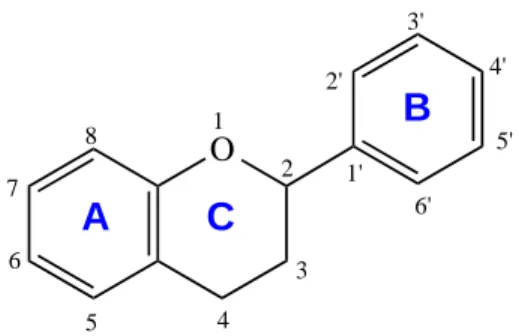
- Structure of flavonoids
- Classification of flavonoids
- Solubility of flavonoids
- Benefits of flavonoids for health
- Bioavailability of flavonoids
They are synthesized in the plants through the phenylpropanoid pathway (Falcone Ferreyra et al. 2012; Kumar and Pandey, 2013). Absorption of flavonoids from food to the intestine depends on their physicochemical properties, size of molecules, lipophilicity and solubility (Sordon et al. 2016).
Glycosylation of flavonoids
- Chemical glycosylation
- Enzymatic glycosylation
Instead, non-Leloir glycosyltransferases are compatible with low-cost donors and a wide range of acceptors, but lead to relatively low product yields (Xu et al. 2016). The general mechanism for glycosidic bond synthesis by different enzymes (adapted from Xu et al.

Glycoside-Hydrolases (GHs)
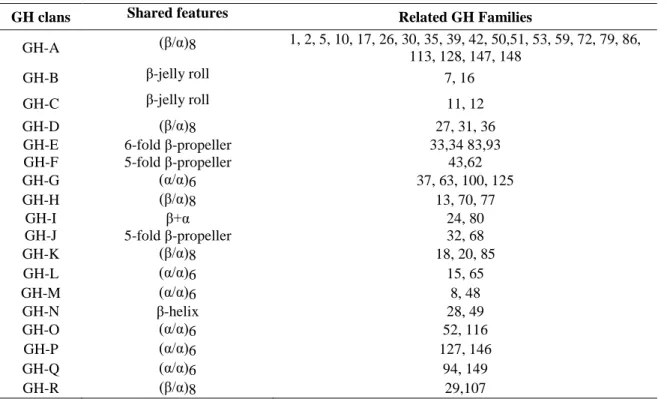
- Glycoside-Hydrolases overview
- Enzymes from GH32 family
- Enzymes from GH68 family
- Catalytic mechanism
Schematic drawing of the sugar-binding subsites from –n to +n nomenclature (adapted from Davies et al. 1997). In the second step (defructosylation), the acid/base catalyst acts as a general base, removing a proton from the incoming fructosyl acceptor (water or a suitable sugar acceptor), which cleaves the fructosyl enzyme intermediate (Lammens et al. 2009).
Aims of the thesis
Hypothesis
Kumar S, Pandey AK (2013) Chemistry and biological activities of flavonoids: an overview Chemistry and biological activities of flavonoids: an overview. Perez-Vizcaino F, Duarte J, Santos-Buelga C (2012) The flavonoid paradox: conjugation and deconjugation as key steps for the biological activity of flavonoids.
FUNCTIONALIZATION OF NATURAL COMPOUNDS BY ENZYMATIC
Summary
Enzymatic fructosylation of organic acceptors other than sugar opens access to the production of new molecules that do not exist in nature. The enzymatic strategies and reaction conditions required to achieve these complex reactions are discussed, particularly in relation to the type of acceptors.
Introduction
The acceptor is a water molecule in the case of hydrolytic reactions or another hydroxylated molecule (sucrose or growing fructan chain) in the case of transfructosylation. Transfructosylation can lead to the formation of different types of -fructoside linkages, depending on the specificity of the enzyme linkage (Lafraya et al. It has also been reported that some sucrose-active enzymes of the GH family 32 and 68 are able to fructosylate different types of organic acceptors as sugars to generate new fructo-conjugates .
The aim of this paper is therefore to provide for the first time an overview of all published knowledge in this field and to describe the enzymatic reactions as well as the biological and physico-chemical properties of the new-to-nature fructo-conjugates.

Fructosylation of different acceptors
- Fructosylation of alkyl alcohol
- Fructosylation of aromatic alcohols
- Fructosylation of alkaloids
- Fructosylation of flavonoids and xanthonoids
GH family 68 levansucrases, which naturally catalyze levan synthesis, have also been tested for fructosylation of alkyl alcohols (Li et al. 2015). This was attributed to the competition between hydrolysis and transfructosylation, which varies with the acceptor (Perez Oseguera et al. 1996). An advantage of using cell walls as biocatalysts is their recycling capacity, which varied between 1 and 20 duty cycles depending on the acceptor species (Dudíková et al. 2007).
This work shows that fructosylation of aromatic compounds has advantages for their formulation in cosmetics (Kang et al. 2009). The authors explained that in the presence of 2-methyl-2-propanol water mixture, the solubility of hydroquinone decreases (Mena-Arizmendi et al. 2011; Castillo and López-Munguía, 2004). There is only one report (Mena-Arizmendi et al. 2011) describing the use of inulosucrase for aromatic alcohol fructosylation.

Physical-chemical properties of β-D-fructofuranosides
Pharmacokinetics parameters
Conclusions and perspectives
Kim MG, Kim CH, Lee JS, Song KB, Rhee SK (2000) Synthesis of methyl-D-fructoside catalyzed by levansucrase from Rahnella aquatilis. Křen V, Flieger M, Sajdl P (1990) Glycosylation of ergot alkaloids by free and immobilized cells of Claviceps purpera. Li D, Park SH, Shim JH, Lee HS, Tang SY, Park CS, Park KH (2004) In vitro enzymatic modification of puerarin to puerarin glycosides by maltogenic amylase.
Wu X, Chu J, Wu B, Zhang S, He B (2013a) An efficient novel glycosylation of flavonoid by fructosidase resistant to hydrophilic organic solvents. Wu X, Chu J, Liang J, He B (2013c) Efficient enzymatic synthesis of mangifera glycosides in hydrophilic organic solvents RSC Advances. Yu C, Xu H, Huang G, Chen T, Liu G, Chai N, Ji Y, Wang S, Dai Y, Yuan S (2010) Permeabilization of Microbacterium oxylans shifts the conversion of puerarin from puerarin-7-O-glucoside. to puerarin-7-O-fructoside.
ENZYMATIC FRUCTOSYLATION OF FLAVONOIDS USING β-
Introduction
Nowadays, flavonoids have received attention because they exhibit a wide range of biological properties, including their antioxidant, antitumor, and anti-inflammatory activities (Quideau et al. 2011; Pandey et al. 2014). To overcome these limitations, flavonoid glycosylation has emerged as an alternative to modify their hydrophilic–lipophilic balance and access a broader structural diversity (Xiao et al. 2014). Alternatively, enzymatic glycosylation of flavonoids using cheap sugar donors such as sucrose has been explored for the synthesis of novel gluco- and fructo-conjugates (Xu et al. 2016).
However, the enzymatic fructosylation of flavonoids with sucrose as donor and the synthesis of new fructo-conjugates have so far been little investigated (Herrera-González et al. 2017). Transfructosylation can also lead to the formation of different types of β-fructosidic bonds, depending on the enzyme coupling specificity (Sangeetha et al. However, in the literature there are few reports that use β-fructosidases for the fructosylation of flavonoids (Herrera-González et al (2017).
Results and discussion
- Screening of transfructosylation activity by β-fructosidases from non-saccharomyces
- Screening of transfructosylation activity on different class of flavonoids
- Gene search in silico from yeast genomes for new β-fructosidases
- Cloning and expression of the new β-fructosidase from Rhodotorula mucilaginosa for
Therefore, we decided to study Rhodotorula mucilaginosa to search in silico for the new β-fructosidase. Cloning and expression of the novel β-fructosidase from Rhodotorula mucilaginosa for enzymatic fructosylation of flavonoids. The results obtained from the cloning and expression of the novel β-fructosidase from Rhodotorula mucilaginosa are presented and discussed in this section.
Next, a restriction assay was performed to verify the presence of the RhInv gene in the pUC57-RhInv construct. In summary, it can be concluded from the results obtained from the cloning and expression of β-fructosidase from Rhodotorula mucilaginosa (RhInv) that it was possible to express an active protein with fructosidase activity using P. In summary, it can be concluded from the Results of the reactions of enzymatic fructosylation of flavonoids using β-fructosidase from Rhodotorula mucilaginosa (RhInv) that it is possible to fructosylate acceptors other than sucrose, but with low yields of about 20%.

Experimental methods
- Yeast propagation
- Production of β-fructosidases
- Activity assay
- Screening of enzymatic fructosylation of different flavonoids by enzymatic extracts
- Quantification of percentage of conversion of flavonoids by Liquid Chromatography-
- Search of a new β-fructosidase gene sequence in silico from available genomes
- Cloning and expression of β-fructosidase from Rhodotorula mucilaginosa in Pichia
- Enzymatic fructosylation of flavonoids by a recombinant β-fructosidase (RhInv) from
Screening of enzymatic fructosylation of different flavonoids was performed with 5 different types of flavonoids such as quercertin, (+)-catechin, luteolin, puerarin and hesperidin. A genome-wide BLAST was then performed using the BLAST tool in CLC Genomics Workbench 9.5; it was performed with the sequence of β-fructosidase, which is close to yeast according to the phylogenetic tree. Finally, to confirm whether the predicted gene corresponds to β-fructosidase, bioinformatic sequence analysis was performed.
Then, gene purification was performed by gel purification (QUIAGEN Gel purification kit). Next, a phenotypic screen was performed on Zeocin-resistant Pichia transformants expressing active RhInv. Fructosylation of different flavonoids is performed using a recombinant β-fructosidase (RhInv) from Rhodotorula mucilaginosa in order to know the ability of this enzyme to fructosylate different acceptors.

Conclusions
Inokuma K, Ishii J, Hara KY, Mochizuki M, Hasunuma T, Kondo A (2015) Complete genome sequence of Kluyveromyces marxianus NBRC1777, a non-conventional thermotolerant yeast. Vega-Alvarado L, Gómez-Angulo J, Escalante-García Z, Grande R, Gschaedler-Mathis A, Amaya- Delgado L, Sanchez-Flores A, Arrizon J (2015) High-Quality Draft Genome Sequence of Candida apicola NRRL Y- 50540. Wang S, Liu G, Zhang W, Cai N, Cheng C, Ji Y, Yuan S (2014) Efficient glycosylation of puerarin by an organic solvent-tolerant strain of Lysinibacillus fusiformis.
Wu X, Chu J, Wu B, Zhang S, He B (2013a) A novel efficient glycosylation of flavonoid by hydrophilic organic solvent-resistant β-fructosidase.
ENZYMATIC FRUCTOSYLATION OF PHLORIZIN BY LEVANSUCRASE
Results and discussion
- Enzyme selection for phlorizin fructoside production
- Effect of sucrose, phlorizin and enzyme concentration on phlorizin conversion
- Structural characterization of phlorizin mono-fructoside
- Water solubility and antioxidant activity of mono fructosyl phlorizin
Enzymatic fructosylation of phlorizin was attempted using three different enzymes a sucrose:sucrose 1-fructosyltransferase (Sa1-SSTrec) from S. Effect of sucrose, phlorizin and enzyme concentration on phlorizin conversion Effect of sucrose concentration on phlorizin concentration effect of sucrose concentration on phlorizin conversion at constant phlorizin concentration is shown in figure 28. We further evaluated the effect of phlorizin concentration (from 25 to 100 mM) on phlorizin conversion at a fixed sucrose concentration of 1M (figure 29 ).
The effect of enzyme concentration on phloricin conversion was studied in reactions containing 25 mM phloricin, 1.5 M sucrose at 42 ºC (Figure 30). According to these results, the best conditions for phloricin fructosylation correspond to the use of 5 U mL-1 at 42 ºC with 25 mM phloricin and 1.5 M sucrose. Chemical shifts from 13C and 1H data of phlorizin and -D-fructofuranosyl-(26)-phlorizin (Data are recorded in MeOD).

Experimental methods
- Chemical materials
- Enzyme production
- Enzyme activity assays
- Enzyme selection for phlorizin fructoside production
- Effect of sucrose, phlorizin and enzyme concentration on the percentage of conversion
- HPLC-MS analysis of fructosylation reaction mixture
- Large-scale production of fructosyl phlorizin
- Structural analysis of phlorizin mono-fructoside
- Solubility determination of mono-fructosyl phlorizin
- Antioxidant activity of mono-fructosyl phlorizin
The fructosylation of phlorizin was performed using three different enzymes: a sucrose:sucrose 1-fructosyltransferase (Sa1-SSTrec) from Schedonorus arundimaceus, a levansucrase (LsdA) from Gluconacetobacter diazotroficus and an invertase (RhInv) from Rhodotorula mucilaginosa. The conversion rate of phlorizin was calculated taking into account the difference between the initial and final concentration of phlorizin. Effect of sucrose, phlorizin and enzyme concentration on the percentage conversion of phlorizin with LsdA conversion of phlorizin with LsdA.
The antioxidant activities of phloricin and monofructosyl phloricin were estimated by DPPH assay as described by Lee et al. As an example is the absorption of phlorizen or phlorizin monofructoside, and Acontrol is the absorption of DPPH solution. Three enzymes with fructosyltransferase activity were tested to synthesize new fructosides from phloricin.
Supplementary data
However, in the case of flavonoids, only puerarin was efficiently fructosylated by β-fructosidases and cells from bacteria originating as catalyst. The presence of co-solvents such as DMSO and ethanol in the reaction mixtures does not facilitate the fructosylation reaction. Comparison of the enzymatic fructosylation of phlorizin by different β-fructosidases from the GH32 and GH68 families.
Among them, only 15 enzymatic extracts retain their fructosyltransferase activity in the presence of 20% (v/v) DMSO as co-solvent. The species that showed fructosyltransferase activity in the presence of DMSO were Rhodotorula mucilaginosa (MB4), Torulaspora delbrueckii (DW1), Crytococcus albidus (DC4), Candida apicola (CC, MT3), Kluyveromyces marxianus (DV4, 1424, Z16 DH4, 1424 Z16, DH4, 16, 16, 16, 16, 16, 16, 16, 2000 bisporus (DG, MS3) and Candida parapsilosis (MF4) In addition, it could be interesting to determine the three-dimensional structure of the levansucrase from Gluconacetobacter diazotrophicus to begin investigations of structure/function relationships, identify structural determinants involved in enzyme specificity, and initiate protein engineering to target and improve the synthesis of novel fructosides.
