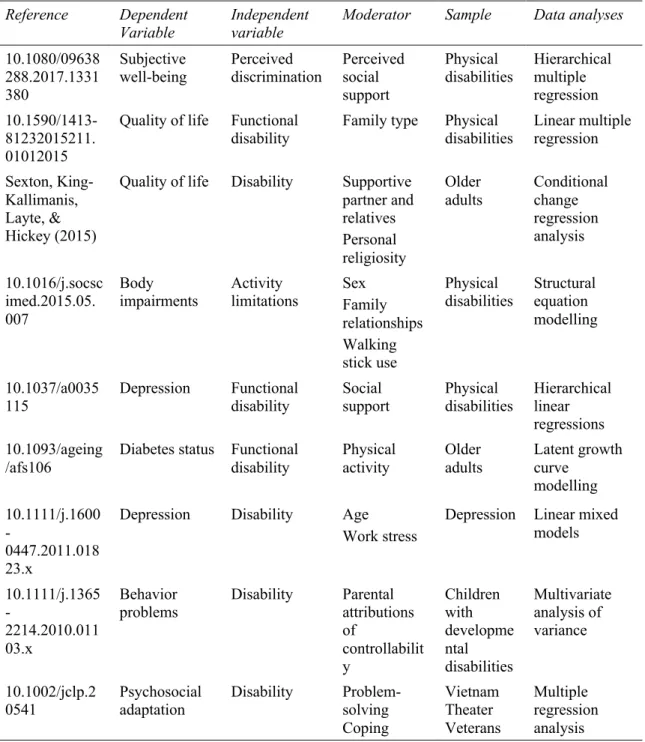
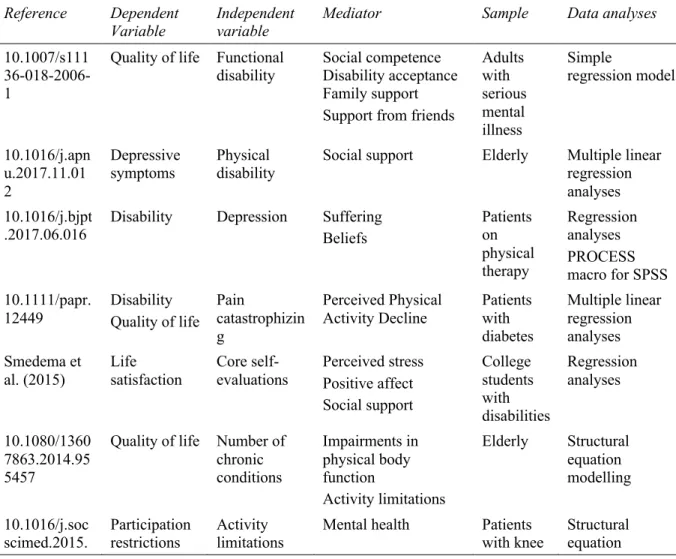
Logic models, with their input, flow, and output/outcome components, are increasingly being used as an organizing framework in the field of intellectual disabilities (IDD). Although the utility of programmatic logic models has expanded over the past three decades through their use in planning and evaluating various types of human service programs, incorporating moderator and mediator variables into these models remains a challenge for policymakers and practitioners in the IDD field (Kmet 2012). In the first part, we describe the use of logical models in the field of IDD.
In the second section, we discuss the role of moderator and mediator variables in program logic models. The role of moderator and mediator variables on outcomes is explained in the article's third section. Finally, a comprehensive framework for incorporating moderator and mediator variables into program logic models is presented in the fifth section.
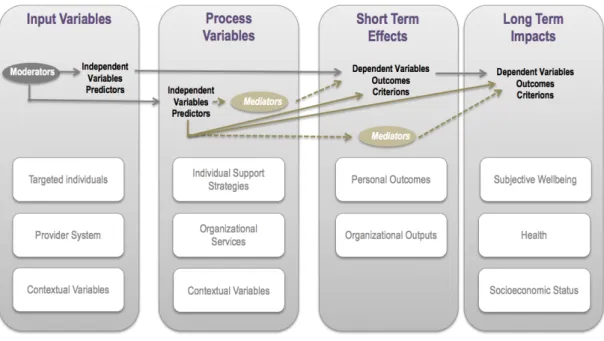
As discussed in the following sections, moderator variables affect input and process variables, while mediator variables affect short-term effects and long-term effects. Although moderators are key to understanding how and why relationships exist between variables, they have not been extensively studied in the field of IDD (Farmer 2012). As we did with moderators, to check the use of mediators in the field of disability, we conducted another review on Web of Science (September 2018).
The Role of Moderator and Mediator Variables in Theory Development As reflected in the previous section, the explanatory and predictive roles that.
A theory, such as one related to individual quality of life, begins with a conceptual model that is used to explain the quality of life concept. Basic to theory development is a conceptual model that organizes knowledge, provides for a common language, and specific components of the quality of life concept without specifying how the components work. As depicted in Figure 2, our conceptual model of individual quality of life has three components: quality of life domains, moderator and mediator variables (Schalock, Verdugo, Gómez et al. 2016).
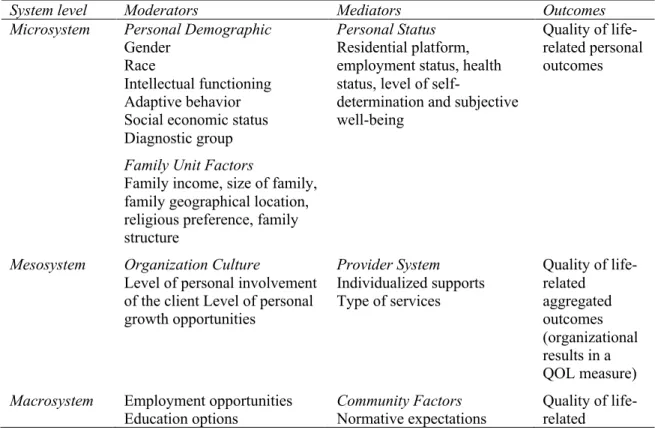
The conceptual model at the heart of Figure 2 assumes a contextual understanding of disability as a condition that results from interacting individual and environmental factors. In the explanatory part of our theory, these factors are of two kinds: moderating and mediating factors (Schalock, Verdugo, Gómez et al. 2016). An overview of these moderator and mediator variables is presented in Table 3, including the specific ones.

A Comprehensive Framework for Incorporating Moderator and Mediator Variables into Program Logic Models
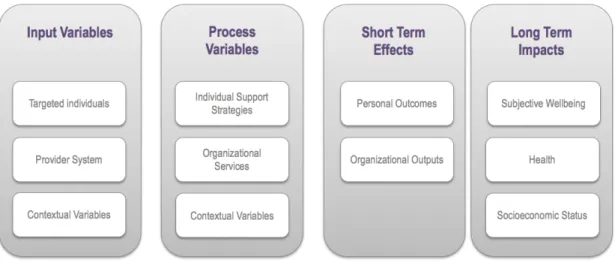
Some of the process variables and short-term effects may have a mediating role between independent variables and dependent variables included in the model. As summarized in Table 3, associated with each of the four program logic components (input, process, short-term effects and long-term effects), the reader will find the respective measurement component and the proposed potential measures/assessments. In this way, the proposed measures in Table 4 for input can be used as potential moderators or independent variables; process variables can be used as independent variables or mediators; short-term effects can be used as dependent variables or mediators; and long-term impacts are used as dependent variables.
Individuals Demographic characteristics: diagnosis, intellectual functioning level (IQ), adaptive behavior level, age, sex, SIS index, mental health status, mobility, marital status. Future-oriented mental models (e.g. ecological model of disability, emphasis on social/inclusion in society, horizontal structuring of organization, learning organization, focus on personal results and organizational output, 'us responsibility'. Self-determination indicators: (a) sense of competence ( i.e., contribution, sense of being engaged, efficacy beliefs); (b) sense of relatedness (i.e., giving and receiving nourishment) and (c) sense of autonomy (i.e., organizing one's own experiences, decision making).
Absence of negative affect: sadness/worry, helplessness, mental disorders, psychological and psychiatric symptoms, challenging behavior. The study of moderators and mediators allows us to gain a more comprehensive understanding when implementing and evaluating IDD-related policies and practices. However, because testing program logic models that include moderator and/or mediator variables can be statistically very complex, the process should begin with testing specific relationships between variables rather than testing the framework as a whole.
Thus, we consider that seeking empirical evidence for specific moderating and mediating effects is both preferable and more reasonable than seeking evidence for all possible relationships shown in Figures 2 and 3. The level of adaptive behavior (input) can mitigate the effect of an intervention (process – independent variable) addressed to improve the quality of life in an organization (short-term effect – dependent variable). Employment opportunities (process) can reduce the effect of an intervention (process and independent variable) addressed to increase material well-being (short-term effect - dependent variable).
Participation (short-term effect) may mediate the relationship between individualized supports (process independent variable) and interpersonal relationships (short-term effect a-dependent variable). Social support (personal outcome) may mediate the relationship between environmental accommodation (process independent variable) and challenging behavior (long-term impact dependent variable). Since a specific variable (e.g. level of support) may play a different role (e.g. independent variable, dependent variable, moderator, mediator) depending on the other variables and the relationships to be tested in a specific model, it noted that we did not propose an a priori classification of moderator and variables.
Future Steps
In addition, researchers, practitioners, and policy makers need to determine the correlates of the evaluated effects or impacts, which would shed light on the conceptual model used to explain the results. Farmer (2012) has proposed the use of causal steps only to understand the function of a moderator or mediator, and the use of a direct statistical test to determine their presence. Ideally, this type of study would also include measures of effect size to evaluate the significance of the relationship between predictors, mediators, and outcome variables.
The Bayesian method in the presence of mediation and moderation (Wang & Preacher, 2014), which can allow for an even wider range of models, which can be expressed in terms of logic models. This article does not contain any studies involving human or animal participants conducted by any of the authors. Does the quality of life differ for children with autism spectrum disorders and intellectual disabilities compared to children without autism.
Keith (Eds.), Cross-cultural quality of life: Enhancing the lives of people with intellectual disabilities (2nd ed.) (pp. 71–80). Kober (Eds.), Improving the quality of life of people with intellectual disabilities: From theory to practice (pp. 17-32). Evidence-Based Practices in Intellectual and Developmental Disabilities: An International Consensus Approach.
Shogren (eds.), Handbook of Positive Psychology in Intellectual and Developmental Disabilities: Translating Research into Practice (pp. 115-126). Journal of Policy and Practice in Intellectual Disability Integrative framework to align policy goals, support and outcomes in intellectual disability. 2017). The responsibility to build contexts that enhance human functioning and promote meaningful outcomes for people with intellectual disabilities: Strengthening system responsiveness.
Using a context-based change model to challenge the status quo and achieve valuable results. The construct of adaptive behavior: Its conceptualization, measurement, and use in the field of intellectual disability. The concept of quality of life and its role in improving human rights in the field of intellectual disability.