What will be the net impact of AI and
related technologies on jobs in China?
September 2018
www.pwc.com/ai-china
Contents
Executive Summary ...3
Introduction ...5
1. Background to and framework for the analysis ...6
2. The displacement effect of AI on jobs in China ...8
3. The income effect of AI on jobs in China ...10
4. The net effect of AI on jobs in China ...12
5. Scenario analysis ...15
6. Comparative analysis ...17
7. Implications for public policy and business ...19
8. Conclusion ...22
Technical annex – details of our methodology ...23
References* ...26
Contacts ...27
* All sources are listed in the references section.
In this report, the terms PwC, our and we are used to refer to the network of member firms of PricewaterhouseCoopers International Limited or, as the context requires, to one or more PwC member firms. For more information, see www.pwc.com/structure.
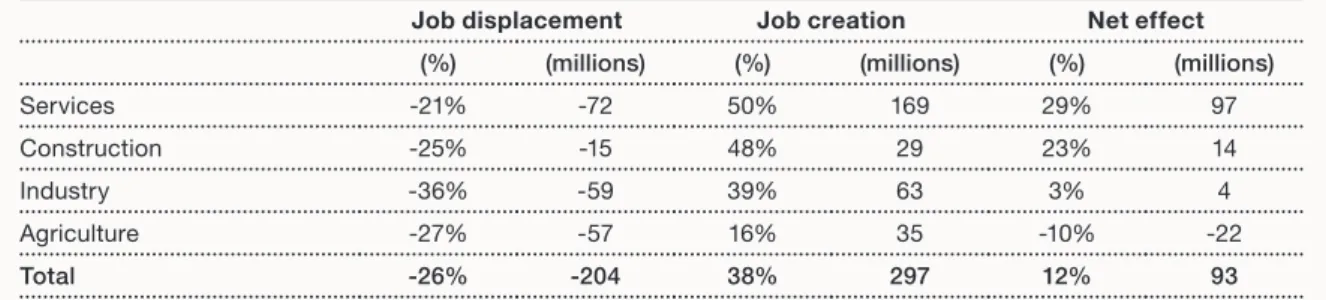
Source: PwC analysis (% figures are shown as a share of estimated employment in 2017)
Table 1: Estimated job displacement and creation from AI and related technologies in China by industry sector (2017-37)
Executive summary
Artificial Intelligence (AI) and related technologies such as robots, drones and autonomous vehicles have great potential to boost economic growth, but there are also concerns about their potential impact on jobs.
PwC’s UK Economic Outlook (July 2018) confirms that AI and related technologies could displace many jobs formerly done by humans, but will also create many additional jobs as productivity and real incomes rise and new and better products are brought to market. Overall, our estimates suggested that the net impact on UK jobs over the next two decades is likely to be broadly neutral, and we think this conclusion would probably also hold broadly true on average for other mature, advanced economies across the OECD.
We have now extended our analysis to China and here we find rather different results. We estimate that AI and related technologies could displace around 26% of existing jobs in China over the next two decades, rather higher than our 20%
estimate for the UK, but could create significantly more additional jobs in China through boosting productivity and real income levels. Our central estimate is that the net impact could be a boost to employment in China of around 12%, equivalent to around 90 million additional jobs over the next two decades.
As the table below shows, however, the net job gains will not be evenly spread across sectors.
Most of the net job gains in China are projected to be in services sectors, where we estimate a 29% net job increase (around 97 million) with sub-sectors such as healthcare likely to see particularly large increases. We project more modest net gains in construction (14 million) and a broadly neutral net jobs impact for industrial sectors. These gains are offset by net job losses in agriculture estimated at around 10% (22 million).
Job displacement Job creation Net effect
(%) (millions) (%) (millions) (%) (millions)
Services -21% -72 50% 169 29% 97
Construction -25% -15 48% 29 23% 14
Industry -36% -59 39% 63 3% 4
Agriculture -27% -57 16% 35 -10% -22
Total -26% -204 38% 297 12% 93
12 %
AI and related technologies could boost employment in China by around 12% over
the next two
decades.
From both a business and a government policy
perspective, our analysis therefore
suggests no room for complacency.
From both a business and a government policy perspective, our analysis therefore suggests no room for complacency. For the government, the challenge is to maximise the benefits (e.g. through implementing the Next Generation AI Plan and continuing to invest heavily in development of world class AI skills) while mitigating the costs in terms of impacts on jobs and income inequality (e.g. through retraining schemes for displaced workers and a stronger social safety net for those who find it hard to adjust to the new technologies).
Only in this way can the great benefits from AI and related technologies be spread as widely as possible across society.
Although our central estimate is that the long-term net effect of AI on jobs will be positive for China, there are many uncertain factors that could tip the balance towards a more optimistic or pessimistic scenario. There will also be considerable disruption to current labour markets as millions of workers need to switch careers and possibly locations.
There will be great opportunities for businesses from investing in AI and related technologies in China, covering all aspects of operations from marketing and product personalisation to R&D, productive efficiency, human resource processes and cyber security. But there will also be great disruption to existing business models in all parts of the economy, as we have already seen in sectors like media, entertainment, finance and retail.
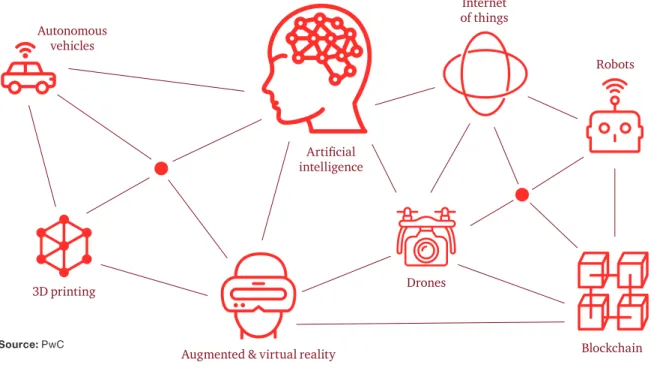
1 For brevity we sometimes refer just to ‘AI’ in this paper, but this should be taken to encompass a broader range of technologies including not just AI per se but also robotics, drones, autonomous vehicles and other digital innovations aimed at ‘smart automation’
as shown in Figure 1.
Report structure
We begin by setting out the background to, and conceptual framework for, the analysis (Section 1).
Next, we present our estimates of the displacement effect (Section 2) and the income effect (Section 3). In Section 4 we weigh these effects against each other, both for the Chinese economy as a whole and by industry. Section 5 then explores the uncertainties around our central estimates by constructing alternative scenarios in which AI has a high and low impact.
Section 6 compares the results for China with those for the UK from our earlier research. In Section 7 we discuss the implications for public policy and business. Section 8 summarises the key findings from our analysis and concludes.
Further details of the methodology are provided in a technical annex.
Innovation has always been at the heart of economic development in China and other countries, but it can be a double-edged sword: it can create jobs, but it can also take them away.
Historically, the creative force of technology has prevailed in the long term, but as AI1 surpasses human capabilities in an ever broader range of cognitive skills, some fear that the destructive force could prevail. So could this time be different?
In this paper we take an objective look at the evidence on this for China, building on our previous work for the UK and other countries. We weigh the potential for AI and related technologies (as shown in Figure 1 below) to replace human workers, which we refer to as the ‘displacement effect’, against the ability of these technologies to create additional jobs, through a mechanism we refer to as the ‘income effect’.
Introduction
Source: PwC
Figure 1: AI and related technologies
Internet of things
Artificial intelligence
Drones Autonomous
vehicles
3D printing
Augmented & virtual reality Blockchain
Robots
But, as well as displacing jobs, new technologies like AI also create them by boosting real income levels.
2 Ford (2015) discusses these developments in detail. Autor (2015) discusses why there are still so many jobs despite the long history of workforce automation, stressing the fact that it is tasks rather than whole jobs that are typically automated.
3 Acemoglu and Restrepo (2016) provide a detailed theoretical model for understanding these effects, focusing on how technological progress may create new tasks just as quickly as it automates old tasks. However, their later empirical study suggests a net negative employment effect from past deployment of industrial robots in the US (Acemoglu and Restrepo, 2017).
4 Or a higher quality product at the same (or lower) cost. For simplicity we refer to this as a (quality-adjusted) price reduction.
1. Background to and framework for the analysis
But, as well as displacing jobs, new technologies like AI also create them, although the way in which this happens is more complex and often less direct3. The most significant effects in the long run generally come through the impact on (quality- adjusted) prices as labour-saving technologies allow firms to produce the same product at a lower cost4. To stay competitive, firms ultimately have to pass on most of these savings to consumers, which has the effect of increasing real income levels.
Households can buy more with their money as a result and firms hire additional workers to respond to the extra demand. As well as reducing prices, labour-saving technologies also improve the quality of existing products and enable new products to be brought to market, which also create a need for additional workers. We refer to these types of mechanisms, through which technology ultimately creates jobs, as the ‘income effect’.
We are all familiar with the way in which technology can automate jobs: inventions come along that perform tasks more cheaply, better or more reliably than humans, and so firms (and other organisations such as government departments) replace humans with these labour-saving
technologies. We refer to this as the ‘displacement effect’ and examples are everywhere. Fifty years ago, three-quarters of workers in China were employed in agriculture, but with the advent of labour-saving technologies, agriculture now only accounts for around one-quarter of employment, which became dominated by manufacturing and services in turn (Felipe et al., 2016).
More recently, we have seen many middle
management and back-office jobs automated using computers, with more to come as AI is deployed more widely across the economy. Automated trading has already displaced many jobs in financial markets and driverless vehicles have the potential to do the same in transport in the coming decades, while robots are likely to spread from factories to construction sites and warehouses in increasing numbers over the coming decades2.
These and other types of intricacies have been modelled in detail in our calculation of the income effect even though they do not feature in Figure 2.
See PwC’s 2017 ‘Sizing the Prize’ report for more details of our methodology here, which involves use of a global computable general equilibrium (CGE) model of the world economy, with China identified as a separate country within this model.
The various effects shown in Figure 2 will take time to work their way through the economy5, so we focus in this paper on the long run impacts over the next 20 years. Given a base year of 2017, our projections therefore focus on impacts in 2037. This long time horizon also allows us to ignore short term ups and downs in employment rates linked to the economic cycle.
Figure 2 illustrates in simplified fashion the countervailing displacement and income effects on jobs. It shows how technology can lead to some job losses via the displacement effect, but also how this is counteracted by the income effect in the longer term. The question of whether AI will lead to technological unemployment in the long term boils down to whether the displacement effect of AI on jobs will exceed the income effect. We estimate each in turn in the sections below.
We recognise that this is a simplified account of the actual mechanisms underlying the income effect. There are additional feedback mechanisms, for example, as cost savings by companies are ploughed into R&D, which should in turn increase productivity further. There are also important dynamic considerations, such as the lag of the income effect behind the displacement effect, which may cause a rise in unemployment in the short to medium term. This in turn may put downward pressure on wages for a period, so helping to price workers back into jobs in the longer run.
Source: PwC
Figure 2: How AI can both destroy and create jobs through the displacement and income effects
Displacement effect Humans lose jobs
to AI/robots
Firms enter the market as
profits rise
Firms and shareholders reinvest profits in new products
and services
Income effect Firms hire more workers to meet the
extra demand
Productivity and competition
effects lower prices, so increasing real
income and spending
AI and related technologies become more cost-effective
than humans Technology
increases productivity lowering cost and increasing
quality Technology
allows for new products
5 Brynjolfsson et al. (2017) argue that these long time lags help to explain why recent productivity growth has remained low despite rapid advances in many digital technologies over the past decade. They point to similar long lags in previous general purpose technologies, such as electric power, having their full effect on the economy.
A job being at
“high risk” of being automated does not mean that it will definitely be automated.
6 This is based on a detailed analysis of the task composition of jobs using the OECD’s PIAAC database.
7 As discussed in more detail in ‘Will robots really steal our jobs?’, PwC (February 2018).
2. The displacement effect of AI on jobs in China
However, a job being at “high risk” of being automated does not mean that it will definitely be automated. This is because there could be a range of economic, legal and regulatory and organisational barriers to the adoption of these new technologies. Based on our earlier probabilistic risk analysis7, we think it is reasonable to scale down our estimates by a factor of two thirds to reflect these barriers, so our central estimate of the proportion of existing jobs in China that will actually be automated over the next 20 years is reduced to 26%. There is uncertainty over the correct scaling factor to use here, so we consider a range of alternative values for this estimate in the scenario analysis in Section 5 below.
In their seminal attempt to measure the displacement effect, Frey and Osborne (2013) considered a list of 702 US occupations and estimated the probability that each would be automated. Frey and Osborne’s original estimate for the US was 47%, and in 2016 they extended their framework to developing countries including China, for which they estimated that as many as 77% of jobs could be at risk of being automated, higher than all other countries in their international study besides Ethiopia.
Other estimates of potential job automation are lower, notably a 2016 OECD study by Arntz, Gregory and Zierahn that used PIAAC survey data to focus on tasks rather than occupations and suggested an estimate of only around 10% for the UK and the US (upgraded to 14% in more recent OECD research published in early 2018). Our own estimates, which used the same OECD PIAAC survey data to analyse the potential automatability of different types of tasks, suggest that the
proportion of existing jobs in China at potential high risk of automation could be around 39% over the next 20 years (see annex for more details of our methodology here)6.
8 ‘Industry’ is defined here to include manufacturing, mining, energy and water.
9 ‘Will robots really steal our jobs?’, PwC (February 2018).
Figure 3: The proportion of existing jobs in China that could be displaced in each sector over the next 20 years Figure 3 shows the estimated proportion of jobs that will be automated by 2037, but we would expect some sectors to be hit earlier than others due to the fact that certain types of AI will develop faster than others (e.g. algorithmic trading is already here while driverless cars will take much longer to roll out across the economy). We presented estimates of the timing of potential job losses for OECD countries in a an earlier report9, which we would expect to follow a typical ‘S-curve’
shape with relatively small impacts over the next few years but more substantial effects as we look a decade or more ahead.
In this paper, however, we are concerned with the long term effects of AI, so we focus on the impact over 20 years, giving time for both the displacement and income effects to take effect fairly fully across the economy. We should
recognise, however, that the precise timing of these effects is uncertain, as reflected in the scenario analysis in Section 5 below.
Displacement rates will vary by sector, as illustrated by our estimates in Figure 3, which show expected automation rates in industry8, agriculture, construction and services over the next 20 years (see technical annex for more details on how these estimates were derived). Our analysis implies that the highest level of job displacement could be in the industrial sector (over 35% even after scaling down as described in the previous paragraph). The services sector is projected to see relatively lower displacement effects, although still over 20% of existing jobs by 2037. No sector group will be unaffected by automation, although some more disaggregated analysis we have done suggests that sub-sectors such as healthcare could see levels of automation below 10% over the next 20 years. These sub-sector estimates are less robust, however, so we have not provided precise estimates here, preferring to focus on the services sector as a whole in this paper.
Source: PwC estimates based on data from the OECD PIAAC survey with adjustments to apply this to China
0% 10% 20% 30% 40% 50% 60%
Industry Agriculture Construction Services Total
Estimated actual job displacement Jobs at potential risk of displacement
AI creates jobs through its effect on the cost, quality and range of products.
10 GVA refers to Gross Value Added, a measure of the contribution of each sector to overall GDP based on the value of outputs of the sector less the value of inputs to the sector.
11 Because we are capturing productivity effects on labour input through the displacement effect, we assume in estimating income effects that the potential percentage increase in jobs from this source is the same as the estimated percentage increase in GVA attributable to AI. This is the same general approach as in the Oxford Economics/Cisco report on ‘The AI Paradox’ (December 2017) for the US, although they further assume that the income effect on jobs exactly offsets the negative displacement effect, which is a relatively restrictive assumption to make ‘a priori’.
3. The income effect of AI on jobs in China
For this paper we have converted this GDP impact estimate into an estimated impact on jobs by, first, projecting Chinese output (GVA10) growth by sector over the next 20 years, and second, estimating the proportion of GVA growth that is attributable to AI, as implied by the estimates in our ‘Sizing the prize’
report. We assume here that the projected increase in jobs due to the income effect will be the same as the projected increase in GVA, since labour- saving productivity gains are already accounted for through the displacement effect11. We explain these steps in more detail in the annex.
AI creates jobs through its effect on the cost, quality and range of products, which boosts real income levels and creates additional demand for new jobs, as described above. In PwC’s 2017
‘Sizing the Prize’ report we evaluated thousands of potential use cases for AI across all sectors of the economy and combined these in a global computable general equilibrium (CGE) model to value the total impact of AI on GDP for the world economy as a whole as well as for major individual economies including the US, China and the UK.
For China, the headline estimate was that GDP could be boosted by up to 26% by 2030 through application of AI and related technologies (by comparison, the global average boost to GDP was estimated at around 14%). In this report we make a somewhat more conservative central assumption that Chinese GDP will be boosted by 20% in 2030.
This is still well above estimated levels in the next highest region (the US with an estimated boost of around 15% of GDP). We consider alternative high and low AI impact scenarios in the scenario analysis below to reflect the uncertainties around any such estimates.
We expect that most of the new jobs created will have nothing directly to do with AI or robots, but will simply be the product of a richer society with consequent increased demand for goods and services of all kinds.
In general, the sectors benefiting most are those that combine strong underlying demand growth with a relatively high propensity to see benefits from application of AI and related technologies.
However, much of the effect will come indirectly from the boost to the size of the economy from increased use of AI and related technologies, rather than being directly linked to investment in these technologies. We find that many commentators ignore or downplay these indirect macroeconomic effects, which helps to explain why they
underestimate the potential job creation arising from AI or indeed any other new technology. In fact, we expect that most of the new jobs created will have nothing directly to do with AI or robots, but will simply be the product of a richer society with consequent increased demand for goods and services of all kinds.
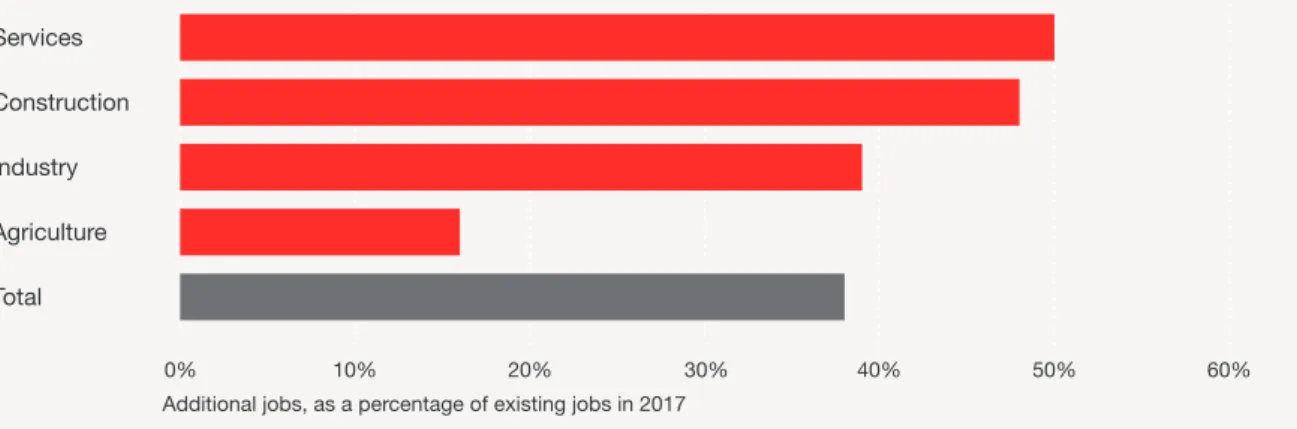
If we assume that 20% of GDP in 2030 will be AI- enabled then, combined with the GVA estimates in the appendix, this implies that AI could account for 38% of cumulative Chinese GDP (or GVA) growth in China over the period 2017-30. We assume this 38% ratio also applies over the longer period to 2037. As noted above, we then assume a one-to- one relationship between GDP (or GVA) growth and jobs growth for the purposes of calculating the income effect, giving the results in Figure 4 below.
The analysis suggests that the economic boost from AI could lead to the creation of additional service sector jobs equivalent to around 50% of the number of existing jobs in the sector. The estimated income effect on jobs is only slightly lower (48%) in construction and also very significant at 39% in industry (which is primarily manufacturing). This is in contrast to agriculture, where the economic boost from AI is estimated to lead to the creation of only around 15% more jobs in the sector over the next 20 years.
Figure 4: Estimated additional jobs in China that could be created by AI and related technologies in each sector over the next 20 years
Source: PwC analysis 0%
Additional jobs, as a percentage of existing jobs in 2017
10% 20% 30% 40% 50% 60%
Services Construction Industry Agriculture Total
Estimated actual job displacement Jobs at potential risk of displacement
Figure 5: Estimated net effect of AI on jobs by sector in China over the next 20 years
4. The net effect of AI on jobs in China
Our estimates suggest that, by 2037, AI and related technologies could provide a net jobs boost equivalent to around 12% of the existing number of jobs in China, with an income effect of 38% and an offsetting displacement effect of 26%. In absolute terms, this would imply a net increase of around 93 million jobs, with nearly 300 million being generated through the income effect but over 200 million jobs lost through the displacement effect.
Of course there are considerable uncertainties around any such projections, but our later scenario analysis shows that a net positive effect holds true even in our low AI impact scenario, so the conclusion seems relatively robust at least in directional terms.
We can now combine the above estimates of the displacement and income effects to get an estimate of the net jobs impact of AI and related technologies in China as shown in Figure 5 (the net effect is given by the solid line in the charts, with the bars showing the estimated displacement and income effects by sector). We would stress that these are not forecasts of what will happen to total employment in China over the next 20 years: our focus in this article is just on the potential impact of AI on jobs, not on the many other factors that could affect total employment in China over this period.
Source: PwC analysis
-300 -200 -100 0 100 200 300 -50% -40% -30% -20% -10% 0% 10% 20% 30% 40% 50%
Services Construction
Industry Agriculture
Total
Creation Net job gains Displacement
Change in jobs (millions) Change in jobs (%) from 2017 base year
0 50 100 150 200 250 300
Creation Net job gains Displacement
0 10 20 30 40 50
Significant net job gains in services and construction are offset by estimated net job losses in agriculture.
Table 2: Estimated job displacement and creation in China from AI and related technologies by industry sector (2017-37) The large net positive effect on jobs in services is, however, more due to high projected growth of this sector rather than low automation, as China transitions from an export- and industry-led growth model to a consumption and services- driven model. This may not be true across all services sectors because, for example, many administrative jobs will be especially vulnerable to displacement through AI and related technologies such as robotic process automation. In the longer term, this could also be true of some transport sector jobs with the advent of driverless vehicles, although we are not expecting these to roll out at scale across the Chinese economy until towards the end of our projection period in the 2030s.
On the other hand, service sectors that focus on improving quality of life such as the healthcare sector are expected to massively expand over the next 20 years as China fulfils its strategy to focus innovation on improving people’s wellbeing, as set out at the 19th National Congress of the Communist Party of China (CPC) (Xinhua News Agency, 2017). Other major growth sectors are projected to include e-commerce and professional, technical and scientific services. While these sub-sectors have considerable scope to use AI to boost productivity, a stronger economy will also disproportionately boost demand for these types of services, with some consequent boost to employment in these sub-sectors.
The most positive net effect is in services, where we estimate the number of jobs to increase by around 97 million (slightly more than the overall net job gains, so other sectors have a small negative net effect). Significant net job gains in services and construction are offset by estimated net job losses in agriculture of around 22 million (10%), while the estimated net impact in industry is close to zero. Therefore, while our central estimate suggests that the overall net effect of AI on jobs in China may be positive, this is by no means true for all sectors. Further details of our sectoral results are set out in Table 2.
We discuss results further for each of the four sectors in turn below.
Services
We expect that AI will have by far the largest positive impact in services, where we estimate that the number of jobs could increase by nearly 100 million, or 29%, over the next 20 years due to the economic impact of AI and related technologies. In part, this reflects the fact that many services roles involve high levels of interpersonal skills requiring a “human touch” that cannot easily be replaced by AI systems or robots. Having said that, the next 20 years will probably see us change our views on the jobs that we think of as requiring a human touch, with the rise of innovations such as “Robo Chef”, which is currently being trained to produce traditional Chinese cuisine (Economist, July 2018).
Source: PwC analysis (percentages refer to % of existing job numbers in the base year of 2017)
Job displacement Job creation Net effect
(%) (millions) (%) (millions) (%) (millions)
Services -21% -72 50% 169 29% 97
Construction -25% -15 48% 29 23% 14
Industry -36% -59 39% 63 3% 4
Agriculture -27% -57 16% 35 -10% -22
Total -26% -204 38% 297 12% 93
23 %
Construction could see a 23%
net increase in employment over the next 20 years due to the economic boost from AI.
Moreover, as China becomes more innovative and less imitative there will also be an ever-growing demand for manufacturing technologies such as robots, drones and autonomous vehicles. Chinese industrial employment is therefore likely to shift from lower value, labour-intensive production to higher value roles, including those involved in the manufacture of AI-enabled equipment for export as well as to meet rising domestic demand.
Agriculture
Our projections suggest that agriculture will be the only major sector in China where AI and related technologies will have a net negative effect on jobs (-10%). This continues the trajectory of the last half century, which has seen the proportion of employees in China involved in agriculture plummet from 81% in 1964 to 27% in 2016 (Felipe et al., 2016). Many of the innovations that catalysed this structural shift have their roots in China. For example, Yuan Longping developed the first hybrid rice varieties in the 1970s, which provides robust food sources in areas with a high risk of famine.
These productivity-enhancing innovations, together with labour-saving technologies such as modern ploughing and fertilising machines, will continue to reduce the demand for agricultural labour in China. The next generation of
agricultural innovations will be more radical still as synthetic meats become a viable alternative to organic meat and advances in genomics allow scientists to understand and enhance yields. All this will serve to move food production from the fields to the laboratories, requiring a set of skills quite different to those of most current farmers.
Construction
We estimate that construction could see a 23%
net increase in employment over the next 20 years due to the economic boost from AI and related technologies. The strong expected growth in the construction sector is largely due to the urban migration, as around 250 million new migrants are expected to move to cities by 2050 according to the latest UN projections for China (UN 2018), particularly in the city clusters around the existing megacities like Beijing and Shanghai.
These shifts will create demand for millions of construction jobs, many of which will be AI- enabled, particularly if the new cities are designed with “smart” principles in mind. The new jobs in construction will therefore not resemble the “brick- layers” of the past, as technologies make these types of materials redundant and as the repetitive and weight-bearing tasks are mechanised and automated.
Industry
We estimate a small net employment gain (3%) in industry, but this is insignificant relative to the uncertainties around any such long-term employment projections, as highlighted later in the scenario analysis. Although AI and related technologies may have a relatively neutral impact on jobs in industry, it will dramatically shape the nature of the jobs on offer. China is already the largest buyer of industrial robots today, accounting for around 30% of robots sold worldwide in 2016 (International Federation of Robots, 2017).
This seems set to continue as robots become increasingly accurate and adaptable and capable of completing even more of the tasks that were previously performed by humans.
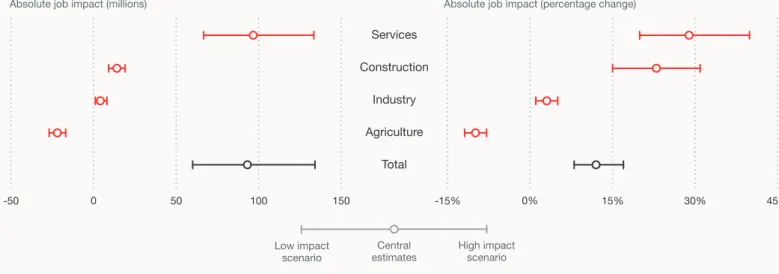
Figure 6: Net effect of AI on jobs in China under each scenario (the bounds represent the low impact and high impact scenarios respectively)
5. Scenario analysis
The type of factors that affect the magnitude of the displacement and income effects, as reflected in these different assumptions would include:
• The extent of economic, legal and regulatory, and organisational constraints on the pace of automation (relative to its technical potential)
• How far displaced workers are supported to retrain for new careers
• How far productivity gains from AI are passed on to consumers in lower prices, which will reflect the degree of competition in the economy
Later we discuss how businesses and government can pull on these levers in order to move China towards the higher end of the range indicated by our alternative scenarios.
Figure 6 displays the estimated net effect of AI on jobs in China under each scenario. The mid-point is the central estimate, as discussed in Section 4 above, while the upper and lower bounds refer to the high impact and low impact scenarios respectively.
In our central case we assumed that two-thirds of existing jobs at potential high risk of being automated will in fact be displaced by 2037, and that AI and related technologies will account for 20% of Chinese GDP by 2030. We vary these two key assumptions to construct alternative ‘low impact’ and ‘high impact’ scenarios:
1. In our low impact scenario we assume that only half of the existing jobs at potential high risk will be automated and that AI will account for only 15% of GDP by 2030. This latter assumption would bring China’s AI contribution into line with that estimated for the US
economy in PwC’s 2017 ‘Sizing the Prize’ report.
2. In our high impact scenario we assume that as many as five-sixths of jobs at potential high risk will be automated and that AI will account for 25% of GDP by 2030. This latter assumption is broadly aligned with the upper end of the range for Chinese GDP impacts in PwC’s 2017 ‘Sizing the Prize’ report.
Source: PwC analysis
-50 0 50 100 150 -15% 0% 15% 30% 45%
-50 0 50 100 150
Services Construction
Industry Agriculture
Total
Low impact
scenario Central
estimates High impact scenario
Absolute job impact (millions) Absolute job impact (percentage change)
0 50 100 150 200 250 300 0 10 20 30 40 50
The estimated effect of AI on jobs in China remains positive even in the low impact scenario.
12 As compared with around 215 million in agriculture, 163 million in industry and 60 million in construction according to data from the 2017 China Statistical Yearbook of the National Bureau of Statistics of China. This is the main source used for the base year employment data in this paper.
13 It might be possible to construct such a scenario if, for example, the gains from large investments in AI were to accrue almost entirely to senior executives and major shareholders in large monopolistic technology companies that did not feel competitive pressure to pass gains on to customers and reinvested most of these gains overseas. However, we doubt that this would be sustainable in the long run (either in China or other countries) given likely reactions by government and regulators, as well as new innovations that over- turned apparent monopolies as we have seen in past waves of technological progress. But this hypothetical scenario does highlight the need for government action to ensure that the benefits from AI are spread as widely as possible across society, as discussed further in Section 7 on implications for public policy.
Overall, our scenario analysis suggests that mass technological unemployment as a result of AI and related technologies is unlikely at the national level in China and that our results are robust, at least in directional terms, to plausible variations in key assumptions. This is not to say that a negative net impact on jobs is impossible, just that it would require both a very high assumed rate of automation of existing jobs from AI and related technologies with a small contribution from these technologies to GDP growth, which does not seem internally consistent13. A high displacement effect would normally be associated with a relatively high income effect, and vice versa, as in our two alternative scenarios.
The overall effect of AI on jobs in China remains positive even in the low impact scenario, although the estimated net effect drops to 8% (around 60 million jobs). In the high impact scenario the net effect is as high as 17% (around 134 million jobs).
Services is subject to by far the most uncertainty in terms of the absolute number of jobs that are impacted in each scenario. This is due to a couple of reasons. Firstly, more people are employed in services (338 million in 201612) than in any other sector, so the same percentage change results in a much larger absolute effect. Secondly, we expect a higher net percentage job gain in services as compared with the other sector groups in our central scenario, which means that the high and low impact scenarios are magnifying an already large net impact. Where we expect a more moderate net effect on jobs in both absolute and relative terms, as in industry, there is a much smaller range of outcomes. This is because the variant assumptions made on displacement and income effects in the two alternative scenarios tend to cancel out in the industrial sector.
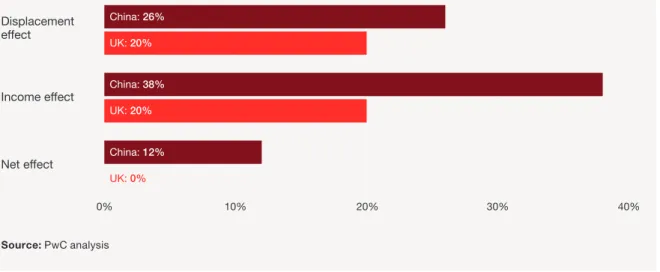
The positive estimated net impact of AI on jobs in China contrasts with the broadly neutral estimated impact on jobs in the UK.
Figure 7: The estimated displacement, income effect and net effect of AI on jobs in China and the UK over the next 20 years
6. Comparative analysis
However, more than offsetting this larger displacement effect for China is higher estimated AI-driven job creation in China due to its much larger domestic market (so more data to fuel AI) and its high investment rate in developing AI and related technologies and the STEM skills needed to make the most of these innovations. This provides China with greater scope for the kind of productivity and product quality gains that fuel the income effect than we found for the UK.
The CGE modelling we performed in PwC’s
‘Sizing the Prize’ report also reveals that China receives a disproportionately greater benefit through the ability of AI to facilitate more personalised goods and services. This is plausible given that market offerings to consumers in China currently tend to be more homogenous than those marketed to their UK counterparts, due largely to a more widespread culture of mass production in China. AI will enable the mass production of personalised goods and services, which seems perfectly suited to the Chinese market.
Comparison of our estimates for China and the UK
In a similar recent analysis for the UK, published in PwC’s UK Economic Outlook report in July 2018, we found a broadly neutral long term net impact on jobs from AI and related technologies.
The estimated net jobs impact is more favourable in China despite the fact that the estimated displacement effect is higher than in the UK (see Figure 7). The latter is due to greater scope for further automation in China (particularly in manufacturing and agriculture) relative to the UK, where centuries of economic development, industrialisation and demographic shifts have already exhausted many of the opportunities to automate and streamline manual work on farms and in factories.
Source: PwC analysis
0% 10% 20% 30% 40%
Displacement effect
Income effect
Net effect
Estimated actual job displacement China: 26%
UK: 20%
China: 38%
UK: 20%
China: 12%
UK: 0%
Jobs at potential risk of displacement
It is less clear that our results for China would generalise to other emerging economies.
It is less clear, however, that our results for China would generalise to other emerging economies.
This is partly because of the sheer scale of the Chinese market, and so the data pool available to fuel AI models. It is also because few emerging economies can match China in terms of its level of economic development, industrial structure and elite education levels, all of which are important enablers of AI-led growth.
Exploring the generalisability of our conclusions further is beyond the scope of this paper, but could be an interesting topic for future research. What seems clear, however, is that you cannot just read across our results from China to other emerging markets in the way that, at least to a degree, our research suggests you may be able to do from the UK to the average net jobs impact across the OECD.
How representative are our results for the UK and China of broader global trends?
Our previous analysis suggests that both the potential for automation of existing jobs and potential GDP gains from investment in AI are similar in the UK to the OECD average (although this disguises significant variation across OECD countries). So, in this sense, our headline finding that the net long-term impact on jobs in the UK is broadly neutral may be a reasonable approximation to average results across mature, developed economies (although, once again, there could be variations across individual OECD countries that would require further country-specific research to estimate).
7. Implications for public policy and business
2. Capitalise on rapid urban expansion in China by putting AI and related technologies at the heart of ‘smart city’
planning. Governments, scientists and city planners have long seen the potential for AI to transform the way that cities operate. China’s booming construction industry, fuelled by the construction of entirely new cities and city clusters, provides an unprecedented opportunity to embed smart principles into the fundamental infrastructure of cities (EU SME Centre, 2015). Embedding these principles into energy, water and transport systems should ultimately result in higher standards of living and worker productivity, as well as reduced pollution and traffic congestion.
China’s leadership has clearly recognised this opportunity, as China has plans to build 100 new smart cities between 2016 and 2020. This level of ambition has defined China’s recent economic success and so it is very positive that China’s leadership is applying this ambition to AI, where big thinking is required to take full advantage of big data.
3. Foster global and open innovation networks.
Big data and a closely connected, collaborative scientific community make up the foundation for the successful development and working of AI and related technologies. To fuel China’s AI strategy with a great wealth of big data, know- how and academic resources it is thus essential to build transparent, open and internationally linked R&D networks and innovation centres that allow for a free cross-border flow of information and data between academic institutions and industry. China should also maintain an immigration policy that welcomes leading AI researchers from around the world.
Public policy implications
Our scenario analysis suggests that AI and related technologies should have a net positive impact on jobs, but also shows that there is considerable uncertainty as to the exact magnitude of the effect.
The outcome is not predetermined: it will depend on how individuals, businesses and government engage with these new technologies.
At the 19th National Congress of the Communist Party of China in October 2017, China’s leadership stated their intent to put innovation at the core of their strategic development plan, potentially steering the economy towards an outcome closer to our high impact scenario. To do so, the government needs to maximise the benefits of AI whilst
mitigating the costs of the displacement effect.
We discuss these two aspects in turn below.
Maximising the benefits of AI
1. Implement the Next Generation AI Plan in full. In 2017 China’s leadership launched the Next Generation AI Plan, a detailed road map of how China intends to become the world leader in AI, tackling areas from R&D and industrialisation to education, skills acquisition and the setting of standards. The plan is one of the most comprehensive AI strategies in the world, and has made world leaders including in the US take note (South China Morning Post, 10 May 2018). If implemented in full and in coordination with other strategic industrial plans such as those set out in ‘Made in China 2025’, the Next Generation AI Plan will go a long way to ensuring that China becomes a “smart society” with the technological ecosystem necessary to maximise the benefits of AI.
(i.e. ‘STEAM’ not just ‘STEM’ subjects), as customer-oriented innovations become more and more about the user experience. Likewise, the education system should reflect the fact that there will remain an irreplaceable demand for interpersonal skills, especially as China’s citizens demand a higher quality of service in the growing leisure, healthcare and other customer-facing industries.
3. Facilitate geographic labour mobility. Based on their industrial composition, some regions will be more exposed to the displacement effect of AI than others. Rural areas, due to their large share of agriculture, could be at a particularly high risk.
This is a key factor explaining why around 250 million new migrants are projected to move to Chinese cities by 2050 according to the UN (2018).
A reform of the hukou system, which determines a resident’s status as being either rural or urban based on their birthplace, could be one option to consider here in encouraging a greater flow of workers from regions short of labour to those with a labour surplus. The additional jobs we expect to see created in China as a result of AI will only emerge if there are enough people with the right skills and in the right places to fill them. It will also be important to have an immigration policy that welcomes those with the skills that China needs as its economy, fuelled by AI, continues to grow relatively rapidly, but its population ages.
Mitigating the displacement effect of AI
1. Ensure the benefits of AI are shared equally.
Rapid economic growth in China has come at the cost of widening income and wealth inequality, as well as a widening gap between rural and urban areas. There could be a concern that the advent of AI will further increase these inequalities by delivering most of the gains to a digital elite in large cities, even if the benefits of AI and related technologies increase the country’s overall national income significantly. It will therefore be important to identify those demographic groups most exposed to the potential negative employment effects of AI (e.g. workers in rural areas and in traditional heavy industries in relative decline) and to redistribute the benefits of AI across these more vulnerable groups through an enhanced social safety net and measures to promote growth in less prosperous regions of the country, building on what the Chinese government is already doing in these areas.
2. Nurture an adaptable labour force by investing in skills that will be most useful to people in this increasingly automated world.
China’s Ministry of Education recently launched its AI Innovation Action Plan for Colleges and Universities, which lays out how infrastructure investment in AI will trigger a process that brings China’s universities to the global frontiers of science and technology by 2030 (Ministry of Education of the People’s Republic of China, 2018).
The goals set out in the plan are ambitious but achievable and will foster a spirit of innovation that will also permeate the job market. However, to truly bring China to the frontier of innovation, it is important that the Chinese education system does not overlook the value of art and design, alongside science, technology, engineering and mathematics
3. Recruit and maintain the best talent. One of the most important success factors for digital transformation is hiring and retaining consistent, diverse and multi-disciplinary talent. Recruiting and maintaining this type of workforce has been a challenge for many firms, especially given the inherent biases that pervade all stages of traditional recruitment processes. AI and related technologies have enormous potential to enhance HR processes.
One example that is on the cusp of widespread uptake is that AI algorithms can help match employees with employers. But the uses of AI for HR departments will not stop at recruitment. For example, as virtual reality develops, technology will also be able to simulate and reimagine workers’ experience, reducing employee attrition and enhancing employee engagement (Artificial Intelligence in HR: a No-brainer, PwC, 2017).
4. Protect against cyber-attacks. With the increased sophistication of AI technologies, potential security risks emerge. For instance, techniques such as machine learning may be employed to customise phishing emails, or to find and interpret patterns to hack into computer systems. However, AI capabilities can also provide the solution to cybersecurity issues by analysing enormous amounts of data and powering real-time threat detection and analysis (AI predictions: 8 insights to share business strategy, PwC, 2018).
5. Embrace ethical consumerism. As disposable income in China continues to rise, consumers may increasingly wish to express their ethical outlook in terms of what they buy.
Moreover, the exponential growth of data and information will equip consumers with a better understanding of where products come from.
Companies that hope to succeed in China’s emerging middle class market in the long run should be conscious of positive buying and wary of the risk of moral boycotts, especially those spread through social media. This will also include making responsible use of AI, for example in relation to data privacy issues.
Implications for business
1. Innovate rather than imitate. Many earlier generations of successful business models in China have been based on imitation, but now Chinese technology companies are increasingly establishing world leading business models, such as e-commerce platforms and delivery and payment services. For the moment, these companies are the exception, but over the next few decades they are likely to become the norm, potentially leaving companies that still rely on imitation-based models behind. An AI strategy will be an essential ingredient of any pioneering business model, as explored in detail in PwC’s 2017 ‘Sizing the Prize’ report. Companies that don’t prioritise AI and don’t build the data infrastructure to support their strategy will very swiftly start to fall behind.
2. Understand customers on a personal level using big data. China leads the world in terms of mobile phone penetration. 4G and 5G network coverage is due to reach every corner of China by 2027 (GSMA Intelligence 2017).
Consequently, there is great appetite for online shopping and cashless payments, which will only grow over time. All of this could allow Chinese firms to learn about their consumers on an unprecedented depth and breadth, but only if they embrace AI. Companies that fail to capture the customer insights gleaned from big data will not be able to provide customers with the personalised products and services that they will come to expect.
We have identified some policy areas where action could help to maximise the benefits from AI and related technologies and mitigate the costs.
8. Conclusion
Although our central estimate is that the net effect of AI on jobs will be positive in China, as opposed to broadly neutral in a mature economy like the UK, there are many uncertain factors that could tip the balance towards more optimistic or pessimistic scenarios. Government policy will therefore have an important role, working with business and other institutions, in steering China towards a more favourable outcome.
We have identified some policy areas where action could help to maximise the benefits from AI (e.g. through implementing the Next Generation AI Plan in full) and mitigate the costs in terms of impacts on jobs and income inequality (e.g.
through extensive retraining schemes for displaced workers, an enhanced social safety net and
increased support for rural areas). In this way, the great potential economic benefits from AI and related technologies can be spread as widely as possible across Chinese society.
Artificial Intelligence (AI) and related technologies such as robotics, drones and autonomous vehicles could displace many jobs formerly done by humans, but will also create many additional jobs as productivity and real incomes rise and new and better products are developed.
We estimate that AI and related technologies could boost employment by up to 12% in China over the next two decades as they create more jobs than they displace. This would be equivalent to an additional 93 million jobs in 2037.
The net job gains will not, however, be spread evenly across sectors. Most are likely to be in services, notably areas like healthcare where demand is growing due to an ageing population in China, with more modest gains in construction.
Manufacturing is projected to see a broadly neutral effect, with significant displacement of jobs in traditional industries as wages rise, but also job gains in manufacturing AI-enabled products like robots, drones and driverless vehicles, where China has the potential to be a world leader in the future. The largest net job losses are likely to be in agriculture.
Technical annex – details of our methodology
The PwC automation rate algorithm involved first taking the labels from the Frey and Osborne study and replicating the methodology from the OECD study using the PIAAC dataset. The methodology was then enhanced using additional data and a refined automation-rate prediction algorithm. This model was initially trained on PIAAC data for the UK, US, Germany and Japan, but then extended to over 200,000 workers across 29 countries. This much larger sample size gives increased confidence in our estimates of the relative automatability of jobs in different industry sectors and across different types of workers (e.g. by age, gender or education level).
The PIAAC database does not cover China, but we estimate results for China on the basis that automation risk would be at relatively high levels (90th percentile of the distribution for OECD countries) for agriculture and manufacturing, and in line with OECD median levels for services and construction jobs. This reflects the fact that, in most OECD countries, the scope for automation in manufacturing and agriculture may largely have been exhausted, while in China it still has some way further to go. This is less obviously true, however, for services and construction.
Using these assumptions, we estimate the average automation risk across all sectors of the China economy at around 39%. However, the actual proportion of jobs that will be displaced will be lower than this since, in practice, there could be a range of economic, legal and regulatory, and organisational factors that may slow automation down. Based on the probabilistic risk assessment in ‘Will robots really steal our jobs?’ (PwC February 2018), we scale down our estimates for China by around two-thirds in our central scenario, from 39% to 26%. This is the basis for the estimate of the displacement effect in the main text of this paper. We vary this scaling factor between one half and five-sixths in the scenario analysis in Section 5 above.
The displacement effect
Our analysis of the displacement effect is adapted from our February 2018 study ‘Will robots really steal our jobs?’ In this analysis we scale down the numbers to bridge the gap between the number of jobs that could be automated and the number of jobs that we estimate will actually be automated, given the range of economic, legal and regulatory and organisational barriers to automation.
In the previous study we built on research by Frey and Osborne (2013), Arntz, Gregory and Zierahn (2016) and our previous research on this topic for the UK in PwC’s UK Economic Outlook (March 2017).
In the original study by Frey and Osborne a sample of occupations taken from O*NET, an online service developed for the US Department of Labor, were hand-labelled by machine learning experts at Oxford University as strictly automatable or not automatable. Using a standardised set of features of an occupation, Frey and Osborne were then able to use a machine learning algorithm to generate a
‘probability of computerisation’ across US jobs, but crucially they generated only one prediction per occupation.
Using the same outputs from the Frey and Osborne study, Arntz, Gregory and Zierahn conducted their analyses on the OECD Programme for the International Assessment of Adult Competencies (‘PIAAC’) database, which includes more detailed data on the characteristics of both particular jobs and the individuals doing them than was available to Frey and Osborne. This allows a critical distinction that it is not whole occupations that will be replaced by computers, algorithms and robots, but only particular tasks that are conducted as part of that occupation. Furthermore, this allows for the fact that the same occupation may be more or less susceptible to automation in different workplaces.
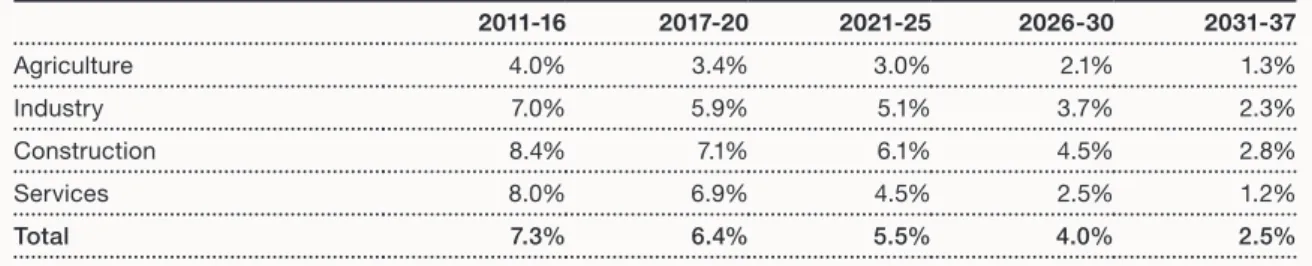
Table 3: Estimated real GVA growth by industry sector in China over next 20 years (% pa)
We take our short term GDP projections from PwC’s latest Global Economy Watch report and our long term projections from PwC’s The World in 2050 report of February 2017 (with some updating).
In the short term, we expect Chinese GDP to grow at an average rate of around 6.4% in 2017- 20, declining progressively to a long term trend rate of around 2.5% per annum in 2030-37. This reflects the impact of China’s ageing population and the maturing of its economy, causing a gradual reversion in the long run towards the kind of growth rates seen in advanced economies like the US.
Individual sector growth is assumed to decelerate over time in line with overall Chinese GDP growth, but with variations based on relative growth rates in 2011-16 as shown in Table 3.
The income effect
In our ‘Sizing the Prize’ report we estimated the total income derived from AI over the period to 2030. For this report we have converted the potential value of AI into jobs numbers by, first, projecting output (GVA) growth by sector over the next 20 years in China and, second, by estimating the proportion of GVA growth that is attributable to AI based on our June 2017 Sizing the Prize report.
We assume here that the projected increase in jobs will be the same as the projected increase in GVA because we are already capturing the productivity impact of AI in saving on labour inputs through our estimates of the displacement effect, so to include this again here would be double counting. This is the same broad assumption as was made in a report on the US by Oxford Economics and Cisco in 2017, but unlike that report we do not assume that the net jobs impact is exactly zero, as this seems to be too restrictive an assumption to impose a priori.
Source: PwC analysis
2011-16 2017-20 2021-25 2026-30 2031-37
Agriculture 4.0% 3.4% 3.0% 2.1% 1.3%
Industry 7.0% 5.9% 5.1% 3.7% 2.3%
Construction 8.4% 7.1% 6.1% 4.5% 2.8%
Services 8.0% 6.9% 4.5% 2.5% 1.2%
Total 7.3% 6.4% 5.5% 4.0% 2.5%
The share of the projected GVA growth in Table 3 that is attributable to AI and related technologies is based on the results of the CGE modelling in PwC’s June 2017 Sizing the Prize report, with some adjustments to reflect the sector breakdown used in the present paper. The results of this calculation are summarised in the final column of Table 4 below.
To work out the number of jobs associated with the GVA growth attributable to AI we assume that the percentage increase in jobs will be the same as the projected increase in GVA for the reasons discussed above. For example, if we expect a 1% GVA annual growth rate in a given sector over the next 20 years that is attributable to AI, we assume the income effect is to increase jobs by 1% per annum on average in this sector. To find the cumulative income effect we compound these growth rates over the 20 years to 2037.
Table 4: AI contribution to projected annual average GVA and jobs growth due to income effect (% p.a.)
Source: PwC analysis
Average GVA growth (2017-37) AI contribution to growth
Agriculture 2.3% 0.7%
Industry 4.0% 1.6%
Construction 4.8% 1.9%
Services 4.7% 1.9%
Total 4.3% 1.7%
References
International Federation of Robotics (2017), Executive Summary World Robotics 2017:
Industrial Robots
Li J., Y. Xin and L. Yuan (2009), Hybrid Rice Technology Development: Ensuring China’s Food Security
Ministry of Education of the People’s Republic of China (2018), MOE holds press conference to present action plan on promoting AI in universities
Oxford Economics and Cisco (December 2017), The AI Paradox: How Robots Will Make Work More Human
PwC (June 2017), Sizing the Prize: Exploiting the AI revolution, available here: https://www.pwc.com/
gx/en/issues/data-and-analytics/publications/
artificial-intelligence-study.html
PwC (2017), Artificial Intelligence in HR: a No- brainer, available here: https://www.pwc.nl/nl/
assets/documents/artificial-intelligence-in-hr-a-no- brainer.pdf
PwC (2018), AI predictions: 8 insights to shape business strategy, available here: https://www.pwc.
es/es/home/assets/ai-predictions-2018-report.pdf PwC (February 2018), Will robots really steal our jobs? Available here: https://www.pwc.co.uk/
services/economics-policy/insights/the-impact-of- automation-on-jobs.html
PwC (July 2018), What will be the net impact of AI and related technologies on jobs in the UK? Available here: https://www.pwc.co.uk/economic-services/
ukeo/ukeo-july18-net-impact-ai-uk-jobs.pdf South China Morning Post (10 May 2018), Here’s what China is doing to boost artificial intelligence capabilities
United Nations (2018), World Urbanization Prospects: The 2018 Revision
Xinhua News Agency (2017), Full text of resolution on CPC Central Committee report
Acemoglu, D. and P. Restrepo (2016), ‘The race between machine and man: implications of technology for growth, factors shares and employment’, NBER Working Paper no. 22252 Acemoglu, D. and P. Restrepo (2017), ‘Robots and jobs: evidence from US labour markets’, NBER Working Papers no. 23285
Arntz, M., T. Gregory and U. Zierahn (2016), The risk of automation for jobs in OECD countries: a comparative analysis, OECD Social, Employment and Migration Working Papers No 189.
Autor, D.H. (2015), ‘Why are there still so many jobs? The history and future of workplace automation’, Journal of Economic Perspectives, 29 (3), pp. 3-30
Brynjolfsson, E., D. Rock and C. Syverson (2017),
‘Artificial Intelligence and the Modern Productivity Paradox: A Clash of Statistics and Expectations’, NBER conference on AI, discussion paper, September 2017
The Economist (12 July 2018), Automating Cooker:
The Rise of Robo Chef
EU SME Centre (in partnership with China-Britain Business Council) (2015), Smart Cities in China Felipe J, C. Bayudan-Dacuycuy and M. Lanzafame (2016), The declining share of agricultural
employment in China: How fast? Structural Change and Economic Dynamics
Ford, M. (2015), The Rise of the Robots, Oneworld Publications
Frey, C.B. and M.A. Osborne (2013), The Future of Employment: How Susceptible are Jobs to Computerisation? University of Oxford Frey, C.B., M.A. Osborne and Citi (2016),
Technology at Work v2.0: The Future Is Not What It Used To Be, Oxford Martin School and Citi GPS GSMA Intelligence (2017), 5G in China: Outlook and regional comparisons
Contacts
For more information about the services and thought leadership provided by PwC in the Economics and Artificial Intelligence areas, please see the following web pages:
www.pwc.co.uk/economics www.pwc.com/ai
This report was written by John Hawksworth and Yuval Fertig of the PwC Economics practice, with research assistance from Stephan Hobler and drawing on earlier data analysis by Richard Berriman and Hugh Dance. We are grateful for helpful comments on earlier drafts of the research from PwC colleagues including Anand Rao, Massimo Pellegrino, Daniel DiFilippo and Jonathan Gillham.
For more information about the issues discussed in this report, please contact one of the following PwC professionals.
John Hawksworth Chief Economist, PwC UK +44 (0)7841 803 665
Anand Rao
Global Leader of Artificial Intelligence, PwC US +1 (617) 530 4691 [email protected]
Yuval Fertig Economist, PwC UK +44 (0)7872 815 700 [email protected]
James Chang
China Financial Services Consulting Leader, PwC China
+86 (10) 6533 2755 [email protected] Jonathan Gillham
Director of Econometrics and Economic Modelling, PwC UK +44 (0)7714 567 297
Euan Cameron
UK Artificial Intelligence Leader, PwC UK
+44 (0)7802 438 423 [email protected]
At PwC, our purpose is to build trust in society and solve important problems. We’re a network of firms in 158 countries with more than 236,000 people who are committed to delivering quality in assurance, advisory and tax services. Find out more and tell us what matters to you by visiting us at www.pwc.com.
This content is for general information purposes only, and should not be used as a substitute for consultation with professional advisors.
© 2018 PwC. All rights reserved. PwC refers to the PwC network and/or one or more of its member firms, each of which is a separate legal entity. Please see www.pwc.com/structure for further details.