There is considerable heterogeneity between different types of EC on the market (such as cigalikes and tank models). Some English smoking cessation services and practitioners support the use of EC in cessation efforts and provide behavioral support to EC users trying to quit;.
Introduction
This report seeks to support that strategy by reviewing recent evidence and studies regarding EC use and its impact on smoking. Blood plasma nicotine concentrations increase after inhalation of EC aerosol [6, 7], and cotinine, a biomarker for nicotine, has been detected in the saliva of EC users [8, 9].
Methodology
A unique longitudinal internet study of smokers and recent ex-smokers in the UK (aged 16 and over), first in 2012 and then again in December 2013 and 2014. A longitudinal cohort study of smokers and recent ex-smokers (aged 18 and over) , interviewed via telephone and internet.
UK policy framework
Prevalence of e-cigarette use in England/Great Britain
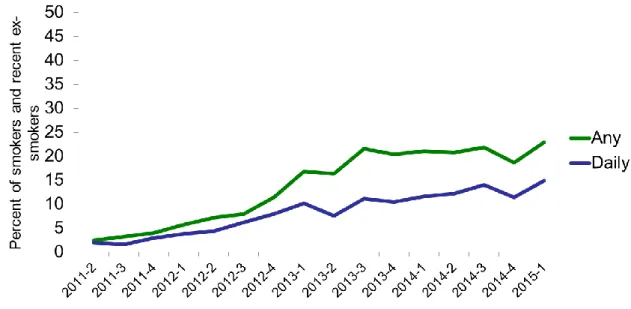
Of the available datasets, only two – the Smoking Toolkit Study (STS, England) and the ASH Smokefree GB adult survey – provide information on population prevalence (Table 1). All three surveys estimate that current EC use among adult never smokers is very rare at 0.2% or less and between 3% and 7% among ex-smokers—the latter estimates may differ because in the STS recent ex-smokers (last year ) are not included in this category (Table 1).

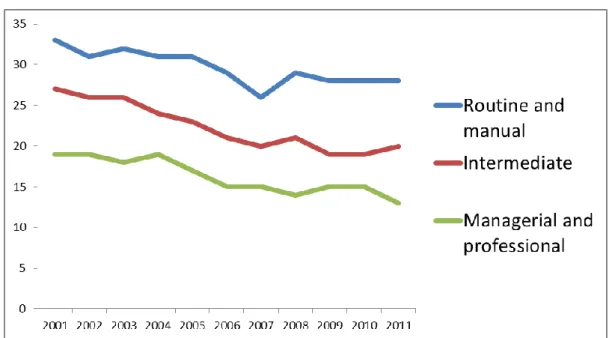
Smoking, e-cigarettes and inequalities
The basis for this fear is being evaluated and the use of tank models may be evaluated in a limited pilot soon. A more general concern has been raised that EC may be used as a vehicle for other drugs. However, if true, EC likely offers a less harmful route of drug delivery than smoking, which could be the subject of study.
Similar to mental health trusts, it would seem inappropriate to ban EC, and available ECs are currently being piloted in at least three prisons [33]. Consideration should also be given to the use of other EC models in pilots. The use of EC in prisons has been considered in other jurisdictions which should also be informative [34].
Some health trusts and prisons have banned the use of EC which may disproportionately affect less privileged smokers.
E-cigarettes and smoking behaviour
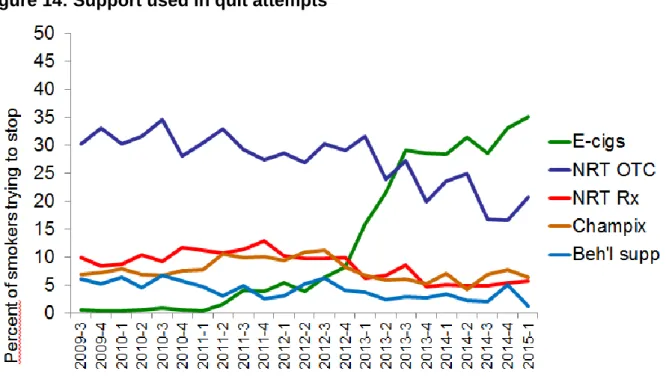
The increased use of EC as a smoking cessation aid is occurring despite the fact that there are no licensed ECs. This section reviews the evidence regarding the use of EC to stop smoking that has been published since the Cochrane Review [39] on the use of EC for smoking cessation and reduction (reduction). However, this study provides some of the best evidence to date on the effectiveness of EC for use in smoking cessation efforts.
Some English smoking cessation services and clinicians support the use of EC in quit attempts [48] and provide behavioral support to EC users trying to quit smoking. Two recent studies examined EC use among smokers enrolled in smoking cessation programs in longitudinal studies [ 51 , 52 ]. The authors concluded that caution is needed when interpreting observational studies on the effects of EC use on smoking cessation.
Borderud et al investigated whether any use of EC in the past 30 days was related to smoking cessation outcomes in a group of cancer patients enrolled in a.
Reasons for use and discontinuation
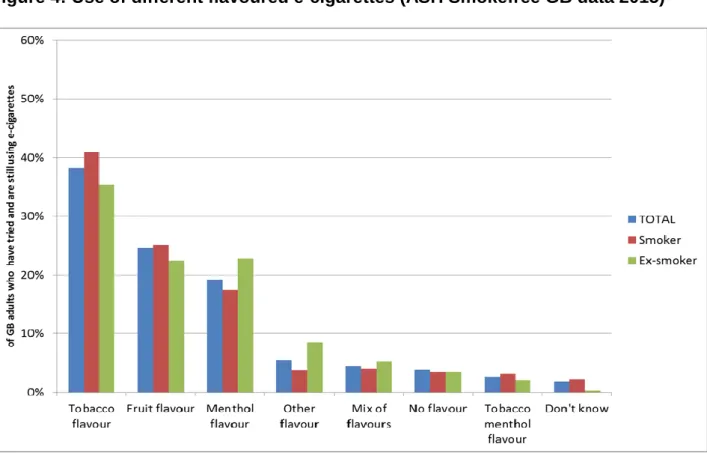
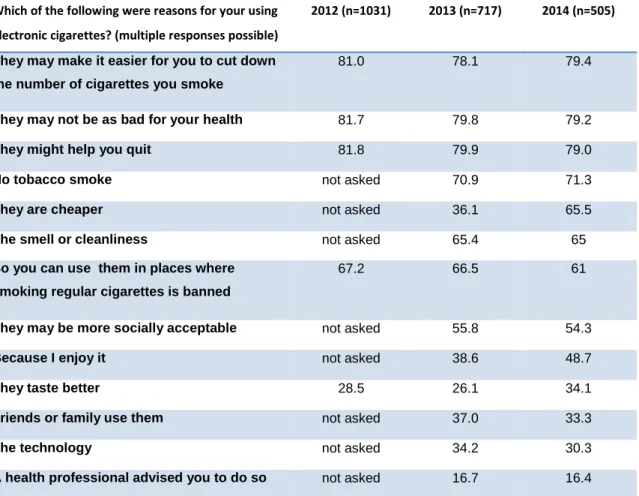
Reasons for using EC have been assessed for adult smokers and ex-smokers in a variety of ways. Across different populations, smoking cessation assistance and harm reduction were the main reasons endorsed for using EC. In the Internet Cohort GB study, the list of possible reasons for using EC was expanded after the first year (the study was conducted in and 2014).
A smaller number of surveys specifically assessed reasons for judgment and allowed the choice of curiosity, which was often cited as an important reason. Continued use was more common among those whose main reasons for trying included help to quit smoking or reduce harm. In the 2014 ASH Smokers survey, the second most frequently endorsed disadvantage was “They may not be safe enough as a product” (35%) among smokers who had tried an EC but no longer used it.
Many studies among different populations demonstrate that the reduction of harm from smoking (for example, by reducing cigarette consumption or assisting withdrawal during temporary abstinence) and the desire to quit smoking are the most important reasons for using EC.
Harm perceptions
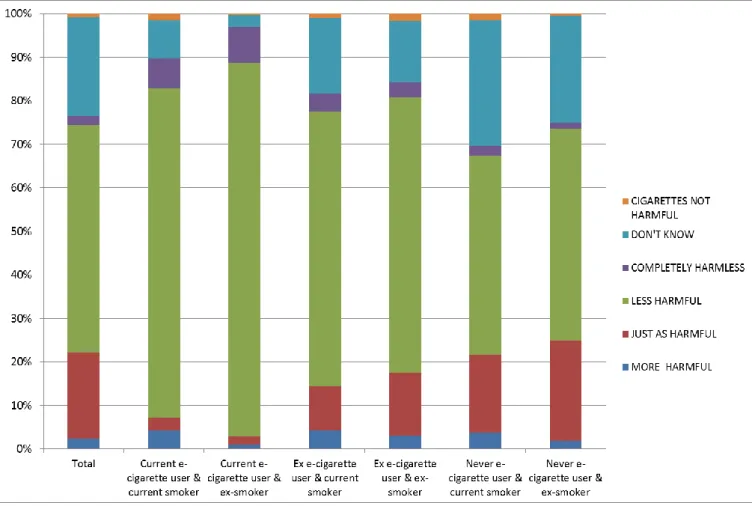
In both the Internet Cohort GB surveys (Figure 16) and in the ASH youth surveys (Figure 17 [64]), significantly higher percentages found EC to be at least as harmful as cigarettes in 2014 than in 2013. In agreement with the other GB surveys, this survey found a sharp increase in the percentage who consider EC to be as harmful as cigarettes (p<0.001). Surveys from the US also suggest that between 2010 and 2013, the percentage of current smokers who knew about EC and believed EC was less harmful than cigarette smoking fell significantly [65].
Young people in the US seem to have a less realistic picture of the relative harm of EC compared to cigarettes than British young people. In the 2012 National Youth Tobacco Survey, of those who knew about EC, about a third thought they were less harmful than cigarettes and about half were doubtful [66, 67]. While the majority of adults and youth still rightly view EC as less harmful than tobacco cigarettes, there is a general shift towards the imprecise.
Interestingly, there is also some evidence that people think EC is less harmful than medical nicotine replacement therapy (NRT).
EC, nicotine content and delivery
E-cigarettes, nicotine content and delivery
The victim appears to have consumed three vials of e-liquid totaling over 10,000 mg of nicotine[76]. We identified five studies of nicotine in the air, 14 studies of nicotine in e-liquid, and nine studies of nicotine vapor. EC releases negligible levels of nicotine into the ambient air with no identified health risks to bystanders.
A recent study discovered another serious problem with trying to understand the nicotine content of e-vapes. Across the middle tier of nicotine levels, nicotine delivery to vapor is determined primarily by mechanical and electrical properties of EC products and by. EU use releases negligible levels of nicotine into the ambient air with no identified health risks to bystanders.
The rate of nicotine absorption is generally slower than from cigarettes, but faster than from NRT.

Safety of e-cigarettes in the light of new evidence
The dry puff setting released formaldehyde at levels stated in the NEJM letter and Japanese press release. EC vapor is inhaled as a replacement for tobacco smoke, but the study did not compare the effects on the lungs of exposure to smoke and vapor. In addition, the mice in the experimental group were exposed to a much higher level of stress than the control group, and stress influences the bacterial and viral response.
McFiggans and Harrison requested a retraction of the piece because their findings did not implicate any health risks. It is the content of the particles rather than their presence or size that has health consequences [144]. None of the studies reviewed above change the conclusion of Professor Britton's 2014 review for PHE.
While vaping may not be 100% safe, most of the chemicals that cause smoking-related illnesses are absent and the chemicals that are present pose a limited hazard.
Other health and safety concerns
Exposure of children to toxic liquid is a concern; but they must be taken in context. The same NPIS report recorded 208 exposures to liquid in reed diffusers, 1168 exposures to pesticides and over 600 exposures to paracetamol. Clinical outcomes of exposure to e-liquids, as detailed in the NPIS report, were mostly "no toxicity" or "mild toxicity."
In addition, there were 3,700 fires from faulty appliances and electrical wiring, causing 19 deaths and 820 non-fatal casualties. Regulations covering chargers and manufacturing quality standards can help reduce the risk of fire and explosion in the EC. It seems likely that the risk of fire and electrical failure is similar to other household electrical products, indicating that EC should be subject to the same guidelines and safety mechanisms.
There is a risk of fire from the electrical elements in EC and a risk of poisoning when consuming e-liquids.

International perspectives
Moore, G., et al., Electronic cigarette use among young people in Wales: evidence from two cross-sectional studies. Schmidt, L., et al., Prevalence and reasons for initiation of electronic cigarette use among adults in Montana, 2013. Kong, G., et al., Reasons for Electronic Cigarette Experimentation and Discontinuation Among Adolescents and Young Adults.
Pellegrino, R., et al., Electronic cigarettes: an assessment of exposure to chemicals and fine particles (PM). Farsalinos, K.E., et al., Nicotine absorption from electronic cigarette use: comparison between first- and new-generation devices. McRobbie, H., et al., Effects of electronic cigarette use with and without concurrent smoking on acrolein disposition.
Krishnan-Sarin, S., et al., E-cigarette use among middle school and high school youth in Connecticut.
- More intensive vaping regimens
- Experience with EC
- Nicotine concentration and chemical composition of e-liquid
- Type of EC device
A significant increase in plasma nicotine was observed after the fourth puff period, with mean blood nicotine levels increasing from 2.2 ng/ml (SD 0.78) at baseline to 7.4 ng/ml (SD 5.1) at at the end of the last absorption period. inflating. 2) Experience with EC. Pharmacokinetic analyzes showed a significant increase in plasma nicotine from a baseline of 2.0 ng/ml to 0.3 ng/ml within five minutes of the first puff. At the end of the ad-lib vaping period, peak plasma nicotine concentration was 16.3 ng/ml.
Using a similar method to Vansickel & Eissenberg (2012), the analysis of plasma nicotine from the seven participants who provided a full blood set showed that levels had increased from 0.74 to 6.77 ng/ml in 10 minutes. After one hour of ad lib use, the peak nicotine concentration achieved was 13.91 ng/ml, again with a wide range of levels observed between individuals (ng/ml). Significantly greater increases were observed using the new generation of EC from 2.46 ng/ml to 6.59 ng/ml to 23.47 ng/ml at baseline, 5 minutes and at the end of the ad lib period.
There was a significant decrease in cotinine from baseline to two weeks in ng/ml, suggesting that the EC used did not provide as much nicotine as the participants' usual cigarettes.