This report is a joint product of the Chief Economist office for Latin America and the Caribbean (LCRCE) and the Macroeconomics, Trade and Investment (MTI) Global Practice of the World Bank. Quy-Toan Do and Jed Friedman (both Senior Economists, DECPI) as well as Roberta Gatti (Chief Economist, GGHVP) provided valuable technical advice on the health and economic impacts of the Covid-19 epidemic. But the Covid-19 epidemic brings in a new dimension, as the necessary measures to contain the outbreak of the epidemic also result in a major supply shock.
But a few months after the outbreak of the epidemic, the growing availability of epidemiological and economic data makes it possible to assess the impact of the measures taken. Getting that balance "right" requires assessing both the health and economic implications of the measures that can be taken to contain the spread of the epidemic. For this report, the impact of general and targeted measures on the number of Covid-19 cases was estimated, building on daily data from 25 countries.
With limited resources and limited instruments, a proper design of the policy response becomes extremely important. Internationally, the region is seeing greater portfolio outflows than during the Global Financial Crisis.
From lackluster to calamitous
Since then, average economic growth in the countries of Latin America and the Caribbean has been the same, or even slower, than that of the much richer advanced economies, undermining any hope of long-term convergence. The region's growth rate is strongly influenced by the three largest economies, namely Brazil, Mexico and Argentina. But even by this metric, Latin America and the Caribbean grew by a disappointing 1.7 percent in 2019 (Figure 3).
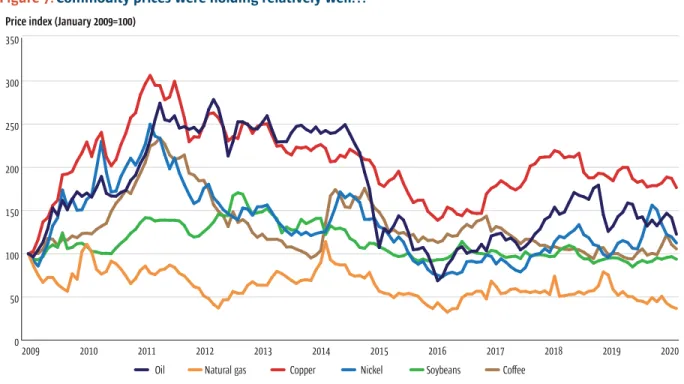
In economic terms, years of slow economic growth and the need for painful fiscal adjustments are straining the population's ability to cope with these problems. In a social interpretation, Latin America and the Caribbean are the regions with the highest level of inequality, and large differences in living standards cause frustration. Commodity prices play a disproportionately important role in Latin America and the Caribbean given how dependent the region is on natural resources.
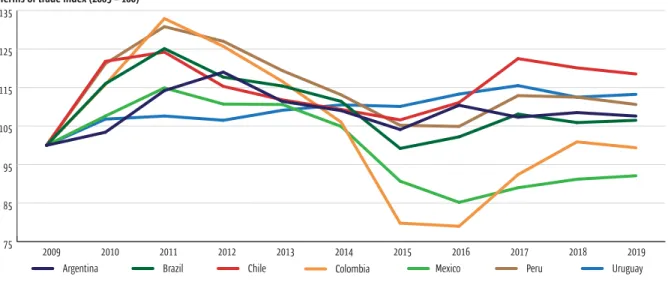
The terms of trade have even improved for a few countries in the region (Figure 8). The region's growth performance has become weak since the end of the golden decade, and 2019 was no exception in this regard.

The outlook for the region
A more comprehensive forecasting effort requires integrating all of these mechanisms into a model of the economy, and linking country-level forecasts to a coherent model of the global economy. Again, there is great uncertainty in such an exercise as the relationship between key variables may not be the same as before in the aftermath of the Covid-19 crisis. With this caveat in mind, the overall picture for the Latin America and Caribbean region is sobering (Table 2).
Assessing the situation in the short run
And second, real-time NO2 emission observations are publicly available for most of the Earth's habitable surface. The main exception is the sunless Arctic in winter, when spectrometers become unusable. Morris and Zhang (2019) took advantage of this finding to assess the reliability of China's GDP estimates at different points in time and created combined measures of economic growth based on both reported GDP and NO2 emissions.
For this report, data on NO2 emissions have been processed in the form of 30-day moving averages at the country level. A crude estimate of the change in economic activity caused by the Covid-19 epidemics is provided by a comparison between NO2 emissions in the month preceding the closing date for this report and the average emissions in the same month over the previous two years. The reference period is advanced in the case of China and Korea, because these two countries declared the containment of the Covid-19 epidemic earlier than the rest of the world.
For example, other things being equal, more urban countries, or countries with a larger manufacturing sector, may generate more NO2 emissions than more rural or agricultural countries. Therefore, the relationship between NO2 emissions and GDP can be expected to vary between countries, even at sub-national levels within countries. That said, a crude approximation can be used to give a sense of what the observed changes in NO2 emissions mean for the magnitude of the current economic downturn.
On average, NO2 emissions between countries increase by about 0.7 percent if GDP increases by 1 percent. The implication of reversing this elasticity is that GDP would have increased by about 1.4 or 1.5 percent, if a 1 percent increase in NO2 emissions is observed. Due to the unusual depth and unprecedented features of the ongoing economic crisis, real-time measurements of economic activity are needed.
Big data could support a more reliable and frequent assessment of the impact of the Covid-19 epidemic on economic activity. This is the time to strengthen supervisory capacity and have a clear sense of the risks faced by banks, non-banking financial institutions, microcredit providers and the like. Note: Figures are percentage changes in NO2 emissions for the period from 7 March to 6 April 2020 compared to the same period in 2019.
Health costs and economic costs
In the socially optimal solution, the severity of the government's containment measures roughly parallels the dynamics of the infection rate itself. Addressing the trade-off between health costs and economic costs requires a robust assessment of epidemic mortality. A naive measure of CFR is given by the ratio of reported deaths due to Covid-19 to the number of known Covid-19 cases.
This starting date is counted from the day of the first diagnosed case in the respective country (Table 3). In this analysis, the rate of infection progression is measured by the rate of increase in the number of cases. The results of the empirical analysis show that general containment measures always result in fewer cases over time than targeted measures.
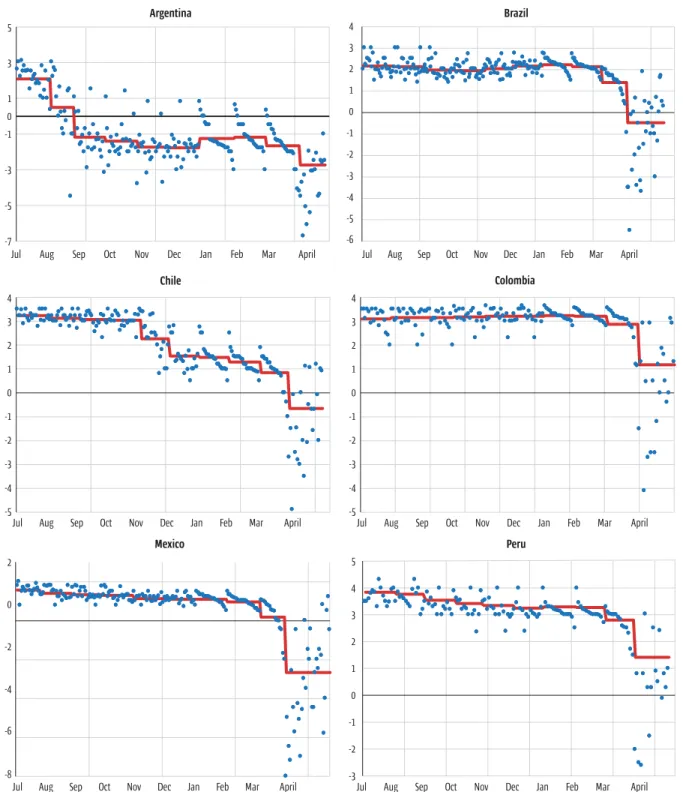
In this equation, the coefficients btj measure the impact of targeted containment measures on the speed of the epidemic j weeks after they were adopted. General and targeted measures to contain the spread of the epidemic may not have the same economic costs. A rough measure of the impact of containment measures on economic activity is NO2 emissions.
A more thorough analysis of the relationship between NO2 emissions and containment measures to slow the spread of the Covid-19 epidemic was carried out for this report. The total economic cost of the measures adopted to slow the spread of the Covid-19 epidemic is still unknown. The impact on economic activity of containment measures adopted to slow the spread of the Covid-19 epidemic can be estimated using a simple econometric model.
A measure of the expected economic cost of the Covid-19 epidemic is provided by consensus forecasts. From this perspective, the measures necessary to limit the spread of the epidemic do not save an average life. To assess the financial costs per lives saved requires an estimate of how many deaths Covid-19 would have caused in the absence of containment measures.
Addressing the economic crisis
Argentina's economy is bracing for a major impact from the Covid-19 outbreak after experiencing a recession for the second consecutive year. The severe impact of Covid-19 and the containment measures will deepen the economic contraction and delay the recovery. External risks stem from commodity price shocks and the impact of the COVID-19 outbreak, which depends on its duration, the severity of transmission through various channels, and their second-round effects.
A significant contraction of the economy is expected for 2020 as a result of the global epidemic of COVID-19. Economic growth slowed in 2019, and a sharp contraction is forecast for 2020 due to the decline in global economic activity triggered by the Covid-19 epidemic. Economic growth slowed in 2019 and GDP is expected to decline in 2020 due to the effects of Covid-19 and low oil prices, rising poverty and inequality.
After strong growth in 2019, GDP is expected to decline in 2020 due to the Covid-19 epidemic, falling oil prices and domestic containment measures. After a period of sustained economic growth in the Dominican Republic, the Covid-19 is expected to cause a slowdown and disrupt fiscal consolidation. Growth will fall further in 2020, following the impact of Covid-19 and lower oil prices.
The Covid-19 epidemic is negatively impacting the economy, with manufacturing expected to fall 1.8 percent in 2020. The outlook is fraught with downside risks amid an unresolved political crisis and the Covid-19 epidemic. Honduras is expected to slide into recession in 2020 amid the Covid-19 epidemic, leading to increased poverty and inequality as remittances decline and the most vulnerable lose income.
Jamaica's successful fiscal consolidation since 2013, which resulted in public debt falling by 54 percentage points of GDP, may be undermined by the continued economic impact of the Covid-19 epidemic. Poverty declined only marginally in 2019 and is expected to increase in 2020 as a result of the Covid-19 outbreak, wiping out the gains in poverty reduction since 2017. After slow performance in 2019, the economy is expected to slide into recession in 2020 due to the Covid- 19 epidemic.
An extreme weather shock combined with the impact of Covid-19 adds to the downside risk and can increase poverty. The economy is expected to enter recession as a result of the Covid-19 shock causing a blow to exports, consumption and employment.

Country briefs