OPTIMIZATION OF OPERATIONS IN MARITIME CONTAINER TERMINALS
F. Cañero1, M.M. Cerbán2andF. Piniella3
Received 06 February 2011; in revised form 15 February 2011; accepted 20 October 2011
ABSTRACT
The objective of this article is to present a general analysis of the various different elements that comprise the operating chain or process for working a container- carrier vessel, defining the operating ratios involved and the relationships between them; similarly, the parameters that influence the operational process are indicated. This paper includes an approach to the problem focused on a case- study: the Spanish terminals. We have carried out a quantitative analysis that allows comparative strategies to be established and applied to practical cases. The correct planning and execution of operations on a container-carrier vessel is a decisive element in the strategy of a Terminal. Numerous factors come into play and some of these, but only some, can be controlled. Experience and knowledge of the problems that can arise is fundamental when attempting to deal with these operations. We put aside, for the time being, the initiatives a terminal can take to optimize yard distribution, as well as reducing the impact of berthing problems.
We consider the different measures of the various kinds of production, and the difficulties that could be encountered in trying to maximize productivity. Finally, we offer some suggestions regarding what is being done presently at the termi- nals to achieve their operating targets.
Key words:Container Terminal, Port management, Optimization, Spain.
Printed in Santander (Spain). All rights reserved ISSN: 1697-4840
1Manager Operations, APM Terminals, Email: [email protected]. Tel. 956671935, APM Terminals - Muelle Juan Carlos I, 11201 Algeciras Cádiz, Spain. 2Profesora Dra, E Politécnica Superior Algeciras UCA, Email: mariadel- [email protected], Tel. 956028000, Ada Ramón Puyol, s/n, 11202 Algeciras Cádiz, Spain. 3Profesor Titular Universidad Direc- tor Departamento, Facultad Ciencias Náuticas UCA, Email: [email protected], Tel. 670674471, CASEM Campus Río San Pedro, 11510 Puerto Real Cádiz, Spain.
INTRODUCTION Objectives
Determining the optimum way of working a container vessel in a terminal is an ardu- ous task, in which numerous different factors need to be juggled. By optimum, we mean in such a way that maximum productivity, measured in movements per hour, is obtained, while the period of time that the vessel has to spend at the quayside in minimized, so that finally the desired costs per unit are achieved. The objective of this article is to pres- ent a general analysis of the various different elements that comprise the operating chain or process, defining the operating ratios involved and the relationships between them;
similarly, the parameters that influence the operational process are indicated.
The diverse sub-systems that are intrinsically combined in this operational process are considered vitally important: the berthing subsystem and the prior plan- ning of this phase; the subsystem of direct operations undertaken at the wharf; the dockyard operations; and finally the port operations, of considerable importance in export-import terminals. The subsystem that has probably been least studied is the one that directly concerns the operational process of the vessel at the quayside. We believe that the fundamental reason for this is the impossibility of mathematically modeling it, given the diversity of the circumstances that directly affect the good functioning or handling of the equipment utilized, the importance of the human fac- tor, and the experience necessary for dealing with these operations. This paper sets out to analyze in more detail this particular subsystem.
Review of the scientific literature on the subject
The studies of Steenken (2004) and, more recently, of Stahlbock and Voß (2008) and Vis and Koster (2003) cover a wide range of experience with container terminals, including case studies, and serve to define the initial problem for us.
One specific problem that has received considerable study, because it is more suit- able for mathematical modeling, is the berthing allocation problem. This concerns how best to plan the berthing of several different vessels at the wharves of the terminal, so that the fixed working periods and the number of hours of work agreed with the cus- tomers in their corresponding contracts (windows) are respected. The length of time that the vessel needs to spend at the wharf must be minimized and the fullest advan- tage must be taken of the handling facilities available. This is the case of the study by Jim Dai (2004) in which the static problem is differentiated from the dynamic problem, and the time factor and its implications in a set period are included in the latter.
In Brown et al. (1994) a practical optimization model, with various restrictions, is offered1. Lim (1998) proposes a heuristic method utilizing graphical representa-
1Of application in the various services of berthing and provisioning of the vessels of the US Navy; demonstrations of the uti- lization of the model were carried out at the US Norfolk Naval Base.
tion2. In another field, the study carried out by Dragovic (2006) deals with the mean time a vessel remains at berth and its dependence on the mean number of vessel arrivals at the port3.
Traditionally, to evaluate the performance of a container terminal, the berthing and yard operations are optimized, either by analytical methods or by computational or algorithmic modeling techniques (Petering 2011; Fockert 2009; Günther 2006; Vis and Koster 2003; Dowd and Leschine 1990). Firstly, an index of occupation of the terminal or adequate yard density must be obtained. There appears to be an inverse statistical relationship between the density and the productivity. The operations in the yard are performed more slowly the greater the number of containers per unit of area; this is because the operating cycles of the machines (trucks, straddle carriers, etc.) needed to move the containers to and from the wharf are longer. More errors may be made and there may be more difficulties in locating the particular containers required, since they may be at lower levels in the stacks. There is a greater possibility of accidents occurring.
Different terminals may measure this ratio in different ways. Some terminals, where the containers are usually stacked to low levels or heights (straddle-carrier ter- minals, or chassis terminals, for example), can measure the occupation of the slot by unit of area, without much need to take into consideration the different heights to which the containers may be stacked (Longo 2010; Lau and Zhao 2008; Lee et al.
2007). Various studies have been made of the operational process in this type of ter- minal. Vis and de Koster (2003) have already demonstrated the difference existing between terminals of the ITS (Indirect Transfer System) type and those of the DTS (Direct Transfer System) type4.
For a DTS type terminal the objective is to minimize the times of the operation to move the container between vessel and stack (and vice versa when loading); how- ever, in the case of the ITS, it can be appreciated that there is an additional objective element or operation to minimize (Nam and Ha 2001). Kim et al. (2003a, 2003b, 2000, 1999a-e, 1998 and 1997), analyze the problem of space allocation in both types, in the case of export terminals.
Zhang et al. (2003) study storage space allocation for import, export and trans- shipment terminals in an ITS system. They break down the problem into two parts:
the first is how to assign the stack for each sequence of work (that is, taking into con-
2This method, with special variants, is frequently utilized in terminals, and can be performed simply using common spread sheets.
3The study applies queuing theory models and an Erlang distribution (k phases) for the mean time for servicing the vessel (berth average) once tied up. Factors directly attributable to the operational process on the wharf in itself have an influence but, as seen in the study previously cited, the creation of queues of waiting vessels directly affects the vessel servicing time, independently of the quality of service that may be provided on the wharf.
4In the first, a fleet of machines or vehicles is used to transport the containers from the side of the vessel to the stacking area, where another type of machine (an RTG or Rubber-Tired Gantry) stacks them according to the storage criteria. In the DTS system, the machine (a Straddle Carrier) that picks up the container at the quayside takes it to the storage area and stacks it directly.
sideration the type of container, import, export, relay); and the second is how to min- imize the distance from the stack to the vessel (that is, reducing the distance that the container-transporting vehicle, or shuttle, has to travel).
Presentation of the problem
The changes of destination of vessels that the shipping line may decide once the con- tainers have already been stored in the yard, have a fundamental effect. A high per- centage of renominations lowers the productivity drastically. It is not unusual for the situation to occur that the loading of a particular vessel on a particular wharf has been prepared for working the vessel in the optimum way, and then to find that it has been changed to another vessel that is or will be berthed on a different wharf. This often happens and, unless the change of plan can be renegotiated with the customer, it must be accepted by the terminal. The customer will normally be ready to accept an additional charge on its agreed cost per movement that, in function of the existing cost statistics, can be negotiated as a lump sum.
The movements that are made to tidy the loads in the yard and prepare the yard for the particular vessels that are going to be worked, or else for the optimum storage of containers and organization of the yard, are normally termed house keeping. The more there are of these container movements associated directly with the renomina- tions, the more the smooth operation of loading or unloading a vessel is inevitably obstructed, when the yard has not been prepared in advance. The result is more non- essential movements, higher costs and lower productivity.
The objective of this article is to identify and analyze the problems that arise on the ground at the wharf, when working directly on vessel. The literature on this sub- system is extensive but does not cover the other subsystems, perhaps because other factors come into play, such as the specialization of the machinery (Robinson 2008), the problems of portainer crane planning and QC scheduling (Sammarra et al. 2007), the human factor (Legato and Monaco 2004), the various collective labor agreements and the legislation in this respect (López-Rueda 2005; Arroyo-Martínez 2009).
We will seek solutions or alternatives to the existing methods for optimizing the operations of container carrier vessels, from the perspective of the wharf, and aim to define the physical measurements that we use for making this assessment and its relationships.
Methodology
In this approach to the problem of optimizing operations in maritime container ter- minals, our starting point is professional experience in the field of port operations in the Bay of Algeciras (Southern Spain); this is the leading Spanish port for the move- ment of containers (Suárez de Vivero and Rodríguez-Mateos 2002). We also analyze the existing bibliography. On the basis of this, we have carried out a quantitative
analysis that allows comparative strategies to be established and applied to practical cases; this has been done in the case of the Container Terminal of the Port of Barcelona. We start from a study made of large-capacity vessels with more than 900 operational movements, utilizing the Six-Sigma Lean methodology (Brook 2009).
The socio-occupational context of this study is the Spanish national legislation appli- cable to the stevedore labor sector (Convenio 2008)(Blanco et al. 2010), but to a large extent, this is similar to the context in the rest of the European Union (Baird 2000).
OPTIMIZING THE OPERATIONAL PROCESS The concept
In all productive processes, the optimization of the operational process consists essentially of obtaining the maximum output at the lowest possible cost while meet- ing the optimum quality standards for the customer and user of the product or serv- ice. In the context studied here, the operational process of a container terminal can be considered as a large productive process where the final element is not a tangible product but rather a specified service. The service to which we refer is the handling and storage of the containerized merchandise of a particular customer. Thus we are talking either of reception terminals (import and export) or of trans-shipment ter- minals, where container s are transferred from one vessel to another. This service needs to be delivered, i.e. performed, on the date agreed with the customer, and in accordance with the same conditions that the seller, exporter, loader (or any other legal entity considered to be the person putting the container at the disposition of the carrier) has contracted with the customer. The basic objective is to carry out the operations as rapidly as possible, to enable the vessel to spend the minimum time necessary in port and, consequently, to obtain maximum economic utilization of the high-value capital asset, the vessel (Onyemechi 2010).
As a general rule, in container terminals today, whether of the trans-shipment or export/import type, several days before the vessel berths, its container load layout is known; that is, how its load has been stowed, and which particular holds (or bays) will need to be worked, in which order. The terminal management must decide, based on the instructions received from the stowage coordinators, how to distribute the containers - by weight, final destination and the characteristics of each particular container (refrigerated, 40’, 20’, IMO, OOG (out-of-gauge), BBK (break-bulk), etc.
Once the containers have been distributed, the loading and unloading in the yard has been planned, and various movements of containers that may need to be carried out on board the vessel, the persons responsible should in theory have full knowledge of the prospective condition of the vessel on its departure after being worked (i.e. the conditions of stability, trim or seating, draught, ballast, etc.). Unless the First Officer or Captain of the vessel decides to make additional changes, the order of working the vessel is maintained during the entire course of the operational
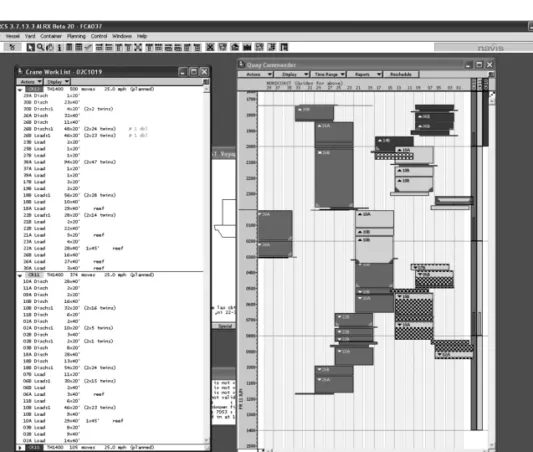
process. The order of working is a sequence of specified tasks, organized for that par- ticular vessels, that can be presented in different forms, according to the terminal and the computer systems used for loading and unloading. It may be a simple sheet of paper on which the work to be done is described, or a plan where the tasks to be car- ried out are indicated consecutively.
The above example may serve as an order of work; either the chart on the left, defined and described or the figure on the right, where normally a color is assigned to each crane or item of handling equipment.
The team of stevedores that works a shift during any twenty four hour period is known as a gang. The gang generally corresponds to a group of employees who work with a particular crane performing a particular order of work with that crane in the bays corresponding to their work.
Case study: Large terminals in Spain.
In Spain a gang works a shift of six hours, but the personnel comprising each gang varies according to the terminal, the customary practices and the work load. This is stipulated in the various sectoral agreements negotiated for each port.
Table 1:Example of a work sequence according to the SPARCS system.
The stevedoring companies of the various ports and/or groupings of ports (Agrupaciones Portuarias de Interés Económico: APIEs) have the responsibility of supplying the various terminal operators with the specialized and specific personnel (stevedores) needed for the tasks or jobs that require them, in the numbers agreed.
The ownership of these companies is usually comprised of personnel designated by the stevedoring companies, with the representation normally proportional to the demand, in terms of volume of work. In terms of finance and accounting, they are companies without any real assets, and the principal movements in their profit and loss account represent personnel costs.
The personnel employed are remunerated according to the piecework method:
the more containers handled during the shift, the higher the remuneration obtained by the stevedore. In theory, under this system, the employees earn a fixed amount per shift on which they are nominated for work, independently of whether any work is done, for whatever reason. This fixed amount of remuneration is set in the collective labor agreements ruling in the sector. Apart from obtaining the negotiated basic income, for any additional container that is handled an agreed extra amount of remuneration is computed.
Obviously there are guarantees negotiated to protect the earnings of this group of employees - for example, if a vessel scheduled does not berth, or if it berths later than planned, or if a crane breaks down, etc. In the granting of these guarantees, the final decision is frequently up to the person with operational responsibility for the terminal at that time. It is therefore understandable that these decisions frequently involve discussion or negotiations that are or should separate from the specific tasks and jobs to be done, according to the various interpretations of the agreements, or as is commonly argued, according to the spirit of the law and not necessarily to the let- ter of the law or contract. The granting of a guarantee of this type when it is not really correct, often results in the operating personnel relaxing their efforts; and such a loss of concentration on the job in a gang has an adverse effect on productivity and, ulti- mately, on the achievement of the operating and financial objectives of the terminal.
It is interesting to note that there are three main types of gang: the complete gang, which includes among its members personnel responsible for the lashing and unlashing of containers; the simple gang, which does not do lashing, and is therefore considerably less costly; and thirdly, the specialist gang for lashing, generally com- posed of a foreman and team who do nothing but the attaching of containers on board to each other and to the structure of the vessel, on loading, and the reverse on unloading.
The particular use of simple gangs is justified by the fact that, apart from being more economical, there are some types of work on the vessel that do not need these specialist lashing activities to be performed: a full shift can be devoted to loading holds or on a vessel with systems of guides on its decks (Convenio 2008).
DISCUSSION BY OBJECTIVES Presentation of operational objectives
The first objective is for the vessel to be tied up correctly to the wharf in the shortest time possible; that is, the operational process, from the time when the first line is made fast to the quayside until the berthing is completed, should be carried out as rapidly as possible. The time taken from when the vessel begins this operation until it is completed is usually referred to as the berth time. The total production or berth productivityis the total number of movements or individual tasks performed on the vessel (including all the concepts) divided by the total berth time(bmph).
The satisfactory organization of specific berthing windows or slots by the termi- nal operator, and commitment on the part of the customer to keep its vessel On Schedule and with the pre-defined movements, should minimize unproductive time drastically.
The customer or shipping line, for its part, should make every effort to keep to the date and time of arrival of its vessel to which it has committed itself (within the reasonable range of variation agreed previously with the terminal), so that the termi- nal operator may be able to work the vessel as planned, again within an equally rea- sonable range of possible variation from plan5.
The second objective, intrinsically linked to the first (but this is not necessarily the order of priority), is for each gang, during its shift, to work the maximum number of containers per hour. This parameter, referred to as the production or productivity of the vessel, is measured in numbers of containers per hour. If no allowance is made for working time lost because of breakdowns of cranes or machinery needed for the operations, this is designated the gross productivityand if such allowance is made, then it is net productivity. For the purposes of this study, the gross time, or number of hours that the gang is theoretically working, will be considered. This is an objective of the operational process of the terminal: When each vessel is worked at a higher speed, the terminal is able to work a greater number of vessels. This results in a better berth production. In other words, this concerns the achievement of economies of scale, and lower cost per movement, by reducing the fixed costs of the terminal.
This minimum cost is the third objective, in this case of the terminal as a whole: it has an enormous impact on the tariffs or charges that the terminal can offer its cus- tomers. The unit cost has several components whose proportionate significance varies in function of the type of terminal and its particular characteristics. Generally the largest component of this cost is the remuneration of the work-force of stevedores, although equipment maintenance costs and depreciation of the capital cost of the machinery is
5The effects of the current world crisis are partially palliating the loss of productive time at the terminals, since it has obliged the shipping lines to cut fuel consumption by reducing cruising speeds and ensuring that the vessel reaches the pilot pick-up station at the correct time to start the maneuver of docking/berthing. For a large-capacity vessel this can take approximately one and a half hours. This means that, in theory and excepting circumstances of force majeure, the larger ships get into port in time, without delays.
not insignificant. The terminal’s income is the result of the number of containers moved multiplied by the tariff applicable to each movement (Sala and Medal 2004).
The total costs, in general, are derived from the number of cranes and other machinery and equipment, plus the expenses of maintenance and depreciation. On the wharf the costs of the activity and the associated fixed costs include the fixed costs for the area of land occupied, the amortization of the loans for the purchase of the capital equipment, the maintenance of that equipment, and last but not least, the direct and indirect personnel costs.
Although, as mentioned, these are the general costs of the terminal, other costs must also be taken into account such as those for the repositioning, repair and replacement of the general machinery of the terminal due to wear-and-tear and obsolescence; other expenses include investment in new technologies and imple- menting them, research, development and innovation, and all the specific investment and expenditure that the terminals must incur in order to comply with and to update the security systems, given heightened awareness of possible terrorist attacks since 11 September 2001, and for risk prevention, health and safety and hygiene of the employees (Piniella 2009 and 2008).
In spite of all the expenditure, one of the more visible and worrying effects of the crisis being felt in this industry is the slow disinvestment that some terminals are making in items such as the preventive maintenance of machinery and safety, as described in the study conducted by Trelleborg Marine (Trelleborg 2010).
Quantitative analysis
If the cost per unit is defined as the quotient between the total costs and the total number of containers handled during a specified period of time; and taking, in turn, the total number of containers handled as the production of the terminal for the total length of time employed in the operations, the unit cost is, within certain limits, inversely proportional to the cited production.
CPU = Total costs / N (1)
And therefore,
CPU = Ct/ (gpmh x Tt) (2)
where CPU = Cost per unit Ct= Total costs
N = Total number of containers moved Tt= Total time employed in moving them
gmph = gross movements per hour, understood as the mean during a specified Tt(similarly designated production).
In productive processes there is a certain level of production that minimizes the unit cost. In container terminals the production of a particular service is measured (containers per hour), and each terminal knows what is its optimum level or rate of production. Higher rates of containers moved per hour imply a greater investment in resources, and this investment increases the cost in a non-linear way. It is a compli- cated process to determine the optimum production, from the analytical perspective.
The operating statistics of the terminal itself serve to orientate the operator regard- ing this optimum.
The number of gangs that, on average, can support the vessel during all the shifts that are worked is known as the crane intensity; this parameter is nothing more than a weighted average of all the gangs with which the vessel is capable of working on each shift. This is a most important parameter for calculating the window or total time available for berthing and, therefore, for optimizing this window: it should be made as small (or short) as possible or in accordance with the contract signed with the customers.
The object of the terminal is to sub-divide the work on the vessel among several separate gangs, while also trying to ensure that the various gangs are as equal or bal- anced as possible. Given that theoretically the gang with the most work takes the longest and this, as we shall see, determines the overall length of time that the vessel has to remain in port, another aim is to organize the work so that all the gangs finish at the same time. This offers the possibility, reflected in the various working agree- ments, that the vessel may waive or forego certain gangs, termed passing; when this occurs, the passed gangs may continue working other vessels. This normally results in the recognition of certain financial guarantees for the stevedores, as already com- mented.
The crane intensity, an adimensional quantity, is easy to predict at the start of operations, according to the expression:
CI= ∑ Mi/ Mmax (3)
where CI= is the crane intensity and ∑Miis the sum of all the movements performed by the several Migangs, and Mmaxis the number of movements of the queue or the sum of movements by the gangs taking the longest times in the order of work (assuming continuous working from the start of operations up to their completion, except for breakdowns, with the same crane). The duration of the longest queue determines the berth time, and therefore the berth productivityis obtained as follows:
Mmax= gmph × bt (4)
where bt is the berth time and the gpmh (gross movements per hour) is the assumed general production of the vessel (total number of movements made divided
by the total number of hours employed); we have already defined the bmph previously, as follows:
bmph = ∑ Mi/ bt (5)
It can easily be deduced that the crane intensityis:
CI= bmph / gmph (6)
This expression inevitably gives the number of cranes or gangs that have been utilized, on average, during the entire operational process of the vessel, the weight applied in number of gangs for each shift worked.
It is preferred, however, to differentiate between the two formulas, although both lead to the same result: The first is known from the start of operations on the vessel.
On a container carrier vessel it is very unlikely that all the gangs work at the same rate or gpmh. The item obtained by equation (6) indicates, at the completion of the operations, how efficiently that entire operational process has been performed. We would like to designate this quotient as Crane density (Cδ), to differentiate it from the parameter given by equation (3), on the one gang, by the point in time when each parameter is useful to know, and on the other, because what is most likely is that they are different. This is because diverse factors come into play, which the terminal, as operators, must control heuristically. The shrewdness of the vessel’s operator, and of the terminal, tends to be very similar: in any case the following will always apply:
CI≥ Cδ (7)
From the same definition of CIand Cδit can be concluded that, once this quantity has been fixed, an increase in the gmph implies another proportional increase in the bmph. For any particular vessel, this indicates clearly that an optimization of the gmph reasonably implies a shorter stay of that vessel in port. Again we perceive the relationships between the three objectives, although the reality is normally otherwise.
The annual datum of the total production of each terminal varies considerably according to the type of terminal and its traffic, (feederor mainliner), from one par- ticular service to another, from one berthing to another, of the same vessel (in conse- quence of a different distribution of the containers in the terminal), from break- downs, climatological conditions, and an endless list of other circumstances that in some cases are difficult to measure.
Nevertheless, for any particular vessel, during the course of a particular opera- tion, the production of the vessel, in gmph, can be considered to be constant. The bmph should have the maximum possible value; this is the principal objective of the customer, in order to minimize the length of time of the stay. Without entering into specific considerations of the correct points to take as the start and finish of the
operational process for the vessel, a bigger CIwill give a higher bmph. In other words, taking the gmph production as constant, it can now be understood that CIis propor- tional to the bmph. The next step is to decide how this CIcan be increased, and the problems encountered in doing this.
The desired level of crane intensitycannot always be attained: The load should be sufficiently well-distributed among the different baysof the vessel to enable it to be worked with the maximum number of cranes, in the shortest time possible. It is very commonly observed that vessels requiring the operation of several gangs during sev- eral shifts have the movements concentrated in baysclose to each other, where theo- retically two gangs cannot work together because of the simple lack of physical space.
The reference here is to a specific linear distribution of the operational move- ments. Such a distribution would need to apply equally over the course of time. It could only be found on regular lines, in vessels of a certain capacity or dimension, with an agreed number of movements, with fixed ports of arrival, with itineraries also fixed, and where, of course, the volumes to be worked in each of these ports are constant over the course of that time (or where the variations are minimal). Hence, the planning from the initial port would be predictable: the crane intensity would remain practically unaltered.
Application to a practical case (the Port of Barcelona)
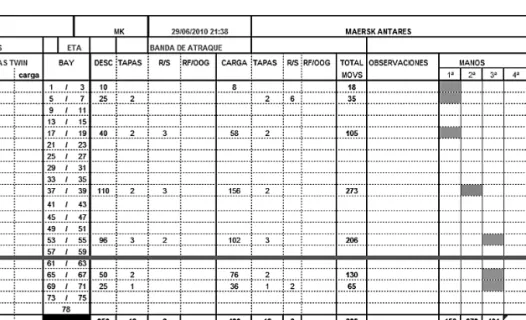
From the preceding analysis, we move on to its application to a practical case. For this the data in table 2 are utilized, corresponding to the Container Terminal of Barcelona (Muñoz 2008). The vessel to be worked is the Maersk Antares, with a total of 832 movements. An average of 26 movements per hour means 32 hours of real work and somewhat more than the work of five gangs (each working a six hour shift). If the vessel could be worked from the start with these five gangs, and the gen- eral operational process is as expected, perhaps with a couple of hours to finish off, the ship would be finished in eight hours. The bmph measure of production would thus be 104 movements per hour. The Crane density would be this production rate divided by the gross obtained, that is,
Cδ= 104 / 26 = 4
This indicates that the vessel in general could be worked with an average of four gangs (it can be considered to have been worked for six hours with five gangs, and for two hours with one gang): the weighting of the average does not deceive us.
However, the way the movements are distributed should be examined. A total of 273 movements are concentrated on bays 37/39. In this case it has to be added that, due to the operational circumstances of the terminal, only a maximum of 3 cranes are available for this vessel. The third gang, the longest, imposes a minimum length of time for working the vessel of
Tt= 401 / 26 = 15 hours 25 minutes
Table 2: Planning sheet for gangs and movements, TCB Barcelona.
Operations on the vessel and their possible delays
In this part we will describe the circumstances that occur in the direct operational process of the vessel that may alter the rate of production of the vessel, measured in movements per hour or gmph; this latter parameter is the measure that is of interest to the stevedores since they are paid on a piecework basis.
There are several factors that have a direct and adverse impact on the rate of pro- duction of particular operational process on board a vessel. It should first be stated that the rate of production decreases in line with the various losses of working time incurred in the operational process in general.
In one of our recent studies of large capacity vessels, in which the operational process comprises more than 900 container movements, utilizing the Six-Sigma Lean methodology6carried out exclusively during the first hour of commencement of operations, it was observed that there are three main factors that most influence this loss of working time: (1) the unlashing of the containers; (2) the time spent waiting for the vessel; and (3) crane breakdowns.
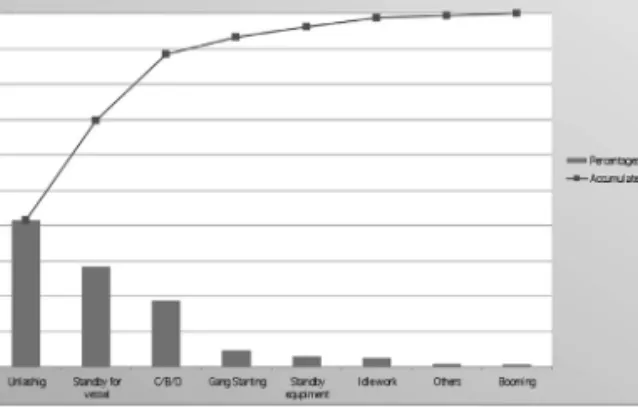
With reference to the unlashing of containers, so that they can be unloaded together with those positioned below them in the stack, it can be seen from Table 3 that this work accounts for more than 40%, on average, of the time lost at the start of the operations: we consider that the scope of the study is sufficiently broad to allow these data to be extrapolated to other terminals and other types of vessel. It is there- fore considered that a loss of up to 20 minutes can be incurred in unlashing tasks.
6A more detailed description of the applications of the system can be found in the study by Quentin Brook (2009), for example.
This is a considerable loss of time. Assuming that those 20 minutes could have been used productively at the same rate of operations, 50% more produc- tion would have been obtained in that hour. It is evident that the unlashing effect at the start of operations gradually dimin- ishes as the work continues during the course of the shifts, and has practically disap- peared by the time the opera- tions on the vessel finish. We may be speaking of vessels which stay in port for 24 hours or more, but it should not be forgotten that each operational minute lost costs money.
Starting from a customary unlashing operation7, the unlashing bars that are nor- mally utilized allow the stevedore to pull the shank of the twistlock and open it, on stacks up to four containers high (five or six if the vessel has pedestal bays); in short, time needed to unlash one container depends on the configuration of the vessel. On the latest generation vessels, it is not unusual to see stacking heights of up to six, seven, eight and even nine containers in some cases. In that case it is advisable for the stevedore to work from inside a safety cage, utilizing long bars to release these twist- locks; terminals are now becoming increasingly strict in insisting that accident pre- vention measures are taken (Cooper 2000).
Apart from these alternatives, of technical character, there are oth- ers of different nature that, to date, have an extra collateral cost associated with them. Thus, if it is decided to berth the vessel ahead of the scheduled time, so that the unlashing work may be carried out before the effective opera- tions are commenced, diverse problems can be encountered. In the event that it is the shipping line that wants this to be done, this would probably require an
Figure 1. Detail of stevedore unlashing containers at height from a safety cage.
Table 3.Causes of the operating delays at the start of operations.
7Basically, the unlashing of containers high up in the stack consists of releasing the semi-automatic twistlocks (with shank) of the top-most row, so that the unloading of them from the vessel can begin while the unlashing stevedores proceed to unlash the containers in the first, second and third levels, releasing them from the bars. We are considering semi-automatic twist- locks, as the manual type, are now rarely used; however, when they are used they are rather more complicated to manipulate.
increase of cruising speed by the vessel in order to arrive sooner. We have comment- ed already on the reluctance of ship-owners to incur higher fuel consumption.
It may be necessary to negotiate, in those ports where they do not exist, lashing/unlashing gangs independent of the rest, not in the operational sense (since these do in fact exist, as we have seen), but in the sense that these independent gangs may be nominated at the discretion of the terminal operator as and when needed.
That is another complicated topic that requires negotiation and that would necessar- ily imply another type of counterparty on the part of the terminal8.
The solutions are not easy, but any possible path must today be open to debate since important issues are at stake for all those involved.
In general, once the loading operations on the vessel are approaching comple- tion, the lashing tasks do not represent much of an obstacle in the search for higher rates of production. The planner will now try to ensure that, if the vessel is finished loading, the various bays should have been lashed previously during the general loading operations (hold loaded, hold lashed). However, it is not unusual to find that the loading of the vessel is finished and that some lashing work is still needed, either because of general delays (inadequate planning), or because lashing personnel have not been designated (poor planning), or because of slacking by the specific gang responsible. Another possible reason, which sometimes occurs, is that the vessel does not give approval of the lashing that has been done (poor quality of work).
With respect to the item Stand by for vessel, it is not intended to enter into dis- cussion of this, since it is understood that, except for specific causes like unexpected congestion of the wharf, this is a topic, decision or error that corresponds to the ship- ping line or customer.
The breakdowns of cranes (referring exclusively to the STS or gantry cranes) constitute a fundamental item in the reduced production of a vessel, not only for the time that the whole gang remains stopped, but also because, after the repair, it is com- plicated to re-start the operations with the same smoothness and coordination as before the breakdown.
From our study it can be stated that this is the second most important cause of lost time at the start of operations (this being the period when breakdowns are most frequent); it is observed that, according to these results, crane breakdown(CBD) is the third biggest cause of loss of time in operations (accounting for 18.72% of the total time lost).
If total crane breakdowns have accounted for the loss of X% of the total time of operations, and that production could have continued at the same rate during this period of time lost, the new production G would be
G = gmph (1 + X/100) (8)
8In Northern European ports, like Rotterdam or Zeebrugge, the lashing services are partially liberalized, and are provided under contract by external companies.
The loss of more than one point of production would be given in this case for percentages of breakdown such that:
X ≥ 100 / gmph (9)
where X is the time of breakdowns, in percent. In other words, for an average ter- minal with a mean operational process of gpmh = 28, when crane breakdowns exceed 3.57% one point of production is lost (in this case, the production would have been 29.00 gmph). That is an extremely high cost on an annual basis. Hence it emphasizes the importance of optimum maintenance of the equipment, in the cor- rective, preventive and predictive aspects.
5. CONCLUSIONS
The correct planning and execution of operations on a container-carrier vessel is a decisive element in the strategy of a Terminal. Numerous factors come into play and some of these, but only some, can be controlled. Experience and knowledge of the problems that can arise is fundamental when attempting to deal with these opera- tions. Especially important are the degree of professionalization specific to the sector and the weak relationships existing between all the various port professionals (including the stevedoring companies, the container terminals, etc.) and the rest of the sectors (in both directions).
As already stated, the operational process in the dockyard itself can be consid- ered the heart of the terminal. It is there where the basic decisions are taken regard- ing the good working of the vessel in function of work planning and the consequent assignment of machinery (whether RTG’s, Straddle-carriers or others). It is on the dockyard operations for the vessel that studies of the productivity of the terminal are normally focused. In short, it can be seen that there are many problems at crane level that can be improved, depending on the terminal.
From the calculations we have done, we can determine that, in any terminal, there are a series of basic rules for working these vessels that should enable this kind of work to be optimized or at least organized with greater efficacy, in the Spanish ports. Historical records need to be kept of how the service has been carried out in general and for the vessel in particular. Advance notice needs to be given urgently to the vessel regarding what needs to be prepared for the berthing – the scale has to be positioned before the operations start. The work on the vessel should be commenced in the holds, bays or decks where there are no lashings. The loading operations need to be finished (in the event of a cut-off, no containers are left on board). It should be made very clear to the stevedores what is the criterion for working each vessel - by rows, by tiers or some other. The sequence of work should be organized in such a way that two consecutive handlings are not obstructed by physical impossibility. The
break-bulksshould be planned with all the equipment and material prepared in such a way that the loading or unloading takes as little time as possible. Twinworking should be adopted (two movements in one single lift) whenever possible. Physical interference by ships’ chandlers, trucks collecting waste (MARPOL) and other com- panies external to the terminal during the operational process should be prevented (or such activities should be scheduled for periods when handling work is not being done).
REFERENCES
Arroyo-Martínez, I (2009). Legislación Marítima y fuentes complementarias. Tecnos, Madrid.
Baird, AJ (2002). Port privatization: objectives, extent, process, and the UK experience. Int J Marit Econ 2(3):177-194.
Blanco, B; Pérez-Labajos, C; Sánchez, L; Serrano, A; López, M; Ortega, A (2010). Innovation in Spanish port sector Journal of Maritime Research Vol. VII(1):71-86.
Brook, Q (2009). Six Sigma and Minitab. QSB Consulting.
Brown, GG; Lawphongpanich, S; Thurman, KP (1994). Optimizing ship berthing. Nav Res Log 41:1-15.
Castillo-Manzano, JI; Castro-Nuño, M; González-Laxe, F; López-Valpuesta, L; Arévalo-Quija- da, MT (2009). Low-cost port competitiveness index: Implementation in the Spanish port system. Mar Pol 33:591–598.
Convenio Sector Estiba del Puerto de Algeciras-La Línea (2008-2017).
Cooper, MD (2000). Towards a Model of Safety Culture. Safety Sci 36:111-136.
Dai, J; Lin, W; Moorthy, R; Teo, C-P (2004). Berth Allocation Planning; Optimization in a con- tainer Terminal. Georgia Institute of Technology, Atlanta and National University of Singa- pore.
Dowd, T; Leschine, T (1990). Container terminal productivity: a perspective. Mar Policy Manag 17(2):107-112.
Dragovic, B; Park, NK; Radmilovic, Z (2006). Ship-berth link performance evaluation: simula- tion and analytical approaches. Mar Policy Manag 33:281-299.
Fockert, F (2009). Funtional Description APMT POSCH YCS, The Hague.
Günther, HO; Kim, KH (2006). Container terminals and terminal operations. OR Spectrum 28:437-445.
Kim, KH; Park, Y-M; Jin, M-J (2008). An optimal layout of container yards. OR Spektrum 30:675-695.
Kim, KH; Park, KT (2003a). A note on a dynamic space allocation method for outbound con- tainers. Eur J Oper Res 148(1):109-136.
Kim, KH; Lee, KM; Hwang, H (2003b). Sequencing delivery and receiving operations for yard cranes in port container terminals. Int J Product Econ 84:283-292
Kim, KH; Park, YM; Ryu, KR (2000). Deriving decision rules to locate export containers in container yards. Eur J Oper Res 124:89–101.
Kim, KH; Bae, JW (1999a). A dispatching method for automated guided vehicles to minimize delays of containership operations. Int J Manag Sci 5(1):1-25.
Kim, KH; Kim, HB (1999b). Segregating space allocation models for container inventories in port container terminals. Int J Product Econ 59(1–3):415-423.
Kim, KH; Kim, KY (1999c). Routing straddle carriers for the loading operation of containers using a beam search algorithm. Comput Ind Eng 36(1):109-136.
Kim, KY; Kim, KH (1999d). A routing algorithm for a single straddle carrier to load export containers onto a containership. Int J Product Econ 59(13):425-433.
Kim, KY; Kim KH (1999e). An optimal routing algorithm for a transfer crane in port contain- er terminals. Transport Sci 33(1):17-33.
Kim, KH; Kim, HB (1998). The optimal determination of the space requirement and the num- ber of transfer cranes for import containers. Comput Ind Eng 35(3-4):427-430.
Kim, KH (1997). Evaluation of the number of rehandles in container yards. Comput Ind Eng 32(4):701-711.
Kim, KY; Kim, KH (1997). A routing algorithm for a single transfer crane to load export con- tainers onto a containership. Comput Industrial Eng 33(3-4):673-676.
Lau, HYK; Zhao, Y (2008). Integrated scheduling of handling equipment at automated con- tainer terminals. Int J Product Econ 112(2):665-682.
Lee, D; Cao, Z; Meng, Q (2007). Scheduling of two-transtainer systems for loading outbound containers in port container terminals with simulated annealing algorithm. Int J Product Econ 107(1):115-124.
Legato, P; Monaco, MF (2004). Human resources management at a marine container terminal.
Eur J Oper Res 156(3):769-781.
Lim, A (1998). On the Ship berthing problem. Oper Res Lett 22(2-3):105-110.
Longo. F (2010). Design and integration of the containers inspection activities in the contain- er terminal operations. Int J Product Econ 125:272-283.
López-Rueda, FC (2005). El Régimen Jurídico de la Carga y Descarga en el Transporte de Mercancías. Eusko Jaurlaritza, Vitoria.
Muñoz Cinca, VE (2008). Optimización de la producción en una terminal marítima de conte- nedores. Umbrales y punto de equilibrio. Ph.D. Departament de Ciència i Enginyeria Nàu-
tiques, Universitat Politècnica de Catalunya.
Nam, K-C; Ha, W-I (2001). Evaluation of handling systems for container terminals. J Waterw Port C-Asce 127:171-175.
Onyemechi, C (2010). Regional Hubs and Multimodal Logistic Efficiency in the 21st Century.
JMR VII(2) 63-72.
Petering, MEH (2011). Decision support for yard capacity, fleet composition, truck substi- tutability, and scalability issues at seaport container terminals. Transportation Res E-Log 47:85-103.
Piniella, F (2009). La Seguridad del Transporte Marítimo. Universidad de Cádiz, Cádiz.
Piniella, F (2008). Global Maritime Security: The role of Spain as a Port State. J Marit Res V(3):15-32.
Robinson, B (2008). Speeding up cranes for the largest containerships. Cargo Systems.
Sala, R; Medal, A (2004). Estudio de la eficiencia técnica y económica de las terminales de con- tenedores. XII Jornadas ASEPUMA. (11pp.), Murcia.
Sammarra, M; Cordeau, J-F; Laporte, G; Monaco, MF (2007). A tabu search heurística for the quay crane scheduling problem. J Scheduling 10(4-5):327-336.
Stahlbock, R; Voss S (2008). Operations research at container terminals: A literature update.
OR Spektrum 30(1):1-52.
Steenken, D; Voss, S; Stahlbock, R (2004). Container terminal operation and operations research – a classification and literature review. OR Spektrum 26:3-49.
Suárez de Vivero, JL; Rodríguez-Mateos, JC (2002). Spain and the Sea. The decline of an Ideol- ogy, crisis in the Maritime sector and the challenges of globalization. Mar Pol 26(3)143-53 Trelleborg Marine Systems (2010). Barometer Reports: www.porttechnology.org
Vis, I; de Koster, R (2003). Transhipment of containers at a container terminal: An overview.
Eur J Oper Res 147(1):1-16.
Zhang, C; Liu, J; Wan, Y-W; Murty, KG; Linn, RJ (2003). Storage space allocation in container terminals. Transportation Res B-Meth 37(10):883-903.
OPTIMIZACIÓN DE LAS OPERACIONES EN TERMINALES MARÍTIMAS DE CONTENEDORES: UNA APROXIMACIÓN A LA PROBLEMÁTICA EN TERMINALES ESPAÑOLAS
RESUMEN
Para trabajar con un buque contenedor en una terminal de forma correcta, de mane- ra que alcancemos la máxima producción, medida en movimientos por hora, mini- micemos la estancia del buque en muelle y finalmente obtengamos los niveles desea- dos de coste por unidad, resulta una tarea ardua en la que entran multitud de factores en juego. El objetivo de este artículo es analizar de forma general los distintos ele- mentos que componen la cadena operativa, definiendo los ratios que entran en juego, así como las relaciones entre los mismos e intentando, de igual manera, señalar los parámetros que influyen en la operativa.
PLANTEAMIENTO DEL PROBLEMA
Los cambios de destino o de barcos que la línea puede dar, una vez los contenedores han sido ya almacenados en patio, son fundamentales. Un porcentaje elevado de
“renominaciones” baja drásticamente la producción. No es raro encontrar la carga de un determinado buque en un sitio preparado para trabajar un barco de manera ópti- ma y tener que ser cambiada a otro buque que se encuentra atracado o va a atracar en otro sitio diferente. Suele suceder y a menos que se logre negociar con el cliente, deberán ser asumidas por la terminal. El cliente normalmente podrá aceptar un cargo en su coste por movimiento adicional que, en función de las estadísticas ante- riores, puede ser negociado como un “Lump sum”.
Los movimientos que, se realizan para “ordenar” la carga de patio y adecuarla a los buques en que van a ser trabajados, o bien para almacenar y organizar el buque de ma- nera óptima, son denominados normalmente “house keeping”. Un mayor número de es- tos movimientos, relacionados directamente con las renominaciones implica un entor- pecimiento de las operaciones de buque, cuando no una preparación previa del patio adicional. Tenemos pues más movimientos sin valor, más costes y menor producción.
El objetivo de este artículo es analizar cuáles son los problemas que nos encon- tramos “a pie de muelle”, directamente operando sobre buque. La literatura existente para este subsistema, aunque siendo amplia, no alcanza la extensión de los demás subsistemas, quizá por entrar en juego otros factores, tales como la especialización de la maquinaria, el problema de la planificación de las grúas portainer ó QC schedu- ling, el factor humano, los diferentes convenios colectivos y la legislación al respecto.
Buscaremos soluciones o alternativas a las existentes para la optimización de las operaciones del buque portacontenedores desde la perspectiva del muelle, definien- do las medidas físicas que utilizamos para hacer tal valoración y sus relaciones.
METODOLOGÍA
Para llevar a cabo una aproximación al problema de la optimización de terminales marítimas de contenedores hemos partido de la experiencia profesional en el campo de la operativa portuaria en la Bahía de Algeciras (Sur de España), principal puerto de España en movimiento de contenedores y el análisis de la bibliografía existente hasta el momento. A partir de ello, hemos llevado a cabo un análisis cuantitativo que permita establecer estrategias comparativas a la hora de aplicarlas a casos prácticos, como así se ha realizado en un caso de la Terminal de Contenedores del Puerto de Barcelona. Partimos de un estudio realizado sobre buques de gran porte y con más de 900 movimientos de operativa, utilizando la metodología Six-Sigma Lean. Hemos de puntualizar que partimos del entorno socio-laboral de la legislación aplicable al sec- tor de estibadores del Estado Español, extensible en gran medida al marco de la Unión Europea.
CONCLUSIONES
La correcta planificación y ejecución de las operaciones en un buque porta-contene- dores es un elemento decisivo en la estrategia de una Terminal. Entran en juego multi- tud de factores, alguno de los cuales, sólo algunos, podremos controlar. La experien- cia, el conocimiento de los problemas que pueden surgir es fundamental a la hora de abordar estos trabajos. De ahí la profesionalización tan específica del sector y la poca relación que hay entre profesionales portuarios (incluimos todos, las empresas estiba- doras, las terminales de contenedores, etc.) y demás sectores (en ambos sentidos).
Como ya hemos mencionado, la operativa de patio (“yard”) puede ser considera- do el corazón de la terminal, allí donde se toman las decisiones básicas a la hora de una buena producción del buque en función de una planificación del mismo y de una asignación de maquinaria consecuente (ya sean RTG’s, Straddle-carrieru otras), y que es donde normalmente están enfocados los estudios de productividad de la ter- minal. Vemos, en definitiva, que existen multitud de factores a “pié de grúa” que dependiendo de la terminal pueden ser mejorados.
De nuestros cálculos realizados podemos determinar que existen en una termi- nal una serie de reglas básicas a la hora de trabajar estos buques que permiten una mayor eficacia y una optimización, de acuerdo con la organización del trabajo en los puertos españoles: el histórico de producción del servicio y del buque en particular;
avisar con premura al buque sobre qué debe tener preparado para el atraque –la esca- la tiene que estar posicionada antes del inicio de las operaciones-; comenzar a traba-
jar el buque “bays” en bodega o en cubierta donde no exista trinca, terminar la opera- tiva cargando (en caso de corte no se quedan contenedores a bordo); dejar muy claro cuál es el criterio de trabajo en cada buque a los estibadores, si por andanas, por pozos u otro; hacer la orden de trabajo de manera que dos manos consecutivas no se estorben por imposibilidad física; planificar los “break-bulks” preparando todo el equipo y material de manera que su carga o descarga dure lo menos posible; trabajar a “twin” si existe posibilidad (dos movimientos en una izada); y evitar interferencias físicas de suministros navales, “ship-chandlers”, camiones de recogida de residuos (MARPOL) u otras empresas externas a la terminal durante la operativa (o planifi- carla en espacios donde no haya mano trabajando).