
In this context, the main objective of this study was to estimate the economic value of ecosystem services provided by wetlands distributed in the coastal area of southern Sinaloa, using remote sensing and GIS to assess the distribution of wetlands and support a value transfer approach to generate baseline estimates of the value of ecosystem services. service. In this sense, the southern part of the considered area is the most susceptible to. The time pattern of the estimated value of ecosystem services for the four wetland categories shows that total flow is increasing over time ($15 million on average), accounting for 8% of the total change.
Overall, the output values obtained here are indicative of the monetary value associated with wetlands due to the ecosystem services they provide.
Introducción general 1
Marco conceptual y clasificación de los servicios ecosistémicos 9
Bienes ecosistémicos (como los alimentos) y servicios (como la asimilación de residuos) que representan los beneficios que las poblaciones humanas obtienen directa o indirectamente de las funciones ecosistémicas (Costanza et al., 1997). Son aspectos de los ecosistemas que se utilizan (activa o pasivamente) para crear bienestar humano (Fisher et al., 2009). 23 Groot et al., (2002) tiene más respaldo ecológico que MA (2003) ya que deriva de los procesos y componentes del ecosistema para finalmente definir lo que llaman bienes y servicios.
En este artículo conceptualizan que los beneficios humanos derivados de los servicios ecosistémicos derivan de servicios intermedios y finales (Figura 2.2).

Valuation of ecosystem services provided by coastal wetlands
Coastal wetlands are among the most productive ecosystems in the world, supporting diverse natural functions and providing important services to human societies. The dependent variable (y) is the natural logarithm of wetland value expressed in USD 2003 per ha per year. After conducting the econometric estimation of the meta-regression model, the results were used to inform value transfer and predict the values of ecosystem services associated with each wetland type in the case study area, as defined by the typology.
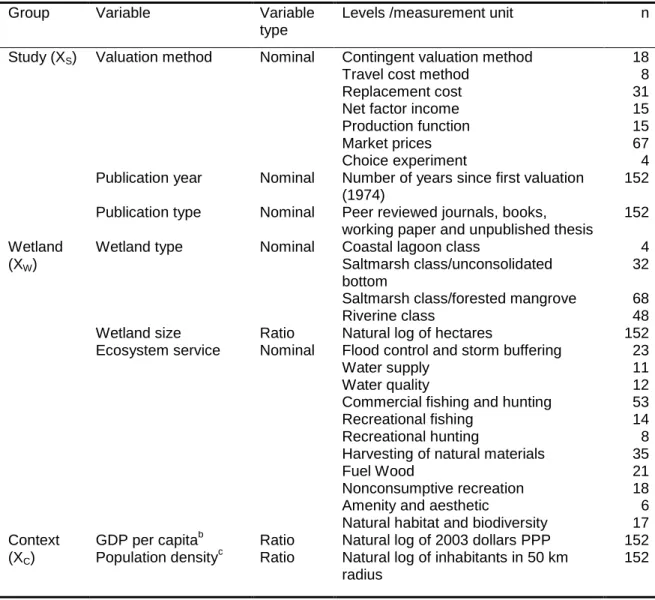
The annual flow value for a unit of a given wetland type was calculated by adding the individual, non-replaceable ecosystem service values (2003 USD per ha per year) associated with that type of cover and multiplying by the area (ha ). Flow estimates were then mapped across the southern coast of Sinaloa, showing the value of the annual flow of services provided by each wetland type. Most reports on ecosystem service valuation for the specific wetlands included in this study come from Asia (71), North America (24) and Europe (22), although all five continents are represented, including reports for Africa (17), South America (14) and Australia (4).
The majority of wetlands in the dataset were salt marshes/forested mangroves (68), riverine wetlands (48), and the salt marsh/unconsolidated bottom class (32), while slightly fewer observations were available for lagoons coastal (4). The value of R2 (0.51) is quite high and indicates that about half of the variation in wetland values is explained by the change in This paper applies GIS and value transfer to produce estimates of the value of ecosystem services provided by coastal wetlands, with the southern coast of Sinaloa, Mexico as a case study.
A meta-regression was performed to identify and assess the relative importance of the determinants of wetland value. Despite its limitations, we were able to create a baseline assessment of ecosystem services using the direct value transfer approach.
Effects of land use changes on the ecosystem service values
The increase is likely due to the high values of ecosystem services attributed to salt marshes/unconsolidated bottoms, the coverage of which showed a 10% increase in the study area. The data set used to determine the meta-analytic value transfer function is based on the work done by Ghermandi et al. The estimated values were then multiplied by the area of each land cover to obtain the annual value of services for each land cover.
The flux estimates in the study years (2000 and 2010) were then mapped across the southern coast of Sinaloa, showing the annual flux value of the services provided by each wetland type and the losses and gains during the study period. Changes in the area of each of the eight general LULC categories, between 2000 and 2010, are shown in Table 4.1. Although some of the observed changes in the matrix were due to interactions between natural wetlands, a significant portion (approximately 30% and 4%, respectively) was the result of change in land cover (inland non-wetland covers) and agriculture classes.
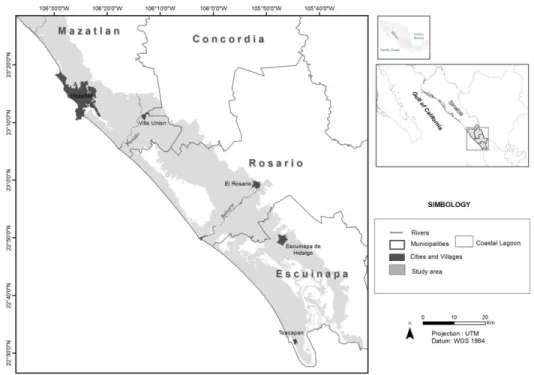
The value of R2 (0.44) is quite high and indicates that approximately half of the variation in land cover values can be explained by the variation in the explanatory variables considered. Using the results of the meta-regression estimation, we applied a meta-analytic value transfer function to estimate an annual value per hectare for each land cover type. For the 2000 map, the highest ESV appears to be concentrated in the central part of the study area (municipality of El Rosario), and the lowest ESV appears to be concentrated in the southern edge of the study area (municipality of Escuinapa).
Furthermore, the resulting losses in the ESV between 2000 and 2010 appear to be concentrated in the central part of the study area, and the gains tend to be concentrated in the southern end. For example, Mendoza et al. 2012) assessed ESV changes in the coastal zone of the Gulf of Mexico and found that land use change (urban sprawl) results in significant loss of ES in mangroves.
Land use/land cover and ecosystem service values provided
This study analyzes land use dynamics and temporal patterns of ecosystem service value in the southern coastal zone of Sinaloa. 78 ecosystems and their functions, there is consequently a decrease in the provision of ecosystem services to local communities (Martinez et al., 2007). Furthermore, a cross-tabulation detection matrix was produced, which showed quantitative data for the overall LULC changes between 2000 and 2010 in the study area.
Agriculture, salt marsh unconsolidated bottom, and coastal lagoon were the covers that contributed the most to landscape transformation over the two study years. Land use and land cover classification of the southern coast of Sinaloa from Landsat TM imagery from 2000 and 2010. Although some of the observed changes in the matrix were due to interactions between natural wetlands, a significant proportion was due to land cover change (interior covers without wetlands), ponds and agricultural classes.
Values contained in the cross-tabulation detection matrix for the period are shown in Table 5.2. Coastal lagoon and salt marsh/unbound bottom categories showed an increase in the period 2000-2010, while other categories (coastal, salt marsh/forested mangrove and agriculture) showed a decrease. The increase in total ESV during the study period is presumably a result of the highest value globally assigned to saltmarsh/unconsolidated bottom cover, which showed an 8% (on average) increase in area.
The total value stream of ecosystem services for each wetland category was estimated based on land cover alone, which is derived from a projection derived from Markov chains. This positive trend in total ESV flow contrasts with trends found in other studies.
Discusión general 92
Los economistas ambientales han desarrollado una verdadera taxonomía de valores sobre la naturaleza de los servicios ecosistémicos integrados en el valor económico total (VET). Los estudios de valoración primaria siempre serán la mejor opción para recopilar información sobre el valor de los servicios ecosistémicos. Con base en los argumentos anteriores, este estudio optó por utilizar un esquema de valor de transferencia para generar estimaciones de referencia de los servicios ecosistémicos proporcionados por los humedales costeros de la región.
97 significativo, con un efecto positivo sobre los valores de los humedales, en contraste con el método de la función de producción, que tiene un efecto negativo sobre los valores. La variable PIB per cápita muestra una relación positiva con el valor de los humedales, lo que indica que los ingresos tienen un efecto importante sobre el valor de los servicios ecosistémicos. Análisis de patrones de cobertura/uso del suelo y valores de servicios ecosistémicos.
En este sentido, estimar variaciones en los valores de los servicios ecosistémicos como consecuencia de cambios de uso del suelo. Según esta tendencia general, las áreas que experimentan cambios en la cubierta de manglares pueden ser más vulnerables y los cambios futuros en el uso de la tierra en la región pueden tener impactos significativos en el valor de los servicios ecosistémicos de estos tipos de humedales. Sin embargo, la tasa de este cambio en el valor de los servicios ecosistémicos disminuye con el tiempo.
Si estas tendencias continúan, indica una posible estabilidad en el valor de los servicios ecosistémicos proporcionados por los humedales en los próximos años. La disminución en el valor de los servicios ecosistémicos del ecotopo de pantano/humedal-bosque arbustivo (manglar) fue el cambio más importante durante el período de estudio.
Conclusiones 103
Markov analysis of land use change: an application of stochastic processes to remotely sensed data. Brander, L.M., Florax, R.J.G.M., Vermaat, J.E., 2006., The empirics of wetland valuation: a comprehensive summary and meta-analysis of the literature. An assessment of the non-market value of the ecosystem services provided by the Catalan coastal zone, Spain.
Challenges in integrating the concept of ecosystem services and values into landscape planning, management and decision-making. Valuing ecosystem and economic services under different land-use scenarios in the Prairie Pothole region of the Dakotas, USA. How ratios of fundamental plant functional traits scale to trade-offs and synergies in ecosystem services.
Quantifying the Impact of Land Use Changes on Ecosystem Services: A Case Study in Pingbian County, China. Land use change and its effects on the value of ecosystem services along the Gulf of Mexico coast. Application of GIS and remote sensing techniques in the generation of land use scenarios for hydrological modelling.
Effects of land use changes on ecosystem service values of coastal wetlands. aceptada con correcciones mayores en Environmental Management). Analysis of land use and ecosystem service values varies along the northern coast of Mexico.