Suggested citation: EFSA AHAW Panel (EFSA Panel on Animal Health and Animal Welfare), 2015. Scientific Opinion on welfare aspects of the use of perches for poultry. EFSA Journal 2015;13(6):4131, 69 pp. doi:10.2903/j.efsa.2015.4131 Available online: www.efsa.europa.eu/efsajournal
SCIENTIFIC OPINION
Scientific Opinion on welfare aspects of the use of perches for laying hens
1EFSA Panel on Animal Health and Animal Welfare (AHAW)2,3 European Food Safety Authority (EFSA), Parma, Italy
ABSTRACT
This opinion investigated the use of perches for laying hens in cage and non-cage systems. It is based on various activities reviewing the effects of perch height and design on hen health and welfare. Systematic and extensive literature reviews were conducted to assess the scientific evidence about hen motivation to grasp and seek elevation, and the appropriate height of perches as well as other features (position, material, colour, temperature, shape, width and length). In addition, an expert knowledge elicitation (EKE) exercise was run with technical hearing experts to discuss and prioritise the various design aspects of perches. Overall, the body of literature on perches is limited. Relevant features of perches are often confounded with others. In the literature, the most commonly used animal-based measures to assess perch adequacy are keel bone damages, foot pad lesions and perch use by hens. Overall, hens seek elevation during the day as well as during the night, when they select a site for roosting. Elevated perches allow hens to monitor the environment, to escape from other hens, avoid disturbances and improve thermoregulation. For night-time roosting hens show a preference for perches higher than 60cm compared with lower perches. However, elevated perches can have negative consequences with increased prevalence of keel deformities and fractures. The risk of injury increases when hens have to jump a distance of more than 80cm vertically, horizontally or diagonally to reach or leave a perch, or jump an angle between 45 and 90° (measured at the horizontal plane). Material, shape, length and width of the perch also influence perch preference by hens. The EKE exercise suggests that an adequate perch is elevated, accessible and functional (providing sufficient overview). The opinion concludes that for the design of an adequate perch, different features of perches need to be further investigated and integrated.
© European Food Safety Authority, 2015
KEY WORDS
laying hens, perches, height, behaviour, welfare, cage systems, aviary systems
1 On request from the European Commission, Question No EFSA-Q-2014-00242, adopted on 6 May 2015.
2 Panel members: Charlotte Berg, Anette Bøtner, Howard Browman, Aline De Koeijer, Klaus Depner, Mariano Domingo, Sandra Edwards, Christine Fourichon, Frank Koenen, Simon More, Mohan Raj, Liisa Sihvonen, Hans Spoolder, Jan Arend Stegeman, Hans-Hermann Thulke, Ivar Vågsholm, Antonio Velarde, Preben Willeberg and Christian Ducrot.
Correspondence: [email protected]
3 Acknowledgement: The Panel wishes to thank the members of the Working Group on welfare aspects of perches for poultry: Inma Estevez, Virginie Michel, Christine Nicol, Lars Schrader, Hans Spoolder and Hans-Hermann Thulke, for the preparatory work on this scientific opinion, and the hearing experts: José Luis Puerta Villegas, Patrick Guillou, Andrew Joret, Knut Niebuhr, Linda Keeling, Valentina Ferrante, Rob Boomstra and Giuliano Maltoni, and EFSA staff: Denise Candiani, Olaf Mosbach-Schulz and Gabriele Zancanaro, for the support provided to this scientific opinion.
TABLE OF CONTENTS
Abstract ... 1
Introduction ... 3
1.1. Background and Terms of Reference as provided by the European Commission ... 3
1.2. Interpretation of the Terms of Reference ... 3
1.3. Additional information ... 4
1.3.1. Definition of a perch ... 4
1.3.2. What does ‘adequate’ mean? ... 5
1.3.3. Description and effects of perches in different housing systems ... 5
1.3.4. Management aspects that affect perch use ... 10
2. Data and methodologies ... 12
2.1. Identification of the degree to which a minimum and a maximum height and the position of the perch are important factors for hens’ welfare (ToR1) ... 13
2.2. Identification of perch design criteria that best satisfy hens’ behavioural needs without impacting negatively on their health (ToR2) ... 13
2.3. Identification of minimum and maximum height and most suitable design of perches (ToR3a) ... 14
2.3.1. Exercise 1: scenarios about perch height and position ... 14
2.3.2. Exercise 2: scenarios about perch design features ... 17
2.4. Identification of perch design criteria and animal-based welfare measures to be used to assess perch adequacy (ToR3b) ... 19
3. Assessment ... 20
3.1. Welfare consequences and animal-based measures related to the presence and adequacy of perches ... 20
3.2. Results about the degree to which a minimum and a maximum height and the position of the perch are important factors for hens’ welfare (ToR1) ... 20
3.2.1. Perching behaviour and motivation related to grasping and seeking elevation ... 20
3.3. Results about perch design criteria that best satisfy the hens’ behavioural needs without impacting negatively on their health (ToR2) ... 24
3.3.1. Perch temperature ... 24
3.3.2. The effect of dry versus wet perches and dirty perches ... 25
3.3.3. Material ... 26
3.3.4. Colour ... 29
3.3.5. Shape ... 29
3.3.6. Width ... 30
3.3.7. Length ... 31
3.4. Results about the minimum and maximum height and most suitable design of perches (ToR3a) ... 32
3.4.1. Height ... 32
3.4.2. Position ... 36
3.4.3. Outcomes from the expert knowledge elicitation process ... 40
3.5. Results about perch design criteria and animal-based welfare measures to be used to assess perch adequacy (ToR3b) ... 51
Conclusions and recommendations ... 52
References ... 57
Appendices ... 63
Appendix A. Links between features of the perches and welfare consequences. ... 63 Appendix B. Animal-based measures (ABM) that can be used to verify the adequacy of perches 65
INTRODUCTION
1.1. Background and Terms of Reference as provided by the European Commission
Council Directive 1999/74/EC about laying hens requires that all birds are provided with adequate or appropriate perches irrespective of housing system. This requirement was adopted on the basis of scientific knowledge indicating that roosting was a high behavioural priority of the birds.
The 1996 Report of the Scientific Veterinary Committee highlighted in point 3.1.6 that ‘the height of a perch is an important factor as perch only 5 cm high is not considered as a perch and has no attractive nor repulsive value in floor pens’, while the EFSA opinion stated that ‘roosting at night on an elevated perch is a behavioural priority’ and that ‘perches should be raised above the level of the ground’.
In short, scientific assessment appears to suggest that poles intended to serve as resting places need to be elevated to be ‘adequate’ in the sense of the objective of Council Directive 1999/74/EC.
The majority of the Member States have ensured that birds are provided with perches which are elevated. However, some discussion has arisen as to which height and design of perches may be considered appropriate from the perspective of the birds’ behavioural needs. Likewise some allege that there may be negative welfare implications (e.g. injury or increased occurrence of bone fractures) due to either the height or the design of the perch. To ensure a uniform implementation across the Union it is necessary to review available scientific knowledge in this area so as to properly elaborate what we believe is an adequate perch, also from a legal perspective.
Therefore, it would be opportune to identify the height and design of perches which according to scientific knowledge may be considered to satisfy the birds’ needs without impairing their welfare and health.
The Commission requests EFSA to review the scientific data available on this issue and any developments which have ensued since the previous opinion was published and on this basis to assess which perch height and design would best satisfy the legal requirement and could be considered adequate from a welfare point of view both in enriched cage and alternative systems.
EFSA is therefore requested to:
1) Identify to which degree a minimum and maximum height and the position of the perch are important factors for the birds’ welfare.
2) Identify the design criteria of the perch, such as material, shape, length, which may influence the birds’ welfare and to assess which design is best suited to satisfy the birds’ behavioural needs without impacting negatively on their health.
3) Propose the minimum and maximum height and most suitable design of the perch according to the above data which may be considered appropriate or adequate. If these data do not enable an assessment of the exact minimum and maximum height or range of heights which are appropriate from a welfare point of view, indicate a set of design criteria of the perch and animal-based welfare measures which may be used to assess whether a perch is adequate.
The assessment should be based on and linked to the previous EFSA scientific opinion on the welfare of laying hens.
1.2. Interpretation of the Terms of Reference
The mandate focuses on defining perch characteristics related to design and height to best satisfy the birds’ behavioural needs without impacting negatively on their health. Although the question itself
seems relatively straightforward, answering it relies heavily on the interpretation of what is meant by perch adequacy.
The opinion therefore starts by considering the different meanings of the term ‘perch’, the underlying behavioural motivations of hens to use perches and the possible consequences for bird health. From this, it can be deduced which welfare consequences and which animal-based welfare measures are relevant when designing perches (e.g. frequency of use, and level of keel bone damage). How the various design parameters (e.g. height, shape, length, etc) affect the welfare consequences can be determined through research, and the available knowledge is summarised in this opinion.
However, to compare the impact of perch design across different welfare consequences, the relative importance of these consequences needs to be weighted. Furthermore, to decide when their level can be considered acceptable, thresholds of acceptability have to be agreed upon. Neither weightings across different parameters, nor thresholds of acceptability of single measures can be scientifically determined, because they involve ethical, political and financial considerations. To illustrate this, an example from another area of welfare science may be useful. It is well known that group housing of sows leads to an increase in aggression between the animals, compared to individual housing. A decision on whether group housing or individual housing is the most adequate way to keep sows depends to a large extent on the relative weighting assigned to behavioural freedom (in group housing), versus protection from injurious behaviours (in individual housing) (e.g. Fraser, 2003;
Spoolder et al., 2003). Cut-off values or thresholds are required when welfare consequences do not show a clear peak (or trough) in response to a gradual change in design parameters. Clear examples can be found when developing legislation or certification systems for animal friendly products: what constitutes an acceptable level of ‘dead on arrivals (DOA’s) following long distance transportation is a matter of opinion, rather than science (Spoolder et al., 2014).
Secondly, although the mandate asks for use of perches in birds, following clarification with the EC and given that Directive 1999/74/EC refers to laying hens only, we interpreted this scientific opinion to apply to laying hens.
Furthermore, it is important to consider that perch design and height affect other aspects of laying hen husbandry, in addition to animal welfare and health. Several practical aspects, e.g. egg safety, cleanliness, costs, worker safety, labour requirements should also be taken into account when identifying the adequacy of perches for implementation in current practice. This opinion does not address these additional issues.
Finally, this opinion also considers that even though the mandate requests the most adequate design of perches, there may very well be more than one design (or combination of design aspects) which result in an adequate solution in terms of animal health and welfare. In addition, a combination of heights might be better suited to meet the requirements of hens that may differ in health condition or jumping ability.
1.3. Additional information 1.3.1. Definition of a perch
Directive 1999/74/EC requires that perches are provided to meet the roosting needs of laying hens.
However, an etymological search shows that ‘perching’ has at least three nuanced meanings, all of which are relevant to the scientific consideration of an adequate perch for laying hens.
First, birds can be said to perch on structures (rods, poles, branches) that they can grasp with their feet.
Second, birds can be said to perch on the edge of structures from which they have a vantage point and can survey their surroundings.
Third, birds can be said to perch on structures which are elevated.
This Scientific Opinion will use these meanings as a starting point for further elaboration on the adequacy of perches to provide good welfare.
1.3.2. What does ‘adequate’ mean?
If and to what degree perches can be regarded as ‘adequate’ depends on their properties and on the arrangement of the perches within the laying house. These factors are the height of the perches, their material and shape (cross section), their width and diameter, the length of the perch per hen, the colour of the perches and their spatial arrangement in relation to other perches and to other furniture within the laying houses. These different characteristics affect whether perches meet hens’ behavioural priorities as described below. Drawing conclusions on adequate perch material, shape and diameter is difficult because, in most studies (see Chapter 3.3), these different features of perches (e.g. material, shape and diameter) were often confounded.
Although there are some indicators of adequate height, an important aspect of height has not yet been tested, making interpretation of the few results that do exist difficult. How hens perceive height is unknown. In multi-tier systems, it may be possible that a perch at the edge of an upper tier is perceived as being higher than a perch in the middle of the same tier if the distance to the floor just below the perch is the only important factor for the hens. The same might apply for perches at the edge and the middle of a furnished cage. In most experimental studies on perch height, the height is measured from the floor of the stable, but this might be confounded with the distance to the roof. Unless information is gained about the perception of height by hens, it is difficult to make practical suggestions for measuring height.
In addition to finding out if perch properties and their height will meet birds’ behavioural priorities, looking at how perches affect aspects of their health is also important. In particular, the health of the keel bone and of the feet and the risk of vent pecking can be affected by both the properties and the height of perches.
The keel bones of laying hens are extremely vulnerable to damage because of their prominent and unprotected anatomical position; this is the result of the fact that layer hens that are intensively selected for high egg yield do not have large breast muscles. Keel bone deformities are observed in pullets and young laying hens, but, as hens get older, the risk of fracture increases because of bone strength deterioration. Fractures often heal rapidly (Richards et al., 2011), but there is evidence of residual pain (Nasr et al., 2012). This will further be addressed in the following chapters.
1.3.3. Description and effects of perches in different housing systems
A wide variety of systems, ranging from enriched/colony cages to mobile systems, are used in commercial egg production across European Union (EU) countries. Despite variability in design, space availability and access (or not) to outdoor space, they have common features, as they have to meet the minimum requirements as established by the directive for the protection of laying hens (1999/74/EC), such as access to a nest box, a dust bathing area and perches.
For enriched/colony cages, current legislation requires a minimum of 15 cm of perch space per hen.
Additional requirements for non-cage housing systems include perches not being mounted above the litter, a horizontal distance between perches of at least 30 cm and a horizontal distance between the perch and the wall of at least 20 cm. However, the directive does not state a minimum perch height requirement and does not specify perch shape or diameter, allowing variability in the interpretation of these aspects across countries (see, for example, Defra, 2013). In some countries, specific governmental assessment guidelines clarify the minimum characteristics for a structure to be considered a perch (e.g. Assessment guidelines for the interpretation of Real Decreto 3/2002, Spain).
The EFSA report on the welfare aspects of housing systems for laying hens specifies that perches should be raised above the level of the floor and that perch material, design and position should also be considered (EFSA, 2005). The provision of inadequate perches may compromise perch use, limit
mobility or cause health issues and/or other behavioural problems (Tauson and Abrahamsson, 1994).
Of greatest concern is that perch provision has been associated with a higher incidence of keel bone damage, although other aspects of housing design may also be important.
Housing design has a substantial effect on the risk of damage, with the lowest prevalence of keel damage reported in conventional cages (17.7 %, Sherwin et al., 2010), intermediate levels of keel damage reported in furnished cages (62 %, Rodenburg et al., 2008; 31.7 %, Sherwin et al., 2010;
36 %, Wilkins et al., 2011), greater levels of keel damage reported in single-tier non-cage systems (50–78 %, Wilkins et al., 2004; 60 %, Nicol et al., 2006; 82 %, Rodenburg et al., 2008; 59–67 %, Wilkins et al., 2011) and the highest level of fractures in systems with the greatest combined available heights suitable for perching (97 %, Rodenburg et al., 2008; 86 %, Wilkins et al., 2011). Solving the problem of keel bone damage will require a multi-disciplinary approach, including the input of geneticists, but good perch design could play an important role in reducing the risks associated with sustained or sudden impact with solid structures.
1.3.3.1. Enriched cages/colony cages
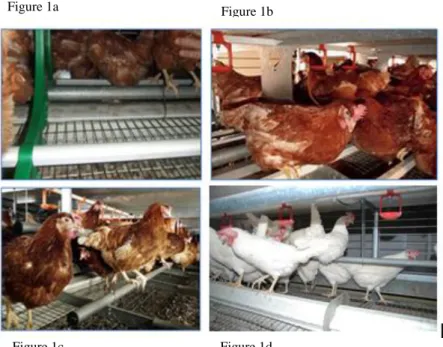
Since the introduction of Directive 1999/74/EC, enriched cage designs have greatly evolved. Current available models are quite homogeneous regarding location of the enrichments compared with initial furnished cage designs. The most recently designed commercially available enriched cages are provided with square or mushroom-type plastic perches with polished edges or rounded steel perches (Figure 1) , usually placed in two or more parallel rows along the length of both sides of the cage, depending on the size of the cage. This set up for the perches is widespread in the latest models, but designs with perches located perpendicular to the front of the cage or in a T-shape arrangement are still currently available. In larger cage units, additional perch space may be provided over the line of drinkers and/or over the feeder if supplementary feeding space must be provided to fulfil the feeding space requirements. Some manufacturers have designed dual-function perches, where the perching requirements are met by structural cage elements, feeders, drinkers or ventilation tubes.
Figure 1: Examples of plastic (a and b) and metal perches (c) in enriched cages (photos: I. Estevez, Big Dutchman). (d) Plastic ventilation tube used as perch (in the front) and an elevated perch in a colony cage (photo: FLI)
Figure 1a Figure 1b
Figure 1c Figure 1d
Legislation requires the height of an enriched cage to be no less than 45-cm high in the lowest part, and this is a limiting factor for the maximum height at which perches can be placed while still providing sufficient head space for the hens to perch comfortably. It has been shown experimentally that a reduction of cage height from 55 to 45 cm affects perch preferences, forcing hens to use lower perches and reducing perch use (Struelens et al., 2008b). Therefore, having less than 20 cm between the highest perch and the ceiling could restrict access to the highest perch. Larger enriched cages, or colony systems used in Germany and the Netherlands that are no less than 60-cm high in the lowest side, allow for higher perch placement.
When considering perch height, it is also important that a minimum height is assured to prevent foot trapping between the perch and the floor. In addition, perch height should allow eggs to pass under the perches. Generally, no specifications on perch characteristics (height, shape or diameter of the perches) are included in manufacturers’ brochures, other than perch availability per hen (15 cm).
Occasionally, perch materials are described when designed to prevent mite infestations (e.g. close-end plastic perches or specially designed non-porous polyvinyl chloride (PVC) solid perches).
Group sizes in enriched cages can vary greatly from 6 to over 100–120 hens in large colony cage systems. In Northern European countries, groups of 8 to 10 hens are most commonly used, while groups of 40 to 80 hens are used in many other EU countries. Large cage units can be adapted to smaller groups, if necessary, by partitioning the cage with a central panel, with perch access divided equally between both sections. Not much scientific information is available regarding the effect of group size on the use of the perches in enriched cages.
To meet all of the requirements, space availability and height in an enriched cage system may be quite restrictive. Normal hen movement between nesting and dust bathing areas, or feeders and drinkers, may cause disruption of perching. In addition, perches have to be passed by moving hens and may constitute obstacles. Disruption of perching may be related to the number of hens in the cage. On the other hand, space in larger groups at constant density appears to be more efficiently used, providing hens with greater mobility. Perch height is necessarily restricted by the dimension of the enriched cage, which in some cases may not be ideal for maximising perch use.
1.3.3.2. Single-tier systems
Single-tier systems are often used in conjunction with access to free-range, quality labelling or organic production programmes. In single-tier systems, a wide variety of perch positions, structures and materials are used. Perches are commonly placed over the slatted area in an A-frame (Figure 2a), square (Figure 2b) or vertical structure (Figure 2c) with multiple levels, although perches can be positioned in other places, such as close to the nest boxes (Figure 2d). Depending on the size of the flock, supplementary perching spaces are provided, usually at the edge of the slatted area. Rounded steel (about 3 cm in diameter) and square or rectangular wooden perches are the most commonly used materials in single-tier systems, but other combinations such as rectangular metal perches are also used.
Although few studies are available, perch use for single-tier systems is high, especially at night where up to 90 % were observed roosting in the top-level perch (Abrahamsson and Tauson, 1995; Oden et al., 2002). Although no scientific evidence is available, field experience suggests that there are major known differences between flocks in the frequency of perch use. The reasons for this are unknown, but management and the opportunity to experience the third dimension during rearing could help to reduce variability in perch use.
Figure 2: Wooden and steel perches mounted on (a) A-frame structure (photo: V. Michel), (b) square structure (photo: I. Estevez) or (c) vertical structure over the slatted area (photo:
L. Wilkins). (d) In some countries, single-tier systems are not provided with additional perches (photo:
J. McKinstry)
Suitable locations to place perches are quite limited, as perches should not be placed above the litter, drinker or feeding areas for sanitary reasons. If perches are placed too high in the house, depending on the house structure and ventilation, use of perches at the top levels might be reduced owing to wind currents. It is also possible that weak, injured hens or hens with poor jumping ability may be less able or may be reluctant to use high perches. In addition, the risk of vent pecking was increased in single- tier systems when perches were placed at more than 50 cm above the slats, compared with less than 50 cm or no perches (Lambton et al., 2015). The lack of guidance on the combination of proper location, height and angle of the perches may result in more accidents.
1.3.3.3. Multi-tiered systems
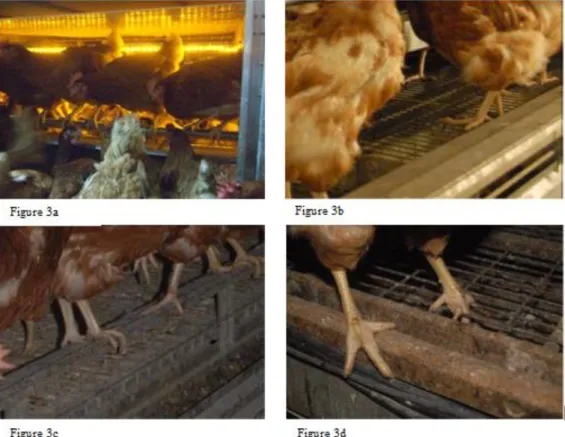
Multi-tiered systems are the most intensive of the non-cage housing systems: they have the highest number of hens in comparison to the available ground surface. Available designs can be quite complex, as feed, water and nest boxes are provided at different levels and arrangements can be different. There are multiple options for the arrangement of these elements. Perches used in multi- tiered systems are mainly steel round perches (approximately 3 cm in diameter) but other shapes and materials can also be used (Figure 3). Because the system is normally compartmentalised in units, perches are placed over the slats on the sides of each unit, and over the top floor, which is mainly a large perching area. However, perches are also placed over feeders and drinkers. Some systems provide aerial perches that are connected sideways to the sides of the units.
Figure 2a Figure 2b
Figure 2c Figure 2d
Figure 3: (a) Round steel perches mounted over a feeder line (photo: I. Estevez), (b, c) steel profiles of different shapes at the edges of tiers (photos: FLI) and (d) wooden perches in a multi-tier system (photo: FLI)
As these systems are designed to house high hen densities, frequent disturbances among hens may imply reduced quality perching, at least during the daytime owing to hen activity.
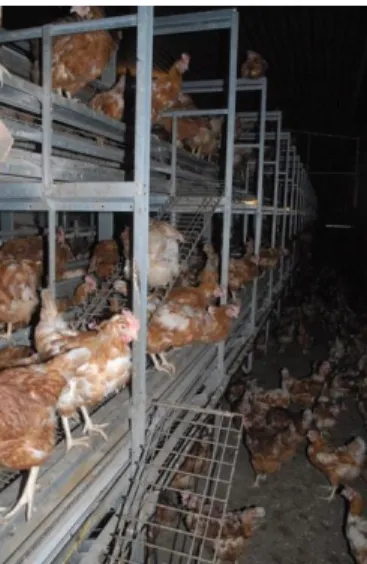
There are constraints on the possible height of the perches in the interior of the unit, especially regarding the ones over drinkers and feeders. Like single-tier systems, there could be differences in perch use among flocks depending on previous experience in the use of the third dimension. Provision of ramps to facilitate hen movement between tiers is also relatively common in multi-tiered systems (Figure 4). Early experience in a three-dimensional space may facilitate the transition from rearing to the production environment as a result of perch usage and possibly as a result of bone strength.
Figure 4: Ramps to facilitate transit in multi-tier systems (photo: FLI) 1.3.3.4. Mobile systems
Mobile systems are small production units which can be moved or regularly rotated on a pasture as needed, depending on the production scheme. Generally, such systems are used almost exclusively for organic egg production. The ability to move the shed produces a more equal distribution of dung across the pasture, reducing pollution and facilitating soil regeneration.
The housing conditions provided in mobile systems are very variable (Wilkins et al., 2011). They can range from commercially available systems for up to 2 000 hens (Big Dutchman, Liberty Livestock Systems, McGregor) to smaller home-made sheds. The commercially available mobile systems are equipped with one or two floors of slatted areas with multi-tier or single-tier equipment and perches mounted over the slats (Figure 5a) or on the sides in the form of aerial perches (Figure 5b). In all situations, perch availability will be the same. However, in general, there is a wide variety of materials, heights, shapes and locations of the perches in mobile systems, ranging from metal perches protected by rubber to wooden perches of different dimensions.
Figure 5: Commercially available mobile system with perches mounted (a) over the slatted floor (photo: McGregor) and (b) aerial perches in white (photo: Big Dutchman)
1.3.4. Management aspects that affect perch use
In addition to perch characteristics, the management of pullets and laying hens will have an impact on perching ability and motivation. The main management aspects known to have an impact are hen rearing, laying hen stocking density and lighting programmes.
Figure 5a Figure 5b
1.3.4.1. Impact of rearing management
The effect of rearing with and without perches on the perch use of laying hens has been investigated by different authors. Hens reared without perches have difficulty using perches owing to low muscle strength, a lack of motor skills and the inability to keep balance, or they have impaired spatial skills, which are necessary for moving around in three-dimensional space. These background factors are not mutually exclusive. Gunnarsson et al. (2000) showed that absence of early access to perches (1–8 weeks of age) does not impair the ability of adult hens to reach food 40 cm above the ground, but such hens have increasing difficulty as the height increases (up to 160 cm above ground), and in some cases could not even reach the food. Giving access to perches during rearing can enhance the capacities of hens to use perches during the laying period. Some authors concluded that there seems to be an association between an early start to perch use and later use of perches by laying hens for real night- time roosting (Heikkilä et al., 2006). Roll et al. (2008) showed that floor-reared hens spend more time perching in laying furnished cages than cage-reared hens (7.5 % versus 13.4 %). In this case, rearing condition has an impact on perch use, even if no perch has been provided during rearing.
Providing perches to pullets compared with providing no perches had long-term benefits, as gross and relative thigh and total leg muscle deposition of laying hens were increased. Muscle growth during development is probably stimulated by physical activity, such as jumping on and off perches during light hours (Hester et al., 2013). The increase of keel bone mineralisation resulting from perch access during rearing and laying was not sufficient to prevent a higher incidence of keel bone fractures, caused by perch usage, at the end of lay (Hester et al., 2013).
1.3.4.2. Stocking density and group size
Stocking density can have an influence on perch use in broiler chickens (Hongchao et al., 2014: 1-day- to 5-week-old chickens) and laying hens (Chen and Bao, 2012). Guo et al. (2012) showed that bigger group size (48 versus 21 hens, with small differences in stocking density, i.e. 543 versus 586 cm2/hen) can stimulate perching. In some papers, stocking density and group size effect are confounded (Chen et al., 2012, 2014; Hongchao et al., 2014), and thus no conclusions can be drawn on the main influencing factor. This is the case in the work of Chen et al. (2012), who showed that, in the same pen, groups of four hens were perching more than groups of one or eight hens. In the same way, Hongchao et al. (2014) demonstrated that there was more perching among chickens in groups of 64 chickens (16 hens/m2) than for smaller (48 chickens, 12 chickens/m2) and higher (80 chickens, 20 chickens/m2) groups/stocking densities.
Some social - group size or stocking density- dependent factors, such as stimulation, social facilitation (Pettit-Rilez and Estevez, 2001) and competition (Newberry et al., 2001), may also have an effect on perch use.
Pettit-Riley and Estevez (2001) suggested that social facilitation, related to the larger number of hens, was probably the explanation; this is similar to the findings that bigger groups size can stimulate perching (Guo et al., 2012). On the other hand, in a study in which density was controlled for, Newberry et al. (2001) found lower perching in larger groups (120 hens) than in groups smaller (15 hens) during the daytime. These results were explained as an anti-predator response.
1.3.4.3. Lighting
Commercial housing systems for laying hens are often kept at low light intensity to reduce the incidence of feather pecking. This low light intensity may restrict the ability of hens to visually perceive environmental features such as perches. By affecting the visibility of perches, lighting management can have an impact on perch use and can impair take-off and landing from perches and increase the risk of injury to hens. On one hand, the results of Taylor et al. (2003) (who compared light intensity from 0.8 to 40 lx) suggest that very low light intensity conditions could restrict the movement of hens and their access to perches in non-cage systems. As an example, the latency to jump and the number of vocalisations were significantly higher at lower light intensity when hens have to jump
from one perch to another. On the other hand, Moinard et al. (2004) did not show any effect of lighting conditions (5, 10 or 20 lx; incandescent or high- or low-frequency fluorescence) on hens’ ability to jump to and from perches in different light environments. These differences can be explained by the fact that lower light intensity in the Moinard et al. study (5 lx) was higher than the low light intensity of Taylor et al. (2003) (0.8 lx).
Gunnarsson (2013) investigated if environmental enrichment (e.g. CDs, plastic bottles) and light characteristics enhanced perching behaviour at an early age and consequently protected against behavioural problems. No significant effect of enrichment was found on the latency to start perching, but pullets given access to enrichment on the floor had a tendency to roost earlier. Exposure to daylight has a tendency to promote perching early in life.
As roosting is triggered by a reduction in light and because hens need some time to find a resting place, a period of dim light before lights are turned off at night is recommended. A phase of gradually dimmed light will allow the hens to orientate while searching for a resting place and will reduce the risk of failed landings while entering perches during dusk in particular in non-cage systems.
1.3.4.4. Relationships between breed and perch use
Hens of all breeds that have been studied so far will perch at night and, to a lesser extent, will also perch during the daytime. However, there are some indications of differences in perch usage between breeds. For example, in an experimental study, White Leghorn hens showed higher perch usage than Rhode Island Red × Light Sussex hens, and Brown Leghorn hens showed the least perch usage (Faure and Jones, 1982b). In get-away cages, Shaver hens used a low perch more often than Lohmann Selected Leghorn hens, although usage of a higher perch did not differ between breeds (Tauson and Abrahamsson, 1994). In furnished cages, Lohmann Selected Leghorn hens used perches more than Lohmann Brown hens at night, and Hy-Line Brown hens showed a tendency for a higher usage of perches than Hy-Line White hens (Wall and Tauson, 2007). However, Cook et al. (2011) did not find any differences in perch usage when they compared Lohmann Brown hens with White Leghorn hens kept in enriched cages.
One possible explanation for differences in the usage of perches may be differences in body weight and, consequently, differences in wing load. These factors seem to affect the control of jumps and flights from perches and hens of heavier breeds showed more difficulties controlling jumps and/or flights from perches (Moinard et al., 2004) or landings on perches (Scholz et al., 2014). These differences may also result in different perch usages. However, different breeds may also have different motivations to perch.
In another study, the effect of domestication was investigated (Eklund and Jensen, 2011). Daytime perching of junglefowl and White Leghorn chickens has been compared, but not night time roosting.
Junglefowl performed more frequent and more synchronous daytime perching. Single sex and single strain groups of three hens were provided with a 100-cm perch at a height of 45 cm within a test arena.
Hens were allowed 24 hours to habituate and then their behaviour was recorded for a further 24 hours, but data from only the 12-hour light period was extracted. Synchrony was assessed by recording the average frequency within each time window when two or three of the hens were exhibiting the same behaviour. Red Junglefowl perched more than chickens during the day, and males perched more than females. Red Junglefowl also perched significantly closer together than chickens, again suggesting a possible relaxation of protective behaviour in domestic chickens. The need for daytime vigilance may have decreased during domestication but it certainly has not been eliminated.
2. Data and methodologies
The terms of reference (ToRs) were addressed on the basis of the outcomes of six main activities:
1. A literature review about the motivation of hens to perch and to stay at an elevated area (ToR1).
2. The development of an overview table linking the risk factors (i.e. the aspects of the perch) and the welfare consequences for the hens based on the Working Group (WG) expert opinion (ToR2 and ToR3).
3. A scoping review to investigate the available data on different aspects of perches in relation to the welfare consequences for the hens (ToR2).
4. A qualitative literature review addressed the different housing systems that hens are kept in, and the diversity of the aspects involved when addressing perch use (ToR2).
5. A systematic literature review on a limited number of aspects related to perches, followed by semi-quantitative analyses of these data (ToR2 and ToR3).
6. An expert knowledge elicitation process to determine appropriate levels of various aspects of perches (ToR2 and ToR3).
2.1. Identification of the degree to which a minimum and a maximum height and the position of the perch are important factors for hens’ welfare (ToR1)
ToR1: Identify to what degree a minimum and maximum height and the position of the perch are important factors for the birds’ welfare.
ToR 1 was primarily addressed through an extensive literature review (activity 1 of Section 2) conducted by the WG members to investigate the motivation and ability of hens to perch related to height and position.
In addition, ToR1 was addressed in the technical meeting with hearing experts (activity 6), in which one of the scenarios presented to the hearing experts (see ‘Technical meeting with hearing experts’
under Section 2.3) was about hens provided with perches of different heights (from 0 to 200 cm), investigating what experts believe about hens’ motivation to perch.
2.2. Identification of perch design criteria that best satisfy hens’ behavioural needs without impacting negatively on their health (ToR2)
ToR 2: Identify the design criteria of the perch, such as material, shape and length, which may influence the hens’ welfare and assess which design is best suited to satisfy the hens’ behavioural needs without impacting negatively on their health.
ToR 2 was addressed by the WG experts, first, by listing risk factors (perch design aspects) in relation to health and welfare consequences (activity 2 of Section 2). The factors and consequences identified by the WG experts provided key words for a subsequent scoping review (activity 3 of Section 2), which was followed by extensive literature searches (activity 4 of Section 2) and by a systematic literature review (activity 5 of Section 2). The scoping review consisted of an analysis of the scientific literature on perches in laying hens. Its aim was to identify relevant studies for each perch characteristic, as well as relevant outcomes that describe animal-based welfare outcomes in relation to perch presence and features.
The two most commonly mentioned animal-based welfare outcomes identified by the scoping review were: (1) the level of use of the perches (day and night) and (2) the level of keel bone damage (including fractures and deformities). These were then used in a systematic literature review – carried out by an external contractor (O’Connor et al., in press) – that focused on the height of the perch in relation to the two animal-based outcomes. The systematic literature review aimed at providing a quantitative description of this relationship.
Aspects related to the position and other features of the perches were addressed through extensive literature searches on relevant studies identified in the scoping review. Such literature searches (activity 4 of Section 2) were carried out by the WG members, and their outcomes were discussed in
the WG. These literature sources were then used to describe (in a qualitative way) the outcomes of ToR 2.
2.3. Identification of minimum and maximum height and most suitable design of perches (ToR3a)
ToR 3a: Propose the minimum and maximum height and most suitable design of the perch according to the above data which may be considered appropriate or adequate.
ToR 3a was addressed through expert knowledge elicitation in a technical meeting with hearing experts (activity 6 of Section 2), as insufficient quantitative data exists. The table linking risk factors and welfare consequences, the outcomes of the systematic literature review on perch height and the analyses of the scientific papers resulting from the scoping review all provided input for the meeting with experts.
The technical meeting with hearing experts was held on 24 February 2015 in order to elicit expert knowledge following the methodology adopted by EFSA in its ‘Guidance on expert knowledge elicitation in food and feed safety risk assessment’ (EFSA, 2014). The objective of this meeting was to address questions regarding the ‘appropriateness’ of various perch characteristics in relation to their implications for animal welfare and health. Eight hearing experts were invited to participate in this meeting. They were selected on the basis of criteria set by the WG to cover practical experience with the different systems considered by the opinion (furnished cages, and single-tier and multi-tier aviary systems). Experts were also selected to cover experience of different EU countries and experience with more than one system.
The elicitation procedure required attendance at a one-day workshop—this allowed sufficient time for the experts to discuss the information provided. The experts received a briefing document, including the main findings from the literature, before the workshop. The aim of this was to bring all invited experts up to the same level of knowledge and to ask for any other scientific evidence available.
In the workshop, the elicitor introduced the participants to the process of expert knowledge elicitation.
The experts of the WG gave an outline of the EFSA mandate, an outline of the literature findings and an explanation of the parameters they were asked to elicit. The experts were then given a series of cards explaining different ‘perch scenarios’ combining several perch heights with several perch features. Different scenarios were formulated for each of the two exercises that were carried out:
Exercise 1: scenarios focusing on the height of the perches (in single-tier non-cage systems) Exercise 2: scenarios focusing on other perch features (in both cage and non-cage systems)
For both exercises, the experts were first asked to rank the scenarios individually. The ranking was based on the judgement of (1) the preference of the hens to use the perch at night and (2) the expected rate of keel bone deformities (including damage and fractures).
Finally, through a group discussion, consensus was sought to rank the scenarios, following the Sheffield method (EFSA, 2014).
2.3.1. Exercise 1: scenarios about perch height and position
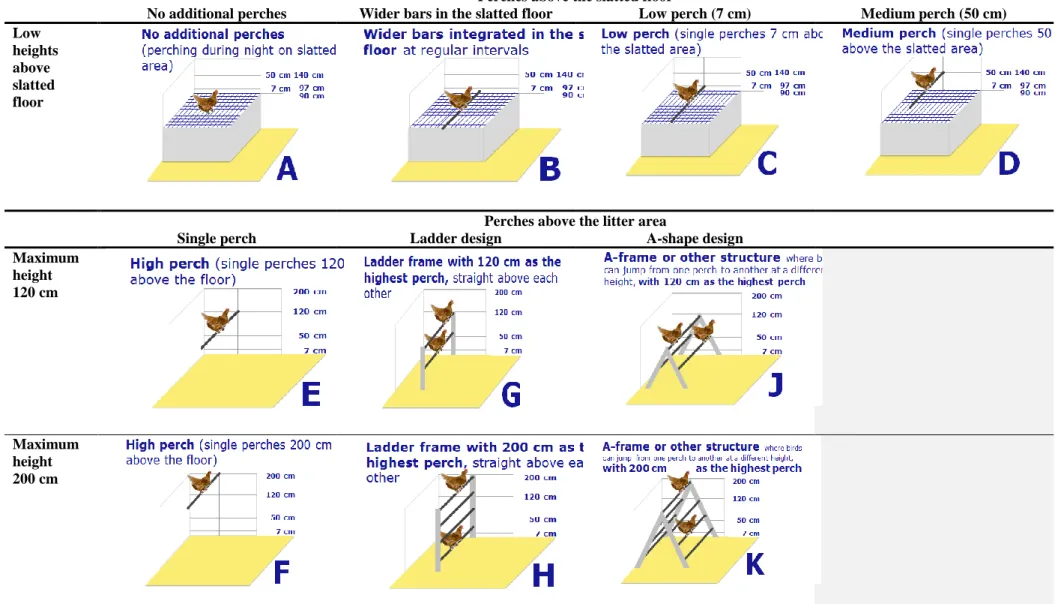
The first 10 scenarios were all based on the presence of a part-slatted area (ca. 90 cm above ground) and a part-littered area (ground level). Perches were arranged above the slatted area (grid structure in Table 1) or above the littered area (yellow area in Table 1). Scenarios A–F in Table 1 represent single- tiered arrangements of (multiple) perches with different heights above the slatted area or littered area.
Scenario A did not have a perch (B, C and D had perches at 0, 7.5 and 50 cm above the slats (equal to 90, 97.5 and 140 cm above ground level), respectively). Scenarios E and F had perches at 120 and 200 cm above ground level (i.e. above the littered area). Alternatively, an equal number of perches
was arranged in a ladder (G and H: highest perch at 120 or 200 cm above ground level) or an A-shape design (J and K: with the highest perch at 120 or 200 cm above ground level). Table 1 summarises the 10 scenarios in a revised version that reflected the reasoning of the hearing experts. All scenarios allow the same perch space per hen.
Table 1: Scenarios to elicit perching preferences (figures were revised after the elicitation process, reflecting the reasoning of the hearing experts) Perches above the slatted floor
No additional perches Wider bars in the slatted floor Low perch (7 cm) Medium perch (50 cm) Low
heights above slatted floor
Perches above the litter area
Single perch Ladder design A-shape design
Maximum height 120 cm
Maximum height 200 cm
2.3.2. Exercise 2: scenarios about perch design features
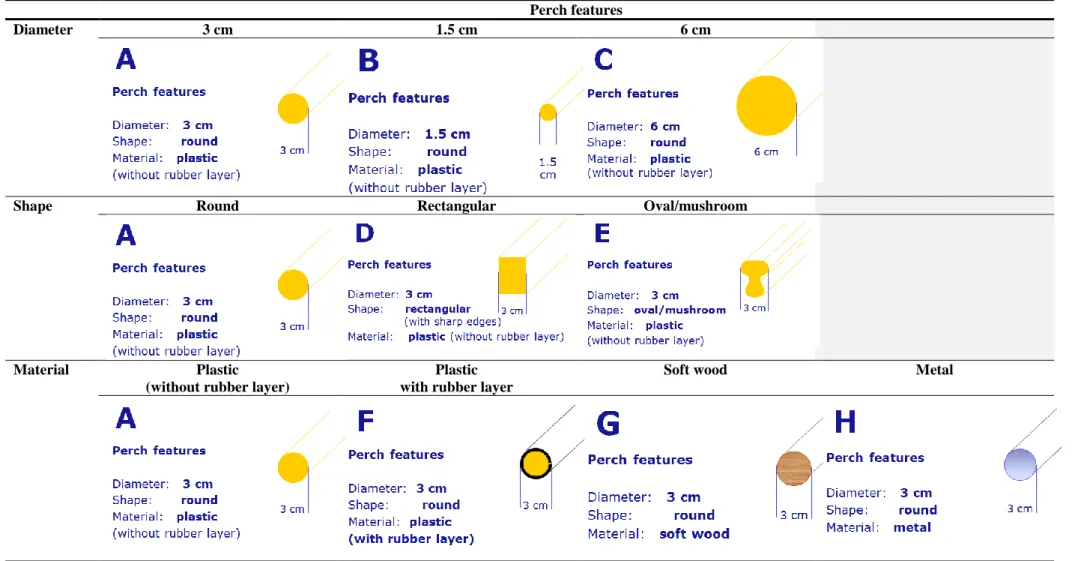
The eight scenarios in this exercise (Table 2: A to H) combined three aspects of perch design:
(1) thickness or diameter (1.5, 3 and 6 cm), (2) shape (flat—rectangular profile; round—circular profile; rounded edge—mushroom profile) and (3) material (metal, plastic, wood, rubber coated).
Within these dimensions, the ratings were consistent (see Table 2 below). The additive combination across the dimensions was not supported because the experts were not unequivocal regarding the interaction of thickness and profile shape.
The scenarios were ordered by their dimension.
Table 2: Scenarios to elicit preferences to features of perches (figures were revised after the elicitation process, reflecting the reasoning of the hearing experts)
Perch features
Diameter 3 cm 1.5 cm 6 cm
Shape Round Rectangular Oval/mushroom
Material Plastic
(without rubber layer)
Plastic with rubber layer
Soft wood Metal
2.4. Identification of perch design criteria and animal-based welfare measures to be used to assess perch adequacy (ToR3b)
ToR 3b: If these data do not enable an assessment of the exact minimum and maximum height or range of heights which are appropriate from a welfare point of view, indicate a set of design criteria of the perch and animal-based welfare measures which may be used to assess if a perch is adequate.
ToR 3b was addressed by the WG through the design of two tables. In the first table, the WG listed all relevant perch design aspects and linked them to potential welfare outcomes.
In the second table, the welfare consequences were linked to animal-based measures to assess them.
Details on how to apply the animal-based measures and supporting literature for their assessment (mainly the Welfare Quality® protocols for laying hens) were also provided in the table.
3. Assessment
3.1. Welfare consequences and animal-based measures related to the presence and adequacy of perches
The first step taken to evaluate if height and position of the perches are important factors for hen health and welfare (see ToR1) and to assess the adequacy of perch design and other features (see ToR2) was to investigate the welfare consequences linked to such aspects. The welfare consequences related to the ability (or inability) to perch and the adequacy of perches are numerous. Appendix A presents these potential welfare consequences. Among them are the occurrence of red mites, keel bone injuries including fractures, foot pad lesions and other foot problems (such as bumble foot), and toe and claw damage. Differences in perch availability also potentially affect injurious behaviours. If the relative position of perches allows easy access to the cloaca of other perching hens this can increase the risk of cloaca injuries and plumage damage. The level of perch use will also be affected by design features, as well by the actual type of behaviour hens perform on the perch (resting, balancing, comfort behaviour). Finally, it is likely that some physiological parameters, e.g. body temperature, can be affected by the design of the perch.
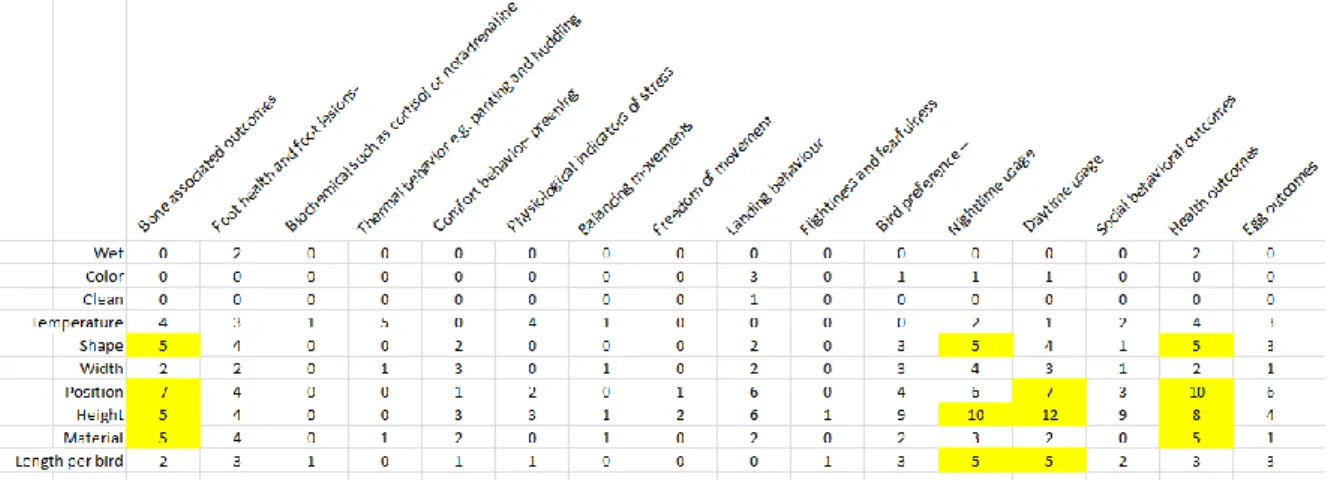
All welfare consequences listed in Appendix A were investigated in the literature scoping review.
Figure 6 gives a summary of the results from the scoping review. From this figure, it can be seen that usage of the perches— daytime and night time usage—as well as health outcomes—predominantly referring to bones—are mostly referred to when assessing perch adequacy (yellow highlighted cells).
Figure 6: Summary of results from the scoping review (O’Connor, in press).
3.2. Results about the degree to which a minimum and a maximum height and the position of the perch are important factors for hens’ welfare (ToR1)
3.2.1. Perching behaviour and motivation related to grasping and seeking elevation
ToR 1: Identify to what degree a minimum and maximum height and the position of the perch are important factors for the hens’ welfare.
To establish what an adequate perch is, it is necessary to investigate if a perch is needed at all by looking at the possible motivations for animals to use a perch. Therefore, it is necessary to identify the motivational basis for perching and the strength of the motivation, if possible. Under natural or semi- natural conditions, chickens make use of elevated structures in the environment (most often tree branches) to perch on during the day (Wood-Gush et al., 1978) and to roost on at night (Blokhuis, 1984). Often chickens grasp branches or other structures with their feet whilst perching. Thus, in considering the causation, function and need to perch or roost, it is important to consider both grasping and the seeking of elevation separately, where possible, although in most studies these two aspects are confounded.
The literature review conducted by the WG members to investigate the ability of hens to perch and their motivation to grasp and seek elevation led to the following results.
3.2.1.1. Grasping
Grasping is the act of wrapping the toes around a (rod or stick) perch, via active or passive flexion of the toes. Chickens can grasp branches with their feet, and originally it was proposed that grasping required considerable muscular effort. Early experimenters with domestic fowl (e.g. Watson, 1869) disproved this hypothesis and argued instead that grasping was a passive process, starting with the body weight of the sitting hen leading to flexion of the hip, knee and ankle joints and passive stretching of the particular avian arrangement of limb muscles and tendons. Finally ‘as the tendons passing to the toes in front are closely connected with that one passing to the posterior toe, they are consequently put upon the stretch at the same moment, and thus compel the toes to grasp firmly the branch on which the hen is situated’. Most subsequent authors have taken the same view and proposed complementary mechanisms (e.g. ratchet-like microstructure of avian foot tendons, Quinn and Baumel, 1990) that might act together to maintain digital force without continuous muscular effort.
However, actual tests of this hypothesis are rare. Recently, Galton and Shepherd (2012) examined anaesthetised starlings and found that passive leg flexion produced no toe flexion, and also found that hens subjected to surgery to disable toe flexion roosted in a similar way to control hens. They noted that starlings did not always grasp the structures or branches they were sitting on and suggested that, when a high degree of balance is necessary (e.g. during high winds), grasping could be maintained by an active contraction of flexor muscles acting on the toes only.
Chickens possess touch receptors (Herbst corpuscles) in the pads of their feet which assist in grasping and balancing movements.
Chickens have feet that are capable of grasping. However, in comparison with many other hen species, the feet of chickens are less specialised for grasping, as chickens make greater use of their feet for locomotion and for scratching for food (Sustaita et al., 2013).
The relative preference of roosting hens for an object that can be grasped versus an elevated structure was examined by Schrader and Muller (2009) who offered hens different combinations of high (60 cm) or low (15 cm) perches, or high or low flat plastic grids, for night-time roosting. Hens showed a very strong preference for high roosting structures over low, and a weaker preference for perches over grids when these were presented at the same height. When forced to make a choice between high grids or low perches, the height was by far the most important component in hens’ preference.
However, there is no work examining grasping motivation per se (e.g. examining if the need to grasp increases with time after grasping was last performed).
3.2.1.2. Seeking elevation
Birds subject to the threat (or perceived threat) of predation tend to seek locations which provide a good view of their surroundings so that subtle predatory cues can be detected. Individuals of many avian species invest less time in vigilance behaviour when they have an unobstructed view of their surroundings (Metcalf, 1984; Devereux et al., 2005). However, there is a potential trade-off between having a good view of predators and being more visible and exposed to this same threat and this aspect has not been studied in laying hens. Further research would be required to establish whether achieving a good view of their surroundings was an important component in hens’ motivation to seek elevation.
Commercial laying hens provided with continuous access to elevated structures were less fearful than flocks with no aerial perches (Donaldson and O’Connell, 2012), again supporting the idea that perches enhance a sense of security. However, not all studies have found an effect of perches on fearfulness (Campo et al., 2005 (ornamental breed); Brake et al., 1994 (broiler breeder pullets)). The height of the perches used in these studies, and the effects on fearfulness for hens in edge versus central locations of elevated platforms or grids, requires further investigation.
There may be ways to provide hens with a sense of security other than through elevated structures or perches; for example, hens prefer pen areas with partial cover and preferentially perform resting and preening behaviours in these areas (Newberry et al., 2001). Hens that have experienced hostility from conspecifics use floor-level covered areas beneath tiers of perches as a refuge (Freire et al., 2003). It is not known if the provision of cover (i.e. a partially covered area by, for example, a canopy or awning) could substitute partially or fully for the provision of an elevated structure or perch.
3.2.1.3. Motivation to perch at night
The motivation to seek elevation is particularly strong at night when hens select a site for resting or sleeping (Blokhuis, 1984) and this instinct remains strong in domestic chickens. Feral domestic hens seek out branches for perching during the late afternoon or early evening (Wood-Gush et al., 1978).
This ensures that the majority of hens are safely elevated when night falls. The proximate cue that triggers roosting appears to be a fall in light levels during afternoon periods when hens are more photosensitive (Kent et al., 1997). Thus, a drop in ambient light levels in the afternoon triggers roosting, whereas similar drops in light levels at other times of day do not. This mechanism applies both to broody hens caring for young chicks and to adult hens (Kent et al., 1997).
The high percentage of perch usage at night is, in itself, some indication that roosting is a highly motivated behaviour. Studies demonstrate a strong preference to seek and access elevated areas at night (Oden et al., 2002; Wichman et al., 2007), although Cordiner and Savory (2001) reported a tendency for greater utilisation of low perches than of high perches in small experimental pens. Good evidence that roosting is a highly motivated behaviour comes from studies showing that, when roosting is prevented, hens become agitated (Olsson and Keeling, 2000). The high motivation for night-time roosting is further demonstrated by studies showing that hens will use a push-door to access a perch at night. Olsson and Keeling (2002) increased the force required for a hen to open the push- door from 25 % of an individual’s capacity to 100 %, the maximum possible for that individual hen (calculated from the force overcome to reach food after 24 hours of food deprivation). The median resistance overcome to access the perch was 75 % of capacity, compared with 0 % for a sham perch.
The motivation to seek an elevated area is reduced in caged hens by a competing motivation to avoid contact with the cage roof. Provided there is a minimum distance of approximately 20 cm between the top perch and the cage roof, hens prefer to roost at night on the highest perches available over a range of 6 to 36 cm (Struelens et al., 2008b). However, cage heights of less than 55 cm removed the preference for the highest perches, reduced perch use overall and reduced the amount of comfort behaviour performed on the perch.
3.2.1.4. Motivation to perch during the day
During the day, perching in elevated locations gives chickens a vantage point from which they can monitor their environment and reduce the risk of daytime predation. Elevation may also allow social monitoring, but this is a lesser influence as shown by group size effects on perching behaviour (Newberry et al., 2001) and as was discussed previously about stocking density. These authors found that daytime perch usage rates were slightly higher (just over 40 %) in small groups of young White Leghorn chickens than in larger groups, over group sizes ranging from 15 to 120 hens. In addition, the proportion of perching hens that were vigilant on the highest perches declined with increasing group size. If hens were using perches to monitor their social companions, the opposite result would be expected, with more perch use in larger groups where there are more individuals to observe. Instead, the authors suggested that individuals in smaller groups have to be more vigilant for potential predators (Newberry et al., 2001). Likewise, Cheng et al. (2014) reported a higher perch use in smaller groups of one to eight Hy-Line Brown laying hens, with perching frequencies varying from 86.7 % to 68.3 % in single-housed hens and groups of eight, respectively. In addition, hens in smaller groups preferred higher perches (20 cm), while hens in groups of eight showed a preference for lower height perches (10 cm). In support of the idea that seeking elevation during the day may increase chickens’
perception of safety, Keeling (1997, conference abstract) reported that chickens perching on a low perch reacted sooner to the presence of a model predator than chickens on a higher perch. However,
not all results are consistent with this idea, as Guo et al. (2012) found higher perch use in larger groups of 48 hens compared with groups of 21 hens, although perch use in both groups was rather low (below 10 %). In non-cage systems, greater utilisation rates have generally been reported for high perches than for low perches during the daytime (Newberry et al., 2001). However, for caged hens, the tendency to avoid contact with the cage roof has a greater effect on daytime perching than on night- time roosting (Struelens et al., 2008b). Indeed, in cage environments, non-elevated perches can be preferred for daytime use (e.g. Rönchen et al., 2010). Chen et al. (2014) found that hens in 65-cm high cages preferred perches at heights of 10 cm or 20 cm than perches at heights of 30 cm or 40 cm.
Large flock sizes of many thousands in both colony cage and non-cage houses may reduce hens’
motivation to be vigilant for predators, and hence their motivation to perch, but this has not been studied.
Chickens may also use elevated structures to escape from other hens (Cordiner and Savory, 2001).
These authors sequentially provided small groups of 20 adult hens with no perches or combinations of perches in low (17.5 cm above ground), medium (highest perch 35 cm above ground) or high (highest perch 70 cm above ground) configurations. The frequency of aggressive interactions was significantly lower when a high perch was provided than when no perch was provided, but no significant effects were detected for feather pecking. In two of the four groups, perches of all heights were used more by subordinate hens than by dominant hens, suggesting that the perches may have provided a refuge.
Aggressive interactions were relatively frequent in this experiment, as newly mixed hens within these small groups attempted to form social hierarchies, so generalisation to larger or more stable groups requires caution.
Finally, hens may seek elevation to avoid poor or damp litter conditions that are known to have a direct impact on foot pad lesions (Wang et al., 1998), but the use of perches to avoid deteriorated litter conditions has not been directly investigated.
The proximate cues that influence daytime perching are not known. Demand experiments for daytime perching have not been conducted. However, two early experiments examined the relative preferences of hens for structures that could be grasped versus elevated platforms. Hens made little use of a wooden perch compared with a wire mesh cube when both of these were presented in pens either for 1 hour/day or continuously (Faure and Jones, 1982a, b). In the latter experiment, chickens were provided with continuous access to one of five perching options, namely covered or uncovered wire mesh cubes at a height of 45 cm or 5 cm, or a rectangular wooden perch (45 cm length, 5 cm breadth, 2 cm depth) at a height of 35 cm. Little or no daytime perching was observed on the wooden perch in comparison with the elevated cubes, suggesting no motivation for grasping a rectangular perch. The limitations of this work include the small number of hens, the lack of group-level replication and the lack of control over other experimental variables.
3.2.1.5. Motivation when perches are absent
Although there is evidence that laying hens are frustrated if they are unable to access perches that they have previously used, evidence of a deprivation effect is equivocal. The extent to which the actual presence of higher structures stimulates hens’ preference for elevated perching (i.e. provides a cue that the hens would not miss in its absence) remains to be investigated. No one has examined if any type of chicken ‘misses’ absent perches. When pullets or laying hens are housed in conventional or furnished cages either with or without the provision of a perch, no differences in stress response have been observed in commercial breeds (Barnett et al., 1997, 2009; Yan et al., 2013), despite the fact that the perches are well-used when provided. An exception to this general result has been reported for a Spanish ornamental breed (Black Menorca) housed in small experimental pens, where hens with perches had lower heterophil to lymphocyte ratios after 15 weeks (Campo et al., 2005) and greater fluctuating asymmetry at 36 weeks (Campo and Prieto, 2009), which are indicators of lower stress.