AD
Report No. TN95-3
ENVIRONMENTAL INFLUENCES ON BODY FLUID BALANCE DURING EXERCISE -
COLD EXPOSURE
U S ARMY RESEARCH INSTITUTE OF
ENVIRONMENTAL MEDICINE Natick, Massachusetts
3TIC
LEGTE
I, MAY 1 1 1995
Approved for public release: distribution unlimited.
United States Army
Medical Research and Materiel Command
1
DISCLAIMER
The views, opinions and/or findings contained in this report are those of the authors and should not be construed as an official Department of the Army position, policy or decision unless so designated by other official documentation.
Approved for public release; distribution is unlimited.
TECHNICAL NOTE NO. TN 95-3
ENVIRONMENTAL INFLUENCES ON BODY FLUID BALANCE DURING EXERCISE - COLD EXPOSURE
Prepared by
Beau J. Freund and Andrew J. Young
April 1995
Accesion For NTIS CRA&I DTIC TAB Unannounced Justification
By.
Distribution/
I
DAvailability Codes Dist
m
Avail and /or Special
U.S. Army Research Institute of Environmental Medicine Natick, Massachusetts 01760-5007
REPORT DOCUMENTATION PAGE
Form Approved OMB No. 0704-0788Public reporting burden for this collection of information is estimated to average 1 hour per response, including the time for reviewing instructions, searching existing data sources, gathering and maintaining the data needed, and completing and reviewing the collection of information. Send comments regarding this burden estimate or any other aspect of this collection of information, including suggestions for reducing this burden, to Washington Headquarters Services, Directorate for Information Operations and Reports, 1215 Jefferson Davis Highway, Suite 1204, Arlington, VA 22202-4302. and to the Office of Management and Budget, Paperwork Reduction Project (0704-0188), Washington, DC 20503.
1. AGENCY USE ONLY (Leave blank) 2. REPORT DATE
April 1995
3. REPORT TYPE AND DATES COVERED
Technical Note
4. TITLE AND SUBTITLE
Environmental Influences on Body Fluid Balance During Exercise - Cold Exposure
6. AUTHOR(S)
FREUND, Beau J. and Andrew J. YOUNG
5. FUNDING NUMBERS
7. PERFORMING ORGANIZATION NAME(S) AND ADDRESS(ES)
US Army Research Institute of Environmental Medicine Natick, MA 01760-5007
PERFORMING ORGANIZATION REPORT NUMBER
9. SPONSORING /MONITORING AGENCY NAME(S) AND ADDRESS(ES)
US Army Medical Research and Materiel Command Ft. Detrick
Frederick, MD 21702-5012
10. SPONSORING/MONITORING AGENCY REPORT NUMBER
TN95-3
11. SUPPLEMENTARY NOTES
12a. DISTRIBUTION/AVAILABILITY STATEMENT
Approved for Public Release; Distribution Unlimited
12b. DISTRIBUTION CODE
13. ABSTRACT (Maximum 200 words)
Body fluid losses in cold climates can be similar to those in hot environments.
Fluid loss results from sweating and increased respiratory water losses as well as cold induced diuresis. Additional studies are needed to further document the magni- tude of cold-induced dehydration as well as the specific distribution of these losses throughout various body water compartments. Fluid intake in cold environ- ments can be reduced as a result of logistical constraints in fluid delivery, problems with water freezing, reduced thirst sensation, and voluntary fluid
restriction. Dehydration.negatively influences physical and cognitive performance as well as thermoregulation and possible susceptibility to peripheral cold injury.
More research is needed to determine the direct effects of cold-induced dehydration on thermoregulatory responses to cold and susceptibility to peripheral cold injury.
Recent experimental findings suggest that ingestion of glycerol in drinking water might be an effective countermeasure to reduce or delay cold-induced dehydration and the associated decrements to performance. Additional countermeasures and aids for maintaining hydration during cold exposure should be explored.
14. SUBJECT TERMS
Cold Diuresis, Cold Stress, Fluid Balance, Dehydration, Physical Exercise, Performance
15. NUMBER OF PAGES
38
16. PRICE CODE
17. SECURITY CLASSIFICATION OF REPORT
UNCLASSIFIED
18. SECURITY CLASSIFICATION OF THIS PAGE
UNCLASSIFIED
19. SECURITY CLASSIFICATION OF ABSTRACT
20. LIMITATION OF ABSTRACT
UNCLASSIFIED
NSN 7540-01-280-5500 Standard Form 298 (Rev.
Prescribed by ANSI Std. Z39-18 298-102
2-89)
TABLE OF CONTENTS
ACKNOWLEDGMENTS v EXECUTIVE SUMMARY 1 INTRODUCTION 2
*
OVERVIEW: HUMAN HEAT BALANCE DURING RESTAND EXERCISE
IN THE COLD 3 BIOPHYSICAL FACTORS 3 THERMOREGULATORY RESPONSES 5 EXERCISE AND HEAT BALANCE IN THE COLD 6 INDIVIDUAL MODIFYING FACTORS 7 Body Morphology 7 Physical Fitness 7 Age 8 Gender 8 Nutrition Status 9 Acclimatization 10 Clothing * 10 CHALLENGES TO FLUID BALANCE DURING COLD EXPOSURE 11
FACTORS INCREASING FLUID LOSSES IN THE COLD 11 Cold Induced Diuresis 11 Respiratory Fluid Losses 13 Cold Weather Clothing 14 Metabolic Cost of Movement in Cold Terrain 16
FACTORS LIMITING FLUID INTAKE IN THE COLD 17 FLUID AVAILABILITY 17
"INADEQUATE DRINKING 18 DEHYDRATION EFFECTS IN THE COLD 19 PHYSICAL AND COGNITIVE PERFORMANCE 19 THERMOREGULATION & COLD INJURY SUSCEPTIBILITY 20 COUNTERMEASURES: MAINTENANCE OF BODY FLUID BALANCE
IN THE COLD 22 REFERENCES 23 DISTRIBUTION LIST 32
LISTS OF FIGURES
FIGURE 1 Total insulation (lT,Clo) of clothing plus air necessary for comfort at various metabolic rates (1 met = 100 watts). ECWCS = U.S.
Army Extended Cold Weather Clothing System. SOURCE:
Gonzalez (1988) 15 FIGURE 2 Predicted energy expenditure for walking at various speeds
considering the type of terrain. SOURCE: Modified from Pandolf etal., (1977) 17
LIST OF TABLES
TABLE 1. WIND CHILL CHART 4 TABLE 2. SIGNIFICANT STUDIES REGARDING COLD INDUCED DIURESIS 12 TABLE 3. EFFECTS OF AMBIENT TEMPERATURE ON RESPIRATORY
WATER LOSS .* 14 TABLE 4. EFFECTS OF WORK AND CLOTHING ON SWEAT LOSS 16
IV
ACKNOWLEDGMENTS
The authors thank Ms. Roberta Ciaramicoli for her professional preparation of this technical note and to Dr. Michael Sawka for his editorial/scientific comments.
EXECUTIVE SUMMARY
Body fluid losses in cold climates can be similar to those in hot environments.
Fluid loss results from sweating and increased respiratory water losses as well as cold induced diuresis. Additional studies are needed to further document the magnitude of cold-induced dehydration as well as the specific distribution of these losses throughout various body water compartments. Fluid intake in cold environments can be reduced as a result of logistical constraints in fluid delivery, problems with water freezing, reduced thirst sensation, and voluntary fluid restriction. Dehydration negatively influences physical and cognitive performance as well as thermoregulation and
possible susceptibility to peripheral cold injury. More research is needed to determine the direct effects of cold-induced dehydration on thermoregulatory responses to cold and susceptibility to peripheral cold injury. Recent experimental findings suggest that ingestion of glycerol in drinking water might be an effective countermeasure to reduce or delay cold-induced dehydration and the associated decrements to performance.
Additional countermeasures and aids for maintaining hydration during cold exposure should be explored.
INTRODUCTION
Physical work, mental stress, exposure to climatic extremes, alone or in concert can markedly disrupt body fluid balance. This is as true in cold as in hot climates.
For example, soldiers conducting cold-weather operations are often dehydrated by 3- 8% of their body weight.11,64 This dehydration is similar to the magnitude experienced by people in hot climates. Few studies investigated cold effects on body water
regulation or the influence of dehydration has on exercise capacity, thermoregulation or cold-injury susceptibility during cold weather.
Sixty percent of the earth's land has January low temperature below 0°C (32°F), and over 25% of the earth's land experiences January lows below -18°C (0°F).6 However, cold weather need not deter outdoor exercise. People can exercise safely even in extreme cold if they wear clothing adequate to maintain body core temperature and protect the skin from peripheral cold injury. However, cold weather and wearing cold-weather protective clothing can affect body fluid balance, and in turn, degrade physical performance and increase susceptibility to cold injury. This technical note will briefly review the physiological responses to defend body temperature in cold environments and then consider in detail: 1) factors affecting fluid balance in cold climates; 2) the effects of dehydration on exercise in the cold; and 3) possible countermeasures to minimize dehydration in the cold.
OVERVIEW: HUMAN HEAT BALANCE DURING REST AND EXERCISE IN THE COLD
Humans protect themselves against the cold first by behavioral
thermoregulation. That is, they wear clothing, remain in shelters and use various heat generating devices. However, when behavioral strategies alone fail to defend body temperature homeostasis, physiological responses are elicited. Besides protecting against the cold effects and playing a role in the etiology of cold injuries, these
physiological responses may alter metabolism and fluid balance of persons living and working in cold climates.
BIOPHYSICAL FACTORS .
The biophysics of human thermal balance is considered in detail elsewhere so only a brief summary will be presented here.' 66
Body temperature reflects the net effects of internal heat production and heat transfers between the body and ambient environment. The heat balance equation describes the relationship:
S = M - (+W^ + E ± R + C + K [W/m2].
M represents metabolic heat production and Wk represents energy leaving (positive for concentric work) or entering (negative for eccentric work) the body as external work.
Heat exchange between the body and environment occurs via evaporation (E),
radiation (R), convection (C) and conduction (K). The sum of these processes is body heat storage (S), which represents heat gain if positive or heat loss if negative.
In environments colder than body temperature, heat flows from the body core toward the environment, primarily via dry heat-loss exchange (i.e., conduction and convection). Wind increases convective heat loss from the body surface,66 thus
providing the basis for the concept of wind chill70 (Table 1). Water has a much higher thermal conductivity than air. Therefore, convective heat transfer is greater (perhaps 70-fold) during water immersion than during exposure to air of the same
temperature.32 Clothing insulates the body from the environment, limiting convective
and conductive heat loss although wet clothing provides considerably less insulation than dry.
Another environmental factor influencing physiological function is atmospheric air's water content. Saturation vapor pressure of air decreases as air temperature falls. Therefore, as air temperature falls, so too does atmospheric moisture content, even if the relative humidity is high. Fluid is transferred from the body to air via
evaporation as it comes in contact with skin and with respiration as water saturated air is exhaled. The potential for fluid loss from the body is inversely related to the
inspired air's water content; therefore, greater fluid losses generally occur with cold air which is relatively dry.66 Thus, environmental characteristics besides temperature, influence the potential for body heat and water loss and the resulting physiological strain of defending homeostasis.
TABLE 1. WIND CHILL CHART
ACTUAL TEMPERATURE (°F) WIND SPEED
(IN MPH) CALM
50 40 30 20 10 0 -10 -20"' -30 -40 -50 -60 EQUIVALENT CHILL TEMPERATURE (°F)
50 40 30 20 10 0 -10 -20 | -30 -40 -50 -60 5
10
48 , 37 27 16 6 -5 -15 1 -26 -36 -47 -57 -68 40 28 16 3 -9 -21 | -33 :46 -58 -70 | -83 -95 15 36 22 9 -5 -18 | -32 -45 -58 -72 | -85 -99 -112 20 32 18 4 -10 -25 -39 -53 -67 -82 -96 -110 -124 25 30 15 0 -15 -29 -44 -59 -74 -89 -104 -118 -133 30 28 13 -2 -18 -33 -48 -63 -79 -94 -109 -125 -140 35 27 11 -4 -20 -35 -51 -67 -82 -98 -113 -129 -145 40 26 10 -6 -22 -37 -53 -69 -85 -101 -117 -132 -148
(WIND LITTLE DANGER INCREASING GREAT DAf« IGER
SPEEDS DANGER
GREATER THAN 40 MPH
HAVE LITTLE (In less than 5 hrs with dry (Exposed flesh may (Exposed flesh may freeze within 30
ADDITIONAL skin. Greatest hazard from freeze within 1 seconds )
EFFECT) false sense of security) minute)
THERMOREGULATORY RESPONSES
Humans respond to cold in two principal ways: 1) vasomotor responses reduce dry heat loss; 2) metabolic heat production increases.
Cold exposure elicits vasoconstriction which reduces peripheral blood flow. The vasoconstrictor response is not limited to the extremities, but is widespread throughout the peripheral shell. The decrease in peripheral blood flow reduces convective heat transfer between the body's core and shell (skin, subcutaneous fat and skeletal
muscle), and increases body insulation. Heat is lost from the body surface faster than it is replaced. As a result, whole-body cold exposure causes a decline in skin
temperature over the entire body. Thus, during cold exposure, core temperature is defended at the expense of declining skin temperature. The blood flow reduction and consequent fall in skin temperature contribute to the etiology of cold injuries.59 The hands and fingers are particularly susceptible to cold injury12 and a loss of manual dexterity because effects of cold-induced vasoconstriction are pronounced in those regions.30
The other mechanism to defend body temperature during cold exposure involves an increase in metabolic heat production. Muscle is the primary source of increased metabolic heat. Besides generating external force, muscle contractions also liberate considerable heat (approximately 70% of total energy expended). Thus, physical activity (work or exercise) increases metabolic heat production (exercise is considered next). When skin and/or core temperature are reduced, and exercise or physical activity are not initiated, shivering begins. Shivering is an involuntary pattern of repeated, rhythmic muscle contractions which may start immediately, or after several minutes of cold exposure, and usually begins in torso muscles, then spreads to the limbs.38 Certain animals respond to cold exposure with an increase in metabolic heat production by non-contracting tissue, i.e., non-shivering thermogenesis.45
However, there is no clear evidence that humans share this mechanism.74
EXERCISE AND HEAT BALANCE IN THE COLD
Physical activity can increase metabolic heat production more than shivering.
Whereas maximal shivering elevates Vo2 to about 2 liter/min,81 exercise can increase N/o., to 5 liter/min or higher. However, exercise not only increases metabolic heat production, but also facilitates body heat loss by increasing skin and muscle blood flow. This enhances convective heat transfer from the body core to peripheral shell.
Also, limb movement increases convective heat loss from body surfaces by disrupting the stationary layer of air, or water, that develops at the skin surface. Thus, while metabolic heat production increases progressively as exercise intensity increases, so too does heat loss due to rising muscle and skin blood flow. In cold air, metabolic heat production during exercise can be high enough to completely compensate for increased heat loss and allow core temperature to be maintained even when ambient temperature is extremely cold.74 In contrast, increased heat loss during exercise in cold water can be so great that metabolic heat production, even during intense exercise, is insufficient to defend body core temperature.74
During submaximal exercise in the cold, Vo2 can be higher than, or the same as, in temperate conditions, depending on the exercise intensity and clothing
insulation.82 At low intensities of exercise, when clothing is inadequate, Vo2 is higher in cold than temperate conditions. In this case, metabolic heat production is
insufficient to maintain core and skin temperatures high enough to prevent shivering.
Thus, the increased Vo2 represents the added oxygen requirement for shivering. As metabolic heat production rises with increasing exercise intensity, the stimulus for shivering declines, and at some point exercise metabolism is high enough to
completely prevent shivering. At this intensity and higher, Vo2 during exercise is the same in cold and temperate conditions. The exercise intensity at which metabolic heat production is sufficient to prevent shivering depends on the severity of cold stress. Further, that intensity will not necessarily be the same for all persons exposed to the same cold stress due to individual characteristics that may modify the
magnitude of physiological responses. These individual modifying factors are discussed later.
Cold exposure can reduce maximal oxygen uptake (Vo2max), but not always Conditions must be severe enough to markedly reduce core or muscle temperature
82
before Vo2max is reduced.8,9,23,38,50 Exposure to conditions which lower core temperature less than 0.5°C, do not significantly reduce VOj.max.68 Lower body temperatures may impair myocardial contractility and limit maximal heart rate8,9,23,38,50
sufficiently to limit maximal cardiac output, thus accounting for the reduced Vo2max.
INDIVIDUAL MODIFYING FACTORS Body Morphology
Differences in body size, configuration and composition explain much of the variability between individuals in their capability to defend body temperature during cold exposure. Since the principal avenue of heat loss in humans exposed to cold is convective heat transfer at the skin surface, a large surface area favors greater heat loss than a smaller surface area. On the other hand, a large body mass favors maintenance of a constant temperature by virtue of a greater total heat content
compared to a small body mass. Gonzalez32 explains that the ratio of surface area to body mass governs heat loss. All other factors being equal (which is rarely the case), persons with a large surface area to mass ratio experience greater declines in body temperature during cold exposure than those with smaller surface area to mass ratios.14,74
Body fat is another anthropomorphic characteristic modifying the stress an individual experiences with cold exposure. Thermal resistivity of fat is greater than that of either skin or muscle.74 Thus, thermal conductance decreases, and insulation increases as subcutaneous fat thickens. Therefore, different persons exposed to the same cold conditions do not experience the same cold stress, or exhibit physiological responses of the same magnitude.
Physical Fitness
There is no consensus concerning the influence of physical fitness, particularly aerobic capacity, on thermoregulatory response to cold. Cross-sectional studies conclude that fit persons maintain warmer skin temperatures than less fit persons during rest in cold air.10 However, the effect appeared due to thinner subcutaneous fat thickness and higher metabolic heat production in fit compared to less fit subjects,
rather than to a fitness effect, per se. Longitudinal studies indicate that endurance training strengthens cutaneous vasoconstrictor response to cold43,79 which therefore, may provide a thermoregulatory advantage for persons exposed to cold.
Age
Aging is widely thought to compromise body temperature defense during cold exposure.83 The incidence of hypothermia on admission to hospitals may be greater for older (60 yrs or more) than younger persons.44 However, overall incidence of hypothermia compared to other ailments resulting in hospital admission is low, and factors such as injury, illness and alcohol or drug intoxication may confound these data.16,42 Epidemiological surveys of body temperature of older persons while in their own homes do not indicate a large incidence of hypothermia.17,24 Nevertheless,
controlled laboratory comparisons show that older men may be less able than younger men to defend core temperature during cold exposures. The cutaneous
vasoconstrictor response to cold may be slower, and cold-induced vasodilation is blunted in older than younger men.48 Shivering thermogenesis may also be less in older than younger men.83 The latter effect probably results from a loss of muscle mass, rather than an aging effect on thermoregulation per se.48 These aging effects begin to be apparent after about 45 years of age in men.83 Data from one study, however, indicated that older women defended core temperature during cold exposure as well as, or better than younger women.75 Here again, body composition changes with aging (the older women were much fatter than the younger women) probably accounted for the difference attributed to aging. It is possible that preventable changes in body composition and physical fitness rather than aging per se may account for impaired thermoregulatory responses to cold.
Gender
Gender-related differences in body size, shape and composition, and hormonal effects associated with the menstrual cycle affect heat balance and thermoregulatory response to cold.71 These differences contribute to a disparity in cold tolerance between men and women, which is particularly apparent in cold water. Generally, women have greater fat content and thicker subcutaneous fat thickness than men of comparable age. A thicker subcutaneous fat layer accounts for the greater maximal
8
tissue insulation and lower critical water temperature (coldest water tolerated without shivering) observed in women than men.60 Despite this, greater fat content may not provide women with a thermoregulatory advantage over men.
When women and men of equivalent subcutaneous fat thickness are
considered, the women usually have a greater surface area and smaller total body mass than men. Although insulation is equivalent, total heat loss is greater due to the larger surface area for convective heat flux. Body heat content is less in the women because of their smaller body mass. Therefore, body temperature falls more rapidly for any given thermal gradient and metabolic rate.32,49,51 When men and women of equivalent subcutaneous fat thickness exercised in cold water at the same metabolic rate per unit surface area, both experienced similar core temperature changes.49
Comparing men and women of equivalent total body mass, still seems to put women at a disadvantage in the cold. In this case, women's greater fat content enhances insulation, and surface area differences between genders are not as pronounced.
Nevertheless, their smaller lean body mass, the source of metabolic heat production, limits capacity for heat production, compared to men of comparable total body mass.
Under cold conditions that stimulate shivering, especially maximal shivering, the limited thermogenic capacity will result in a more rapid core temperature decline in women than men of equivalent total body mass.
Nutrition Status
Both carbohydrate and fat are oxidized to meet the metabolic cost of shivering.
The increase in plasma catecholamines that typically occurs with cold exposure facilitates mobilization of both glycogen and triglyceride stores.75 Debate exists as to the importance of muscle glycogen as a substrate for shivering.40,47,84 It is quite clear, however, persons who become hypoglycemic during cold exposure have a reduced tolerance to cold stress and are more susceptible to cold injury.27,33,37 Hypoglycemia restricts or abolishes the shivering response to cold exposure and hence, significantly blunt metabolic heat production.27,28,33,37 Although glucose serves as a metabolic substrate during shivering or exercise in the cold, the effects of hypoglycemia on shivering may be mediated by the central nervous system.27
Acclimatization
Persons chronically exposed to cold exhibit adjustments in thermoregulation.81
Habituation is, by far, the most common adjustment. Blunting of both shivering and cold-induced vasoconstriction are the hallmarks of habituation.81 These adjustments enable skin to be kept warmer during cold exposure, but can exacerbate heat loss and the fall in core temperature. Besides habituation, cold acclimatization and cold
acclimation can heighten responses to cold, or induce responses not apparent in the unacclimatized state. These adjustments follow two patterns. A more pronounced thermogenic response to cold characterizes metabolic acclimatization/acclimation.81
Enhanced heat conservation mechanisms characterize the insulative «
acclimatization/acclimation pattern.81 More rapid cutaneous vasoconstriction develops in some chronically cold exposed persons. This adjustment may reflect an enhanced sympathetic nervous responses.81 While repeated cold exposure can cause
measurable differences in human physiological responses to subsequent cold
exposure, the importance of these adjustments in preserving thermal balance during cold exposure is limited. This is especially true in comparison to the marked
improvements that occurs with repeated exposures to hot environments as previously described (see earlier Chapter by Sawka et al.).
Clothing
If too little clothing is worn, hypothermia and its consequences can occur.
Wearing clothing with high insulation can effectively attenuate body heat loss during cold exposure even in extreme cold. For optimal effectiveness, the insulative value of the clothing should be balanced with metabolic heat production. As described earlier, heat production rises with increasing physical activity or exercise intensity. Excessive clothing insulation during exercise in the cold leads to increases in core temperature.
This stimulates sweating, as described by Sawka and associates in the preceding chapter. Sweating can wet clothing materials degrading insulative properties and increasing risk for cold injury. It is generally recommended that persons wear several layers of clothing during cold exposure to enable clothing addition or removal as exercise intensity and weather conditions dictate.
10
CHALLENGES TO FLUID BALANCE DURING COLD EXPOSURE
Cold exposure can compromise fluid balance. Some effects result from
increase fluid losses, others result from reduced fluid intake. Both physiological and physical mechanisms exert influences. This section describes some of the most significant factors challenging fluid balance during cold exposure.
FACTORS INCREASING FLUID LOSSES IN THE COLD
Cold Induced Diuresis.
*
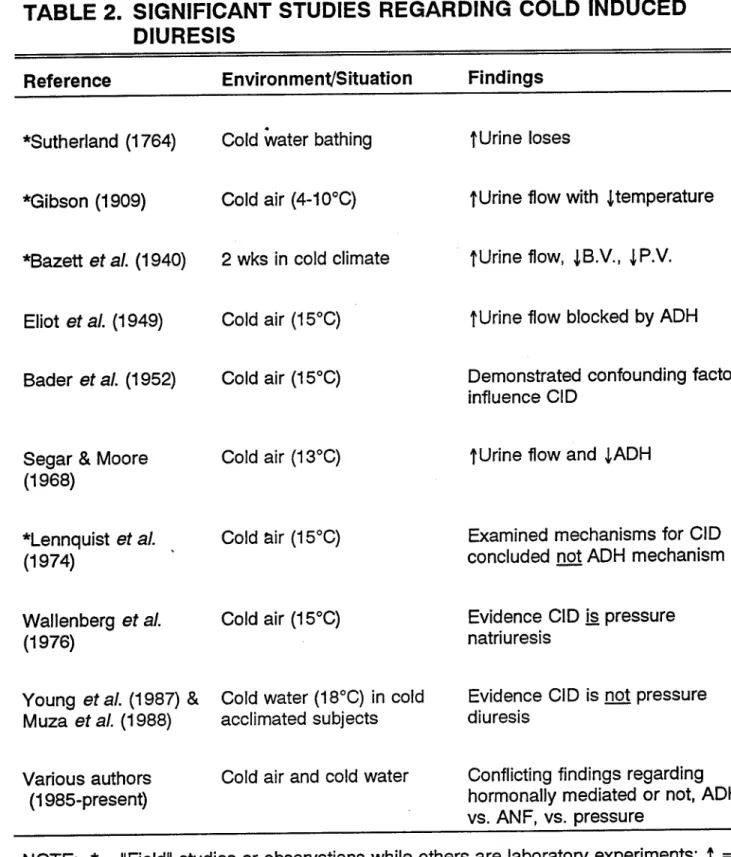
Cold induced diuresis (CID) is one area regarding fluid balance in cold that has received considerable attention. Debate exists with regard to: 1) the impact of CID;
2) the nature of the diuresis, i.e., free water or osmotic; and 3) the physiological mechanism/s responsible for CID. Table 2 summarizes key studies regarding CID.
Over two hundred years ago, Sutherland72 first reported CID as an increased urine flow following cold water bathing. Sutherland, however, made no mention or speculation about the possible influence of hydrostatic pressure effects versus cold exposure per se. Not until 1909 did Gibson31 demonstrate an increased urine flow as the direct result of cold exposure. In 1940, Bazett et al.,7 published a field study which confirmed that cold exposure increased urine flow, and also reduced blood and
plasma volume.
Confounding factors influence the magnitude of CID and whether, or not, a diuresis even occurs during cold exposure. Bader, et al.,4 demonstrated that CID could be prevented by exercising moderately during cold exposure. It also appears CID can be influenced by: 1) intensity and duration of cold exposure; 2) hydration; 3) body posture; 4) exercise; 5) diet; 6) gender; 7) age; 8) body composition; and 10) time of day.4-284346
Lennquist and associates (1974) conducted a series of studies to determine the mechanism/s responsible for CID and concluded CID was not the result of a fall in antidiuretic hormone (ADH) as others had suggested.4,21,e9
11
TABLE 2. SIGNIFICANT STUDIES REGARDING COLD INDUCED DIURESIS
Reference Environment/Situation Findings
♦Sutherland (1764) Cold water bathing f Urine loses
*Gibson (1909) Cold air (4-10°C) t Urine flow with J temperature
*Bazett ef al. (1940) 2 wks in cold climate tUrine flow, JB.V., JP.V.
Eliot et al. (1949) Cold air (15°C) t Urine flow blocked by ADH Bader et al. (1952) Cold air (15°C) Demonstrated confounding factors
influence CID Segar & Moore
(1968)
Cold air (13°C) t Urine flow and JADH
*Lennquist et al.
(1974)
Cold air (15°C) Examined mechanisms for CID concluded not ADH mechanism
Wallenberg et al.
(1976)
Cold air (15°C) Evidence CID is pressure natriuresis
Young et al. (1987) & Cold water (18°C) in cold Evidence CID is not pressure Muza et al. (1988) acclimated subjects diuresis
Various authors (1985-present)
Cold air and cold water Conflicting findings regarding hormonally mediated or not, ADH, vs. ANF, vs. pressure
NOTE: * = "Field" studies or observations while others are laboratory experiments; t = increase; j = decrease; B.V. = blood volume; P.V. = plasma volume; ADH = antidiuretic hormone; CID = cold induced diuresis; ANF = atrial natriuretic factor.
12
The hypothesis that CID was simply a pressure diuresis was favored by many.
The logic for that explanation was that increased systemic arterial blood pressure would increase renal blood pressure and thereby reduce tubular reabsorption of both water and solute i.e., electrolytes. In support, Wallenberg and Granberg76
demonstrated that blood pressure increases during cold exposure correlated with sodium excretion (r=0.60). However, data from two other publications55,80 suggests CID may not be a pressure diuresis. The two papers reported data from the same experiments in which subjects were immersed in cold water before, and following a 5- wk cold water acclimation program. Mean arterial blood pressure markedly increased during the initial cold water exposure before acclimation. However, following
acclimation, blood pressure did not increase during cold exposure55. The CID response to cold water immersion was not affected by cold acclimation i.e., the magnitude of diuresis was the same during the post test as it was during the initial pre-test despite the lower blood pressure response.80 Together, these data provide evidence that CID and blood pressure responses can be disassociated. Hence, the validity of the pressure diuresis hypothesis is challenged.
With regard to CID, the following conclusions can be made: 1) the mechanism/s remain undefined; 2) the central movement of fluid caused by peripheral
vasoconstriction may be involved but other mechanisms should be explored; 3) if studies are to be meaningful, confounding factors must be controlled or specifically examined.
Respiratory Water Losses
Cold dry air is often credited as a contributor to fluid losses, particularly respiratory fluid loss, in cold environments. However, the actual magnitude of these losses is not usually measured or reported. Fluid loss via respiration depends on ventilator/ volume and the water vapor content of the inspired air.13 Respiratory water losses can be estimated from metabolic rate, and inspired air temperature and relative humidity. As mentioned earlier, despite high relative humidities (100% used for
demonstration) cold air contains significantly less water than warmer air of even a lower relative humidity. The difference in water vapor pressure between the saturated air in the lung (water vapor 44 mm Hg) and ambient air determines the amount of
13
respiratory water lost with each breath. Using predictive models,13,53 respiratory fluid losses can be estimated.
Respiratory water loss rises with increasing metabolic rate. To determine the effect of cold air and metabolic rate on respiratory water loss, we predicted respiratory water losses during both rest and exercise at three ambient temperatures and water vapor pressures. A twenty-four hour scenario was modeled in which a person rests for 8 hour, performs moderate activity for 12 hours, and performs strenuous work for 4 hours. The models indicate that respiratory losses approximately double at -20°C (- 2°F) versus 25°C (78°F) i.e., 1.02 vs 0.68 liters/24 hr (Table 3). Hence, respiratory water losses can contribute to dehydration in the cold. However, metabolic rate (i.e.
sweating) appears to have a far greater impact than ambient temperature on respiratory fluid losses and hence, fluid requirements.
TABLE 3. EFFECTS OF AMBIENT TEMPERATURE ON RESPIRATORY WATER LOSS
Temperature (°C)
r.h.
(%) 65 100 100
Water Vapor (mmHg)
Metabolic Rate (W)
Respiratory Water (ml/h)
25 0 -20
15 5 1
Rest (100) Rest (100) Rest (100)
-10 -13 -15 25
0 -20
. 65 100 100
15 5 1
Light-moderate (300) Light-moderate (300) Light-moderate (300)
-30 -40 -45 25
0 -20
65 100 100
15 5 1
Moderate-heavy (600) Moderate-heavy (600) Moderate-heavy (600)
-60 -80 -90 If 8 Hour Rest, 12 Hour Light-Moderate Activity and 4 Hour Moderate-Heavy Activity
Total Respiratory Loss 25
0 -20
65 100 100
-680 ml/24h -905 ml/24h -1020 ml/24h
NOTE: Effect of cold air itself could account for increased respiratory water losses as great as 340ml/24h i.e. 50% increase; r.h. = relative humidity; W = watts.
Cold Weather Clothing
Heavy and cumbersome winter clothig also influences water losses in the cold.
Significant metabolic heat can be generated and stored, stimulating sweating even in 14
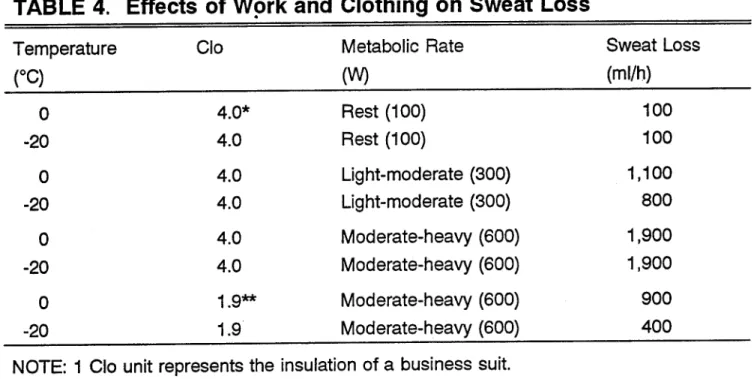
cold climates. Figure 1 demonstrates the relationship of total insulation and metabolic rate on thermal comfort of individuals exposed to different ambient temperatures.32 A resting person requires considerably more total insulation to keep warm than persons performing moderate to heavy work/exercise. Note, in Table 4, that a person dressed in the U.S. Army Extended Cold Weather Clothing System (insulation ~ 4.0 Clo), sweats little while resting in the* cold. However, during strenuous exercise in that uniform an estimated 2.0 liters/hr of sweat would be lost. This clothing system allows little evaporation and would become sweat soaked during heavy exercise. A wet uniform has serious implications for heat loss and subsequent cold injury susceptibility when the exercise/work is stopped. If the clothing system is altered to reduce total insulation to a Clo of 1.9, estimated sweating decreases by five fold i.e., to about only 0.4 liter/hr (Table 4). Therefore, persons in cold climates should dress in layers that can be removed or replaced allowing insulation to be matched to metabolic rate when work rates decrease and increase.
FIGURE 1.
16nTYPICAL ENSEMBLES DOWN
SLEEPING BAG
EXTENDED COLD (ECWCS)
„STREET
"CLOTHING
-50 -40
~T~
-30
—T-
-20
-I-
-10 10 -T" 20 30°C
Total insulation (lT,Clo) of clothing plus air necessary for comfort at various metabolic rates (1 met = 100 watts).
ECWCS = U.S. Army Extended Cold Weather Clothing System. SOURCE: Gonzalez (1988).
15
TABLE 4. Effects of Work and Clothing on Sweat Loss
Temperature Clo Metabolic Rate Sweat Loss
(°C) (W) (ml/h)
0 4.0* Rest (100) 100
-20 4.0 Rest (100) 100
0 4.0 Light-moderate (300) 1,100
-20 4.0 Light-moderate (300) 800
0 4.0 Moderate-heavy (600) 1,900
-20 4.0 Moderate-heavy (600) 1,900
0 1.9** Moderate-heavy (600) 900
-20 1.9 Moderate-heavy (600) 400
NOTE: 1 Clo unit represents the insulation of a business suit.
* = Approximate Clo for U.S. Army Extended Cold Weather Clothing System (ECWCS);
** = approximate Clo for ECWCS parka with field coat liner over Woodland Battle Dress Uniform
W = watts.
Metabolic Cost of Movement in Cold Terrain
Figure 2 illustrates the effects of terrain type and cover associated with cold climates (e.g., snow) on the energy cost of movement.57 The energy cost of walking 2.5 miles/hr on a blacktop surface is ~ 150 watts. However, deep snow increases metabolic rate for movement at the same speed by three to four fold. As discussed above, high metabolic rates can stimulate sweating and hence, increase fluid
replacement requirements. The hobbling effects of cumbersome cold-weather clothing increase the metabolic rate during physical activity by an additional 10-20%.3,73 The magnitude of the hobbling effect on metabolic rate depends on the number of clothing layers as well as the exercise or work intensity.
16
FIGURE 2
*> J> * *3 «!> «V
/// // // '/ '/
0.0 0.4 0.8 .6 2.0 2.4 M/S 0.0 1.0 2.0 3.0 4.0
Velocity
5.0 MPH
Predicted energy expenditure for walking at various speeds considering the type of terrain. SOURCE: Modified from Pandolf'etal., (1977).
FACTORS LIMITING FLUID INTAKE
Cold-weather related factors can constrain fluid intake in the cold. These effects become more significant with increasing duration of cold exposure. That is, constraints to drinking may be a simple inconvenience to a winter jogger, or serious threat to health and performance to a winter hunter or hiker.
Fluid Availability
Fluid availability can constrain fluid intake in the cold. Individual and bulk water supplies often freeze during cold weather, and to thaw frozen containers can take several hours. Care must be given to ensure that sufficient water supplies are protected from freezing. During outdoor competitions, fluid supplies at water points should be kept warm in vehicles or tents. Individuals carrying their own water supply during winter should wear personal water bottles or canteens close to the body, i.e.,
17
inside clothing (or sleeping bags, at night). While snow or ice might be available, hunters, hikers and campers should not plan to relying on such sources for drinking water. Orth56 has observed:
"In experiments conducted last winter, it was found that at -50°F and an altitude of approximately 600 feet, using a Coleman stove it took 200 ml of fuel (gasoline) and 30-45 minutes to melt enough snow to give 600 ml of water. It was determined it would take more than six hours per day and a half a gallon of gasoline to get sufficient water for one man."
Clearly, the time and fuel required to use snow and ice as a major drinking water source are prohibitive for most outdoor recreationists. In addition, snow is often contaminated. Therefore, drinking water must be carried or supplied at regular intervals.
Another factor constraining fluid intake during cold weather concerns the fluid content of foods. This is more of a problem for people whose activity entails
prolonged periods of outdoor exposure than for people who live indoors and spend relatively short periods outside for activity and exercise. The light-weight packaged food used by most hikers and campers, especially types formulated for winter use, contain little fluid. Many packaged foods are dehydrated and require considerable fluid to rehydrate the various components. High water content food items such as fruits and vegetables are often avoided during cold weather as they may freeze.
Inadequate Drinking
A blunted thirst sensation can also contribute to reduced fluid intake.1 This condition, termed "voluntary dehydration,"36 occurs in hot climates, but, may be even more pronounced in the cold.64,77 Rogers and associates64 reported that during survival experiments in the subarctic, despite marked dehydration thirst was not displayed or reported until individuals came inside and warmed. Afferent stimulation from cold skin and/or a reduced body core temperature may modify thirst sensation.
In addition, persons in cold climates sometimes consciously choose to restrict fluid intake, despite thirst sensations. Women, in particular, may avoid drinking if sheltered bathrooms are unavailable, to minimize the need to disrobe to urinate outdoors in the
18
cold. Both men and women often limit drinking late in the day to avoid having to leave a warm tent or sleeping bag during the night to urinate.
DEHYDRATION EFFECTS IN THE COLD
Dehydration affects physical performance in hot climates as described in the preceding chapter. These same dehydration effects would probably also be observed in cold weather. However, few studies have investigated dehydration effects in the cold.
DEHYDRATION AND PHYSICAL AND COGNITIVE PERFORMANCE
*
Numerous studies report physical performance decrements during cold exposure. The decrements include reductions in manual dexterity and
coordination,52,78 muscular strength,18,39,41 maximal power output, jumping and sprint performance,9 submaximal and maximal exercise performance,2,22,58 and maximal aerobic work capacity.8,19 However, other studies report no reduction in submaximal performance62 or maximal aerobic power.58,63,65 Upon close examination, the
discrepancy between studies can be explained by considering the effects of cold on body core and/or muscle temperature. In the studies finding no effect of cold
exposure on performance,58,62,63,65 exposures were too short or protective clothing too effective for body temp to fall. When muscle temperature falls, maximal muscle tension during voluntary sustained contractions, as well as peak power output, decrease significantly.15,20 Therefore, cold exposure only reduces when muscle temperatures are markedly lowered.
*
The preceding studies do not address dehydration effects on physical performance in the cold. Lennquist et al.,46 concluded that cold diuresis and the resulting negative water balance reduced physical work capacity. However, Lennquist et al., failed to include a cold exposed, euhydrated group for comparison, so it is difficult to determine the direct effects of hypohydration per se. It could be argued, their performance decrements might have resulted from muscle cooling.
Roberts et al.,62 examined dehydration effects on physical performance in the cold. In this study, one group of subjects were maintained euhydrated, while a second
19
subject group dehydrated by 3.5% of body weight (exercise and fluid restriction).
Subjects then performed two (30 min cycle exercise tests at 75% of maximal oxygen consumption (24°C or 76°C)). One exercise test was performed in a temperate
environment and one during cold air (0°C or 32°F) exposure. There was no significant effect of cold or hypohydration on submaximal exercise performance. However,
exercise duration and/or intensity were too short or too low to really evaluate effects of hydration and temperature.
Many studies report that cold exposure reduces cognitive performance.
However, only one controlled study examined dehydration effects on cognitive performance in the cold. Banderet et al.,5 studied two groups of 18 subjects. One maintained euhydration while the other dehydrated by 2.5% body weight (exercise and fluid restriction). Hypohydration degraded cognitive performance as assessed by performance measures of coding, number comparison, computer interaction, pattern comparison, and grammatical reasoning. However, effects were no different than would be expected in warm conditions.
THERMOREGULATION & COLD INJURY SUSCEPTIBILITY
Dehydration by as little as 1% body weight degrades exercise
thermoreguiation.35 It is well known that dehydrated persons are more susceptible to heat exhaustion.67 Furthermore, Adolf and associates1 indicated that body fluid losses in excess of 10% body weight are life threatening. Much less is known about the effect of dehydration on susceptibility to cold injuries.
A variety of mechanisms account for the effects of dehydration on
thermoreguiation in the heat.67 A delayed onset of sweating, as well as reduced sweating rate during hypohydration, constrain evaporative heat loss.67 This results in additional heat storage and a greater rise in body core temperature which has
important implications for physical performance and for thermal injury/illness as well.
See the previous chapter by Sawka et al., for further details. Dehydration also appears to affect a person's perception of effort. Montain and Coyle54 demonstrated significantly higher ratings of perceived exertion during exercise in the heat when little or no water was ingested compared to trials in which large or moderate amounts of fluid were ingested.
20
The overall effect of dehydration on thermoregulation in the cold depends on a combination of factors that determine whether an overall gain or loss in body heat storage will occur. For example, in moderately cold climates when individuals are wearing heavy clothing and performing heavy work or exercise, dehydration could exacerbate the core temperature rise and increase heat strain. On the other hand, in severe cold, or when work rates are low and body heat losses exceed heat
production, dehydration may accentuate peripheral cooling (see below).
Dehydration is often suggested to increase susceptibility to peripheral cold injuries.29 Numerous case reports indicate that patients suffering from peripheral cold injury are often dehydrated. However, little direct evidence demonstrates that
dehydration itself significantly increases the risk for peripheral cold injury.
Roberts and Berberich61 assessed hydration effects on peripheral and central body cooling during cold exposure. Two groups of subjects, one maintained
euhydrated and the other dehydrated by 4.6% of body weight (exercise and fluid restriction), were exposed to cold air on each of two days prior to dehydration and two days following dehydration. Subjects wore standard military cold weather clothing and after 15 min cold exposure they removed their gloves and glove liners. Rectal
temperature responses were similar. While finger temperature responses were similar across trials, the skin temperature of the back of the hand in the dehydration group was significantly colder following dehydration. The control group showed no
differences in response across trials. These data indicate that dehydration may
increase the susceptibility to cold injury. However, the large variability between groups and trials suggests that caution be exercised when interpreting these data.
Another study of dehydration effects on thermoregulation during cold exposure was conducted by Roberts and colleagues.62 Two groups of subjects, both provided a complete complement of arctic clothing, lived in an environmentally controlled chamber for 5 days (temperature range -25 to 0°C or -14 to 32°F). During this period, one group was provided 3 liters of fluid/day while the other group received only 1.5
liters/day. During an initial pretest in the cold before dehydration and twice during the 5 day experiments, cooling responses were studied during 90 min cold air exposures (0°C or 32°F), during which one glove was removed. Temperature over time cooling curves for each digit were obtained and the area under the curve was calculated.
21
Results indicated that the group receiving only 1.5 liter water per day were dehydrated by approximately 2.5% of total body weight while the other group's body weight
remained essentially unchanged. There were no changes in finger cooling responses in the group receiving adequate fluid while the group on restricted fluid showed
"decreases in the average temperature over time". However, closer examination of the data indicates that the difference between groups was accounted for by an apparent increase in mean finger temperature per unit time of the euhydrated group rather than a greater fall in temperature in the dehydrated group. While the authors suggest the data supports the hypothesis that dehydration increases susceptibility to peripheral cold injury, additional work is clearly merited.
COUNTERMEASURES: MAINTAINING EUHYDRATION IN THE COLD
To prevent dehydration, ensure adequate fluids are ingested. However, due to various factors that cause dehydration in cold environments, this is not easily
accomplished. Recent efforts have been made to investigate potential
countermeasures to prevent or blunt cold-induced dehydration and hence the related decrements to performance and health. Glycerol, a nontoxic, naturally occurring metabolic by-product and food additive, improved fluid retention over standard
electrolyte beverages or water alone. Our laboratory25 demonstrated that 3 hours after drinking approximately 1.75 liters of water in attempt to achieve hyperhydration, only 33% of the fluid was retained. The rest was eliminated by the kidney. When the same volume of water was consumed with approximately 70 grams of glycerol added, nearly a doubling in fluid retention occurred, i.e., 59%.25 Those experiments were done in temperature conditions so they were repeated during cold air exposure.
Again, greater fluid retention was found following the ingestion of glycerol and water versus water alone.26 Differences in fluid retention with glycerol resulted from a blunted increase in urine flow. Importantly, the differences in urine flow were entirely accounted for by differences in free water and not osmotic clearance.25,26 Although further study is required, these studies provide evidence that differences in the
antidiuretic hormone response may be responsible for the improved fluid retention with glycerol containing solutions. In addition to improving fluid retention and adding
calories, glycerol also reduces a fluid's freezing point (e.g. a 30% glycerol solution reduces the freezing point 9°C or 18°F below water). Hence, adding glycerol might also be effective in preventing drinking water from freezing.
22
REFERENCES
1. Adolph, E. F. and Associates., Physiology of Man in the Desert. Interscience Publishers, Inc., New York, 1947, pp. 357.
2. Adolph, E. F. and Molnar, G. W., Exchanges of heat and tolerances to cold in men exposed to outdoor weather, Amer. J. Phvsiol. 146:507-537, 1946.
3. Amor, A. F., Vogel, J. A. and Worsley, D. E., The energy cost of wearing multilayer clothing. Report APRE, (TM) 18/73, 1973.
«
4. Bader, R. A., Eliot, J. W. and Bass, D. E., Hormonal and renal mechanisms of cold diuresis, J. APDI. Phvsiol. 4:649-658, 1952.
5. Banderet, L E., MacDougall, D. M., Roberts, D. E., Tappan, D., Jacey, M. and Gray, P., Effects of hvpohvdration or cold exposure and restricted fluid intake upon cognitive performance. Natick, MA: US Army Research Institute of Environmental Medicine, Technical Note T15/86, 1986.
6. Bates, R. E-.and Bilello, M. A., Defining the cold regions of the Northern Hemisphere. Hanover, NH: Cold Regions Research & Engineering Laboratory (CRREL), Technical Report 178, 1966.
7. Bazett, H. C, Sunderman, F. W., Dupe, J. and Scott, J. C, Climatic effects on the volume and composition ofblood in man, Am. J. Phvsiol. 129:69-83, 1940.
8. Bergh, U., and Ekblom, B., Physical performance and peak aerobic power at different body temperatures, J. APPI. Phvsiol. 46:885-889, 1979.
9. Bergh, U. and Ekblom, B., Influence of muscle temperature on maximal muscle strength and power output in human skeletal muscles, Acta Phvsiol. Scand. 107:33- 37, 1979.
23
10. Bittel, J. H. M., Nonott-Varly, C, Livecchi-Gonnot, G. H., Savourey, G. L M. J.
and Hanniquet, A. M., Physical fitness and thermoregulatory reactions in a cold environment in men, J. APPI. Phvsiol. 65:1984-1989, 1988.
11. Bly, C. G., Johnson, R. E., Kark, R. M., Consolazio, C. F. Swain, H. L, Laudani, A., Maloney, M. M., Figueroa, W. G. and Imperiale, L E., Survival in the cold, U.S. Armed Forces Med. J. 1:615-628, 1950.
12. Boswick, J. A., Thompson, J. D. and Jonas, R. A., The epidemiology of cold injuries. Sura. Gvn. & Obst. 149:326-332. 1979.
13. Brebbia, D. R., Goldman, R. F. and Buskirk, E. R., Water vapor loss from the respiratory tract during outdoor exercise in the cold, J. APPI. Phvsiol. 11: 219-222, 1957.
14. Burton, A. C, and Edholm, O. G., Vascular reactions to cold, in Man in a Cold Environment. Bayliss, L. E., Feldberg, W. and Hodgkin, A. L, Eds., Edward Arnold Publishers, LTD, London, 1955, pp. 129-147.
15. Clarke, R. S. J., Hellon, R. F. and Lind, A. R., The duration of sustained contractions of the human forearm at different muscle temperatures, J. Phvsiol.
(Lond.). 143:454-473, 1958.
16. • Coleshaw, S. R. K., Easton, J. C, Keatinge, W. R., Floyer, M. A. and Garrard, J., Hypothermia in emergency admissions in cold weather, Clin. Sei. 70:93, 1986.
17. Collins, K. J., Dore, C, Exton-Smith, A. N., Fox, R. H. and Macdonald, I. C, Accidental hypothermia and impaired temperature homeostasis in the elderly, Br. Med.
J, 1:353-356, 1977.
18. Coppin, E. G., Livingstone, S. D. and Kuehn, L A, Effects on handgrip strength due to arm immersion in a 10°C water bath, Aviat. Space Environ. Med. 49:1322- 1326, 1978.
24
19. Craig, F. N. and Cummings, E. C, Dehydration and muscular work, J. Appl.
Phvsiol. 21:670-674, 1966.
20. Davies, C. T. M. and Young, K., Effect of temperature on the contractile
properties and muscle power of triceps surae in humans, J. APPI. Phvsiol. 55:191-195, 1983.
21. Eliot, J. W., Bader, R. A. and Bass, D. E., Blood changes associated with cold diuresis, Fed. Prog 8:41, 1949.
22. Faulkner, J. A., White, T. P. and Markley, J. M., The 1979 Canadian ski
marathon: a natural experiment in hyperthermia, in Exercise in Health and Disease - Balke Symposium. Nagle, F. J. and Montoye, H. J., Eds., Charles C. Thomas,
Springfield, IL, 1981, pp. 184-195.
23. Fortney, S. M., and Senay L. C, Effect of training and heat acclimation on exercise responses of sedentary females, J. APPI. Phvsiol. 47:978-984, 1979.
24. Fox, R. H., Woodward, P. M., Exton-Smith, A. N., Green, M. F., Donnison, D.
V. and Wicks, M. H., Body temperatures in the elderly: a national study of
physiological, social, and environmental conditions, Br. Med. J. 1:200-206, 1973.
25. Freund, B. J., Montain, S. J., DeLuca, J. P., Pandolf, K. B., Valeri, C. R., Young, A. J. and Sawka, M. N., Glycerol hyperhydration: hormonal, renal and vascular fluid responses, J. APPI. Phvsiol. in Review, 1995.
26. Freund, B. J., McKay, J.*M., Roberts, D. E., Laird, J. E., O'Brien, C, Shoda, G.
R., Young, A. J. and Sawka, M. N., Glycerol hyperhydration reduces the diuresis induced by water alone during cold air exposure, Med. Sei. Sports Exerc. 26:S5, 1994.
27. Freund, B. J., O'Brien, C, Young, A. J., Alcohol ingestion and temperature regulation during cold exposure, Wildern. Med. 5:88-98, 1994.
28. Gale, E. A. M., Bennett, T., Green, J. H., MacDonald, I. A., Hypoglycemia, hypothermia and shivering in man, Clin. Sei, 61:463-469, 1981.
25
29. Gamble, W. B., Perspectives in Frostbite and Cold Weather Injuries, in Advances in Plastic Surgery. Vol 10: Mosby-Year Book Inc., 1994, pp 21-71.
30. Gaydos, H. F., Effect on complex manual performance of cooling the body while maintaining the hands at normal temperatures, J. APPI. Phvsiol. 12:373-376, 1958.
31. Gibson, A. G., On the diuresis of chill, Qrtlv. J. Med. 3:52-60, 1909.
32. Gonzalez, R.R., Biophysics of heat transfer and clothing considerations, in Human Performance Physiology and Environmental Medicine at Terrestrial Extremes.
Pandolf, K. B., Sawka, M. N. and Gonzalez, R. R., Eds., Benchmark Press, Inc., Indianapolis, IN, 1988, pp. 45-95.
33. Graham, T., Dalton, J., Effect of alcohol on man's response to mild physical activity in a cold environment, Aviat. Space Environ. Med. 51:793-796, 1980.
34. Greenleaf, J. E., Problem: thirst drinking behavior, and involuntary dehydration, Med. Sei. Sport Exerc. 24:645-656, 1992.
35. Greenleaf, J. E. and Harrison, M. H., Water and electrolytes, in Nutrition and Aerobic Exercise. Layman, D. K., Ed., American Chemical Society, Washington, DC,
1986 pp. 107-124.
36. Greenleaf, J. E. and F. Sargent, F. II, Voluntary dehydration in man, J. AppI.
Phvsiol. 20:719-724, 1965.
37. Haight, J. S. J., Keatinge, W. R., Failure of thermoregulation in the cold during hypoglycemia induced by exercise and ethanol, J. Phvsiol. 229:87-97, 1973.
38. Horvath, S. M., Exercise in a cold environment, in Exercise Sport Science Review. Miller, D. I., Ed., Franklin Institute, Philadelphia, PA, 1981, pp. 221-263.
39. Horvath, S. M. and Freedman, A., The influence of cold upon the efficiency of man, J. Aviat. Med. 18:158-164, 1947.
26
40. Jacobs, I., Tiit, T, Kerrigan-Brown, D., Muscle glycogen depletion during exercise at 9°C and 21 °C, Eur. J. APDI. Phvsiol. 54:35-39, 1985.
41. Johnson, D. J. and Leider, F. E., Influence of cold bath on maximum handgrip strength, Percept. Mot. Skills. 44:323-326, 1977.
42. Keatinge, W., Medical problems of cold weather, J. Royal Col. Phvsc. Lond, 20:283-287, 1986.
43. Kollias, R. B., and Buskirk, E. R., Effects of physical condition in man on thermal responses to cold air, Int. J. Biometeor, 16:389-402, 1972.
*
44. LeBlanc, J., Cote, J., Dulac, S. and Dulong-Turcot, F., Effects of age, sex and physical fitness on responses to local cooling, J. APPI. Phvsiol. 44:813-817, 1978.
45. LeBlanc, J., Robinson, D., Sharman, D. F. and Tousignant, P., Catecholamines and short-term adaptation to cold in mice, Am. J. Phvsiol. 213:1419-1422, 1967.
46. Lennquist, S., Granberg, P. O. and Wedin, B., Fluid balance and physical work capacity in humans exposed to cold, Arch. Environ. Health. 29:241-249, 1974.
47. Martineau, L, Jacobs, I., Muscle glycogen utilization during shivering thermogenesis in humans, J. APPI. Phvsiol. 65:2046-2050, 1988.
48. Mathew, L, Purkayastha, S. S., Singh, R. and Gupta, J. S., Influence of aging in the thermoregulatory efficiency of man, Int. J. Biometeor. 30:137-145, 1986.
49. McArdle, W. D., Magel, J. R., Gergley, T. J., Spina, R. J. and Toner, M. M., Thermal adjustment to cold-water exposure in resting men and women, J. AppI.
Phvsiol. 56:1565-1571, 1984.
50. McArdle, W. D., Magel, J. R., Lesmes, G. R. and Pechar, G. S., Metabolic and cardiovascular adjustment to work in air and water at 18, 25 and 33°C, J. AppI.
Phvsiol. 40:85-90. 1976.
27
51. McArdle, W. DM Magel, J. R., Spina, R. J., Gergley, T. J. and Toner, M. M., Thermal adjustment to cold-water exposure in exercising men and women, J. APPI.
Phvsiol. 56:1572-1577, 1984.
52. Meese, G. B., Kok, R., Lewis, M. I. and Wyon, D. P., The effects of moderate cold and heat stress on the potential work performance of industrial workers: Part 2.
Pretoria, South Africa: National Building Research Institute Council for Scientific and Industrial Research, Research Report, 1981.
53. Mitchell, J. W., Nadel, E. R. and Stolwijk, J. A. J., Respiratory weight losses during exercise, J. APPI. Phvsiol. 22:474-476, 1972.
54. Montain, S. J. and Coyle, E. F., Influence of graded dehydration on
hyperthermia and cardiovascular drift during exercise, J. APPI. Phvsiol, 73:1340-1350, 1992.
55. Muza, S. R., Young, A. J., Sawka, M. N., Bogart, J. E. and Pandolf, K. B., Respiratory and cardiovascular responses to cold stress following repeated cold water immersion, Undersea Biomed. Res. 15:165-178, 1988.
56. Orth, G. L, Food requirements in the arctic reaions.Milit. Surq. (March), pp.
204-206, 1949.
57. Pandolf, K. B, Givoni, B. and Goldman, R. F., Predicting energy expenditure with loads while standing or walking very slowly, J. AppI. Phvsiol: Respirat. Environ.
Exerc. Phvsiol. 43:577-581, 1977.
58. Patton, J. F. and Vogel, J. A., Effects of acute cold exposure on submaximal endurance performance, Med. Sei. Sports Exerc. 16:494-497, 1984.
59. Purdue, G. F., and Hunt, J. L, Cold injury: a collective review, J. Burn and Cancer Research. 7:331-341, 1986.
60. Rennie, D. W., Covino, B. G., Blair, M. R. and Rodahl, K., Physical regulation of temperature in Eskimos, J. APPI. Phvsiol, 17:326-332, 1962.
28
61. Roberts, D. E. and Berberich, J. J., The role of hydration on peripheral response to cold, Milit. Med. 12:605-608, 1988.
62. Roberts, D. E., Patton, J. R., Pennycook, J. W., Jacey, M. J. Tappan, D. V., Gray, P. and Heyder, E., Effects of restricted water intake on performance in a cold environment. Natick, MA: US Army Research Institute of Environmental Medicine, Technical Note T2/84, 1984.
63. Rodahl, K., Horvath, S. M., Birkhead, N. C. and Issekutz, B., Jr., Effects of dietary protein on physical work capacity during severe cold stress, J. APPI. Phvsiol.
17:763-767, 1962.
*
64. Rogers, T. A., Setliff, J. A. and Klopping, J. C, Energy cost, fluid and electrolyte balance in subarctic survival situations, J. APPI. Phvsiol. 19:1-8, 1964.
65. Saltin, B., Cold work and altitude: central circulatory aspects, Proceedings on the Symposia on Arctic Biology and Medicine IV. The Physiology of Work in Cold and Altitude. Ft. Wainwright, Alaska: Arctic Aeromedical Laboratory, 1966, pp. 313-360.
66. Santee, W. R., and Gonzalez, R. R., Characteristics of the Thermal
Environment, in Human Performance Physiology and Environmental Medicine at Terrestrial Extremes. Pandolf, K. B., Sawka, M. N. and Gonzalez, R. R., Eds., Benchmark, Indianapolis, IN, 1988, pp. 1-43.
67. Sawka, M. N., Physiological consequences of hypohydration: Exercise performance and thermoregulation, Med. Sei. Sport Exerc. 24:657-670, 1992.
68. Schmidt, V., and Brück, K., Effect of a precooling maneuver on body temperature and exercise performance, J. APPI. Phvsiol. 50:772-778, 1981.
69. Segar, W. E. and Moore, W. W., The regulation of antidiuretic hormone release in man, J. Clin. Invest. 47:2143-2150, 1968.
70. Siple, P. A., and Passel, C. R., Measurements of dry atmospheric cooling in sub freezing temperatures, Proc. Am. Philosoph. Soc. 89:177-199, 1945.
29