Elsevier Editorial System(tm) for Journal of Environmental Management
Manuscript Draft
Manuscript Number: JEMA-D-19-03753R1
Title: Biodegradability improvement and toxicity reduction of soil
washing effluents polluted with atrazine by means of electrochemical pre- treatment: influence of the anode material.
Article Type: Research Article
Keywords: Atrazine; soil washing effluent; anodic oxidation;
biodegradability; toxicity
Corresponding Author: Dr. José Villaseñor Camacho, PhD
Corresponding Author's Institution: University Castilla La Mancha First Author: María B Carboneras Contreras, PhD
Order of Authors: María B Carboneras Contreras, PhD; José Villaseñor Camacho, PhD; Francisco J Fernández Morales, PhD; Pablo Cañizares Cañizares, PhD; Manuel A Rodrigo Rodrigo, PhD
Abstract: This work focuses on the partial anodic electro-oxidation of atrazine-polluted soil washing effluents (SWE) in order to reduce its toxicity and to improve its biodegradability. Concretely it has been evaluated the influence of the anodic material used. It is hypothesized that such partial oxidation step could be considered as a pre-treatment for a subsequent biological treatment. At first, atrazine was extracted from a polluted soil by means of a surfactant-aided soil-washing process.
Then, four different anodic materials were studied in partial electro- oxidation pre-treatment batch experiments at different electric charges applied: Boron Doped Diamond (BDD), Carbon Felt (CF), and Mixed Metal Oxides Anodes with Iridium and Ruthenium. Atrazine, TOC, surfactant and sulphate species concentrations, as well as changes in toxicity and biodegradability, were monitored during electrochemical experiments, showing important differences in their evolution during the treatment. It was observed that BDD was the most powerful anodic material to completely degrade atrazine. The other materials achieve an atrazine degradation rate about 75%. Regarding mineralization of the organics in SWE, BDD overtakes clearly the rest of anodes tested. CF obtains good atrazine removal but low mineralization results. All the anodes tested slightly reduced the ecotoxicity of the water effluents. About the
biodegradability, only the effluent obtained after the pre-treatment with BDD presented a high biodegradability. In this sense, it must be
highlighted the mineralization obtained during the BDD pre-treatment was very strong. These results globally indicate that it is necessary to find a compromise between reaching efficient atrazine removal and
biodegradability improvement, while also simultaneously avoiding strong mineralization. Additional efforts should be made to find the most adequate working conditions.
Biodegradability improvement and toxicity reduction of soil
1
washing effluents polluted with atrazine by means of
2
electrochemical pre-treatment: influence of the anode
3
material.
4
5
María Belén Carboneras Contreras1, José Villaseñor Camacho1, Francisco Jesús 6
Fernández-Morales1, Pablo Cañizares Cañizares2, Manuel Andrés Rodrigo Rodrigo2 7
1 Chemical Engineering Department. Research Institute for Chemical and 8
Environmental Technology (ITQUIMA). University of Castilla- La Mancha, 13071, 9
Ciudad Real, Spain.
10
2 Chemical Engineering Department. Faculty of Chemical Sciences and Technology.
11
University of Castilla- La Mancha, 13071, Ciudad Real, Spain.
12 13 14 15
Keywords 16
Atrazine, soil washing effluent, anodic oxidation, biodegradability, toxicity 17
18 19 20
Conflict of Interest: The authors declare that they have no conflict of interest.
21 22 23 Title page
Dr. Villaseñor, J.
Chemical Engineering Department, ITQUIMA University of Castilla - La Mancha 13071 Ciudad Real SPAIN Journal of Environmental Management
Editor
18-November-2019 Dear Editor:
Attached you will find the REVISED form of the manuscript JEMA-D-19-03753
“Biodegradability improvement and toxicity reduction of soil washing effluents polluted with atrazine by means of electrochemical pre-treatment: influence of the anode material”, by María Belén Carboneras, José Villaseñor, Francisco Jesús Fernández, Pablo Cañizares and Manuel A. Rodrigo (corresponding author:
[email protected]), in order to be reviewed for a possible publication as research paper in Journal of Environmental Management.
The following items are included in the new submission:
1. The “Responses to reviewers”: One MS Word document containing the detailed answers to each concrete reviewer’s comments. Each answer indicates the position of the modifications in the highlighted revised manuscript.
2. The “Highlighted revised manuscript”, that is the revised manuscript MS Word file, using the track changes mode, where you can easily find the modifications made to the text.
3. The “Revised manuscript”
Yours sincerely
Dr. J. Villaseñor
Cover Letter R1
Revision Notes: Response to Reviewers
This document shows detailed responses to the reviewer`s comments. The responses indicate also the changes made in the revised manuscript. The changes are easily identifiable in the highlighted revised manuscript (revised manuscript changes marked document). The location of changes (page/line details in the responses) always refer to the highlighted revised manuscript MS Word file. Note that it is possible that the PDF generated by EES move lines.
Reviewers' comments:
Reviewer #1:
A large amount of papers have been available related to the anodic oxidation of various pollutants on different types of electrodes. The BDD has been accepted as the most effective and suitable electrode. Therefore, this manuscript does not give any new findings in this respect. Atrazine is selected as the model pollutant, but its accounts for only 1% of the organic amount in the tested solution. Thus, the efficiency of the process is virtually based on the surfactant but no atrazine. In addition, the language requires an improvement.
The present work is not focused on the treatment of atrazine but on the treatment of a soil washing effluent SWE containing atrazine. The main difference is that a low atrazine concentration is emulsified into a large amount of surfactant, but despite atrazine concentration is low, SWE presents toxicity and low biodegradability. Soil washing using surfactants is a widely used method for soil remediation. This is the main novelty point of the present work and it is an important difference as compared to other atrazine electrooxidation works found in the literature (see Bravo-Yumi et al., 2018; Zhu et al., 2019 cited in references list). This statement has been deeply explained at the end of introduction section (lines 139-143 revised manuscript) and also was stated in discussion (lines 267-268 in revised manuscript).
Additionally, English language has been revised in the whole manuscript (changes can be observed in the highlighted revised manuscript)
Response to Reviewers
Some specific comments are listed as follows:
What are the degradation products of atrazine?
Degradation products of atrazine were not identified as there are many interferences caused by partial degradation of the high surfactant concentration in SWE. This information has been included in revised manuscript (lines 277-278 revised manuscript).
What is the main oxidant in the system? Reactive oxygen species or active chlorine?
According to the background in introduction section, the main oxidant species in the system depend on the anode nature. BDD anode is considered as non-active electrode, where the degradation of the organic molecules is carried out by hydroxyl radicals.
Conversely, the other anodes (CF and MMO) are active-electrodes and hydroxyl radical can interact with the anode surface in spite of attacking the target pollutant. In the present work, active chlorine species should be considered because the medium contains chloride ions, however the concentration of NaCl is only 84 mg dm-3, and it remains below the optimal concentration found in bibliography to take advantage about active chlorine oxidant species. In addition, in the case of BDD, the subsequent formation of chlorite, chlorate and perchlorate ions is expected to occur, according to Equations 1 to 4.
(1)
(2)
(3)
(4)
This explanation has been included in discussion section, lines 306-315 in revised manuscript.
L 243 For carbon felt with large porosity and surface area, what is the contribution of adsorption?
The present work belongs to a research program about partial electrooxidation of different organochlorines (atrazine, lindane, clopyralid, oxyfluorfen) using carbon felt (CF)
and other anode materials. Because of the possible contribution of pollutant adsorption on CF surface, previous adsorption tests are always performed (see Carboneras et al., Bioresource Technology 252, 2018, 1-6) although in the present work it was not detailed in section “materials and methods” in the original manuscript. Our previous adsorption tests proved that atrazine adsorption on CF was negligible during experiments in this work. This information has been now detailed in revised manuscript (lines 219 - 224 revised manuscript)
L250 I don't agree with this statement. Biodegradability of the products is not determined by the mineralization efficiency, and partial mineralization is usually necessary to generate products with good biodegradability.
The statement in L250 has been modified according to the reviewer’s comment (lines 356- 358 revised manuscript).
L263-264 low mineralization efficiency does not ensure good biodegradability of products.
So, it may not be "a good result".
The reviewer’s comment is true but note that the sentence is “in principle is a good result”, that is, we look for the compromise between (1) no strong mineralization and (2) increase in biodegradability. Thus, low mineralization is a “good result” but only if biodegradability increases. The results of the present work show that it is difficult to reach this point. The sentence has been modified according to this explanation (lines 372-373 revised manuscript).
L348 While more than 90% TOC removal is obtained on the BDD electrode, why the effluent displays so high toxicity?
According to the reviewer’s comments above, it is assumed that at least partial mineralization is necessary to improve biodegradability.
However, authors do not consider that there is a direct relationship between these two parameters. Despite high mineralization is obtained with BDD, toxic products (not identified) from electrooxidation could be present in the remaining organic composition.
This information has been included in the revised manuscript (lines 482-484).
Reviewer #2:
The manuscript JEMA-D-19-03753, Biodegradability improvement and toxicity reduction of soil washing effluents polluted with atrazine by means of electrochemical pretreatment: influence of the anode material, present an interesting study about the possibility of combined sequential treatment in order to reduce the cost and improve the efficiency.
Some additional information or improvements should be done:
- The references along the text appear sometimes by chronologic order and other times by alphabetic order …
Instructions for authors indicate “Groups of references can be listed either first alphabetically, then chronologically, or vice versa”.
The option chronologically has been selected and changes have been made where necessary in revised manuscript.
- In section 2.2 – The volume of effluent used in the assays should be referred and also the geometric area of electrodes (anodes and cathode)
The experimental details (volume of effluent and area of electrodes) have been included in section 2.2 in the revised manuscript.
- In line 157 – “35.3m2 g−1 and 17,700m2m−2, areal weight 500 gm−2 ,” should be 35.3 m2 g−1 and 17,700 m2 m−2, areal weight 500 g m−2
The line has been changed (Line 209 revised manuscript)
- In lines 285-286 – “This increment is more important working with MMO-Ir, as can be shown in TOC depletion figure.” Please explain! An referred to fig 2.
The sentence is not correct. It has been rewritten:
“Despite MMO-Ir causes higher TOC removal than MMO-Ru (as shown in figure 2), no clear differences have been observed between both MMO anodes regarding sulphate ions produced during electrolysis (figure 3).”
It has been included in revised manuscript (lines 404-408).
- In lines 292-293 – “They are transformed into oxygen, which help to explain the lower efficiency observed”. Please, improve this explanation!
The sentence has been changed:
“They are transformed into oxygen, which help to explain the lower efficiency observed since active electrodes have low O2 overpotentials. It means that hydroxyl radicals are quickly converted into oxygen, in contrast to BDD electrode, where these radicals could de accumulated and used to degrade organics.” (Revised manuscript lines 414-418).
- In lines 308-309 – “keeps near to neutral values” with pH above 9?
The sentence has been changed (line 436).
SURFACTANT AIDED WASHING OF ATRAZINE
POLLUTED SOIL
Atrazine polluted effluent (SWE)
ELECTROCHEMICAL PRE-TREATMENT
Check different anode materials:
BDD, CF, MMO
Atrazine removal and changes in toxicity and biodegradability
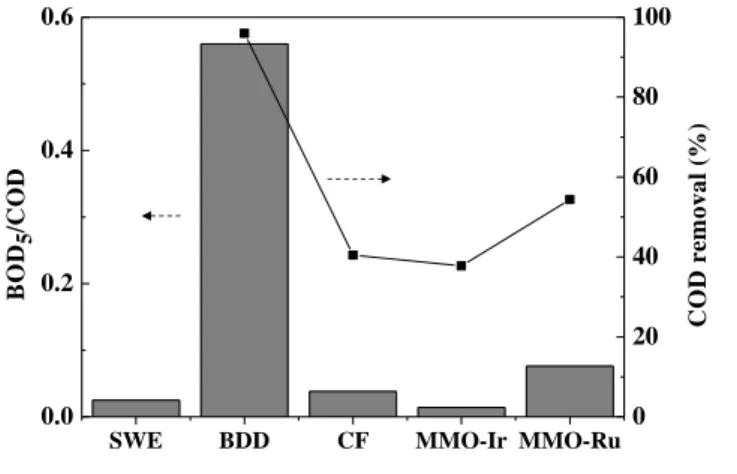
SWE BDD CF MMO-Ir MMO-Ru 0.0
0.2 0.4 0.6
COD removal (%)
BOD5/COD
0 20 40 60 80 100
Graphical Abstracts
Highlights
Anode material influences electrooxidation of atrazine in soil washing effluents
BDD completely removes atrazine but also produces strong mineralization of surfactant Rest of anodes reached approximately 75% atrazine removal and partial mineralization Toxicity slightly decreased in all cases
Biodegradability improved only when using BDD but mineralization should be reduced
*Highlights (for review)
Click here to view linked References
Biodegradability improvement and toxicity reduction of soil
1
washing effluents polluted with atrazine by means of
2
electrochemical pre-treatment: influence of the anode
3
material.
4
5
María Belén Carboneras Contreras1, José Villaseñor Camacho1, Francisco Jesús 6
Fernández-Morales1, Pablo Cañizares Cañizares2, Manuel Andrés Rodrigo Rodrigo2 7
1 Chemical Engineering Department. Research Institute for Chemical and 8
Environmental Technology (ITQUIMA). University of Castilla- La Mancha, 13071, 9
Ciudad Real, Spain.
10
2 Chemical Engineering Department. Faculty of Chemical Sciences and Technology.
11
University of Castilla- La Mancha, 13071, Ciudad Real, Spain.
12 13
Abstract 14
This work focuses on the partial anodic electro-oxidation of atrazine-polluted soil 15
washing effluents (SWE) in order to reduce its toxicity and to improve its 16
biodegradability. Concretely it has been evaluated the influence of the anodic material 17
used. It is hypothesized that such partial oxidation step could be considered as a pre- 18
treatment for a subsequent biological treatment. At first, atrazine was extracted from a 19
polluted soil by means of a surfactant-aided soil-washing process. Then, four different 20
anodic materials were checked studied in partial electro-oxidation pre-treatment batch 21
experiments at different electric current charges applied: Boron Doped Diamond 22
(BDD), Carbon Felt (CF), and Mixed Metal Oxides Anodes with Iridium and 23
Ruthenium. Atrazine, TOC, surfactant and sulphate species concentrations, as well as 24
Highlighted revised Manuscript Click here to view linked References
changes in toxicity and biodegradability, were monitored during electrochemical 25
experiments, showing important differences in their evolution during the treatment. It 26
was observed that BDD was the most powerful anodic material to completely degrade 27
atrazine. The other materials achieve an atrazine degradation rate about 75%. Regarding 28
mineralization of the organics in SWE, BDD overtakes clearly the rest of anodes tested.
29
CF obtains good atrazine removal results while no excessbut low mineralization results.
30
All the anodes tested slightly reduced the ecotoxicity of the water effluents. Regarding 31
About the biodegradability, only the effluent obtained after the pre-treatmentpre-treated 32
with BDD presented a high biodegradabilityat the conditions used in the present work 33
would be suitable for the application of a post-biological step, although mineralization 34
is too strong. In this sense, it must be highlighted the mineralization obtained during the 35
BDD pre-treatment was very strong. These results globally indicate that it is necessary 36
to find a compromise between reaching efficient atrazine removal and biodegradability 37
improvement, while also simultaneously avoiding strong mineralization. Additional 38
efforts should be made to find the most adequate working conditions.
39 40
Keywords 41
Atrazine, soil washing effluent, anodic oxidation, biodegradability, toxicity 42
43
Highlights 44
Anode material influences electrooxidation of atrazine in soil washing effluents 45
BDD completely removes atrazine but also produces strong mineralization of surfactant 46
Rest of anodes reached approximately 75% atrazine removal and partial mineralization 47
Toxicity slightly decreased in all cases 48
Biodegradability improved only when using BDDBDD, but mineralization should be 49
reduced 50
51 52
Conflict of Interest: The authors declare that they have no conflict of interest.
53 54
1. Introduction 55
Biological treatment is the most common technology used to treat polluted water 56
effluents. The main reasons which support this statement are the following: it is a cost 57
effective and eco-friendly technology, it has a high public acceptance, sometimes it is 58
able to carry out the complete destruction of target pollutants, and it can often be carried 59
out on site and can prove less expensiveat lower costs than other technologies (Vidali, 60
2001; Chawla et al., 2013). Nevertheless, it is not specifically designed to eliminate 61
recalcitrant compounds such as pesticides, which can pass through wastewater 62
biological treatment processeswhich are hardly biodegradable (Grandclément et al., 63
2017). For this reason, pesticides and other organic recalcitrant compounds can be 64
usually found in aquatic environment (Aydin et al., 2018) and alsoand in drinking-water 65
supplies (Stackelberg et al., 2007).
66
Atrazine has been one of the most used herbicides around the world from his 67
appearance in 1950 because of its suitable properties. This pesticide is used to control 68
annual grasses and broad-leaved weeds in selected vegetable and cereal crops, vines, 69
fruit orchards, citrus grove, sugar cane, grassland and forestry (Chan et al., 2004). The 70
widely use of atrazine has caused that it can be found in soil, aquatic environment and 71
groundwater (Mandelbaum et al., 1993). Atrazine concentrations about 13 mg kg-1 in 72
heavily contaminated sites have been reported (Belluck et al, 1991), which is 20 times 73
more frequent than other pesticides in groundwater. Atrazine has been shown as a very 74
stable molecule which presents a relative resistance to microbial attack. A previous 75
study done in our research group showsed that atrazine was not able to be biodegraded 76
after a period of 90 days of incubation with activated sludge from a conventional 77
wastewater treatment plant (Carboneras et al., 2017).
78
Because of thatIn this regard, new remediation alternatives have been suggested to 79
pretreat effluents polluted with non-biodegradable compounds pollutants before 80
applying a biological treatment. Electrochemical Advanced Oxidation Processes 81
(EAOPs) have gained increasing attention as a promising technology to remove 82
recalcitrant molecules (Moreira et al., 2017). Anodic Oxidation (AO) is one of the most 83
used EAOP, where pollutants could be oxidized directly at the anode surface by electron 84
transfer or indirectly oxidized thanks to the action of hydroxyl radicals and other 85
oxidative species such as chlorine species or persulphates (Moreira et al., 2017).
86
An important variable which should be considered when using AO is the kind of 87
anodeanodic material used to perform the electrochemical pretreatment. The anodeic 88
material influences the effectiveness of oxidation, degradation pathways, and reactions 89
mechanisms (Zhu et al., 2008; Wang et al., 2012; Zhu et al., 2008). There are two kinds 90
of anodes depending on the Oxygen Evolution Reaction. On one hand, actives anodes, 91
with low O2-overpotentials, where higher oxidation states are available on the electrode 92
surface and adsorbed hydroxyl radicals may interact with the anode. Mixed Metals 93
Oxides and carbon anodes belong to this group. On the other hand, non-active anodes 94
(with high O2-overpotentials) where hydroxyl radicals, called physorbed ‘active 95
oxygen’, may assist the nonselective oxidation of organics (Panizza and Cerisola, 2009;
96
Moreira et al., 2017; Panizza and Cerisola, 2009). Boron-Doped Diamond (BBD), 97
which takes part in the second group, is presented as a potential material to degrade 98
organics thanks to its extraordinary properties (Cobb et al., 2018).
99
AO is a powerful technology to treat recalcitrant wastewater, however the main 100
drawback relate to AO is the energy consumption (Shestakova and Sillanpää, 2017).
101
Hence, some authors have reported the combination of EAOP with biological 102
treatments with the aim of taking advantage of the upsides of both technologies (Oller et 103
al., 2011; Fontmorin et al., 2014; Ganzenko et al., 2014). Coupling EAOP with 104
biological treatment can be combined in 2 ways. If the electrochemical pre-treatment is 105
applied in the first step, the objective will be the partial oxidation of the biologically 106
persistent organic fraction to produce biodegradable reaction intermediates (Carboneras 107
et al., 2018). The opposite way is to apply the EAOP as a post-treatment: first, the 108
mostly biodegradable compounds will be oxidized by microbial attack, and then, the 109
post EAOP step will degrade the recalcitrant compounds (Carboneras et al., 2020). As 110
expected, some authors have achieved good removal efficiencies in the electrochemical 111
degradation of atrazine using BDD (Borrás et al., 2010; Oturan et al., 2012; Bu et al., 112
2018; Bravo-Yumi et al., 2018; Bu et al., 2018 Oturan et al., 2012; Borrás et al., 2010).
113
However, the degradation of this herbicide has not been studied using another kind of 114
anodeic materials. Moreover, the composition of the matrix, in this case a polluted soil, 115
effluent directly affects directly to the removal efficiency of the pollutant (Ribeiro et al., 116
2019) and the present work considers the case of atrazine contained in polluted soil 117
washing effluents.
118
In this context, the aim of the present work is to study the partial anodic oxidation of 119
atrazine-polluted soil washing effluents, in order to reduce its toxicity and improve its 120
biodegradability. Thus, such partial oxidation step could be considered as a pre- 121
treatment for a subsequent biological treatment. In order to reach this objective, the At 122
first, atrazine was extracted from a polluted soil by means of a surfactant-aided soil- 123
washing process. Then, four different anodic materials were checked in partial electro- 124
oxidation pre-treatment batch experiments. The changes in toxicity or biodegradability 125
of soil washing atrazine-polluted effluents were subsequently checked determined by 126
using biological and toxicity standard tests. It is important to note that the present work 127
is not focused on the treatment of atrazine but on the treatment of SWE containing a 128
high amount of surfactant and a low amount of atrazine which is an important difference 129
as compared to other atrazine electrooxidation studies. To the author’s knowledge, no 130
previous works regarding the combination of electrooxidation and biodegradation of 131
atrazine-polluted soil washing effluents using different anodice materials have been 132
reported to date.
133 134 135 136 137 138 139 140 141
2. Materials and methods 142
2.1. Soil and soil washing process 143
The soil used in this work is a real clay soil obtained from a quarry located in Toledo 144
(Spain). The main properties of this soil can be checked elsewhere (Barba et al., 2019).
145
The soil was polluted with pure atrazine (99.1%) supplied by Sigma Aldrich. Atrazine 146
(100 mg) was dissolved in 0.1 dm3 of hexane and then 1 kg of soil was polluted with 147
this solution. To favor the evaporation of hexane, the clay soil was aerated for 1 day.
148
Because of the low solubility of atrazine, the addition of a surfactant wais required forto 149
carry out the soil washing procedure. Thisese kinds of washing processes areis known 150
as Surfactant-Aided Soil Washing (SASW) (Wang and Keller, 2008). The surfactant 151
used was Sodium Dodecyl Sulphate (SDS) and it was supplied by Panreac. The SASW 152
process was carried out in a stirred tank, operated in batch conditions. The polluted soil 153
was mixed with 0.8 dm3 of soil washing fluid (SWF) and 0.5 g of SDS. The SWF 154
consists of a synthetic groundwater. According to the literature (Carboneras et al., 155
2019), tThe composition of thise groundwater used in this work, expressed in mg dm-3, 156
wais the following: 0.667 MgSO4‧ 7H2O, 0.1312 NaCl, 0.130 NaNO3, 0.025 KI and 157
0.249 CaCO3. After 6 hours of mixing, the soil was settled for 12 additional hours to 158
separate the soil from the aqueous phase. The optimization of the SASW process was 159
develop in a previous study (dos Santos et al., 2015). The atrazine concentration 160
obtained in the polluted effluent was about 40 mg dm-3. 161
2.2. Electrochemical reactor and experimental procedure 162
Electrooxidation batch experiments were carried out in ana bench-scale electrochemical 163
flow cell detailed elsewhere (Carboneras et al., 2018). The polluted effluent was 164
introduced into a reservoir tank (5.0 L) and it was passed through the electrochemical 165
cell and recirculated by means of a peristaltic pump (flow rate of 15 mL s-1). The 166
temperature was kept constant (22ºC) using a recirculating water bath. The electrical 167
current was applied using a DC Power Supply (FA-376 PROMAX).
168
Regarding electrode materials, 4 different anodes were used: p-Si Boron Doped 169
Diamond (BDD) manufactured by Adamant (Switzerland), Ruthenium based Mixed 170
Metal Oxides (Ru-MMO) and Iridium based Mixed Metal Oxides (Ir-MMO) 171
Formatted: Superscript
manufactured by Tiaano (India) and Carbon Felt (CF) Sigracell® GFA6EA 172
manufactured by ElectroChem Inc. (USA). CF presented an specific surface area of 173
35.3 m2 g−1 and 17,700 m2 m−2, areal weight 500 g m−2, porosity 95% and roughness 30 174
μm. In all cases, the cathode was an AISI 316 steel electrode. Geometric area of anodes 175
were 78 cm-2 (BDD, MMO-Ir and MMO-Ru) and 100 cm-2 (CF). In all cases, the 176
cathode was an AISI 316 steel electrode, and cathode geometric area was identical to 177
anode area in each case..
178
The experiments were carried out under galvanostatic mode conditions (15 mA cm-2) 179
and liquid samples were taken at different times. The selection of this current density 180
was based on previous experiments carried out with similar pesticides (Bravo-Yumi et 181
al., 2018; Carboneras et al., 2018). A higher current density would generate a higher 182
voltage, leading to detrimental effects for the stability of the carbonaceous anode 183
(Ridruejo et al., 2017).
184
Before experiments, and because of the porosity of the CF electrode, the potential 185
adsorption of atrazine over the electrode surface was determined. To do that, pieces of 186
CF electrodes were submerged in soil washing effluents containing different atrazine 187
concentrations ranging from 25 to 200 ppm during three days (Carboneras et al., 2018).
188
From the obtained results, it can be concluded that atrazine was not absorbed on the CF 189
electrode.
190 191
2.3. Analytical techniques 192
Atrazine concentration in liquid samples was determined by spectrophotometry. The 193
spectrophotometer used was a Pharma Spec 1700 Shimazu®. The wavelength to detect 194
atrazine corresponds to 229 nm. This technique has been reported to show good results 195
for pesticide determination (Debasmita and Rajasimman; 2013; Carboneras et al., 2017;
196
Formatted: Superscript
Formatted: Superscript Formatted: Superscript
Formatted: Superscript
Debasmita and Rajasimman; 2013). Total Organic Carbon (TOC) concentration was 197
monitored using a Multi N/C 3100 Analytic Jena analyzer. The inorganic ions 198
concentration in the water samples were determined by ionic chromatography in a 199
Metrohm 930 Compact IC Flex device. The species monitored by this methodology 200
were fluoride, chloride, chlorate, perchlorate, nitrate, sulphate, sodium, potassium, 201
calcium, phosphate, ammonium and magnesium.
202
Biodegradability was measured by BOD5/COD ratios. BOD5 (Biological Oxygen 203
Demand) measures the oxygen mass that is consumed by microorganisms in the course 204
of 5 days to oxidatively degrade the organic substances present in water, and it was 205
determined by using standard BOD5 tests by triplicate using Standard Methods 206
(A.P.H.A., 1998). The test and the required BOD nutrient solution were provided by 207
Merck. COD (Chemical Oxygen Demand) was also measured by Standard Methods.
208
The required tests for COD determination were supplied by Merck (Germany) in the 209
range of 25-1500 mg dm-3 COD.
210
The determination of toxicity of water samples was carried out by using the 1243 -500 211
BioToxTM Kit. The inhibition of the luminescence is determined by combining 212
different dilutions of the test sample with luminescent bacteria. The bacteria used are 213
Aliivibrio fischeri. The sample toxicity was evaluated as toxicity units (TU), calculated 214
as 100/IC50, where IC50 represents the percent dilution of the initial solution causing 215
50% reduction of the luminescence (Sanchis et al., 2014). The luminometer employed 216
was a Junior LB 9509 portable tube luminometer from Berthold.
217 218 219 220 221
222 223 224 225 226 227 228 229 230
3. Results and discussion 231
3.1.Electrolysis of soil washing effluents 232
The atrazine recovery efficiency of the SAWS corresponded to 40%. This percentage is 233
similar to the obtained in previous studies working with atrazine and other non-polar 234
pesticides (dos Santos et al., 2015; Muñoz-Morales et al., 2017). Because of the high 235
amount of surfactant needed, it is important to consider that only about 1% of the 236
organic amount dissolved in the polluted SWE was atrazine, while the rest corresponds 237
to SDS. This is an important difference as compared to other atrazine electrooxidation 238
works found in the literature (Bravo-Yumi et al., 2018; Zhu et al., 2019), because the 239
atrazine degradation rates, the organic degradation or mineralization efficiencies, and 240
changes in the biodegradability and toxicity can be influenced by the presence of such a 241
high amount of surfactant.
242
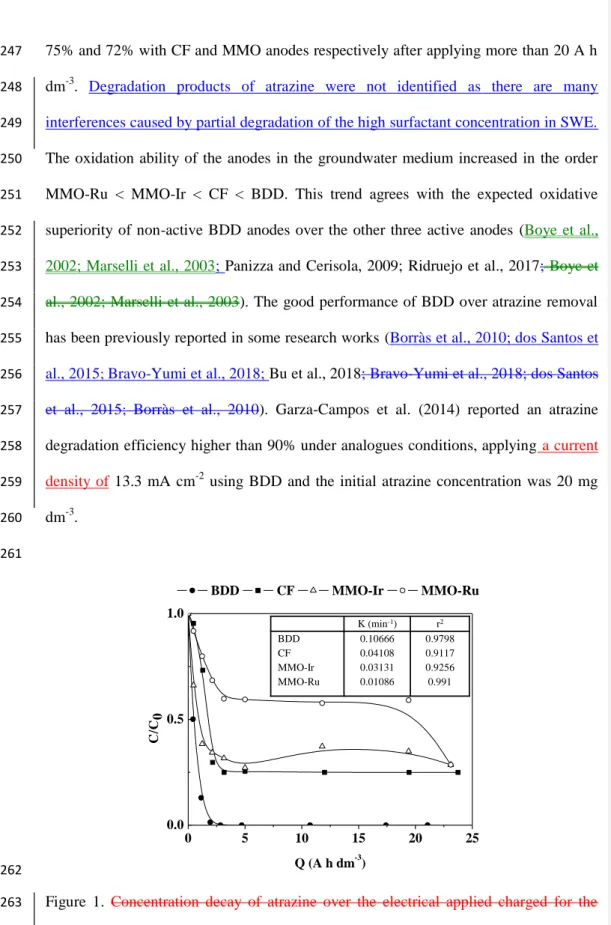
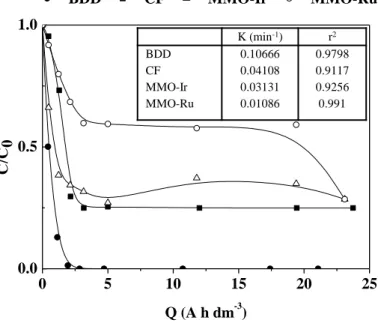
Figure 1 presents the results of atrazine degradation (relative decrease: C/C0) using the 243
four anodes as a function of the electrical charge between 0 to 20 A h dm-3 at a current 244
density of 15 mA cm-2. BDD achieved the total degradation of atrazine after applying 3 245
A h dm-3 of electrical charge. In contrast, atrazine concentration was only reduced by 246
75% and 72% with CF and MMO anodes respectively after applying more than 20 A h 247
dm-3. Degradation products of atrazine were not identified as there are many 248
interferences caused by partial degradation of the high surfactant concentration in SWE.
249
The oxidation ability of the anodes in the groundwater medium increased in the order 250
MMO-Ru < MMO-Ir < CF < BDD. This trend agrees with the expected oxidative 251
superiority of non-active BDD anodes over the other three active anodes (Boye et al., 252
2002; Marselli et al., 2003; Panizza and Cerisola, 2009; Ridruejo et al., 2017; Boye et 253
al., 2002; Marselli et al., 2003). The good performance of BDD over atrazine removal 254
has been previously reported in some research works (Borràs et al., 2010; dos Santos et 255
al., 2015; Bravo-Yumi et al., 2018; Bu et al., 2018; Bravo-Yumi et al., 2018; dos Santos 256
et al., 2015; Borràs et al., 2010). Garza-Campos et al. (2014) reported an atrazine 257
degradation efficiency higher than 90% under analogues conditions, applying a current 258
density of 13.3 mA cm-2 using BDD and the initial atrazine concentration was 20 mg 259
dm-3. 260
261
262
Figure 1. Concentration decay of atrazine over the electrical applied charged for the 263
electrochemical oxidation of polluted SWEEvolution of the atrazine relative 264
0 5 10 15 20 25
0.0 0.5 1.0
BDD CF MMO-Ir MMO-Ru
C/C0
Q (A h dm-3)
K (min-1) r2
BDD 0.10666 0.9798
CF 0.04108 0.9117
MMO-Ir 0.03131 0.9256
MMO-Ru 0.01086 0.991
concentration with the applied electrical charge when treating polluted SWE with 265
different anodic materials, apparent rate constant and square of correlation coefficient.
266 267
According to the background in introduction section, the main oxidant species in the 268
system depend on the anode nature. BDD anode is considered as non-active electrode, 269
where the degradation of the organic molecules is carried out by hydroxyl radicals.
270
Conversely, the other anodes (CF and MMO) are active-electrodes and hydroxyl radical 271
can interact with the anode surface in spite of attacking the target pollutant. In the 272
present work, active chlorine species should be considered because the medium contains 273
chloride ions, however the concentration of NaCl is only 84 mg dm-3, and it remains 274
below the optimal concentration found in bibliography to take advantage about active 275
chlorine oxidant species. In addition, in the case of BDD, the subsequent formation of 276
chlorite, chlorate and perchlorate ions is expected to occur.
277
The initial stage of atrazine depletion, from 0 to 5 A h dm-3 of electrical applied charge 278
can be adjusted to a first-order kinetic model. Figure 1 also summarizes the apparent 279
rate constants and the square of correlation coefficient of the linear fittings. Kinetics 280
analyses corroborate the statement of the superior ability of BDD to degrade organic 281
matter.
282
283
It is known that the active anode MMO-Ru has good performances in chloride medium, 284
because it allows the production of active chlorine species that can attack rapidly the 285
aromatic structures, and they are good catalysts for chlorine evolution (Panizza and 286
Cerisola, 2009). Groundwater medium in the present work contains a concentration of 287
chloride ions about 84 mg dm-3 and therefore, in principle it was expected that MMO- 288
Ru could act as a good anode material for atrazine removal. MeanwhileHowever,, the 289
Formatted: Superscript
behaviour of MMO-Ru in atrazine degradation was not good as expected. Once A 290
reason that could justify the unexpected operation of this anode is that such chloride 291
concentration, as previously indicated, is not high enough. Rajkumar and Palanivelu 292
(2003) optimized a NaCl concentration about 2.5 g dm-3 to degrade cresol using MMO- 293
Ru anodes. On the other hand, Panizza et al. (2007) reported an optimal chloride 294
concentration of 1.2 g dm-3 to degrade methylene blue through anodic oxidation with 295
MMO-Ru anode. As indicated, the chloride concentration in the synthetic groundwater 296
in the present work was only 84 mg dm-3, this value is below to the optimum NaCl 297
concentrations observed in bibliography.
298
Regarding carbon felt electrode, it offered similar behaviour to MMO-Ir. Generally, the 299
use of carbon basedcarbon-based material as anode generates low degradation 300
efficiencies because they can also be electrochemically incinerated (transformed into 301
carbon dioxide) during the electrochemical process when using the high voltages 302
required to oxide organic pollutants (Sopaj et al., 2015). Additionally, itIt should be 303
considered the large great porosity of the carbon felt. Due to this fact, the electrode 304
surface is much larger than that of the other electrodes, which helps and this may help 305
to explain the better performance in atrazine degradation of this electrode in the current 306
density studied over MMO anodeswhen carbon felt electrodes are used instead of the 307
MMO anodes.
308
At this point, it is known that the atrazine molecule is degraded during the electrolysis 309
but, both atrazine and surfactant could be converted into intermediate compounds or 310
they could be finally completely mineralized to CO2. Mineralization is not a desired 311
result in the present work, but it is difficult to avoidPartial mineralization is usually 312
necessary to generate products with good biodegradability, but strong mineralization is 313
not a desired result in the present work. Note that strong mineralization would produce 314
Formatted: English (United Kingdom)
high operation cost as it would reduce the fraction of organic pollution to be oxidized by 315
a subsequent biological step. The mineralization rate of the solution is directly related to 316
the degradation of the surfactant, SDS. It is important to remark that the SWE has an 317
important amount of TOC due to the use of SDS during the SW process. For this 318
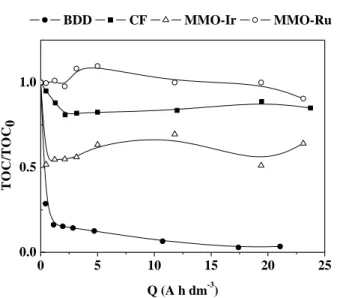
reason, TOC is a significant parameter to consider. Relative TOC depletions 319
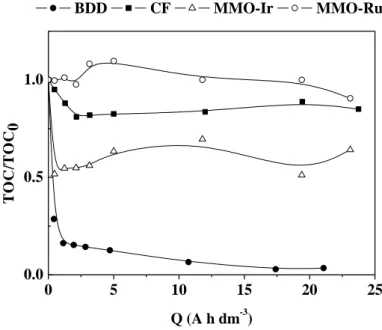
(TOC/TOC0) appear in Figure 2.
320
Figure 2 shows that the BDD anode is the most powerful material that mineralizes most 321
of the organic matter in solution, it means that BDD was powerful enough not only to 322
remove atrazine (Figure 1), but also to mineralize a large amount of its by-products and 323
the surfactant. On the contrary, MMO-Ru was the most inefficient anode to transform 324
the intermediates into CO2. This is not surprising based on the very slow degradation 325
rate observed for atrazine. Regarding the other two materials, MMO-Ir caused an 326
important TOC removal, reaching a 50% of TOC decayremoval. Finally, CF only 327
achieved a 20% of mineralization, which in principle is a good result as atrazine is 328
removed while TOC is not strongly reducedwhich in principle may be a good result 329
(atrazine is removed while TOC is not strongly reduced) if subsequent tests would show 330
a biodegradability increase. The mineralization results obtained with active anodes are 331
in agreementagree to the expected because these kind of materialsthese kinds of 332
materials allow the partial organic degradation, along the formation of many refractory 333
species as final products (Moreira et al., 2017). The greater mineralization achieved 334
with BDD could then be accounted for two factors: the low formation of active chloride 335
species, with subsequent accumulation of a lower amount of chloroderivatives, and the 336
larger ability of BDD to mineralize the intermediates formed (Ridruejo et al., 2017).
337
Formatted: English (United Kingdom)
338
Figure 2. TOC removal over the electrical applied charged for the electrochemical 339
oxidation of polluted SWE.
340 341
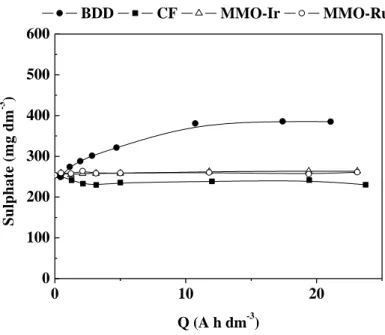
TOC depletion is also related to the generation of sulphate when SDS is oxidized, 342
because the sulphate group contained in the tail of SDS molecule is broken and 343
generates sulphate (dos Santos et al., 2016). The generation of sulphate ions is plotted in 344
Figure 3.
345
The results shown in Figure 3 agree to the ones in Figure 2 (TOC depletion). The 346
highest sulphate concentration is achieved working with BDD anode, which 347
corroborates the good ability of BDD to eliminate TOC. In the experiment carried out 348
with CF, the concentration of sulphate remains constant during electrolysis, indicating 349
again that this anodic material does not degrade the surfactant. Using MMO anodes 350
cause a slight increase of the sulphate ion concentration. This increment is more 351
important working with MMO-Ir, as can be shown in TOC depletion figure Despite 352
MMO-Ir causes higher TOC removal than MMO-Ru (as shown in Figure 2), no clear 353
differences have been observed between both MMO anodes regarding sulphate ions 354
produced during electrolysis (Figure 3).. Using BDD anodes, hydroxyl radicals are 355
0 5 10 15 20 25
0.0 0.5 1.0
BDD CF MMO-Ir MMO-Ru
TOC/TOC0
Q (A h dm-3)
Formatted: English (United Kingdom)
available to be combined with sulphate, forming sulphate radical and mono and 356
diperoxosulphate, a powerful oxidant, which may extend the oxidation from the 357
nearness of the electrode surface to the bulk (Barrera-Díaz et al., 2014). On the other 358
hand, with MMO and CF anodes, these radicals are produced but are consumed in other 359
processes (reversible oxidation of the electrode components) before they can oxidize 360
sulphate anions to sulphate radicals. They are transformed into oxygen, which help to 361
explain the lower efficiency observed They are transformed into oxygen, which help to 362
explain the lower efficiency observed since active electrodes have low O2
363
overpotentials. It means that hydroxyl radicals are quickly converted into oxygen, in 364
contrast to BDD electrode, where these radicals could de accumulated and used to 365
degrade organics (Sopaj et al., 2015).
366 367
368
Figure 3. Sulphate ions produced during the electrolysis of polluted SWE.
369 370
The changes in pH are shown in Figure 4. In the experiment completed with BDD, the 371
value of pH dropped significantly to a final value close to 3.This behaviour is due to the 372
fact that atrazine can generate many acidic compounds of low molecular weight, which 373
0 10 20
0 100 200 300 400 500 600
BDD CF MMO-Ir MMO-Ru
Sulphate (mg dm-3 )
Q (A h dm-3)
Formatted: Subscript
decreases the pH (Martínez-Huitle and Brillas, 2009). This drop in the pH during 374
electrolysis of atrazine with BDD has been previously detected (Bravo-Yumi et al., 375
2018). Moreover, the depletion in pH can be also associated to the release of H+ to the 376
liquid medium during the mineralization or the progressive oxidation of chloride ions 377
which generates H+ (Dominguez et al., 2018).
378
On the other hand, CF produces also a decrease in the pH. This decrease is not so high 379
as the produced with BDD, and thus it would allow a subsequent biological treatment.
380
MMO anodes do not generate a depletion indecreased the pH, but just a slight increase, 381
keeping the and the pH keeps near to neutral value9.0s. Regarding electrical 382
conductivity, not important changes were appreciated during the different electrolyses, 383
and the values (not shown) were kept constants over electrical charge with the four 384
anodes checked.
385 386
387
Figure 4. pH values during anodic oxidation of polluted SWE.
388 389
0 5 10 15 20 25
0 2 4 6 8 10
BDD CF MMO-Ir MMO-Ru
pH
Q (A h dm-3)
Before finishing the discussion of the effect of the different anodes, the changes in the 390
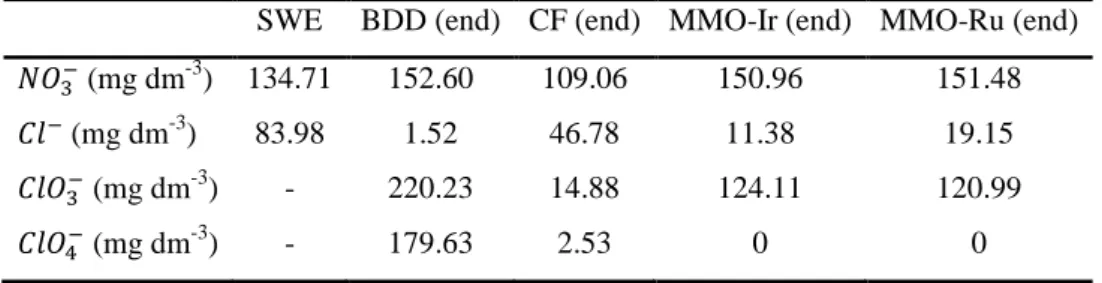
concentrations of inorganic ions were studied. Table 1 shows the ion concentrations for 391
the initial SWE and after electrolyses using the four anodes tested.
392 393
Table 1. Inorganic ions concentrations before and after electrolysis with different anodic 394
materials.
395
SWE BDD (end) CF (end) MMO-Ir (end) MMO-Ru (end) (mg dm-3) 134.71 152.60 109.06 150.96 151.48 (mg dm-3) 83.98 1.52 46.78 11.38 19.15
(mg dm-3) - 220.23 14.88 124.11 120.99
(mg dm-3) - 179.63 2.53 0 0
396
The concentration increases in the case of using BDD and MMO anodes. This 397
trend is indicative of the presence of much lower amounts of N-derivate in the final 398
solutions using these three anodes. It could be due to the preferential destruction of the 399
by-products by active chlorine. On the contrary, the electrolysis carried out with CF 400
tried out a decrease in concentration (Ridruejo et al., 2017). Moreover, 401
deamination of the atrazine molecule leads to the release of (Borràs et al., 2010).
402
The nitrogen of atrazine is converted progressively into , as well as to a 403
much lesser extent, but only in the case of BDD, in a concentration of 3.21 mg dm-3. 404
Similar concentrations of and were detected by Borrás et al. (2010) in the 405
degradation of 30 mg dm-3 of atrazine using BDD.
406
The dechlorination process of atrazine is not detected by IC due to that this process 407
competes with the chlorine evolution. ion is unstable and disappears from the 408
solution in all electrolyses. Table 1 shows that initial was more rapidly removed 409
using BDD than using MMO and CF anodes. The larger destruction of with BDD 410