For Peer Review
Akaline, saline and mixed saline-alkaline stresses induce physiological and morfo-anatomical changes in Lotus tenuis
shoots.
Journal: Plant Biology Manuscript ID: Draft
Manuscript Type: Research Paper Date Submitted by the Author: n/a
Complete List of Authors: Paz, Rosalía; Unidad de Biotecnología 1, IIB-IINTECH/UNSAM-CONICET, Chascomús, Buenos Aires, Argentina,
Reinoso, Herminda Espasandin, Fabiana González Antivilo, Francisco
SANSBERRO, PEDRO; Facultad de Ciencias Agrarias UNIVERSIDAD DEL NORDESTE, 3Instituto de Botánica del Nordeste
Rocco, Ruben; Unidad de Biotecnología 1, IIB-IINTECH/UNSAM-CONICET, Chascomús, Buenos Aires, Argentina,
RUIZ, OSCAR; INTECH-CONICET,
MENÉNDEZ, ANA; UNIVERSITY OF BUENOS AIRES, DEPARTMENT BIODIVERSITY AND EXPERIMENTAL BIOLOGY
Keyword: salinity, alkalinity, shoot anatomy, proline, osmotic potential, transpiration
For Peer Review
Akaline, saline and mixed saline-alkaline stresses induce physiological and morfo-anatomical 1
changes in Lotus tenuis shoots.
2 3
Abridged title: Long term responses to neutral and alkaline stress 4
5
Abstract 6
Saline, alkaline and mixed, saline-alkaline conditions frequently co-occur in soil. In this work, we 7
compared these plant stresses sources on the legume species Lotus tenuis, regarding their effects on 8
shoot growth, and leaf and stem anatomy. In addition, we aimed at gaining insight on the plant 9
physiological status of stressed plants. We performed pot experiments with four treatments, control 10
without salt addition (pH=5.8; EC=1,2 dS m-1) and three stress conditions: saline (100 mM NaCl, 11
pH=5.8; EC=11 dS m-1), alkaline (10 mM NaHCO3 , pH=8.0, EC= 1.9 dS m-1), and mixed salt–
12
alkaline (10 mM NaHCO3 plus 100 mM NaCl, pH=8.0, EC= 11 dS m-1). Neutral and alkaline salts 13
produced a similar level of growth inhibition on L. tenuis shoots, whereas their mixture exacerbated 14
their detrimental effects. Our results showed that none of the analyzed morpho-anatomical 15
parameters categorically differentiated one stress from the other. However, NaCl and NaHCO3- 16
derived stresses could be discriminated by different extents and/or directions of changes in some of 17
the anatomical traits. For example, alkalinity led to increased ostiolar opening area, conversely to 18
NaCl-treated plants, where a stomatal aperture reduction was observed. Likewise, plants from the 19
mixed saline-alkaline treatment characteristically lacked of a palisade mesophyll in their leaves.
20
The stem cross-section and vessels areas, as well as the number of vascular bundles in the sectioned 21
stem were reduced in all treatments. A rise in the number of vessel elements in the xylem was 22
registered in NaCl-treated plants, but not in those treated exclusively with NaHCO3.
23 24
Keywords: salinity, alkalinity, shoot anatomy, proline, osmotic potential, transpiration 25
For Peer Review
26
Authors:
27
Paz, Rosalía Cristina 1,5 28
E-mail: [email protected] 29
Reinoso, Herminda 2 30
E-mail: [email protected] 31
Fabiana Daniela Espasandin 4 32
E-mail: [email protected] 33
González Antivilo, Francisco Alberto 5 34
E-mail: [email protected] 35
Sansberro, Pedro Adolfo 4 36
E-mail: [email protected] 37
Rocco, Ruben Anibal 1 38
E-mail: [email protected] 39
Ruiz, Oscar Adolfo 1#
40
E-mail: [email protected] 41
Menéndez, Ana Bernadina 1,3, #*
42
E-mail: [email protected] 43
44
#A. Menéndez and O. Ruiz contributed equally and should be considered co-senior authors.
45 46
1 Unidad de Biotecnología 1, IIB-IINTECH/UNSAM-CONICET, Chascomús, Buenos Aires, 47
Argentina 48
2 Laboratorio de Morfología Vegetal, Departamento de Ciencias Naturales, Universidad Nacional 49
de Río Cuarto, 5800, Rio Cuarto, Córdoba, Argentina.
50
For Peer Review
3 Departamento de Biodiversidad y Biología Experimental, Facultad de Ciencias Exactas y 51
Naturales, Universidad de Buenos Aires, Argentina 52
4 Facultad de Ciencias Agrarias (UNNE), Instituto de Botánica del Nordeste (IBONE-CONICET), 53
Sargento Cabral 2131, Casilla de Correo 209, W3402BKG Corrientes, Argentina.
54
5 Facultad de Ciencias Agrarias (FCA), Instituto de Biotecnología Agrícola de Mendoza (IBAM), 55
Alte. Brown 500, Chacras de Coria, Lujan de Cuyo, 5505, Mendoza, Argentina.
56 57
*Complete correspondence address 58
Dra. Ana B. Menéndez 59
Departamento de Biodiversidad y Biología Experimental 60
Facultad de Ciencias Exactas y Naturales, 61
Universidad de Buenos Aires.
62
Piso 4 Pab II Ciudad Universitaria (1428) 63
Buenos Aires 64
Argentina 65
Tel: (05411) 45763300-09 int 202 66
Tel/Fax: (05411) 47872706 67
email: [email protected] 68
69 70 71 72
For Peer Review
Introduction 73
Saline stress refers to the presence of neutral salts such as NaCl or Na2SO4 in soil, whereas 74
alkaline stress is only related to the occurrence of alkaline salts (Na2CO3 or NaHCO3, Yang et al., 75
2007). Saline and alkaline stresses affect more than 10% of world arable lands, limiting agricultural 76
production (Lauchli and Luttge, 2002). Both conditions often co-occur in nature, with variable 77
neutral to alkaline salt proportions according to the soil (Shi and Wang, 2005; Li et al., 2010).
78
Saline soils affect plant growth by inducing osmotic inhibition of water absorption (Munns 79
2002). Therefore, cells need to adjust osmotically and reestablish the ion balance (Li et al. 2003).
80
Saline stress also induces ion injury in plants, inhibiting the activity of several enzymes, and 81
hampering protein synthesis, photosynthesis and energetic metabolism (Tester and Davenport, 82
2003). Alkalinity can disrupt the balance of ions (Shi and Zhao 1997), cause micronutrient 83
deficiency due to alteration of micronutrients availability in soil (Alam, et al., 1999) and change 84
antioxidant enzymes, amino acids and carbohydrate composition (Zhang et al., 2012; Kukavika et 85
al., 2013).
86
At the morphological level, NaCl alters morphological and anatomical characteristics of 87
leaves and stems such as leaf thickness, stem cross section area or size and number of xylem vessel 88
(Kiliç et al., 2007; Boughalleb et al., 2009; Dolatabadian et al., 2011). Whereas the relationship 89
between salinity and morpho-anatomical plant responses has been explored to some extent, reports 90
on the effects of alkaline or mixed salt-alkaline stresses are limited to few plant species such as 91
aspen (Mandre et al., 2012), Pisum sativum (Gharsalli et al. 2001), Catharanthus roseus (Cartmill 92
et al. 2008), and Phaseolus vulgaris (Valdez-Aguilar and Reed 2008).
93
Lotus tenuis (Waldst. and Kit., syn. L. glaber) is a glycophytic forage legume, well adapted 94
to the lowlands of the Buenos Aires Province (the most important cattle production region in 95
Argentina). This region is characterized by the presence of soil Na2CO3 and NaHCO3 (Costa and 96
García, 1998), the main sources of high soil alkalinity (pH > 9.0). In a previous work, the response 97
For Peer Review
of L. tenuis plants to saline, alkaline and mixed saline-alkaline stresses were compared in relation to 98
plant growth, key nutrients accumulation, and root architecture and anatomy (Paz et al., 2012).
99
However, the morpho-anatomical responses of L. tenuis shoots to these stresses remained 100
unexplored.
101
With the purpose of increasing current knowledge on differences and similarities between 102
the above mentioned stresses, in this work we proposed to compare saline, alkaline and mixed 103
saline-alkaline stresses on L. tenuis, regarding their effects on shoot growth, and leaf and stem 104
anatomy. In addition, we have prospected leaf proline content, gas exchange, transpiration and 105
osmotic potential in order to gain insight on the plant physiological status of L. tenuis plants grown 106
under these stress conditions.
107 108
Materials and Methods 109
110
Plant growth conditions.
111
Seeds of L. tenuis cv. Esmeralda were scarified with sulphur acid (100%), washed in 112
distilled water and sown in Petri plates containing water-agar (0.8%). Plates were incubated during 113
7 days in a growth chamber, with a 16/8 h photoperiod at (day/night) 24°C/19°C and 60/80±5 % 114
relative humidity. Light intensity (200 µmol m−2 s−1) was provided by daylight and Grolux 115
fluorescent lamps (F 40W). One seedling was transferred to each 5.8 cm (diam) × 20 cm (length) 116
cylindrical pot (one replicate, n=1)) containing washed sand (pH 7.0 and EC= 0.05 dS.m-1) and 117
irrigated with 0.5 × Hoagland’s nutrient solution containing 3 mM KNO3; 2 mM Ca(NO3)2•4H2O; 1 118
mM SO4Mg•7H2O; 0.5 mM NH4H2PO4; 0.5 EDTA NaFeO8•2H2O and 0.5 mM of each of the 119
following micronutrients sources: MnCl2•4H2O, H3BO3, CuSO4•5H2O, ZnSO4•7H2O and 120
MoO4Na2•2H2O. Sand was kept at container capacity during the time-lapse experiment. A drip 121
irrigation system (9001 Digital Watering Timer Weekly Program, ELGO®, www.elgo.co.il) was 122
For Peer Review
used in order to avoid variations in pH and salt accumulation due to water evaporation throughout 123
the experiment. This system allowed a homogeneous distribution of nutrients within the pot and a 124
daily replacement, by percolation, of an amount of nutrient solution equivalent to ¾ of the substrate 125
field capacity.
126 127
Experimental design and stress treatment.
128
Experiments were performed according to a completely randomized design of one factor 129
(stress) and four levels: control, saline, alkaline and mixed salt-alkaline. The alkaline condition in 130
the pot was created by adding 10 mM NaHCO3 to 0.5 × Hoagland´s solution, whereas for the saline 131
condition, 100 mM NaCl were used as the salt stress source. For the mixed saline-alkaline 132
treatment, we employed the same 0.5 × Hoagland´s solution additioned with 90 mM NaCl plus 10 133
mM NaHCO3, thus obtaining a stress solution with the same Na+-derived EC, but a higher alkalinity 134
than that of the saline stress treatment. Control treatment consisted of plants irrigated with 0.5 × 135
Hoagland´s solution without NaCl or NaHCO3 addition. The pH and EC of irrigation solutions were 136
monitored every 3 days with a combined pH meter/conductimeter (HI 255, Hanna Instrument) and 137
maintained at pH-EC (dS m-1) 5.8-1.2; 5.8-11; 8.0-1.9 and 8.0-11, for control, saline, alkaline and 138
mixed saline-alkaline treatments, respectively. In order to avoid any osmotic shock in the saline and 139
mixed saline-alkaline treatments, 8-day-old seedlings initially received 30 and 20 mM NaCl plus 10 140
mM NaHCO3 concentrations, respectively. Salt concentrations were then stepwise increased during 141
one week (acclimatation) until reaching final concentrations. In the alkaline treatment, 8-day-old 142
plants received the final NaHCO3 concentration. After acclimation, plants were further grown under 143
their respective treatments during 20 days longer.
144 145
Growth and morphological parameters 146
For Peer Review
Ten plants per treatment were used for dry matter, length and number of stem nodes and leaf 147
area determinations (n=10). For dry matter, plants were dried at 60°C until constant weight. For leaf 148
area, fully extended leaves were scanned with a 600 ppi resolution (HP PSC 1510 Hewlett Packard 149
Development Company, LP, USA). Leaf area was measured on digitalized images with the Image- 150
ProPlus V 4.1 software.
151 152
Analysis of leaf and stem anatomy 153
Anatomical variations caused by the three different stresses were analyzed in tissues 154
developed at the end of the experiment in eight plants per treatment (n=8). A 1 cm long stem 155
sample was sectioned from the internode immediately below the apical bud, whereas the leaf from 156
the basal portion of this internode was dissected. The micro morphology of leaf epidermis was 157
analyzed according to D´Ambrogio de Argüeso (1986). Briefly, FAA 158
(Formaldehyde:Alcohol:Acetic Acid, 10%:50%:5% + 35% water) fixed leaves were incubated in 159
5% KOH at 35°C, overnight and then stained with 5% Safranin. Abaxial and adaxial epidermis 160
were removed from mesophyll with dissecting needles, mounted on slides with water-glycerin (1:1), 161
and observed at 400× (Nikon-Eclipse E-600 microscope attached to a computer and a digital camera 162
Nikon DS Qi1Mc). The ostiolar opening area (or stomatal aperture) and the number of stomata and 163
ordinary epidermal cells per mm2 were registered in the central leaflets. Data from abaxial and 164
adaxial faces were averaged. The stomatal index was calculated according to Salisbury (1927): SI 165
(%)= stomatal density/(stomatal density + epidermal cell density) x 100. Leaf and internode 166
samples were fixed with FAA, dehydrated and embedded according to the procedures outlined in 167
Johansen (1940). A series of transversal cross sections 10 µm thick were obtained from the sample 168
blocks using a Minot rotary microtome. Cross sections were observed under the microscope and 169
photographed. Digitalized images were analyzed with the Image-ProPlus V 4.1 software. The 170
cuticle-epidermis height in both leaf faces, and the morphology and thickness of each mesophyll 171
For Peer Review
(spongy and palisade) were measured on digitalized images of leaf transversal cross sections. The 172
cross-section areas of stem, cortex, bundle xylem and phloem, vessel elements and pith, as well as 173
the stem epidermal thickness and number of bundles, were also measured on digitalized images.
174 175
Analytical determinations 176
Leaf proline content was estimated spectrophotometrically by the ninhydrin reaction method (Troll 177
and Lindsley, 1955) with modifications (Magné and Larher, 1992). Data was collected from six 178
plants for each treatment (n=6).
179 180
Gas-exchange measurement 181
Fifteen days after the stress treatment was initiated, transpiration rate (E, mmol m_2 s_1) and mean 182
stomatal conductance (g) were measured in intact, fully expanded leaves, which were basal to the 183
internode immediately below the apical bud. This measurement was performed with an infrared gas 184
analyzers built into a leaf cuvette in an open-flow gas exchange system (LiCor 6400, USA).
185
Measurement conditions were: PPFD, 1500 µmol m-2 s-1; airstreams, 350 µmol CO2 mol-1; leaf 186
temperature, 27°C; leaf-to-air vapor pressure deficit: 1.6 kPa was also measured with a LI-6400.
187
Data was collected at mid-day, from ten plants for each treatment (n=10).
188 189
Osmotic potential (ψπ100) measurement.
190
At the en of the experiment, leaves from the same region as above were re-hydrated to 191
constant fresh weight by placing them in a beaker of distilled water under controlled environmental 192
conditions. Fully hydrated leaves were then introduced in a syringe, frozen in liquid N2 and kept at - 193
80°C, pending for further analysis. Syringes were thawed until samples reached room temperature, 194
and the ψπ100 of leaked sap was measured with a C-52 thermocouple. Data was collected from three 195
plants for each treatment (n=3).
196
For Peer Review
197
Statistical analysis.
198
Data was subjected to one-way analysis of variance (ANOVA), and comparisons using 199
Duncan´s test. A y=log10x transformation was used to correct the lack of normality in biomass data.
200 201
Results 202
203
Plant growth and morphology 204
The three stress treatments substantially reduced total plant biomass, stem length and 205
number of nodes (Fig 1A, B and C). The amount of growth reduction induced by NaCl or NaHCO3
206
as a sole stress source was similar, whereas the combination of both salts led to a maximum growth 207
reduction.
208
Our results also showed that leaf area was negatively affected by alkalinity, in either 209
presence or absence of the neutral salt (Fig 1D). In contrast, the leaf area did not change in plants 210
treated exclusively with NaCl.
211 212
Effect of salt treatments on leaf anatomy.
213
The leaf epidermal cells density was drastically reduced by soil alkalinity (Table 1), 214
indicating an enlargement of the epidermal cell size. Opposite to the former result, this parameter 215
did not change in NaCl-treated plants. Alkalinity also led to reduced stomatal density, being this 216
reduction more obvious in the mixed salts treatment. However, the SI was not affected by any 217
stress. On other hand, plants treated with NaCl (either alone or mixed with the alkaline salt), 218
showed reduced ostiolar opening area compared with control plants. Interestingly, plants treated 219
with NaHCO3 as a sole stress source presented a higher ostiolar opening area than control plants.
220
For Peer Review
L. tenuis leaves have a dorsiventral mesophyll, consisting of one layer of palisade and one 221
layer of spongy tissue (Fig 2). Leaf thickness was increased by NaCl treatment, as result of 222
augmented cuticle thickness, higher epidermal height and increased thickness of mesophyll cells 223
(Table 1, Fig 2). Alkalinity also led to augmented leaf thickness derived from increments in cuticle 224
and spongy parenchyma thickness, and in epidermal cells heights. However, the most striking effect 225
of alkalinity on leaf anatomy was the dorsiventral mesophyll loss, because palisade parenchyma 226
cells became more isodiametric and larger, losing their shape, and preventing the differentiation 227
between palisade and spongy parenchyma. This phenomenon was observed in 50% and 100% of 228
analyzed leaves in the alkaline and mixed saline-alkaline treatments, respectively (data not shown), 229
and whenever palisade parenchyma was recognizable in the alkaline treatment, their cells were 230
highly vacuolated and thicker, compared with the control.
231 232
Effect of salt treatments on stem anatomy.
233
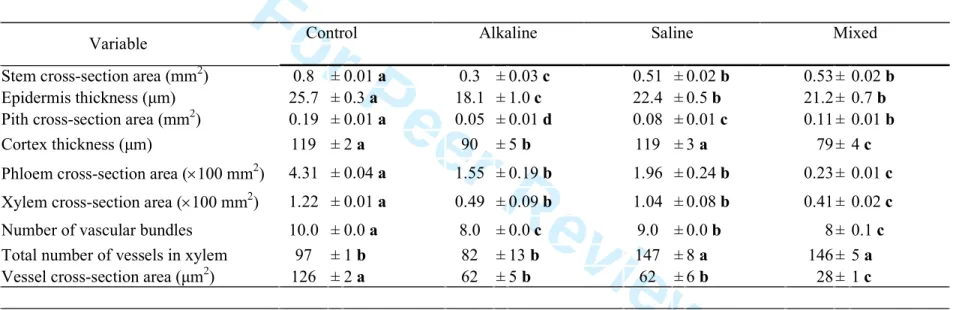
The stem cross-section area was reduced in all cases, because of decreased pith, phloem and 234
xylem cross-section areas, and reduced epidermal height (Table 2). In plants treated exclusively 235
with the alkaline salt, a diminution of the cortex cross-section area was also observed, in addition to 236
the above-mentioned effects, leading to a maximal stem cross-section area contraction in this 237
treatment (Table 2).
238
The number of vascular bundles in the sectioned stem was also reduced by the three saline 239
treatments, although the effect was more obvious under elevated alkalinity (Table 2). On other 240
hand, a noteworthy rise in the number of vessel elements in the xylem was registered in NaCl- 241
treated plants, but not in those treated exclusively with NaHCO3. In contrast, the area of each vessel 242
element was diminished in all cases. Moreover, both salts showed a synergistic effect on vessel 243
cross-section area when applied simultaneously.
244 245
For Peer Review
246
Effect of salt treatments on leaf proline content, gas exchange, transpiration and osmotic 247
potential.
248
The leaf proline content was increased in leaves of NaCl-treated plants, whereas NaHCO3
249
did not affect this content (Fig 3).
250
Reductions of g and E were observed in L. tenuis plants treated with NaCl regardless the 251
alkalinity level (Fig 4). Contrarily, there were not changes in g or E in plants confronted exclusively 252
with NaHCO3 (Fig 4).
253
At the time of harvest, the leaf ψπ100 was not significantly altered by separately applied NaCl 254
or NaHCO3, but in plants treated with the mixture of the neutral and alkaline salts, the ψπ
100 was 255
significantly augmented (Fig 5).
256 257
Discussion 258
259
The present work was aimed at exploring and comparing the morpho-anatomical responses 260
of L. tenuis shoots to alkaline, saline and mixed saline-alkaline stresses. Our results showing that 261
separately applied NaCl and NaHCO3 salts induced similar growth reductions (Fig 1) is in contrast 262
with previous studies where alkaline salts created a significantly higher level of plant toxicity than 263
neutral salts (Shi and Wang 2005; Shi and Sheng 2005; Wang et al. 2008; Yang et al. 2008). Such 264
seeming disparity may be explained by the fact that at the NaHCO3 concentration used in our work 265
(10 mM, a several-fold lower concentration than those used by other authors), the ionic and osmotic 266
components of saline stress are avoided and the growth reduction effect can be fundamentally 267
attributable to alkalinity (Yang et al., 2008). Whereas neutral and alkaline salts produced a similar 268
level of growth inhibition on L. tenuis shoots, their mixture exacerbated their detrimental effects.
269
For Peer Review
Such synergism is in line with previous observations reported for other glycophytes (Shi and Wang 270
2005; Shi and Sheng 2005; Wang et al., 2008; Yang et al., 2008).
271 272
Salt treatments effects on leaf and stem anatomy.
273
The anatomical analysis revealed that leaves and stems exhibited a plastic response to the 274
three evaluated stress conditions (Tables 1 and 2). Interestingly, an enlargement of the epidermal 275
cell size was found in plants grown under alkaline conditions. To our knowledge, there are no 276
previous reports showing an alkalinity-induced enlarging effect on plant cells, beyond the 277
documented relationship between alkalinity and cell extension in growing lily pollen tube (Lovy- 278
Wheeler et al, 2006), and therefore, additional specific experimentation in this regard would be 279
worthwhile of further attention.
280
The fact that the NaCl addition (regardless the alkalinity level) reduced the ostiolar opening 281
area of L. tenuis leaves is in accordance with the concept that osmotic stress (either elicited by water 282
deficit or high salt concentration) leads to stomatal closure. Similarly, our finding that NaHCO3, as 283
sole stress source, induced higher ostiolar opening area is compatible with previous results 284
indicating that the stomatal aperture of isolated abaxial epidermis (incubated on simple buffers) 285
increased with the external alkalinity (Wilkinson and Davies, 1997).
286
On other hand, despite the cell size augmentation observed in plants treated with NaHCO3, 287
leaf area was reduced, suggesting that alkalinity decreased new cells production by leaf meristem.
288
The reduced leaf area evidenced in our alkalinized L. tenuis plants (either in presence or absence of 289
NaCl) is in accordance with previous results obtained from several ornamental species such as rose, 290
vinca, chrysanthemum and hibiscus treated with bicarbonate (HCO3-, Valdez-Aguilar, 2004, 291
Cartmill et al., 2007, 2008). In addition, the neutral effect of NaCl, as sole stress source, observed 292
on the L. tenuis leaf area agrees with former results obtained on soybean (Dolatabadian et al., 293
2011).
294
For Peer Review
Our finding that plants treated with NaCl presented thicker leaves is in line with descriptions 295
in several other plant species (e.g.: Qadir and Shams, 1997; De Vos et al., 2010), suggesting the 296
occurrence of osmolytes accumulation and osmotic adjustment. Plants treated exclusively with 297
NaHCO3 also presented thickened leaves, although in a much lower extent compared with NaCl 298
addition, but this effect should not be assigned to an osmotic effect, since a low salt concentration 299
(10 mM) was used in this treatment.
300
The observed loss of leaf mesophyll dorsiventrality in plants grown under high alkalinity 301
highlights a different stress sensitivity between palisade and spongy parenchyma mesophylls. As far 302
as we know, mesophyll dorsiventral loss has been reported formerly only in plants subjected to low 303
temperature stress (Kadohama et al., 2013). It has been postulated that since palisade mesophyll is 304
the site for most of the plant photosynthetic activity, an increased palisade: spongy mesophyll ratio 305
positively increases photosynthesis (Kulkarni et al., 2008). Thus, our results showing the absence of 306
palisade mesophyll in most of the analyzed leaves of NaHCO3-treated plants could have possibly 307
contributed with the noticeable growth diminution registered in these plants.
308
The reduction in the stem cross-section area observed in L. tenuis plants stressed exclusively 309
with NaCl, is in line with previous studies performed on diverse plant species subjected to this 310
saline condition (Qadir and Shams, 1997; Habba et al., 2013; Guo et al., 2013; dos Santos et al, 311
2013; Soltekin et al, 2012). In the case of plants treated with the mixed salts, the registered smaller 312
leaf area could have led to further reduction of the stem cross-section area. However, maximal stem 313
cross-section reduction was registered in L. tenuis plants treated exclusively with NaHCO3. In these 314
plants, the observed reduction could be related to other sources of growth constraint not measured 315
in this work, such as diminished cell division and expansion, besides a smaller leaf area. In turn, 316
slender stems could affect bending, tensile and shearing properties of L. tenuis plants. These 317
properties could be significant from the economical viewpoint, given the importance of L. tenuis as 318
forage species, in several cattle production areas worldwide.
319
For Peer Review
Fewer vascular bundles, along with smaller vessel cross-section area was observed in salt- 320
treated L. tenuis plants. These anatomical changes may lead to hampered water and solutes transport 321
capacity. Therefore, our result displaying a rise in the number of vessel elements due to NaCl 322
treatment could be interpreted as an adaptive response of L. tenuis plants to withstand the osmotic 323
constraint imposed by NaCl, as it was shown for other crop species (Cachorro et al., 1993; Nawaz 324
et al., 2013).
325
Effect of salt treatments on leaf proline content, gas exchange, transpiration and osmotic 326
potential.
327
The amino acid proline is one of the compatible osmolytes that most commonly build up in 328
the cytoplasm as response to osmotic imbalance (Hasegawa et al. 2000). The increased leaf proline 329
content detected in plants treated with NaCl (Fig 3), put forward that they had experienced some 330
extent of osmotic stress. Furthermore, the fact that the proline level was not affected in plants 331
treated exclusively with 10 mM NaHCO3 indicates that no salt-derived osmotic effect intervened 332
and hence, the observed growth and morphological detrimental effects should be assigned to 333
alkalinity itself. This result helps to explain the apparent incongruence between our finding (no 334
difference between alkaline and neutral salts in their effect on plant growth) and those obtained by 335
other authors, who used a several-fold higher NaHCO3 concentration, and reported a higher level of 336
plant toxicity in plants treated with the alkaline, compared with the neutral salt (Shi and Wang 337
2005; Shi and Sheng 2005; Wang et al. 2008; Yang et al. 2008).
338
Diminutions in g and E parameters noted in NaCl-treated plants (Fig 4) are congruent with 339
the observed decrease in the ostiolar opening area and could have accounted for the decline in plant 340
growth registered in both NaCl treatments (Table 1; Fig 1). Since enhanced transpirational volume 341
flow tends to augmentate salt accumulation and hence, cell damage (Munns, 1985), the observed 342
contracted ostiolar opening area may be interpreted as an adaptive L. tenuis response to the osmotic 343
component of saline stress. On other hand, our results from plants treated exclusively with NaHCO3
344
For Peer Review
showed no changes in g or E. This result would advocate a possible compensation effect between an 345
increase in the ostiolar opening area and a reduction in the stomata density in these plants. A similar 346
salinity-induced reduction in stomata density was recently reported for the halophyte species 347
Chenopodium quinoa (Orsini et al., 2011; Shabala et al., 2012) and was interpreted as a 348
fundamental mechanism by which quinoa plants may improve water use efficiency under saline 349
conditions. Since the waxy cuticle of leaves allows water and small amounts of CO2 to pass through 350
(Scott, 1964,1966; Norris and Bukovac, 1968; Leon and Bukovac, 1978; Boyer et al., 1997), one 351
may also hypothesize that the increase in cuticle thickness observed in plants from this treatment 352
could have contributed to the E balance.
353
Another outcome of our work was the increased leaf ψπ100 observed in L. tenuis plants 354
subjected to the mixed saline-alkaline treatment (Fig 5). However, the proline level reached by 355
plants in this treatment (0.4 µmol.g-1 fresh weight, Fig 3) seems to be too low to act as osmolyte, 356
compared with those needed for conventional osmotic adjustment (Marcum, 2006). On other hand, 357
adverse environmental factors may induce a rapid production of reactive oxygen species (ROS), 358
leading to oxidative burst and cell damage (Mittler, 2002). In turn, proline may significantly reduce 359
ROS-induced K+ effluxes (Cuien and Shabala, 2005, 2007). It has been postulated that a number of 360
functions played by proline could come into the effect of reducing the extent of the ROS-induced 361
K+ efflux, such as free radicals scavenging (Smirnoff and Cumbes, 1989), reduction of ROS 362
generation (Hong et al., 2000), osmoprotection (Delauney and Verma, 1993) and protein 363
stabilization (Shah and Dubey, 1998). Therefore, it is possible that the increased proline level could 364
have indirectly contributed to the osmotic adjustment of L. tenuis leaves in the mixed saline- 365
alkaline treatment.
366 367
Conclusions 368
For Peer Review
Neutral and alkaline salts produced a similar level of growth inhibition on L. tenuis shoots, 369
whereas their mixture exacerbated their detrimental effects. On other hand, common and distinct 370
effects of the three stresses on L. tenuis shoot growth and anatomy were evidenced, according to the 371
analyzed parameter. Our results showed that none of the analyzed parameters categorically 372
differentiated the three types of stress from each other. However, NaCl and NaHCO3-derived 373
stresses could be discriminated by different extents and/or directions of changes in some of the 374
anatomical traits. For example, alkalinity itself presented increased ostiolar opening area, 375
conversely to NaCl-treated plants, where a reduction of the stomatal aperture was observed.
376
Likewise, plants from the mixed saline-alkaline treatment may be recognized by the lack of a 377
palisade mesophyll in their leaves. The conspicuous lack of information regarding the effect of 378
alkalinity on plant cell growth prevents us from further discussing our results related with high pH 379
conditions, while invites to conduct research in this direction. Further studies are required to 380
ascertain the unambiguous cause-and-effect relationships between the observed anatomical traits 381
changes in L. tenuis and each of the factors intervening in the three studied stresses (e.g.: osmotic, 382
toxicity, pH homeostasis, etc.). Such studies could help to design mechanistic models for predicting 383
the whole-plant response to stresses derived from different salt sources.
384 385
Acnowledgements 386
This work was supported by the following Argentine grants: PICT, Agencia Nacional de Promoción 387
Científica y Tecnológica (ANPCYT), Consejo Nacional de Investigaciones Científicas y Técnicas 388
(CONICET), Universidad de San Martin (UNSAM) and Comisión de Investigaciones Científicas de 389
la Provincia de Buenos Aires (CIC). Authors acknowledge grants in-aid from COST-Action 390
FA0605. We also thank Sr. Jorge Luis Paz for their valuable help with the irrigation system set up.
391
RCP expresses her gratitude to CONICET for doctoral fellowships.
392 393
For Peer Review
References 394
Alam S.M., Mehdi Naqvi S.S., Ansari R. (1999) Impact of Soil pH on Nutrient Uptake by Crop 395
Plants. In: “Handbook of Plant and Crop Stress” M. Pessarakli (Ed) pp 51–60.
396
doi:10.1201/9780824746728.ch3 397
Boughalleb F., Denden M., Tiba B.B. (2009) Anatomical changes induced by increasing NaCl 398
salinity in three fodder shrubs, Nitraria retusa, Atriplex halimus and Medicago arborea. Acta 399
Physiologiae Plantarum 31, 947-960. doi:10.1007/s11728-009-0310-7 400
Boyer J.S., Wong S.C., Farquhar C.D. (1997) CO, and Water Vapor Exchange across Leaf Cuticle 401
(Epidermis) at Various Water Potentials. Plant Physiology 114, 185-191.
402
Cachorro P., Ortiz A., Barcelo A.R., Cerda A. (1993) Lignin deposition in vascular tissues of 403
Phaseolus vulgaris roots in response to salt stress. Phyton-Annales Rei Botanicae 33, 33-40.
404
Cartmill A., Alarcón A., Valdez-Aguilar L.A. (2007) Arbuscular mycorrhizal fungi enhance 405
tolerance of Rosa multiflora cv. Burr to bicarbonate in irrigation water. Journal of Plant Nutrition 406
30, 1517–1540.
407
Cartmill A.D., Valdez-Aguilar L.A., Bryan D.L., Alarcón A. (2008) Arbuscular mycorrhizal fungi 408
enhance tolerance of vinca to high alkalinity in irrigation water. Scientia Horticulturae 115, 275–
409
284. doi:10.1016/j.scienta.2007.08.019 410
Costa J.L., García F.O. (1998) Respuesta de un pastizal natural a la fertilización con fósforo y 411
nitrógeno en un natracuol. Revista de Investigaciones Agropecuarias 28, 31-39.
412
Cuin A.T, Shabala S. (2005) Exogenously supplied compatible solutes rapidly ameliorate NaCl- 413
induced potassium efflux from barley roots. Plant Cell Physiology 46, 1924-1933.
414
Cuin A.T, Shabala S. (2007) Compatible solutes reduce ROS-induced potassium efflux in 415
Arabidopsis roots. Plant Cell and Environment 30, 875-885.
416
D'ambrogio de Argüeso A. (1986) Manual de Técnicas en Histología Vegetal. Hemisferio Sur. Pp.
417
50-67. (Buenos Aires Publisher) 418
For Peer Review
Delauney A.J., Verma D.P.S. (1993) Proline biosíntesis and osmoregulation in plants. Plant Journal 419
4, 215-223.
420
De Vos A.C., Broekman R., Groot M.P., Rozema J. (2010) Ecophysiological response of Crambe 421
maritima to airborne and soil-borne salinity. Annals of Botany 105, 925-937.
422
doi:10.1093/aob/mcq072 423
Dolatabadian A., Modarressanavy S.A.M., Ghanati F. (2011) Effect of salinity on growth, xylem 424
structure and anatomical characteristics of soybean. Notulae Scientia Biologicae 3, 41-45.
425
dos Santos J.B., dos Santos D.B., de Azevedo C.A.V., Rebequi A.M., Cavalcante L.F., Cavalcante 426
I.H.L. (2013) Comportamento morfofisiológico da mamoneira BRS energia submetida à irrigação 427
com água salina | [Morphophysiological behavior of castor bean brs energia submitted to irrigation 428
with saline water]. Revista Brasileira de Engenharia Agrícola e Ambiental 17, 145–152.
429
Gharsalli M., Zribi K., Hajji M. (2001) Physiological responses of pea to iron deficiency induced by 430
bicarbonate. In “Plant nutrition- food security and sustainability of agro-ecosystems”. IN Horstet 431
(Ed) pp. 606-607. doi: 10.1007/0-306-47624-X_294 432
Guo X.P., Tackmore M., Obai K., Salahou M.K. (2013) The combined effects of salinity and water 433
stress on the growth and yield quality of tomato. Applied Mechanics and Materials 295, 2265- 434
2273. doi:10.4028/www.scientific.net/AMM.295-298.2265 435
Habba I.E., Abd El Aziz N.G., Metwally .SA., Mazhar A.A.M. (2013) Response of growth and 436
chemical constituents in Khaya sengalensis to salinity and gypsum under calcareous soil 437
conditions. World Applied Sciences Journal 22, 447-452.
438
Hasegawa P.M., Bressan R.A., Zhu J.K., Bohnert H.J. (2000) Plant cellular and molecular 439
responses to high salinity. Annual Review of Plant Physiology 51, 463–499.
440
Hong Z.L., Lakkineni K., Zhang Z.M., Verma D.P.S. (2000) Removal of feedback inhibition of ∆1- 441
pyrroline-5-carboxylated synthetase results in increased proline accumulation and protection of 442
plants from osmotic stress. Plant Physiology 122, 1129-1136.
443
For Peer Review
Johansen D.A. (1940) Plant microtechnique. McGraw-Hill (Ed) pp. 1-523. (New York) 444
Kadohama N., Goh T., Ohnishi M., Fukaki H., Mimura T. (2013) Sudden collapse of vacuoles in 445
Saintpaulia sp. palisade cells induced by a rapid temperature decrease. PLoS ONE 8, e57259.
446
doi:10.1371/journal.pone.0057259 447
Kiliç S., Cavuşoğlu K., Kabar K. (2007) Effects of 24-epibrassinolide on salinity stress induced 448
inhibition of seed germination, seedling growth and leaf anatomy of barley. Journal of Science 2, 449
41-52.
450
Kukavica B., Morina F., Janjiæ N., Boroja N., Jovanoviæ L., Veljoviæ-Jovanoviæ D. (2013) Effects 451
of mixed saline and alkaline stress on the morphology and anatomy of Pisum sativum: the role of 452
peroxidase and ascorbate oxidase in growth regulation. Archives of Biological Sciences 65, 265- 453
278. doi:10.2298/ABS1301265K 454
Kulkarni M., Borse T., Chaphalkar S. (2008) Mining anatomical traits: a novel modeling approach 455
for increased water use efficiency under drought conditions plants. Czech Journal of Genetics and 456
Plant Breeding 44, 11-21.
457
Läuchli A., Lüttge U. (2002) Salinity: Environment — Plants — Molecules. (Ed XIV) pp. 552.
458
Leon J.M., Bukovac M.J. (1978) Cuticle development and surface morphology of olive leaves with 459
reference to penetration of foliar-applied chemicals. Journal of the American Society of 460
Horticultural Science 103, 465-472.
461
Li P.H., Zhang H., Wang B.S. (2003) Ionic homeostasis of plant under salt stress. Acta Botanica 462
Boreal-Occident Sin 23, 1810-1817.
463
Li R., Shi F., Fukuda K. (2010) Interactive effects of salt and alkali stresses on seed germination, 464
germination recovery, and seedling growth of a halophyte Spartina alterniflora (Poaceae). South 465
African Journal of Botany 76, 380–387. doi:10.1016/j.sajb.2010.01.004 466
For Peer Review
Lovy-Wheeler A., Kunkel J.G., Allwood E.G., Hussey P.J., Hepler P.K. (2006) Oscillatory 467
increases in alkalinity anticipate growth and may regulate actin dynamics in pollen tubes of lily.
468
Plant Cell 18, 2182–2193. doi:10.1105/tpc.106.044867 469
Magné C., Larher F. (1992) High sugar content of extracts interferes with colorimetric 470
determination of amino acids and free proline. Analytical Biochemistry 200, 115-118.
471
Mandre M., Klõšeiko J., Lukjanova A., Tullus A. (2012) Hybrid aspens responses to alkalization of 472
soil: growth, leaf structure, photosynthetic rate and carbohydrates. Trees 26, 1847–1858.
473
doi:10.1007/s00468-012-0754-z 474
Marcum K.B. (2006) Saline tolerance physiology in grasses. In: “Ecophysiology of High Salt 475
Tolerant Plants” M.A. Khan, D.J. Weber (Eds) pp 157-172.
476
Mittler R. (2002) Oxidative stress, antioxidants and stress tolerance. Trends in Plant Science 7, 405- 477
410.
478
Munns R. (2002) Comparative physiology of salt and water stress. Plant, Cell & Environment 25, 479
239-250.
480
Munns, R. (1985) Na+, K+ and C1- Xylem sap flowing to shoots of NaCl-treated barley. Journal of 481
Experimental Botany 36, 1032-1042.
482
Nawaz T., Hameed M., Ashraf M., Batool S., Naz N. (2013) Modifications in root and stem 483
anatomy for water conservation in some diverse blue panic (Panicum antidotale Retz.) ecotypes 484
under drought stress. Arid Land Research and Management 27, 286-297.
485
doi:10.108715324982.2012.727947 486
Norris R.R., Bukovac M.J. (1968) Structure of the pear leaf cuticle with special reference to 487
cuticular penetration. American Journal of Botany 55, 975-983.
488
Orsini F., Accorsi M., Gianquinto G., Dinelli G., Antognoni F., Ruiz Carrasco K.B., Martínez E.A., 489
Alnayef M., Marotti I., Bosi S., Biondi S. (2011) Beyond the ionic and osmotic response to 490
For Peer Review
salinity in Chenopodium quinoa: functional elements of successful halophytism. Funtional Plant 491
Biology 38, 818-831.
492
Paz R.C., Rocco R.A., Reinoso H., Menéndez A.B., Pieckenstain F.L., Ruiz A.O. (2012) 493
Comparative study of alkaline, saline, and mixed saline-alkaline stresses with regard to their 494
effects on growth, nutrient accumulation, and root morphology of Lotus tenuis. Journal of Plant 495
Growth Regulation 31, 448-459. doi:10.1007/s00344-011-9254-4 496
Qadir M., Shams M. (1997) Some agronomic and physiological aspects of salt tolerance in cotton 497
(Gossypium hirsutum L.) Journal of Agronomy and Crop Science 179, 101-106.
498
Salisbury E.J. (1927). On the causes and ecological significance of stomatal frequency, with special 499
reference to the woodland flora. Philosophical Transactions of the Royal Society of London B216, 500
1–65.
501
Scott F.M. (1964) Lipid deposition in the intercellular space. Nature 203, 164-165.
502
Scott F.M. (1966) Cell wall surface of the higher plants. Nature 210, 1015-1017.
503
Shabala L., Mackay A., Tian Y., Jacobsen S., Zhou D., Shabala S. (2012. Oxidative stress 504
protection and stomatal patterning as components of salinity tolerance mechanism in quinoa 505
(Chenopodium chinoa) . Physiologia Plantarum 146, 26-38.
506
Shah K., Dubey R.S. (1998) Effect of cadmium on proline accumulation and ribonuclease activity 507
in rice seedlings: role of proline as a possible enzyme protectant. Biologia Plantarum 40, 121-130 508
Shi D., Sheng Y. (2005) Effect of various salt-alkaline mixed stress conditions on sunflower 509
seedlings and analysis of their stress factors. Environmental and Experimental Botany 54, 8-21.
510
doi:10.1016/j.envexpbot.2004.05.003 511
Shi D., Zhao K. (1997) Effects of sodium chloride and carbonate on growth of Puccinellia 512
tenuiflora and on present state of mineral elements in nutrient solution. Acta Pratacult Sinica 6, 513
51–61.
514
For Peer Review
Shi D.C., Wang D. (2005) Effects of various salt–alkaline mixed stresses on Aneurolepidium 515
chinense (Trin.) Kitag. Plant and Soil 271, 15–26. doi:10.1007/s11104-004-1307-z 516
Smirnoff N., Cumbes Q.J. (1989) Hydroxyl radical scavenging activity of compatible solutes.
517
Phytochemistry 28, 1057-1060.
518
Soltekin O., Tüzel Y., Öztekin G.B., Tüzel I.H. (2012) Response of pepino (Solanum muricatum 519
Aiton) to salinity. Acta Horticulturae 960, 425-431.
520
Taiz, L., Zeiger, E. (2010) Plant Physiology, Fifth Edition, M.A. Sunderland (Ed). pp. 1970.
521
(Sinauer Associates) 522
Tester M., Davenport R. (2003) Na+ tolerance and Na+ transport in plants. Annals of Botany 91, 503–
523
527.
524
Troll W., Lindsley J. (1995) The photometric methods to determination of proline. The Journal of 525
Biological Chemistry 215, 655-660.
526
Valdez-Aguilar L.A., Reed D.W. (2008) Influence of potassium substitution by rubidium and 527
sodium on growth, ion accumulation, and ion partitioning in bean under high alkalinity. Journal of 528
Plant Nutrition 31:867-883. doi:10.1080/019041608020432313 529
Valdez-Aguilar L.A. Effect of alkalinity in irrigation water on selected greenhouse crops. PhD 530
thesis in Horticulture, Texas A&M; 2004, University, 500014.
531
Wang Y., Guo J.X., Meng Q.L., Cui X.Y. (2008) Physiological Responses of Krishum (Iris lactea 532
Pall. var. chinensis Koidz) to neutral and alkaline salts. Journal of Agronomy and Crop Science 533
194, 429–437. doi:10.1111/j.1439-037X.2008.00337.x 534
Wilkinson S., Davies W.J. (1997) Xylem sap pH increase: a drought signal received at the 535
apoplastic face of the guard cell which involves the suppression of saturable ABA uptake by the 536
epidermal symplast. Plant Physiology 113, 559-573.
537
For Peer Review
Yang C., Chong J., Changyou L., Kim C., Shi D., Wang D. (2007) Osmotic adjustment and ion 538
balance traits of an alkali resistant halophyte Kochia sieversiana during adaptation to salt and 539
alkali conditions. Plant and Soil 294:263-276. doi:10.1007/s11104-007-9251-3 540
Yang C., Shi D., Wang D. (2008) Comparative effects of salt and alkali stresses on growth, osmotic 541
adjustment and ionic balance of an alkali-resistant halophyte Suaeda glauca (Bge.). Plant Growth 542
Regulation 56, 179–190. doi:10.1007/s10725-008-9299-y 543
Zhang P., Fu J., Hu L. (2012) Effects of alkali stress on growth, free amino acids and carbohydrates 544
metabolism in Kentucky bluegrass (Poa pratensis). Ecotoxicology 21, 1911-1918.
545
doi:10.1007/s10646-012-0924-1 546
547 548
Legends 549
550
Figure 1. Total dry weight (A), stem length (B), number of nodes in the stem (C) and leaf area (D) 551
of L. tenuis. Fifteen-day-old plants were watered with nutrient solution containing or lacking salt 552
addition over 20 days. For saline and alkaline stress treatments, 100 mM NaCl and 10 mM NaHCO3
553
respectively, were added to 0.5 × Hoagland’s solution. For the mixed salt–alkaline stress treatment, 554
this solution contained 90 mM NaCl and 10 mM NaHCO3. Average data (±SE; n = 10) with the 555
same letter are not significantly different (Duncan, P<0.001).
556 557
Figure 2. Leaf anatomical response of L. tenuis. A) Control; B) Alkaline; C) Saline and D) Mixed 558
saline-alkaline. Scale bars = 200 µm. pp, palisade parenchyma; sp, spongy parenchyma; ea, abaxial 559
epidermis; x, xylem; p, phloem. Transversal cross-section of L. tenuis leaves. Fifteen-day-old plants 560
were watered with nutrient solution containing or lacking salt addition over 20 days. For saline and 561
alkaline stress treatments, 100 mM NaCl and 10 mM NaHCO3 respectively, were added to 0.5 × 562
For Peer Review
Hoagland’s solution. For the mixed salt–alkaline stress treatment, this solution contained 90 mM 563
NaCl and 10 mM NaHCO3. 564
565
Figure 3. Leaf proline contents (µmol g-1 fresh weight) in L. tenuis. Fifteen-day-old plants were 566
watered with nutrient solution containing or lacking salt addition over 20 days. For saline and 567
alkaline stress treatments, 100 mM NaCl and 10 mM NaHCO3, respectively, were added to 0.5 × 568
Hoagland’s solution. For the mixed salt–alkaline stress treatment, this solution contained 90 mM 569
NaCl and 10 mM NaHCO3. Average data (±SE; n = 6) with the same letter are not significantly 570
different (Duncan, P<0.01).
571 572
Figure 4. Mean stomatal conductance (A) and transpiration rate (B) in L. tenuis. Fifteen-day-old 573
plants were watered with nutrient solution containing or lacking salt addition over 20 days. For 574
saline and alkaline stress treatments, 100 mM NaCl and 10 mM NaHCO3, respectively, were added 575
to 0.5 × Hoagland’s solution. For the mixed salt–alkaline stress treatment, this solution contained 90 576
mM NaCl and 10 mM NaHCO3. Average data (±SE; n = 10) with the same letter are not 577
significantly different (Duncan, P<0.01).
578 579
Figure 5. Leaf osmotic potential (Ψπ100
MPa). Fifteen-day-old plants were watered with nutrient 580
solution containing or lacking salt addition over 20 days. For saline and alkaline stress treatments, 581
100 mM NaCl and 10 mM NaHCO3, respectively, were added to 0.5 × Hoagland’s solution. For the 582
mixed salt–alkaline stress treatment, this solution contained 90 mM NaCl and 10 mM NaHCO3. 583
Average data (±SE; n = 3) with the same letter are not significantly different (Duncan, P<0.01).
584 585
For Peer Review
215x279mm (150 x 150 DPI)
For Peer Review
179x131mm (150 x 150 DPI)
For Peer Review
148x153mm (72 x 72 DPI)
For Peer Review
216x110mm (72 x 72 DPI)
For Peer Review
170x114mm (72 x 72 DPI)
For Peer Review
Table 1. Leaf micromorphological and anatomical parameters measured in L. tenuis. Fifteen-day-old plants were watered with nutrient solution containing or lacking salt addition over 20 days. For saline and alkaline stress treatments, 100 mM NaCl and 10 mM NaHCO3, respectively, were added to 0.5x Hoagland’s solution. For the mixed salt–alkaline stress treatment, this solution contained 90 mM NaCl and 10 mM NaHCO3. Average data (±SE; n = 8) with the same letter are not significantly different (Duncan, P<0.01).
Variable Control Alkaline Saline Mixed
Epidermal cells density (number of cells mm2) 30.8 ± 0.9 a 24.9 ± 0.9 b 29.5 ± 0.9 a 20.7 ± 0.8 c Stomata density (stomata number mm2) 115 ± 6 a 93 ± 6 b 108 ± 6 a,b 75 ± 5 c
Stomatal index (SI %) 29 ± 3 a b 30 ± 1 a 29 ± 3 b 28 ± 1 b
Ostiolar opening area (µm2) 15 ± 1 b 20 ± 1 a 12 ± 1 c 13 ± 1 c
Leaf thickness (µm) 99 ± 12 b 156 ± 11 a 178 ± 15 a 173 ± 16 a
Cuticle thickness (µm) 0.9 ± 0.0 b 1.6 ± 0.1 a 1.7 ± 0.1 a 1.8 ± 0.1 a Adaxial epidermis height (µm) 9 ± 1.0 c 16 ± 1.0 b 21 ± 2.0 a 22 ± 2.0 a Abaxial epidermis height (µm) 15 ± 2.0 c 24 ± 1.0 b 31 ± 2.0 a 36 ± 1.0 a Thickness of palisade parenchyma (µm) 47 ± 4 c 69 ± 6 b 94 ± 6 a - Thickness of spongy parenchyma (µm) 52 ± 7 b 66 ± 9 a 92 ± 9 a 82 ± 4.0 a
For Peer Review
Table 2. Stem anatomical parameters measured in L. tenuis. Fifteen-day-old plants were watered with nutrient solution containing or lacking salt addition over 20 days. For saline and alkaline stress treatments, 100 mM NaCl and 10 mM NaHCO3, respectively, were added to 0.5x Hoagland’s solution. For the mixed salt–alkaline stress treatment, this solution contained 90 mM NaCl and 10 mM NaHCO3. Average data (±SE;
n = 8) with the same letter are not significantly different (Duncan, P<0.01).
Variable Control Alkaline Saline Mixed
Stem cross-section area (mm2) 0.8 ± 0.01 a 0.3 ± 0.03 c 0.51 ± 0.02 b 0.53 ± 0.02 b
Epidermis thickness (µm) 25.7 ± 0.3 a 18.1 ± 1.0 c 22.4 ± 0.5 b 21.2 ± 0.7 b
Pith cross-section area (mm2) 0.19 ± 0.01 a 0.05 ± 0.01 d 0.08 ± 0.01 c 0.11 ± 0.01 b
Cortex thickness (µm) 119 ± 2 a 90 ± 5 b 119 ± 3 a 79 ± 4 c
Phloem cross-section area (×100 mm2) 4.31 ± 0.04 a 1.55 ± 0.19 b 1.96 ± 0.24 b 0.23 ± 0.01 c Xylem cross-section area (×100 mm2) 1.22 ± 0.01 a 0.49 ± 0.09 b 1.04 ± 0.08 b 0.41 ± 0.02 c
Number of vascular bundles 10.0 ± 0.0 a 8.0 ± 0.0 c 9.0 ± 0.0 b 8 ± 0.1 c
Total number of vessels in xylem 97 ± 1 b 82 ± 13 b 147 ± 8 a 146 ± 5 a
Vessel cross-section area (µm2) 126 ± 2 a 62 ± 5 b 62 ± 6 b 28 ± 1 c