
Neale on the theory of the firm in the context of sports competition, published in the Quarterly Journal of Economics. Stakes are defined based on the type of strategy (attack or defense) that the teams have formed.
INTRODUCTION
Game Theory
The purpose of this study is to use these subjects to examine the extent to which knowledge of one's opponent's rationality is a key determinant of the predictive power of perfect subgame equilibrium in the classic centipede game. These findings are also very consistent with the predictions of the theoretical literature, since the predictive power of perfect subgame equilibrium depends primarily on knowledge about the rationality of the players and not on altruism or social preferences.
Experimental Economics: Field and Lab
The main findings are that both in the field and in the laboratory, when chess players play against chess players, the outcome is very close to the prediction of subgame perfect equilibrium. In other words, they behave in the laboratory essentially the same way they behave in the field.
Labor Economics
Kleven, Landais, and Saez (2013) take an important step to fill this gap in the literature by exploiting the specific labor market of professional soccer players in Europe. Thus Szymanski found a clever way out of the many problems that plague the empirical analysis of discrimination.
Finance
More precisely, they test whether the career prospect of being selected for a Euro Cup national team affects players' pre-Cup performance, using nationals from countries that did not participate in the Euro Cup as a control group. Interestingly, they find that Euro Cup career prospects have positive effects on the performance of players with intermediate chances of being selected for their national team, but negative effects on the performance of players whose selection is very likely.
Crime
Therefore, any change in half-time prices can be unambiguously interpreted as evidence of market inefficiency since efficient prices should not move during the news-free interval. Furthermore, it is possible to apply a statistical efficiency test to half-time prices in games in which a goal is scored shortly before half-time (“peak goals”), as well as an economic efficiency test that would ask if a hypothetical trader could make money during the interval by exploiting any potential over- or under-reactions to achieve goals.
Behavioral Economics and Human Preferences 1. The Resolution of Uncertainty
This feature greatly simplifies the analysis of the influence of temporal rank on performance, since athletes. Gary Becker, 1996 As we have just seen, the pressure associated with the state of competition can cause significant differences in the performance of competitors.
CONCLUSION
Tournaments, fairness and the Prouhet-Thue-Morse series. palacioS-huerta, Beautiful Game Theory, Chapter 10, Princeton University Press c), From the Makana Football Association to Europe.
Sports Economics: Its Peculiarity
BE IMPROVED?
- REVENUE SHARING
- SALARY CAPS
- RESTRICTIONS ON PLAYER MOBILITY, AND THE TRANSFER MARKET
- CONCLUSION
- continued)
The impact of salary on competitive balance can be seen in a simple graphical representation of the talent market. The new equilibrium in the talent market is given by the intersection E* of the small team demand curve (MRy or ARy) and the cap line. This methodology is based on the reasonable assumption that competitive equilibrium improves (deteriorates) if the downward shift in the talent demand curves of the large market teams is greater (smaller) than the downward shift in the talent demand curves of the small teams. market teams.
BALANCE
THE IMPORTANCE OF MEASURING COMPETITIVE BALANCE Competitive balance refers to the equality of strength of teams in a sports
Sports economists have devoted much time and effort to developing measures of competitive balance and using these measures to analyze outcomes in sports leagues. This paper examines the topic of measuring competitive balance in sports leagues based on end-of-season outcomes. These dynamic measures better capture changes in relative positions over time, an important aspect of competitive balance.
MEASURING COMPETITIVE BALANCE
- Static Measures of Competitive Balance
- Dynamic Measures of Competitive Balance
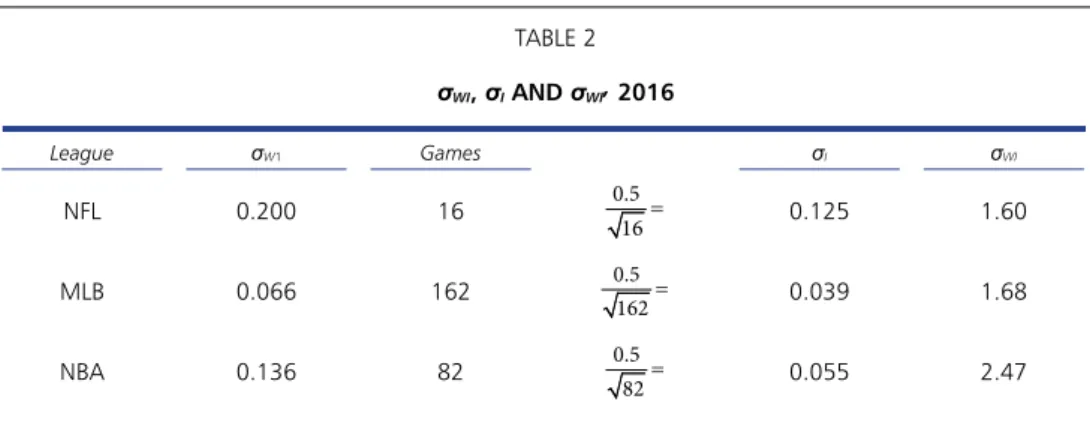
The HHI also states that the two leagues have the same level of competitive balance. Depken (1999) proposed dHHI as a measure of competitive balance in leagues that expand over time. Again, variation in relative rankings over time cannot be captured by σ measures of competitive balance.
APPLICATION: COMPETITIVE BALANCE IN MLB
- Static Measures σ-measures
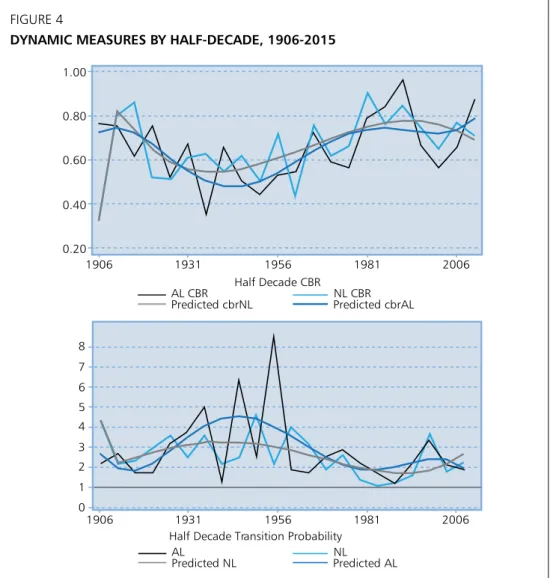
- Dynamic Measures
First note that the first half decade in the sample shows a striking difference in competitive balance between the AL and NL for both measures. Competitive balance was much lower in the NL than in the AL over this period. This probably affected the level of competitive balance in the NL in subsequent years.
CONCLUSIONS
The transition ratio was lowest in both leagues in the 1980s, when both leagues were moving towards state independence or maximum competitive balance. The impact of postseason restructuring on competitive balance and fan demand in Major League Baseball. Competitive balance and market size in Major League Baseball: a response to baseball's Blue Ribbon Panel.
DIFFERENCES (?): A RETROSPECTIVE
FANS ARE DIFFERENT
- Synopsis of the category from Fort00
- Retrospective
Shortly after Fort00, Szymanski (2003) examined all work at UOH and found that it somehow failed to produce compelling results regarding fans' preferences for outcome uncertainty. All other work they review found ∂∂OUA ≤0 in upper-level ELs (Austria: 1 paper; Mills and Fort (2018) find dramatic variation in the explanatory power of the UOH in team-level time series analysis of participation in large NALs.
SPORTS ORGANIZATIONS ARE DIFFERENT 1. Synopsis of the category from Fort00
And all other sports are in fact organized just like the rest of the sports in the world. Initially, the strongest teams' revenues have grown faster than the rest, in both NALs and ELs. A similar result occurs in ELs with the increase in the value of post-season tournaments such as Champion's League.
TEAM OBJECTIVES ARE DIFFERENT 1. Synopsis of the category from Fort00
Since Heilmann and Wendling (1976), ticket prices can be in the inelastic region for any number of reasons. But maximizing wins would have talent selected where the winning percentage equals the ratio of the team's total revenue to the league's total revenue. Fort00 pointed out that the objective function question can be investigated according to the theoretically predicted behavior of owners of each type.
FORWARD FROM THE PAST
In the almost 20 years since Fort00, EL is doing pretty well in terms of their dominance in Europe. Second, the analysis allows for the exploration of the potential of behavioral economics, which has been insufficiently addressed despite the growing number of articles on this topic produced in the field of sports economics. The rest of the paper is structured as follows: Chapter II describes the key concepts of behavioral economics; in chapter III, applications from the field of sports economics are discussed; lastly they are in IV. section presents the main conclusions and sets possible directions for future research.
CONCEPTS OF BEHAVIORAL ECONOMICS
- Non-Standard Risk Preferences
- Non-Standard Time Preferences
- Non-Standard Social Preferences
- Overconfidence
- Law of Small Numbers
- Projection Bias
- Framing
- Limited Attention
- Heuristics for Choice Overload
- Persuasion and Social Pressure
- Emotions
Both biases refer to the fact that variation in the probability of winning or losing does not consistently affect subjective valuation of outcomes (Samson, 2014). This bias refers to the tendency to continue a project that has involved an investment in resources that cannot be recovered (sunk costs). It refers to the fact that individuals' confidence in their own ability is greater than their actual performance.
APPLICATIONS
- Players-teams
- Coaches
- Owners and Managers
- Referees
- League Organizers: Regulations
- Fans
- Recreational Sport
For their part, González-Díaz, Gossner, and Rogers (2012) analyzed point-by-point data from 12 US Open tennis editions and concluded that the best players (i.e., the most successful throughout their careers) are those who are able to to improve their performance in key points when the pressure is higher. 7 One of the most important penalty kicks ever in the Spanish football league was in May 1994.
Professional Sport: Markets
THE DOMINATION OF FOOTBALL
They have won the league thirty-three times in total and twenty-one times in the last fifty years alone, well ahead of arch-rivals FC Barcelona (seventeen times) and well ahead of anyone else (in fact, only five other teams have won the league in the last half century). The most dominant league in half a century was Scotland, where Celtic won twenty-four titles - almost half. In the last twenty-five years of the Champions League, the most wins by one nation is eight (Spain), and clubs from eight different nations have won the Champions League trophy.
THE MANY PATHS TO DOMINANCE
- The Royal Team
- Red Devils and Red Meat
- FC Hollywood
Even more sinisterly, many critics would say that the core of the club's strategy was to fix the referees. When Edwards secured control of the club in 1964, Matt Busby had already been manager for twenty years. By this time Louis Edwards was handing over control of the club to his son Martin.
DOMINANCE IN A COMPETITIVE ENVIRONMENT
In the early days of such industries, there are many competitors vying for recognition, leading to an arms race in advertising. The reason for this is that in the soft drink industry and in most other major markets, small companies that try to keep up with the dominant companies go out of business. Of the eighty-eight clubs in the English Football League in 1923, eighty-five still exist, and most still play in the four English divisions.
DISTRESS
Of the seventy-four clubs that played in the top divisions of England, France, Italy and Spain in 1950, seventy-two still exist. Yet this is only a small fraction of the total number of football clubs in Europe and beyond. There are approximately 700 clubs in the top divisions of the member states of UEFA, and hundreds, if not thousands, more clubs in the lower levels.
TAKING INEQUALITY SERIOUSLY
The Super League model is essentially the model that has been adopted in the American sports system. Instead of an inclusive pyramid structure where all participants can compete within a system of promotion and relegation, the American model is a closed system with a limited number of teams (30 each in Major League Baseball, the National Basketball Association and the National Hockey League and National Hockey League and thirty-two in the National Football League). With a limited number of teams, there is a basis for collaborative action, which has enabled them to adopt a variety of measures to establish a goal of equality.
CONCLUSION
Competitive balance at the highest level of English football A missing principle and a forgotten ideal. In reality, during this half-century, there were only nineteen teams that finished the season in the top five. The club has never won it since, and in the last fifty years has bounced between the bottom three tiers.
Applying Sutton's model to the world of professional club football, the focus should be on player investment rather than advertising. These clubs may have developed this image because they were first on the trail, because of their location, because of a special event in their history, or because of their association with certain individuals or movements. These clubs can never break into the dominant group unless they receive significant funding from an investor (who does not expect a direct financial return) or are extremely lucky.
AND AUDIENCE
UNCERTAINTY OF OUTCOME, SUSPENSE AND SURPRISE
As pointed out in the introduction, the impact of outcome uncertainty on demand in professional sports has been and continues to be one of the most empirically analyzed aspects in the field of sports economics. In this sense, authors such as Humphreys and Zhou (2015), Skrok (2016), Budzinski and Pawlowski (2017), Humphreys and Pérez (2017), Brown and Salaga (2018) or Pawlowski, Nalbantis and Coates (2018) underline lack of empirical support for the outcome uncertainty hypothesis. As with the analysis of stadium attendance, there is a turning point in audiovisual demand studies following the publication of the theoretical model designed by Coates, Humphreys and Zhou (2014), based on an earlier contribution by Card and Dahl (2011).
