
Fontàs, An efficient hollow fiber supported liquid membrane system for trace Cr(VI) removal and preconcentration, Sep. Anticó, Liquid-Liquid Extraction Modeling and Liquid Membrane Separation of Arsenic Species in Environmental Matrices, Sep.
RESUM DE LA TESI
En tots els casos, es va trobar que la principal espècie responsable del transport d'As(V) era HAsO42-. Finalment, es va demostrar l'aplicabilitat de l'optòde per dur a terme la determinació selectiva de Cr(VI) en diverses mostres d'aigua.
SUMMARY
Although the values of the constants for both As(V) and As(III) are similar, kinetic studies resulted in As(V) reaching equilibrium in 5 min, whereas As(III) needed more than 2 h. Finally, the effect of the possible interferences due to the anions in the feed solutions has been investigated for the three membrane systems.
Introduction and objectives CHAPTER 1
INTRODUCCIÓ
- OXOANIONS I METALLS TÒXICS
- OXOANIONS DE CROM I ARSÈNIC
- METALLS PESANTS
- PROCESSOS DE SEPARACIÓ QUÍMICS PER AL TRACTAMENT DE MOSTRA
- EXTRACCIÓ LÍQUID-LÍQUID
- SISTEMES DE SEPARACIÓ BASATS EN MEMBRANES
L'Organització Mundial de la Salut (OMS) és l'autoritat líder i coordinadora de les accions sanitàries al sistema de les Nacions Unides. L'ús de la tecnologia de membrana per a l'eliminació de diversos contaminants ha augmentat en els últims anys.

El complex metall-portador es difon a través de la membrana
La força motriu per al transport de solut a través de la membrana líquida és la diferència de concentració de solut a les dues interfícies de membrana. La velocitat de transport de soluts a través de la membrana està relacionada amb el mecanisme de transport [97].
A la interfase membrana-solució de retroextracció, el complex es trenca i s‟allibera el metall a la solució receptora
- SENSORS QUÍMICS PER MONITORITZAR ESPÈCIES
- ELS SENSORS ELECTROQUÍMICS
- ELS SENSORS ÒPTICS
- Selectivitat
- Límits de detecció i interval de treball
- Temps de resposta
- REFERÈNCIES
- OBJECTIUS
- OUTLINE AND OBJECTIVES
Les propietats d'això afectaran tant l'estabilitat de la membrana com la velocitat de transport de soluts. El suport porós d'un SLM també pot tenir un paper important en la permeabilitat i estabilitat de la membrana. Formació d'una emulsió líquida en fase de membrana en aigua induïda per forces laterals.
Les propietats de les membranes depenen fonamentalment dels materials que les componen i de la seva estructura. L'elecció d'aquests components juga un paper fonamental en la selectivitat de la separació i en l'estabilitat de la membrana. Aquest factor ve determinat pel caràcter de la cadena principal i la naturalesa de les cadenes laterals.
També cal tenir en compte que en determinades condicions es va observar una pèrdua de l'extractant de membrana [186, 190]. L'aplicació de les dades experimentals en l'expressió de l'equilibri de Donnan permet predir el transport d'espècies iòniques a través de la membrana d'intercanvi iònic. ACM (Neosepta), i aquesta disminució de l'eficiència coincideix amb la disminució de la capacitat d'intercanvi iònic de la membrana [240].
L'etapa d'electrodeposició (etapa a) consisteix, com s'ha dit anteriorment, en la concentració de l'analit de la solució a la superfície de l'elèctrode. La intensitat de la resposta voltamètrica, ip, sol ser el paràmetre experimental relacionat amb la concentració de l'analit.

Separation systems based on Aliquat 336 for As(V) and As(III): solvent extraction and membrane transport
MODELLING OF LIQUID-LIQUID EXTRACTION AND LIQUID MEMBRANE SEPARATION OF ARSENIC SPECIES IN
- ABSTRACT
- INTRODUCTION
- EXPERIMENTAL
- RESULTS AND DISCUSSION
- REFERENCES
The SLM selection combines the extraction process of the species in question and the subsequent stripping process in a single step. A quantitative characterization of the extraction reactions is provided, based on results obtained from liquid-liquid experiments, and the system is implemented in SLM in a flat configuration for As(V) transport. Food and stripping solutions (190 mL each) were placed in each compartment of the cell.
From the value of the slope, we can again assume that the species responsible for the extraction of As(III) have stoichiometry 1:2 and 1:3. In particular, the protonation of the oxoanion (AsO43- or AsO33-) present in the aqueous phases is considered [32]. As can be observed, the values of the constants obtained for the As(V) and As(III) species are similar, which indicates a comparable stability of the As:Aliquat 336 species formed in the organic phase.
For studies of As(V) in H2SO4 medium and with DBBP and D2EHPA as solvates, species in the organic phase were formed with log K ~ 28 [33]. The composition of the feed solutions was 10 mg L-1 As (V) at pH 13, and the stripping phase consisted of 0.1 M HCl. The liquid membrane was Aliquat 336 in dodecane modified with 4% dodecanol, and the effect of carrier concentration on As transport was studied.

TRANSPORT AND SEPARATION OF ARSENATE AND ARSENITE FROM AQUEOUS MEDIA BY SUPPORTED LIQUID
- ABSTRACT
- INTRODUCTION
- EXPERIMENTAL
- RESULTS AND DISCUSSION
- REFERENCES
The difference in the electrochemical potential on both sides of the membrane acts as the driving force. The membrane was fixed between the two half-cells of the apparatus and the feed and stripping solutions (190 ml each) were placed in the respective compartment of the cell. The concentrations of the anions were measured with a 761 Compact IC (Metrohm) ion chromatograph with an automatic injector (813 Compact Autosampler).
Effect of stripping composition on SLM efficiency for As transport Stripping solution after transport (%) (after 5 hours). The results are presented in Figure 2.2.1, where the time course of As concentration in the removal phase is given for each pH. The effect of feed solution pH was further investigated by testing arsenic transport through multivalent AEM at pH 10 and 13, and the results are presented in Table 2.2.3.
In this case, the explanation of the results obtained must be related to the Donnan exclusion theory. The hydrophilicity of the H2AsO4 anions is weaker and their movement in the hydrophilic zone of the membrane. Transport of non-electrolytes to the stripping compartment is therefore only possible through dynamic water clusters that can be formed in the organic phase of the extractant.

- ABSTRACT
- INTRODUCTION
- EXPERIMENTAL
- RESULTS AND DISCUSSION
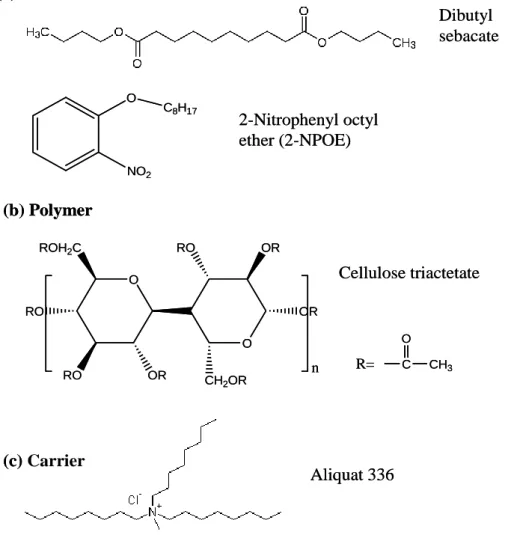
The nature of the plasticizer used to form the membrane is also an important parameter to be taken into account. Then the permeability P can be calculated from the slope of the linear representation ln[As]f,t/[As]f,0 vs. In this situation, arsenic species are expected to be released due to the dissociation of the ion pair formed in the organic phase.
In the present study, the transport of HCl from the stripping side to the feeding side of the membrane is responsible for a neutralization reaction that results in the formation of H2AsO4-. As mentioned in the introduction, the composition of the PIM is crucial for an effective separation system. Effect of the nature and content of the plasticizer that forms the PIM on the As(V) transport.
Since another important parameter affecting the transport of ionic species is the membrane conductivity [25], PIM prepared with or without NPOE were further characterized by electrical impedance spectroscopy (IS). Composition of the different PIMs and their corresponding conductivity () and dielectric constant () as well as the permeability values for As(V). In the case of As(III), the concentration profile in transport experiments indicates that during the first 5 hours almost no transport takes place, independent of the pH of the source solution.
- REFERENCES
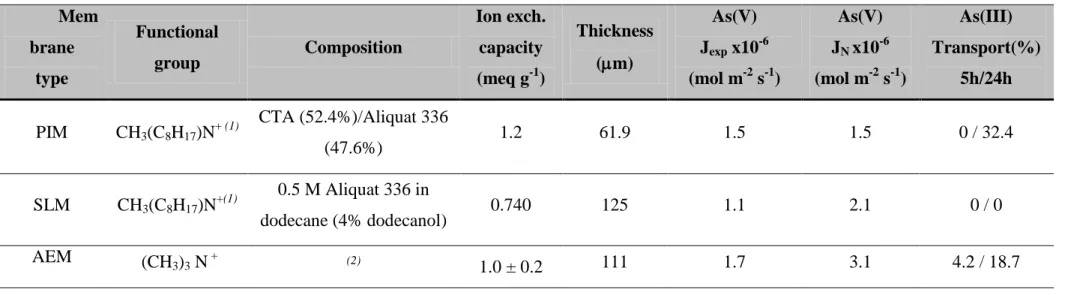
The analysis of the anions present in the stripping compartment showed that the anionic species initially present in the feed solution were also transported through the membrane, but without affecting the As(V) transport. In this section, the performance of the developed PIM for As transport is compared with both an SLM also containing Aliquat 336 and a commercial multivalent anion permselective membrane (AEM) (PC SA). In the case of SLM, the membrane is the liquid membrane contained within the pores of a PVDF carrier.
Flux values (V) (also included in Table 2.3.4) were calculated for each membrane system from the initial slope of the feed profile. As the thickness of the membranes varied, it was considered that the flux values were normalized to the PIM thickness, which was used as a reference. Therefore, PIMs represent a valuable option for AEM as stable membranes with similar flux values as SLMs which suffer from instability due to loss of membrane fluidity in adjacent aqueous solutions.
The transport efficiency of different As(III) transport membranes is also tabulated for 5 and 24 h. Kolev, Influence of the composition of polymer inclusion membranes on their homogeneity and flexibility, Desalination. Fontàs, Study of sorption and preconcentration capabilities of commercial solid-phase extraction cartridges against As, unpublished results.
Chromate preconcentration and optical sensing with membranes incorporating Aliquat 336
EFFICIENT HOLLOW FIBER SUPPORTED LIQUID MEMBRANE SYSTEM FOR THE REMOVAL AND PRECONCENTRATION OF
- ABSTRACT
- INTRODUCTION
- EXPERIMENTAL
The influence of the chemical composition on the efficiency of the membrane system was investigated, such as the organic solvent and the syrup composition. Furthermore, physical parameters such as the stability of the membrane and the mode of operation of the module were also evaluated. In addition, the system enabled both the separation and enrichment of the metal, thereby facilitating the detection of chromate in aqueous samples and reducing the volume of contaminated water to be treated.
Among the heavy metals, chromium, especially in its hexavalent form, is considered one of the most toxic elements despite its widespread use in industries such as leather tanning, metallurgy, electroplating, and textile production [1]. In addition, this configuration allows not only the removal of the required compounds from the stream, but also the concentration of these species for possible further processing and exploitation. The purpose of this work is to investigate the applicability of a hollow fiber-supported liquid membrane using Aliquat 336 as an extractant for the removal of Cr(VI), especially from polluted waters containing low levels of this metal.
The study is focused on the selection of the most suitable chemical conditions of the system and the evaluation of the physical parameters that influence its efficiency, such as the stability of the membrane and the mode of operation of the module. Special emphasis is given in the preconcentration of Cr(VI) in a clean matrix to facilitate the analytical determination of the metal with conventional atomic spectroscopic techniques, as well as to reduce the volume of polluted water that must be treated. To evaluate the performance of the developed separation system, various samples containing Cr(VI) were used, such as an industrial sample obtained from an electroplating plant as well as spiked river water or spiked tap water.