Frequency distribution of the number and type of biosynthetic genes for antimicrobial peptides in 184 of Bacillus isolates from field samples. Frequency distribution of the antibacterial activity of 184 Bacillus isolates against 8 bacterial plant pathogens tested in LB and NA medium.
Biology, ecology and applications of Bacillus
- Genome
- Endospores
- Taxonomy
- Diversity and ecology
- Bacillus in industry
- Bacillus in plant health
- Safety of Bacillus as a biocontrol agent
Several BCAs have been able to control plant diseases such as Pseudomonas fluorescens EPS62e (Pujol et al. 2005), P. It is based on the inactivation of quorum-sensing molecules that reduce bacterial virulence (Liu et al. 2013).

Bacillus as a source of antimicrobial peptides
Ribosomal peptide antibiotics
Post-translational modification of the ribosomally synthesized precursor enables the formation of lanthionine, including dehydration of serine and threonine residues and addition of adjacent cysteine thiol groups (Klein et al. 1993, Lee and Kim 2011, Stein 2005). The A group of lantibiotics includes subtilin and ericin, and the B group includes mersacidin, sublancin, and subtilosin (Klein et al. 1993, Mannanov and Sattarova 2001, Stein 2005). A-type lantibiotics act against Gram-positive target cells by forming voltage-dependent pores in the cytoplasmic membrane (Lee and Kim 2011, Parisot et al. 2008, Stein 2005, Stein and Entian 2002) or by inhibiting peptidoglycan synthesis (Bierbaum and Sahl 2009).
On the other hand, SpaRK expression is controlled by the sporulation transcription factor Sigma H (Stein et al. 2004). The mersacidin gene cluster consists of the structural gene mrsA, as well as genes involved in post-translational modification (mrsM and mrsD), transport (mrsT), immunity (mrsFEG) and regulation (mrsR1, mrsR2, mrsK2) (Guder et al. 2002).
Non-ribosomal peptide antibiotics
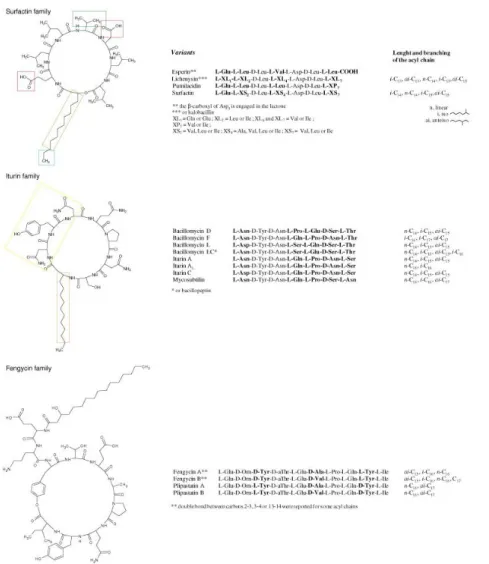
This may explain why surfactins exhibit haemolytic, antiviral and antibacterial activities (Ongena and Jacques 2008, Peypoux et al. 1999). The synthesis of surfactin is growth phase dependent and is induced during transition to stationary phase (Chen et al. 2009b). The last three genes code for the NRPSs responsible for the incorporation of the first residue for bmyA (or mycA or ituA), the next four residues for bmyB (or mycB or ituB) and the last two residues for ituC (or mycC) (Chen et al. 2009b, Ongena and Jacques 2008).
Fengicin is synthesized by NRPSs encoded by a five-ORF fenA-E operon (Steller et al. 2004). Furthermore, unlike other LPs such as surfactin, biosynthesis of bacillisin is not tightly coupled to sporulation (Yazgan et al. 2001a).
Miscellaneous antibiotic compounds
The peptide linked with L-alanine proceeds to a non-ribosomal state catalyzed by an amino acid ligase (bacilysin synthetase) (Chen et al. Bacilysin is active against a wide variety of bacteria and yeasts, and its action is carried out by the anticapsin moiety, which is released after uptake into susceptible cells and blocks glucosamine synthetase, an essential enzyme in cell wall biosynthesis (Chen et al. In addition, bacilysin production is regulated by nutritional and feedback regulation, negatively by GTP via the transcriptional regulator CodY and AbrB, and positively by guanosine tetraphosphate (ppGpp) and a quorum-sensing mechanism through the peptide pheromone PhrC (Stein 2005).
Additional secondary domains are responsible for modifying the growing PK molecule (Arguelles-Arias et al. 2009). The activity is more pronounced against the eukaryotic organism Saccharomyces cerevisiae, in addition to fungi with non-filamentous growth, such as Candida pseudotropicalis and Cryptococcus neorformans (Hamdache et al. 2011).
Involvement of antimicrobial peptides in biocontrol
They may be applicable as anti-adhesion agents against biofilms and as biosurfactants for the degradation of polycyclic aromatic hydrocarbons (Romero et al. 2007). The production of AMPs has also been associated with the ability to induce induced systemic resistance (ISR) in plant systems (Choudhary and Johri 2009, Jourdan et al. 2009, Ongena et al. 2005). There was also a clear accumulation of non-polar antifungal compounds in the treated plants with LPs, indicating a pytoalexin-inducing activity of Bacillus LPs (Raaijmakers et al. 2010).
Selection of the adequate screening procedure will depend on the preferred mechanism of action, but also on the biocontrol strategy (Pliego et al. 2011). The most effective Bacillus strains inhibiting Sclerotinia sclerotiorum also harbored the surfactin and iturin A biosynthetic genes (Athukorala et al. 2009).
O BJECTIVES
M ATERIALS AND METHODS
Development of PCR tools based on AMP genes to screen field samples and culture collections of Bacillus spp
- Bacterial strains
- Selection of suitable molecular markers and design of primer sets for PCR
- Evaluation and optimization of PCR based methods for detection of molecular markers
- Validation of PCR tools in natural samples
The search focused on AMPs associated with biological control (Chen et al. 2007, Joshi and McSpadden-Gardener 2006, Montesinos et al. 2007, Ongena and Jacques 2008, Stein 2005), although attempts were made to include a wide range of compounds. Finally, six sequences were selected as specific markers for AMP biosynthetic genes within the coding regions of bmyB (bacilomycin L synthetase B) (Hofemeister et al. 2004, Joshi and McSpadden-Gardener 2006, Koumoutsi et al. 2004, Koumoutsi et al. 2007), fenD (fengicin synthetase) (Joshi and McSpadden-Gardener 2006, Kunst et al. 1997), ituC (iturin. Two additional sequences were selected as specific markers for the genus Bacillus within the coding regions of 16S rDNA (16S ribosomal DNA) (Cazorla et al . 2007, Ronimus et al. 2003) and spoVG (putative septation protein spoVG) (Broggini et al. 2005, Kunst et al. 1997, Matsuno and Sonenshein 1999, Nakano et al. 1988, Schiött and Hederstedt 2000) therefore both gene showed good specificity for Bacillus species.
The second method was based on precipitation of DNA with isopropanol (Llop et al. 1999) (Table 2.5). A total of 14 Bacillus strains (Table 2.1), with a final concentration of 108 cfu/ml, were processed by multiplex PCR to evaluate its specificity using PCR mix 3, according to the results obtained from the multiplex PCR optimization (Table 2.6) .

Development of a selective enrichment method
- Analysis of the presence and population level distribution of Bacillus spp. in natural environments
- Development of a method for the traceability of Bacillus strains upon introduction in natural samples
- Strategies for the development of a selective enrichment procedure for Bacillus
- Selective enrichment procedure
- Comparison of standard and selective enrichment methods
The sensitivity of single and multiplex PCR for 4 strains of Bacillus (QST713, UMAF6614, RGAF51 and EPS2004) was also assessed in natural samples only using a 1:100 dilution of the sample. To optimize the selective enrichment procedure, a study was conducted on the behavior of a modified Bacillus strain in the natural extract. Population levels were then determined at three stages of the procedure (before thermal treatment, after thermal treatment and after complete enrichment) by plating an appropriate decimal dilution in LB agar, for the total number of culturable bacteria, and supplemented in LB agar with rifampicin (100 mg/l) for the rifampicin-resistant Bacillus strains.
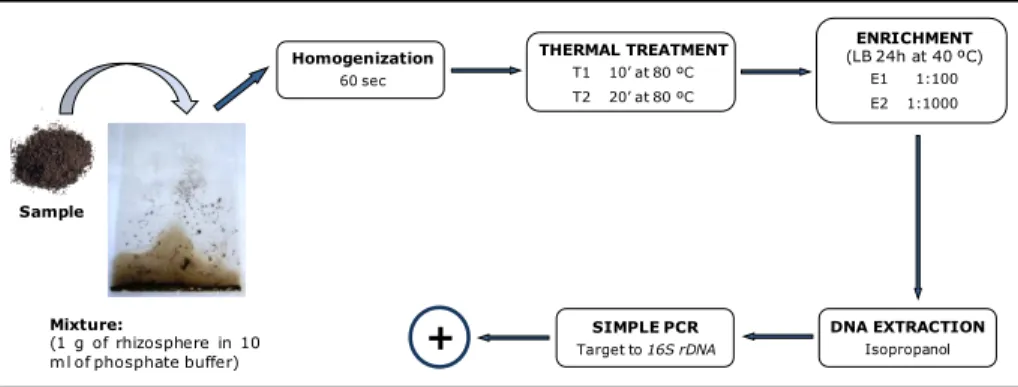
In the three stages of the procedure, the presence of Bacillus was confirmed by PCR directed at the 16S rDNA gene, as previously described. The standard method involved obtaining Bacillus isolates directly from the sample extract and was based on the homogenization of 1 g of material in 10 ml of phosphate buffer using a stomaster for 60 s.
R ESULTS
Development of PCR tools targeted to AMP genes for screening field samples and culture collections of Bacillus
- Selection of molecular markers and design of primer sets
- Evaluation and optimization of methods for detection of molecular markers
- Evaluation and validation of PCR tools in field samples
- Evaluation of selection and enrichment strategies
- Comparison of the standard and selective enrichment methods of isolation of Bacillus spp
The sensitivity of detection of the primers for the biosynthetic genes (bmyB, fenD, ituC, srfAA, bacA and spaS) showed a high variability among genes and strains (Table 2.9). Seven of the tested Bacillus strains (FZB42, RGAF5, RGAF9, RGAF11, RGAF32, RGAF51 and RGAF66) were sensitive to all antibiotics. The selective enrichment method was evaluated in two assays consisting of the addition of a Bacillus strain to a mixture of Gram-negative strains (artificial microcosm) and field extracts.
Populations were determined at different stages of the selective enrichment method: Untreated (U), after heat treatment (T) and after heat treatment and enrichment (TE). Then, the selective enrichment yield, in terms of Bacillus isolation, was about three times higher than in the standard procedure.

D ISCUSSION
Our results were consistent with the presence of the srfAA, bacA, bmyB and fenD genes in strain FZB42 and of the srfAA, bmyB, fenD and ituC genes in strain QST713 (Joshi and McSpadden-Gardener 2006, Koumoutsi et al. 2004). The sensitivity was better than in primers previously reported for the genes srfAA, bmyB, fenD and ituC (Joshi and McSpadden-Gardener 2006, Koumoutsi et al. 2004). The second method was based on the ability of Bacillus to withstand high temperatures in contrast to non-sporulating bacteria that are sensitive to temperatures above 60–70 °C (Cortezzo and Setlow 2005, Okahisa et al. 2008).
In this study, most strains contained sufactin and iturin genes (Athukorala et al. 2009). The presence of antimicrobial peptide (AMP) biosynthetic genes srfAA (surfactin), bacA (bacilysin), fenD (fengycin), bmyB (bacillomycin), spaS (subtilin) and ituC (iturin) was examined in 184 isolates of Bacillus spp.
I NTRODUCTION
However, most studies of these metabolites have been focused on the inhibition of fungal pathogens, while rare studies have been focused on the antibacterial properties of these metabolites (Chen et al. 2009c). No definitive evidence has been found for the antibacterial activity of iturin and fengycin families (Maget-Dana and Peypoux 1994, Koumoutsi et al. 2004), although some studies support the activity of surfactin in reducing infections by P. CLP' has been found. the most well-studied secondary metabolites in Bacillus, such as gene clusters involved in their biosynthesis (Arguelles-Arias et al.
In addition, the implication of cLPs and other AMPs such as bacteriocins and dipeptides, polyketides and other antimicrobial compounds in plant health has led to the identification of the related genes involved in their biosynthesis (Kunst et al. 1997, Koumoutsi et al. al. 2004). In addition, in other studies, the presence of some biosynthetic genes has been related to the production of cLPs, such as surfactin, iturin A and fengycin, and the iron siderophore bacillibactin, the antibacterial polyketide macrolactin, the bacillaene and difficidin, the dipeptide antibiotic bacilysin and the chlorinated derivative chlortetain ( Arguelles-Arias et al. 2009).
M ATERIALS AND METHODS 1. Strains and growth conditions
Collection of Bacillus isolates from plant environments
Bacillus isolates were obtained from 183 field samples, including different plant environments (143 aerial plant samples, 25 rhizosphere samples, 15 bare soil samples) and 35 plant species (cultivated, wild) taken from seven samplings. sites (mainly in Catalonia and the Balearic Islands) in Spain (Table 3.2). To improve strain yield, samples were processed using the selective enrichment procedure described in the previous chapter. Aliquots of 100 µl of the enriched samples were sown on LB agar plates and incubated at 28 ºC for 24-48 hours.
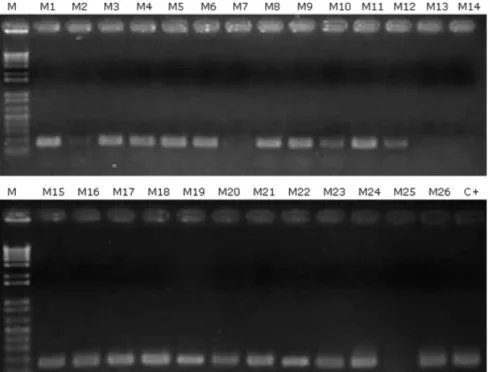
A maximum of three different colonies of the typical Bacillus morphology (Sneath 1986) were purified per sample. In addition, Bacillus isolates were also confirmed by PCR using the primers developed for the specific detection of 16S rDNA from Bacillus.
Characterization of Bacillus isolates
- Analysis of biosynthetic AMP genes
- Analysis of AMPs produced by Bacillus strains
- Antimicrobial activity assays
Most of the samples were obtained from aerial plant parts due to the interest of obtaining biocontrol agents that could work against diseases of aerial plants. Bacterial microbiota was obtained from each sample after homogenization of 1 g of material in 10 ml of phosphate buffer (pH 7, 0.02 M). Na2HPO4, 0.05 M KH2PO4) using a paddle homogenizer (Masticator, IUL Instruments, UK) for 60 s. Bacillus strains grown overnight on LB agar plates at 28 ºC were picked from the surface of the agar coating with toothpicks. Identification of AMPs contained in culture supernatants requires extraction of AMPs from media components.
Qualitative analysis of antimicrobial activity against 6 bacterial pathogens (E. amylovora PMV6076, P. syringae pv. syringae EPS94, Rhizobium radiobacter CECT472, Pectobacterium carotovorum sbsp. .. carotovorum CECT225, Xanthomonas axonopodis pv. vesicatoria CFBP327 5, Ralstonia solanacearum CECT125) was performed. in LB using an agar incorporation assay as previously described. In the agar plug proliferation assay (as described in section 3.2.1), the intensity of inhibition was quantified using the same scale determined by the diameter of the halo surrounding the Bacillus colony.
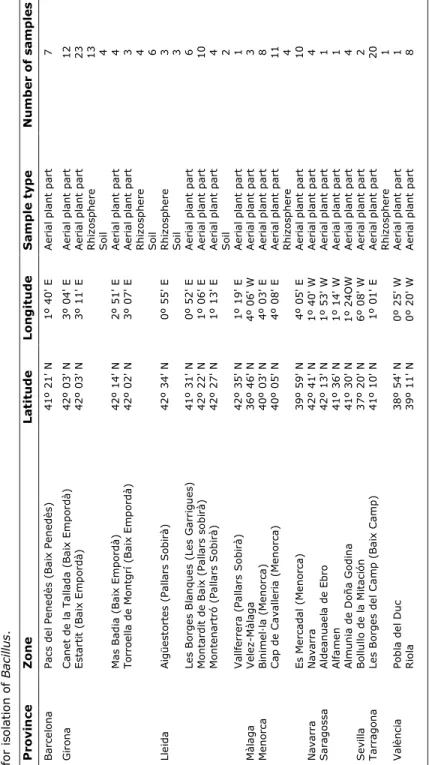
At the end of the screening process, 184 putative Bacillus isolates (based on colony morphology) were obtained from 132 samples that gave a positive signal for the Bacillus 16S rDNA gene (Fig. 3.2-A). Finally, 184 isolates were reconfirmed as Bacillus using primers for 16S rDNA genes designed for specific detection of Bacillus (Fig.3.3). They were observed to be more frequently isolated from rhizosphere (average 1.72 isolates per sample) and soil (average 1.93 isolates per sample) than from aerial plant parts (average 0.78 isolates per sample) (Fig. 3.4) .
Characterization of Bacillus isolates 1 Analysis of AMPs biosynthetic gene patterns
- Analysis of AMPs produced by Bacillus strains
Frequency distribution of the number (A) and type (B) of biosynthetic genes for antimicrobial peptides in 184 Bacillus isolates from field samples. Number of total isolates showing each gene was represented in the right part of the panel. A different behavior of the activity of culture supernatants was observed between the two tested plant pathogenic bacteria.
Also, no activity against any of the tested pathogens was observed in the aqueous fraction (Figure 3.16). Quantitative analysis of the antimicrobial activity of culture supernatants and corresponding organic and aqueous phases against E.