Nanopaper intel·ligent basat en nanofibres de cel·lulosa amb híbrid PEDOT:PSS/polipirrol per a dispositius d'emmagatzematge d'energia. Així, es van obtenir capacitats específiques de més de 300 F g-1 per a nanocomposites CNF-PPy i CNF-PEDOT:PSS-PPy.
GENERAL INTRODUCTION
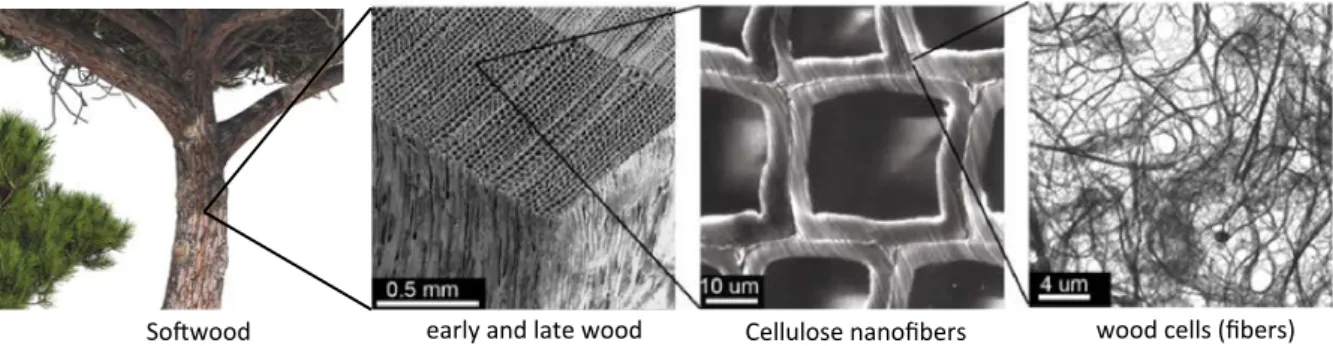
Revolution from cellulose to cellulose nanofibers and its current potential research
In the 1980s, Turbak, Snyder, and Sandberg (1983) discovered the first successful production of cellulose nanofibers. He described the preparation of cellulose nanofibers (various pretreatments and mechanical processing), characterization of physical, thermal, and mechanical properties.

Cellulose nanofibers
- Production of CNF
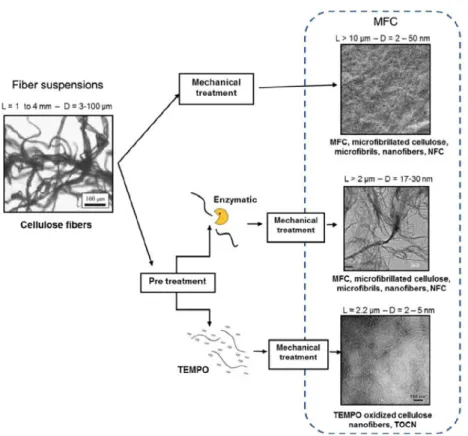
- Pretreatment process
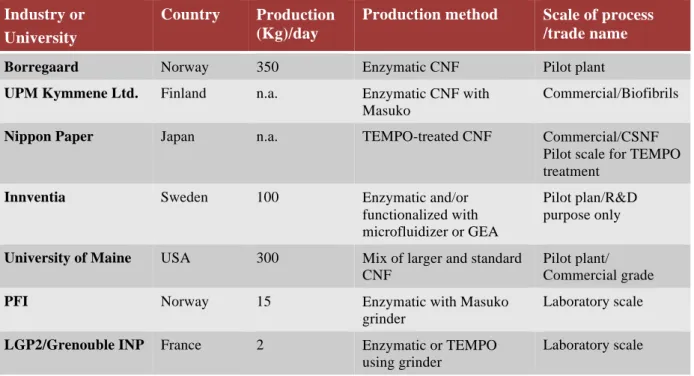
- Mechanical treatment
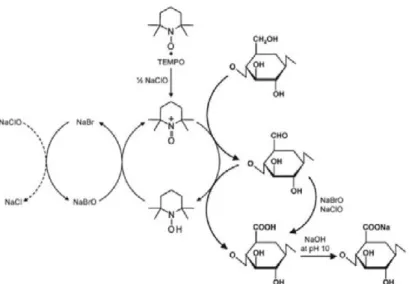
This is the most promising process for the production of TEMPO-oxidized cellulose on an industrial scale (Oksman et al., 2014). Recently, Spence et al. 2011), conducted a very detailed comparative study of energy consumption and physical properties of CNF produced by different process methods; homogenizer, microfluidizer, and grinder.

Bacterial cellulose
- History and production methods
- Bacterial cellulose properties and its application
However, there are challenges in expanding BC production to commercial scale (Gama et al., 2013). A unique property is its ability to be formed into three-dimensional structures during biosynthesis (Gama et al., 2013).
Conducting polymers
- Polypyrrole
- Poly(3,4-ethylenedioxythiophene) and its derivative
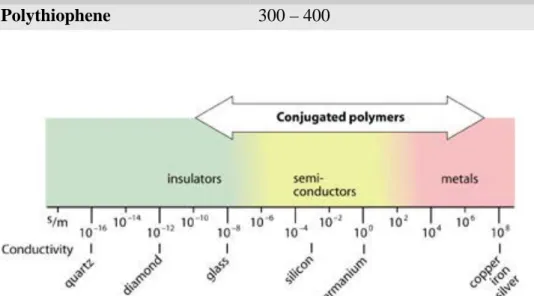
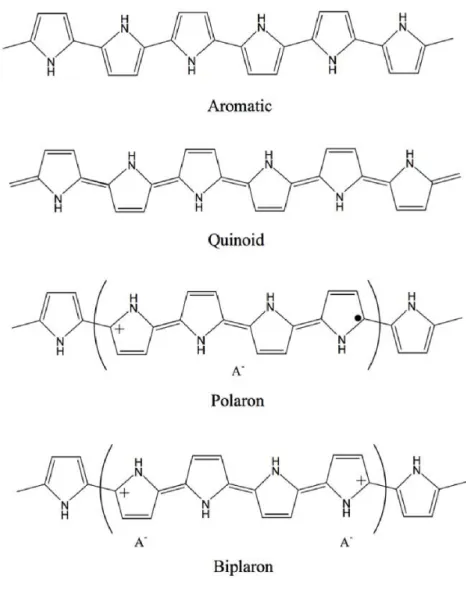
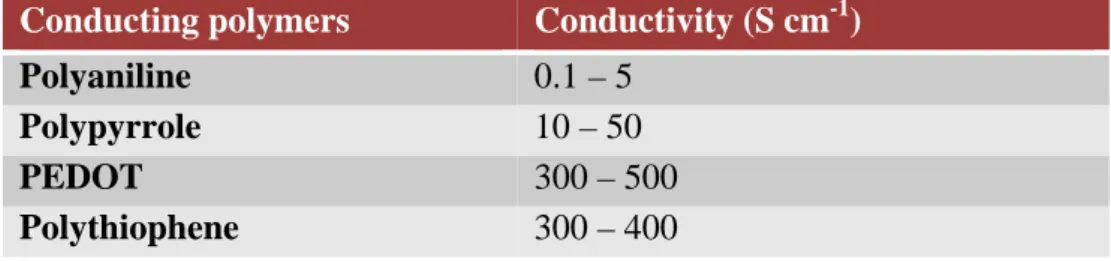
There are many types of conducting polymers such as polyacetylene, polypyrrole, polyphenylene vinylene, polythiophene, polyaniline, PEDOT and their derivatives (Abdelhamid et al., 2015). Theoretical aspects focusing on the electrochemistry of PPy were discussed in several book chapters (Audebert & Miomadre, 2007; Müllen et al., 2014).
Carbon nanotubes
- Surface modification of carbon nanotubes
- Properties of carbon nanotube and their applications
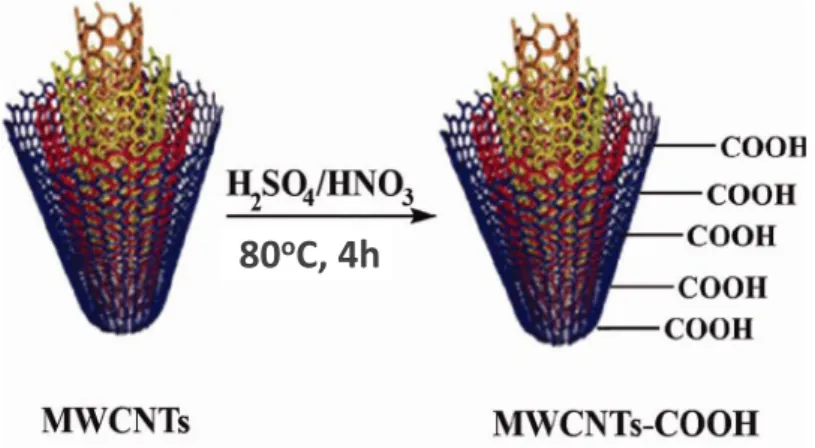
To overcome self-aggregation, surface modification of carbon nanotubes is required to improve the dispersion and interfacial adhesion of composites (Ahmed, Haider, & . Mohammad, 2013; Salajkova, Valentini, Zhou, & Berglund, 2013). In storage devices, carbon nanotubes play an important role in battery technology because some charge can be successfully stored inside the nanotubes.
CNF nanocomposites and their applications
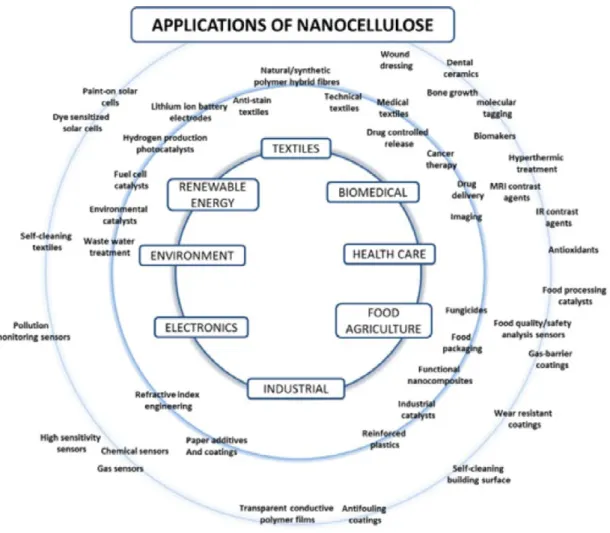
In a further work, the authors investigated the mechanical properties of PPy-cellulose nanocomposites of different porosity (Carlsson et al., 2012). Carbon nanotube modification has been used to reinforce cellulose nanofibers to obtain an electrically conductive nanopaper (Jung et al., 2007) for flexible supercapacitors (Gao et al., 2013).
AIMS OF THE THESIS
General objective
Particular objectives
Scope of the study
MATERIALS AND METHODS
- Materials
- Methods
- Preparation of cellulose nanofibers (Paper I-III)
- Preparation of Acetobacter xylinum bacterial culture (Paper IV)
- Functionalization of multi-walled carbon nanotubes (Paper II)
- Preparation of CNF and BC nanopapers, and conductive nanopapers
- CNF nanopapers (Paper I-III)
- BC nanopapers (Paper IV)
- CNF-PPy nanopapers (Paper I)
- CNF-MWCNT and CNF-MWCNT-PPy nanopapers (Paper II)
- CNF-PEDOT:PSS and CNF-PEDOT:PSS-PPy nanopapers (Paper III)
- BC-PPy nanopapers (Paper IV)
- Characterization of CNF, BC, and conductive nanopapers
- Elemental analysis (Paper I-V)
- Density and porosity of nanopaper (Paper I-III)
- Fourier transform infrared (FTIR) (Paper I-IV)
- Tensile properties (Paper I-IV)
- Field emission scanning electron microscopy (FE-SEM) (Paper I-IV)
- Transmission electron microscopy (TEM) (Paper III)
- Thermogravimetric analysis (TGA) (Paper I, III, and IV)
- Electrical conductivity measurement (Paper I-IV)
- Cyclic voltammetry measurement (Paper I-IV)
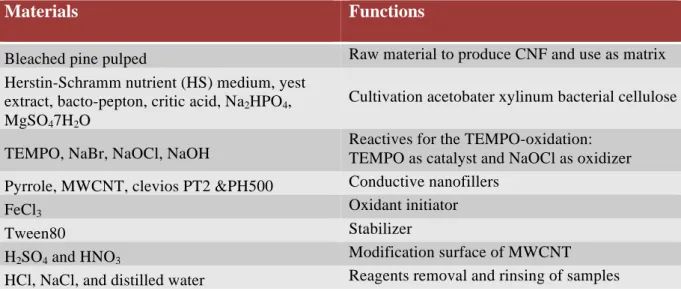
To prepare the pyrrole solution, 0.1 mL of pyrrole was dissolved in 15 mL of 0.5 M HCl. Following a similar procedure for the fabrication of CNF nanopaper, the CNF-MWCNT suspension was filtered overnight with a glass filter and dried for 20 min with a sheet dryer.
RESULTS AND DISCUSSION
Nanopapers and conductive nanopapers
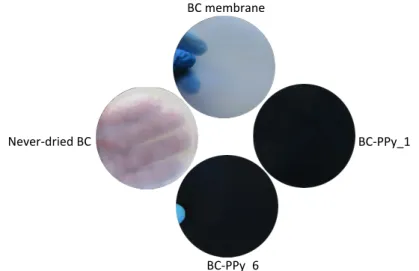
A graphical description of the interactions between components for the conductive nanopapers fabricated in this work is shown in Figures 22 and 23. The chemical representation of nanocellulose chains (CNF or BC), showing the hydrogen bonding with water, and the intermolecular interactions between nanocellulose chains and PPy after the in situ chemical polymerization using FeCl3 is illustrated in Figure 22a, the interactions between MWCNT or MWCNT-PPy with CNF chains are outlined in Figure 22b. For the nanopapers containing PEDOT:PSS or the hybrid PDETOD:PSS-PPy, the coating process is illustrated in Figure 23.
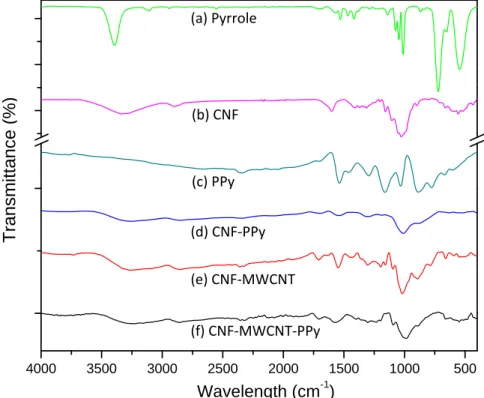
FTIR
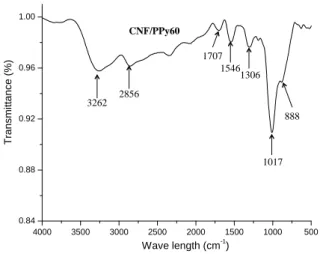
The absorption peak at 1288 cm-1 is assigned to a mixed bending and stretching vibration related to the C-N bond of the aromatic amine. Comparing this wavelength with the carboxyl group one of CNF (Figure 24b), the absorption peak shifted to higher values, which is representative of the interaction between CNF and the coating PPy. The strong band at 1546 cm-1 is characteristic of the C=C stretch of the aromatic ring of PPy.
Moreover, the change in intensity of the peak at 3250 cm-1 may be due to the formation of intermolecular hydrogen bonds between modified nanotubes and cellulose nanofibrils. The spectra of BC-PPy nanopapers changed in the fingerprint region cm-1), which belongs to the characteristic tail of the electronic absorption related to the electrical conductivity of PPy. The blue shift of these bands confirms that the presence of cellulose affected the delocalized π−electronics of PPy, because the chemical bond between the H of the N in the pyrrole ring and the lone pairs on the O of the OH groups at the surface of the cellulose, and/or between the H of the OH groups of the cellulose and the lone pair of electrons on the pyrrole N occurred (Johnston, Kelly, Moraes, Borrmann, & Flynn, 2006).
Tensile properties
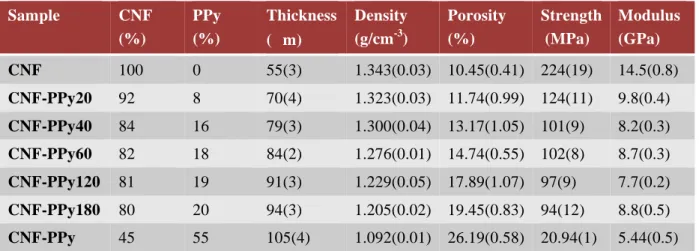
The stress-strain curves in uniaxial tension and the ultimate tensile strength and Young's modulus of CNF-MWCNT and CNF-MWCNT-PPy are shown in Figure 28. The tensile strength and Young's modulus of CNF-MWCNT10 decreased about 30% and 38%, respectively, and the tensile strength continued with decreasing 130% for CNF-MWCNT30 nanocomposite. With the polymerization of polypyrrole in the CNF-MWCNT blend, the mechanical behavior began to decrease dramatically.
The present mechanical properties of CNF-MWCNT are higher than those obtained in previous study by Salajkova et al. 2013), probably due to the experimental methodology that resulted in less porosity in the final nanopapers. The tensile properties of CNF with PEDOT:PSS and CNF with hybrid PEDOT:PSS/PPy nanopaper are shown in Figure 29a and b (next page), and their values are summarized in Table 11. As a result, the mechanical properties of CNF-PT2 and CNF-PH500 nanopaper was lower compared to the unmodified CNF nanopaper.
FE-SEM
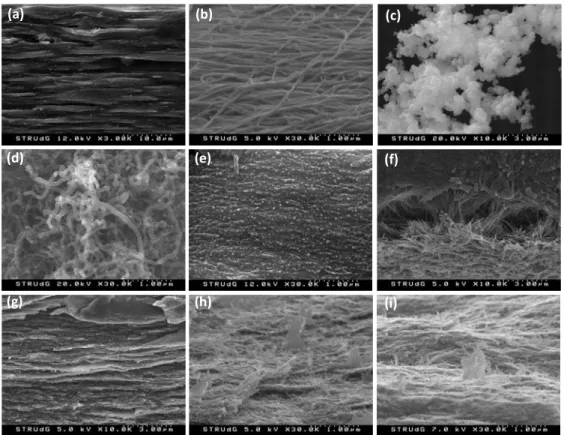
The coating of pyrrole on the BC surface produced the typical brittle behavior with a strain lower than. This can be explained by the reduction of hydrogen bonding of BC due to the presence of PPy nanoparticles attached to the surfaces of the nanofibrils (Müller et al., 2013). Moreover, the fragmentation of BC occurring during the polymerization of pyrrole leads to cracks between the BC and PPy layers.
It can be said that this nanopaper consisted of about 60 µm thick PPy on each side, and this thick PPy payer is the reason for the low tensile properties, because PPy itself is mechanically weak (Pandey et al., 2015). In all cases, the surface of nanocellulose became rough and brittle when coated with conductive filler, for example with the coating of PPy on CNF (Figure 31e) or on BC (Figure 31f). On the other hand, the mixture of MWCNT and CNF, in Figure 31g, leads to a less dense structure compared to pure CNF.
Electrical Conductivity
The conductivity of nanopaper with 50% of MWCNT reached 0.78 S cm-1 because the MWCNTs within the network of CNF created a conductive path. However, this value is still low considering the electrical conductivity of pristine MWCNT, which is within the range of the metallic materials. It can be said that the acid modification of MWCNT induced defects on the MWCNT sidewall by forming carboxylic acid and other oxygen-containing groups on their surface, which reduced the electrical conductivity of MWCNT (Li & Zhitomirsky, 2013).
The conductivity of CNF-PT2_5 nanopaper was five times lower compared to CNF-PH500_5 nanopaper. Furthermore, the polymerization of 14% PPy in the CNF-PH500 suspension yielded a CNF-PH500-PPy nanopaper with a dramatically increased conductivity of 10.55 S cm-1. With a filler volume fraction of 0.1 to 0.6 (Figure 34a), the experimental conductivity was five to ten times lower than the predicted conductivity.

Cyclic voltammetry
When the porosity is reduced, the ion mass transport is too slow to allow full utilization of the inherent charge storage capacity for scan rates above 5mV s-. The surface-modified MWCNTs helped to improve the specific capacitance due to the functional groups (carboxyl, hydroxyl) formed during the acid treatment, which are known to act as redox-active centers (Peng et al., 2007). This high specific capacitance can be explained by the direct interaction between the delocalized electrons on polymer chains and the MWCNT.
It was reported that PPy has the ability to provide the capacitive response via fast redox reactions of the conjugated region in polymer networks (Xiong et al., 2015). The oxidation-reduction peaks of BC-PPy_5 are found at +0.6 V and –0.6 V versus Ag/AgCl, demonstrating the retention of the important redox characteristic of conductive polymer in the BC-PPy nanopaper (Wang, Bian, Zhou, Tang and Tang, 2012). The increasing thickness (~100 µm) of PPy around the BC nanofibrils could provide a larger specific surface area of the electrode/electrolyte interface (Xu et al., 2013).

Thermogravimetric analysis
In Figure 40b , the thermal degradation of CNF by TEMPO oxidation was broad and mainly consisted of two peaks around 232°C and 296°C, both below the degradation point of the original cellulose (∼310°C). According to the literature (Fukuzumi, 2012), the first degradation peak corresponds to the degradation of sodium anhydroglucuronate units and the second is related to the degradation of cellulose chains containing more unstable anhydroglucuronate units on the crystal surface. For this nanopaper, the loss was not only a result of the cellulose degradation process, but also partly due to the thermal degradation of the polymer backbone in the polypyrrole.
The process during which the counterion is expelled occurs before the degradation of the polymer backbone in PPy and is probably responsible for shifting the main degradation of CNF/PPy to have its maximum degradation temperature at a temperature lower than that for CNF (Nyström et al., 2010). Regarding PEDOT:PSS nanosheets, the maximum degradation temperature of CNF-PH500_50 nanopaper was 210ºC. Since PPy was more thermally stable, the total weight loss of CNF-PH500-PPy was lower.
CONCLUSIONS AND FUTURE WORK
General conclusions
Main specific findings
Future work
Strong highly conductive nanocomposites based on nanocellulose-assisted aqueous dispersions of single-walled carbon nanotubes. A comparative study on electrochemical co-deposition and capacitance of composite films of conducting polymers and carbon nanotubes. Efficient paper-based energy storage devices with high active mass containing free additive-free polypyrrole-nanocellulose electrodes.
Preliminary results of a small artery replacement performed with a novel cylindrical biomaterial composed of bacterial cellulose.
ANNEX: PUBLICATIONS AND MANUSCRIPTS
The FTIR spectrum of CNF/PPynanopaper was obtained to characterize the absorption peaks of nanopaper after the chemical polymerization. For comparison purposes, FTIR spectra of pyr-role, cellulose nanofibers (CNF) and polypyrrole (PPy) were also recorded. –500cm−1 using 24 scans. Scheme 1 illustrates the intermolecular interaction between CNF chains, and the interaction mechanism between CNF and PPy after the in situ chemical polymerization using FeCl3 as an oxidizing agent; images of CNFgel (Sc.1a), highly transparent CNFnanopaper (Sc.1b), CNF/PPcynanopaper (Sc.1b),CNF/PPcynanopaper (Sc.Fcynano-paper), CNF/PPcynano-paper (Sc.d) are depicted in Scheme 1. The obtained CNF/PPynano papers were flexible black films due to the presence of black precipitated PP on the CNF surface. They give PPy (%) each reaction time is presented in the supplementary information S1. Likewise, the thickness, density, and porosity of each sample are listed in S3. The thermal-mechanical properties of three materials, namely pure CNF nanopaper, CNF/PPy20 and CNF/PPy120 nanopapers were investigated by DMA. In the test, an oscillating force is applied to a sample and the response of the material is analyzed. The data shown in Fig. composed of real and imaginary terms, corresponding to the storage modulus (E′) and the loss modulus (E′′). The materials obtained in the present study mainly exhibited an elastic behavior, with values of storage modulus much higher than those of loss modulus ( E′≫E′′), so the complex modulus is very similar to the storage modulus (E*≈moc-0-0-0)(E*≈0-5). under conditions of low molecular mobility, cellulose composite can be very stiff (Sehaqui, Allais, Zhou ,&Berglund, 2011) and, expectedly, mod-.
While heating continued, a glass transition was not found for all samples; the original CNF does not have a glass transition due to its high degree of crystallinity (Rastogi, Stanssens, & Samyn, 2014). The complex modulus of CNF nanopaper continuously decreased with temperature between 40◦Can and 160◦Cals due to the slippage of crystals between each other. presence of PPy on the CNF surface hindered the chain movements, causing CNF/PP to slowly change from glassy to rubbery compared to CNF nanopaper. In the FT-IR spectrum of CNF (S4.b), the broadband vibration of –OH groups is found in 3334 cm-1; and the stretching of aliphatic C-H bonds of cellulose in 2898 cm-1. Where 𝜎 is the theoretical conductivity, 𝜎0 is the ultimate conductivity, 𝜙 is the volume fraction of 214. the conductive filler, and 𝜙𝑐 is the percolation threshold.
PPy on the CNF surface limits the number of CNF inter-fibril-OH interactions (Nyström et al., 343.. The microstructures shown in Figure 4e and f) prove the asperities and surface 344. With the volume fraction of 0.1 to 0.6 (Figure 5c), the experimental conductivity was five to ten times lower than the predicted conductivity. especially at high filler loading may be related to the poor disentanglement of PEDOT:PSS chains 436. agglomerates), or the non-uniform distribution of individual PEDOT:PSS on a microscopic scale 437.