THE STOCK EXCHANGE, THE STATE AND ECONOMIC DEVELOPMENT IN MEXICO, 1884-2012
JAVIER MORENO LÁZARO
FUNDACIÓN DE LAS CAJAS DE AHORROS DOCUMENTO DE TRABAJO
Nº 746/2014
De conformidad con la base quinta de la convocatoria del Programa de Estímulo a la Investigación, este trabajo ha sido sometido a eva- luación externa anónima de especialistas cualificados a fin de con- trastar su nivel técnico.
ISSN: 1988-8767
La serie DOCUMENTOS DE TRABAJO incluye avances y resultados de investigaciones dentro de los pro- gramas de la Fundación de las Cajas de Ahorros.
Las opiniones son responsabilidad de los autores.
1
THE STOCK EXCHANGE, THE STATE AND ECONOMIC DEVELOPMENT IN MEXICO, 1884-2012
Javier MORENO LÁZARO
Abstract
In this article I support the hypothesis that the stock exchange market played an small roll in Mexican economic development due to its small size. The State was to blame. Public Institutions provides credit to the firms to guaranty its political loyalty during the PRI coorporativism Government. On the other Stock Exchange has serious problems in terms of property rights definition, information and freedom. Big corporations grew thanks to this institutional obstacles. Only since 2000, thanks to the democratization of the country, Stock Exchange had assumed has become a strong financial agent and has democratized itself.
Key Words: Mexican Economic History, Property rights, stock exchange, State regulation, PRI.
JEL CODES N26, N46, N86
Corresponding autor: Javier Moreno Lázaro. Facultad de Ciencias Económicas.
Avenida Valle de Esgueva, 6. 47011 Valladolid.
2 INTRODUCTION
From the start of the phenomenon known as the second globalization, financial specialists and investors have demonstrated increased interest in Latin America. However, the Stock Exchanges are the Cinderella of their financial history. We know little about their birth and functioning, except for the cases of Havana, Santiago de Chile, and Rio de Janeiro for very specific periods1. In this article I study one in particular: the stock exchange of Mexico City.
The Mexican Stock Exchange was the most recent to be created among the Latin American countries, finally emerging in 1895 (after Sao Paulo in 1850, Buenos Aires, in 1854, La Habana in 1859, and Lima in 1863). As had occurred with the banking system, institutional obstacles, together with the financial weakness of the Federal Government and poor development in the country, delayed its creation2. However, despite this delay and the cyclical oscillations experienced by the Mexican economy (particularly after 1976), in 2010, the Mexican stock exchange ranked second in degree of market capitalization, behind Sao Paulo, in the entire Latin American region. The Mexican Stock Exchange quickly advanced from being an anecdote in the global financial system to one of the strongest among emerging countries.
In my opinion, placing importance on transaction volume is misguided. I propose as my working hypothesis that the contribution of the Mexican Stock Exchange to the economic modernization of the country has been minimal because public authorities have imposed upon it missions that have nothing to do with the functions that are proper to it.
This analytical goal forces me to describe a financial narrative through the economic history of Mexico from the late Porfiriato to the return to power by the Institutional Revolutionary Party (PRI for its initials in Spanish) in 2012. In this paper, I relate the development of stock quotes and size of the stock market
1Moreno 2013, Couyoumdian, Millar &Tocornal 1992; Levy 1977.
2Del Ángel 2002, Marichal 1992, p.118; Haber 1991, pp. 566-67 and 1998, p. 157;Coastworth 1990, pp. 95-106 and 1978; Maurer, 1992.
3 with macromagnitudes, the focus of economic policy, and the political change experienced by Mexico during this long period.
I consider analysis from an institutionalist point of view to be an enriching exercise to help interpret the ongoing backwardness of such an introverted and statist economy as Mexico. The Stock Exchange held a singular place in the PRI corporatism (chameleonic and pragmatic), which ruled for seven decades, and that place is what I intend to explain below.
THE CONSTRUCTION OF A STOCK INDEX
The Mexican Stock Exchange has little statistical history. This lack of data is not an accident: opacity shielded it from greater state control3. It was not even the stock exchange itself that developed its first index4. Instead, the first index was created by the League of Nations in 1937, but only for industrial values and only from 1929 to the year in question5. A much more sophisticated index was constructed by the newspaper El Excelsior from 1956, inspired by the NASDAQ in New York, and included the stocks of 11 industrial companies, which was immediately taken as a reference by investors. Given the obvious public statistical service of this index, Nacional Financiera S.A. (NAFINSA), an institution I will examine below, quickly constructed a rigorous retrospective index in 1960 that began in 1950 and included all types of equity securities6. Meanwhile, the Stock Exchange still did not provide its own calculations, leaving the powerful instrument of information to third parties7. Finally, in 1978, it corrected this anomaly. Since then, the leadership of the Stock Exchange has drawn up a new Index of Prices and Quotations (IPC for its initials in Spanish), including the 35 companies with the highest liquidity on the market.
3Haber 2008, p. 14.
4See Haber 1998, p. 159.
5League of Nations, 1937, p. 249.
6Nacional Financiera, 1977, pp. 340-8.
7 Caso, 1971, p. 7.
4 The gaps are greater in fixed-income instruments, in securities issued both by the Treasury and by companies. The silence on bond prices from 1937 up to 1978 was absolute. In this case, the NAFINSA calculations are not that precise. Another issue was the external debt, whose price on the markets ceased to be published starting in 1933, whether due to the wish of the Government to hide the limited solvency of the country from the general public or because it had been repudiated.
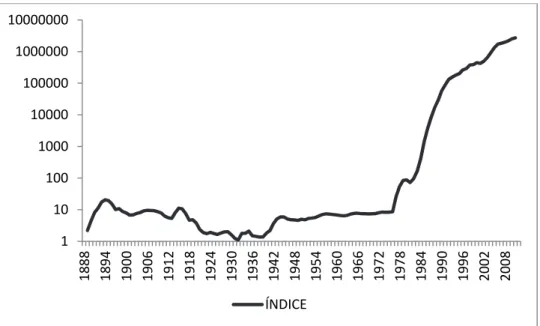
I have thus had to develop my own series based on data of thirty industrial, banking, and mining companies starting in 1888, seven years before the formal launch of the Stock Exchange. I have weighted the values in accordance with the trade volumes. I then linked this series with the series calculated by NAFINSA and the Stock Exchange in 1950 and 1978, respectively. In Figures 1 and 2, I present the results of my calculations. For the 1888-1899 and 1910- 1920 periods, I have used the consumer price index as a deflator rather than the implicit GDP deflator, which is not available. In the reconstruction of the quotes in fixed-income instruments, I was forced to make use of the financial press (Figure 3).
5 Figure 1. STOCK PRICE INDEX IN THE STOCK EXCHANGE IN MEXICO CITY (in current pesos, base index numbers for 1980, three-year moving average, and logarithmic scale)
Source: El Economista Mexicano, City of Mexico, various dates, El Excelsior; City of Mexico, various dates (Both available in The Hemeroteca Nacional de México); Bolsa de Valores de México,1978-2012; Nacional Financiera, 1977, pp. 340-8; Lagunilla, 1973.
Figure 2. STOCK PRICE INDEX IN THE STOCK EXCHANGE IN MEXICO CITY AND GDP PER CAPITA IN REAL TERMS, 1888-2012, (base index numbers for 1980, three-year moving average, and logarithmic scale)
Sources: See Figure 1 and Gómez-Galvarriato & Musacchio, 2000; Aparicio (2013); Noriega &
Rodríguez-Pérez (2011); http://dgcnesyp.inegi.gob.mx/cgi-win/bdieintsi.exe/NVO 1
10 100 1000 10000 100000 1000000 10000000
1888 1894 1900 1906 1912 1918 1924 1930 1936 1942 1948 1954 1960 1966 1972 1978 1984 1990 1996 2002 2008
ÍNDICE
0 20 40 60 80 100 120 140
10 100 1000 10000
1896 1902 1908 1914 1920 1926 1932 1938 1944 1950 1956 1962 1968 1974 1980 1986 1992 1998 2004 2010 GPD PER CAPITA
STOCK PRICE INDEX
INDEX GPD PER CAPITA
6 Figure 3. BOND PRICE INDEX IN THE STOCK EXCHANGE IN MEXICO
CITY IN NOMINAL TERMS, 1888-1978 (in current pesos and base index numbers for 1960)
Sources: El Excelsior, City of Mexico, various dates; Nacional Financiera, 1997, pp. 340-48.
THE BIRTH OF THE STOCK EXCHANGE AND THE FIRST STOCK CRASHES (1884-1909)
The first stock purchases (of mining companies) can be dated to approximately 1850, conducted on the street near the Zócalo in the capital. The police prosecuted these transactions, often conducted in secret in a doorway, a carriage, or a tavern8. It was not until 1880 that these transactions could seek physical and institutional shelter from the Compañía de Gas9. The Government feared stock speculations and the financial crises that it believed were an inherent feature.
Given the futility of bans after the 1885 crash, Porfirio Díaz, the president of the Republic, authorized these operations, which were to be regulated by the
8 Lagunilla 1973, Vol I, p.. 3.
9Eiteman 1966, p.1.
0 50 100 150 200 250 300 350
1888 1892 1896 1900 1904 1908 1912 1916 1920 1924 1928 1932 1936 1940 1944 1948 1952 1956 1960 1964 1968 1972 1976
OBLIGATIONS MORTGAGE BONDS BONDS
7 Commercial Code approved in the same year10. In fact, the recognition of their legality was due to the perennial needs of the Treasury. In effect, the Government opted to place new issues on the formal capital market (two fixed- income instruments at 3 and 5%) rather than to rely on creditors11. As in the rest of Latin America, the Mexican stock exchange originated not with the main objective of contributing to business financing but for the purpose of placing bonds on the secondary market in an easier and expedited way.
During the first years, bond sales were conducted in half a dozen of the so-called “mercantile agencies”, where investors now enjoyed greater legal security and better information12. Thanks to these investors, trade began in the shares of approximately fifty mining companies held by foreigners13. These operations were developed in a climate of authentic euphoria, thanks to rising silver exports14. The listing of securities also followed the price of oil, a dependent relationship that continued until the beginning of the XXI century (Figure 4).
10Lagunilla 1981, pp. 41-42; Cárdenas & Del Ángel (2011), pp. 31-2; Marichal 1997, pp. 129- 130.; Maurer 2002, pp. 24-25.
11Costeloe 2003; Marichal 1993 and 1997, pp. 129-131.
12Marichal 1997, 129-30.
13Haber 1989, p. 79-80.
14 Solís 1997, p. 97.
8 Figure 4. STOCK PRICE INDEX OF THE MEXICAN STOCK EXCHANGE AND CRUDE OIL BARREL PRICE IN THE UNITED STATES, 1888-2012 (in index numbers based on 1980, three-year moving average, 2012 dollars, and logarithmic scale)(*)
(*) 1888-1944 US Average.1945-1983 Arabian Light posted at Ras Tanura.1984-2012 Brent dated.
Sources: See Figure 2 and http://www.bp.com/en/global/corporate/about-bp/statistical-review- of-world-energy-2013.html
However, the contagion in 1891 from the “Argentine financial panic” and the financial difficulties of the United States after the crash of the New York Stock Exchange on May 5 1893 hampered the rise of the Mexican Stock Exchange. The mining dream reached its end, and Mexican investors took refuge in public debt (Figure 3). This investment was small comfort for the Treasury, as it contributed to the deterioration of its credibility abroad (Figure 5)
0 20 40 60 80 100
10 100 1000 10000
1888 1895 1902 1909 1916 1923 1930 1937 1944 1951 1958 1965 1972 1979 1986 1993 2000 2007 OIL CRUDE PRICE
STOCK INDEX PRICE
STOCK INDEX PRICE OIIL CRUDE PRICE
9 Figure 5. MEXICAN STOCK QUOTES IN NATIONAL AND FOREIGN STOCK
EXCHANGES, 1888-1933 (in nominal terms and index numbers with 1914=100)
Sources: Lagunilla,1977, pp. 245-271; El Economista Mexicano;, City of Mexico, various dates; El Boletín Financiero y Minero, City of Mexico (various dates).
The Government tried to combat financial slack through the institutional modernization of the capital market. In October 1895, the Bolsa Mexicana was founded with initial capital of 60,000 pesos15. However, it would last only a few weeks. In April 1896, miners who had become convinced that their financing troubles were due to the disloyal competition of the State and its bonds created their own Stock Exchange16, which further exacerbated the situation. Mining companies had to seek financing on the Stock Exchanges of London and New York due to a lack of investors17. Only after the new rearrangement of Mexican foreign debt in 1899 and the resumption of Mexican mineral exports after the end of the Spanish-American war did the situation improve (Figures 2 and 6).
15Solís 1997, p. 94, Lagunilla 1973,Vol I, pp. 3-11.
16Solis 1997, pp. 94-5.
17Marichal 1998, p.134; Macedo 1905, vol I, p. 126.
0 50 100 150 200 250 300 350 400 450 500
1888 1890 1892 1894 1896 1898 1900 1902 1904 1906 1908 1910 1912 1914 1916 1918 1920 1922 1924 1926 1928 1930 1932
EXTERNAL DEBT EXTERNAL EQUITIES INTERNAL EQUITIES INTERNAL DEBT
10 Figure 6. DEGREE OF MEXICAN ECONOMIC OPENNESS AND STOCK PRICE INDEX OF THE MEXICAN STOCK EXCHANGE IN REAL TERMS, 1896-2011 (in three-year moving averages, percentages, base index numbers for 1980, and logarithmic scale)
Sources: See Figure 2 and Kunz 2007, pp. 72-73; INEGI 2009;
http://datos.bancomundial.org/indicador/NE.IMP.GNFS.ZS;
The adoption of the gold standard in 1905 by Limantour, head of the Treasury in the Porfirio Díaz Executive since 1893, had highly positive effects on the capital market18. After a similar change, the time had come to put an end to the atomization of the stock market by creating a Stock Exchange as such, formalized on January 4th 190719.
However, it was exactly this financial normalization that enabled the contagion from the New York Stock Exchange crash of October in the same year (Figure 7)20. All macroeconomic indicators demonstrate the intensity of the first great financial crisis suffered by Mexico in the XX century (Figures 2 and 5).
The prices of equities collapsed, both on the Mexican market and in Europe, as a consequence of the decrease in international trade. Alarmed, investors took
18Ludlow, 1990; Lagunilla 1981, pp. 41-44.
19 Lagunilla, 1973, Vol I, p. 67.
20Romero, 2009; Cavazos 1976, p. 58; Reinhart&Rogoff 2009, p. 402.
0 10 20 30 40 50 60 70 80
1 10 100 1000 10000
1896 1902 1908 1914 1920 1926 1932 1938 1944 1950 1956 1962 1968 1974 1980 1986 1992 1998 2004 2010 DRGREE OF TRADE OPENNESS
STOCK PRICE INDEX
SOTCK PRICE INDEX DEGREE OF TRADE OPENNESS
11 refuge in public debt (Figure 3). Large banks suspended convertibility, which had been recently introduced.
Figure 7. EVOLUTION OF THE MEXICO CITY STOCK EXCHANGE INDEX AND THE DOW JONES (in real terms), 1896-2012
Sources: See Figure 2 and http://research.stlouisfed.org/fred2/tags/series
THE STOCK EXCHANGE AND THE REVOLUTION (1910-1933)
At the beginning of 1910, the economic situation showed signs of improvement. However, the triumph of the Revolution in this year not only halted the recovery but also led to monetary chaos, prolonged financial weakness, and declines in the stock market (Figure 2)21. A comparison with events on the New York Stock Exchange is pertinent (Figure 7). For another comparison, the annual closure quotation for the Havana Stock Exchange in 1928 in real terms was twice as high as in 1914. In Mexico, it was exactly one half of the index for that date and twenty times lower than its Cuban peer22.
21Paz 2006; Cárdenas & Manns 1989; Cavazos 1976, pp. 59-63; Haber, Razo & Maurer 2003, pp. 93-123.
22 Moreno 2013.
1 10 100 1000 10000 100000
1896 1901 1906 1911 1916 1921 1926 1931 1936 1941 1946 1951 1956 1961 1966 1971 1976 1981 1986 1991 1996 2001 2006 2011
CITY OF MEXICO NEW YORK
12 The rise to power of Madero in 1910, a highly educated moderate, was welcomed by investors. In fact, Mexican public debt maintained its price abroad as well as in Mexico itself (Figures 2 and 5). Madero even received financial help from Speyer & Co., a British bank that was a frequent creditor of Latin American Governments and was prepared to enter Mexico in 1906 together with Deutsche Bank23.
However, the situation changed substantially after the coup d’état of February 9th 1913, which began the so-called “tragic decade” with the bloody end of Madero’s execution. The management of the new dictator Victoriano Huerta and the uprisings opposing his rule severely damaged the economic outlook. The decline of international trade caused by the above conflicts, the abandonment of the gold standard, and the American occupation in 1914 led to a significant drop in GDP and stock prices (Figure 2). That year, Huerta repudiated external debt, a blunder to which European Stock Exchanges responded by suspending trading of Mexican equities (Figure 4)24. The large national companies were faced with dried up taps of foreign financing at a time when obtaining funds within the country was practically impossible due to the massive withdrawal of bank deposits and the inactivity of the Stock Exchange.
Dozens of companies fled the trading floor. The number of companies traded regularly dropped from 117 in 1910 to 43 in 1913.
Venustiano Carranza, president beginning in July 1914, sanctioned the moratorium on the payment of external debt. On June 6th 1916, he closed the Stock Exchange, blaming it for the “rampant speculation” that threatened the success of the Revolution. This decision was accompanied by a temporary closure of the banks, which had already been essentially seized beforehand25.
After one month, the institution was reinstated, now under tight state control and scorned by investors (Figures 2 and 5). The importance of this reform was more than merely circumstantial. Carranza’s concept of the Stock Exchange as a dangerous financial intermediary and only useful if it served the
23New York Times, 26 July 1906.
24Bazant 1968, pp. 174-200.
25 Reina 1946, p.26; Zebaldúa 1994, pp. 109-116.
13 interests of the State continued in subsequent Mexican Presidents, heirs to the revolution, for decades.
This situation of weakness lasted until 1918 when, thanks to the recognition of the external debt and, above all, increases in oil production, the stock indices experienced mild improvement along with the Mexican economy as a whole (Figures 2 and 4). The first measures of fiscal reform included in the 1917 Constitution and the subsequent reorganization of the State contributed to these improvements26. Mexican equities were even traded once again on European stock markets (Figure 5). However, due to revolutionary hostilities, the country could not benefit as much as its neighbors from the war in Europe. Seen from a financial perspective, the World War I was a lost development opportunity for the Mexican capital market27. Going further, the dwindling positive effects of the conflict were diluted by the financial crisis of 1920-21, caused by excessive oil production.
After these calamities, international markets rewarded the settlement and payment of external debt included in the De la Huerta-Lamont agreement between the United States and Mexico in 1922 (Figure 5)28. However, stagnation persisted in the Mexican Stock Exchange. Obregón, the new leader of the Revolution after the assassination of Carranza in 1920, was able to generate greater trust in foreign than national investors, as seen by the evolution of the public debt quotes (Figure 3). The Stock Exchange was a haven for a small number of industrial companies. The rest obtained resources in the informal capital market thanks to family and regional networks29.
The rise to power of Plutarco Elías Calles in December 1924 (and the start of the period known as “the Maximato”) saw the return to financial orthodoxy, thanks to the economic policy measures applied by Julio Pani, Minister of Finance and Public Credit (Secretaría de Hacienda y Crédito Público, in Spanish) . Pani directed the country finances expertly. Thanks to his actions and the renegotiation of the external debt, the Banco de México (Bank
26Riguzzi 2001.
27 De la Vega 1999.
28Castro 1997.
29 Haber, 1998.
14 of Mexico) was created in 1925 with a monopoly on issuing currency30. After three decades of uninterrupted falls, Mexican equities finally experienced growth in the Mexican Stock Exchange and in trade abroad (Figures 2 and 5).
The peace was short-lived. Immediately after the start of the Cristero movement, in 1927 the Mexican Government suspended (again) the payment of external debt to bankroll this new religious conflict. The price of Mexican securities collapsed both inside and outside the country (Figures 2 and 5). In 1928, president Obregón was assassinated. In a few months, political contingencies squandered the legacy of Pani, and Mexico plunged once again into the financial abyss. With an external debt of 33% of GDP, Mexico was at the brink of bankruptcy that year31.
Although the country, in economic terms, seemed to have reached rock bottom, it suffered the 1929 crisis with greater intensity than the rest of Latin America. Securities on the Mexican Stock Exchange during 1930 were quoted at 17.6 points, compared to 6.9 in Santiago de Chile and 15.8 in Bogota32. In 1931, a series of bank failures occurred, starting with the failure of the Sonora bank33. That same year, Mexican oil production fell to 1915 levels34. Mexico, a country devastated by more than two decades of wars and revolts, was mired in the deepest economic slump since its birth as a nation.
The return of Pani in 1932 to the Ministry of Finance and Public Credit provided some relief to investors. In effect, under the presidency of Abelardo Rodríguez, the Mexican economy began a slight recovery, stimulated by the devaluation of the peso, the reduction of interest rates from 12 to 8%, and the reorganization of the Treasury35. The Banking Rearrangement Act from 1932, which included new regulations on publicly traded businesses, ended the financial chaos of the Revolution36. Even the Stock Exchange experienced some recovery, and Mexican public debt recovered part of its diminished credit among the country’s population (Figures 2 and 3).
30Tedde&Marichal 1999; Oñate, 2000; Cevazos 1975, p. 65.
31Bazant 1936 pp. 209-211.
32League of Nations 1937, pp. 248-9
33Banco de Mexico, 1931.
34 De la Vega 1999.
35 Banco de México 1932.
36Caso 1971, p. 63.
15 THE STOCK EXCHANGE, IMPORT SUBSTITUTION, AND
INFLATIONARY GROWTH (1934-1958)
The coming to power of president Lázaro Cárdenas in December 1933 dispelled all hopes of maintaining monetary orthodoxy due to his clear desire to introduce a growth policy using import substitution and the creation of the public business sector. The Stock Exchange as an institution was formally limited.
Cárdenas attributed responsibility for the crisis to it. In his eyes, it was an entity owned by spurious foreign interests37. In his distinctly nationalist and statist ideology, the Stock Exchange had no place.
Cárdenas was much more preoccupied with healing pubic finance. To solve this problem, he used NAFINSA, created in 1934 by his predecessor Abelardo Rodríguez and conceived as an agent serving the Treasury to buy bonds38. Cárdenas made sure of this function by committing the Banco de México in 1936 and 1938 to buying all titles issued by the Stock Exchange and other public banks39.
In the first years of the Cárdenas term, there was considerable macroeconomic stability, with low inflation and a stable peso. However, the departure from the policies of Pani and the Keynesian tendencies of the President caused unease among investors40. They were right in their predictions. In 1938, Cárdenas nationalized the petroleum companies, prompting an immediate fall in the price of securities, both fixed-income instruments and equities (Figures 2 and 5). Cárdenas persisted, however, in the moratorium on external debt payment, which isolated the country from foreign financing.
The recognition of the external obligations of the country in 1941 by his successor Ávila Camacho was a great relief for investors41. At the time, the supply demands of the United States during the II World War led to growing exports, which were reflected in the stock indices. Investors perceived it as
37 Otero, 1935.
38 López 2012, p. 131; Aubey, 2005.
39Banco de Mexico, 1936. Cárdenas 1987, pp. 47-88.
40 Torres 1980, pp. 228-40; Cárdenas 1994, pp. 70-89
41Bazant pp. 215-22.
16 beneficial to return to the Stock Exchange, which was offering a more than generous dividend payout (Figure 8). They even trusted equities again (Figure 3).
However, Ávila Camacho caused an authentic seismic shock in the capital markets in 1940 by entrusting NAFINSA with industrial financing, completely eclipsing the Stock Exchange (Table 1)42. The President worked under the assumption that Mexican entrepreneurs could not undertake the country’s industrialization due to their ongoing preference for investing in real estate43. In their place, the State would have to invest, channeling private savings into the secondary sector. For this job, NAFINSA was employed. Thus, NAFINSA solved the conflict of interest between the development of the Stock Exchange and the Government in terms of fundraising44.
Figure 8. DIVIDENDS PAID OUT IN THE MEXICAN STOCK EXCHANGE, 1945-75) (in moving averages and percentages of the nominal
stock value)
Sources: See Figure 2.
42 López 2012, pp. 132-133.
43Hernánez 1988, pp. 45-47.
44 Haber 2008, p. 14.
2 4 6 8 10 12 14 16
17 Table 1. INSTITUTIONAL PARTICIPATION IN SECURITY
OPERATIONS IN THE SECONDARY MARKET IN MEXICO, 1945-1970 (in percentages)
INSTITUCIÓN 1940 1945 1950 1955 1960 1965 1970
Stock Exchange 4.0 0.2 0.4 0.6 4.8 7.2 3.3
Over the counter 96.0 99.8 99.6 99.0 95.2 928 96.7
NAFINSA 5.7 39.0 32.9 12.0 1.9
Banco de México 58.9 37.9 39.4 (b)60.4 45.2 51.6
Resto (a) 31.4 22.9 27.4 189.0 35.5 43.2
TOTAL 100.0 100.0 100.0 100.0 100.0 100.0 100.0
(a): Private banks, insurance companies, savings institutions, and financial societies (b): Includes NAFINSA
Source: Quiroz 1952, pp. 40-50; Comisión Nacional de Valores 1955-79.
Ávila Camacho converted this institution into a financial freak of megalomaniac dimensions that completely eclipsed the capital market.
NAFINSA raised funds by issuing fixed-income instruments, which were very attractive to investors, starting in 1944. NAFINSA used these resources to award credit to industrial companies and to buy the equities they issued.
Furthermore, NAFINSA took control of the Mexican Stock Exchange. Its leadership decided which companies could or could not be traded. NAFINSA was not a public holding similar to the ones created at the time in Europe;
rather, it was a financial instrument organized by the Mexican Government to support its client network in the business sphere. NAFINSA in practice replaced the Banco de México and the Stock Exchange45. There is no institution in the economic history of Latin America of a similar character and size.
Under such circumstances, the functioning of the Stock Exchange was completely anomalous. In the Mexican Stock Exchange, there were no properly open and competitive auction operations, as in the rest of the continent, which was not solely due to the intervention by NAFINSA. Groups of investors trading
45Aubey 2005, pp. 36-40.
18 directly with the company, with close links to its owners, made up the clientele of the Stock Exchange and conducted occasional operations at the behest of its managers46. Ávila Camacho himself decreed the legality of the entities known as “Financial Groups” (Grupos Financieros) and their operations in 194147. The banks (especially Financiera Banamex, a division of Banco Nacional de Mexico) also bought large packages of shares that they resold to their clients as credit.
Thus, a genuinely Mexican form of “over the counter” operations was born:
“counter sales” (operaciones de mostrador”, in Spanish), not subject to any registration or control48.
Credit facilities led to drawing a debt on NAFINSA, rather than reinvesting the profits, which left the country to invest in foreign Stock Exchanges where speculation was possible49. The financial architecture of the Government satisfied entrepreneurs due to the low costs of borrowing. The high rate of indebtedness they accumulated guaranteed their loyalty to the PRI, given the impassivity of employees due to the sedative effects of monetary illusion and the populist messages of the party in Government50.
Obviously, the stock index recorded losses year after year, completely distancing itself from the development of the Mexican economy (Figure 2). The result was a denaturalized Stock Exchange, whose priority was securing funds for NAFINSA and where only 25 equity instruments were traded.
Its position was even more marginal after the approval of the Havana Charter in 1947, a prelude to the first round of GATT. Mateo Alemán, the new President, and his Minister of Finance and Public Credit, Ramón Beteta Quintana, a zealous follower of the autarchic growth path, considered that the generalization of the most-favored nation status included in the agreement, harmed the country’s interests51. Therefore, Mexico did not join the treaty, reinforcing its international isolation.
In this new scenario, the Stock Exchange was only useful for serving the State in financing its discretionary and selective industrial policy. NAFINSA fulfilled this mission with new issues. To avoid any competition, the National
46Caso,1971, p. 33-4.
47 De la Fuente 1993 p 97.
48 Caso 1971; Ramírez 2007, p. 43; Hernández 1988, p. 153
49 Hernández 1988, p. 153; Haber 1997.
50Caso 1971 p. 7; Bash 1990.
51Riguzzi, 2003.
19 Securities Commission (Comisión Nacional de Valores) tightened the access criteria for firms wanting to enter the Stock Exchange, arguing that this restriction was necessary to avoid penetration by foreign capital, which was more demonized than ever before. The number of equities traded as well as their trading volume returned to insignificant numbers (Figure 9).
Only large corporations with financial subsidiaries could obtain resources on the Stock Exchange by issuing mortgage bonds. This financing strategy was adopted by the members of the so-called Monterrey Group52. This collective consisted of entrepreneurs from this part of northern Mexico and even had its own Stock Exchange beginning in 1950.
In sum, the high point of the interventionist and autarchic Cárdenas project conducted by Mateo Alemán was the origin of monopoly formation, which integrated financial and industrial activities vertically: not due to strategic decisions, as was the case in the United States, but due to stimuli described, with some excess and yet right on target, as “feudal53”. The Stock Exchange, paradoxically, was the instrument to achieve this goal54.
The opportunities for export to the United States provided by the Korean War (1950-1953) and the anti-inflationary policy of Adolfo Ruiz Cortines, elected president in 1951, slightly revived share transactions (Figure 2 and 6)55. However, as soon as the conflict ended, the apathy of the capital market returned. The Government, under the strain of runaway inflation and employer pressure, had to approve a significant devaluation of the peso on Holy Saturday 1954. Ruiz Cortines used this instrument, which had been so unpopular in 1958, one more time at the end of his term in office. The Stock Exchange bid him farewell with well-known drops in dividends (Figures 2 and 8)56.
52Cardero 1984, pp. 120-121; Ejea, Garrido, Leriche& Quintana 1991, pp. 30-31; Lagunilla 1977, vol. II, p.77; Cárdenas & Del Ángel (2011), p. 23
53 Caso 1971 ,p. 66.
54Castañeda 2010.
55Cevazos 1976, pp. 98-109; Cárdenas 1996, pp 41-46.
56Cevazos 1976, pp. 100-3.
20 Figure 9. EQUITY TRADING IN THE MEXICAN STOCK EXCHANGE, 1933-
2011 (in percentages of the total amount of private instruments traded)
Sources: Nacional Financiera 1977 pp. 340-348; INEGI 2009 and 2012.
THE STOCK EXCHANGE AND THE MEXICAN ECONOMIC MIRACLE (1959-1975)
Although his predecessor had done the dirty work, the new president, Adolfo López Mateos, was faced with a desolate economic outlook when sworn into office at the end of 1958: inflation was over 40%, the peso was free-falling, and GDP growth had slowed due to the decline in exports. In response to this situation, the new Minister of Finance and Public Treasury, Antonio Ortiz Mena, designed a new model of “stabilized” growth (“crecimiento estabilizardor”). The new priorities were now a stable currency (denouncing the idea of competitive devaluations), reining in inflation, a balanced budget, and investment financing through resources obtained from abroad57.
With this new growth strategy, which departed from the most entrenched tenets of the Revolution, and with significant achievements in growth and prosperity, the Government wanted to assign a greater role to the Stock
57Ortiz Mena 1970, pp. 417-41.
0 10 20 30 40 50 60 70 80 90 100
1933 1937 1941 1945 1949 1953 1957 1961 1965 1969 1973 1977 1981 1985 1989 1993 1997 2001 2005 2009
21 Exchange in corporate financing. This philosophy was behind the new Law regulating its activity, which was approved in 1960. Further protection was awarded by the regulations signed into law in 1963, which declared Stock Exchange activity to be “public” with the intention of removing all obstacles set up by prior presidents. Additionally, the first investment funds, financial hybrids that up until that moment had been unknown in Mexico, were created and traded by Brokerage Firms and Mutual Funds whose activity was encouraged.
The Government even allowed the opening of a new Stock Exchange in Guadalajara in 1963.
In practice, the results of this opening were very limited, despite the expected financial modernization58. It is true that the number of publicly traded companies grew. Throughout 1963, 356 companies joined the Stock Exchange, with the majority from the industrial sector59. However, only 54 were regularly traded. The owners of the rest entered the stock market to facilitate collateral loans from Banks and the sale of their shares to NAFINSA60.
The stock market did not gain popularity among the middle class, even though the Mexican telephone company (Telmex) required its clients to buy its shares to receive service61. In fact, the creation of the National Association of Stock Exchange Brokers in 1966 contributed in practice to the creation of new barriers to market entry by banning individual operators from the stock market.62 The clients of the Stock Exchange, in effect, did not change much. The usual buyer was a member of the “Financial Group” with a minimally diversified portfolio who was only willing to speculate on the New York Stock Exchange63. Banking Houses (including Merrill Lynch) and Mutual Funds could capture very few clients due to the lack of legal guarantees64. In 1868, they handled only 1.4% of the value of stock traded65. The lethargic brokers (82 in 1969) confined themselves to reluctantly executing orders from their clients (never more than fifty on average), never really developing their bidding skills, due to their limited
58 Caso 1971, p.20; Ángel 2010; Solís 1979.
59Caso, 1971 p.21.
60 Caso, 1971 p..21.
61Eiteman 1966, p. 12.
62Cárdenas & Del Ángel, 2011, p. 34.
63Caso 1971, p.19.
64 Cárdenas & Del Ángel 2011, p. 35.
65 Caso 1971, p.35.
22 incentives to do their job compared to other countries66. In these circumstances, the trading volume never exceeded 0.1% of GDP.
However, above all, as was denounced by the Stock Exchange brokers themselves in 1963, the negligible scale of equity securities trading weighed on the stock market development in the country (Figure 9)67. In 1964, shares represented 5% of the total trading volume of the Mexican Stock Exchange, compared to 92.2% in Rio de Janeiro and 45.5% in Sao Paulo (61.2% on average for the country as a whole)68.
It is true that NAFINSA saw diminished control over trading activity (its instruments went from making up 80% of the trading volume in 1960 to a meager 19%) in favor of Financiera Banamex and Telmex69. However, the damage done by NAFINSA was done outside the Stock Exchange. In 1965, it lent to companies and underwrote their activities to the amount of 10.624 billion pesos, of which at least 46.4% went to listed companies. Furthermore, NAFINSA bought their shares on the primary market to the amount of 2.239 billion pesos. In all, the transactions driven away from the Stock Exchange in share trading can be estimated at 7.710 billion pesos. Altogether, the activity of NAFINSA diminished the size of the equity market by a factor of five70.
Furthermore, counter sales, now known as the “free market” and already officially recognized, gained extraordinary importance at the expense of stock market trading, while the Government actually claimed it was pursuing the opposite goal (Table 1)71.
The insignificant size of the Stock Exchange was also due to the investors who avoided it due to the lack of sufficient incentives and legal certainty. Not even property rights were properly defined72. In the Mexican Stock Exchange, as opposed to the rest of Latin America, not even registered shares were issued or exchanged. Selling in a circle, the Mexican Stock Exchange was the most archaic, cumbersome, and slow stock market of the
66 Caso 1971, p.30.
67Lagunilla 1973, vol. II, p.156.
68Eiteman 1966.
69Comisión Nacional de Valores 1969, pp. 35-7.
70Nacional Financiera 1965 pp. 248-50.
71Comisión Nacional de Valores, Boletín, 1960-72.,
72Caso 1971 p.19.
23 Americas73. “Silent auctions” were not implemented, despite signing a computerization contract with IBM to this end74. Furthermore, trading was subject to significant fiscal pressure, which could be avoided by leaving the Stock Exchange75.
In such circumstances, the stock index fell in this period due to lower gold prices and, above all, cheap oil (Figures 2 and 4), together with the fall in imports caused by foreign trade restrictions established by the administration of President Johnson from 1964. The stagnation of the American economy, together with the political uncertainty caused by Mexican student revolts in 1968, sharpened the fall.
Things grew worse with the start of the Luis Echevarría presidency in 1971. Echevarría expressed his intention of doing away with what he called the
“strike of private investment” using a Stock Exchange reform in 1974, now considered a vital instrument in the strategy of “shared development”(“crecimiento compatido). He even aimed to open the institution to new investors who would share his goal of “Mexicanizing the industry”76. However, these changes were never made.
With the appointment of Ortiz Mena as president of the Interamerican Development Bank, the PRI lost its most qualified leader in economic policy.
The new executive allowed a statist, populist, and autarchic drift, starting with the nationalization of Telmex77. The income from growing oil exports (Figure 4) was insufficient. The industrializing project of Echevarría had to be financed through the intervention of NAFINSA in the Stock Exchange, which again became an instrument serving the Government78.
Once more, this autarchic economic policy led to chaos. In 1976, inflation grew exponentially, while the public deficit exceeded 10% of GDP79. The strong
73Eiteman 1966, pp. 12-14.
74Lagunilla 1973, vol. II, p.173.
75Kassler 1999, 42.
76Ejea, Garrido, Leriche& Quintana 1991, pp. 33-7; Kessler 1999, p. 42-43; Tello 1979 and 2007, p. 581.
77Cevazos 1976, p. 119. Cárdenas 1996, pp. 93-94.
78Cypher 1990, pp. 96-107.
79 Newell & Rubio 1981,p.141; Kessler 1999, 42-43. Cárdenas 1996, pp. 86-106; Hernández 1988, p. 41.
24 devaluation of the peso that year, with which Echevarría ended his term in office, led to inevitable drops in stock prices and dividends (Figures 2 and 8)80.
ECONOMIC LIBERALIZATION, GLOBALIZATION, AND FINANCIAL CYCLES, 1977-2012
López Portillo, who became president of the Republic in December 1976, initially worked prudently on the execution of economic policy, guided by his Minister of Programming, Carlos Tello, due to fears of a coup d’état, something unheard of in the history of Mexico81.
The new President finally noticed the possibilities of the Stock Exchange as a financial intermediary82. López Portillo undertook the modernization of this institution, already freed from under NAFINSA supervision in 1978, with full management autonomy. In the same year, the Stock Exchange developed its own index (the IPC) (Figure 10). Not only did this development lead to improved trading, but for the first time in decades, investment in equities rose (Figure 9).
Mexico, now a solvent country thanks to the introduction of a value added tax (VAT), was rewarded for the fiscal adjustment with generous loans from the IMF83.
However, López Portillo, seduced by the discovery of new oilfields, did not take long to fall into the trap of using internal and external debt to pay for fixed social capital investment programs, plagued by megalomania and corruption84. The Stock Exchange once again became merely a financial pawn of the State.
In effect, in 1978, the Treasury issued new short-term debt instruments (known as CETES), highly liquid and highly profitable (Figure 10), and bonds of the oil company PEMEX (Petrobonds)85. The new bonds replaced equity securities almost entirely, despite beginning to earn negative returns. No wonder that the majority of subscribers were small investors who did not have significant experience in the stock market86.
80 Tello 1979, pp. 146-82; Torres, 1980, pp. 340-58.
81 Cárdenas & Del Ángel, 2011, p. 48; Kessler 1999, pp. 15-18.
82Cypher 1990, 107-116; Cárdenas 1995, 106-113.
83 Hernández 1998.
84Kessler 1999, pp. 30-31.
85Kessler 1999, pp. 40-1; Ejea, Garrido, Leriche& Quintana, 1991
86Kessler 1999, pp. 60-2
25 The price of oil experienced an accelerated decline in 1981 once tensions in the Persian Gulf were overcome (Figure 4)87. López Portillo, who had committed to the stability of the peso, had no alternative but to monetize the debt, spurring hyperinflation (which exceeded 500%) and subsequent capital flight. By the end of February 1982, he had devaluated the currency by 581%, decreed control of foreign exchange, and suspended payments of external debt. Despite converting deposits, he could not prevent the massive withdrawals of bank deposits. In September, he announced their nationalization88. Obviously, the IPC fell (Figure 2). The comparison with the behavior of the Stock Exchange in the other large Latin American economy, Brazil (Figure 10), and the stock market in New York (Figure 7) shows the poor state of Mexican finances. López Portillo left the country economically devastated, with a public deficit of approximately 15% of GDP, a statist capital market, a Stock Exchange under interference, and unrealistic foreign debt.
The situation did not improve during the bleak term of Manuel de la Madrid (December 1982-December 1988)89. The president persevered in foreign debt escalation (equivalent to 60.5% of GDP in 1986), tolerance for inflation (which reached 3000%), and disdain for capital markets. Mexico’s accession to the General Agreement on Trade and Tariffs (GATT) in 1985 was the only positive signal for investors (Figures 2 and 10)90. However, to suggest a boom on the stock market would be excessive91. The pressure on the demand for securities amounted to very little, as can be observed by comparison with Brazil (Figure 10). In such circumstances, the crash of October 1987, despite the alarm and capital flight it caused, had less impact than in Mexico. In this country, things could not get worse92. Indeed, national investors lost money, but only in the New York Stock Exchange or in bond speculation (Figures 7 and 10).
87 Cárdenas 1996, p. 113.
88 Cárdenas & Del Ángel, 2011, pp. 73-4; Del Ángel, Bazdresch& Suárez (1985); Hernández, 1988; Maxfield 1990, 148-53; Cypher 1990, pp. 1206; Listing, 2002.
89 See Cárdenas 1996, pp. 118-152.
90 Flores, 1998, pp. 258-339..
91Kessler 1999, pp. 60-62; Cypher 1990, pp. 155-6.
92Ejea, Garrido, Leriche& Quintana, 1991, pp. 90-100; Tello 2007, p.642.
26 Figure 10 MEXICAN STOCK EXCHANGE INDEX (IPC), SAO PAULO INDEX (BOVESPA), AND TRADING IN 90-DAY CETES, 1978-2013 IN
MEXICO
Source: Bolsa de Valores de México and BOVESPA
The victory in 1988 of Carlos Salinas de Gortari led to a radical turn for Mexican economic policy. Salinas tried to reconcile a policy of income redistribution (embodied in the so-called Solidarity Pact) with the gradual liberalization of the country’s economy and its opening to the outside world. In 1990, he signed a free trade pact with the United States and Canada, healed public finance (in 1992 Mexico recorded a budget surplus of 4.5%), substantially reduced foreign debt to 21.6% in the same year by taking advantage of the Brady Plan, and tackled inflation93.
In 1990, Salinas put an end to the legacy of the Revolution in the stock market. NAFINSA was expelled from the market and relegated to dealing with credit for small companies. The president even allowed the participation of foreign investors in the Stock Exchange, which had been taboo since 1932. In exchange, to maintain the corporatist status quo, new regulations provided greater legal certainty and support for the old “Financial Groups”94.
This improvement in defining the institutional framework and property rights, together with a wave of privatizations, provided vitality to the Stock
93 Cárdenas & Ángel, 2011, pp. 99.101; Cárdenas 1996, pp. 158-164:; Aspe 1993, pp. 13-61.
94 Aspe 1993 , pp. 74-85.
0 20 40 60 80 100 120 140 160
0 10000 20000 30000 40000 50000 60000 70000 80000 90000 100000
1979 1981 1983 1985 1987 1989 1991 1993 1995 1997 1999 2001 2003 2005 2007 2009 2011 BONDS
EQUITIES
MEXICAN EQUITIES BRAZILIAN EQUITIES MEXICAN BONDS
27 Exchange95. The demand for equity securities achieved values unknown in the economic history of Mexico (Figure 9)96. In the Stock Exchange, the Grupo Carso grew to large proportions as the property of Carlos Slim, who was awarded Telmex in a controversial auction97.
In all, this growth model, which placed Mexico as one of the most dynamic emerging markets, was based on the fixed exchange rate of the peso and unusually high oil prices. The pillars of the new Mexican miracle would soon crumble.
Increased public expenditure in 1994 (a usual practice in the last year in office of outgoing presidents), falling crude prices (Figure 2), the Zapatista uprising, and the assassination of Colossio (the PRI candidate) and Ruiz Massieu (president of the party) incited panic among economic agents.
Investors dumped their Tesebonos (debt securities redeemable in dollars issued since 1989), draining the reserves of the Bank of Mexico.
Ernesto Zedillo, immediately after being sworn in as President on December 1st 1994, negotiated a modest devaluation of the peso (15%) with national and international investors. However, the disclosure of his intentions (the so-colled “December error”) led to a much larger fall in the exchange rate.
Zedillo was forced to announce the free flotation of the peso. This announcement was followed by inevitable capital flight and decreasing investment98. The “Tequila crisis” (Figure 10) caught thousands of foreign investors by surprise, who had previously been persuaded to confidence by the improved property rights99.
American help, oil price appreciation, and the socialization of the large financial and corporate companies thorough the Bank Savings Protection Fund (FOBAPROA for its initials in Spanish) lifted the country from financial collapse.
However, contagion from the Asian crisis in 1998 slowed the recovery of the stock indices, which had already been slowed for a long time by the aftermath of the 1994 crash (Figure 10).
95See Haber 2005.
96Kessler 1999, 100-4.
97Martínez 2002; Castañeda 2010.
98 Del Angel (2010); Del Ángel, Haber &Musacchio (2006); Kessler 1999, 120-22; Cárdenas 1996, pp.
183-190; Muñoz 2004; Listing 2002, pp.191-278.
99 Reinhart, &Rogoff 2009, p. 46.
28 After seven decades of PRI rule, the victory of the PAN party and its candidate Vicente Fox in 2000 instilled a sense of euphoria in Mexican business circles, together with promises of economic liberalization. In fact, during a five- year period, the Mexican Stock Exchange registered higher increases than ever before, despite the repercussions of the Argentine crisis in 2001. This financial euphoria was the consequence of rising oil prices, the 2002 emancipation of the Stock Exchange from the Government, the new wave of privatization, and foreign investment. Felipe Calderón, also a PAN politician, who was elected president in the 2006 elections, maintained this economic policy of deregulation of the capital markets.
The Stock Exchange finally occupied its rightful place as a financial intermediary free from government control. In the years of the second globalization, Mexico relived the investment enthusiasm experienced at the end of the XIX century due to the same impulse coming from abroad and the abandonment of self-sufficiency and intervention paradigms.
Furthermore, sustained by high oil prices (Figure 4), the losses in the Mexican Stock Exchange between September and November 2008 (41.9%) were clearly smaller than the losses experienced in Buenos Aires (48.4%), Sao Paulo (51.5%), and even in New York (56.6%), Amsterdam (74.6%), Milan (52.8%), or Madrid (57.1%)100. In fact, it was the Latin American Stock Exchange that resisted the crash to the highest degree, immediately after Lima (with 38% of losses). The same result occurred with the new stock market losses of 2011, also more attenuated (Figure 10) thanks to the application of the same preventive measures against speculative activity as were used in the US.
However, the Mexican Stock Exchange did not achieve the importance enjoyed by its peers in neighboring countries. The Stock Exchange maintained its commitment to financing the needs of the public sector, especially after Mexico’s inclusion in the World Government Bond Index (WGBI). The identity of the most active agents did not change substantially: they were the “Financial Groups”, now including Carlos Slim and his Grupo Carso 101.
100 See Vázquez (2008).
101Kessler 1999, pp. 40-1; Ejea, Garrido, Leriche& Quintana 1990, p. 123; Basave 1996.
29 Comparisons with neighboring countries lead to clear conclusions regarding the slow stock market development in Mexico102. Indeed, its capital market was much less vigorous than in Brazil (Figure 10). Small wonder that in 2002, Mexican companies obtained just 17% of their financing from the Stock Exchange, as opposed to 68% in other emerging markets and 84% in developed countries. The volume of market capitalization, measured against GDP (never exceeding 0.5%) was, after Argentina, the lowest indicator in Latin America.
Paradoxically, however, in 2011 the companies traded on the Mexican Stock Exchange occupied the third place globally (2.836 billion dollars) behind the United States (3.388) and Brazil (3.122)103. Mexico had a diminutive Stock Exchange that financed gigantic companies.
In July 2012, the Mexican Stock Exchange suffered severe losses due to strictly endogenous factors: violence, presidential elections, and stalling economic growth. In effect, in this year the GDP grew by only 2.6%, only ahead of El Salvador among Latin American countries. This point was when the first signs of the end of the growth period became evident: falling prices of raw materials, fluctuations of the Stock Exchange in Brazil, and the difficulties faced by Argentina104. Mexico had again lost its opportunity to strengthen the Stock Exchange.
CONCLUSIONS AND DISCUSSION
Despite its apparent vitality at the beginning of the XXI century due to high regard among foreign investors and their opinions of the potential and investment opportunities in this emerging economy, the Stock Exchange has played a residual role in the economic development of Mexico. I am not saying that the backwardness in Mexico is due to the inadequate functioning of this institution, but that Mexico grew despite this fact.
102 Manuelito & Jiménez 2010; Kessler 1999, pp. 40-1; Ejea, Garrido, Leriche& Quintana 1991, pp. 144-145.
103Valores. Boletín de la Asociación Mexicana de Intermediarios Bursátiles, City of Mexico, various dates.
104 Banco de Mexico 2012, p. 2.
30 This phenomenon was in large part caused by the traditional disdain of politicians towards the Stock Exchange. While the “scientists” of Porfirio Díaz regarded it with mistrust, the Governments running the country since the Revolution completely compromised its mission. After the rise to power of Cárdenas, it became an instrument to satisfy the financing needs of the State.
Additionally, the Stock Exchange became a tool needed by the Executive to financially sustain its client network, allocating resources through NAFINSA to large corporations that were stagnant due to minimal risk. All PRI Governments used the Stock Exchange for this non-economic end, be it resource provision or privatization. NAFINSA, as a completely anomalous institution in a modern capital market of a democratic country, due to both its nature and its inner workings, is the best evidence in the Mexican case that an inappropriate and rigid definition of property rights in the financial system facilitates State abuse105.
If financial system modernization is inconceivable in a country such as Mexico, where there was no effective competition between political parties until 2000, the modernization of the Stock Exchange is even more difficult106. The democratization of investment (understood as broadening the range of agents active in the capital market to a large spectrum of the population), the public nature requirements of traded companies, the financial situation of the State itself, free speculator activities, and the anonymous character of transactions are difficult to fit into an authoritarian regime. And Mexico suffered 70 years of PRI domination, notwithstanding the reductionism and controversy of this statement. In fact, the conversion of the Mexican Stock Exchange to one of the main players among emerging markets was contemporaneous with the political reforms that swept the country. Violence and reversals in real competition between the parties were barriers to its growth, which nonetheless could not happen in any other way107.
It is not at all unusual that small savers avoided the Stock Exchange.
Given the uncertainty and favoritism, they preferred preserving wealth to
105 Haber, Kieff& Paredes 2008, pp. 216-217; Kessler 1999, p. 19; Tello 2007, 755.
106 Haber 2008, p. 12.
107 Haber 2008, p. 48.
31 multiplying it. This investment behavior is not an inherent feature of Mexico. It is a logical consequence of inefficient political institutions.
However, the small number of agents active on the stock exchange, enveloped by the State, also made it possible to create large fortunes and integrate corporations. Carlos Slim most likely could not have become the richest man on the planet on the New York or London Stock Exchange. Apart from his abilities, only on a Stock Exchange with limited access to information, with intervention, that is hermetic and ruled by public authorities, could he have done what he did. In all, the case of Mexico suggests that state intervention, co- opting, and the small size of the Stock Exchange facilitate the formatio