For each city, we provide an occupancy forecast, ADR and RevPAR, as well as the economic outlook and our analysis of opportunities driving tourism and investment in 2013. RevPAR growth is expected to slow in 2013 and there will not be double-digit gains in either surveyed cities. In local currency terms, London still sits at the bottom of the RevPAR decline league (-6.8%).
Hotels located further from the city or in poor places may be more difficult in 2013.
ADR €
Fewer new customers to flow in 2013 Little economic growth and low consumer confidence across Europe means that winning new customers is expected to be difficult in 2013. Accor's latest research into the preferences and characteristics of business travelers showed that European business travelers want attentive hotels that offer guests a.
This time it’s personal as consumers move beyond just ‘research and buy’
Economic outlook: The success of the hotel sector in 2013 largely depends on how the crisis in the Eurozone develops. In this scenario, a curtailed Greek exit leads to a 1.7% decline in the currency area's GDP in 2013.
Our forecasts are based on our main economic scenario. Should the euro crisis intensify, we may see a less encouraging outcome for hotels
Most of the hotel markets we are analyzing are based in the Eurozone, and many of the economic fundamentals across the currency bloc remain uncertain. Scenarios for the eurozone outcome With the level of uncertainty about the future of the eurozone remaining high, we express our view of its future in terms of three scenarios. But even then we expect GDP across the currency area to fall by 0.7% in 2012 and then no growth in 2013.
Our first downside scenario involves a Greek exit, but also a commitment by leaders of the remaining eurozone countries to 'do whatever it takes' to save the euro. In practice, this will mean building a firewall around vulnerable economies and accelerating fiscal austerity measures in the periphery to avoid 'the Greek fate'. Growth in 2013 in the UK is expected to come in at 1.8%, stronger than any other major Western European economy.
While some Western European destinations showed growth in the first eight months of 2012, Central and Eastern European destinations continue to lead the way. A recent American Express survey concludes that the ongoing euro crisis and economic uncertainty in Europe means that the region is likely to experience declines in both meeting spending and the number of meetings in 2013. As a result, one of the top emerging trends in the space is the shift to more local meetings.
Around 45,000 new hotel rooms opened in 2012 and a further 54,000 are under construction across Europe
The financial crisis has made it more difficult to secure financing for new hotel projects, yet the European hotel development pipeline includes approximately 870 hotels with a total of 141,000 rooms, according to STR Global. In 2013, around 280 new hotels are expected to open in Europe, with an additional 45,000 rooms – most of which will be in the luxury segment. In terms of cities with supply hotspots, STR Global cites London, Berlin and Moscow with between 2,000 and 3,500 rooms under construction (as of September 2012).
Following in the footsteps of Z Hotels, citizenM and Motel One, IKEA has announced plans to open 100 budget hotels across Europe, starting in Germany. The new budget hotels are proving popular with both business and leisure travelers looking to cut costs in style.

Economic downturn and a highly competitive environment could hit home in 2013
Occupancy is set to rise to its highest level for 10 years, but economic worries could hamper growth in Spain's second-largest city in 2013.
Occupancy to soar to highest level for 10 years but economic worries could depress growth in Spain’s second largest city in 2013
The third most visited city and 'capital of culture' in Europe saw record occupancy and ADR in 2013.
The third most visited city and ‘cultural capital’ of Europe could see record breaking occupancy and ADR in 2013
Modest decline in 2013 compensated by EU spend in this top conference hub
Bounced back and posted strong growth in 2011 and 2012
Expect modest growth in 2013
The last quarter of 2012 was very strong, although some of this is event driven, but there is good momentum heading into 2013. The fundamentals for the Dublin hotel sector next year are quite good, even though events activity is likely to be weaker. I believe ADRs will continue to rise incrementally over the next 12 to 18 months, albeit at a slower pace than this year, due to an ongoing correction in the market.”
It has been a very strong year in Dublin, with double digit growth in 2012 on top of double digit growth in 2011, driven by the Convention Centre, sporting events and concerts. Forward booking rate in the early months of 2013 is encouraging, but events in the City are not as strong as in 2012 and we expect a slight softening in RevPAR.”.
A disappointing 2012 as the Olympics disrupt travel patterns but expect a bounce back in 2013
The Frankfurt hotel market has been buoyed by the euro crisis and is at record highs (since 2000). After coming through the euro crisis and with trading already at record highs in Germany's financial capital, expect slower growth in 2013.
After powering through the euro crisis and with trading already at record highs in Germany’s financial capital, expect slower growth in 2013
The Swiss economy is expected to grow in 2013 and assuming the franc does not appreciate further, we expect a stable picture in 2013.
A brighter outlook for 2013 as long as the Swiss franc doesn’t keep visitors away
Lisbon had a poor 2012 due to economic problems at home and abroad, with fewer business travelers but a 4% increase in room supply. However, continued growth and improved performance from key markets (such as Brazil, Germany, France and the UK) will help stabilize the market in 2013, where we forecast a 0.8% gain in RevPAR. More new rooms and fewer business travelers had a negative impact in 2012, but a marginal improvement is expected for 2013.
More new rooms and fewer business travellers negatively impacted 2012, but a marginal improvement is expected in 2013
ADR is expected to decline in 2013 following the record highs experienced during the 2012 London Olympics. Although we expect a weaker hotel market in 2013 as the inevitable Olympic hangover kicks in and the increase in new supply in 2012 and 2013 brings down occupancy and rates , we don't expect these temporary factors to hold London back for long. Leading global cities have seen recent record-breaking performances and are unlikely to be held back for long by softer trading in 2013.
Leading global city has seen recent record breaking performances and unlikely to be held back for long by softer trading in 2013
More declines expected with little prospect of stabilisation
The economic situation is expected to improve slightly in 2013 and we see the market generally flat in 2013 as a result and our latest forecast is for a relatively flat occupancy rate remaining at 61.4%.
Fairly robust rates growth despite recession. Anticipate a flat 2013
Moscow is Russia's financial center and home to more than 600 of the 1,250 credit institutions operating in the country. Both occupancy and ADR grew in 2011 and as a result, Moscow saw a strong 7.9% increase in RevPAR. By the end of 2012, we expect occupancy and ADR growth to continue, with RevPAR having another strong year, increasing RevPAR to RUB 3940.
According to data from STR Global, Moscow has 147 hotels with more than 37,000 rooms and about 415 rooms opened in the last nine months of 2012. If all the planned openings happen as planned, the number of rooms in Moscow will increase by more than 560 rooms in Q4 2012. It shows solid levels of regional output growth (5-6%) and has the lowest levels of unemployment (1% against the Russian average of 6.2%).
Growth is expected to be 3.8% in 2013 and levels of unemployment and government debt are relatively low. Paris has performed exceptionally well in recent years and the record ADR (ADR is €68 above the long-term average) has failed to dampen demand.
A global city that enjoyed a remarkable 2012 with sky high rates
Expect the pace to slow in 2013
Robust growth returned in 2012 but RevPAR remains around half 2004 levels. Weaker growth forecast for 2013
Rome's hotel market has been fairly robust since Italy returned to recession, but we expect a modest decline in 2013 as economic problems in Italy and key demand markets take their toll.
International tourism buoys up hotels despite the recession but expect a modest decline in 2013
St. Petersburg has performed well in 2011 and 2012, but rates in particular remain below pre-recession peaks. We expect growth to remain strong in 2013, but to be weaker than previous years as global economic headwinds and occupancy approaches more normal trend levels. The recent stellar performance continues into 2013, but weaker than previous years with rates below pre-recession levels.
Recent star performances continue into 2013 but weaker than previous years with rates below pre-recession levels
However, Austria plunged into negative growth in the third quarter of 2012 and we expect the market to be flat in 2013 with only marginal growth driven by 1.8% ADR increase.
Weathered the crisis but new supply additions and slower growth mean a flat market in 2013
Zurich has been hit by the strong franc and a weak business environment, and many of Zurich's leading financial companies are cutting staff and cutting costs. Increasing individual leisure tourist arrivals from India, China and Russia are also developing positively and are expected to support trade in 2013.
Switzerland’s largest city sees hotels hit by the strong franc. Expect some stabilisation in 2013
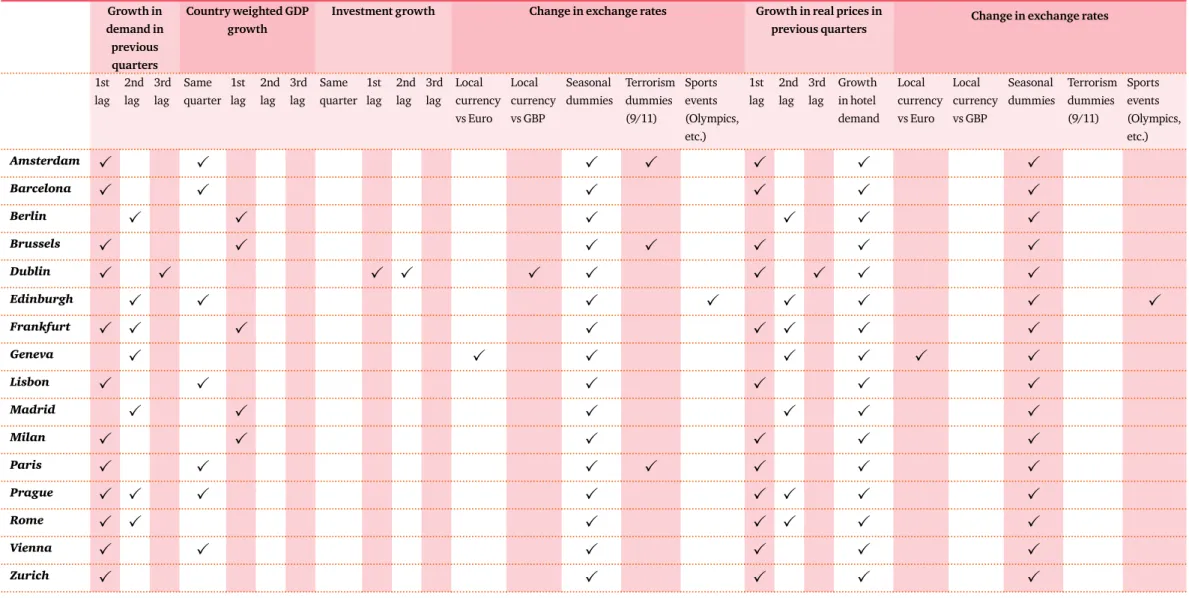
Occupancy has now exceeded the 10-year average of 70.9%, but ADR and RevPAR are still lagging behind. Our hotel dataset provided by STR Global includes ADR, hotel room supply, demand and occupancy on a monthly basis for each of the 19 cities. Macroeconomic variables such as GDP growth and Consumer Price Indexes (CPI) were obtained from Eurostat for all countries except Russia.
Total nights spent by residents and non-residents in hotels, used to calculate GDP weights, and also obtained from Eurostat for all countries except Russia. We used a weighted measure of GDP in our models; this is a weighted average of the GDP growth of the main countries of origin of hotel guests, where the weights are the percentage of hotel guests from the respective country. This section describes in more detail the PwC models used to forecast hotel occupancy, average daily rate (ADR) and revenue for.
This section outlines in more detail the PwC models used to forecast hotel occupancy, Average Daily Rate (ADR) and Revenue Per
Available Room (RevPAR) for 18 European cities
Note: London: see details in UK Hotel Forecast 2013: www.pwc.co.uk/hotelsforecast Moscow and St. We periodically review our model specifications based on a review of current academic literature and industry best practices. Based on our results, we updated our model to the 2-stage least squares (2SLS) instrumental variables approach.
ADR growth and hotel demand forecasts were generated using PwC forecasts for macroeconomic variables, supplemented by additional hotel supply forecast data based on country-level pipeline data provided by STR Global. An attrition factor (10% for hotels in the pipeline and 0.5% for existing hotels) per year was applied to the supply. For more information visit www.pwc.co.uk/hospitality-leisure/hotels or contact Liz Hall, Hospitality & Leisure Research: [email protected] Cities of Opportunity 2012.
Emerging Trends in Real Estate Europe A joint venture of the Urban Land Institute and PwC, Emerging Trends in Real Estate®. PwC's team of hospitality specialists offers an unbiased overview of how the hospitality industry in South Africa is expected to develop over the coming years. Report on the key events in the Indian hospitality and leisure sector, based on interviews with the business leaders who shape the industry.