Popular video games can significantly influence second language teaching and learning (L2TL) for motivation and learning because they engage and encourage encounters. The results show positive and promising feedback for the research: the use of Minecraft as a teaching tool has a positive effect on student motivation and learning, without negative effects on the game.
Introduction
- Beyond the game
- Gamefulness as a framework for teaching and learning
- Background to the study: Italian EFL contemporary context
- Dissertation: structure
Moreover, the recent painful experience of the pandemic has revived interest in video games and learning based on them (Kriz, 2020). 6 Competitions (Game@school, BYOEG - Bring Your Own Game Education) as well as the use of video games as part of the learning process (Minecraft Edu, Gran Sasso Videogame) are highly recommended, according to the Italian National Digital School (action #15, innovative scenarios for the development of applied skills, and action #7, creative workshop).
Theoretical framework
How does L2 learning happen with digital games?
- SLA and L2TL
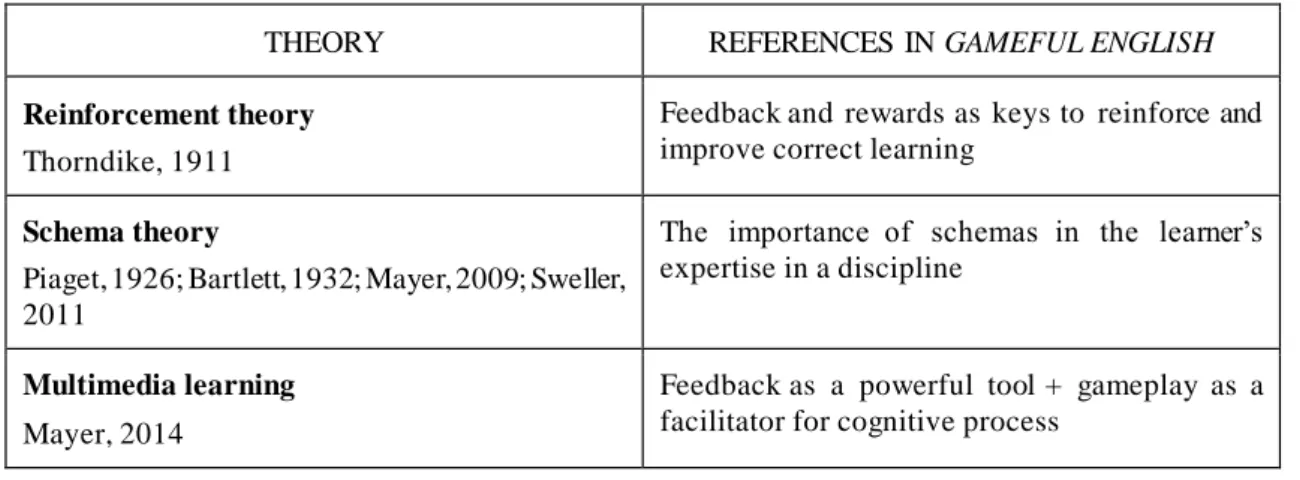
- Structural-behaviourist perspective – Reinforcement theory
- Conceptual perspective: the Schema theory
- Psycho-cognitive perspective: Multimedia learning
- Social-informed perspectives
- Ecological perspectives
- Affordances and L2 learning
For example, providing comprehensible inputs, using a stage, and providing feedback could help prevent the student-actor's working memory from being overloaded (Reinhardt, 2019). In addition, almost all digital games have tutorials (walkthroughs) that gradually introduce players to the objects and rules of the game and introduce them to the gameplay.
How games affect motivation to learn
- Motivation in learning and gaming
- Interests: Interest theory and Value theory
- Beliefs: Self-Efficacy theory
- Goals: Goal-orientation theory
- Needs: Self-Determination theory
- Motivation and L2 learning: the integrative-instrumental orientation model 38
- Engagement
- Flow
According to Sykes and Reinhardt, flow is "the ultimate manifestation of motivation" (Sykes & Reinhardt, 2013, p. 97). It is an intense state of enjoyment that incorporates focus, euphoria and high levels of motivation (Carr et al., 2006).
Game and play
- What is Play?
- What is Game?
- Multiliteracies
- Game types and L2TL
- Game elements and L2/EFL learning
The fourth effect can be seen as the result of losing self-awareness: time is transformed. Designed narratives provide a context through which players learn the rules of the game and then play according to them.
Game-based learning
Moreover, in the design of gamified English, the course was imagined as a game and the mechanics as different rules and procedures of online classroom tasks. The advent of broadband expansion and the rise of multiplayer online gaming during the 2000s, along with the "social turn" in second language acquisition (SLA) (Firth & . Wagner, 1997), prompted a new look in educational games specifically for second language (L2) learning (Reinhardt, 2019). Research (deHaan et al., 2010) shows that learning the rules of the game and the language of the rules and narratives of a game at the same time can result in cognitive overload for L2 learners, leading to frustration and failure.
To reduce the risks of failure, Berns et al. 2013) suggests working on the design to find the right balance between the story and the structure focus; Neville (2010) argues that L2 learning game designers need to carefully balance fixed narratives with more open-ended narrativable resources; Reinders and Wattana (2015) emphasize the importance of shelter for practice as well as controlling who the players can communicate with and the tasks they do. Researchers and developers of game-based applications need to be aware of game-enhanced practice and research to better understand the benefits of working with vernacular games;.
Game-Enhanced learning
- Pedagogical interventions
- Wraparound activities
- Frameworks for game-enhanced activity design
- A brief history of digital games in L2/EFL teaching and learning
- Video games in L2/EFL teaching and learning
- MMOGs- Massive Multiplayer Online Games
Reinders & Wattana (2015) and Piirainen-Marsh & Tainio (2009) looked at cooperative play, Zheng et al. 2010) investigated ecological psychology, and Purushotma (2005) and Sundqvist & Kerstin Sylvén (2012) investigated vocabulary acquisition. According to Ahmed et al. 2022), the implementation of game-based learning had the potential to reduce EFL learners' anxiety to improve their English learning. MMOGs are considered high-stakes, meaningful spaces with social consequences for the players involved (Squire & Steinkuehler, 2006; Thorne et al., 2009).
Involvement: Involvement in MMOGs leads to a rewarding experience in the long run, despite the challenges involved (Purushotma et al., 2009). MMOGs can provide multiple opportunities for second language learning and socialization, allowing second language learners to enrich their second vocabulary and increase their communicative competence in the target language (Jueru et al., 2019).
Game-informed learning
- Affordances for game-informed practice
- Gamification
- Elements of gamification
That effect (an external reward as an incentive) has led to criticism of gamification because it undermines the significance of intrinsic motivators (Mekler et al., 2013). Gamification and gameful learning have contributed to a better understanding of the psychology of games and how they motivate players and students (Przbylski et al., 2010). Students can grow through failure if they are given the tools and opportunities to do so (Alexander et al., 2019).
Both intentional integration and a solid research base for teaching strategies can be provided by play-based learning (Alexander et al., 2019). Language learning is facilitated because the challenge provides a coherent context for meaningful language use (Galbis-Còrdova et al., 2017).
Summary of the analysis dimensions: interpretation path
After considering the theories behind video games as learning tools, the role of motivation and the possibilities that the use of gamification offers to promote learning in a clear, conscious and fun way, the next paragraph will clarify how these theories have been applied in the creation of Gameful English course and guided the research. As Mayer (2014) suggested, Gameful English was additionally provided with instructional features that guided the learner's cognitive process during the gameplay (specific tasks and tasks). Tasks in Gameful English were based on vocabulary acquisition and its use in narrativized speaking activities.
In this study, I wanted to consider what motivates people to put effort into learning and playing video games to see if both aspects could find a synthesis in Gameful English. Gameful English design allowed students to choose alternative paths, as Armstrong and Landers (2017) suggested.
Research design
Premise
The use of gamification aligns game theories and play with the practice of L2 teaching and learning thanks to the possibilities of games; this is why I also considered the established theory of learning, self-determination theory (SDT), as one of the underlying theoretical frameworks. The other theory from which this study moves is the theory of flow, proposed by Csikszentmihalyi (1990): people who are immersed in a challenging activity such as games may experience 'flow' when they reach peak performance. In Rachels and Rockinson-Szapkiw's (2018) study, the authors found that when game elements are included in game activities, they can potentially lead individuals to a state of flow if the challenge is appropriate for the individual's skill level.
Other key contributions that I considered essential in the gamified design of the implementation were scaffolding, individualized learning and social interaction. The concept of scaffolding can be referred to Vygotsky's zone of proximal development (Vygotsky, 1978) and the basic principles of SDT: learning can be enhanced due to these motivational opportunities when students interact with their more able peers.
Gameful English: a case study
- Research questions, hypotheses, and objectives
- General objectives
- Specific objectives
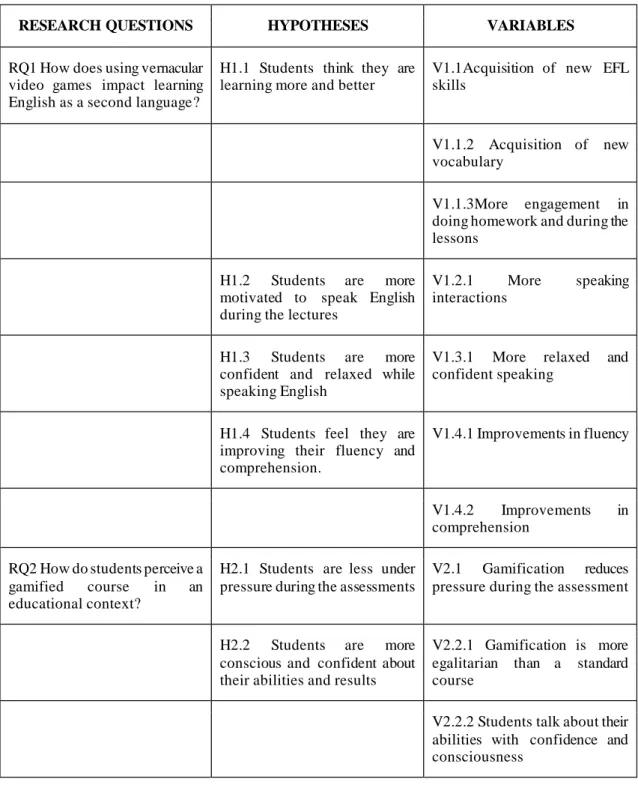
Overall objective number three seeks to understand students' perceptions of their learning outcomes after implementation. The implementation was designed to change students' behavior (stress and anxiety during assessment, fear of speaking, low motivation in oral interactions) and to develop certain skills (mainly speaking and listening). Understand how to improve technical, methodological and design issues based on student feedback.
The number one specific aim is to analyze learners' perceptions and comments about playful English. According to the students, it is important to understand its limitations in design and use.
Methodology
- Participants
- School context and contact
- Language
- Game: Minecraft
- Ethics of the research
The purpose of the case study is to make a 'generalizing' rather than a 'detailing' analysis (Lipset et al., 1956). To summarize, the choice of the case study as the research strategy for this study constitutes an all-encompassing method in the logic of the project (meaning specific data collection and analysis approaches). The choice of methodological approach also determined the sample of participants who took part in the study.
The school recognized participation in the project as part of the student's extracurricular activities (PCTO - Percorsi per le Competenze Trasversali e per l'Orientamento)25. The potential of the game for learning has been an object of studies and researchers (York, 2014; Bradshaw, 2014; Cózar-Gutiérrez & Sáez-López, 2016) and has received really good outcomes from a pedagogical point of view (York, 2014) .
Data collection: techniques and instruments
- Rationale for data collection instruments
- Survey
- Participant-observation
- Interviews
- Focus groups
- Phases of the implementation
28 One of the students had health problems and was unable to participate in the interview and focus group. This is a narrative account of the researcher's observations, reflections, and responses to what he observes. Use of technology: obstacles or facilities in the development of the activity related to the use of video games.
Adequacy of the proposal: adaptation of the material used to the didactic objectives and the level of the class group. User: favorable and/or unfavorable conditions for the acquisition of the goals related to the user's handling of the materials.
Design framework of Gameful English
The pre-play phase introduces the topic of the session with wrap-up tasks (acronyms in web chats, explore biomes, look at different play styles, comment on Youtube videos, etc.) and review vocabulary and the debriefing tasks (assignments). This phase is done in class and requires the active participation of the students who are asked about their opinions and solutions on the proposed topic. The initial session (level 0) outlined what to do before, during, and after each playing session of Minecraft: getting familiar with the task, playing the video game, and performing the task.
Some gamification components (leaderboard, points and badges) were also introduced as another assessment method32, and the structure of the gamified course, adapted from Ajlen et al. 2020) was explained in detail (Appendix 1), with some of the dynamics (story, progress and limitations) and the mechanisms (rewards, feedback and challenges) the students had to deal with were shown. The follow-up session (level 10) included a general debriefing with the presentation and review of the final products (edited live comments on the students' gameplays).
Results
Final survey, interviews, focus groups, and participant observation results
- Factors that promote learning
- Tasks assessment
- EFL skills assessment
- General assessment of the course
- Gamification: positive aspects
- Gamification: limits
- PBL
- Gamification AND Assessment
- Gameplay experience
- What limits the gameplay
- Use of vernacular video games at school
- Development of the project
- Suggestions for improvements
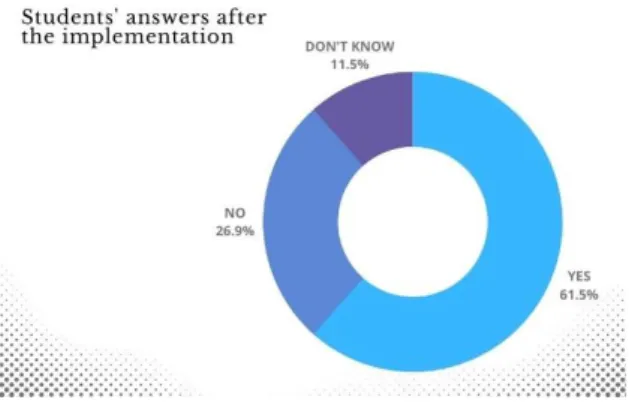
The results obtained in English with games did not affect the assessment of the standard English course. 38.5% of students liked the topic and the fact that they can interact in English with other players:. I felt motivated to speak in English also because of the challenge we had between us.
To earn extra points, at the end of the course, students were given the opportunity to do a "big topic" task (Appendix 7). The remaining 40.7% of students thought they had more chances to learn grammar with English games. To summarize the results for this category, Figure 32 shows the positive aspects of the subject that students can identify after implementing the English language.
If you're at the bottom of the leaderboard, you're encouraged to do more:.
Synthesis and interpretation of the results
- General objective one: Implementation of a gamified and gameful EFL course
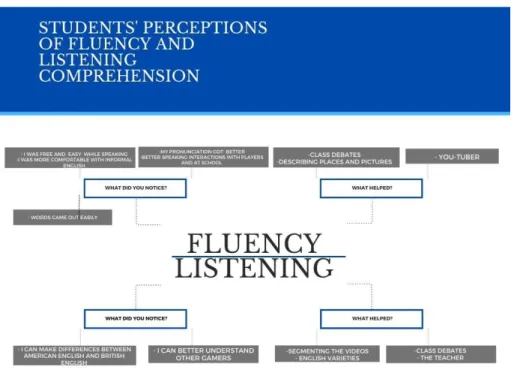
- General objective three: Students’ communicative competence in a gameful
- General objective four: Gamification as an assessment method
- General objective five: Stress and anxiety within a gameful approach
- General objective six: Gameplay and learning
- Specific objectives
- Specific objective one: Motivation within a gameful approach
- Specific objective two: Gamification in other educational contexts
- Specific objective three: What influences the gameplay
- Specific objective four: Possible improvements
Comparison of the variables
Conclusions
General conclusions
Limits
Further research