Rev. R. Acad. Cien. Serie A. Mat.
VOL.2000 (1-2), 2006, pp. 155–182 Análisis Matemático / Mathematical Analysis Artículo panorámico / Survey
Recent progress and open questions on the numerical index of Banach spaces
Vladimir Kadets, Miguel Martín, and Rafael Payá
Abstract The aim of this paper is to review the state-of-the-art of recent research concerning the numer- ical index of Banach spaces, by presenting some of the results found in the last years and proposing a number of related open problems.
Resultados recientes y problemas abiertos sobre el índice numérico de los espacios de Banach
Resumen. El propósito de este trabajo es revisar el estado actual de la investigación reciente sobre el índice numérico de los espacios de Banach, presentando algunos de los resultados obtenidos en los últimos años y proponiendo un cierto número de problemas abiertos.
Introduction
The numerical index of a Banach space is a constant relating the behavior of the numerical range with that of the usual norm on the Banach algebra of all bounded linear operators on the space. The notion of numerical range (also called field of values) was first introduced by O. Toeplitz in 1918 [79] for matrices, but his definition applies equally well to operators on infinite-dimensional Hilbert spaces. IfH denotes a Hilbert space with inner product(· | ·), thenumerical rangeof a bounded linear operatorT onH is the subsetW(T)of the scalar field defined by
W(T) :=©
(T x|x) : x∈H, (x|x) = 1ª .
Some properties of the Hilbert space numerical range are discussed in the classical book of P. Halmos [29,
§17]. Let us just mention that the numerical range of a bounded linear operator is (surprisingly) convex and, in the complex case, its closure contains the spectrum of the operator. Moreover, if the operator is normal, then the closure of its numerical range coincides with the convex hull of its spectrum. Further developments can be found in a recent book of K. Gustafson and D. Rao [28]. In the sixties, the concept of numerical range was extended to operators on general Banach spaces by G. Lumer [54] and F. Bauer [4]. Let us give the necessary definitions. Given a real or complex Banach spaceX, we writeBX for the closed unit ball andSX for the unit sphere ofX. The dual space will be denoted byX∗ andL(X)will be the Banach algebra of all bounded linear operators onX. Thenumerical rangeof an operatorT ∈L(X)is the subset V(T)of the scalar field defined by
V(T) :={x∗(T x) : x∈SX, x∗∈SX∗, x∗(x) = 1}.
Presentado por Vicente Montesinos Santalucía.
Recibido: 28/03/2006.Aceptado: 01/06/2006.
Palabras clave / Keywords: Numerical range; numerical radius; numerical index; duality; Daugavet equation.
Mathematics Subject Classifications: 46B20, 47A12.
°c 2006 Real Academia de Ciencias, España.
Thenumerical radiusis the seminorm defined onL(X)by
v(T) := sup{|λ| : λ∈V(T)}
forT ∈ L(X). Classical references here are the monographs by F. Bonsall and J. Duncan [9, 10] from the seventies. Let us mention that the numerical range of a bounded linear operator is connected (but not necessarily convex, see [10, Example 21.6]) and, in the complex case, its closure contains the spectrum of the operator. The theory of numerical ranges has played a crucial role in the study of some algebraic structures, especially in the non-associative context (see the expository paper [46] by A. Kaidi, A. Morales, and A. Rodríguez Palacios, for example).
The concept ofnumerical indexof a Banach spaceX was first suggested by G. Lumer in 1968 (see [20]), and it is the constantn(X)defined by
n(X) := inf{v(T) : T ∈L(X), kTk= 1}
or, equivalently,
n(X) = max{k>0 : kkTk6v(T) ∀T ∈L(X)}.
Note thatn(X)>0if and only ifvandk · kare equivalent norms onL(X). At that time, it was known that in a complex Hilbert spaceH with dimension greater than1,kTk62v(T)for allT ∈L(H), and2is the best constant; in the real case, there exists a norm-one operator whose numerical range reduces to zero.
In our terminology,n(H) = 1/2ifH is complex, andn(H) = 0if it is real. Actually, real and complex general Banach spaces behave in a very different way with regard to the numerical index, as summarized in the following equalities by J. Duncan, C. McGregor, J. Pryce, and A. White [20]:
{n(X) : Xcomplex Banach space} = [e−1,1], (1) {n(X) : Xreal Banach space} = [0,1].
The fact thatn(X) > e−1 for every complex Banach space X was observed by B. Glickfeld [26] (by making use of a classical theorem of H. Bohnenblust and S. Karlin [7]), who also gave an example where this inequality becomes an equality. It is showed in the already cited paper [20], thatM-spaces,L-spaces and their isometric preduals, have numerical index1, a property shared by the disk algebra (M. Crab, J. Duncan, and C. McGregor [16, Theorem 3.3]). Finally, let us mention that the real spaceXRunderlying a complex Banach spaceX satisfiesn(XR) = 0; actually, the isometryx7−→i xhas numerical radius0 when viewed as an operator onXR.
In the last ten years, many results on the numerical index of Banach spaces have appeared in the litera- ture. This paper aims at reviewing the state of the art on this topic and proposing a variety of open questions.
The structure of our discussion is as follows.
Contents
1. Computing the numerical index 157
2. Numerical index and duality 160
3. Banach spaces with numerical index one 163
4. Renorming and numerical index 166
5. Real Banach spaces with numerical index zero 168
6. Asymptotic behavior of the set of finite-dimensional spaces with numerical index one 171
7. Relationship to the Daugavet property. 172
8. The polynomial numerical indices 175
We finish this introduction by recalling some definitions and fixing notation. We writeTto denote the unit sphere of the base fieldK(= RorC). We use the notationRe(·)to denote the real part function, which should be considered as the identity whenK =R. Given a real or complex Banach spaceX, we writeco(B)andco(B)to denote, respectively, the convex hull and the closed convex hull of a setB ⊆X and we denote byext(C)the set of extreme points of a convex setC ⊆X. A subsetAofBX∗is said to benorming (forX)if
kxk= sup{|x∗(x)| : x∗∈A} ¡ x∈X¢
or, equivalently, ifBX∗ = cow∗(TA)(Hahn-Banach Theorem). Finally, for1 6p6∞, we write`mp to denote the normed spaceKmendowed with the usualp-norm, and we writeX⊕pY to denote the`p-direct sum of the spacesXandY.
1. Computing the numerical index
In view of the examples given in the introduction, the most important family of classical Banach spaces (in the sense of H. Lacey [47]) whose numerical indices remain unknown is the family ofLpspaces when p 6= 1,2,∞. This is actually one of the most intriguing open problems in the field but, very recently, E. Ed-Dari and M. Khamsi [21, 22] have made some progress. We summarize their results in the following statement and use it to motivate some conjectures.
Theorem 1 ([21, 22]) Let16p6∞be fixed. Then,
(a) n(Lp[0,1]) =n(`p) = inf{n(`mp) : m∈N}, and the sequence{n(`mp)}m∈Nis decreasing.
(b) n(Lp(µ))>n(`p)for every positive measureµ.
(c) In the real case, 1
2Mp6n(`2p)6Mp, where Mp = sup
t∈[0,1]
|tp−1−t|
1 +tp .
Whenp6= 2, it is known thatn(`mp )>0for everym>2, and also thatv(T)>0for every non-null T ∈ L(`p)(see [22, Theorem 2.3 and subsequent remark]), but we do not know ifn(`p) > 0. Observe that a positive answer to this question implies, thanks to (b) above, thatn(Lp(µ))> 0for every positive measureµ.
Problem 1 Isn(`p)positive for everyp6= 2?
With respect to item (c) in the above theorem, let us explain the meaning of the numberMp. It can be deduced from [20, §3] that, given an operatorT ∈L(`2p)represented by the matrix
µa b c d
¶
, one has
v(T) = max
max
t∈[0,1]
z∈T
¯¯a+d tp+z b t+z c tp−1¯
¯
1 +tp , max
t∈[0,1]
z∈T
¯¯d+a tp+z c t+z b tp−1¯
¯ 1 +tp
. (2)
It follows thatMpis equal to the numerical radius of the norm-one operatorU ≡
µ 0 1
−1 0
¶
inL(`2p)(real case), son(`2p)6Mp. Forp= 2, the operatorU has minimum numerical radius, namely0. We may ask if Uis also the norm-one operator with minimum numerical radius for all the real spaces`2p.
Problem 2 Is it true that, in the real case,n(`2p) = sup
t∈[0,1]
|tp−1−t|
1 +tp for every1< p <∞?
In the complex case, the operatorU acting on`22satisfiesv(U) =kUk(takez =iandt = 1in (2)) and, therefore, its numerical radius is not the minimum. Actually, one has
n(`22) = 1
2 =v(S), whereS ∈ L(`22)is the ‘shift’S ≡
µ0 0 1 0
¶
. Therefore, we bet thatn(`2p) = v(S)for every pin the complex case. It can be checked from (2) that
v(S) =(p−1)p−1p
p = 1
p1pq1q, where1p+1q = 1.
Problem 3 Is it true that, in the complex case,n(`2p) = 1
p1pq1q for every1< p <∞?
In view of Theorem 1.a, the two-dimensional case is only the first step in the computation ofn(`p), but it is reasonable to expect that the sequence{n(`mp )}m∈Nis always constant, as it happens in the cases p= 1,2,∞.
Problem 4 Is it true thatn(`p) =n(`2p)for every1< p <∞?
In a 1977 paper [35], T. Huruya determined the numerical index of aC∗-algebra. Part of the proof was recently clarified by A. Kaidi, A. Morales, and A. Rodríguez-Palacios in [45], where the result is extended toJB∗-algebras and preduals ofJBW∗-algebras. Let us state here those results just forC∗-algebras and preduals of von Neumann algebras.
Theorem 2 ([35] and [45, Proposition 2.8]) LetA be aC∗-algebra. Then,n(A)is equal to1 or 12 de- pending on whetherAis commutative or not. IfAis actually a von Neumann algebra with predualA∗, thenn(A∗) =n(A).
We do not know if there is an analogous result in the real case. We recall that arealC∗-algebracan be defined as a norm-closed self-adjoint real subalgebra of a complexC∗-algebra, and arealW∗-algebra(or real von Neumann algebra) is a realC∗-algebra which admits a predual (see [36] for more information).
Problem 5 Compute the numerical index of realC∗-algebras and isometric preduals of realW∗-algebras.
The fact that the disk algebra has numerical index1was extended to function algebras by D. Werner in 1997 [82]. Afunction algebraAon a compact Hausdorff spaceKis a closed subalgebra ofC(K)which separates the points ofKand contains the constant functions.
Proposition 1 ([82, Corollary 2.2 and proof of Theorem 3.3]) IfAis a function algebra, thenn(A) = 1.
Of course, there are many other Banach spaces whose numerical index is unknown. We propose to calculate some of them.
Problem 6 Compute the numerical index ofCm[0,1](the space ofm-times continuously differentiable real functions on[0,1], endowed with any of its usual norms), Lip(K)(the space of all Lipschitz functions on the complete metric spaceK), Lorentz spaces, and Orlicz spaces.
Some of the classical results given in the introduction about the numerical index of particular spaces have been extended to sums of families of Banach spaces and to spaces of vector-valued functions in various papers by G. López, M. Martín, J. Merí, R. Payá, and A. Villena [52, 62, 64].
We start by presenting the result for sums of spaces. Given an arbitrary family{Xλ : λ ∈ Λ} of Banach spaces, we denote by[⊕λ∈ΛXλ]c
0,[⊕λ∈ΛXλ]`
1and[⊕λ∈ΛXλ]`
∞ thec0-,`1- and`∞-sum of the family.
Proposition 2 ([62, Proposition 1]) Let{Xλ: λ∈Λ}be a family of Banach spaces. Then n
³
[⊕λ∈ΛXλ]c0
´
=n
³
[⊕λ∈ΛXλ]`1
´
=n
³
[⊕λ∈ΛXλ]`∞
´
= inf
λ n(Xλ).
The above result is not true for`p-sums ifpis different from1and∞. Nevertheless, it is possible to give one inequality and, actually, the same is true for absolute sums [56]. Recall that a direct sumY ⊕Zis said to be anabsolute sumifky+zkonly depends onkykandkzkfor(y, z)∈Y×Z. For background on absolute sums the reader is referred to [66] and references therein.
Proposition 3 ([56, Proposición 1]) LetX be a Banach space and letY,Z be closed subspaces ofX. Suppose thatXis the absolute sum ofY andZ. Then
n(X)6min©
n(Y), n(Z)ª .
The following somehow surprising example was obtained in [62] by using Proposition 2.
Example 1 ([62, Example 2.b]) There is a real Banach spaceXfor which the numerical radius is a norm but is not equivalent to the operator norm, i.e. the numerical index ofXis0althoughv(T)>0for every non-nullT ∈L(X).
The numerical index of some vector-valued function spaces was also computed in [52, 62, 64]. Given a real or complex Banach spaceX and a compact Hausdorff topological spaceK, we writeC(K, X)and Cw(K, X)to denote, respectively, the space ofX-valued continuous (resp. weakly continuous) functions onK. Ifµis a positiveσ-finite measure, byL1(µ, X)andL∞(µ, X)we denote respectively the space ofX-valuedµ-Bochner-integrable functions and the space ofX-valuedµ-Bochner-measurable functions which are essentially bounded.
Theorem 3 ([52], [62], and [64]) LetKbe a compact Hausdorff space, and let µbe a positiveσ-finite measure. Then
n(Cw(K, X)) =n(C(K, X)) =n(L1(µ, X)) =n(L∞(µ, X)) =n(X) for every Banach spaceX.
The numerical index ofCw∗(K, X∗), the space ofX∗-valued weakly-star continuous functions onK is also studied in [52]. Unfortunately, only a partial result is achieved.
Proposition 4 ([52, Propositions 5 and 7]) LetKbe a compact Hausdorff space and letXbe a Banach space. Then
n(Cw∗(K, X∗))6n(X).
If, in addition,Xis an Asplund space orKhas a dense subset of isolated points, then n(X∗)6n(Cw∗(K, X∗)).
To finish this section let us comment that, roughly speaking, when one finds an explicit computation of the numerical index of a Banach space in the literature only few values appear; namely,0(real Hilbert spaces),e−1(Glickfeld’s example),1/2(complex Hilbert spaces), and1(C(K),L1(µ), and many more).
The preceding results about sums and vector-valued function spaces do not help so much, and the exact values ofn(`2p)are not still known. Let us also say that, when the authors of [20] prove (1), they only use examples of Banach spaces whose numerical indices are the extremes of the intervals, and then a connectedness argument is applied. Very recently, M. Martín and J. Merí have partially covered this gap in [59], where they explicitly compute the numerical index for four families of norms onR2. The most interesting one is the family of regular polygons.
Proposition 5 ([59, Theorem 5]) Letn > 2 be a positive integer, and letXn be the two-dimensional real normed space whose unit ball is the convex hull of the(2n)th roots of unity, i.e.BXn is a regular 2n-polygon centered at the origin and such that one of its vertices is(1,0). Then,
n(Xn) =
tan³ π
2n
´
if n is even,
sin³ π 2n
´
if n is odd.
Problem 7 Compute the numerical index for other families of finite-dimensional Banach spaces. In par- ticular, it would be interesting to get the complex analog of the results in[59].
2. Numerical index and duality
Given a bounded linear operatorTon a Banach spaceX, it is a well-known fact in the theory of numerical ranges (see [9, §9]) that
sup ReV(T) = lim
α↓0
kId +α Tk −1
α (3)
and so
v(T) = max
ω∈T lim
α↓0
kId +α ω Tk −1
α .
It is immediate from the above formula that
v(T) =v(T∗), (4)
whereT∗∈L(X∗)is the adjoint operator ofT, and the result given in [20, Proposition 1.3] that
n(X∗)6n(X) (5)
clearly follows. The question if this is actually an equality had been around from the beginning of the subject (see [46, pp. 386], for instance). Let us comment some partial results which led to think that the answer could be positive. Namely, it is clear thatn(X) = n(X∗)for every reflexive spaceX, and this equality also holds whenevern(X∗) = 1, in particular whenX is anL- or anM-space. Moreover, it is also true thatn(X) =n(X∗)whenXis aC∗-algebra or a von Neumann algebra predual (Theorem 2).
Nevertheless, in a very recent paper [12], K. Boyko, V. Kadets, M. Martín, and D. Werner have answered the question in the negative by giving an example of a Banach space whose numerical index is strictly greater than the numerical index of its dual. Our aim in this section is to present such counterexample with a new and more direct proof.
Let us recall thatcdenotes the Banach space of all convergent scalar sequencesx= (x(1), x(2), . . .) equipped with the sup-norm. The dual space ofcis (isometric to)`1and we will writec∗≡`1⊕1Kwhere
h(y, λ), xi= X∞
n=1
y(n)x(n) + λlimx ¡
x∈c,(y, λ)∈`1⊕1K¢ .
For everyn∈N, we denote bye∗nthe norm-one element ofc∗given by e∗n(x) =x(n) ¡
x∈c¢ .
We are now ready to show that the numerical index of a Banach space and the one of its dual do not always coincide.
Example 2 ([12, Example 3.1]) Let us consider the Banach space X =©
(x, y, z)∈c⊕∞c⊕∞c : limx+ limy+ limz= 0ª . Then,n(X) = 1andn(X∗)<1.
PROOF. We observe that
X∗=£
c∗⊕1c∗⊕1c∗¤
/h(lim,lim,lim)i so that, writingZ =`31/h(1,1,1)i, we can identify
X∗≡`1⊕1`1⊕1`1⊕1Z and X∗∗≡`∞⊕∞`∞⊕∞`∞⊕∞Z∗. (6)
Figure 1.The unit ball ofZ
With this in mind, we writeAto denote the set
{(e∗n,0,0,0) : n∈N} ∪ {(0, e∗n,0,0) : n∈N} ∪ {(0,0, e∗n,0) : n∈N}.
ThenAis clearly a norming subset ofSX∗and
|x∗∗(a∗)|= 1 ¡
x∗∗∈ext(BX∗∗), a∗∈A¢
. (7)
Let us prove thatn(X) = 1. Indeed, we fixT ∈L(X)andε > 0. SinceT∗ isw∗-continuous andAis norming, we may finda∗∈Asuch that
kT∗(a∗)k>kTk −ε.
Now, we takex∗∗∈ext(BX∗∗)such that
|x∗∗(T∗(a∗))|=kT∗(a∗)k.
Since|x∗∗(a∗)|= 1thanks to (7), we get
v(T) =v(T∗)>|x∗∗(T∗(a∗))|>kTk −ε.
It clearly follows thatv(T) =kTkandn(X) = 1.
To show thatn(X∗)<1, we use (6) and Proposition 2 to get n(X∗)6n(Z),
and the fact thatn(Z)<1follows easily from a result due to C. McGregor [65, Theorem 3.1]. Actually, in the real case, the unit ball ofZis an hexagon (see Figure 1 above), which is isometrically isomorphic to the spaceX3of Proposition 5, son(Z) = 1/2. ¥
The above example can be pushed forward, to produce even more striking counterexamples.
Examples 3 ([12, Examples 3.3])
(a) There exists a real Banach spaceXsuch thatn(X) = 1andn(X∗) = 0.
(b) There exists a complex Banach spaceXsatisfying thatn(X) = 1andn(X∗) = 1/e.
Once we know that the numerical index of a Banach space and the one of its dual may be different, the question aries if two preduals of a given Banach space have the same numerical index. By apredualof a Banach spaceY we mean a Banach spaceX such thatX∗is (isometrically isomorphic to)Y. The answer is again negative, as the following result shows.
Example 4 ([12, Example 3.6]) Let us consider the Banach spaces X1=©
(x, y, z)∈c⊕∞c⊕∞c : limx+ limy+ limz= 0ª
and
X2=©
(x, y, z)∈c⊕∞c⊕∞c : x(1) +y(1) +z(1) = 0ª .
Then,X1∗andX2∗are isometrically isomorphic, butn(X1) = 1andn(X2)<1.
The following question might also be addressed.
Problem 8 LetY be a dual space. Does there exist a predualXofY such thatn(X) =n(Y)?
Another interesting issue could be to find isomorphic properties of a Banach spaceX ensuring that n(X∗) =n(X). On the one hand, Example 2 shows that Asplundness is not such a property. On the other hand, it is shown in [12, Proposition 4.1] that if a Banach spaceX with the Radon-Nikodým property has numerical index1, then X∗ has numerical index 1as well. Therefore, the following question naturally arises.
Problem 9 LetXbe a Banach space with the Radon-Nikodým property. Is it true thatn(X) =n(X∗)?
Another sufficient condition would follow from a positive answer to Problem 8.
Problem 10 LetY be a dual space admitting a unique predualX (up to isometric isomorphisms). Is it true thatn(Y) =n(X)?
Let us finish this section by remarking that the space given in Example 2 is useful as a counterexample for many other conjectures, as we will see later on.
3. Banach spaces with numerical index one
The guiding open question on these spaces is the following.
Problem 11 Find necessary and sufficient conditions for a Banach space to have numerical index1which do not involve operators.
In 1971, C. McGregor [65, Theorem 3.1] gave such a characterization in the finite-dimensional case.
More concretely, a finite-dimensional normed spaceXhas numerical index1if and only if
|x∗(x)|= 1 for everyx∈ext(BX)and everyx∗∈ext(BX∗). (8) It is not clear how to extend this result to arbitrary Banach spaces. If we use literally (8) in the infinite- dimensional context, we do not get a sufficient condition, since the setext(BX)may be empty and this does not imply numerical index1(e.g.ext(Bc0(`2)) =∅butn(c0(`2))<1). On the other hand, we do not know if (8) is a necessary condition.
Problem 12 Let X be a Banach space with numerical index1. Is it true that|x∗(x)| = 1for every x∗∈ext(BX∗)and everyx∈ext(BX)?
Our first aim in this section is to discuss several reformulations of assertion (8) to get either sufficient or necessary conditions for a Banach space to have numerical index1.
Aiming at sufficient conditions, it is not difficult to show that (8) implies numerical index1for a Banach spaceX as soon as the setext(BX)is large enough to determine the norm of operators onX, i.e.BX = co(ext(BX)). Actually, we may replaceext(BX)with any subset ofSX satisfying the same property. On the other hand, we may replaceext(BX)byext(BX∗∗)and the role ofext(BX∗)can be played by any norming subset ofSX∗. Let us comment that this is is what we did in the proof of Example 2. All these ideas appear implicity in several papers (see [53, 57, 58] for example); we summarize them in the following proposition.
Proposition 6 Let X be a Banach space. Then, any of the following three conditions is sufficient to ensure thatn(X) = 1.
(a) There exists a subsetCofSXsuch thatco(C) =BXand
|x∗(c)|= 1 for everyx∗∈ext(BX∗)and everyc∈C.
(b) |x∗∗(x∗)|= 1 for everyx∗∗∈ext(BX∗∗)and everyx∗∈ext(BX∗).
(c) There exists a norming subsetAofSX∗such that
|x∗∗(a∗)|= 1 for everyx∗∗∈ext(BX∗∗)and everya∗∈A.
Let us comment on the converse of the above result. First, condition (a) is not necessary as shown byc0. Second, it was proved in [12, Example 3.4] that condition (b) is not necessary either, the counterexample being the space given in Example 2. Finally, we do not know if there exists a Banach with numerical index1 in which condition (c) is not satisfied.
Problem 13 ([12, Remark 3.5]) Let X be a Banach space with numerical index 1. Does there exist a norming subsetAofSX∗such that|x∗∗(a∗)|= 1for everyx∗∗∈ext(BX∗∗)and everya∗∈A?
Necessary conditions in the spirit of McGregor’s result were given in 1999 by G. López, M. Martín, and R. Payá [53]. Their key idea was considering denting points instead of general extreme points. Recall that x0 ∈BX is said to be adenting pointofBXif it belongs to slices ofBX with arbitrarily small diameter.
IfXis a dual space and the slices can be taken to be defined by weak∗-continuous functionals, then we say thatx0is aweak∗-denting point.
Proposition 7 ([53, Lemma 1]) LetX be a Banach space with numerical index1. Then, (a) |x∗(x)|= 1 for everyx∗∈ext(BX∗)and every denting pointx∈BX.
(b) |x∗∗(x∗)|= 1 for everyx∗∗∈ext(BX∗∗)and every weak∗-denting pointx∗∈BX∗. This result will play a key role in the next section.
Let us comment that, like McGregor original result, the conditions in Proposition 7 are not sufficient in the infinite-dimensional context. Indeed, the spaceX =C([0,1], `2)does not have numerical index1, whileBXhas no denting points and there are now∗-denting points inBX∗. Actually, all the slices ofBX
and thew∗-slices ofBX∗have diameter2(see [43, Lemma 2.2 and Example on p. 858], for instance).
Anyhow, if we have a Banach spaceX such thatBX has enough denting points (ifX has the Radon- Nikodým property, for instance), then item (a) in the above proposition combines with Proposition 6 to characterize the numerical index1 forX. The same is true for item (b) whenBX∗ has enough weak∗- denting points (ifX is an Asplund space, for instance).
Corollary 1 ([57, Theorem 1] and [58, §1]) LetXbe a Banach space.
(a) IfXhas the Radon-Nikodým property, then the following are equivalent:
(i) Xhas numerical index1.
(ii) |x∗(x)|= 1 for everyx∗∈ext(BX∗)and every denting pointxofBX. (iii) |x∗∗(x∗)|= 1 for everyx∗∗∈ext(BX∗∗)and everyx∗∈ext(BX∗).
(b) IfXis an Asplund space, then the following are equivalent:
(i) Xhas numerical index1.
(ii) |x∗∗(x∗)|= 1 for everyx∗∗∈ext(BX∗∗)and every weak∗-denting pointx∗∈BX∗.
In the remaining part of this section we discuss other kind of sufficient conditions for a Banach space to have numerical index1.
The eldest of these properties was introduced in the fifties by O. Hanner [30]: a real Banach space has theintersection property 3.2(3.2.I.P.in short) if every collection of three mutually intersecting closed balls has nonempty intersection. The 3.2.I.P. was systematically studied by J. Lindenstrauss [50] and Å. Lima [48], and typical examples of spaces with this property areL1(µ)and their isometric preduals. Real Banach spaces with the 3.2.I.P. have numerical index1since they fulfil Proposition 6.b (see [48, Corollary 3.3] and [50, Theorem 4.7]). The converse is false even in the finite-dimensional case (see [30, Remark 3.6] and [50, p. 47]).
Another isometric property, weaker than the 3.2.I.P. but still ensuring numerical index1, was introduced by R. Fullerton in 1960 [24]. A real or complex Banach space is said to be aCL-spaceif its unit ball is the absolutely convex hull of every maximal convex subset of the unit sphere. If the unit ball is merely the closed absolutely convex hull of every maximal convex subset of the unit sphere, we say that the space is an almost-CL-space(J. Lindenstrauss [50] and Å. Lima [49]). Both definitions appeared only for real spaces, but they extend literally to the complex case. For general information, we refer to the already cited papers [48, 49, 50]; more recent results can be found in [63, 71]. Let us remark that the complex space`1is an almost-CL-space which is not a CL-space [63, Proposition 1], but we do not know if such an example exists in the real case.
Problem 14 Is there any real almost-CL-space which is not a CL-space?
The fact that CL-spaces have numerical index1was observed by M. Acosta [1], and her proof extends easily to almost-CL-spaces (see [55, Proposition 12]). Actually, almost-CL-spaces fulfil condition (c) of Proposition 6 as shown in [63, Lemma 3]. In the converse direction, the basic examples of Banach spaces with numerical index1are known to be almost-CL-spaces (see [63] and [10, Theorem 32.9]). Moreover, all finite-dimensional spaces with numerical index1are CL-spaces [49, Corollary 3.7], and a Banach space with the Radon-Nikodým property and numerical index1is an almost-CL-space [57, Theorem 1]. Never- theless, Banach spaces with numerical index1which are no almost-CL-spaces have been recently found.
Actually, this happens with the space given in Example 2 [12, Example 3.4].
The last condition we would like to mention is a weakening of the concept of almost-CL-space intro- duced in [12]. A Banach spaceX is said to belushif for everyx, y ∈ SX and everyε >0, there exists y∗ ∈SY∗such that
y∈S(BX, y∗, ε) :={z∈BX : Rey∗(z)>1−ε}
and
dist¡ x,co¡
TS(BX, y∗, ε)¢¢
< ε.
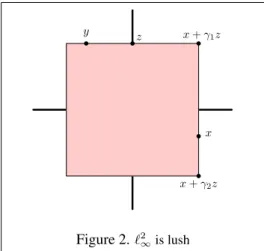
In the real case, the above definition is equivalent to the following one: for everyx, y ∈ SX and every ε >0, there existz∈SXandγ1, γ2∈Rsuch that
ky+zk>2−ε, |γ1−γ2|= 2, kx+γizk61 +ε (i= 1,2).
See Figure 2 below for an interpretation of this property in dimension2.
y z
x x+γ1z
x+γ2z
Figure 2.`2∞is lush
Almost-CL-spaces are clearly lush, and lush spaces have numerical index1[12, Proposition 2.2]. The converse of the first implication is not true, and once again the counterexample is the spaceX given in Example 2: as we already mentioned,X is not an almost-CL-space, but the original proof given in [12, Example 3.1] of the fact thatn(X) = 1passes through the lushness of the space. Actually, this example is only a specimen of a general family of lush subspaces ofC(K)introduced in [12], namely C-rich subspaces.
A subspaceX ofC(K)isC-richif for every nonempty open subsetU ofKand everyε > 0, there is a positive continuous norm-one functionhwith support insideU, such that the distance fromhtoXis less thanε.
Theorem 4 ([12, Theorem 2.4]) LetKbe a Hausdorff topological space and letXbe a C-rich subspace ofC(K). Then,Xis lush and, therefore,n(X) = 1.
In particular, this occurs for finite codimensional subspaces ofC(K)whenKhas no isolated points.
Actually, the following result characterizes C-rich finite-codimensional subspaces of an arbitraryC(K).
We recall that thesupportof a regular measureµ∈C(K)∗is supp(µ) =\
{C⊂K : Cclosed, |µ|(K\C) = 0}.
Example 5 ([12, Proposition 2.5]) LetK be a compact Hausdorff space and letµ1, . . . , µn ∈ C(K)∗. The subspace
Y =
\n
i=1
kerµi
is C-rich if and only if Sn
i=1supp(µi)does not intersect the set of isolated points ofK.
We do not know if the class of lush spaces exhausts the whole class of Banach spaces with numerical index1.
Problem 15 LetXbe a Banach space withn(X) = 1. IsX lush?
4. Renorming and numerical index
In 2003, C. Finet, M. Martín, and R. Payá [23] studied the numerical index from the isomorphic point of view, i.e. they investigated the setN(X)of those values of the numerical index which can be obtained by equivalent renormings of a Banach spaceX. This study has a precedent in the 1974 paper [78] by K. Tillekeratne, where it is proved that every complex space of dimension greater than one can be renormed to achieve the minimum value of the numerical index; the same is true for real spaces.
Proposition 8 ([23, Proposition 1] and [78, Theorem 3.1]) LetXbe a Banach space of dimension greater than one. Then 0∈ N(X)in the real case,e−1∈ N(X)in the complex case.
One of the main aims of [23] is to show thatN(X)is a interval for every Banach spaceX. To get this result, the authors use the continuity of the mapping carrying every equivalent norm onX to its numerical index with respect to a metric taken from [10, §18].
Proposition 9 ([23, Proposition 2]) N(X)is an interval for every Banach spaceX.
As an immediate consequence of the above two results, we get the following.
Corollary 2 ([23, Corollary 3]) If 1∈ N(X)for a Banach spaceX of dimension greater than one, then N(X) = [0,1]in the real case andN(X) = [e−1,1]in the complex case.
Sincen(`m∞) = 1for everym, the following particular case arises.
Corollary 3 ([78, Theorem 3.2]) Letmbe an integer larger than1. Then N(Rm) = [0,1] and N(Cm) = [e−1,1].
Now, one may ask if the above result is also true in the infinite-dimensional context, equivalently, whether or not every Banach space can be equivalently renormed to have numerical index1. The answer is negative, as shown in the already cited paper [53].
Theorem 5 ([53, Theorem 3]) LetXbe an infinite-dimensional real Banach space with1∈ N(X). IfX has the Radon-Nikodým property, thenXcontains`1. IfXis an Asplund space, thenX∗contains`1.
It follows that infinite-dimensional real reflexive spaces cannot be renormed to have numerical index1.
But even more is true.
Corollary 4 ([53, Corollary 5]) LetX be an infinite-dimensional real Banach space. IfX∗∗/X is sepa- rable, then1∈ N/ (X).
It is easy to explain how Theorem 5 was proved in [53]. Namely, the authors used Proposition 7, the well-known facts that the unit ball of a space with the Radon-Nikodým property has many denting points and that the dual unit ball of an Asplund space has many weak∗-denting points (see [11], for instance), and the following sufficient condition for a real Banach space to contain eitherc0or`1.
Lemma 1 ([53, Proposition 2]) Let X be a real Banach space, and assume that there is an infinite set A⊂SXsuch that|x∗(a)|= 1for everya∈Aand everyx∗∈ext(BX∗). ThenXcontainsc0or`1.
Thus, the first open question in this line is the following.
Problem 16 Characterize those Banach spaces which can be equivalently renormed to have numerical index1.
We also propose to study separately necessary and sufficient conditions for a Banach space to be renormable with numerical index1. With respect to necessary conditions, we have obtained two in the real case, namely Theorem 5 and Corollary 4. It is not known if they are valid in the complex case; actually, the following especial case remains open.
Problem 17 Does there exist an infinite-dimensional complex reflexive space which can be renormed to have numerical index1?
For more necessary conditions, we suggest to study the following two questions. The first one has a positive answer for real almost-CL-spaces [63, Theorem 5].
Problem 18 LetXbe an infinite-dimensional (real) Banach space satisfying that1∈ N(X). DoesX∗ contain`1?
Problem 19 LetX be an infinite-dimensional (real) Banach space satisfying that1 ∈ N(X). DoesX containc0or`1?
Let us remark that we do not know of any non-trivial sufficient condition for a Banach space to be renormable with numerical index1. We propose the following ones to be checked.
Problem 20 LetXbe a Banach space containing an infinite-dimensional subspaceY with1∈ N(Y). Is it true that1∈ N(X)?
One may consider many especial cases.
Problem 21 Let X be a Banach space containing a subspace isomorphic to eitherc0, `1, C[0,1], or L1[0,1]. Is it true that1∈ N(X)?
The following question is especially interesting since in view of Problem 18 it might lead to a charac- terization of Banach spaces that can be renormed to have numerical index1.
Problem 22 LetXbe a Banach space such that`1⊆X∗. Is is true that1∈ N(X)?
We finish this section by showing that the value1of the numerical index is very particular. Indeed, it is proved in [23] that “most” Banach spaces can be renormed to achieve any possible value for the numerical index except eventually1. Recall that a system{(xλ, x∗λ)}λ∈Λ ⊂ X ×X∗ is said to bebiorthogonalif x∗λ(xµ) =δλ,µforλ, µ∈Λ, andlongif the cardinality ofΛcoincides with the density character ofX.
Theorem 6 ([23, Theorem 10]) LetX be a Banach space admitting a long biorthogonal system. Then supN(X) = 1. Therefore, when the dimension ofX is greater than one,N(X)⊃[0,1[in the real case andN(X)⊃[e−1,1[in the complex case.
Typical examples of Banach spaces admitting a long biorthogonal system are WCG spaces (see [18]).
For instance, ifX∗∗/Xis separable, then the Banach spaceXis WCG (see [80, Theorem 3], for example) while, in the real case,1 ∈ N/ (X)unlessX is finite-dimensional (see Corollary 4). Therefore, in many cases one of the inclusions of Theorem 6 becomes an equality.
Corollary 5 ([23, Corollary 11]) LetXbe an infinite-dimensional real Banach space such thatX∗∗/Xis separable. ThenN(X) = [0,1[.
Let us comment that Theorem 6 is proved by using a geometrical property that was introduced by J. Lindenstrauss in the study of norn-attaining operators [51] and calledpropertyαby W. Schachermayer [75]. It is known that, under the continuum hypothesis, there are Banach spaces which cannot be renormed with propertyα[27, 67]. Nevertheless, B. Godun and S. Troyanski proved in [27, Theorem 1] that this renorming is possible for Banach spaces admitting a long biorthogonal system; as far as we know, this is the largest class of spaces for which renorming with propertyαis possible.
The question arises if the assumption of having a long biorthogonal system in Theorem 6 can be dropped.
Problem 23 Is is true thatsupN(X) = 1for every Banach spaceX?
It is also studied in [23] the relationship between the numerical index and the so-called propertyβ [51, 75]. Contrary to propertyα, propertyβ is isomorphically trivial (J. Partington [69]), but it does not produce such a good result as Theorem 6. At least, it can be used to prove thatN(X)does not reduces to a point when the dimension ofX is greater than one.
Theorem 7 ([23, Theorem 9]) LetXbe a Banach space withdim(X)>1. ThenN(X)⊃[0,1/3[in the real case andN(X)⊃[e−1,1/2[in the complex case.
5. Real Banach spaces with numerical index zero
As we commented in the introduction, real Banach spaces underlying complex Banach spaces as well as real Hilbert spaces of dimension greater than one, have numerical index0. By Proposition 3, the absolute sum of such a space and any other real Banach space has numerical index0.
The general open question in this section is the following.
Problem 24 Find characterizations of Banach spaces with numerical index0which do not involve oper- ators.
A sufficient condition which generalizes all the introductory examples is the following easy result of M. Martín, J. Merí and A. Rodríguez Palacios [60]. We say that a real vector space has acomplex structure if it is the real space underlying a complex vector space.
Proposition 10 ([60, Proposition 2.1]) LetXbe a real Banach space, and letY, Zbe closed subspaces ofX, withZ 6= 0. Suppose thatZ is endowed with a complex structure, thatX =Y ⊕Z, and that the equality°
°y+ eiρz°
°=ky+zkholds for every(ρ, y, z)∈R×Y ×Z. Thenn(X) = 0.
It looks like if a necessary condition for numerical index0could be the emergence of a subspace with some kind of complex structure. As a matter of fact, the following example shows that this is not the case.
Example 6 ([60, Example 2.2]) There exists a real Banach spaceXwith numerical index0which is poly- hedral, i.e. the intersection ofBXwith any finite-dimensional subspace ofXis the convex hull of a finite set of points. Therefore,X does not contain any isometric copy ofC.
The above example has the additional interest that the numerical radius is a norm onL(X), i.e. the only operator with numerical radius0is the zero operator. It could be the case that a Banach space in which there is a non-null operator with numerical radius0has a subspace with some kind of complex structure.
We recall that a bounded linear operatorT on a (real or complex) Banach spaceX isskew-hermitianif ReV(T) = {0}; we write Z(X) for the (possibly null) closed subspace ofL(X)consisting of skew- hermitian operators onX. In the real case,T is skew-hermitian if and only ifv(T) = 0; when the space Xis complex, an operatorT ishermitianifV(T)⊂R, i.e. the operatori T is skew-hermitian. Hermitian operators have been deeply studied since the sixties and many results on Banach algebras depend on them;
we refer to [9, 10] for more information. Also, skew-hermitian operators have been widely discussed in the seventies and eighties, especially in the finite-dimensional case; more information can be found in the papers by H. Rosenthal [73, 74] and references therein.
Problem 25 Let X be a real space which has a non-null skew-hermitian operator. DoesX contain a subspace with a complex structure?
Let us give a clarifying example. IfH is an-dimensional Hilbert space, it is easy to check thatZ(H) is the space of skew-symmetric operators onH (i.e.T∗ =−T in the Hilbert space sense), so it identifies with the space of skew-symmetric matrixesA(n). It is a classical result from the theory of linear algebra that an×nmatrixAbelongs toA(n)if and only ifexp(ρA)is an orthogonal matrix for everyρ∈R(see [3, Corollary 8.5.10] for instance).
It is shown in [9, §3] that the above fact extends to general Banach spaces. Indeed, for an arbitrary Banach spaceXand an operatorT ∈L(X), by making use of the “exponential formula”
sup ReV(T) = sup
α>0
logkexp(αT)k
α ,
it is easy to prove that the following are equivalent:
(i) T is skew-hermitian,
(ii) exp(ρT)is an onto isometry for everyρ∈R.
From now on, we will restrict ourselves to finite-dimensional spaces. Here, the above result reminds the theory of Lie groups and Lie algebras, for which the group of orthogonal matrices and the space of skew-symmetric matrices are distinguished examples. Actually, the group of all the isometries on a finite- dimensional real spaceX is a Lie group whose associated Lie algebra is Z(X)[73, Theorem 1.4 and Proposition 1.5]. With this in mind and using results from the theory of Lie groups, it is proved in [73, Theorem 3.8] that the following are equivalent for a finite-dimensional real spaceX:
(i) the numerical index ofX is0,
(ii) there are infinitely many isometries onX.
The main open question in this section is the following.
Problem 26 Describe the finite-dimensional real Banach spaces with numerical index0.
The next result follows this line. In particular, it shows that finite-dimensional normed spaces with numerical index0wear some kind of complex structure.
Theorem 8 ([73, Corollary 3.7] and [60, Theorem 2.4]) LetXbe a finite-dimensional real Banach space.
Then, the following are equivalent:
(i) The numerical index ofXis zero.
(ii) There are nonzero complex vector spacesX1, . . . , Xm, a real vector spaceX0, and positive integer numbersq1, . . . , qmsuch thatX =X0⊕X1⊕ · · · ⊕Xmand
°°x0+ eiq1ρx1+· · ·+ eiqmρxm°
°=kx0+x1+· · ·+xmk for allρ∈R,xj ∈Xj(j= 0,1, . . . , m).
Some remarks are pertinent. First, the above result shows that a finite-dimensional space with numerical index0contains complex subspaces (at least one), whose complex structures are well related one to the others and to the non-complex part. Second, the above result is taken literally from the paper [60], but the same equivalence with arbitrary real numbersq1, . . . , qmhad appeared in the 1985 Rosenthal’s paper [73]; the fact that theqj’s can be taken integers is new from [60] and it uses the classical Kronecker’s Approximation Theorem (see [32, Theorem 442] for instance). Third, it can be asked if the number of complex spaces in the theorem can be reduced to one, and so Proposition 10 would be an equivalence in the finite-dimensional case. The answer is negative.
Example 7 ([60, Example 2.8]) The spaceR4with norm k(a, b, c, d)k=1
4 Z 2π
0
¯¯Re¡
e2it(a+ib) + eit(c+id)¢¯
¯dt (a, b, c, d∈R)
has numerical index0, but the number of complex spaces in Theorem 8.iicannot be reduced to one.
Such an example as the above is not possible in dimensions two or three. Actually, in this case, Theo- rem 8 takes a more suitable form [73, Theorem 3.1]. LetXbe a real Banach space with numerical index0.
(a) Ifdim(X) = 2, thenXis isometrically isomorphic to the two-dimensional real Hilbert space.
(b) Ifdim(X) = 3, thenXis an absolute sum ofRand the two-dimensional real Hilbert space.
Our next aim is to discuss some questions related to the Lie algebra of skew-hermitian operatorsZ(X) of an arbitraryn-dimensional space which. The main related open question is the following.
Problem 27 Figure out what are the possible values for the dimension ofZ(X)whendim(X) =n.
Let us fix a n-dimensional real Banach spaceX. It follows from a theorem of Auerbach [72, The- orem 9.5.1], that there exists an inner product(·|·)onX such that every skew-hermitian operator onX remains skew-hermitian (hence skew-symmetric) onH := (X,(·|·)). Then, by just fixing an orthonormal basis ofH, we get an identification ofZ(X)with a Lie subalgebra of the Lie algebraA(n). Therefore,
dim¡ Z(X)¢
6 n(n−1)
2 .
The equality holds if and only ifXis a Hilbert space (see [73, Theorem 3.2] or [60, Corollary 2.7]). It is a good question whether or not all the intermediate numbers are possible values for the dimension ofZ(X).
The answer is negative, as a consequence of Theorem 3.2 in Rosenthal’s paper [73], which reads as follows.
(a) Ifdim¡ Z(X)¢
> (n−1)(n−2)2 , thenXis a Hilbert space and, therefore,dim¡ Z(X)¢
= n(n−1)2 . (b) dim¡
Z(X)¢
= (n−1)(n−2)2 if and only ifX is a non-Euclidean absolute sum ofRand a Hilbert space of dimensionn−1.
For low dimensions, Problem 27 has been solved in [74]. When the dimension ofX is3, the above result leaves only the following possible values for the dimension ofZ(X): 0as forX =`3∞,1as forR⊕1C, and3as for`32. When the dimension ofXis4, the possible values of the dimension ofZ(X)allowed by the above result are0,1,2,3,6; all of them are possible [74, pp. 443]. The first dimension in which Problem 27 is open isn= 5.
Problem 28 What are the possible values for the dimension ofZ(X)whenX is a5-dimensional real Banach space?
6. Asymptotic behavior of the set of finite-dimensional spaces with numerical index one
Let us start the section by recalling that most of the sufficient and the necessary conditions for having numerical index1given in section3are actually characterizations in the finite-dimensional case. For the convenience of the reader, we summarize them in the following paragraph.
LetXbe a finite-dimensional real normed space. Then, the following are equivalent.
(i) Xhas numerical index1.
(ii) |x∗(x)|= 1for all the extreme pointsx∗ofBX∗andxofBX.
(iii) X is a CL-space, i.e.BX = co(F ∪ −F)for every maximal convex subsetF ofSX.
(iv) Xis lush, i.e. for everyx, y∈SX, there arez∈SXandγ1, γ2∈Rsuch that ky+zk= 2, |γ1−γ2|= 2, andkx+γizk61 (i= 1,2).
Our aim in this section is to consider the asymptotic behavior (as the dimension grows to infinity) of some parameters related to the Banach-Mazur distance for the family of finite-dimensional real normed spaces with numerical index1. Let us writeNmfor the space of allm-dimensional normed spaces endowed with theBanach-Mazur distance
d(X, Y) = inf{kTk kT−1k : T :X −→Y isomorphism} (X, Y ∈ Nm),
and let us writeMmfor the subset consisting of thosem-dimensional spaces with numerical index1. Our aim is to study some questions related to these two spaces. As far as we know, the first result of this kind was given very recently by T. Oikhberg [68].
Theorem 9 ([68, Theorem 4.1]) There exists a universal positive constantcsuch that d(X, `m2)>c m14
for everym>1and everyX ∈ Mm.
It is well-known thatd(`m1 , `m2 ) =d(`m∞, `m2) =√
mfor everym >1(see [25, pp. 720] for instance).
Therefore, the following question arises naturally.
Problem 29 Does there exists a universal constantc >0such that d(X, `m2 )>c√
m for everym>1and everyX ∈ Mm?
It was observed in [68, pp. 622] that the answer to this question is positive for the spaces with the 3.2.I.P., even withc = 1. This is a consequence of the 1981 result by A. Hansen and Å. Lima [31] that these spaces are constructed starting from the real line and producing successively`∞and/or`1sums. But, as we already mentioned, not every element ofMmhas the 3.2.I.P.
Finally, we would like to propose some related questions.
Problem 30 What is the diameter ofMm? Is it (asymptotically) close to the diameter ofNm? Problem 31 What is the biggest possible distance from an element ofNmto the setMm?