This is reflected in changes in specific values derived from estimates of the income and price elasticities of demand for gasoline, creating a good deal of uncertainty from a public policy perspective. Y = Xβ + ε (2) where Y is a vector (nx1) containing independent variables (eg gasoline demand), X is a vector (nxm) of explanatory variables, β is a vector (mx1) of coefficients estimated and ε is a vector (nx1) of the error term.
Meta-regressions and public policy
SE is standard error. i) The magnitudes of the income and price elasticities of gasoline demand vary by country or region (Pock, 2007; Bentzen, 1994; Sterner, Dahl, & Franzén, 1992). The magnitudes of income and price elasticities also differ depending on the estimation methods used (Graham and Glaister, 2002; Espey, 1998).
Conclusions and general comments
2012), “Measuring global gasoline and diesel price and income elasticities”, Energy Policy, vol. 1992), “A survey of energy demand elasticities for the developing world”, Journal of Energy Finance & Development, vol. Informe Finale, Mexico City, National Autonomous University of Mexico. a cointegration approach”, Energy Policy, vol. 1992), "Imperfect Price Reversibility of World Oil Demand", Energy Journal, vol.
The development of the literature on this subject is based on pragmatic considerations not directly related to the orthodox or heterodox schools of economic thought, which means that the debate on macroprudential policy is devoid of theory. For example, Zysman (1983) argues that the various institutions of the financial system, which are actively shaped by government policy, entail different forms of financing and economic growth.
Introduction
Based on the concept of the legal-economic nexus, Samuels (2007) outlines how public policies transform into different strategies within firms, as regulations, defined in the political sphere of society, delineate the profile that markets will have. In an attempt to reconcile the institutionalist and post-Keynesian ideas, Conceição and Ferrari-Filho (2001) argue that the Keynesian idea of the socialization of investments can be understood as the construction, through public policies, of an institutional environment that promotes productive investment. and in which the cyclical movements that condition monetary economies of production are mitigated.
Institutionalist approaches
The first involves a thorough revival of the old institutionalism, including its opposition to neoclassicism; and the institutions are both a shared habit according to Veblen (1919), and collective action according to Commons (1931). A society's institutional matrix consists of the rules of the game devised by the individuals themselves.
Macroprudential policy
In contrast, Landau (2009) argues that avoiding economic bubbles can be one of the tasks of macroprudential measures. Systemic capital allowance; reduction in the sensitivity of capital requirements to the current point of the cycle; security.
Macroprudential policy: an institutionalist reading
Nevertheless, the idea is that the new short-term rules of the game provide greater stability in the financial system in the medium and long term. But the relationship between the rules of the game (macroprudential policy) and the actors (the financial institutions) configures the profile of what the institutional structure will be.
Conclusions
2000b), "What is the essence of institutional economics?", Journal of Economic Issues, Vol. 1998), “An Institutional Economics Approach”, Journal of Economic Literature, vol. 1995), “The Current State of Institutional Economics”, Cambridge Journal of Economics, vol. 1942), Capitalism, Socialism and Democracy, New York, Harper & Row.
Located in the southern Caribbean, Trinidad and Tobago has one of the highest levels of development among island nations in the region. This vulnerability highlights the importance of examining the competitiveness of a country's non-oil exports.
Trinidad and Tobago: economic growth and international trade
The denominator of the rca index represents the share of the exports of one sector or product in the exports of the reference market. When the rca index is equal to one for a product (or group of products) from a particular country, the share of that country's total exports contributed by that product (or group of products) is identical to that in the reference market .
Trinidad and Tobago’s international trade
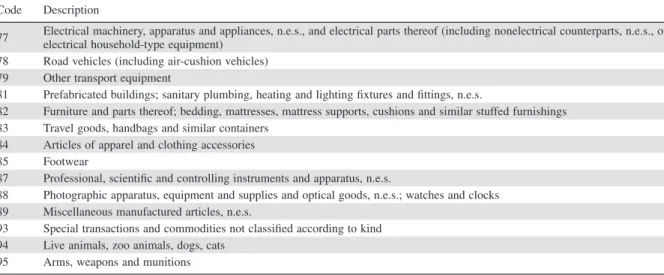
Trinidad and Tobago: imports from the rest of the world and the United States, 1985 to 2010. Note: The size of the circles indicates the relative weight of each sector's exports in the total exports of Trinidad and Tobago.

Competitiveness matrices: analysis by divisions and by technological contents
The competitive situation for Trinidad and Tobago's exports is relatively stronger in the US market than in the rest of the global market as a whole, although it is not very good. Nevertheless, their competitive performance in the US market was relatively better than in the rest of the world.
Then we relate the specifications and the most important aspects of the econometric model and discuss the results obtained. The first refers to an independent activity that a person can undertake due to the difficulty of finding work.
Background
Thomas-Hope (1999) analyzes this phenomenon in the case of Jamaica, and emphasizes the institutional climate of trust as an element that facilitates return, as well as the importance of the positive sociocultural impact of returnees on that country. In this regard, Ilahi—in a 1999 study on migrants returning to Pakistan—shows that they have a high tendency toward non-agricultural self-employment, thanks to savings accumulated in the host country; McCormick and Wahba (2001) show for.
Survey of returnees in the Canton of Loja
In terms of education level, a significant proportion of respondents have a university degree (42%), but important groups have only secondary (38%) or primary (19%) schooling. In the country of destination, these persons carried out activities similar to those of the entrepreneurial group.

Econometric model
In the case of Loja, more education seems to increase the likelihood of the latter possibility. 2011 Global Report [online] http://www.gemconsortium. 1974), "Return migration in the United States", International Migration Review, vol. 1990), "Development and return migration to rural French Polynesia", Migration Review, vol.
Vicente Fruet Cardozo and Guzmán A. Muñoz Fernández
1 According to the integrated budget programming system and the integrated accounting system (sipp-sico), which is part of the integrated financial administration system (siaf), only 63% of the budgeted 616 billion guarantees (135.52 million USD) were implemented in 2012. In section III, we calculate Paraguay's housing deficit to determine the parameters of the population segment under consideration.
Housing financing and literature review
The goal is an annual tender for 7,500 homes up to 60 m2 in size; its construction should begin each year, but will be completed over a longer period of time, with the final payment being made on completion of the project.
The housing sector in Paraguay
Housing shortage and affected population This study focuses on the specific segment of the population in the fifth line of Table 1, which illustrates how disposable income per capita was distributed in 2012 (dgeec, 2012). They live in the poor outskirts of the cities and belong to the population that lives below the poverty line.3 This means that they do not even have the $2 needed to buy enough food every day.

Financing options for the housing sector
The steps and the organizations involved are as follows: i) The beneficiaries negotiate and sign a bond with a cooperative or s&l. Muellbauer, John and Anthony Murphy (1997), "Booms and busts in the uk housing market", The Economic Journal, vol. 1969), Cities and Housing, Chicago, Chicago University Press.

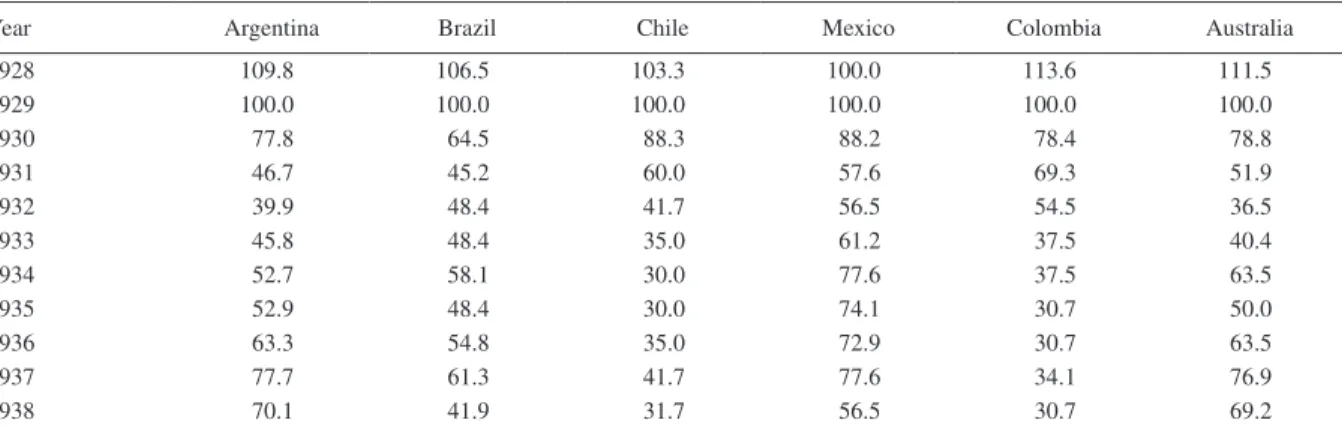
Its focus is therefore not on variables of the real economy, but on the tree of laboratory decisions that led to the abolition of the gold standard in Argentina. Metaphorically, the entrance to the labyrinth is the past, the not always comfortable but ultimately accepted primacy of the gold standard; the exit is the future: fiat money and the irreversible —and initially mistrust—.
The external shock: the deepest peace-time crash in history
Source: Prepared by the authors, based on Ronald Findlay and Kevin O'Rourke, Power and Plenty: Trade, War and the World Economy in the Second Millennium, Princeton, Princeton University Press, 2007. Economic Commission for Latin America and the Caribbean (eclac ), “Relación de precios de intercambio Santiago, 1977, unpublished.
Yrigoyen’s swift reaction: suspension of convertibility and currency depreciation
The dynamics of events culminated in a de facto abandonment of convertibility in December 1929 (Eichengreen, 1995). Given the imbalance in the current account of the balance of payments and the growing obstacles to financing in the international capital market, the unknown that emerged was the size of the currency devaluation.
The rediscounting policy of the Central Bank
In times of crisis, it is common for disappointed hopes to be pinned on the impossible. 10 Prebisch (1932a) states—not without exaggeration, according to the authors of this article—that attempts to secure an external line of credit had to be abandoned at the last minute because of the uncertainty in the financial markets caused by the radicals. ' won the post of governor of the province of Buenos Aires on April 5, 1931, just a few months after being ousted from the presidency.
April 1931
Banco Nación had the roles of clearing house for checks, managed the clearing house. In any case, an additional component is needed to fully understand the different dynamics that follow loans and deposits.
A lasting innovation: currency controls and fixed exchange rates (October 1931 to April 1933)
The government was counting on the stabilization of the exchange rate as a result of negotiations with local banks. This was compounded by the effect of deflation on debt and, more generally, on demand (à la Fisher).
Exiting the labyrinth: fiat money and reformed currency controls (November 1933)
Did the economic policy innovations of the early 1930s help the economy escape depression and deflation? Flandreau (2009), "The rise and fall of the dollar (or when did the dollar replace sterling as the main reserve currency?)", European Review of Economic History, Vol.
However, it has been argued (see, e.g., Heckman and Hotz, 1986) that this may simply reflect the bias caused by the selective composition of employee samples. Under this premise, the better performance of the segmentation models would be mainly due to the parametric nature of the profit equations used.
Identifying informality
Extent and recent evolution of informality
Pratap and Quintín (2006) use this approach but conclude that the results were inconclusive, partly due to the small sample size (they use data limited to Greater Buenos Aires for the period 1993-1995). Perry and others (2007) examine estimates of formal-informal earnings gaps, produced by Arias and Khamis using a propensity score approach applied to panel data, which reveal a significant positive difference between the incomes of registered and non-registered wage earners bring.
Estimating the formality premium using a semiparametric panel data model
From registered wage earners to unregistered wage earners (excluding company size as an independent variable). 1990), “Labor market modeling and the urban informal sector: theory and evidence”, The Informal Sector Revisited, D.

A number of empirical studies point to a significant reduction in the volume of exchange rate pass-through since the early 1990s. Both findings reveal that the exchange rate pass-through to prices strongly depends on the parameters of the monetary policy framework.
Stylized facts
A simple way to illustrate the evolution of the pass-through coefficient over the past three decades is to run a rolling regression between changes in price levels and changes in the exchange rate. Based on monthly data, a 60-month rolling window, and a simple regression between inflation and the year-on-year rate of change in the exchange rate, Figure 3 provides a first look at the sensitivity of the exchange rate flow-through coefficient to changes in the macroeconomic environment.
Empirical model and results
The first considers domestic inflation as a function of the percentage change in the nominal exchange rate, external inflation, the excess of domestic expenditure growth over output growth (the gap) and a multiplicative dichotomous variable (D1) showing the transmission effect of the adoption of inflation targets. The natural logarithm change of the quarterly mean for each variable was used for percent variation.
Summary and conclusions
Goldberg (2005), »Prenos menjalnega tečaja na uvozne cene«, The Review of Economics and Statistics, vol. Ihrig (2004), “Monetary policy and exchange rate pass-through”, International Journal of Finance and Economics, vol.
It is hypothesized that progress in the production of ICT goods and services in Mexico has been relatively slow, while demand from other manufacturing sectors has also lagged behind, suggesting that the industrial policy model followed has been inadequate. In terms of productivity, the ICT revolution has changed the way manufactured products and services are designed, organised, processed, distributed and marketed.
Mexico’s production of ict goods and services compared to other countries
The figures used are comparable for the three countries analyzed in the case of ICT goods, but not comparable in the ICT services sector, so the comparison is carried out bilaterally: Mexico-Brazil and Mexico-United States. In the Mexico-Brazil comparison, the ICT goods sector includes the production of computers, communications, measurement and other equipment; while the ICT services sector includes segments such as the Internet;.
The United States is integrated into gvcs, but it has positioned itself in the links with higher added value. Note: ICT services* includes a larger number of segments than the ICT services considered in the comparison between Mexico and the United States.
Analysis of the ict sector based on input-output matrices
Mexico experienced a similar phenomenon (albeit less acute) after the onset of the crisis in the US and globally in 2008. Regarding mcit, consumption in production also fell sharply in the US, but not in the.
Industrial policies in the ict sector
Nevertheless, the domino effect towards other ICT goods in that country weakened in the period analysed. Nevertheless, a state-level analysis in the latter country shows that government policies to promote the ICT goods sector have been pursued with positive results.
Concluding remarks
Such is the case of the PC Conectado [connected pc] program of 2005, which supplied one million low-cost computers to students in schools, running open source rather than proprietary software, in order to stimulate of local software development and cost reduction. (unctad, 2012). The United States exhibited a much more flexible path than Mexico in the ICT goods sector before the 2001-2003 sector crisis.
The main activity of the automotive sector is vehicle assembly, which constitutes a global oligopoly formed by a few large internationalized firms organized into different productive groups in different countries. Following this brief Introduction, section II presents a number of preliminary considerations about the automotive industry which help to some extent to explain the spatial distribution of the firms (mainly assembly firms).
The automotive industry: some preliminary considerations
Therefore, they were located in smaller and more distant urban centers, although they usually had to remain in the peripheral radius of the metropolitan center with the higher level function "central place". The automotive industry is also an excellent candidate for generating large multiplier effects in the production structure, due to its cross-sectoral relationships with different segments, mainly the backward links in the production chain.
Sectoral linkages of the automotive industry in Brazil
The backward indices of the automobile industry showed levels above 1 in all the countries analyzed. The largest multiplier of total output is that of Goia's automotive industry at 2.61, which means that, to satisfy each additional monetary unit of demand in the sector, the economy as a whole must produce 2.61 units.

Geographical distribution of the automotive industry in Brazil: an analysis by coefficients
As might be expected, the result of the production multipliers shown in Table 2 reflects the origin of. This result shows that the automotive industry in these three states produces significant interregional effects that must be taken into account in sectoral policies that aim to create an effect at the national level.
This new locational pattern, adopted by the automobile industry, remained unchanged in the first decade of the twenty-first century. Geographical connection of the distribution of the automotive industry in Brazil in relation to the production and assembly of vehicles.
Guidelines
Anuario estadístico de América Latina y el Caribe 2014 / Anuario estadístico de América Latina y el Caribe 2014, 238 p. América Latina y el Caribe: Mirando al futuro desde los Objetivos de Desarrollo del Milenio.