Suggested citation: EFSA (European Food Safety Authority), 2015. Refined exposure assessment for Azorubine/Carmoisine (E 122). EFSA Journal 2015;13(3):4072, 35 pp., doi:10.2903/j.efsa.2015.4072
Available online: www.efsa.europa.eu/efsajournal
STATEMENT OF EFSA
Refined exposure assessment for Azorubine/Carmoisine (E 122)
1European Food Safety Authority2,3
European Food Safety Authority (EFSA), Parma, Italy ABSTRACT
Following a self-tasking request, the European Food Safety Authority (EFSA) carried out a refined exposure assessment for Azorubine/Carmoisine (E 122) taking into account additional information on its use in foods. In 2009, the EFSA Panel on Food Additives and Nutrient Sources added to Food (ANS) adopted a scientific opinion on the re-evaluation of Azorubine/Carmoisine (E 122) used as a food additive. In that opinion, the Panel concluded that, at the high percentile of exposure (95th), using either the maximum permitted levels (MPLs) or the reported use levels provided by industry, intake estimates for 1- to 10-year-old children could be above the Acceptable Daily Intake (ADI) of 4 mg/kg body weight (bw) per day. Following this conclusion, EFSA performed a refined exposure assessment for this food colour, using new usage data from industry, as well as analytical data submitted to EFSA by Member States, and the EFSA Comprehensive European Food Consumption Database. Usage data from industry were provided to EFSA for five out of the 50 food categories in which Azorubine/Carmoisine (E 122) is authorised as a food additive, whereas analytical data from Member States were provided to EFSA for 32 food categories. Using MPLs, exposure estimates exceeded the ADI at the high level for toddlers and children. In the refined exposure scenarios, the ADI was not exceeded for any of the population groups at either the mean or the higher exposure level.
© European Food Safety Authority, 2015 KEY WORDS
Azorubine/Carmoisine, E 122, dietary exposure, EFSA Comprehensive European Food Consumption Database, food colours
1 On request from EFSA, Question No EFSA-Q-2012-00885, approved on 26 March 2015.
2 Correspondence: [email protected]
3 Acknowledgement: EFSA wishes to thank Polly Boon, Jean-Charles Leblanc and Oliver Lindtner for the preparatory work on this scientific output and EFSA staff: Alexandra Tard and Stavroula Tasiopoulou for the support provided to this scientific output. EFSA acknowledges those European competent authorities, food industry and other stakeholders that provided occurrence data (usage and analytical data) on Azorubine/Carmoisine (E 122) in food and beverages, and supported the data collection for the Comprehensive European Food Consumption Database.
SUMMARY
Following a self-tasking request, the European Food Safety Authority (EFSA) carried out a refined exposure assessment for Azorubine/Carmoisine (E 122) taking into account additional information on its use in foods.
In 2009, the EFSA Panel on Food Additives and Nutrient Sources added to Food (ANS) adopted a scientific opinion on the re-evaluation of Azorubine/Carmoisine (E 122) used as a food additive. In that opinion, the Panel concluded that, at the high percentile of exposure (95th), using either the maximum permitted levels (MPLs) or the reported use levels provided by industry, intake estimates for 1- to 10-year-old children could be above the Acceptable Daily Intake (ADI) of 4 mg/kg body weight (bw) per day. Following this conclusion, EFSA carried out a refined exposure assessment for this colour, taking into account additional information on usage levels in foods, as well as analytical data submitted to EFSA by Member States.
Azorubine/Carmoisine (E 122) is an azo dye authorised as a food additive in the European Union (EU). This food colour has been previously evaluated by the Joint FAO/WHO Expert Committee on Food Additives (JECFA) in 1983 (JECFA, 1983a, b) and by the Scientific Committee for Food (SCF) in 1984 (SCF, 1984) and 1989. Both committees established an Acceptable Daily Intake (ADI) of 0–
4 mg/kg bw.
In 2009, the ANS Panel re-evaluated Azorubine/Carmoisine (E 122) as a food additive. The safety of the use of Azorubine/Carmoisine (E 122) was assessed on the basis of uses and use levels authorised in legislation4 and of reported use levels, as provided by industry. Based on that assessment, the ANS Panel concluded that there was no reason to revise the ADI of 4 mg/kg bw per day.
The ANS Panel also concluded that at both the MPLs and the maximum reported use levels of Azorubine/Carmoisine (E 122), intake estimates for 1- to 10-year-old children at the high percentile (95th) could exceed the ADI of 4 mg/kg bw per day.
The present review provides a refined exposure assessment for Azorubine/Carmoisine (E 122) based on individual food consumption data which became available within the EFSA Comprehensive European Food Consumption Database and newly submitted information on the actual usage levels and analytical data of Azorubine/Carmoisine (E 122) in foods as consumed, provided to EFSA by the food industry and Member States, following an EFSA call for data5 launched in March 2013.
Usage levels of Azorubine/Carmoisine (E 122) reported by industry covered five out of the 50 authorised uses of Azorubine/Carmoisine as a food additive, whereas analytical data received from Member States covered 32 food categories.
In comparison with the previous assessment, the current exposure estimates based on the MPL scenario were of the same order of magnitude, at both the mean and the high level, for all populations.
However, based on the refined scenarios, the current estimates were lower for all populations at both the mean and the high exposure level, and did not exceed the ADI.
EFSA concluded that, using MPLs, exposure estimates exceeded the ADI of 4 mg/kg bw per day at the high level for toddlers and children. In the refined exposure scenarios, the ADI was not exceeded by any of the population groups.
4 European Parliament and Council Directive 94/36/EC of 30 June 1994 on colours for use in foodstuffs. OJ L 237, 10.9.1994, p. 13.
5 Call for food additives usage level and/or concentration data in food and beverages intended for human consumption.
Published: 27 March 2013. Deadline 15 September 2013. Available online: http://www.efsa.europa.eu/en/data/call/
130327.htm
TABLE OF CONTENTS
Abstract ... 1
Summary ... 2
1. Introduction ... 4
1.1. Background and Terms of reference as provided by EFSA ... 4
1.2. Interpretation of the Terms of Reference ... 5
1.3. Additional information ... 5
2. Data and methodologies ... 6
2.1. Data ... 6
2.1.1. Use and use levels of Azorubine/Carmoisine (E 122) ... 6
2.1.2. Reported use levels and analytical levels of Azorubine/Carmoisine (E 122) in foods ... 9
2.1.2.1. Summarised data on reported use levels of Azorubine/Carmoisine (E 122) in foods provided by industry ... 10
2.1.2.2. Summarised data on analytical levels of Azorubine/Carmoisine (E 122) in foods provided by Member States ... 10
2.1.3. Food consumption ... 11
2.1.3.1. EFSA Comprehensive European Food Consumption Database ... 11
2.1.3.2. Food items selected for the refined exposure assessment of Azorubine/Carmoisine (E 122) ... 12
2.2. Methodologies ... 13
2.2.1. Regulatory maximum level exposure assessment scenario ... 14
2.2.2. Refined exposure assessment scenario ... 15
3. Assessment ... 16
3.1. Exposure to Azorubine/Carmoisine (E 122) from its use as a food additive ... 16
3.2. Main food categories contributing to exposure to Azorubine/Carmoisine (E 122) ... 16
3.3. Uncertainty analysis... 19
3.4. Discussion ... 19
4. Conclusions ... 21
Documentation provided to EFSA ... 22
References ... 22
Appendices ... 24
Abbreviations ... 35
1. Introduction
1.1. Background and Terms of reference as provided by EFSA
In its letter of 26 May 2011 to the European Food Safety Authority (EFSA), the European Commission (EC) requested clarification on the outcomes of the exposure calculations undertaken by the EFSA Panel on Food Additives and Nutrient Sources added to Food (ANS) in the opinions on the so-called Southampton colours (quinoline yellow,6 sunset yellow,7 ponceau 4R8). The Member States and stakeholders had informed the EC that the figures used in these exposure assessments required possibly some updating.
On 1 August 2011, EFSA responded by a letter indicating that following the discussions which took place on 27 May 2011 between EFSA, the EC and Member States representatives, where the possibility to make refined exposure assessments in the future was discussed, further exchanges between the EC and EFSA have shown an interest for performing such refined assessments.
Once the necessary preparatory work to enable the realisation of the foreseen refined exposure assessments, e.g. the establishment of a correspondence table between the food classification system (FCS) of the new European legislation (Regulation (EU) No 1129/20119) and that of the EFSA Comprehensive Food Consumption Database (FoodEx) had been finalised, EFSA requested information on the priorities set by the EC in its letter of 26 April 2012.
On 23 May 2012, the EC sent a letter to EFSA setting the priorities for the refined exposure assessments of 12 food colours (Priority 1: caramel colours (E 150a, E 150c and E 150d); Priority 2:
curcumin (E 100), amaranth (E 123), brown HT (E 155); Priority 3: azorubine/carmoisine (E 122), Allura Red AC (E 129), brilliant black BN (E 151); Priority 4: quinoline yellow (E 104), sunset yellow (E 110), and ponceau 4R (E 124)), and indicated that revised data on use and use levels for food colours under priorities 2 and 3 were currently being collected by FoodDrinkEurope and should be provided to EFSA once they were available. Similar revised use data for the caramel colours (E 150a, E 150c and E 150d) have been provided by the EC to EFSA.
EFSA is to provide refined exposure assessments for food colours already re-evaluated taking into account the restrictions/exceptions listed in Regulation (EU) No 1129/2011, especially in the case of main contributors.
Furthermore, it is requested that following the establishment of a correspondence table between the FCS of Regulation (EU) No 1129/2011 and that of the EFSA Comprehensive Food Consumption Database (FoodEx), EFSA will use the FoodEx food classification system in order to provide refined exposure assessments and exclude non-relevant food subgroups from the intake calculations. The list of priorities, as provided by the EC, is set as follows:
Priority 1 – caramel colours (E 150a, E 150c, E 150d)
Priority 2 – curcumin (E 100), amaranth (E 123), brown HT (E 155)
Priority 3 – azorubine/carmoisine (E 122), allura red AC (E 129), brilliant black BN (E 151) Priority 4 – quinoline yellow (E 104), sunset yellow (E 110), ponceau 4R (E 124)
6 EFSA, 2009. Scientific Opinion on the re-evaluation of Quinoline Yellow (E 104) as a food additive, ON-1329.
7 EFSA, 2009. Scientific Opinion on the re-evaluation of Sunset Yellow FCF (E 110) as a food additive, ON-1330.
8 EFSA, 2009. Scientific Opinion on the re-evaluation of Ponceau 4R (E 124) as a food additive, ON-1328.
9 Commission regulation (EU) No 1129/2011 of 11 November 2011 on amending Annex II to Regulation (EC) No 1333/2008 of the European Parliament and of the Council by establishing a Union list of food additives. OJ L 295, 12.11.2011, p. 1.
1.2. Interpretation of the Terms of Reference
The aim of the present statement is to provide a refined exposure assessment for Azorubine/Carmoisine (E 122) as a food colour using the exposure assessment approach adopted by the ANS Panel at its 52nd plenary meeting10 as part of the safety assessment of food additives under re-evaluation. The current exposure assessment uses the EFSA Comprehensive European Food Consumption Database (hereinafter referred as Comprehensive database) and the FoodEx food classification system, and takes into consideration, besides the maximum permitted levels (MPLs), updated use levels reported by the industry and analytical data from Member States.
1.3. Additional information
Azorubine/Carmoisine (E 122) is an azo dye allowed as a food additive in the EU and has been previously evaluated by the Joint Food and Agricultural Organization (FAO)/World Health Organization (WHO) Expert Committee on Food Additives (JECFA) in 1983 (JECFA, 1983a, b) and by the EU Scientific Committee for Food (SCF) in 1984 (SCF, 1984). Both committees established an Acceptable Daily Intake (ADI) of 0–4 mg/kg body weight (bw).
In 2009, the EFSA Panel on Food Additives and Nutrient Sources added to Food (ANS) re-evaluated Azorubine/Carmoisine (E 122) as a food additive (EFSA ANS Panel, 2009). The safety of the use of Azorubine/Carmoisine (E 122) was assessed on the basis of uses and use levels authorised in the legislation11 and of reported use levels, as provided by industry. The ANS Panel concluded that the database did not provide reason to revise the ADI of 4 mg/kg bw per day.
The ANS Panel concluded that at the maximum reported levels of use of Azorubine/Carmoisine (E 122), refined intake estimates are below the ADI, although, in 1- to 10-year-old children, the high percentile of exposure (95th) could be slightly higher than the ADI at the upper end of the range (Table 1).
The main contributors (> 10 %) to the total anticipated mean exposure of the adult population to Azorubine/Carmoisine (E 122) were non-alcoholic beverages (50 %) and sauces and seasonings (e.g.
curry powder, tandoori), pickles, relishes, chutney, piccalilli (17 %). For children, the main contributing food categories were non-alcoholic beverages (17–65 %), fine bakery wares (e.g.
Viennoiserie, biscuits, cakes, wafer) (10–34 %), desserts, including flavoured milk products, (15–
42 %) and sauces, seasonings (e.g. curry powder, tandoori), pickles, relishes, chutney, piccalilli (15–
70 %). Surimi accounted for 11 % of exposure in one country.
10 http://www.efsa.europa.eu/en/events/event/140701a-m.pdf
11 European Parliament and Council Directive 94/36/EC of 30 June 1994 on colours for use in foodstuffs. OJ L 237, 10.9.1994, p. 13.
Table 1: Summary of anticipated exposure to Azorubine/Carmoisine (E 122) in children and the adult UK population as calculated in the previous ANS Panel opinion (EFSA ANS Panel, 2009) (mg/kg bw per day)
UK, adults (a) (> 18 years
old)
UK (a) and EXPOCHI (b), children (1- to 10-year-olds, 15–30 kg body
weight (c)) Estimated exposure using MPLs
Mean exposure 0.5 0.3–2.5
Exposure 95th (b) or 97.5th percentile (a) 1.1 0.7–6.7
Estimated exposure using reported use levels
Mean exposure 0.4 0.3–2.4
Exposure 95th (b) or 97.5th percentile (a) 1.0 0.6–6.5
(a): For the UK, estimates are based on the UNESDA (Union of European Soft Drinks Associations) report, which gives the 97.5th percentile intake from beverages plus per capita average from the rest of the diet (Tennant, 2006).
(b): For EU children, estimates are based on the EXPOCHI (individual food consumption data and exposure assessment studies for children) report (Huybrechts et al., 2010), which gives the 95th percentile intake.
(c): Except for 11- to 14-year-old children Cypriot children, whose reported body weight was 54 kg.
2. Data and methodologies 2.1. Data
2.1.1. Use and use levels of Azorubine/Carmoisine (E 122)
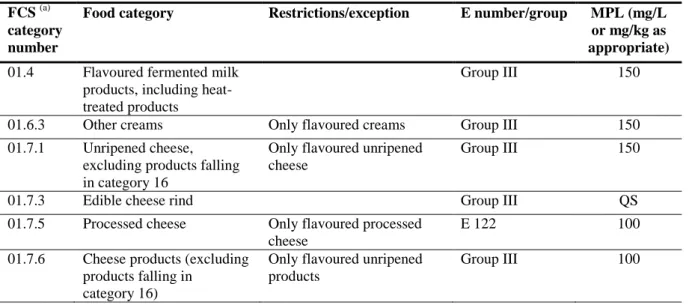
Maximum permitted levels (MPLs) of Azorubine/Carmoisine (E 122) are defined in Annex II to Regulation (EC) No 1333/200812 on food additives, as amended. The MPLs range from 50 to 500 mg/kg and are set at quantum satis (QS) in two food categories. In addition, Azorubine/Carmoisine (E 122) is included in Group III of food colours with combined maximum limit, and may therefore also be used in the food categories in which Group III food additives are allowed.
Table 2 summarises foods that are permitted to contain Azorubine/Carmoisine (E 122) and the corresponding MPLs as set by Annex II to Regulation (EC) No 1333/2008.
Table 2: MPLs of Azorubine/Carmoisine (E 122) in foods according to Annex II of Regulation (EC) No 1333/2008
FCS (a) category number
Food category Restrictions/exception E number/group MPL (mg/L or mg/kg as appropriate) 01.4 Flavoured fermented milk
products, including heat- treated products
Group III 150
01.6.3 Other creams Only flavoured creams Group III 150
01.7.1 Unripened cheese, excluding products falling in category 16
Only flavoured unripened cheese
Group III 150
01.7.3 Edible cheese rind Group III QS
01.7.5 Processed cheese Only flavoured processed cheese
E 122 100
01.7.6 Cheese products (excluding products falling in
category 16)
Only flavoured unripened products
Group III 100
12 Regulation (EC) No 1333/2008 of the European Parliament and of the Council on food additives. OJ L 354, 31.12.2008, p. 16.
FCS (a) category number
Food category Restrictions/exception E number/group MPL (mg/L or mg/kg as appropriate)
03 Edible ices Group III 50
04.2.1 Dried fruit and vegetables Only preserves of red fruit E 122 200 04.2.2 Fruit and vegetables in
vinegar, oil or brine
Only preserves of red fruit E 122 200 04.2.3 Canned or bottled fruit and
vegetables
Only preserves of red fruit E 122 200 04.2.4.1 Fruit and vegetable
preparations, excluding compote
Only mostarda di frutta Group III 200
04.2.4.1 Fruit and vegetable preparations, excluding compote
Only preserves of red fruit E 122 200
05.2 Other confectionery, including breath
refreshening microsweets
Except candied fruit and vegetables
Group III 50
05.2 Other confectionery, including breath
refreshening microsweets
Only candied fruit and vegetables
Group III 200
05.3 Chewing gum Group III 50
05.4 Decorations, coatings and fillings, except fruit-based fillings covered by category 4.2.4
Only decorations, coatings and sauces, except fillings
Group III 500
05.4 Decorations, coatings and fillings, except fruit-based fillings covered by category 4.2.4
Only fillings Group III 50
06.6 Batters Only batters for coating Group III 500
07.2 Fine bakery wares Group III 50
08.3.3 Casings and coatings and decorations for meat
Only decorations and coatings, except edible external coating of pastourmas
Group III 500
08.3.3 Casings and coatings and decorations for meat
Only edible casings Group III QS
09.2 Processed fish and fishery products, including molluscs and crustaceans
Only surimi and similar products and salmon substitutes
Group III 500
09.2 Processed fish and fishery products, including molluscs and crustaceans
Only fish paste and crustacean paste
E 122 100
09.2 Processed fish and fishery products, including molluscs and crustaceans
Only precooked crustacean E 122 250
09.3 Fish roe Except Sturgeons’ eggs
(caviar)
Group III 300
12.2.2 Seasonings and condiments Only seasonings, for example curry powder, tandoori
Group III 500
12.4 Mustard Group III 300
12.5 Soups and broths Group III 50
FCS (a) category number
Food category Restrictions/exception E number/group MPL (mg/L or mg/kg as appropriate)
12.6 Sauces Including pickles, relishes,
chutney and piccalilli;
excluding tomato-based sauces
Group III 500
12.9 Protein products, excluding products covered in category 1.8
Only meat and fish analogues based on vegetable proteins
Group III 100
13.2 Dietary foods for special medical purposes defined in Directive 1999/21/EC (excluding products from food category 13.1.5)
Group III 50
13.3 Dietary foods for weight control diets intended to replace total daily food intake or an individual meal (the whole or part of the total daily diet)
Group III 50
14.1.4 Flavoured drinks Excluding chocolate milk;
malt products
Group III 50
14.2.3 Cider and perry Excluding cidre bouché Group III 200
14.2.4 Fruit wine and made wine Excluding wino owocowe markowe
Group III 200
14.2.6 Spirit drinks as defined in Regulation (EC) No 110/2008
Except: spirit drinks as defined in article 5(1) and sales denominations listed in Annex II, paragraphs 1–14 of Regulation (EC) 110/2008 and spirits (preceded by the name of the fruit) obtained by maceration and distillation, Geist (with the name of the fruit or the raw material used), London Gin, Sambuca, Maraschino, Marrasquino or Maraskino and Mistrà
Group III 200
14.2.7.1 Aromatised wines Except americano, bitter vino
Group III 200
14.2.7.1 Aromatised wines Only americano, bitter vino E 122 100 14.2.7.2 Aromatised wine-based
drinks
Except bitter soda, sangria, claria, zurra
Group III 200
14.2.7.2 Aromatised wine-based drinks
Only bitter soda E 122 100
14.2.7.3 Aromatised wine-product cocktails
Group III 200
14.2.8 Other alcoholic drinks, including mixtures of alcoholic drinks with non- alcoholic drinks and spirits with less than 15 % of alcohol
Only alcoholic drinks with less than 15 % of alcohol and nalewka na winie
owocowym, aromatyzowana nalewka na winie
owocowym, nalewka na winie z soku
winogronowego,
aromatyzowana nalewka na
Group III 200
FCS (a) category number
Food category Restrictions/exception E number/group MPL (mg/L or mg/kg as appropriate) winie z soku
winogronowego, napój winny owocowy lub miodowy, aromatyzowany napój winny owocowy lub miodowy, wino owocowe niskoalkoholowe and aromatyzowane wino owocowe niskoalkoholowe 15.1 Potato-, cereal-, flour- or
starch-based snacks
Excluding extruded or expanded savoury snack products
Group III 100
15.1 Potato-, cereal-, flour- or starch-based snacks
Only extruded or expanded savoury snack products
Group III 200
15.2 Processed nuts Only savoury-coated nuts Group III 100
16 Desserts, excluding products covered in categories 1, 3 and 4
Group III 150
17.1 Food supplements supplied in a solid form, including capsules and tablets and similar forms, excluding chewable forms
Group III 300
17.2 Food supplements supplied in a liquid form
Group III 100
17.3 Food supplements supplied in a syrup-type or chewable form
Only solid food supplements Group III 300
17.3 Food supplements supplied in a syrup-type or chewable form
Only liquid food supplements
Group III 100
(a): FCS, Food Categorisation System (food nomenclature), presented in the Annex II to Regulation (EC) No 1333/2008.
2.1.2. Reported use levels and analytical levels of Azorubine/Carmoisine (E 122) in foods Most food additives in the EU are authorised at a specific MPL. However, a food additive may be used at a lower level than the MPL. Therefore, information on actual use levels is required for performing a more realistic exposure assessment, especially for those food additives for which no MPL is set and which are authorised according to QS.
In the framework of Regulation (EC) No 1333/2008 on food additives and of Commission Regulation (EU) No 257/201013 regarding the re-evaluation of approved food additives, EFSA issued a public call14 for food additives concentration data (usage level and/or analytical data) on Azorubine/Carmoisine (E 122).
Data on Azorubine/Carmoisine (E 122), including present use and use patterns (i.e. the food categories and subcategories and the actual use levels (typical and maximum use levels), especially for those uses which are limited only by QS), were requested from relevant stakeholders. European food
13 Commission Regulation (EU) No 257/2010 of 25 March 2010 setting up a programme for the re-evaluation of approved food additives in accordance with Regulation (EC) No 1333/2008 of the European Parliament and of the Council on food additives. OJ L 80, 26.3.2010, p. 19.
14 Call for food additives usage level and/or concentration data in food and beverages intended for human consumption.
Published: 27 March 2013. Deadline 15 September 2013. Available online: http://www.efsa.europa.eu/en/
data/call/130327.htm
manufacturers, national food authorities, research institutions, academia, food business operators and any other interested stakeholders were invited to submit analytical data on Azorubine/Carmoisine (E 122) in foods and beverages. Data submission to EFSA followed the requirements of the EFSA Guidance on Standard Sample Description for Food and Feed (EFSA, 2010a).
2.1.2.1. Summarised data on reported use levels of Azorubine/Carmoisine (E 122) in foods provided by industry
Industry provided EFSA with data on use levels (n = 25) of Azorubine/Carmoisine (E 122) in foods belonging to five out of the 50 food categories in which Azorubine/Carmoisine (E 122) is authorised.
These data were provided by Food Drink Europe (FDE), the International Chewing Gum Association (ICGA), Capsugel and the Association of the European Self-Medication Industry (AESGP), and covered the following food categories: chewing gum (FCS 05.3); decorations, coatings and fillings, except fruit-based fillings covered by category 04.2.4 (FCS 05.4); sauces (FCS 12.6); flavoured drinks (FCS 14.1.4); and food supplements supplied in a solid form, including capsules, tablets and similar forms, excluding chewable forms (FCS 17.1).
Several values were reported by the industry (minimum, typical and maximum use levels) for the same product. For the purpose of the exposure assessment, maximum reported use levels were used, as well as the mean of the typical reported use levels per food category for estimating the exposure in the refined exposure assessment scenarios (Section 3.1).
Data provided by industry are summarised by food category in Appendix A.
2.1.2.2. Summarised data on analytical levels of Azorubine/Carmoisine (E 122) in foods provided by Member States
Analytical results from Member States were collected through the EFSA call for concentration data.
Complete information on the methods of analysis was not made available to EFSA. In total, 6 644 analytical results were reported by eight countries: Austria (n = 994), Cyprus (n = 194), the Czech Republic (n = 333), Germany (n = 3 296), Hungary (n = 480), Ireland (n = 208), Slovakia (n = 1 099) and Spain (n = 40). These data were mainly on flavoured drinks (FCS food category 14.1.4), other confectionery, including breath freshening microsweets (FCS food category 05.2), fine bakery wares (FCS food category 07.2) and edible ices (FCS 03). Foods were sampled between 2000 and 2013 and analysed during the same period of time. All samples came from accredited laboratories.
In order to include only recent data, analytical results sampled before 2004 (n = 18) were excluded from the exposure assessment. Moreover, 940 analytical results expressed as qualitative values were also not used, as they gave only an indication of the presence or absence of the food additive in the food analysed.
Food samples were codified by the Member States in accordance with the Food Classification System as in Regulation No 1333/2008, Annex II, Part D. A large number of samples (n = 1439) either were not codified in sufficient detail to allow them to be assigned to the correct authorised food category (e.g. FCS 14.1) or were codified with information resulting in the suggestion that Azorubine/Carmoisine (E 122) is present in non-authorised food categories; the latter, however, could be caused by codification errors. Based on the information made available to EFSA on the food analysed (free text field), it was not always possible to distinguish between samples with a codification error and samples in which Azorubine/Carmoisine (E 122) was present in a food in which it is not authorised. These 1 439 samples were not used in the present exposure assessment. In most of the 1 439 samples, Azorubine/Carmoisine (E 122) was not detected or not quantified (below the limit of detection (LOD) or the limit of quantification (LOQ), respectively), but in others (n = 309) numerical values (i.e. with quantified levels of the food additive in food) were reported. These were mostly data on the food categories other sugars and syrups (FCS 11.2), non-alcoholic beverages (FCS 14.1, not specified), fruit juices (FCS 14.1.2), alcoholic beverages (FCS 14.2, not specified), spirit drinks (FCS 14.2.6, other than those defined under the restrictions which apply to the use of
Azorubine/Carmoisine), other alcoholic drinks, including mixtures of alcoholic drinks with non- alcoholic drinks and spirits with less than 15 % of alcohol (FCS 14.2.8, other than those defined under the restrictions which apply to the use of Azorubine/Carmoisine), jam, jellies and marmalades and similar products (FCS 04.2.5), other similar fruit or vegetables spreads (FCS 04.2.5.3) and cocoa and chocolate products (FCS 05.1).
Overall, 4 247 out of the 6 644 analytical results reported for Azorubine/Carmoisine (E 122) corresponded to food categories in which Azorubine/Carmoisine (E 122) is currently authorised. Out of this dataset, analytical results of Azorubine/Carmoisine (E 122) were not quantified (lower than the LOQ) in 498 samples and not detected (lower than the LOD) in 2 603 samples; 1 146 were numerical values (quantified).
Samples with numerical values covered mainly the following four food categories: flavoured drinks (FCS 14.1.4), other confectionery, including breath freshening microsweets (FCS 05.2), alcoholic beverages (FCS 14.2) and edible ices (FCS 03). Out of these samples, 32 contained levels of Azorubine/Carmoisine (E 122) above their MPLs: 18 samples of flavoured drinks; six of food supplements; two each of spirit drinks and edible ices; and one each of flavoured fermented milk products, including heat-treated products, other alcoholic drinks, including mixtures of alcoholic drinks with non-alcoholic drinks and spirits less than 15 % alcohol, candied fruit and vegetables and fine bakery wares. For the exposure assessment, EFSA considers analytical data resulting from only authorised uses at levels not exceeding the MPLs; exposure resulting from the presence of food additives in food at levels above the MPLs are part of risk management measures, e.g. non-compliance controls. For this reason, such analytical results above the MPLs are not considered in the exposure assessment.
Therefore, after removal of these 32 samples, 4 215 analytical results were available for the refined exposure assessment. These data covered 32 food categories out of the 50 in which Azorubine/Carmoisine (E 122) is authorised.
Appendix B shows the analytical results of Azorubine/Carmoisine (E 122) in foods as reported by Member States (whole set of analytical data reported and positive samples only) and considered in the exposure assessment.
2.1.3. Food consumption
2.1.3.1. EFSA Comprehensive European Food Consumption Database
Since 2010, the EFSA Comprehensive European Food Consumption Database (Comprehensive Database) has been populated with national data on food consumption at a detailed level. Competent authorities in the European countries provide EFSA with data on the level of food consumption by individual consumers from the most recent national dietary survey in their country (see Guidance of EFSA ‘Use of the EFSA Comprehensive European Food Consumption Database in Exposure Assessment’ (EFSA, 2011a)).
The food consumption data gathered by EFSA were collected by different methodologies, and thus direct country-to-country comparisons should be interpreted with caution. Depending on the food category and the level of detail used for exposure calculations, uncertainties could be introduced by subjects’ possible under-reporting and/or misreporting of the consumption amounts. Nevertheless, the EFSA Comprehensive Database represents the best available source of food consumption data across Europe at present.
Consumption records were codified according to the FoodEx food classification system (EFSA, 2011b). Nomenclature from the FoodEx food classification system has been linked to the FCS, as presented in Annex II, part D, to Regulation (EC) No 1333/2008, as amended, for the exposure assessment.
2.1.3.2. Food items selected for the refined exposure assessment of Azorubine/Carmoisine (E 122) The food categories in which the use of Azorubine/Carmoisine (E 122) is authorised were selected from the nomenclature of the EFSA Comprehensive Database (FoodEx classification system food codes), at the most detailed level possible (up to FoodEx Level 4) (EFSA, 2011b).
Some analysed food items are not referenced in the EFSA Comprehensive Database and could therefore not be taken into account in the present estimate. This resulted in an underestimation of the exposure to Azorubine/Carmoisine (E 122). The food categories not taken into account are described below (in ascending order of FCS code):
01.7.3 Edible cheese rind
01.7.6 Cheese products (excluding products falling into category 16), only flavoured unripened products
04.2.4.1 Fruit and vegetable preparations, excluding compote, only mostarda di frutta
05.4 Decorations, coatings and fillings, except fruit-based fillings covered by category 4.2.4, only decorations, coatings and sauces, except fillings
05.4 Decorations, coatings and fillings, except fruit-based fillings covered by category 4.2.4, only fillings
06.6 Batters
08.3.3 Casings and coatings and decorations for meat, only decorations and coatings except edible external coating of pastourmas
08.3.3 Casings and coatings and decorations for meat, only edible casings
14.2.4 Fruit wine and made wine
The food category ‘Other creams, only flavoured creams’ (FCS 01.6.3) could not be differentiated from other kinds of creams included under the same food category (FCS 01.6 Cream and cream powder). The same applied in differentiating flavoured cream from plain cream. This food category was therefore also not taken into account in the present exposure assessment.
For some food categories, no usage or analytical data were provided to EFSA and could therefore not be taken into account in the refined scenarios:
01.7.3 Edible cheese rind
01.7.6 Cheese products (excluding products falling into category 16), only flavoured unripened products
04.2.2 Fruit and vegetables in vinegar, oil, or brine, only preserves of red fruit
04.2.4.1 Fruit and vegetable preparations excluding compote, only mostarda di frutta
06.6 Batters
08.3.3 Casings and coatings and decorations for meat, only decorations and coatings, except edible external coating of pastourmas
08.3.3 Casings and coatings and decorations for meat, only edible casings
09.2 Processed fish and fishery products, including molluscs and crustaceans, only surimi and similar products and salmon substitutes
09.2 Processed fish and fishery products, including molluscs and crustaceans, only fish paste and crustacean paste
09.2 Processed fish and fishery products, including molluscs and crustaceans, only precooked crustaceans
09.3 Fish roe, except sturgeon’s eggs (caviar)
12.9 Protein products, only meat and fish analogues based on vegetable proteins
13.3 Dietary foods for weight control diets intended to replace total daily food intake or an individual meal (the whole or part of the total daily diet).
Nevertheless, it should be noted that if Azorubine/Carmoisine (E 122) is used in these food categories, the calculated refined exposure assessment results in an underestimation of exposure to this food additive.
For the following food categories, the restrictions which apply to the use of Azorubine/Carmoisine (E 122) could not be taken into account, and therefore the whole food category was considered in the exposure assessment. This results in an overestimation of the exposure:
In the case of the food category 01.7.1, distinction between flavoured and non-flavoured foods is not possible within the EFSA Comprehensive Database.
In the case of the food category 04.2.2, it is not possible to distinguish the foods defined under the restrictions applicable for the use of Azorubine/Carmoisine (E 122), i.e. only preserves of red fruit.
14.2.3, cider and perry: no distinction was possible between cider and cidre bouché; therefore, the entire food category was accounted for in the exposure estimates.
14.2.7.1, aromatised wines, and 14.2.7.2, aromatised wine-based drinks: no distinction is possible between Americano, bitter vino and other products and bitter soda and other products in these food categories; therefore, the highest MPL and the highest use level reported within these categories were taken into account.
15.1, potato-, cereal-, flour-, starch-based snacks: no distinction between savoury snacks (extruded, expanded or not) is possible within the FoodEx nomenclature; therefore, this food category was considered as a whole and the highest MPL and the highest analytical level within this food category were taken into account in the exposure estimates.
17.1/17.2/17.3, food supplements: no distinction between the form of the food supplements (solid, liquid or syrup-type or chewable form) is possible within the FoodEx nomenclature;
therefore, these three food categories were considered as a whole and the highest MPL and highest use level reported were taken into account.
Overall, 17 food categories were not taken into account in the exposure assessment either because they were not referenced in the EFSA Comprehensive Database or because no usage or analytical data were available to EFSA. Another nine food categories were included in the exposure assessment without considering the restrictions for the use of Azorubine/Carmoisine (E 122) as set in Annex II to Regulation No 1333/2008.
2.2. Methodologies
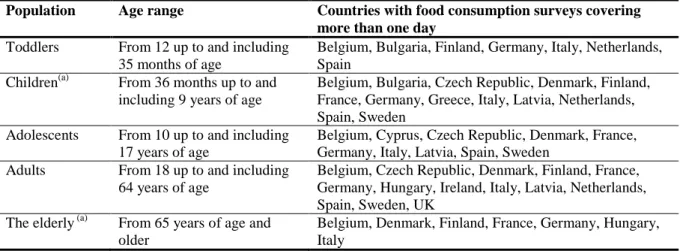
Dietary exposure to Azorubine/Carmoisine (E 122) from its use as a food colour was estimated using the approach adopted by the Panel at its 52nd plenary meeting15. This approach is to be followed to assess exposure as part of the safety assessment of food additives under re-evaluation, making use of food consumption data available within the EFSA Comprehensive Database, as presented in Table 3, and with the limitations described below.
15 http://www.efsa.europa.eu/en/events/event/140701a-m.pdf
EFSA estimated chronic exposure to Azorubine/Carmoisine (E 122) for the following population groups: toddlers, children, adolescents, adults and the elderly. For the assessment, food consumption data were available from 26 different dietary surveys carried out in 17 different European countries (Table 3). Calculations were performed using individual body weights. For calculation of chronic exposure, intake statistics have been calculated based on individual consumption over the total survey period, excluding surveys with only one day per subject, which are considered inadequate to assess chronic dietary exposure, as suggested by the EFSA Working Group on Food Consumption and Exposure (EFSA, 2011a).
Table 3: Population groups considered for the exposure estimates of Azorubine/Carmoisine (E 122)
Population Age range Countries with food consumption surveys covering more than one day
Toddlers From 12 up to and including 35 months of age
Belgium, Bulgaria, Finland, Germany, Italy, Netherlands, Spain
Children(a) From 36 months up to and including 9 years of age
Belgium, Bulgaria, Czech Republic, Denmark, Finland, France, Germany, Greece, Italy, Latvia, Netherlands, Spain, Sweden
Adolescents From 10 up to and including 17 years of age
Belgium, Cyprus, Czech Republic, Denmark, France, Germany, Italy, Latvia, Spain, Sweden
Adults From 18 up to and including 64 years of age
Belgium, Czech Republic, Denmark, Finland, France, Germany, Hungary, Ireland, Italy, Latvia, Netherlands, Spain, Sweden, UK
The elderly (a) From 65 years of age and older
Belgium, Denmark, Finland, France, Germany, Hungary, Italy
(a): The terms ‘children’ and ‘the elderly’ correspond, respectively, to ‘other children’ and the combination of ‘elderly’ and
‘very elderly’ in the Guidance of EFSA on the ‘Use of the EFSA Comprehensive European Food Consumption Database in Exposure Assessment’ (EFSA, 2011a).
To estimate the exposure, FoodEx food codes were matched to the FCS food categories and the exposure was subsequently calculated by multiplying MPLs (Table 2) and values reported in Appendix C for each food category, by the corresponding consumption per kilogram body weight separately for each individual in the database. The exposure per food category was subsequently added to derive an individual total exposure per day. Finally, these exposure estimates were averaged over the number of survey days per individual, resulting in an individual average exposure per day for the survey period. This was carried out for all individuals in the survey and per age group, resulting in distributions of individual average exposure per survey and population group (Table 3). Based on these distributions, the mean and 95th percentile exposure was calculated per survey for the total population and per population group.
High percentile exposure was calculated only for population groups in which the sample size was sufficiently large to allow calculation of the 95th percentile of exposure (EFSA, 2011a). Therefore, in the present assessment, high levels of exposure for toddlers from Belgium, Italy and Spain are not included.
Exposure assessment to Azorubine/Carmoisine (E 122) from its use as a food additive was carried out based on (1) MPLs set down in the EU legislation (defined as the regulatory maximum level exposure assessment scenario) and (2) use levels or analytical data (defined as the refined exposure assessment scenario).
2.2.1. Regulatory maximum level exposure assessment scenario
The regulatory maximum level exposure assessment scenario is based on the MPLs as set in Annex II to Regulation No 1333/2008, as amended, and listed in Table 2.
The exposure estimates derived following this scenario should be considered as the most conservative since they assume that the consumer will be continuously (over a lifetime) exposed to Azorubine/Carmoisine (E 122) present in the foods at the MPLs. It should be noted, however, as described in Section 2.1.3.2, that some food items could not be taken into account in the present exposure assessment for all scenarios, including two food categories with QS (Table 2). This should, nevertheless, represent a minor underestimation of the exposure calculated with this scenario.
2.2.2. Refined exposure assessment scenario
The refined exposure assessment scenario is based on information on reported use levels provided by industry and analytical results submitted to EFSA by Member States. In the refined exposure scenario only food categories for which the above data are available can be considered.
Based on the available dataset, EFSA calculates two estimates based on different model populations:
(1) The brand-loyal consumer scenario: This scenario assumes that a consumer is exposed long term to the food additive present at the maximum reported use/analytical levels for one food category. This exposure estimate is calculated as follows:
combining food consumption with the maximum of the maximum reported use levels or the maximum of the analytical results for the main contributing food category at the individual level;
using the mean of the typical reported use levels or the mean of analytical results for the remaining food categories.
(2) The non-brand-loyal consumer scenario: This scenario assumes that a consumer is exposed long term to the food additive present at the mean reported use/analytical levels in food. This exposure estimate is calculated using the mean of the typical reported use levels or the mean of analytical results for all food categories.
In the refined exposure assessment scenarios, concentration levels considered are extracted from the whole dataset received (i.e. reported use levels and analytical results). Regarding analytical results, in considering left-censored analytical data (i.e. analytical results < LOD or LOQ), the substitution method as recommended in the ‘Principles and Methods for the Risk Assessment of Chemicals in Food’ (WHO, 2009) and the EFSA scientific report ‘Management of left-censored data in dietary exposure assessment of chemical substances’ (EFSA, 2010b) is used. Analytical data below the LOD or LOQ are assigned half of the LOD or LOQ value, respectively (medium bound (MB)). For each food category, the mean or median, as appropriate, is used. For the reported use levels, the mean typical reported use level for each food category is used.
If both reported use levels and analytical results are available for the same food category, the most reliable value is used.
For Azorubine/Carmoisine (E 122), the refined exposure assessment scenario was applied as described above. Appendix C summarises the concentration levels used in the assessment. Food categories with no or inadequate reported use/analytical levels of Azorubine/Carmoisine (E 122) were not considered in the exposure assessment. EFSA noted that, if Azorubine/Carmoisine (E 122) is nevertheless used in those food categories, the calculated refined exposure assessment might result in underestimation of exposure to this food additive.
3. Assessment
3.1. Exposure to Azorubine/Carmoisine (E 122) from its use as a food additive
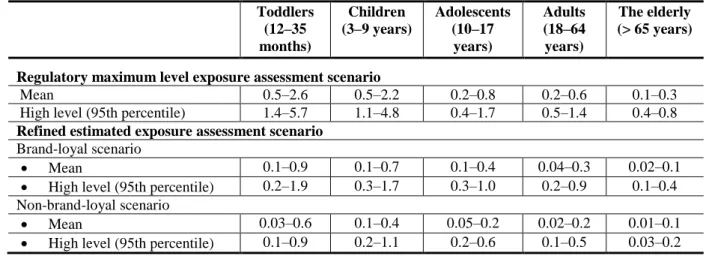
Table 4 summarises the anticipated exposure to Azorubine/Carmoisine (E 122) from its use as a food additive for all five population groups (Table 3). Detailed results per population group and survey are presented in Appendix D.
Table 4: Summary of anticipated exposure to Azorubine/Carmoisine (E 122) from its use as a food additive according to the regulatory maximum level exposure scenario and the refined exposure scenarios in five population groups (minimum–maximum across the dietary surveys in mg/kg bw per day)
Toddlers (12–35 months)
Children (3–9 years)
Adolescents (10–17
years)
Adults (18–64 years)
The elderly (> 65 years)
Regulatory maximum level exposure assessment scenario
Mean 0.5–2.6 0.5–2.2 0.2–0.8 0.2–0.6 0.1–0.3
High level (95th percentile) 1.4–5.7 1.1–4.8 0.4–1.7 0.5–1.4 0.4–0.8 Refined estimated exposure assessment scenario
Brand-loyal scenario
Mean 0.1–0.9 0.1–0.7 0.1–0.4 0.04–0.3 0.02–0.1
High level (95th percentile) 0.2–1.9 0.3–1.7 0.3–1.0 0.2–0.9 0.1–0.4 Non-brand-loyal scenario
Mean 0.03–0.6 0.1–0.4 0.05–0.2 0.02–0.2 0.01–0.1
High level (95th percentile) 0.1–0.9 0.2–1.1 0.2–0.6 0.1–0.5 0.03–0.2 3.2. Main food categories contributing to exposure to Azorubine/Carmoisine (E 122)
The main food categories contributing to total mean exposure to Azorubine/Carmoisine (E 122) (> 5 % of total exposure) according to the regulatory maximum level exposure assessment scenario and the refined exposure assessment scenarios, as well as the number of surveys in which each food category is contributing, are shown in Tables 5, 6 and 7, respectively.
Table 5: Main food categories contributing to the total mean exposure to Azorubine/Carmoisine (E 122) using the regulatory maximum level exposure assessment scenario (> 5 % of total exposure), and number of surveys in which each food category contributes
FCS category number
FCS food category Toddlers Children Adolescents Adults The elderly Range of % contribution to the total exposure
(number of surveys) (a) 01.4 Flavoured fermented
milk products, including heat-treated products
14.9–86.4 (7)
14.4–59.9 (13)
5.6–33.2 (10)
7.1–54.0 (14)
7.8–49.8 (7) 01.7.1 Unripened cheese,
excluding products falling in category 16
5.6–13.9 (6) 5.6–30.6 (7)
5.2–32.0 (4)
6.0–39.9 (9)
5.0–41.7 (7) 01.7.5 Processed cheese 12.8–13.8
(2)
7.8 (1)
03 Edible ices 9.1
(1)
5.6–8.2 (7)
6.2 (1) 07.2 Fine bakery wares 8.0–30.9 (3) 5.3–29.0
(12)
7.0–21.6 (11)
5.8–18.3 (12)
5.2–20.4 (6)
FCS category number
FCS food category Toddlers Children Adolescents Adults The elderly Range of % contribution to the total exposure
(number of surveys) (a) 09.2 Processed fish and
fishery products, including molluscs and crustaceans
7.1–10.6 (2)
5.3–11.6 (5)
6.1–7.1 (2)
12.4 Mustard 6.6
(1)
6.2 (1)
12.5 Soups and broths 9.6
(1)
6.2–32.3 (5) 6.4–29.7 (4)
5.0–40.4 (5)
19.4–32.9 (2) 14.1.4 Flavoured drinks 13.8–31.2
(5)
10.8–52.5 (15)
21.6–66.2 (12)
11.2–
55.1 (15)
7.7–44.8 (5) 14.2 Alcoholic beverages,
including alcohol-free and low-alcohol counterparts
5.2–9.3 (4)
11.3–15.6 (2)
15.1 Potato-, cereal-, flour- or starch-based snacks
6.0–16.8 (2) 5.9–9.8 (6) 5.4–23.1 (7)
7.3–9.9 (4) 16 Desserts, excluding
products covered in categories 1, 3 and 4
6.0–17.8 (3) 5.1–19.3 (7) 8.0–17.1 (3)
7.7–13.3 (3)
6.5–17.8 (3) 17 Food supplements as
defined in Directive 2002/46/EC, excluding food supplements for infants and young children
7.9 (1)
(a): The total number of surveys may be greater than the total number of countries listed in Table 3, as some countries submitted more than one survey for a specific age range.
Table 6: Main food categories contributing to the total mean exposure to Azorubine/Carmoisine (E 122) using the brand-loyal refined exposure scenario (> 5 % of total exposure), and number of surveys in which each food category contributes
FCS category number
FCS food category Toddlers Children Adolescents Adults The elderly Range of % contribution to the total exposure
(number of surveys) (a) 01.4 Flavoured fermented
milk products, including heat-treated products
7.4–38.8 (3)
5.1 (1)
5.0 (1)
01.7.5 Processed cheese 6.6–9.5 (2)
03 Edible ices 12.3–23.5
(3)
6.1–18.2 (6) 6.3–12.9 (2) 5.1–12.3 (2) 6.3–15.6 (2) 07.2 Fine bakery wares 8.0–32.4
(4)
5.3–32.6 (10) 7.1–17.7 (9) 7.0–23.9 (10)
6.6–40.8 (5) 12.5 Soups and broths 5.3–5.9
(2)
5.6–14.1 (2) 12.8 (1)
5.2–20.4 (2) 12.7–18.4 (2) 14.1.4 Flavoured drinks 11.5–79.6
(6)
26.8–93.8 (15)
44.7–95.2 (12)
33.3–91.8 (15)
14.1–84.5 (7) 14.2 Alcoholic beverages,
including alcohol-free and low-alcohol counterparts
5.7–17.1 (5) 31.6–34.2 (2)
FCS category number
FCS food category Toddlers Children Adolescents Adults The elderly Range of % contribution to the total exposure
(number of surveys) (a) 15.1 Potato-, cereal-, flour-
or starch-based snacks
11.0–28.3 (4)
5.3–21.6 (8) 8.5–29.3 (5)
5.4–11.5 (6)
16 Desserts, excluding products covered in categories 1, 3 and 4
8.0–53.0 (3) 6.0–38.6 (9) 5.4–25.8 (5)
5.9–25.0 (5) 17.4–49.2 (3) 17 Food supplements as
defined in Directive 2002/46/EC, excluding food supplements for infants and young children
18.1 (1)
(a): The total number of surveys may be greater than the total number of countries listed in Table 3, as some countries submitted more than one survey for a specific age range.
Table 7: Main food categories contributing to the total mean exposure to Azorubine/Carmoisine (E 122) using the non-brand-loyal refined exposure scenario (> 5 % of total exposure), and number of surveys in which each food category contributes
FCS category number
FCS food category Toddlers Children Adolescents Adults The elderly Range of % contribution to the total exposure
(number of surveys) (a) 01.4 Flavoured fermented
milk products, including heat-treated products
5.4–32.9 (4)
5.2–6.4 (2)
5.5 (1)
6.3 (1)
01.7.5 Processed cheese 19.5–25.8 (2)
10.0 (1)
03 Edible ices 5.6–10.3
(2)
5.5–7.9 (3)
5.1 (1)
5.1 (1)
6.3 (1) 07.2 Fine bakery wares 8.0–33.4
(5)
5.5–31.9 (11)
7.2–20.0 (9)
5.1–22.2 (11) 5.2–41.6 (6) 12.5 Soups and broths 8.8–12.0
(2)
6.6–27.1 (5) 5.6–25.0 (3)
8.7–38.9 (3) 27.8–35.1 (2) 14.1.4 Flavoured drinks 13.2–80.0
(6)
40.6–92.5 (15)
52.5–94.6 (12)
37.8–93.9 (15)
27.9–88.6 (7) 14.2 Alcoholic beverages,
including alcohol-free and low-alcohol counterparts
5.3–7.5 (2)
17.0–19.4 (2)
15.1 Potato-, cereal-, flour- or starch-based snacks
7.4–10.2 (2)
5.4 (1)
6.6–7.0 (2) 16 Desserts, excluding
products covered in categories 1, 3 and 4
14.6–30.6 (2)
5.7–11.8 (4) 7.9 (1) 7.8 (1)
19.4 (1) 17 Food supplements as
defined in Directive 2002/46/EC, excluding food supplements for infants and young children
11.1 (1)
(a): The total number of surveys may be greater than the total number of countries listed in Table 3, as some countries submitted more than one survey for a specific age range.