
The strong interaction sector of the Standard Model is explained by quantum chromodynamics (QCD), which is a quantum field theory that describes the strong interactions between quarks and gluons, which are the gauge bosons of the theory. Finally, in Chapter 5, the results of the renormalization of the baryonic axial vector flow will be presented.
Quantization
Canonical Quantization
This is the Klein-Gordon equation, which is one of the most well-known field equations [1]. To complete the quantization procedure, the next commutation relations have been obtained from the definition of the field operators.
Path Integral
Now, as a note, the procedures in the path integral formalism involve several types of currents, so working with them will be easier if we introduce the generating functional Z[J] which is an ordinary path integral involving a current and representing a source in the form: It is defined in terms of currents as. through this definition to obtain the functional derivative for Z, we have δZ. here, the |Ωi state represents the vacuum state for the interactive theory while the |0i state represents the same in the free theory. 1.37).
Gauge Groups
Then, when the Lagrangian is invariant with respect to the transformation, it has federal symmetry and consequently the Noether flow is preserved [10]. Other important notes are that the j0 component is called the charge density and ~j is the current density, so the Noether charge is defined by.
Renormalization
One of the most important applications of the renormalization procedure is the calculation of effective coupling constants obtained from 1-loop corrections. These are also called running links and are scale dependent, i.e. in the case of QED this link is given by. 1.57) where e is the charge of the electron, eR is the renormalized charge, which is obtained in a similar way to the renormalized coupling in the λφ4 theory and eef f is the effective charge.
Effective Field Theory
The non-abelian behavior is responsible for the self-interaction between gluons in the theory. The parameter g is the coupling constant of the strong interaction and the strength field is Gaµν.
Running coupling
Symmetries and operators
Chiral Symmetry
The QCD Lagrangian quark sector is purely fermionic, it can be written as a combination of left and right spinors through the matrix γ5 = iγ0γ1γ2γ3γ4, which satisfies {γµ, γ5}= 0 andγ52 = 1. Now, considering the Lagrangian flavor symmetry ordinary QCD and using the γ5 matrix, the chiral transformation analog can be constructed.
Spontaneous Symmetry Breaking
Baryon axial current in HBChPT
By following the usual Noether procedure, we can easily construct the baryon axial vector current in the SU(3) symmetry limit at the lowest order from the contributions of the octet and decouplet and the result is [19]. All the αAij, ¯λij and ¯βijA can be calculated in terms of the chiral coefficients D, F, C and. The dependence of the matrix elements of the axial current on the scale parameter µ is due to the fact that (3.17) contains only the leading non-analytic correction of the form mslnms, where ms is the strange quark mass, but also has MK2 terms with coefficients that come from operators with a higher dimension in the Lagrangian.
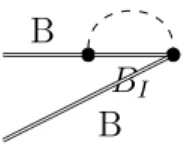
This integral is solved by Jenkins and Manohar in [19] and µ is the scale parameter from the dimensional regularization. The integral comes from the one-cycle renormalization of the baryon wave function given by Fig. To calculate the loop correction it is necessary to sum over all possible intermediate BI baryons.
The tree-level contributions are then included in αij, the ¯βij factors being the one-loop corrections given by (a) in the diagram in Fig. The coefficients ¯λΠij are the corrections due to renormalization of the wave function from (b) and (c) and γBΠ.
Large-N c QCD
Spin-flavor symmetry for large N c baryons
To use these operators in the baryon, we need to add up all the lines of Nc quarks in the baryon, so that way we can construct the numerical operator as. In general, n-body operators with n ≥ 2 can be written as a fully symmetric product of degree n operators in baryon spin-flavor generators. Finally, since Ji, Ta, and Gia are generators of SU(2NF), they satisfy a well-defined algebra given by relations.
Properties of baryons
In the way to build a more efficient effective field theory with better results, an obvious idea is to combine the two formalisms of the heavy baryon chiral perturbation theory and the large Nc limit to develop a more efficient theory. Two successes of the combined formalism are the construction of a Chiral 1/Nc Lagrangian for baryons with the lowest extension and the renormalization of the baryon axial vector current[20]. In this chapter, the combined formalism, the Lagrangian of the combined formalism, and techniques for axial current renormalization will be presented.
To formulate the Lagrangian we will consider the baryons as heavy static fields with fixed velocity vµ as in the chiral Lagrangian. All terms involving baryons in the Lagrangian can be expanded using spin flavor generators (3.23), the flavor indices going from 1 to 9 because we include the full nonet meson (3.2) plus η0. Also, the vector axial and vector combinations of meson fields (3.3) that appear in the Lagrangian have components.
As we said, all QCD operators involved in the Lagrangian have a well-defined 1/Nc expansion, in particular the baryon axial vector currentAkc is a spin-1 object, random in time-varying and an octet under SU(3) that pairs the axial combination of the pion with the baryons, Akc is given by. As an important remark, the Nc counting rules for the theory, in the case of baryons with order unity spin, are summarized in
Renormalization of the axial current in the HBChPT and the large N c limit
We could test it with a Taylor expansion, moreover the tensor Πab(n) is symmetric and consists of meson loop integrals, where we assumed that an a-flavor meson is emitted and then a b-flavor meson is reabsorbed. Axial vector current corrections were constructed considering the (a,b,c) diagrams so far and it can be seen that the structure of the corrections became more complicated as the order of the symmetric tensor Πab(n) became higher, the complexity of the structure appears as an addition several commutators and anticommutators per link. The full one-loop correction to the baryonic axial vector flow was never explicitly calculated, it was only calculated to a certain order, but without considering the full expression of the axial flow in terms of n-body operators.
In this chapter, the contributions of the singlet and octet singlet representations to the axial flow will be presented and this result will be compared with that obtained from chiral perturbation theory to demonstrate the computational power of the combined chiral perturbation theory of heavy baryons with the large Nc formalism. To calculate the complete one-loop correction of the baryonic axial vector flow, the full inn-body expansion terms given by (4.5) must be taken into account, only the physical value Nc = 3 should be considered and replaced in the loop correction (4.20). With all the commutators expanded in the basis of spin-flavor operators, it is possible to calculate the matrix elements in various processes, we only need to include the coefficients a1, b2, b3 and c3 to have a complete expansion of the axial flux in the large Nc limit.
The singular contribution of the matrix element of the renormalized axial current of the neutron-proton process is given by. Another example is the Λ−Σ+/− process, where the single contribution of the renormalized axial current is given by.
Comparison between ChPT and HBChPT in the large-N c limit
Another example is the process Λ−Σ+/−, where the single contribution of the renormalized axial current is given by. these results are obtained using the large Nc expansion, with physical values of Nc = 3 and Nf = 3. 5.2 Comparison between ChPT and HBChPT in the large-Nc limit. of the neutron-proton matrix element, the flavor contributions are given as linear combinations of the following factors [31]. In the case of the Λ−Σ+/− matrix element, the flavor contributions are given as linear combinations of the following factors [31]. In this work, the full 1-loop renormalization for the single flavor and octet contributions to the leading order of the baryon axial vector current is calculated in the combined formalism of the heavy baryon chiral perturbation theory in the large Nc limit, based on a expansion in the spin-flavor symmetry and its operators for the physical value Nc = 3 and taking ∆ = 0 which is the baryon mass distribution.
Then these results were compared with the heavy baryon chiral perturbation theory by calculating the matrix elements for SU(6) states. Since future perspectives for this work are considered to be the complete calculation of the renormalization, including the 27 contribution, then the numerical evaluation of the chiral coefficients D, F, C and H. Furthermore, the results of this work will be useful for the calculation of the quadrupole momentum operator in the large-Nc limit.
The mathematical structure of the gauge theories is based on the Lie algebras and Lie groups, and that is why this is a necessary topic for all theoretical physicists in high energy physics and related fields. In particular, this work is based on the SU(N) group, i.e. the special unitary Lie group, this is one of the most important groups in particle physics and interesting quantities can be expressed as a representation of this group as the spin, flavor, color, etc. The past theorem implies that if a representation of the SU(N) group is the unitary n×n matrix with a determinant equal to 0, the generators (elements of the algebra) are n×n traceless matrices.
J2 =J12+J22 +J32, (A.11) this operator is also called the Casimir algebra operator and commutes with every generator Ji.