The scope of the above studies is limited to the current situation in the USA. To do this, we will start by reviewing the role that people play in ISO 14001. In the next chapter, the hypotheses of the paper will be developed based on the reference model, the ISO standard and the literature review.
The literature has abundantly emphasized the fundamental nature of training in terms of the appropriate implementation of environmental measures (Dechant & Altman, 1994; Starik & Rands, 1995; Wehrmeyer, 1996). This is stated in the relevant section of the standard and can be gleaned from studies focused on the quality domain (Powell, 1995).
Data collection and measurement of variables
Data collection
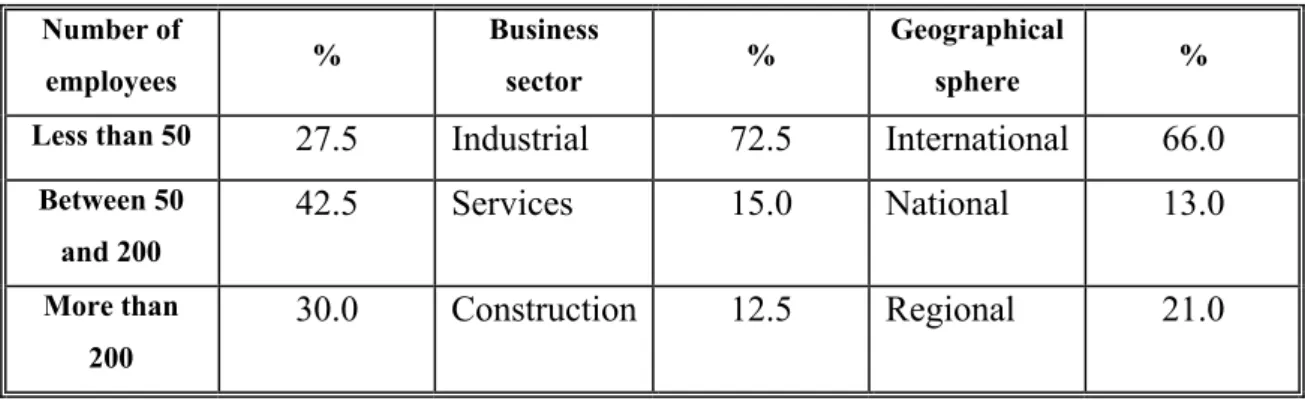
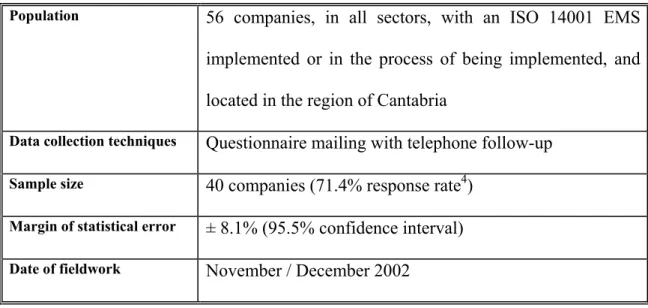
To obtain a current census of the population studied, we used information from the "Sociedad Española de la Calidad", as well as from the Cantabria Chamber of Commerce which, through its initiative, "Programa Cantabria XXI", actively promotes the implementation of environmental management systems in the companies in the region. Using these two sources, and after rectifying the first data received, the total number of companies with an ISO 14001 EMS implemented or in an advanced stage of implementation was determined to be 59. enclosed with the survey describing the motive and objectives of our research, ensuring the privacy of the data provided and, as an incentive, offering the research results.
The data collection took place in the months of November and December 2002, when the companies were called to remind them of the survey. As a consequence of these calls, we found that three of the companies initially included in the sample population had abandoned their intention to implement an EMS, thus reducing our study group to 56 companies. When creating the questionnaire, we referred to the literature on the implementation of environmental management systems as well as to that which deals with the effects of the implementation of quality management systems (Saraph, et al., 1989;.
The inclusion of the quality management literature is justified not only because of the greater level of empirical research in this area, but also because quality management and environmental management share the same philosophy and many similar practices. We decided not to create separate questionnaires tailored to industrial or service companies, and we paid special attention to the preparation of the questions to avoid misunderstandings. Based on the results of this pretest, together with the participants' suggestions, we compiled the final version of our questionnaire.
Different versions of the questionnaire were prepared, in which the order of the items in each question was changed to avoid bias in the responses.
Measurement of variables
One question explored this link as it related to environmental managers, and the second did so in terms of the rest of the management team. These aspects form the phases of the continuous improvement cycle, or the PDCA cycle. Interdepartmental information flow and coordination” was measured with three questions about how the need to analyze information flow between departments of the work center or factory varied, and about the information flow and coordination between the environmental management department and the other company departments.
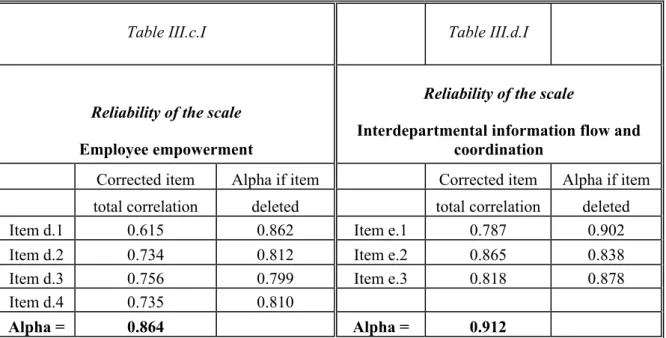
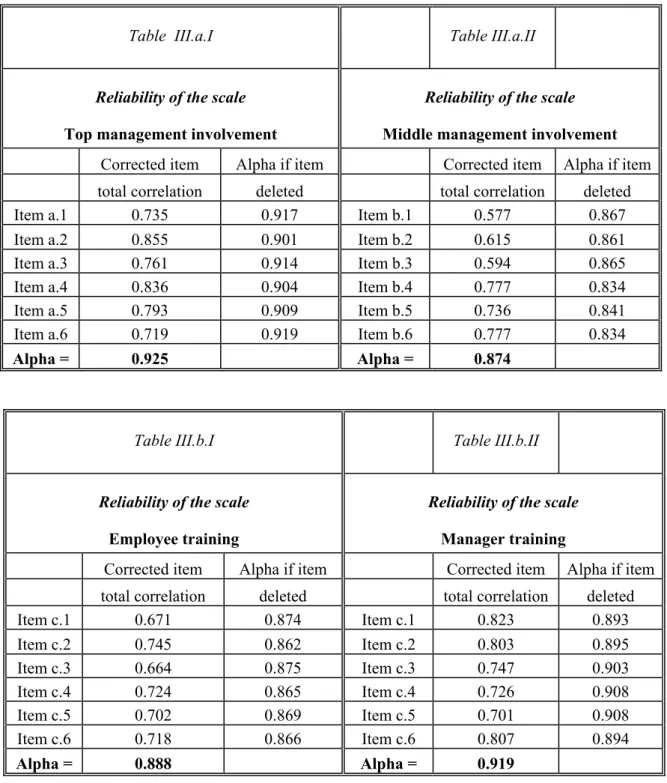
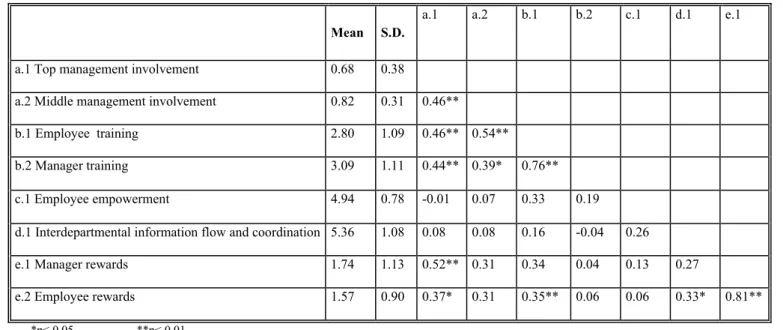
In order to check whether, in cases where more than one item was used to measure the variation of a certain parameter, the scales used correctly reflect this variation, reliability was analyzed using Cronbach's alpha coefficient. It can be seen from the tables that all items in each scale show a correlation greater than 0.5. The lower limit of alpha in terms of acceptance of scale validity is generally accepted as 0.7 (Nunnally y Bernstein, 1994; Peterson, 1994), a value that is well exceeded by all scales in the tables mentioned above.
In the leadership rewards scale (consisting of two items), the alpha is 0.982, also above the values considered valid. In addition to this analysis of reliability, a factor analysis was conducted for each of the scales comprising more than two items. In each case, a single factor was obtained with an eigenvalue greater than one.[5] This allowed us to use the mean value of the items that make up the scale as a global indicator of the corresponding parameter.
And it is this indicator that is used in the analyzes that appear in the next section where we present the main results of the empirical study.
Results
It is striking that the value for the training of employees appears to be smaller than that for management. This result could be due to the fact that the EMS has been recently implemented in the majority of the companies surveyed (87.5% of the companies in the sample have been ISO 14001 certified for less than two years). The fact that the increase in the need for information and interdepartmental coordination was not substantial could be due to the fact that 52.5%.
And for those hypotheses where the variation was measured with a 5-point Likert scale, two categories were created to indicate that the indicator being analyzed was promoted or showed no variance. The hypotheses regarding management involvement (top and middle) were both supported by the fact that they both increased significantly (in 87 to 92% of the cases, respectively). In this case, based on an analysis of the results, it can be deduced that there was a significant intensification of training for both groups, with 97% of the sample population confirming this situation.
The empowerment hypothesis was supported in a statistically significant manner, with 92% of cases indicating that employee empowerment increased. Finally, the hypotheses related to rewards are the only ones that were not supported, since the results obtained, although not statistically significant, are contrary to those expected. It was reported that a correlation exists between manager's rewards and the achievement of environmental goals in only 35% of the cases studied, and this dropped to 32% for employees.
As a synthesis, the results obtained confirm that the percentage of answers that confirm the hypotheses are significantly different in statistical terms, as well as being superior to those obtained that refute the hypotheses.
Conclusions
1996) "Development and Validation of TQM Implementation Constructs", Decision Sciences, Vol.27, No.1, p 1998) "Strategic Proactivity and Firm Approach to the Natural Environment", Academy of Management Journal, Vol. 2002) “Managerial discretion and corporate commitment to the natural environment”, Journal of Business Research, Vol. 1998) "Empowerment: the emperor's new clothes", Harvard Business Review, Vol. "Why companies go green: a model of ecological responsiveness", Academy of Management Journal, Vol. 1991) “The effects of organizational context on quality management: an empirical investigation”, Management Science, Vol. 1998) “Proactive corporate environmental management: a new industrial revolution”, Academy of Management Executive, Vol. 1994) “Environmental management plus total quality management equals continuous improvement”, in Willing, J.T. ed) Environmental TQM, 2º ed., McGraw-Hill, New York, pp. A call for research”, Journal of Operations Management, Vol. 2000) "Environmental management systems in the New Zealand plastics industry", International Journal of Operations and Production Management, Vol. environmental managers: application of Ajzen's theory of planned behavior", Academy of Management Journal, Vol. 1995) "The effect of a TQM intervention on teamwork: a longitudinal assessment", Employee Relations, Vol. 2001) "Achieving sustainability through mindfulness on human resource factors in environmental management”, Journal of Operations & Production Management, Vol.
1994) "En ramme for kvalitetsstyringsforskning og et tilhørende måleinstrument", Journal of Operations Management, Vol Changing the Role of Top Management: Beyond Structure to Processes", Harvard Business Review, Jan-Feb. 1998) "A survey instrument for standardizing TQM modeling research”, International Journal of Quality Science, Vol. 1991) “Environmental issues as threats and opportunities for technological innovation”, Technology Analysis and Strategic Management, Vol 3, No 1, pp Environmental operations management: an opportunity for improvement” , Production and Inventory Management Journal, bind 2000) "Linking operational and environment improvement through staff involvement", International Journal of Operations and Production Management, bind 1995) "A natural-ressource-based view of the firma", Academy of Management Review, bind 1999) "Forholdet mellem miljøengagement og ledelsesmæssige opfattelser af interessenters betydning", Academy of Management Journal, Vol. 2001) "Sammenkædning af organisatoriske analyser og analyser på feltniveau: spredningen af virksomheders miljøpraksis", Organisation and Environment, Vol. 2000) "Forholdet mellem ISO 14001 og kontinuerlige kildereduktionsprogrammer", International Journal of Operations and Production. 2002) "Jobs versus the environment: An industry-level perspective", Journal of Environmental Economics and Management, Vol. 1995) "Opnåelse af miljømæssig ekspertise gennem TQEM strategiske alliancer", Total Quality Environmental Management, Vol. 1994) "A meta-analyse af Cronbach's Coefficient Alpha", Journal of Consumer Research, Vol. 1995) "Total Quality Management som konkurrencefordel: en gennemgang og empirisk undersøgelse", Strategic Management Journal, Vol. 2000) "Rollerne af tilsynsstøttende adfærd og miljøpolitik i medarbejdernes økoinitiativer hos førende europæiske virksomheder", Academy of Management Journal, Vol. 1997) "Et ressourcebaseret perspektiv på virksomhedens miljøpræstation og rentabilitet", Academy of Management Journal, Vol. 1989) "Et instrument til måling af de kritiske faktorer ved kvalitetsstyring", Decision Sciences, Vol. Proaktiv virksomheds miljøstrategi og udvikling af konkurrencedygtige værdifulde organisatoriske kapaciteter", Strategic Management Journal, Vol.19, s. 1999) "The biotecnology industry and strategys of biodiversity conservation: the influence of managemential interpretation and risk propensity", Business Strategy and the Miljø, bind. 2000) "Lederlige fortolkninger og organisatorisk kontekst som forudsigere for virksomhedens valg af miljøstrategi", Academy of Management Journal, Vol. 1995) "Vævning af et integreret web: multilevel and multisystem perspectives of ecologically sustainable organizations", Academy of Management Review, Vol. ed) (1996) Greening People: Human Resources and Environmental Management, Greenleaf Publishing, Sheffield.
190/2004 Una aproximación al análisis de los costes de la esquizofrenia en España: modelos jerárquicos bayesianos. 197/2005 Análisis de cointegración de la respuesta de la oferta a largo plazo de la agricultura española a la PAC. 241/2006 Estimación de la depreciación del capital humano dividida por sector, por profesión y en el tiempo.
246/2006 Medición y análisis de la bolsa española mediante el exponente de Lyapunov con tecnología digital. 263/2006 Análisis de la presencia de mujeres en los consejos de administración de las mil mayores empresas españolas. Ana Rosa Martínez-Cañete, Elena Márquez de la Cruz, Alfonso Palacio-Vera e Inés Pérez-Soba Aguilar.