Redox molecules and cancer prevention: the importance of understanding the role of the antioxidant network. One of the functions of multipurpose solution (MPS) is to remove lens deposits when lenses are soaked in the solution overnight.
Materials
En el estudio, se crearon intencionalmente depósitos de lisozima y albúmina en lentes de contacto hidrófilas. Estos depósitos de lentes de contacto se trataron con la solución multiusos durante 12 horas.
Preparation of standard tear fluid (STF) containing deposition constituents STF of pH 7.4 was prepared (Table I)
La albúmina se depositó más en comparación con la lisozima, y las lentes de contacto hidrófilas no iónicas tienen menos probabilidades de depositarse que las iónicas. Los limpiadores enzimáticos proporcionan una limpieza eficaz, pero dejan alrededor del 25% de la superficie de la lente aún recubierta.
Selection of hydrophilic contact lenses and MPS
Method
Estimation of lysozyme
The amount of lysozyme was determined by using standard plots according to the method. From the readings, a bar graph was plotted to show the effect of MPS on the removal of lysozyme from hydrophilic contact lenses (CLs)6.
Estimation of albumin
Lysozyme can be removed more easily than albumin from MPS for hydrophilic contact lenses. Sodium citrate 0.1% can be used as a deproteinizer to remove lysozyme and albumin present on the surface of hydrophilic contact lenses.
Arora
Influence of day and nightwear on the surface properties of silicone hydrogel contact lenses and bacterial adhesion. Conformational and quantitative characterization of lysozyme extracted from galyfilcon and senofilcon silicone hydrogel contact lenses.
PURIFICATION COLUMN ON SILICA AND CHEMICAL CHARACTERIZATION OF A
EXCERPT OF THE STEMS OF
PLANT SECAMONE AFZELII (ACLEPIEDACEAE) FROM ABIDJAN - IVORY COAST
1 Hervé ZABRI, 2 Ahipo DUE, 3 Véronique MAMBO
Method
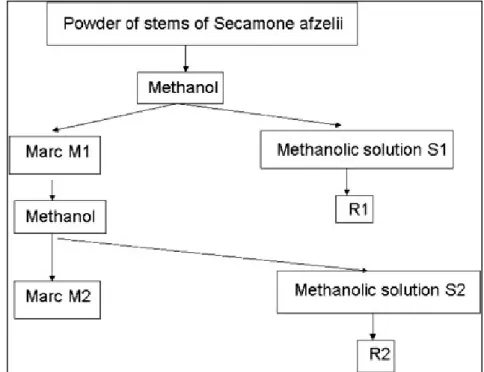
The raw methanol solution S1 is vacuum distilled by an evaporator (Buchi R110 type MKE 6540/2) to a solid gross dry R1. The height of silica is 15 cm and the inner diameter of the column is 4 cm.
Purification
Thin layer chromatography (TLC) with the development of a chloroform/methanol mixture was performed on the crude methanol extract. This reveals a CCM at 366 nm and an Rf = 0.6 luminescent product that is not visible to the naked eye, nor visible at 254 nm. The methanolic extract was purified by silica column chromatography to isolate the compound that luminesces at UV 366 nm.
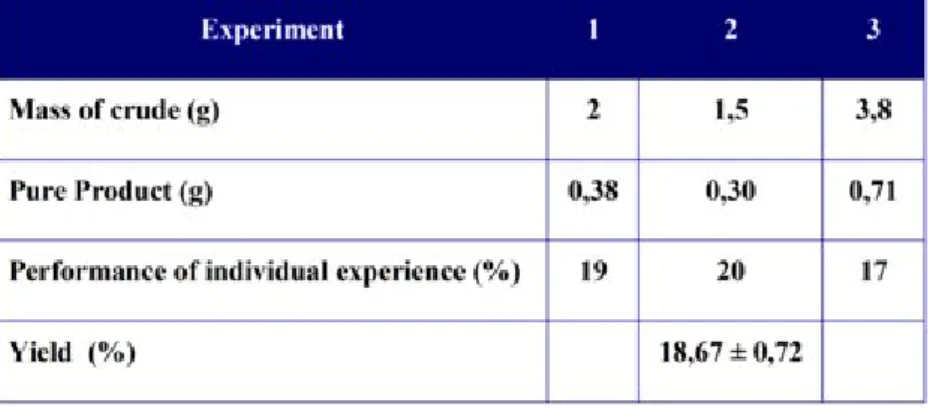
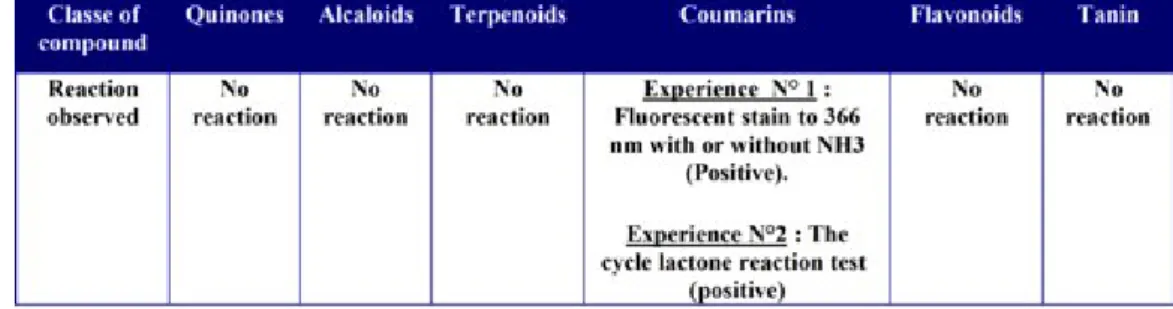
Several experiments described in the literature6 have been carried out to characterize the chemical family in which it would be possible to include this molecule. The yield purification shows that in the methanol extract this compound appears at a remarkable rate.
Characterization
The antioxidant capacity of methanol extracts obtained from this plant was previously reported by Mensah et al (2004) and Houghton et al (2005). In this work, the authors demonstrate a simple and rapid method for purifying and characterizing in part one of the components with antioxidant capacity present in the metabololic extract of S. The importance of this study is the potential use of the pure extract on based on their antioxidant capacity.
It is known that compounds of the family of coumarins to act as antioxidants in biological systems. Evaluation of the antioxidant and free radical scavenging properties of Secamone afzelii Rhoem Phytother Res. Chemically derived from the cyclization of O-hydroxycinnamic acid and it has different radicals in the 6- and 7-position.
From a chemical point of view, coumarins can be simple (umbelliferone, esculetol, fraxetol,..) or compounds (furocoumarins [psolareno, imperatorine, bergapten ..], 7,8-furocoumarins [pimpinelin, angelicin, ..], 3-, [samidine , visnadine,. Coumarins have various pharmacological properties (which are not synonymous with therapeutic application): sedative (tonka bean), antispasmodic (Kella), phlebotonic (Indian horse chestnut). Currently, some plant species are used in therapy in the form of dry extract (capsule) or as an oral solution.
RELATION BETWEEN GLUCOLIPID PROFILE AND SMALL INTESTINE HISTOLOGICAL PATTERNS IN
DIETARY RESTRICTION
Alberto Enrique D'Ottavio Ph.D 1,2
No modifications in lectinhistochemical patterns between AL and R eSMT rats
A partnership proceedings of the international joint meeting XII ICLAS General Assembly & Conference 7th FELASA Symposium. Effects of dietary fiber on mucosal growth and cell proliferation in the rat small intestine: a comparison of oat bran, pectin and guar with total fiber deprivation. The effects of different levels of dietary restriction on aging and survival in the Sprague-Dawley rat: implications for chronic studies Aging Clin.
Anatomical adaptation of the rat gastrointestinal tract to the hyperphagia of chronic alloxan diabetes, Nature. Enhanced growth of the small intestine in rats due to adaptation to intermittent starvation. Analysis of lectin binding sites in the intestine of hooded Lister rats with special emphasis on recently discovered lectins.
In recent years, the global incidence of type 2 diabetes mellitus has increased exponentially and has become a widespread health problem. In this experimental paper, Hisano et al., show the beneficial metabolic effect of intermittent dietary restriction in eSMT rats, decreasing body weight, basal glycemia, glycemia after a glucose overload, and serum cholesterol and triglyceride levels. These results will help us understand the physiopathology of type 2 diabetes mellitus and focus on the importance of diet in the treatment of this widespread disease.
OXCARBAZEPINE INDUCED HYPONATREMIA
A POTENTIAL EXPLANATION OF ITS PHYSIOPATHOLOGY
Since it was difficult to achieve an adequate anticoagulation status in this patient, it was interpreted that the inducer-enzymatic effect of carbamazepine could explain this resistant anticoagulation. Then it was decided to change the antiepileptic drug from carbamazepine (600 mg/day) to oxcarbazepine (600 mg/day), which has a lesser enzymatic induction effect. Forty-eight hours after this change, the patient developed an asymptomatic hypotonic hyponatremia, with normal extracellular fluid, which progressively decreased her serum sodium level from 138 mmol/l to 120 mmol/l.
Because oxacarbazepine treatment was planned to be maintained, water restriction was effectively implemented (documented by decreased fractional urea excretion), but there was no improvement in her serum sodium level (Table 1). Another study documented a decrease in serum sodium and free water clearance after water loading in subjects (patients or volunteers) taking oxcarbazepine. These findings suggest that oxcarbazepine-induced hyponatremia cannot be attributed to the syndrome of inadequate antidiuretic hormone secretion7-8.
Furthermore, it was also reported that serum levels of natriuretic peptides were decreased in these hyponatremic patients7. Furthermore, a greater induction of these tubular changes in patients on oxcarbazepine compared to those induced by cabamazepine could explain the reported higher incidence of hyponatremia in patients on oxcarbazepine. Oxcarbazepine-induced hyponatremia and regulation of serum sodium after switching carbamazepine to oxcarbazepine in children.
HIPONATREMIA INDUCIDA POR OXCARBACEPINA
UNA HIPÓTESIS FISIOPATOLÓGICA
GANGLIO CENTINELA Y CÁNCER DE MAMA
Juan de Dios Díaz-Rosales, MD
HIPOTESIS MEDICA
USO DEL TAMOXIFENO PARA TRATAMIENTO DE LA FIBROSIS SISTÉMICA NEFROGÉNICA
Enz PA 1 , Musso CG 2 , Fato C 2 , Torre A 1 , Galimberti R 1 , Algranati L 2
La fibrosis sistémica nefrogénica (FSN) es una entidad rara que se desarrolla en pacientes con insuficiencia renal sometidos a diálisis, y su etiología se relaciona con varios factores, como el uso de gadolinio intravenoso, operaciones vasculares, etc. Esta patología se caracteriza por la acumulación de tejido conectivo. tejido en la piel, por lo que se engrosa y se caracteriza clínicamente por una induración progresiva de la piel, que se adhiere a los planos profundos, que primero adquiere una consistencia dura-elástica y luego dura-rocosa. , y provoca durante su progresión la contractura en flexión de las articulaciones de las extremidades. Con respecto al gadolinio, se sospecha que en pacientes con insuficiencia renal, los quelatos de este elemento químico metálico sufrirán un proceso de transmetilación, proceso que conducirá a un aumento del gadolinio libre en el plasma y su precipitación en la sangre. otros cuerpos.
Se ha planteado la hipótesis de que el depósito de estos compuestos provocaría daño tisular y podría actuar atrayendo fibrocitos circulantes a la dermis procedentes de la médula ósea y que ante diversos estímulos pasarían a la sangre y al tejido que provocarían. fibrosis. Sus principales interacciones farmacológicas son la inhibición de su metabolismo (inhibidores de proteasas antirretrovirales, ciclosporina, efavirenz, eritromicina, nevirapina, benzodiazepinas, nifedipina, diltizem) así como con inhibidores del citocromo P450: ciclofosfamida, alcofosfamida, isofosfamida e isofosfaxel. En este artículo presentamos la hipótesis original de que el tamoxifeno, por sus propiedades fibrinolíticas, podría ser una terapia no inmunosupresora potencialmente útil para el tratamiento de la fibrosis sistémica nefrogénica, evitando su uso en pacientes con contraindicaciones para su uso (condiciones). protrombóticos, etc.), así como implementarlo realizando los controles adecuados para su uso: hemograma, lipidograma, evaluación oftalmológica y ginecológica.
Papel potencial del gadolinio en la fibrosis sistémica nefrogénica: informe de dos casos y revisión de la literatura. España Aunque la hipótesis es plausible, ya se están utilizando diferentes inmunosupresores para tratar la FSN y el tamoxifeno, aunque su principal mecanismo de acción es diferente, también tiene un efecto inmunosupresor. Sería imposible decir, si resulta útil, cuál sería su efecto real. La FSN es una entidad nueva (el primer caso es de 1997), hasta el momento sólo se han descrito unos 200 casos en todo el mundo, y parece que su frecuencia está empezando a disminuir debido a los trasplantes de riñón y a mejores tratamientos.
MEDICAL HYPOTHESES
USE OF TAMOXIFEN FOR THE TREATMENT OF NEPHROGENIC SYSTEMIC FIBROSIS
Nephrogenic systemic fibrosis (NSF) is a rare entity that develops in patients with renal failure undergoing dialysis, and its etiology is related to several factors such as the use of intravenous gadolinium, certain types of medication (erythropoietin, etc.), previous vascular operations , hyperphosphatemia, liver disease, hypercoagulability and pro-inflammatory conditions. The NSF usually starts in the limbs and then progresses to the trunk, and it can involve the subcutaneous tissue as well as the muscular one. This disease can develop in a period of days or weeks, and even have a potential systemic compromise, with a rapid and severe evolution in 5% of cases (1-10).
When estrogen binds to its receptor, it triggers a series of molecular changes and molecular interactions that ultimately produce protein transcription, some of which are essential to drive cellular multiplication. In addition, it can inhibit the transcription of other proteins that modulate a negative. the progression of the cellular cycle and mitotic division. For example, tamoxifen blocks the dominium activation activities of the receptor AF-2, which will make it an estrogen antagonist in all cellular environments on genes that require only AF-2; nevertheless, in the environments where AF-1 is the dominant activator, tamoxifen will manifest its potential as a partial agonist. It is highly bound to serum albumin (>99%) and is extensively metabolised in the liver via the cytochrome P450.
Its metabolites are excreted mainly in the feces, and since it is not excreted through the kidneys, there is no need to adjust doses in case of nephropathy. Its main pharmacological interactions are metabolic inhibitors (antiretroviral protease inhibitors, cyclosporine, efavirenz, erythromycin, nevirapine, benzodiazepines, nifedipine, diltizem), as well as cytochrome P450 inhibitors: cyclophosphamide, isophosphamide, etoposide, paclitaxel, and vinca alkaloids. There are few cases in the literature of tamoxifen in desmoid tumors, Peyronie's disease, fibrotic dysplasia and retroperitoneal fibrosis, with little evidence of its use.
Letters to the Editor / Cartas al Editor
MAY A PROBLEM-BASED LEARNING CURRICULUM ENTAIL PROBLEMS?
Alberto Enrique D'Ottavio
Rosario. Argentina
Medical College of Santa Fe Province (2nd District): Data actualized at December 31, 2007
PROMOCIÓN DE LA DONACIÓN
Beatriz Cuevas-Ruiz y María Zamora González-Mariño Servicio de Hematología y Hemoterapia