NEW INTERPRETATIVE WAYS TO STUDY THE TRANSNATIONAL MIGRANT ORGANIZATIONS. CASE
OF AGUA VERDE, SINALOA
—
Renato Pintor Sandoval [email protected]
[email protected] Ismael García Castro
Faculty of International Studies and Public Policies of the Universidad Autónoma de Sinaloa, México
— Abstract—
This document analyzes, from the study of transnationalism, the mechanisms and strategies implemented by home towns associations to maintain social, religious, political, family and economic relations between migrant communities and societies of origin: takes as a case study San José’s transnational home town association. The analysis of this organizations shows how relationships and links between family and community are expanding, including organizational strategies and leadership that lead to social infrastructure projects and community services. This reflects the formation and operation of a solid social capital, which procedurally defines the identities of the migrant subject with bases to the intervention in the place of origin; Agua Verde, Sinaloa. As a methodological strategy, a qualitative approach was implemented through the documentary review, taking as an analytical axis the transnationalism, social capital and habitus. Likewise, personal interviews were used in this migrant community to document the links and identity recognition of the migrants.
Keywords
Transnationalism; social capital; habitus; Home town association.
To quote this article:
Pintor, R. y García, I. (2019). Nuevas formas interpretativas de estudiar las organizaciones migrantes transnacionales. El caso de agua verde, Sinaloa. Espacio I+D, Innovación más Desarrollo. VIII (20), 31-54. doi: 10.31644/IMASD.20.2019.a02
F
or a long time, the research that has been done on international migration, especially that from Mexico to the United States, has been characterized by touching or deepening the approach of the transnational migrant. What attracts the students of the transnational theory or approach is the relationship between the emitting societies, as well as the receiving societies, as well as between both; trying to investigate and know the link and why the migratory movements are narrower, bidirectional and simultaneous.Authors such as Guarnizo (1998, 2003 and 2006) Portes, Guarnizo, and Landolt (2003); Moctezuma (1999, 2003 and 2011); García (2007); Goldring (1998 and 1999) addresses the migratory phenomenon of Mexicans to the United States, with special interest in a central question: how are the bonds, values, loyalties, commitments and political participation of international migrants changed with their home localities? This led Stefoni, (2007: 7) to wonder if trying to answer the previous question would be talking about a societal process or daily practices carried out by migrants in their places of destination. And if so, when do the migrants’ actions start being trans- national and when do they cease to be?
The criticism towards the transnational lies in the lack of a frame of reference that allows to delimit and categorize the different units of analysis of the transnational. One of the purposes of this research is to try to help the transnational approach and try to see if this delimitation will be possible to determine through a case study, that of the Benítez family and the San José Club, which are part of a transnational community, or if they have even gone further.
Stefoni (2007) says that one of the elements that allows to place studies as transnational is the "composition of the locality". It must be seen that not all locations remain static; for this reason, there have been structural patterns typical of a society of rural origin, which with international migration and under the effects produced generate changes in parts of its structure, such as schooling, employment opportunities, the region or even the political that modify the socio-economic, political, cultural and values that societies suffer after migration.
A study carried out by Portes together with Guarnizo and Haller (2003, cited in Portes, 2007, p.660) to Latin American immigrants from Colombia, El Salvador and the Dominican Republic, in migrant communities in the United States, found that participants in transnational activities, entrepreneurs economic and political or socio-cultural activists, in general, "were not the most recent migrants nor those who were in a more marginal position educationally or economically". On the contrary, they found that the level of education correlates positively with participation in transnational activities, as well as the level of occupation and income. This shows that the activities
of transnationalism imply a certain economic solvency and a minimum of job security and income.
This statement allows two axes of analysis; one that transnationalism is not a model that can be applied indistinctly and another, the condition and historical development, together with the economic condition of the subjects, depends on the degree of assimilation by the target society, since it produces conditions to provide accommodation for transnational activities when there is economic solvency and migrant residence time. Based on the described lines, we begin to describe the case study, which is the Benítez Family, executed through the leadership imposed by Javier, with the inten- tion of exemplifying that there are leaderships, antagonisms, social capital, but mainly, practices and transnational links, that together with identity factors allow migrants to be and live the transnational in their different transnational fields, or understand that there are elements beyond the trans- nationalism that allow the migrant to feel attached to a society of origin.
Thus, according to Stefoni (2007) the notion of family, is a nodal category in the understanding of this transnationalism in rural communities.
The presence of this link allows contextualizing the value that is culturally assigned to the family and its descendants, since it allows the departure of one of its members not to mean family dissolution (Ariza, 2002). On the contrary, through the practices and links of bi-national reciprocity, they can feed transnationality, but also reinforce identity bonds, allowing them to be part of different units, according to the migrant's wishes; for example, it allows the family to be the main social organizer, while maintaining loyalty to the family and to the community that has physically left behind.
The present work is divided into three parts, one on the different studies and initial forms of the process of migrant transnationalism, a second on the Benítez family and its levels of organization and implementation of social investments (collective remittances) in Agua Verde, and finally, the analysis of the degree of transnationalism and if there is a transnational erosion.
THE STUDY OF TRANSNATIONAL MIGRATION: BETWEEN SOCIAL CAPITAL AND HABITUS
Since the eighties, due to the tendency towards migratory mass, theoretical perspectives on international migration began to be written; the supposed advances in establishing a general theory of international migration have consisted in a succession of separate approaches, models or frameworks, which are usually a series of cumulative and disconnected contributions, based on previous structuralist and functionalist contributions of the general theories of the social sciences. Starting from the division carried out by
Doña-Reveco (2004)1, we find three theoretical generations that intend to explain international migration. The first two focuses2 on the object of study, the migrant being (act of departure), and are based on questions about the role that migrant work plays in a society, particularly in capitalist societies and what kind of impulses promote said displacements.
From a contemporary methodological perspective, the transnational one, starts mainly from the contributions made by anthropology and so- ciology, where it is conceptualized based on the following questions: how is the relationship between migrants and their places of origin? And also, what social and cultural characteristics do migrants sustain by preserving their identity? This analysis of the transnational being is based on a set of practices, values, histories, loyalties and social commitments that migrants hold with their family and place of origin, beyond the national border.
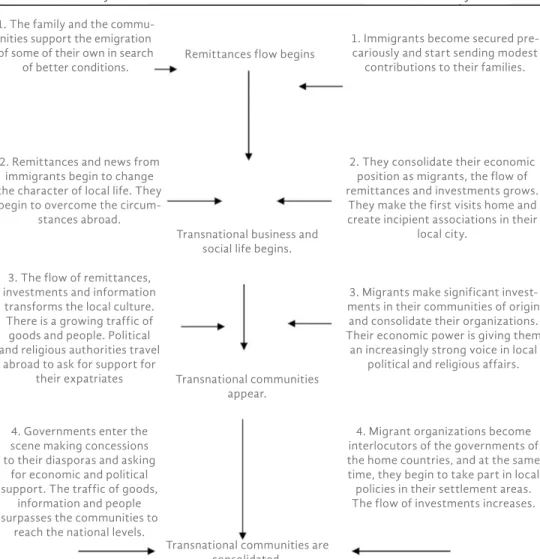
The idea of how transnational links and practices start and sustain, is based on the assumption of Portes (2006) and Portes and Jensen (1989), which stresses that the mechanism of the transnational approach must start from a linear and sustained process (Image 1). The author argues that "once international labor flows start, social networks emerge between migrants and their localities of origin, which over time, allow this movement to stand on its own" (Portes, 2007: 17). This basic phenomenon, the author con- tinues, in its economic, political and sociocultural spheres can represent the constitution of transnational communities, from the bottom up, from the local to the transnational, from popular solidarities to transindividual emergencies. Despite being a grassroots phenomenon, transnationalism has a greater social impact; the most obvious example of this is collective remit- tances (Portes, 2003). Furthermore, this same impulse "can support the continuity of migration even when the original economic incentives have been reduced or completely disappeared" (Portes, 2007, 11).
1 Doña-Reveco starts from how this accumulation of theories has been adjusted to the economic and social problems of humanity. Currently, the process of globalization has brought with it changes in the composition of migratory flows, mainly through a diversification of its origin, the temporality of migration and the feminization of the migratory flow. These changes in the structure of international mobility have been related both to the process of globalization and to the end of the cold war, since, on the one hand –in what has become a common place in the countries receiving immigrants, the increase in the speed of displacements and communications have facilitated migration (Doña-Reveco, 2004: 4).
2 The theory of neoclassical economics can be found in the first generation. In the second generation, there are approaches such as the new economy of migration (NEM); theories of the dual market and of the world systems.
Figure 1. Transnationalism migrant process. Source: Portes y DeWind (2006, 10)
Certainly, transnational practices have always been present to a greater or lesser extent in migratory movements. If transnationalism is understood as the establishment of links of a diverse nature between the place of origin or reference and the place of establishment or arrival. But where does the process of migrant transnationalism begin in itself? For Portes, Guarnizo and Landolt (2003), the recurrent practices carried out by migrants lead to a rethinking of the very concept of the migrant, since he is not only an international worker, but a person who "from the distance maintains contacts, manifestations and cultural ties and that has an impact, not only economic, but sociocultural in their place of origin; just what is called migrant transnationalism "(p.45). In addition, they point out that there are three requirements that allow identifying activities of a transnational nature, and, therefore, justify the use of the term.
1. The family and the commu- nities support the emigration of some of their own in search
of better conditions.
Host country
1. Immigrants become secured pre- cariously and start sending modest
contributions to their families.
Remittances flow begins
2. Remittances and news from immigrants begin to change the character of local life. They begin to overcome the circum-
stances abroad.
2. They consolidate their economic position as migrants, the flow of remittances and investments grows.
They make the first visits home and create incipient associations in their
local city.
Transnational business and social life begins.
3. The flow of remittances, investments and information transforms the local culture.
There is a growing traffic of goods and people. Political and religious authorities travel
abroad to ask for support for their expatriates
3. Migrants make significant invest- ments in their communities of origin
and consolidate their organizations.
Their economic power is giving them an increasingly strong voice in local
political and religious affairs.
Transnational communities appear.
4. Governments enter the scene making concessions to their diasporas and asking
for economic and political support. The traffic of goods,
information and people surpasses the communities to
reach the national levels.
4. Migrant organizations become interlocutors of the governments of the home countries, and at the same time, they begin to take part in local policies in their settlement areas.
The flow of investments increases.
Transnational communities are consolidated.
Host country
• The process must involve a significant proportion of people in the relevant universe (namely, immigrants and their counterparts in the countries of origin).
• The practices of object of study cannot be fleeting, transitory or exceptional, but must show some stability and resistance over time.
• The content of these practices cannot be captured from other pre-existing concepts, since this would mean that the creation and use of a new term would be unnecessary. (Portes, Guarnizo and Landolt (2003: 140).
In short, transnational living thus becomes a behavior with different focuses of attention, ranging from the family to the community level, and from a community loyalty to a strictly family or individual trans- national field, whose interest varies, according to the commitment and the strength of this one. The transnational fields where migrants live condition the nature of themselves, as Guarnizo explains (2007: 57), facilitate or prevent, encourage or discourage, claim some or all of the transnational links and practices that migrants form.
Within transnationalism the unit of analysis surpasses the migrant himself or the individual himself and the organizations, communities, companies, political parties that directly or indirectly intervene in the migratory process adhere. However, the greatest importance remains in the individual, since in this subject, always active, the most viable starting point in transnational migration research is centered (Guarnizo, Portes y Landolt, 2003). The selection of individuals as a starting point to venture into different stadiums or fields, allows us to go back to their history, to their trajectory, in which they can "differentiate the initiatives and practices that are carried out"
(Guarnizo, Sánchez and Roach, 2003: 22). As the individual is the starting point, his activities are aimed, first, at assessing his legacy and his migration experience, and the way in which his connections have developed. Individuals treat their migration experience, from their background, their mobility and their distance, seeking to approach their actions and practices with their society of origin, even in a symbolic way.
This way of acting allows to collect the analysis of the migrant's history and his different individual activities. This position indicates that the activities at the individual level allow us to understand the different structures of transna- tionalism and its effects since "the data obtained in individual interviews can identify the counterparts and establish the effects of those activities"
(Guarnizo, Sánchez and Roach, 2006: twenty-one).
All these characteristics and methodological reformulations have their validity, but in each case, the unit of analysis allows to deepen the attention, where the individual through the development of their social networks
reaches a degree of consolidation through their migrant organizations, and even, with his intervention in his community, in some cases with leadership and negotiations undertaken, allowing him to give meaning to his identity and recognition. But as Aroncena (2001) warns, it also tells us that when dealing with the issue of strategies in local development, we are introducing, in fact, one of the most important determinants of local development processes: the capacity to constitute local actors. "Local actors are simul- taneously motor and expression of local development" (Aroncena, 2001).
We propose to reflect on the idea of transnationalism and social capital, as part of the reinforcement of social networks, where it allows us to focus on the discussion of the question of how the first relations between migrants and their place of origin are gestated, and if Social links are lasting. At the individual level, the relationship between transnationalism and social capital is delimited by habitus, proposed by Pierre Bourdieu, where he notes that the difference between habitus and habit is that in the second, is considered spontaneously as something repetitive, mechanical, automatic, more repro- ductive than productive. As regards the habitus, we have to:
It is defined as a system of durable and transferable dispositions - structured structures3 predisposed to function as structuring structures- that integrate all past experiences and functions at all times as the structuring matrix of perceptions, assessments and actions of agents for a conjuncture or event. (Bourdieu, 1972: 178).
It is important to clarify that the transnational habitus proposed here is an analytical category that serves as a starting point to account for the path that migrants, even without reaching the level of social associations, establish the first ties or networks that will lead to the formation of the so-called transnational subsidiary communities. Obviously this cannot exist without the presence of the migrant established in a certain geographical area and whose establishment will be first made with the family, which will be the main interlocutor of community events (Pintor, 2011). Then it will be from the habitus that the "subjects" will produce their practices. The habitus, allows the "internalization" of the structures from which the individual and
3 The structured structures referred to by Bourdieu (1988: 37 and 1999) are the principles that generate different and distinctive practices (for example, what is eaten and how it is eaten, rituals and how to apply it in a party, celebration, etc.), the way of expressing their practices differs systematically from the consumption or from the corresponding activities of the industry (massive or general). Habitus are also structured structures that contain classifying schemes, principles of vision and division of differentiated tastes.
the social environment in which he has been educated (re)produces his thoughts and his transnational practices, will form a set of practical schemes of perception -division of the world in categories-, appreciation - distinction between the beautiful and the ugly, the appropriate and the inadequate, what is worthwhile and what is not - and evaluation -distinction between the good and the bad- from which the practices -the "elections"- of the social agents will be generated (Bourdieu, 1997). This way, neither the subjects are free in their choices, since the habitus is the unelected principle of all choices, nor is it simply determined; it is a disposition, which can be reactivated in differentiated sets of relationships and give rise to a range of different practices (Safa, 2002).
The foregoing is related to the migrant who converges through his practices, and allows the concept of social capital to be operative, and thus measure the importance of the network's performance and its confidence, its degree of consistency; in which you can build trust between people who had different ideas or symbolic representations of the social projects to which they were subjected. The development of the network and the accentuation of trust evolve towards the construction of a social capital.
The first studies of the concept of social capital are located in the field of economic activities and, precisely, it is linked to the "social phenomena that condition the functioning of the economy" (Pizzonio, 2003: 34). Currently, the new sociology -as Pizzonio points out (2003: 34), wants to measure this concept in relation to the economy in its own territory: the choice of non- economic means to achieve an end. In other words, we want to show that economic choices are not only influenced by the availability of economic resources, but also by the availability of social agents, in particular by the relationships and information that fall within them.
Although we must be careful when we use the concept of social capital and not as a mechanism to solve the problems of poverty and economic and political development, but to the criterion of the non-economic capital that people and their uses have (Kliksberg, 1999 ). On the other hand Durston (2000) deeps in the fact that social capital is a resource or access to other resources, which in combination allow to achieve benefits for those who own it; this capital resides and is based on social relations. Bourdieu (2000) defines it as "the sum of resources, real or virtual, that becomes an enduring network of more or less institutionalized relations of knowledge and mutual recognition" (Guarnizo, 2003). In short, social capital can be defined as:
goodwill, companionship, empathy and social relations between individuals and families that make up a social unit, or community "(Ostrom and Ahn, 2003). Likewise, he argues that "the social capital of the people is added to the social capital of the organization, since the skills, the knowledge of the environment, the availability and the trust, represent the social capital".
Perhaps the concept is not related to the solution of an internal problem of collective action of the group, but rather it is the sum of connections of networks between the members, as well as of their personal skills (human development), which can be used for achieve your goals.
The recovery of the concept of social capital, says Ostrom (2000), should be given in the field of local development, although this does not mean resigning to the objective of national development, rather: "return to the deposit of trust and cooperation". This capital cannot be combined on a large scale, as Bertucci (2003) says, but it must adjust to the conditions and scale of the neighborhood, town, ranch or small population, a convenient scale in order to allow sufficient interpersonal contact to develop relations of trust.
The point where social capital originates is in primary networks, which based on trust where they are mainly represented, such as "neigh- borhoods, family and neighbors, everything else is virtual" (Caracciolo and Foti, 2003), starting with that the strengths and opportunities of a given territory are established based on trust and the organization of the neighbors.
Apart from generating development in the communities of origin, their deposits are translated into actions that radiate in optimism; through their transfers, there are also goodwill links, hence they are labeled as "high quality"
resources (Torres, 2001 and 2001a).
For Bourdieu (1999, 2000), the benefits of these successes can be material and symbolic, where a mixture of strategies and cooperation is allowed.
Moreover, "the existence of a network of relationships is the product of the work of installation and maintenance, which is necessary to produce and reproduce social relationships, to be durable and useful (Enríquez, 2000), but implies having obligations towards theirs. This means that the more the social network is reinforced, the more sustained are the projects that are carried out and allow the incorporation of new social actors.
In short, migrants depend on their friends, relatives, neighbors, partners in their social networks, in obtaining the resources they need for a successful border crossing and a place to live in the United States; but in the same way, as Spener (2007, 127) suggests, migrants depend on their network and the social capital deposited in them, to obtain information and guidance to make the trip across the border, recommendation of "reliable coyotes", money loans, transportation, work, obtaining documents; but above all, information about job offers, among others. However, as far as the trust of the social network is concerned, destroying it is very easy, for this reason trust and solidarity are fundamental pieces in social relations through reciprocal exchanges of cooperation and mutual help, which constitute a core aspect in the development of societies, of origin and destination.
ANALYSIS OF THE BENÍTEZ FAMILY AS TRANSNATIONAL ACTOR Among the group of Agua Verde migrants, belonging to the municipality of Rosario, Sinaloa, who left for the metropolitan area of Los Angeles in the seventies in search of work and well-being, the Benítez family stands out, with a strong social roots in the region, because some of its members were teachers of the primary school of the locality, and as organizers of the religious festivities to the patron saint "San José".
The Benítez family maintained abroad the principle of coexistence between their own and with the people of the Sinaloa town; one of those who most fostered that nostalgia, among the residents of Los Angeles4 was José Javier, the oldest of the Benítez. He is currently a businessman in the service sector, with a cleaning company and a leading member of a local Christian organization: All Saints.
In one of his continuous trips to Agua Verde, at the end of the seventies, José Javier was visited by Filemón García, parish priest of the local church.
He tells that in that meeting, the father asked him to make a collection to help build a new temple, since the previous one was too small, and Javier accepted, committing to take the collection to Los Angeles. The need to rebuild the temple of the patron saint of the place gradually expanded among the people of Agua Verde who emigrated in Los Angeles, and managed to get together and then find a way to help. The request lasted for three years, and the need for the members to organize and carry out actions without the intervention of the State began to be perceived. Here two subjects excelled;
the migrant, as part of a family, and on the other hand, the parish priest as part of a religious institution.
At the patron saint's party, the facade of the temple and the parish atrium were inaugurated. This was the founding action of the Agua Verde migrant club, and for this reason, with this community action, the group of organized migrants received the social recognition that gave their collaborators the opportunity to recover the community membership that had been diluted due to their condition of migrant. Thus, social integration within the community of origin from abroad is an expression of the transnational process.
The realization of projects of migrant organizations is not an easy task, especially when it comes to raising funds, since the problem of resource
4 It is normal for individuals in the distance to manifest that feeling of nostalgia when they leave their homeland, since in general, this state of mind is related to the spatial displacement and the separa- tion of the place and the loved ones (Hirai, 2009 : 32-33).
management arises, as well as that of possible government obstacles, so the interest of migrants tends to disappear as the work does not culminate in time and form (Morán, 2002 and 2004).
This shows that behind an investment is an organization with objectives and missions, and that in this set, the activities of the associations, are not only limited to how to gather financial resources, but also to human and social capital within the transnational community.
However, when it comes to seeing the reach of these groups of migrants or associations, one must evaluate not only the number of social investments but above all the level of organization, management, negotiation and evaluation within the transnational social field where they perform. This social field allows not only the recreation of transnational habitus, but the extension of their social networks: "loans and free work" and "forms of mutual aid", typical of this type of community. The formula therefore is: "I can cooperate now with you, hoping that later you can do it for me" (Fernández Kelly, MP, 1997: 216) or as a classic of sociology says: "like you with me, I with you" ( Weber, M., 1984: 293 in Moctezuma 2011, 62). On this subject, Arizpe (2004, 37) highlights just what is essential in rural migrant culture:
"... the importance of these groups lies not in the work force gathered, but in the reciprocity that is generated ... ", Or in other words: the social rationality of this type of community comes into clear contradiction with the cost-benefit mentality.
This social learning that must be experienced by migrant clubs, makes them prone to postpone works with a slow process; however, the main thing is to recognize who is interested, what functions they will play, what is the situation of migrants to participate, because, as Gibson (1994) points out, "collective remittances that reach the communities of origin, as well as individual remittances that arrive at homes, may be delayed or never be present", but in this transnational social field it is allowed to find a space where they revive and recreate habitus, with the character of transnationals.
The success or failure of these investments is due to "the forms of maturation of the organizations and the degree of collaboration and negotia- tion they have with local governments" (Sada, 2007, 21). These negotiations can lead organizations to fail because sometimes the cases are presented in an advantageous manner for one of the parties; or, because there is a lack of knowledge about the scope of migrant organizations and the scope of municipal or state participation. In addition, governments change continuously, interests are put before needs and this has an impact on the fact that long-term goals cannot be achieved (Soto and Velázquez, 2007, 11).
In this understanding, it fits what Arocena (2010) points out, migrant organizations, linked to the community, feeling part of it as part of their identity, make possible the design and execution of long-term strategies
linked to local development. However, it is not a matter that is concrete, as it can act as a lever of development when there is support behind, not only formalized institutions, but also that there are social and economic conditions that allow it, since negative factors can intervene of null real commitments and only nostalgic. Based on Arocena (2010), the successful dynamics of transnational migrant organizations linked to local development are related to economic, social or political and cultural dimensions, but at the same time as demonstrating and experiencing the collective identity linked to the place of origin, as development engine. This shows that in this migratory process, where the relations that go and remain are conjugated, a local society is recreated with a collective project.
SAN JOSE CLUB AND ITS TRANSNATIONAL ACTIONS/ACTORS Agua Verde’s club abroad, motivated by its leader Jaime Benítez, soon became a prestige, due to the experience and the success obtained in the realization of social investments in favor of the town. This translated into a social capital that was based on the organization and personal attributes, which now puts the organization before new social norms. To the extent that the organization responds to the actions of social agents, as pointed out by Moctezuma (2011, 69), the level reached is also due to the competition of its protagonists.
In the first phases of the migrant organization or level 1, trust is equivalent to mutual respect, recognition as migrants, understood as the mutual benefit or the calculated risk for not doing so. These are the main factors that determine the functioning of the network and trust in the dawn of the volunteer organization.
Thus, the family and its networks make migration continue with its bimodal information elements, functioning as the axis of organization of the social life of the international migrant, contributing to the deepening of local roots, providing a sense of continuity and permanence to migrants, serving to give interpretation to the meaning of their personal stories and constituting a social instance of vital importance in their environment.
It should not be forgotten that the political and economic environment
"can encourage or discourage the organization from abroad and offer people incentives or punishments according to their participation" (Goldring, 1999). A favorable environment is characterized by a good mandate of the club, association, but also conditions of sociability in the community that minimize conflicts among the participants.
Currently, other problems faced by groups are bureaucratic relations with municipalities that can lead to the organization of migrants not to carry out social works, because without the support of some institutional authority
and local leaders, the objectives fail. Which suggests that with a public policy with management and intervention the results in the financing for the development of communities of origin would be enhanced and would translate into a better standard of living.
In the transition from the beginning of a work to its conclusion, actions of the members that obey rules are presented, and in the case of non-compliance, sanctions can be applied, but there are also changes in the perception of the club, or a positive recognition can be increased or the opposite. Sometimes it has been generated that they temporarily be isolated to those who fail; and it has even reached the point that, in the face of so much discontent in the club, aggression is generated. It is not easy, then, for emigrants to continue the works of a social nature, since there is a series of problems, as we have exemplified, where reality is extremely complicated. (Goldring, 1998).
For Smelser (1989), the success of this type of actions allows the group to meet individual needs, both explicit and implicit. The former usually fit directly with the tasks and the specific objective of the group. Implicit ones can be less evident-friendship or leadership, for example- but they mobilize the individual to participate in group activities. And as Arocena (2010) points out, organizations, in this case migrants, are seen as functioning as open systems, but in a vulnerable scenario, subject to situations that require pressure and to regulate specific actions, and in which the subjects of the community, migrants or not, are visualized with multiple belongings, interests and multiple loyalties.
TRANSNATIONAL PROCESS: BETWEEN CONSOLIDATION AND WEAR Historically, among migrant organizations that have carried out their first social works through collective remittances and others that have not done so, there are notable differences, mainly in the internal social process of the organization. Organizations with completed works have advanced in more complex organizational charts, specifically pointing out roles and hierarchies among their members. From the lack of recognition, that informality was given to the organizations, it became formal, the "tasks entrusted" became their own objectives and the leadership ceased to be symbolic and ephemeral to be representative, community.
In Agua Verde, during the realization of projects that concluded successfully, there was full social and community coexistence that functioned as a neural axis of collective remittances; which later was translated into status and social integration by their collaborators. The works of greater recognition were: multipurpose rooms, renovation of squares, benches for
the temple, arrangement of facades and welcome arch, and symbolically reinforced the local religious and cultural festivities.
The "tasks entrusted" by Father Filemón of Agua Verde to the San José Club, created an acknowledgment and an important social status in the organization of bi-national migrants when they finished such works.
Although the objective is not to compare, it is necessary to point out that the absence of a good leader and the null participation of the other members of emigrants lead to inactivity, and that collective works are not carried out;
in these cases, there are more limitations or failures than the successes that can be had. For example, in his study of Jala, Nayarit, Imaz (1999) reports that migrants fixed the central square, cleaned the gold plate from the altar of the basilica and gave school scholarships. Coordinated with authorities and teachers of the town, they built the secondary school, donated an ambulance car, chose a day for the patronal feast and gave donations for municipal pre- campaigns. But when they were going to carry out their most important project: the expansion of the potable water service, they had problems with the money collected, causing clashes between themselves and with the municipal authorities.
With a more organized scheme and with the degree of social integration gained, the San José Club undertook the task of totally rebuilding the village church; donate a truck to the high school so that students from more remote locations could attend classes; remodel the primary school; reforest and build benches in the plaza; as well as building the public library of the town. In this situation what Smelser (1989) points out fits; once the work is finished, the added value of the collective action is obtained; prestige, recognition and roots that the workers achieve. A finished work gives to the group an important status in its community of origin. When a group is formed, other migrants will try to join it, because this reduces the insecurity that the works would not be carried out. They feel stronger, have less personal doubts and resist threats better when they belong to a group.
The current parish priest, Carlos Ramírez with five years in the town, narrates that with the contributions of the San José Club have managed to rebuild the church, provide it with furniture, sound system, ventilation equipment, remodeling the altar, religious images and sculptures and do carpentry and painting works to the facades. Thanks also to the club, annual donations have been obtained for the feast of the Patron Saint and other religious festivities (mainly Christmas, day of the dead, mothers’ day).
The previous consolidated that the aguaverdenses that stay grouped in the organization of "San José" migrants play a role that the association and the status that is granted to them, as having a set of shared ideas, beliefs, evaluations and symbols. This reflects a shared identity that mobilizes collective representations in the form of symbolic unions, such as the fact
of belonging to the same place, which makes it possible to bring together a certain number of people, but also to separate them or limit their external links to the group. Here it is worth noting what Hall (2002) says, in terms of not only talking about identities, but also a sense of identification in which an acknowledgment of the common origin and shared characteristics with another person or group is established, framing axes of solidarity and loyalties. However, from the discursive approach, this identification with the community is seen as a construction, an unfinished process because interests and subjects in motion will be included or excluded. Thus, identification is a process of articulation that can bring together what was thought to be forgotten or alien to the group or community but pointing out differences with "others", that is why identities are never unified and it seems that they are getting more and more fragmented and fractured, without disappearing, of course, because they are constructed in different ways through speeches, practices and different positions, sometimes even antagonistic (Hall, 2002)
These migrant organizations of a transnational nature make it possible for more organized and more transcendental schemes to appear, which facilitate the creation, or inclusion, of associations or federations. Table 1 shows the characteristics and the way in which transnational participation takes place and that leads to the formation of a transnational association.
Table 1
Categories and sociopolitical impact of the clubs in their place of origin
Type of club Characteristics Transnational participation
Transnational organization
* Frequent meetings.
* Organizational schemes more or less normalized.
* Founding leaders * Inclusion of new actors as intermediaries, parish priest, director or teacher, coopera-
tives, etc.
* Organized migrants seeking the reproduc- tion of their culture.
* Participate in simultaneous celebrations of civic, religious and sports festivities on both
sides.
* Raising funds to beautify the town.
* Some autonomy in the decision to get involved in the project.
* The members of the club by the emigrated society support mostly the design and opera-
tion of social investments.
* Social remittances
Transnational association
* Frequent transnational meetings between emigrated society and
authorities.
* Standard organizational schemes.
* Board of directors and periodic elections among the members of the
Federation of Migrant Clubs.
* Co-participation of authorities with the emigrated society.
* Participation sponsored or institutionalized by local society authorities.
* Management of resources before local, state or federal co-investment authorities.
* Co-participation of authorities and Migrant Club in the design and operation of the
project.
* Social and political remittances.
Source: Own elaboration
This table shows us that migrants contain different organizational struc- tures, which have different levels and different degrees of maturity, as Moctezuma explains:
The former have an informal, unstable structure, almost of a community nature that serves as civic clubs; others have a certain degree of formalization, their permanence has not yet been consolidated, but they have a minimum of stability, with recognition and legitimacy at the community level and have the capacity to negotiate with the municipal authorities as the most advanced, when they are already part of a club association, their structure is so complex that it is necessary to regulate and formally register it, they are permanent organizational structures that also count on the wide recognition and social legitimacy, their actions are referred in municipal, state or binational projects, and they are used to influence the design of public policies (Moctezuma, 2007, 40-41).
Similarly, identity is not lost if there is a referenced framework, since the individual belongs to a subjective and objective territory at the same time, because it belongs, apart from criteria of training, thought and character, as Gendrau and Giménez tell us (2002: 149) "When we speak of socio- territorial belonging we are referring specifically to the feeling of territorial belonging shared by a human group, with a specific cultural, economic and demographic substratum", which in the distance migrants try to conserve, being partly transnational and at the same time migrants. As Robins (2003, 112) points out when resorting to Paul Ricceur; it is no longer spoken in terms of cultural identity, as something static and provided by the society of belonging, but it is spoken of a cultural exchange in which they conjugate and exchange memories and experiences, so that identity, then, is in terms of relationship experience, what can happen through relationships and what happens to them.
Group identity, which is not only geographically delimited, such as this migratory case, is the product of a collective definition that is obtained through the results of the identification of similarities and differences of the actors through relationships, in this case transnational, and in which other actors may intervene that do not necessarily belong to a group. As Chihu (2002: 7) says in this group identity, a process of identification of those that do not belong is created; that is, there is a process of social categorization.
CONCLUSIONS
In Agua Verde, Sinaloa, there is an integration and transnational social habitus developed from the substantive membership to the San José club, public actions are carried out from a distance and promote new rules of community coexistence.
In carrying out this analytical exercise, it is concluded in the first instance and in a very general way, which identity is redefined from transnational practices. That is, despite the fact that the migrant organization does not massively carry out actions in its community of origin, the mere conformation of the club reveals the strength of the sense of identity and belonging of its members for their homeland. That is, from the outside the migrant subject is part of the community of origin.
A second instance, we have that the degrees of transnationalism vary due to the fact that there is no course of uniform trajectories that are closely linked to the migrant social network, which allows the so-called transnational filial communities to be developed or established; first, the migrants reach a transnational community membership to later become what is known as a collective migrant, whose function is to be constituted as an "agent of change".
It is necessary to understand that the social capital within the study of transnationality, allows to capture the differentiations in the social relations of each community. The rules of each organization or institution show different experiences, social and economic environment, which makes each organization contain different components of society but that are enriched from a migration process.
Within organizations of natives or groups of migrants, we have that the organization is encompassed in transnationality, reflected in mutual practices and commitments among migrants, and this is one of the elements that reflect this type of identity enriched by the degree of politicization in the organization, therefore, influences the leadership, management and cooperative coordination between the migrant and the one who continues in the place of origin, together, of course, with the dynamics of collective remittances.
In sum, when carrying out the analysis of the San José migrant organization, and the leadership of the Benítez family, it should be noted that its result from transnational practices and habitus, as well as the social capital built, along with strongly politicized leadership, show a recognition and community participation within a migrant social structure. However, we can see that for some authors like García Zamora (1999 and 2003) maintain in the organizational dynamics of migrants: as long as Mexican migration continues to the United States, new grassroots associations will increase and will be grouped into new organizations or they will be complemented with existing ones, thus increasing their links to Mexico and their communities.
REFERENCES
Ariza, Marina. (2002). “Migración femenina y transnacionalidad en el contexto de la globalización: algunos puntos de reflexión” en Revista mexicana de Sociología, vol. 64(4) octubre- diciembre.
Arizpe, Lourdes. (2004). Migración y Cultura. Las redes simbólicas del futuro, en Lourdes Arizpe, Los retos Culturales de México, ma. Porrúa-crim, México.
Aroncena, José. (2001). “Globalización, integración y desarrollo local apuntes para la elaboración de un marco conceptual”, en Madoery, Oscar y Vázquez Barquero, Antonio (eds.), Transformaciones globales, Instituciones y Políticas de desarrollo local. Editorial Homo Sapiens, Rosario.
Bertucci, Juliana. (2003). Social Capital and Poverty: Cases and Methods of Community Building. Contribuciones al desarrollo local. Buenos Aires: Paidos.
Bourdieu, Pierre. (1972). Esquisse d'une theorie de la pratique. Droz. Paris:
Genève.
Bourdieu, Pierre. (1997). Capital cultural, escuela y espacio social. México:
Siglo XXI editores, México.
Bourdieu, Pierre. (1999). "El espacio para los puntos de vista", Revista Proposiciones, núm. 29: Historias y relatos de vida. Investigación y práctica en las ciencias sociales, Santiago de Chile, Ediciones Sur.
Bourdieu, Pierre. (2000). Las estructuras sociales de la economía. Buenos Aires: Manantial.
Caracciolo Basco, Mercedes -María del Pilar Foti Laxalde. (2003). Economía Solidaria y Capital Social: Contribuciones al desarrollo local. Buenos Aires: Paidós.
Chihu, Amparán Aquiles (Coord.) (2002). Sociología de la identidad., México:
Miguel Ángel Porrua-uam-I.
Doña Reveco, Cristian. (2004). Transnacionalismo y nuevas perspectivas de integración. Transnacionalismo y nuevas perspectivas de integración, en Documento presentado en el Primer Coloquio Internacional "Migración y Desarrollo: transnacionalismo y nuevas perspectivas de integración"
realizado los días 23, 24 y 25 de octubre del 2003 en Zacatecas, México.
Durston, John. (2000). ¿Qué es el capital social comunitario? cepal, Santiago de Chile, julio.
Enríquez, Rocío. (2000). Redes sociales y pobreza, mitos y realidades en La Ventana, Revista de Estudios de Género, núm. 11, Universidad de Guadalajara, México.
García Castro, Ismael. (2007). Vidas Compartidas: Formación de una red migratoria transnacional, Aguacaliente Grande Sinaloa y Victor Valley, California, uas- Plaza y Valdés Editores, Sinaloa.
García Zamora, Rodolfo. (1999). Desarrollo, migradólares y la participación ciudadana de los norteños en Zacatecas” en Impacto de la Migración y Remesas en el Crecimiento Económico Regional, Senado de la República, México.
García Zamora, Rodolfo. (2003). “Los Proyectos Productivos con los emigrantes en México, Hoy” en Revista Arenas, uas, núm. 5, octubre- diciembre.
Gibson, James L. John M. Ivancevich, James H. Donnelly, Jr. (1994). Las or- ganizaciones. Addison-Wesley Iberoamericana, Boston.
Goldring, Luin. (1998). La Migración México-eua y la Transnacionalización del Espacio Político y Social: Perspectivas Desde el México Rural.
Estudios Sociológicos Vol. 10, N.29. colmex.
Goldring, Luin. (1999). The Mexican State and Transmigrant Organizations:
Negotiating the Boundaries of Membership and Participation. Latin American Research Review, Vol. 3 , Num 35.
Giménez Montiel, Gilberto y Mónica Gendreau. (2002). La migración Internacional desde una perspectiva sociocultural. Migraciones Internacionales, Vol. 1 (2). colef (pp. 147-180).
Guarnizo, Luis. (1998). El levantamiento de formaciones sociales transna- cionales: respuestas de los estados mexicano y dominicano a la migración transnacional. Political Power and Social Theory, vol. 12 (Diane Davis, Ed.), jai Press.
Guarnizo, Luis. (2003). Desconfianza, solidaridad fragmentada y migra- ción transnacional: los colombianos en la ciudad de Nueva York y Los Ángeles. Alejandro Portes La Globalización desde abajo: transnacio- nalismo inmigrante y desarrollo. La experiencias de Estados Unidos y América Latina" Miguel Ángel Porrúa y flacso.
Guarnizo, Luis. (2006). “Aspectos económicos del vivir transnacional”, Marina Ariza- Alejandro Portes (Coordinadores). El País transnacional.
Migración mexicana y cambio social a través de la frontera., México:
unam- Porrúa.
Guarnizo, Luis Eduardo, Arturo Ignacio Sánchez y Elizabeth M. Roach. (2003).
Desconfianza, solidaridad fragmentada y migración trasnacional: los colombianos en la ciudad de Nueva York y Los Ángeles. Portes, Alejandro, Luis Guarnizo y Patricia Landolt (Coord.) La globalización desde abajo:
Transnacionalismo Inmigrante y Desarrollo. La experiencia de Estados Unidos y América Latina, Miguel Ángel México: Porrúa, flacso- F.
Hall, Stuart. (2002). “Introducción: ¿quién necesita identidad?” en Hall, Stuart y Du Gay Paul (comp.) Cuestiones de identidad cultural. Buenos Aires- Madrid: Amorrortu editores, pp-13-39.
Hirai, Shinji (2009). Economía política de la nostalgia. Un estudio sobre la transformación del paisaje urbano en la migración trasnacional entre México- Estados Unidos. México: uam-JP Editores.
Imaz, Cecilia. (1999). El efecto político en México de las organizaciones trans- nacionales de migrantes mexicanos en Estados Unidos. Tesis para obtener el título de doctor en Ciencias Políticas y Sociales. México: unam.
Kliksberg, Bernardo (1999). Capital social y cultura, claves esenciales del desarrollo. Revista de la cepal, (69), diciembre. Argentina.
Moctezuma, Miguel. (1999). Redes Sociales, Comunidades Filiales, Familias y Clubes de Migrantes. El circuito migrante Saín Alto, Zacatecas.-Oakland, Ca. Tesis de Doctorado en Ciencias Sociales, El Colegio de la Frontera Norte.
Moctezuma, Miguel (2003). Territorialidad de los Clubes de Zacatecas en Estados Unidos en Revista Migración y Desarrollo. (1). Octubre.
Moctezuma, Miguel. (2007). El migrante colectivo transnacional: Senda que avanza y reflexión que se estanca. I Congreso Internacional de Migraciones Globales, Mazatlán, Sinaloa
Moctezuma, Miguel. (2011). La transnacionalidad de los sujetos. México:
ma. Porrúa.
Ostrom, Elionor (2000). Social capital: A Fader a Fundamental Concept?
Social Capital: A Multifaceted Perspectiva. Parha Dasgrupa e Ismail Seralgeldin (Comp.). The World Bank, Washington.
Ostrom, Elionor y T. K. Ahn. (2003). Una perspectiva del capital social desde las ciencias sociales: capital social y acción colectiva. Revista Mexicana de Sociología, año 65(1). enero-marzo, iss-unam, México.
Pintor, Renato (2011). El habitus y los campos transnacionales en el proceso del transnacionalismo migrante. Migraciones internacionales, vol. 6(2).
julio-diciembre.
Pizzonio, Alessandro. (2003). Por qué pagamos la nafta. Por una teoría del capital social. Arnaldo Bagnsco, et. al. El capital social. Instrucciones de uso. Argentina: fce.
Portes, Alejandro. (2004). “El transnacionalismo de los inmigrantes:
Convergencias teóricas y evidencia empírica a partir del estudio de los colombianos, dominicanos y salvadoreños en Estados Unidos”
El desarrollo futuro de América Latina. Neoliberalismo, clases sociales y transnacionalismo. Bogotá, Colombia: ilsa Colección En Clave de Sur.
Portes, Alejandro (2007). Migration and Development: A Conceptual Review of the Evidence, en Red de Migración y Desarrollo, Documento de trabajo.
Princeton University: Estados Unidos.
Portes, Alejandro. (2003). Theoretical Convergencies and Empirical Evidence in the Study of Immigrant Transnationalism. International Migration Review, 37 (Otoño): 874-892.
Portes, Alejandro, Luis Guarnizo, Patricia Landolt. (2003). El estudio del transnacionalismo: peligros latentes y promesas de un campo de inves- tigación emergente, Alejandro Portes, Luis Guarnizo, Patricia Landolt,
La Globalización desde abajo: Transnacionalismo inmigrante y desarrollo.
flacso-ma. Porrúa, México.
Portes, Alejandro y Josh DeWind. (2006). Un Dialogo transatlántico: El progreso de la investigación y la teoría en el estudio de la migración internacional. en Alejandro Portes y Josh DeWind, Repensando las migraciones: Nuevas Nuevas perspectivas teóricas y empíricas. México:
Instituto Nacional de Migración/Universidad Autónoma de Zacatecas/
Miguel Ángel Porrúa.
Robins, Kevin. (2002). Identidades que se interpelan: Turquía/ Europa en Hall, Stuart y Du Gay Paul (2002). (comp.) Cuestiones de identidad cultural. Buenos Aires- Madrid Amorrortu editores. (pp. 107-141)
Stefoni, Carolina. (2003). Reflexiones sobre el transnacionalismo a la luz de la experiencia migratoria peruana en Chile. Documento presentado ante el Senado de Chile, Chile.
Spener, David (2007). “Cruces clandestinos: migrantes, coyotes y capital social en la frontera noreste de México y sur de Texas”, en Socorro Arzaluz Solano (Cord.) La migración a Estados Unidos y la Frontera Noreste., México: colef-m.a. Porrúa
Smelser, Neil J. (1989). Teoría del comportamiento colectivo. México: fce.
Soto Priante, Sergio y Marco Antonio Velázquez Holguín. (2007). El proceso de institucionalización del Programa 3x1 para migrantes., Rafael Fernández de Castro, Rodolfo García Zamora y Ana Vila Freyer (2007) El programa 3x1 para migrantes ¿Primera política transnacional en México? México:
itam-m.a. Porrúa.
Torres, Federico. (2001). “Remittances for Small–Scale Infrastructure and Small Enterprise Development in Mexico. Evidence from the Public – Private Infrastructure Advisory Facility Study”, Approaches to Increasing the Productive Value of Remittances, iaf, eclac and World Bank Conference, Washington, D.C., 19 March
Torres, Federico (2001). El capital de los migrantes, ¿Un gigante dormido? cepal.