COMMUNICATION AND
INFORMATION TECHNOLOGIES IN READING HABITS OF UNIVERSITY
STUDENTS IN MEXICO
—
Rosana Santiago García [email protected]
Gabriela Grajales García
Facultad de Ciencias Sociales , Universidad Autónoma de Chiapas
— Abstract—
This research project was focused on the conception of Information and Communication Technologies as a mediation tool in reading and cultural habits of b.a. students of two campuses of the University of Guadalajara in Jalisco, Mexico: The University Center of Economic and Management Sciences (known as cucea because of its initials) and The University Center of the South Coast (known as cucostasur because of its initials), both of them offer the b.a. in Management.
The objective is analyzing the role of information and communication technologies as tools that could give an advantage about the reading exercise among higher education students, it is thought that reading habits make possible the increasing of their cultural, human and social capital, and, as a consequence they could face professional challenges successfully. The methodological approach used in this research was quantitative; the research problem was explained through data obtained by applying a questionnaire to a sample of 120 students of a total population of 172 students of the degree previously mentioned.
The results show that most of the students read with frequency but their reading is not related to the degree they are studying, also they normally read in printed text because of the reading habit generated around them, however, derived of globalization process students have access to information and communication technologies and even though its use for reading (mostly academic readings) is low, being in contact with this type of technology, possessing in a personalize way one or more device with Internet access and especially its use in classrooms with academic purposes, could generate the reading habit through them and, as a consequence, increasing the level of reading skills in students.
Keywords
University student; Information and communication students; Reading habit;
Cultural and human capital; Social capital.
To quote this article:
Santiago, R. y Grajales, G. (2019). Tecnologías de la información y la comunicación en los hábitos lectores de estudiantes universitarios en México. Espacio I+D, Innovación más Desarrollo. VIII (20), 148-70. doi: 10.31644/IMASD.20.2019.a08
T
he importance of constant and permanent reading in higher education students is essential in their training process, it is through them that they access scientific knowledge and become professional with the appropriation of certain knowledge that allows them to successfully face the challenges that this discipline imposes.Those who have the habit of reading are in a privileged position before the knowledge and information society, to which they can easily belong. For university students, the new Information and Communication Technologies represent, on the one hand, the possibility of important access to knowledge and information and on the other, they are a useful instrument to generate, consolidate and diversify study habits, the objective of this article is to analyze this relationship.
In view of the diversity of existing university contexts and the differences between them - products of their own social, economic, cultural and, of course, academic conditions - it is pertinent to study particular cases, and from that to account for the way in which students are taking advantage of these resources to achieve their school goals. This is the case of the students of the b.a. in Management of two university centers of the University of Guadalajara.
This paper is divided into four sections, the first corresponds to the background, this poses the problem of the existence of low levels of reading in Mexico and the absence of habits and reading culture and the possibility of reversing them through the proper use of Information and Communication Technologies, and generate through it a cultural, human and social capital; in the second section the methodology with which the research was carried out is explained; in the third section the discussion of the results is presented from the analysis of three dimensions, in the first of them the actors are characterized to later analyze the relationship between reading and cultural and human capital and the last part of this section reflects on the relation between reading and social capital.
Finally, the conclusions about the case studied, here it is highlighted that the new Information and Communication Technologies are a viable alternative to raise the reading level of university students and increase their cultural, human and social capital, by virtue of Students identify several positive characteristics present in the use of electronic devices to access the reading of electronic materials and above all, because for the case studied students have one or more electronic devices and have access to Internet connectivity.
BACKGROUNDS
One of the most important challenges facing school institutions in our country is to raise reading and comprehension rates of what is read,
according to Camacho-Quiroz (2011), more than 70 % of Mexicans do not even read a book a year, this due to several factors among which stand out:
1) because they cannot read (illiterate) and 2) because they do not want to read (functional illiterates).
The National Reading Survey has the intention of measuring the reading index in Mexicans, its latest results were published in 2015, and it emphasizes that: 1) of every ten people who read, four do so obligated. 2) Of every ten people who read, six do not understand what they read, these six do not read books and they have not read them before. 3) Out of every ten people who read, four read only when they need to read; these figures turn out to be alarming (conaculta, 2015).
Reading rates in Mexico are very low and have remained so until the second decade of the 21st century, showing that there is little reading culture in the country. According to the National Institute for the Evaluation of Education (inee, 2013) in 2012, 34.5 % of 15-year-old students did not reach the baseline of reading comprehension, 27.5 % only understood fragments of information or paragraphs, 27 % are in an average level, while 11 % of students are in the lowest level, that is, they do not understand the text or an instruction to perform an activity.
Throughout history in Mexico, there have been several programs that have been promoted with the aim of encouraging reading.
From the project led by José Vasconcelos at the beginning of the last century, to the most recent program called Towards a country of readers. All the efforts have turned fundamentally in two senses, the first is the development of great levels of literacy and the second in making books available to everyone.
However, little has been done to train citizens with the ability, and commitment to make these books a part of their lives. Despite the achievements of the National Educational System, this has not been able to transmit to the population the need and the taste for reading as an activity of great individual and social benefits (Del Ángel and Rodríguez, 2007, p.12).
The little reading culture characteristic of all educational levels, forced the creation of the Law of Promotion for Culture and Books (the last reform was published on January 19, 2018), and the formation of the National Development Council for Books and Reading from which the Program of Promotion for Books and Reading 2016-2018 is derived. All this in order to create a reading culture among Mexicans and raise readership rates.
Reading is essential for the academic education of students, not only because it is a necessary tool for life, but also because it is a means for the incorporation of knowledge (Bourdieu, 1987).
Therefore it is necessary to generate in students the habit of reading, understood as the usual practice of reading. The Mexican educational system has as one of the fundamental objectives of training students from the basic level up to the higher level, the teaching of reading and writing; however, there is not specifically a habit formation plan reader, the plans and study programs focus on the need to teach reading, but not to generate the habit of reading, which results in the absence of reading.
The lack of a reading habit, makes that most students read by obligation more than by pleasure and this of course inhibits the frequency of reading.
The current social reality presents other alternatives to access information and knowledge (reading through electronic texts), however, its use is threatened by several factors: access to electronic devices, connectivity, reading culture and reading habits. Reading texts in electronic format requires, ideally, a special training plan for the reading habit of this type of texts, which would involve:
familiarizing the reader with the format, structure and organization of the text, this represents an important challenge in a society in which the practice of reading has developed regularly in printed texts, to which students have become accustomed, that is: they know and dominate the format, structure and organization.
However, the contact of students with electronic devices, the attractiveness that these result visually, together with the generation of a plan for the formation of reading habits in electronic texts, represents an important possibility to increase reading levels in university students.
Yubero and Larrañaga (2015) consider that reading is fundamental within the university context, in a certain way it is part of the academic core, however, it is not just, since for it to be effective it is necessary to see it as a means to gather information and apply what is apprehended through the development of academic and professional competences.
The reading in university students is fundamental for the comprehension of texts that approach specialized subjects in the degree that they study, never- theless, Yubero and Larrañaga (2015) maintain that, because in the previous formation to the university studies the students have not developed the skills necessary to understand the texts correctly; the practice of reading must be recovered and students must be introduced to the knowledge of the specific concepts and terminology of each career.
The aforementioned authors conducted a research about reading habits in various universities in Spain and Portugal, where 2,745 students participated, they chose the universities in such a way that the different regions of each country were reflected and the sample was randomly selected, always and when there are students from different careers such as: Arts and humanities, social sciences, health sciences, engineering and architecture; the students were between 18 and 65 years old, with an average of 21.98. In order to know
the students' reading habits, a questionnaire was applied, the questions were focused on knowing if the students read voluntarily, reading types, reading motivation and reading taste.
In the results the authors highlight that, although there are students who say they have not read any book in the last year (7.9 % in Spain and 7.4
% in Portugal), the fact is that 50.7 % of Spanish students have read between 3 to 10 books annually, a % rage very similar to that of Portuguese students with 51.5 %. Young people suggest that they read more out of necessity than by will. In this research the authors do not mention the reading made through mobile or electronic devices to read, this was not the subject of their research.
In what refers to Mexico, Márquez (2017) suggests there have been several surveys to know the level of reading comprehension in students, however, it is necessary to analyze how reader habits have changed due to the arrival of Information Technologies and the Communication:
There is a tendency to think of reading as a complex sociocultural practice, trying to obtain information that goes beyond traditional reading media and inquires about these practices in different printed media (books, magazines, newspapers and comic strips), digital media and the Internet. The purpose is to provide a broader view of the means of reading used by the population, the social uses they provide and discover the practices associated with reading (Márquez, 2017, p.8).
This is proof that reading habits are dynamic, since derived from technological progress, reading through mobile and electronic devices is a recurring activity among university students, which is why the promotion of reading habits through this type of devices has become an essential task.
Despite the fact that Higher Education Institutions are at the top of the educational pyramid, the problem remains that students read little and even less is what they understand about what they read, that is why institutions are forced to confront it by launching a series of programs, among others are: The Manual for the Promotion of Reading and, the Program for the Promotion of Books and Reading and the Commitment for the Promotion of a Reading Culture, which have been promoted by the Federal Government.
At the state level, some universities have tried to propose their own strategies, such as the University of Guadalajara, which, to achieve this goal, promotes the Letras para Volar program.
Beyond that, and countries are immersed in the globalization process, characterized among other things, by the high level of interconnection and intercommunication through the use of Information and Communication
Technologies, these are presented as an alternative to raise the readers indexes. However, Castells asserts that:
The connectivity gap is one of the biggest obstacles for developing countries and poor regions to engage in the global dynamic economy and with global communication networks that offer access to information, education and services ( 2006, p.374).
In virtue of the existence of Information Societies and Knowledge Societies, it is interesting to know the mechanisms through which university students are apprehending knowledge, it is clear that reading is an indispensable vehicle for achieving the objective, therefore it is pertinent to identify the mechanisms through which this is done. Pay attention to the role of Information and Communication Technologies, in the sense of seeing if these are the means by which reading is increased in university students, is an indispensable task. Mayos (2009) states that:
The postmodern society of knowledge and ict has created the means for the collective creation of knowledge to expand exponentially and subsist without needing the conscience, memory, reflection ... of any individual. The "knowl- edge society" makes it possible for knowledge to exist in the Internet nodes independently of any of us (p.58-59).
There are several effects on the human individual that can be exposed to knowledge on a massive level, however, there is no doubt that in these first two decades of the XXI century and through electronic media, there is a huge possibility of access to knowledge and to the increase in reading levels.
METHODOLOGY
It is a quantitative work, which used the survey as a research technique. To carry out the research, a public higher education institution was envisaged that will have a program that encourages the reading of its students, once it has been chosen and for testing purposes, the participation of two groups of students who studied the same degree was required (with the same academic requirements), located in different academic centers of the same university and that would capture a population with different socioeconomic characteristics. To this end, a survey with 15 questions was carried out, which was applied to a sample of 120 students from a total population of 172 (the statistical formula for sample calculation
The research was carried out at the University of Guadalajara, this university has a reading incentive program called "Letras para volar" and the ques- tionnaire was applied to the students of the Administration Degree in two university centers: University Center of Economic Sciences Administrative (cucea) and University Center of the South Coast (cucostasur).
The survey has two sections, the first contains general questions essential to characterize the actors and the second raises questions that allow addressing the problem in question, such as: type of reading made by students, media or instruments used to read (printed material, electronic material or both), how they access reading materials, how often they read, reasons why they read and if they do, is it for pleasure or obliged, opinion on reading electronic texts, importance of this type of reading in their academic activities and belonging or participation in a learning community or a workshop or reading or social club; starting from the basis that a university student, must, to achieve school goals, make a set of readings that support and consolidate their learning and thereby increase their cultural and social capital.
Based on the hypothesis that by virtue of the age of the students (18 to 22 years old) and the contact they have with Information and Communication Technologies, they would make their readings using mostly electronic texts instead of printed books, in this regard Brey (2009) declares:
It is evident that, at a professional level, daily use as a working tool of powerful personal computers permanently connected to a global network is modifying the rhythm and sequence of our mental processes. Today it is usual several documents at the same time while information is collected on the Internet, email is attended or simultaneous conversations are held through instant messaging services [...] (2009, p.28).
Based on this, it was considered that university students would use electronic media more than printed media to read and study. Therefore, in this analytical-descriptive research, a relationship between reading frequency and materials is established to perform it, and in the results and conclusions we carry out analyzes and inferences about the problem posed. According to Hernández (2006) the descriptive approach explains a phenomenon, situation or event, in order to know in detail what happens in a community, which is the case that concerns us, to account for the frequency of reading, types of reading and materials used by students to perform their reading practices, the case of b.a. Management students from two university centers of the University of Guadalajara.
n= N×Z
a2×p×q
d
2×(N-1)+Z
a2×p×q
The research process was carried out based on the phases suggested by Monje (2011):
Preparatory phase. Reflection and design of the research work, that is, elaboration of the research project whose general objective was to analyze the role of Information and Communication Technologies, as tools that can favor and increase the exercise of reading in university students, starting with of the hypothesis that due to the age of the students these would make their readings using mostly electronic material.
Phase of field work. This phase is a determining factor in the research process, as it provides access to the context and knowledge of the problems posed by approaching the actors. In this case, a survey was elaborated whose questionnaire consists of 15 questions, which was applied to a total of 120 undergraduate B.A. students of first and eighth semesters of two University Centers of the University of Guadalajara, 50 % of first semester and 50 % of the eighth semester, the students surveyed were chosen at random, of which 52 % are women and 48 % are men.
Analytical phase. Based on the hypothesis and the general objective of the research, a reduction of the data obtained in the field and captured in the questionnaires was made through the classification of variables. For the systematization of the data and its subsequent interpretation, the Statistical Package for the Social Sciences (spss) program was used.
Informative phase. After carrying out the research, it is of fundamental importance to disclose the results, which are reflected in this article.
DISCUSSION OF RESULTS
For the analysis of results, the variables were classified into three dimensions, the first is the characterization of the students, the second consists of the reading-cultural and human capital relations and finally, and the third in which the reading-social capital relation is expressed.
Characterization of students
These are university students whose ages range from 18 to 22 years, most of them from the middle stratum, whose average family income ranges between 6 and 10 umas1. The majority of the parents' education (62 %) completed secondary education, followed by those who have a primary education (20 %), 12 % have a high school education, and only 6 % have a
1 The Unit of Measurement and Update (UMA), in 2017 had a monthly value of $ 2,294.42MXN (Consulted from the page of the INEGI: http://www.beta.inegi.org.mx/temas/uma/
bachelor's degree, there are not illiterate parents. From the schooling of the parents it is inferred that the students -subject of study- are basically the first generation of the family that carries out university studies.
On the other hand, 85 % of the students did their previous studies in public schools, schools where there were no computers available for homework, 65 % of them did not have a computer in their home while they studied high school, only 33 % said they had a personal computer after they turned 15 years old, which could be used exclusively in their home and was shared with the rest of the siblings (97 % of students have at least one sibling).
However, 67 % of them said that while they studied high school they usually used a computer to do some homework and they went to cybercafés or businesses where they could hire computer services with Internet.
Most students of the two university centers surveyed have electronic devices (68 %), among the cucea students include: iPad and iPhone of the Apple brand with iOS operating system; the Samsung Galaxy Tab Android and the Samsung S8 phone with Android operating system. In terms of the computer system highlighted Mac from Apple, Sony with Windows and Hewlett Packard with Windows.
In the cucostasur, the use of the Samsung phone with Android operating system and dell computers with Windows operating system stands out, the possession of one or other electronic devices is directly related to the socioeconomic level of the students, while the average family income of the students of the cucea is from 8 to 10 umas, the average family income of cucostasur students ranges between 6 and 7 umas.
They mentioned that the decision on the choice of career they studied was based on economic interests fundamentally, since they consider that the degrees they study have a good working future, 85 % of them mentioned that the career choice was strongly motivated by their families and therefore are encouraged to study, only 12 % work and those who do attend 3 to 4 hours a day in a schedule that does not interfere with their classes.
On the other hand, 72 % say that the part that most convinces them of studying a B.A. is the curriculum, since most of them contain practical subjects, which makes the training process more dynamic and attractive.
They go to school in a single shift (morning), which allows them to perform other activities in the afternoon. These activities are: exercise, study a language, listen to music, some work, and do homework. They were asked if the tasks included reading and mentioned yes, but only sporadically, that is, twice a week 33 %, 42 % once a week and the rest (25 %) they did not answer.
Regarding the habit of reading, they were asked: Do you usually read frequently? What time do you dedicate to reading? Do you do it voluntarily?
What kind of reading do you do?
The answers varied according to the university center, however, the students of the cucea 48 % assure that they read frequently, to the question of how much time they devote to reading, they answered that they do it from one to two hours a day and 40 % mentioned that they read at least once a week, of which only 20 % do it voluntarily, although what they read is not directly related to the contents that are addressed in the degree, most say they review social notes.
Students of cucostasur mention that they read frequently (52 %), 25
% dedicate to reading one hour a day and the rest say they do not read daily, only when they are required at school and that it is a sporadic requirement, 22 % mentioned that they read on average two hours a week and the rest (53 %) said they do it twice a month, but mentioned that they consult their electronic devices permanently and are aware of the most relevant news, especially those referred to the world of entertainment and sports.
In the two university centers, the reading of texts for school is not a fun- damental activity and this is explained because they indicate that most of their subjects are practical subjects and for the development of these is not necessary to read a lot, although reading is essential to increase your cultural capital.
Reading-Cultural and Human Capital relation
An important part of generating the habit of reading in individuals is that through reading, they increase their cultural capital, for Bourdieu the cultural capital is constituted in the following way:
Cultural capital can exist under three forms: in the incorporated state, that is, in the form of durable organism dispositions: in the objectified state, in the form of cultural goods, paintings, books, dictionaries, instruments, machinery, which they are the mark or the realization of theories or criticisms of these theories, and of problems, etc., and finally in the institutionalized state, as a very particular form of objectification, because as can be seen with the school title, it confers cultural capital - which supposedly must guarantee - totally original properties (Bourdieu, 1987, p.12).
According to Bourdieu (1987), the incorporated state refers to the investment of time that the individual uses to learn, it is a constant work, this way the individual acquires it little by little until he understands, this is a personal and non-transferable possession. The school is one of the spaces in which cultural capital is incorporated, once this happens then it is objectified, this means that this will be reflected in the possession of books, paintings, instruments, normally the objectified state is related directly with the management of economic capital that the individual has, to greater
economic capital greater objectified cultural capital, or at least, greater ease of access to knowledge, in this case we see how the students of the university centers studied, have at least one electronic device, in this way cultural capital is objectified.
Meanwhile the institutionalized state refers to the school titles that the individual has and that endorse the possession of specific skills and knowledge, so that nowadays it is not only necessary to know, but also to verify through official documentation that you actually possess such knowledge, it is essential to obtain certification, in this case the certification extended by the University.
Cultural capital is directly related to human capital, the latter being for Schultz (1972) the set of knowledge, skills and attributes that the individual has so that he can perform a job productively, which must be permanently updated throughout the life of the individual.
According to Villalobos and Pedroza (2009) the knowledge acquired as human capital are tools that will allow the subjects to be productive, as a result, the subjects will enter the productive process of the country, but they will also be part of the productive society. This human capital is a personal possession and, like cultural capital, is non-transferable.
The possession of both cultural capital and human capital, will provide the individual with the tools necessary for success in life, however, both cultural capital and human capital require high levels of reading of the subjects. Reading is an ideal mechanism through which knowledge can be incorporated.
In the case at hand, it was essential to know not only the frequency and type of reading carried out by the students, but also to identify the means and materials through which the students read, in view of the need to determine the role the communication and information technologies are playing in the generation of reading habits in university students.
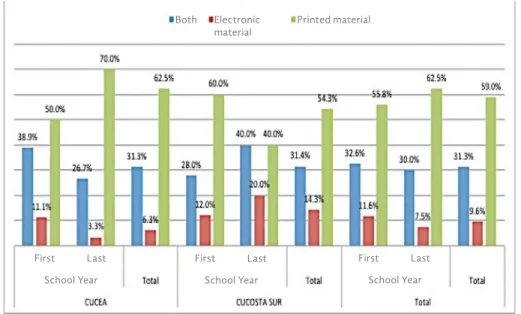
Of the students surveyed in the two university centers, 59 % prefer to read in printed material, 9.6 % in electronic material and 31.3 % use both.
Printed reading is the favorite in students. Due to their age, it was thought that their preference would be concentrated mostly in electronic documents, however, it was not. This can be explained because their first contact with a computer was in high school, and in previous years their relationship with reading was with printed texts, which may have generated the habit of reading in print, and now that they are college students due to the type of discipline they study, much of the material used for reading is not digitized.
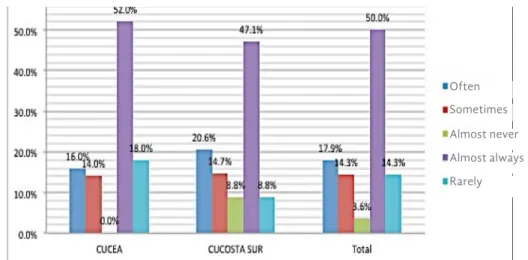
The frequency with which they read is high, 50 % of the total population surveyed said they almost always read, 17.9 % read often, 14.3 % rarely, 14.3
% sometimes, while only 3.6 % say that almost never (See graph 1).
That is, 67.9 % of the population are constant readers, it is a quite significant percentage, however, they said that most of reading they do
is entertainment and leisure (60 %), 26% read scientific texts required at school and the rest, 14 %, read informative notes, in general social notes, the latter percentage corresponds to those who perform electronic reading.
Graph 1. Reading frequency in printed text. Source: Own elaboration based on applied survey to University Center students: Administrative Sciences (CUCEA) and South Coast (CUCOSTASUR), November 2017
The percentage of students who read electronic texts varies according to the semester and the university center where they study. In the case of cucea, the percentage of students that use electronic material to read is the following: 11.1 % in the first semester and 3.3 % in the eighth semester, in this sense it is evident that the preference for electronic reading increases according to age, so it is inferred that, in this case, the tendency to use electronic means to read is increasing, while for the case of students of cucostasur the trend is contrary, since 20 % of eighth-semester students use electronic material to read and only 12 % of first-semester students read through electronic material, which shows that the trend is towards decreasing the use of this type of material (See graphic 2).
Often Sometimes Almost never Almost always Rarely
Graph 2. Reading of the students, by type of material used. Source: Own elaboration based on applied survey to University Center students: Administrative Sciences (CUCEA) and South Coast (CUCOSTASUR),
November 2017
When interrogating students about the importance of reading in electronic format and the way in which it supports the development of their school activities, the following results were obtained: 27.7 % mentions that electronic reading is positive, since that one of its characteristics is portability, which is an important factor, that is, it can be consulted in any space and/or time, the only inconvenience that they see is that they have to be connected to an Internet network and if it is not available then it will be impossible to access the document; 27.7 % say that it is positive for practicality (you do not have to be carrying books); 21.7 % consider that it is better than the printed reading, because the flow of information seems fast and the amount of information is greater; 12 % consider that it is better for saving physical space (this response is associated to students who live in rented homes);
while 10.8 % said that electronic texts are a possibility to increase their readership, are more economical and are constantly updated, allowing them to engage in conversations between peers and their teachers with greater ease and knowledge. In addition, accessing this type of texts supports their opinions in class (although they also mentioned that some teachers do not allow them to be connected to Internet during class).
Of the total number of students who read electronic texts, 41.2 % prefer to read on a computer (either desktop or laptop), 17.6 % on a smartphone, 14.7 % on a computer and smartphone, 8.8 % on a smartphone and electronic tablet, 5.9 % only in electronic tablets, 2.9% in the computer and electronic tablet, while 8.8 % uses any of the aforementioned, depending on where they are.
Both Electronic material
Printed material
First Last School Year
First Last School Year
First Last School Year
It is evident that the students of the two university centers researched have the electronic devices necessary to access electronic information, which of course is an important possibility for their use every day. Nevertheless most of them do not use it because they have not yet generated the habit of reading through these devices; however, by virtue of the permanent contact with this type of devices and the opportunities they offer, which are recognized by the students, it is expected that their use is increased until generating a reading habit from them.
Reading-Social Capital Relation
In the part corresponding to the social capital, it is understood as such:
The totality of potential or current resources associated with the possession of a lasting network of more or less institutionalized relations of mutual knowledge and recognition. Expressed differently, this is the totality of resources based on belonging to a group. The total capital possessed by the individual members of the group serves them all, together, as a backup, in addition to making them- in the broadest sense of the term-worthy of credit. In practice, social capital relationships can only exist on the basis of material and/or symbolic exchange relationships, and also contribute to their maintenance. [...] In these relations of exchange, on which social capital is based, the material and symbolic aspects are inseparably linked, to the point that those can only function and be maintained as long as this union is recognizable (Bourdieu, 2001, pp. 148-149) Consequently, it can be said that as part of their social capital students establish socialization networks mediated in a very important way by the means of communication that they have within their reach and that are not reduced to speech in face-to-face and co-presence relationships, referred to the rationalization of the action which is focused on an intentionality and that necessarily has to occur in circumstances of interaction in the routine (Giddens, 2015), but the electronic means that they have, such as computers, smartphones and electronic tablets, by the socioeconomic level of the students it was evidenced that 100 % of the students interviewed have at least one of the mentioned devices, more than 51 % two of them and 32 % have all three.
These attachments are part of their personal possessions, which they use regularly to communicate with each other and with their teachers, which of course increases their social capital, so they were questioned about whether they belong to a learning community understood as educational spaces which serve as meeting places to develop skills (Elboj Saso and Oliver Pérez, 2003). The questioning revolved around knowing if outside
the rigorous school activities and required by the curriculum, concur to extra-curricular activities that can enhance their training in the degree, 42
% mentioned yes, while 45.8 % said not (See graph 3).
Graph 3. Belonging to a learning community. Source: Own elaboration based on applied survey to University Center students: Administrative Sciences (CUCEA) and South Coast (CUCOSTASUR), November 2017
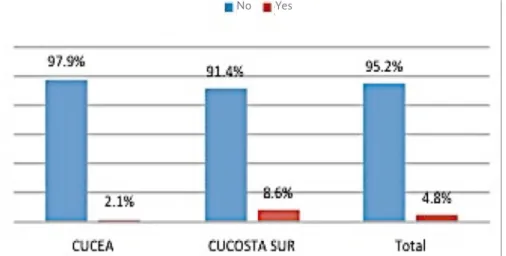
Among the questions, it was highlighted if they belonged to a club or reading workshop (since the University of Guadalajara provides such service), 95.2
% said no, only 4.8 % said yes (See graph 4). To the question that if they knew that the university provided the service, only 9.6 % said they did know of the existence of the Reading Club, while 90.4 % said they did not know it, which implies the University's need to do greater diffusion to this, which undoubtedly would result in the students raising their reading level and of course, the comprehension of texts.
Yes No
Yes No
Graph 4. Membership in a reading club or workshop. Source: Own elaboration based on applied survey to University Center students: Administrative Sciences (CUCEA) and South Coast (CUCOSTASUR),
November 2017
They were also asked if they belonged to a social or sports club or had a social network of friends, only 15 % of them belong to a club or sports group, none to a social club and the social networks they establish are only with groups of friends of 3 to 5 members and in face-to-face relationships, and with larger groups through electronic messaging, specifically WhatsApp.
They are students whose levels of communication and interconnection are high and for this they keep their electronic devices active, this could facilitate their use for reading electronic texts.
CONCLUSIONS
The 21st century has been characterized by the high level of interconnection and intercommunication, which is expected to be positive for the socialization of knowledge at a massive level, however, this requires materials and means that are not always within the reach of most of the population, especially when it comes to underdeveloped countries. Additionally and very importantly, cultural differentiation presents broad resistance to changes and the implementation of the use of new technologies, which results in the diverse communities introducing them in different degrees and levels.
An important part of the globalizing discourse is centered on the utility represented by the use and management of new technologies in the educational field and the possibility of increasing the reading level of students through these media, for this reason it is essential to analyze each case in particular, since each context can report different results.
For the case studied:
It is necessary to include in the Mexican educational system a plan for the formation of reading habits, teaching reading and writing is not enough, if the habit of reading is not generated, it will continue an obligation than a pleasure.
Getting used to the reading implies to know the format, the structure and organization of the text, which implies that in the case of reading electronic texts, it is necessary a habit formation plan reader of this type of documents.
The research was carried out in two university centers of the University of Guadalajara, because of its location (west of the country) and the human development index of its population, the family socioeconomic level of the students who go there allows them to possess personal electronic devices, because the average family income of cucea students is higher than that of cucea students, the devices vary in brand and price, but all have at least one.
The possession of electronic devices in which they can consult electronic materials for reading is not a problem, as is connectivity, since most students have this service, either at home or at university.
In both university centers students have a greater preference for reading in printed texts, as a result of a habit of reading generated from the use of
this type of material in their previous training, however, Information and Communication Technologies permeate their lives and although they do not use them fundamentally to read texts about the degree they study, they have access to them permanently because most of them have the means to do so (computers, electronic tablets and cellphones), which is useful to increase both its cultural and human capital, as social. If the use of these instruments in the classroom for academic purposes is promoted, it could generate the habit of reading through them.
It was expected that because of their age, socioeconomic level and depending on the level of connectivity to which they are exposed, students would prefer to do electronic reading and not on printed material, however, it is clear that in the case of school material there is still the habit of read printed material.
In the two university centers studied the reading in electronic texts is low, however, in the cucea the trend is increasing, since in the first semester students, the percentage of its use rises with respect to the eighth semester, in addition it is observed that this university center has 10 computer labs which are available for permanent use, which undoubtedly encourages the use of this type of device and can be an element of motivation for reading electronic texts.
On the contrary, in cucostasur the trend is downward, there is a lower percentage of first-semester students who read electronic texts in relation to the eighth semester, students are of a lower socioeconomic level than those of cucea, therefore their level of connectivity is more restricted, that is, most of them access the Internet only at school, in addition to this university center there are only four computer labs; these could be the reasons why reading in electronic materials is less.
In general, the low percentage of reading in electronic texts in the two university centers investigated is explained by: 1) The contact of students with computer equipment up to the high school level and the generation of the habit of reading through printed material and not electronic, 2) Absence of computer centers in public high schools (from which most students come) that were available to them, 3) Absence of a computer in their home for their individual use and 4) Little digitized material for the b.a. in Management.
The reading materials for degrees (printed or electronic), is not a priority activity in the lives of students, it is necessary to make use of all available tools to increase the level of reading, including Information and Communication Technologies, taking advantage that students are able to recognize positive elements about the use of electronic material for reading, such as: portability, cost, breadth and diversity of information and increase of cultural and social capital.
Additionally, it is necessary to bring young people to the reading workshops offered at university centers and public libraries, and motivate
them by raising the importance of being informed and trained individuals to have informed opinions on relevant and important issues of society with high cultural, human and social capital. Increasing your readership is fundamental and that is achieved only through the habit of reading.
We believe that the type of reading material that students face (printed and/or electronic) has substantive differences that not only refer to access and connectivity, but also to the fact that the electronic format itself has its own characteristics to be learned and that you have to get used to, which means generating the habit of reading electronic texts, which represents a personal challenge, but also a school challenge, taking advantage of the possibility offered by the new Information and Communication Technologies is highly viable for both increase the reading levels of university students so that through them they can increase their cultural, human and social capital.
REFERENCES
Bourdieu, P. (1987). Los tres estados del capital cultural. Sociología, 5. uam- Azcapotzalco, pp.11-17.
Bourdieu, P. (2001). Poder, derecho y clases sociales. Bilbao: Desclée de Brouwer.
Brey, A. (2009). La sociedad de la ignorancia. En: Brey, A; Innerarity, D.; Mayos, Gonçal. La Sociedad de la Ignorancia y otros ensayos. Barcelona: Infonomía.
Camacho-Quiroz, R. M. (2011). La lectura en México, un problema multifactorial. Contribuciones desde Coatepec, núm. 25, pp. 153-156.
Recuperado de http://www.redalyc.org/pdf/281/28128741003.pdf Castells, M. (2006). Comunicación móvil y sociedad. Una perspectiva global.
Barcelona: Ariel.
Consejo Nacional para la Cultura y las Artes [conaculta]. (2015). Encuesta Nacional de Lectura 2015. Recuperado de https://observatorio.librosmexico.
mx/files/encuesta_nacional_2015.pdf
Del Ángel, M., Rodríguez, A. (2007). La promoción de la lectura en México.
Infodiversidad. Sociedad de investigaciones bibliotecológicas. Buenos Aires, Argentina. Número 011. pp. 11-40.
Diario Oficial de la Federación [dof]. (2018). Cámara de Diputados del H.
Congreso de la Unión. Ley de fomento para la cultura y el libro. Última reforma 19-01-2018.
Elboj Saso, C., Oliver Pérez, E. (2003). Las comunidades de aprendizaje: Un modelo de educación dialógica en la sociedad del conocimiento. Revista Interuniversitaria de Formación del Profesorado, Vol. 17 (3), pp. 91-103.
Giddens, A. (2015). La constitución de la sociedad. Bases para la teoría de la estructuración. Buenos Aires: Amorrortu.
Hernández, R. (2006). Metodología de la investigación. México: McGraw Hill.
Instituto Nacional para la Evaluación de la Educación [inee]. (2013).
México en Pisa 2012. Recuperado de http://publicaciones.inee.edu.mx/
buscadorPub/P1/C/I125/P1CI125.pdf
Mayos, G. (2009). La sociedad de la incultura. En: Brey, A; Innerarity, D.; Mayos, Gonçal. La Sociedad de la Ignorancia y otros ensayos. Barcelona: Infonomía.
Márquez, A. (2017). Sobre lectura, hábito lector y sistema educativo. Perfiles educativos, vol. XXXIX, núm. 155, pp. 3-18.
Monje, C. (2011). Metodología de la investigación cuantitativa y cualitativa.
Guía didáctica. Colombia: Neiva.
Schultz, T. (1972). El valor económico de la educación. México: Tecnos.
Villalobos, G., y Pedroza, R. (2009). Perspectiva de la teoría del capital hu- mano acerca de la relación entre educación y desarrollo económico.
Tiempo de Educar, Vol. 10 (20). Pp. 273-306.
Yubero, S., Larrañaga, E. (2015). Lectura y universidad: Hábitos lectores de los estudiantes universitarios de España y Portugal. El profesional de la información, vol. 24 (6), pp. 717-723.