THE MUNICIPALITIES OF CHIAPAS
Dr. Gerardo Núñez Medina [email protected]
Dr. Jorge Lopez Arevalo [email protected]
Autonomous University of Chiapas
ABSTRACT
One of the hardest aspects of poverty and inequality is undoubtedly the death of a child. However, relationships and the mechanisms by which the observed levels of poverty shape and determine the deaths of children have not been yet been properly identified and quantified. In this sense, this investigation aims to analyze the association between estimated infant mortality and food poverty as reported by CONEVAL for the municipalities of Chiapas in the three periods where information on municipal poverty is available, namely the years 1990, 2000 and 2010.
Keywords: poverty, child mortality, Chiapas
There are significant differences in reported figures on infant mortality in the state of Chiapas. These figures vary according to sources and the time they were consulted, mainly due to the inconsistency between the recorded data on the deaths of children in the state. This situation is even more critical when it comes to analyzing the behavior of infant deaths at the municipal level.
Thus, this investigation aims to generate reliable estimates of infant mortality at the municipal level through the application of the Trussell method [U.N. 1990] that has emerged as a variant of the method developed by W. Brass, using information on children born alive and surviving children according to the age of the mother.
The reason it was decided to use the variant developed by Trussell has to do with the fact that it allows for the adjustment of the calendar of the incidence of infant mortality, so the repeated application of the method allows for repeated consecutive census estimates or replicas for a same moment in time, or very close in time. The availability of replicas makes it possible to apply adjustment techniques which are able to interpolate the trend of observed infant mortality and additionally provide a degree of certainty about the estimates.
Moreover, the infant mortality rate, defined as the number of deaths of children under one year of age per thousand live births, is an indicator that there has been included features that go beyond the purpose for which it was created- quantifying the levels of infant mortality. Among the properties that are assigned are: to be an indicator that reflects the levels of economic and social development of a country or region, as an indicator that measures the efficiency of the functioning of health systems and as an indicator of levels of poverty. That is, there is a significant association between increased levels of poverty and its effects on the observed levels of infant mortality.
Although it is possible to cite a large number of investigations that speak of the existence of a direct relationship between the observed levels of child mortality and poverty, and it is generally
stated that poverty is the main cause of observed child deaths, there are actually very few studies that quantify the effect and intensity of the relationship or offer a theoretical and methodological justification to explain its dimensions and determinants [Boltvinik, 1990].
Thus, this investigation has among its objectives to provide such an explanation, with the intent to quantify the effect that poverty has on observed child mortality levels in the municipalities of Chiapas in three moments of time for which data are available on levels of poverty at the municipal level- 1990, 2000 and 2010.
BACKGROUND
In the literature there exist many studies that talk about the relationship between poverty and child mortality. Some argue that the various dimensions of poverty form a wide range of proximal and contextual infant mortality determinants. However, there are few investigations that give theoretical support or quantify the magnitude and direction of the relationship, especially when it comes to explaining the implications in fine levels of geographical breakdown or in the case of a longitudinal cohort analysis.
Many other studies aim to analyze the levels of association between poverty and child mortality assuming that this is a causal relationship, and that this is direct and known and therefore requires no further inquiry or evidence.Another important part of the literature on the subject focuses on studying the general and specific features of poverty and child mortality separately, without delving much into their relationships. On the same line of research, we can find some studies that aim to analyze the nature of the relationship between poverty and infant mortality with empirical or qualitative elements, which results can hardly be extrapolated.
In other words, the relationship between poverty and infant mortality have not been fully studied, at least, from the perspective of economy or the social sciences despite the existence of a large body of empirical evidence showing from distinct points the presence of important causal relationships between the two phenomenon. It is in this sense, that by reviewing work related to both issues both separately and together, we aim to build a theoretical basis on which it is possible to establish the basic theoretical and methodological basis for the definition of a conceptual model which is capable of modeling and quantifying the influence of poverty on child mortality in order to achieve better explanations of the facts observed in the municipalities of Chiapas for at least the past 15 years.
Most of the research focused on the study of infant mortality in Latin America and in Mexico [Arriagada, 2006], [Aguirre, 1992]
and [Yasmin, 2002] have focused on analyzing and quantifying the effect of proximate determinants - at the individual level- because the infant mortality rate (IMR) is considered, as noted, one of the main indicators of the level of economic and social development of a country. Therefore the decline of the IMR is related directly with:
increasing levels of education most notably of mothers, and levels of development and levels of access to goods and services especially health services which is indirectly a measure of welfare. It is easy to imagine that the IMR is an indicator sensitive to changes in structural factors such as poverty and marginalization.
Research on mortality in Latin America has revolved around describing the levels and timing of the different stages of demographic transition. They point out that [Aguirre, 1999], [Chackiel, 1984] and [Maceira, 1996] infant mortality continues to decline, albeit at a slower pace than is desirable, despite the sharp reduction in overall mortality rates the last half century. Infant mortality has important differences in the region, dominated by deaths caused by feasibly avoidable causes, mainly due to the uneven application of measures of public policy on health and
education and the existence of important social, religious and cultural differences.
In the specific case of Mexico, there were several different investigations which intended to estimate the influence of proximate determinants of child mortality [Escobedo et al, 1981], [Martinez, 1990], [Gallardo, 1995], [Gomez et al, 2001], [Hernández, 2001], [Lopez et al, 1991], [Jimenez, 1995], [Camposortega, 1992] and [Mina, 1992]. These studies have addressed the issue of causality, limited to making useful qualitative descriptions to establish the presence of social and economic inequality before death [Hernandez et al, 1991], [Campos, 1992] and [Jiménez, 1988].
However, analysis of contextual determinants and the specific role of poverty in the configuration of causes of death of children have lagged in recent years.
In relation to the conceptual framework surrounding the definition of poverty, it should be noted that we will use the conceptualization that exists for Mexico since the theoretical construction leads to how to operationalize the concept, and this paper focuses on an analysis for the state of Chiapas whose regulatory framework depends on the directives issued for Mexico.
The review of a broader conceptual framework on poverty remains an interesting exercise, but it is beyond the scope for practical purposes of this investigation.
The National Council for Evaluation of Social Policy (Consejo Nacional de Evaluación de la Política Social- CONEVAL) defines the individual condition of poverty as multidimensional for those who “... have not guaranteed the exercise of at least one of their rights for social development, and their income is insufficient to purchase goods and services required to meet their needs.”
This definition seeks to meet the requirements imposed by Article 36 of the General Law of Social Development regarding the measurement of poverty. For purposes of identification and measurement of populations in poverty, CONEVAL analyzes two dimensions: (1) the economic welfare, measured in terms of current
income per capita and (2) social rights, measured in terms of access to education, health, social security, food and housing and services.
Leaving the analysis of its geographical scope pending, the territory is a function of (3), social cohesion (defined as the analysis of the mechanisms of instituted social inclusion and exclusion), and the responses, perceptions and positions of citizenship before the way these mechanisms operate (ECLAC 2007, quoted in CONEVAL, 2009: 30).
One of the most obvious and simple ways to quantify poverty is precisely through the level of income. However, in Mexico at least two dimensions are measured. Although both dimensions of analysis could be strongly correlated, in this paper we use food poverty defined as food poverty [CONEVAL, 2010], as we believe that it is precisely this measurement that exercises the greatest impact on child survival.
For specific case studies examining the relationship between poverty and child mortality, it should be noted that such a case was presented by Almeida-Filho (1999), who makes a review of work focused on the study of inequalities in access and quality of health services both in general as well as for mother-child according to the conditions of life in Latin America. The work refers to the presence of important limitations observed in the studies that were reviewed, among which highlights problems of design, analysis, quality and availability of information. Deficiencies that compromise the explanatory power of the reviewed studies were made.
Within the Latin American studies that analyzed the relationship between poverty and child mortality we can find the review by Madariaga [Madariaga et al, 2004], in which a theoretical framework of interaction between infant mortality and poverty was proposed for the Great North of Argentina. It describes an analysis model which is validated with data from the provinces of that region. The study seeks to understand poverty from a structural
approach and generate a measure of infant mortality classified by type of diseases associated with poverty.
In other work like that of Alvarez, the post-neonatal mortality rate is related to the percentage of population with unsatisfied basic needs from the application of the Pearson correlation coefficient, which established the degree of statistical association between child mortality and poverty. Moreover Trifiró (2001) analyzed the relationship between structural poverty and the environment in correspondence to the physical habitat conditions and their effects on health and child mortality levels. He analyzed the levels of infant mortality with additional levels and associated the levels of access to health services, housing characteristics, overcrowding, and socioeconomic status of the household head, fertility, literacy, health coverage and unmet basic needs. He found evidence of associations between some variables, however, he could not establish causal relationships due to lack of data.
In his work, Behm Rosas (1962) analyzed the relationship between the living standards of a population and the quality of care they receive, as well as their effect in shaping processes of illness and death in children under one year. He found high levels of correlation between the observed infant mortality rates of the working class and its poor living conditions with regard to non- working class.The results were similar to those found by Spinelli (2000) who shows the existence of a relationship between levels of infant mortality and living conditions. Both articles lay down the conditions in terms of a set of socioeconomic factors that are strongly associated with each other, and that in turn impose restrictions on access and quality of health services. Living conditions are, from a conceptual point of view, an important relationship with the configuration of structural poverty levels that make up the intermediate mechanisms through which determinants of infant mortality are structured.
The most important contribution found in the cited works is to promote living conditions as a determinant that is able to
explain the observed levels of child survival that Latin American societies goes beyond the economic to include factors such as access and conditions of quality medical services, which are essential in explaining the observed levels of infant mortality in the region.
Despite the decline observed in infant mortality levels in Mexico, there are still significant differences in terms of the reductions achieved between municipalities and states which may also be increasing as a result of the concentration of premature deaths, especially in areas with high levels of poverty and among groups living in areas of high or very high marginalization.
In particular, the combined effects of poverty, low education levels and high margination can lead to the generation of inequalities in access to health services, which obviously increases the risk of infant mortality especially among the identified groups and in dispersed geographic areas.
DATA
The data used comes from two main sources: the population censuses of 1990, 2000 and 2010, and the 2005 population count for the case of data on live birth children and surviving children by age of mothers. This is crucial to indirectly estimate the rates of infant mortality at both state and municipal information.
In relation to data on poverty, official estimates reported by CONEVAL were used. Although they have long series of data on poverty at the state level, the availability of information at the municipal level for Chiapas is reduced to only three years:1990, 2000 and 2010. This is why it was necessary to limit the study to these points in order to obtain the desired geographical dispersion.
Historical information on the levels of infant mortality was estimated from census data and the previously mentioned count,
and those that were sought corresponded to the same years in which there was information on municipal poverty levels for Chiapas.
Moreover, even though the information concerning vital statistics, including information concerning the deaths of children under one year, can be found annually for the period 1979-2012 and this page is available System National Health Information (SINAIS), it was decided to not use it due to high levels of under- reporting by other researchers [Aguirre, 1999]. It was therefore decided to calculate the rates of infant mortality at the municipal level, using indirect estimation methods.
The indirect method used to estimate the levels of infant mortality starting from the number of children born alive and children who have died by age of mothers, is a variant of the method developed by W. Brass [1990]. The variant was developed by Trussell [U.N., 1990] and allows for the adjustment to the calendar for incidence of infant mortality, so that the successive application of the method to consecutive censuses can produce estimates for moments in the near future. This feature allows for an adjustment to a curve to soften the tendency of child mortality levels for each of the municipalities of Chiapas for the period 1970-2010.
ANALYSIS OF INFANT MORTALITY IN CHIAPAS AND MUNICIPALITIES
As noted, the IMR is an indicator whose level has been commonly associated with structural causes of poverty, which is currently measured in Mexico from a multidimensional perspective. That is, the concept of poverty tries to capture many facets of reality, making it a very attractive exercise to analyze whether there is a relationship between it and infant mortality especially at the municipal level, where disparities are undoubtedly much more evident and hence quantifiable.
In Graph 1 estimates are presented from 1980 to 2010 of the estimated and adjusted infant mortality, both for Mexico and for Chiapas. The estimates were made using the Trussell method on the information on live births and surviving children by age of mothers and the aforementioned census population counts for both Mexico and for Chiapas and its municipalities.
Graph 1. Observed and adjusted levels of infant mortality, 1980-2010 / national
The results shown in Figure 1 are the result of the adjustment of different estimates made from data collected by various censuses and population counts, which under the methodology has been translated into relatively close moments of time so you can check the presence of a downward trend for child mortality both nationally and for the state of Chiapas. This trend is consistent despite coming from sources of information collected in different years.
We can see in Graph 1 the convergence of the trend in infant mortality between the adjusted National levels and of Chiapas, where we see that the gap closes at levels close to 20 infant deaths per thousand live births by 2010.
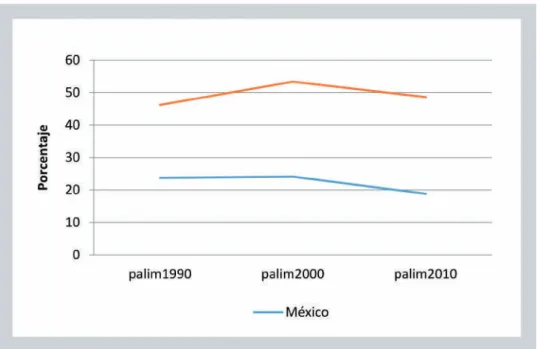
Meanwhile, food poverty levels reported for Chiapas happen to be well above the national average for the three measures presented by CONEVAL. It can be clearly seen that levels of food poverty in Chiapas are over twice the national average and it seems even more serious that the gap does not seem to be closing, as was the case of infant deaths. See Graph 2.
Graph 2. Population in food poverty, Mexico and Chiapas:
1990, 2000 & 2010
Source: own elaboration from CONEVAL data
The trends observed between infant mortality and poverty seem to contradict the initial hypothesis, which states that there are significant levels of association between the two since while child mortality levels are reduced , poverty levels appear to remain constant at least at the state level. This means that child mortality levels are declining, although poverty remains at the same level.
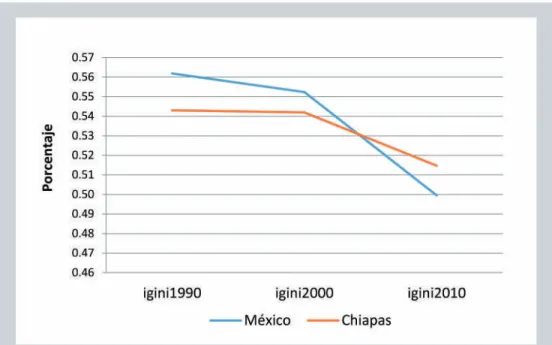
One reason may be due to the reduction, albeit marginal at the state level and in Chiapas, of the levels of economic inequality measured by the Gini index. See Graph 3.
Graph 3. Inequality index by GINI, Mexico & Chiapas 1990, 2000 & 2010
Source: own elaboration from CONEVAL data
That is, the reduction in the levels of economic inequality means that there is greater equity in the distribution of household income, which would mediate the relationship between poverty and reducing child mortality rates. However, this hypothesis is discarded later, because as is well known, child mortality is modeled by a broad & complex union of proximal, intermediate and contextual determinants which have been analyzed in an infinite number of works.
One of the first comprehensive schemes to explain the levels of infant mortality in a society is the one developed by Mosley and Chen (1984). The model is conceived as a process that incorporates structural determinants on the micro and macro (individual, household and community) levels. Within these the educational levels of the mother, traditions, norms and attitudes, power
relations, income, food, economic policy and health systems among others are analyzed.
Figure 4. Infant Mortality Rates municipalities of Chiapas 1990, 2000 and 2010.
At this point, it is important to note that poverty is a contextual determinant formed by a broad number of factors. The same can be found in the definition given by CONEVAL [2009], so it is expected that poverty is a good indicator of the evolution of infant mortality as stated in the initial hypothesis.
The evolution of infant mortality at the municipal level can be seen in Graph 4 and Map 1, where there is clear evidence of the reduction in the number of deaths of children, but also the reduction of the variance of these deaths which clearly indicates that the reduction is real and continuing for a period of at least 30 years.
Food poverty in the municipalities of Chiapas for the indicated years has remained at the same level, or at about 50 percent of the statewide population (see Figure 2) and is stable at levels above 50 percent of the population in just over half the municipalities in the state. In at least 8 municipalities (see Graph 5), food poverty reaches levels above 80 percent of the resident population of the municipality. This figure makes Chiapas one of the states with the highest levels of poverty in Mexico, and is the main reason it was chosen for the study.
Figure 5. Municipal Food Poverty, Chiapas 1990, 2000 and 2010
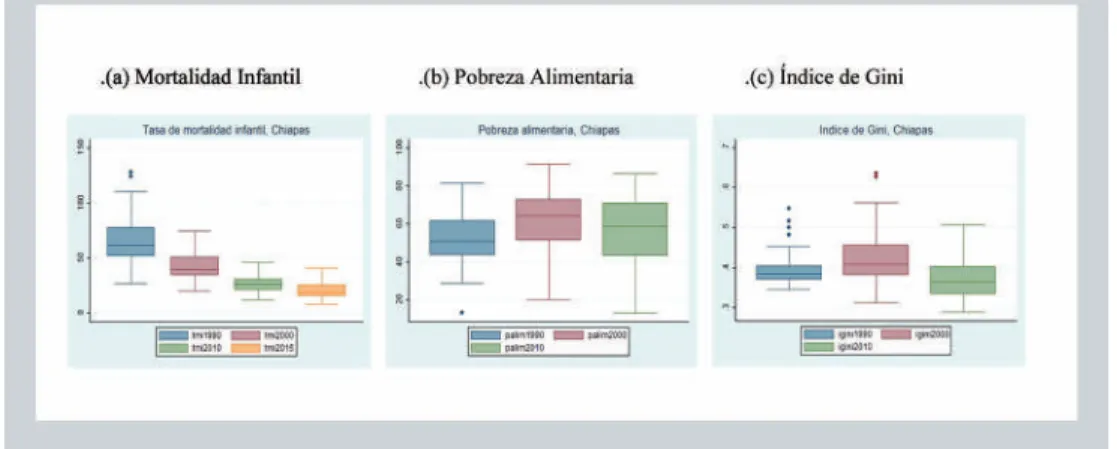
In the graph 6 (a), it can be seen that not only has the average level of infant deaths gradually reduced between the municipalities of Chiapas since the year 1990 until 2010, but a real reduction of the variance observed in interquartile terms, i.e., at the top of the box, which is getting smaller, resulting in fewer deaths for a greater number of municipalities.
In the graphs 5 and 6 (b) the average levels and dispersion of reported poverty in the municipalities of Chiapas in 1990, 2000 and 2010 is municipal poverty levels appear to have not only declined, but the poverty has increased in some municipalities and has spread to more of them. It is easy to see (see Graph 5) that the variance of the phenomenon has grown significantly during this period.
Income inequality as measured by the Gini index, whose behavior can be seen in Graph 6 (c), and seems to follow the same
behavior as poverty, that is, greater inequality in a growing number of municipalities, which can also be reflected in the map.
Figure 6. Evolution of the mortality indicators, poverty and inequality in the municipalities
of Chiapas, 1990, 2000 and 2010
SPATIAL DISTRIBUTION OF FOOD POVERTY AND INFANT MORTALITY IN THE MUNICIPALITIES OF CHIAPAS The evolution of food poverty in the municipalities of Chiapas shows that both economic growth and the efforts of social policies have had greater impact on poverty reduction between 1990 and 2010, during which poverty level was practically at the same continuous levels.
Poverty indicators disaggregated at the municipal level show some of the most important differences in the spatial distribution of food poverty in Chiapas; in addition to allowing for geo-reference patterns of municipal infant mortality and income inequality (see Map 1).
The maps allow for the targeting of geographic areas with higher levels of poverty, child mortality and economic inequality over time, and identify differences and similarities in the patterns of the same indicators, although it is possible to identify the distinctive features of poverty among different geographic areas particularly between urban and rural environments. It is understood that the location itself can create conditions of spatial marginalization of the poorest people in scattered areas of the territory or in outlying areas of cities.
Map 1. Child mortality, inequality and poverty, 1990, 2000 and 2010
To better understand the effects that poverty exerts on infant mortality it is necessary to continue advancing in the geographical breakdown of the phenomena, and thus refine the geographic dimensions of poverty and mortality levels that allow for a better focus on the association between phenomena.
Maps of infant mortality, inequality and poverty are key instruments to analyzing the geographical dimension in terms of its spatial heterogeneity, not only in terms of space, but in a growing body of determinants and sociodemographic variables associated with it that identify areas of high concentrations of poverty, infant mortality or inequality.
INFANT MORTALITY AND FOOD POVERTY IN THE MUNICIPALITIES OF CHIAPAS
To analyze the extent of the relationship between infant mortality and food poverty two statistical models as well as plot graphs were used. The basic way to estimate the level of relationship between two variables is through correlation analysis and the type of graph to represent it through a scatter diagram.
Table 1. Coefficient of Pearson
Year 1990 2000 2010
Correlation
coefficient 0.39 0.22 0.07
It is important to note that the results observed in Table 1 indicate that there is a positive, moderate but statistically significant relationship between levels of child mortality and poverty levels
observed in Chiapas municipalities for all of the years that were studied, but also, it is clear the degree of association between the two phenomena has weakened very significantly during the period that was analyzed, which means that food poverty would be in the coming years, ceasing to be a suitable indicator to model the evolution of infant mortality due to among other things that the incidence of deaths of children are events whose explanation is getting more complicated. In other words, it will become necessary to use a greater number of variables to understand and model its behavior, namely socio-economic status, structural variables, access to health and the environment, among many others.
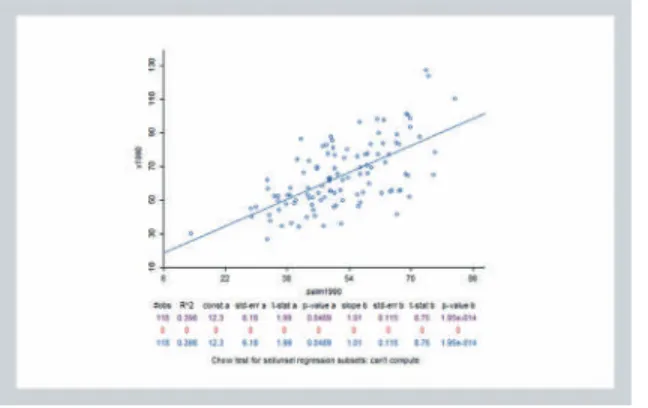
Since it was possible to establish the existence of a significant positive relationship between the variables, you can then proceed to set a linear regression model to estimate the expected value of infant mortality based on observed values of food poverty in different municipalities.
The regression model allows for the determination of the existence of a functional linear relationship between municipal food poverty, as the independent variable and the infant mortality rate as the dependent variable, where the regression coefficient beta indicates not only the degree of association, but what the impact of a one percentage point increase in poverty on child deaths can be expected.
Graph 7: Regression model, food poverty vs infant mortality 1990, 2000 and 2010
In Graph 7 (a, b & c) it shows that the predictive power of the regression model is reduced over time. This also impacts in terms of the variability that the model is able to explain, which was 39.8 percent in the year 1990 and just 6.9 percent in 2010. That is a reduction of just over 30 percentile points. The loss of explanatory power of the regression model can be seen graphically as the gradual decrease in the slope of the regression line between years cited.
It is important to note that a multiple linear regression model was attempted using the Gini index, however the variable measuring income inequality in the home turned out to be statistically insignificant so it was removed from the model.
RESULTS AND CONCLUSIONS
The processes of morbidity and mortality are determined by a set of both biological-individual (proximate determinants) and socio- structural (contextual determinants) situations. These principles apply to both overall mortality and mortality for children, and give rise to the theoretical and methodological conceptualization of the study of the determinants of mortality, which allow for the construction of a comprehensive explanatory framework of infant mortality.
Given the importance that poverty had taken as an element that is often used to explain the observed levels of infant mortality, as if it were a proximate determinant of infant mortality. In this investigation it was considered necessary to evaluate the effect of poverty at the municipal level, which is the level of smaller geographical breakdown for which it is possible to obtain information on the incidence of both poverty and child mortality and thus check the validity of the above hypothesis.
The results are conclusive. Food poverty is a good indicator to model the levels of infant mortality in the municipalities of Chiapas, Mexico, but should be used with caution due to the loss of explanatory power of the indicator. It is very interesting to see how today the phenomenon of child mortality is much more difficult to model, despite having a smaller variance than before, since municipalities with high incidence are concentrated more and more in fewer regions, but these locations concentrate an increasingly complex mix of factors that mediate the occurrence of deaths of children.
Since the definition of poverty as food poverty at the municipal level was available, which is strongly associated with income, it may be reduced to a proximate determinant so that it would be a much more interesting exercise using the new multidimensional definition of poverty, which includes a great number of proximate
and contextual determinants which could be a better predictor of the behavior of infant mortality.
BIBLIOGRAFÍA
Aguirre A (1999). Evolución de la mortalidad en América Latina, 1960-1990, y perspectivas de reducción de la mortalidad infantil, en Las consecuencias de las transiciones demo- gráfica y epidemiológica en América Latina. México: El Colegio de México, Centro de Estudios Demográficos y de Desarrollo Urbano.
Almeida-Filho, N (1999). Desigualdades em saúde segundo condiçoes de vida: analice da produçao científica na América Latina e Caribe. Organización Panamericana de la Salud, Washington DC.
Arriagada, Irma (2006). Cambios de las políticas sociales: polí- ticas de género y de familia, serie Políticas sociales, n 119.
Behm Rosas (1962). Mortalidad infantil y nivel de vida, Editorial de la Universidad de Chile, Santiago, Chile.
Boltvinik, J. (1990). Pobreza y necesidades básicas. Conceptos y métodos de medición, PNDU, Caracas.
Camposortega S (1992). Análisis demográfico de la mortalidad en México, 1940-1980, ed. El Colegio de México, 1992.
Chackiel J, (1984). La mortalidad en América Latina: niveles, tendencias y determinantes. En: Memorias del Congre- so Latinoamericano de Población y Desarrollo. México, D.F.: UNAM, El Colegio de México, PISPAL, vol.1.
CONEVAL, (2009). Metodología para la medición multidimen- sional de la pobreza en México. Consejo Nacional de Eva- luación de la Política de Desarrollo Social. México, DF.
Escobedo, B. y Sauri, R. (1981). La mortalidad infantil en Méxi- co, 1980: resultados y análisis de la información censal.
México. INEGI, 1981.
Gallardo G. (1995). Evolución de la mortalidad infantil en Méxi- co hasta 1990, ed. El Colegio de México.
Gómez de León J. y Partida V, (2001). Niveles, tendencias y di- ferenciales en la mortalidad en La población en Méxi-
co: Tendencias y perspectivas sociodemográficas hacia el Siglo XX. Gómez de León J y Rabell C. Coordinadores CONAPO. FCE.
Hernández H. y Jiménez R (1991). Un panorama de la mortali- dad infantil en México. México. UNAM-CRIM. 1991 Jiménez O, (1988). Marginalidad y mortalidad infantil. Revista
Mexicana de Sociología vol 50, no 4.
López Ríos O. y Wunsch G (1991). Modelo de estructuras de co- varianza para el análisis de las diferencias espaciales de la mortalidad mexicana. Estudios Demográficos y Ur- banos, vol. 6, no 2, 1991.
Maceira D (1996). Fragmentación e incentivos en los sistemas de atención a la salud en América Latina y el Caribe. Wash- ington, D.C.: Banco Interamericano de Desarrollo BID.
Disponible en http://www.iadb.org/res/publications/pub.
les/pubwp-335.pdf.
Madariaga, H., Ortiz de D’Arterio, J. y F. Longhi (2004). “Ca- racterísticas de la pobreza en los hogares del Norte Gran- de argentino. Su relación con la mortalidad infantil”, en Actas I Congreso de la Asociación Latinoamericana de Población, Caxambú.
Martínez C (1990). Causas de muerte, manifestación de las des- igualdades sociales. Revista Demos. Carta demográfica sobre México, vol 3, 1990.
Mina A, (1992). La mortalidad por causas de menores de 1 año, Estudios demográficos y urbanos, vol. 5 n 3.
Mosley W., Chen L. (1984). An Analytic Framework for the Study of Child Survival in Developing Countries. Pages 25-45 in Child Survival: Strategies for Research, W. Mosley and L.
Chen (eds). Population and Development Review, Supple- ment 10.
Spinelli, H., Alarzaqui, M., Calvelo, L. y J. Arakaki (2000). Mor- talidad infantil, un indicador para la gestión local. Aná- lisis de la mortalidad infantil de la provincia de Buenos
Aires en 1998, Organización Panamericana de la Salud, Buenos Aires.
Trifiró, C (2001). “Condiciones de vida y mortalidad infantil en los departamentos de la provincia de Mendoza”, en Actas VI Jornadas Argentinas de Estudios de Población, Bue- nos Aires.
Trussell J (1975). A Re-estimation of the Multiplying Factors for the Brass Technique for Determining Childhood Survi- vorship Rates. Population Studies, Vol. 29, No. 1 (Mar., 1975), pp. 97-107.
United Nations (1990). Step-by-Step Guide to the Estimation of Child Mortality, chapter IV, Trussell Version Of The Brass Method, United Nation Publication, N.Y.
Yasmin von Schirnding (2002). Health and Sustainable Deve- lopment: Can We Rise to the Challenge? The Lancet, Vol.
360.