AND AWARENESS ON GENDER EQUALITY
Leticia Aragon Valencia
Autonomous University of Mexico (UNAM)
LETICIA ARAGON VALENCIA Bachelor of Education from the Autonomous University of Mexico (UNAM) Master’s Student in Higher Education in the
Autonomous University of Puebla, Mexico.
Address: Calle Honduras número 9, Colonia México 68, Naucalpan, Estado de México, C.P. 53260
Phone: 5516380945 Email: [email protected]
ABSTRACT
This paper presents a contextualization and the most relevant results from the perspective of gender on training conducted through the internal network of facilitators and enablers for gender equality and nonviolence in the central sector of the Ministry of Public Education (SEP)of Mexico in 2012, to help build an institution free of gender violence and discrimination.
Keywords: Public Policies, Equality between women and men, education, gender equality, training on gender equality, gender sensitization
In Mexico the first steps in mainstreaming gender into the processes of planning, programming and budgeting respond to the international legal framework and derive from the Fourth International Conference on Women held in Beijing in 1995 ( United Nations Development Program [UNDP], 2010).
In accordance with the Beijing Platform for Action, the General Act on Equality between Women and Men (art. 5) defines the transversal quality of gender as a process that ensures inclusion of the assessment of the implications for women and men in legislation and in all actions, programs, guidelines, policies, economic, administrative and cultural activities, and public and private institutions at all levels (UNDP, 2010).
In this context, the results of the Survey of Institutional Culture with Perspective of Gender and Non-Discrimination, 2008 (Ministry of Education), showed the existence of situations of inequality between women and men in the central sector of the Ministry of Education and hence the need to promote a culture of fairness and equality between public servants in the federal public administration so that there are more fair and equal workplaces.
This paper presents a contextualization and the most relevant results from the gender perspective, training conducted through the internal network of facilitators and enablers for gender equality and nonviolence in the central sector of the Ministry of Education public (SEP) in 2012, to help build a free institution of gender violence and discrimination.
THEORETICAL FOUNDATION
We start from the conceptualization of public policies and actions that governments choose to solve a collective problem that are considered a “public issue”, ie, a problem in the social and political level which is recognized and needs to be addressed (UNDP, 2010).
Evangelina Garcia (2008), after reviewing the literature and experience in the field, said that public policies are products of the political system, and it is principally the State that is responsible for sanctioning the formality that legitimizes their instruments of expression as tools of public policy.
Another element to consider in defining public policies is that they are explicit and are expressed in a public instrument that collects its content in formal documents backed by the authority (García, 2008).
Our definition would be incomplete if we do not determine a common purpose to politics, which is to guide the behavior of a given sector of development and civic life. These policies solve problems or situations that demand attention. Their contents guide and set the course of public action to achieve satisfactory answers and solutions for society (García, 2008).
In addition, gender equality policies are strategies of public intervention that are applied to correct the imbalances that exist between people because of their gender. They are deliberate actions for justice that seek to compensate for disadvantageous positions that develop from gender discrimination that affect women (UNDP, 2010).
According to García (2008), women have been present in some way in the strategies and policies of development, although it was just until recently that their presence was barely noticeable.
The consideration of women was not explicit, as they were assumed subsumed in a larger universe of considerations that marked men as the main subject of history and the efforts of the State. The fact is that they are not named.
For decades women were permanently excluded from theoretical references, methodologies and content of development paradigms and strategies. In the end, the female presence was progressively incorporated. In the evolution of care provided by governments to fit their needs, interests and concerns, several stages can be distinguished according to the United Nations
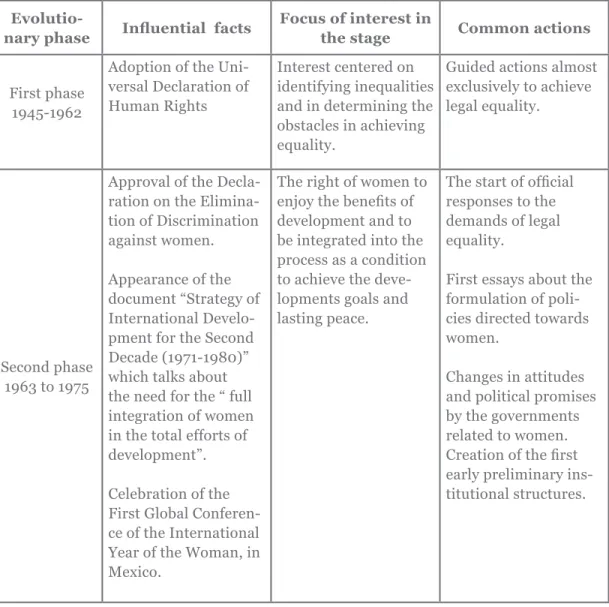
which recounted the 50 years of action since 1945 at the Fourth World Conference Women held in 1995. García (2008) shows a summary of those stages in the following table.
Table 1. Synthesis of the historical evolution of equality policies.
Evolutio-
nary phase Influential facts Focus of interest in
the stage Common actions
First phase 1945-1962
Adoption of the Uni- versal Declaration of Human Rights
Interest centered on identifying inequalities and in determining the obstacles in achieving equality.
Guided actions almost exclusively to achieve legal equality.
Second phase 1963 to 1975
Approval of the Decla- ration on the Elimina- tion of Discrimination against women.
Appearance of the document “Strategy of International Develo- pment for the Second Decade (1971-1980)”
which talks about the need for the “ full integration of women in the total efforts of development”.
Celebration of the First Global Conferen- ce of the International Year of the Woman, in Mexico.
The right of women to enjoy the benefits of development and to be integrated into the process as a condition to achieve the deve- lopments goals and lasting peace.
The start of official responses to the demands of legal equality.
First essays about the formulation of poli- cies directed towards women.
Changes in attitudes and political promises by the governments related to women.
Creation of the first early preliminary ins- titutional structures.
Third phase 1976 to 1985
First Decade of the Woman of the United Nations, in the fra- mework of the Inter- national Strategy for Development.
Second Global Confe- rence of the Woman, Copenhagen, 1980.
Adoption of the Con- vention for the Elimi- nation of all Forms of Discrimination against Women. 1979.
Third Global Confe- rence of the Woman, Nairobi, 1985.
Change in the inter- national awareness on the impact of the situation of women in development, especia- lly through the general phenomena such as poverty, overpopula- tion, illiteracy, nutri- tion, and other similar themes.
New concept of women as “agents and benefi- ciaries of the process of development in all of the sectors and at all levels”.
Programs developed for women from disad- vantaged sectors in or- der to strengthen their economic productive capacity and elevate basic social capacity.
Progressive strengthe- ning of the institutio- nal role of women’s issues.
Fourth phase 1985 to 1995
IV Global Conference in Beijing.
Global Conferences on the Environment, Hu- man Rights, Children, Population, Human Settlements; Social Conference
Evaluation of the im- pacts of the efforts.
Consideration of the global character that they should have.
Appearance of the focus on gender.
Relevance of the the- me of violence.
Strengthening of Or- ganisms dedicated to women.
Public sector poli- cies with attention to women’s issues.
First plans.
Source: García E. (2008) Políticas de Igualdad, Equidad y Gender Mainstreaming ¿DE QUÉ ESTAMOS HABLANDO?: Marco Conceptual. San Salvador. UNDP.
The current stage, called the Post Beijing Stage, is characterized by the emergence of important categories of analysis and the implementation of public policies: equal opportunities, human rights criteria, the redefinition of citizenship of women, and
the globalization of actors and processes that contribute to the advancement of equality. At the same time the emergence of the value of diversity in the establishment of policies which pursue comprehensive equality as important dimensions is being raised (García, 2008).
Although as it was just noted, women have been taken into account in public policy, treating their needs or interest in the above stages has gone through various modalities in the second half of the twentieth century and up through the twenty first century. Despite the diversity of policies that have occurred, many decisions and initiatives failed to achieve what is now called substantive equality. They all are identified as “politics of equality”, whether this equality has or has not been fully achieved because the purpose such decisions and actions were to have a positive effect on this objective.
Education sector institutions are mandated to promote gender equality and non-discrimination and prevent, address and eradicate violence like any other agency of the Federal Public Administration. There is explicit and direct responsibility of educational institutions to ensure that human rights are respected in the provision of services (UNDP, 2010) since education is intended to achieve the full development of the human personality and to strengthen the respect for human rights and fundamental freedoms (Office of the High Commissioner for Human rights, 2013).
The right to education entails the recognition of the right to equality. In this regard, the Ministry of Education created the Deputy General Directorate of Gender Equality in 2008, which is assigned to the Planning and Policy Evaluation Unit (UPEPE).
This entity coordinates its actions with the National Institute for Women (INMUJERES).
The creation of programs aimed at promoting gender equality and non-violence against women has required the allocation of budget items labeled explicitly for these purposes (UNDP, 2010).
Starting with the funds allocated in 11 branch of the Expenditure Budget of the Federation (PEF) of 2008, the SEP strengthened actions initiated four years ago by responding to the obligations of the institution established by the General Law on Women’s Access to a Life Free of Violence, the General Act on Equality between Men and Women and the Law of Federal Expenditures 2008 (UNDP, 2010).
Within the programs for gender equality and nonviolence against women, actions were focused on different Responsible Units (UR) of the SEP , some having national incidence and others in the central areas of the SEP (UNDP, 2010).
Regarding the central area of the SEP, the course “Walking towards equality between women and men” is the subject of this study, which responds to ratification by Mexico of international agreements CEDAW and Belem do Para, which is committed as a State party to take action in order to eliminate all forms of discrimination and violence against women in favor of equal access and full enjoyment of rights and opportunities. This commitment is reflected in the design of public policies consistent with that objective.
GENDER PERSPECTIVE
In academia, movements and feminist organizations, and now in areas of public policy, there has developed a critical, explanatory alternative vision to what happens in the order of genders, created from feminism, which is known as gender perspective(Lagarde, 1996).
This perspective recognizes that women and men are not immutable beings but as socially constructed historical subjects, products of the type of social gender organization prevailing in their society (Lagarde, 1996).
The feminist gender perspective contains proposals, programs and actions against contemporary social problems arising from oppression, gender disparity and the resulting inequities. It is appropriate to analyze and understand the status of women and the situation of women, and also to analyze the male condition and the life situation of men. In other words, gender allows the understanding of any social subject whose construction rests on the social significance of its sexed body with charge of duties and prohibitions assigned to live, and the vital expertise given through sexuality (Lagarde, 1996). In turn, gender theory is comprised of “theoretical, philosophical, ethical and political approaches needed to understand the complex power relations that determine the inequality between men and women” (Cazes, 1990).
The belief that feminism seeks “the revenge of women on men” undermines their approach by associating it with prejudices about the implications that would achieve greater balance of power between women and men. Following this bias, many people, including public servants, refuse to listen, understand and, of course, endeavor to incorporate gender in their work as a dimension of analysis and study of social problems and solutions of public policy (National Institute of Women, 2008b).
In order to correct these biases, the basis of the relationship between gender and feminism is outlined. Gender is a category of analysis. Feminism is a political and theoretical movement that questions the social order and inequality of opportunity between women and men. Both concepts are not synonymous but are related, because the former is a theoretical tool that uses feminism to bolster their arguments, showing the political and ideological character of inequality between women and men.
The fact that gender is a tool used by feminism does not mean that is coincides with the political and theoretical positions that guide the various current political expressions in feminism.
Like any movement, there are diverse, even divergent, political positions.
The ideals of feminism do not tout the “revenge of women”
but the recognition of diversity and the adoption of the principles of equality and equity as guiding principles of social interaction and the work of governments and the state. The standard of these values is raised by women and for many who are sensitive and aware that a better gender balance benefits society and future generations (INMUJERES, 2008b).
The perspective of gender equality permits the analysis of belief networks, personality traits, attitudes, feelings, values, behaviors and activities that differentiate men and women, and are the result of a historical process of social construction.
Socialization covers all instances through which humanity integrates and incorporates slogans and determinations of the social structure in which it interacts- charged with the transmitting, shaping, maintenance or perpetuation of values, beliefs and attitudes that influence and contribute to modes of thinking and acting in people (Delgado, 2003).
In the work environment of the SEP, we found the expression of beliefs, attitudes and behaviors that demonstrate the disadvantaged and violent situation for women. Because of this, in 2008 INMUJERES developed a gender training and professionalization program for workers and public servants in order to consolidate the rule of a common language and create a proactive attitude for the implementation of gender mainstreaming into government processes and routines. Work was divided on two fronts: sensitizing and specialization in order to institutionalize the gender perspective in public policy. The purpose was to incorporate this perspective in the policies of training human resources in the public sector as an ethical value and constantly updating work ability.
GENDER TRAINING AND SENSITIZATION
A central strategy of this program is multiplication, which concentrates efforts in the training of facilitators in federal, state and municipal agencies to act as multipliers on gender, human rights and violence prevention. The objective of this strategy was to take advantage of spaces and merge with the training units of public agencies to extend the understanding of the basic contents of gender awareness and incorporate them as part of the training pool of human resources in public institutions (INMUJERES, 2008a).
Gender violence is a field of particular importance for awareness as it is recognized as a symptom of inequality between women and men as a strategic area for state intervention.
Raise awareness in the literal sense is the ability to experience sensations as perceived from the senses. Raising awareness on gender implies then that those who design, implement and execute programs and public policies-that is to say those who judge, administer, develop budgets, make decisions, define guidelines for hiring, among other activities of institutional activities- see, hear, smell, taste and touch the reality and the problems of gender inequalities and inequities. Hence, awareness is developed as an excellent tool for creating awareness through reflection and address hidden or naturalized aspects in the power relations between individuals and social groups. As a learning strategy, it is a consciousness-raising activity that removes indifferent attitudes to social problems, favoring action, and seeks to challenge prejudice through reflection and knowledge (INMUJERES, 2008a).
Sensitization seeks to have the participants reflect in reference to the “feminine” and “masculine”, the asymmetries and inequalities in order to generate processes of change on both the personal and institutional level in order to shape policies,
programs and projects with a vision of equality and equity for women and men (INMUJERES, 2008a).
A basic principle of this approach is working with social beliefs about gender. Sensitization is presented as an educational and learning process that affects four dimensions:
a) Beliefs and personal experiences.
b) Beliefs and prejudices of society.
c) Information based on concepts and data.
d) The practice or application of knowledge to solve specific situations.
Sensitization requires individual work, collective reflection and the assimilation of information which provides conceptual tools and reviews conduct and behaviors on an individual and collective level, focused on the eradication of practices that we want to move and transform (INMUJERES, 2008c).
In this proposal, awareness is considered an open, creative, flexible, trigger of individual or group processes of analysis and reflection, and constitutes a starting point to stimulate the implementation of gender mainstreaming in the entire process of public policy (INMUJERES, 2008a).
Sensitization is the first phase of capacity building. Through this experience, subjects and the group move from the position of receivers to agents that transform reality. The optical repertoire is amplified and the perceptions and feelings of the subject to be learned is extended: the valuation of feelings in the acquisition of knowledge (INMUJERES, 2008a) arises.
The sensitization of gender, as a basis for teaching, took place during the course “Walking towards equality between women and men”, through which personnel from the central sector of the SEP were trained in the period between 2009-2012. It was an action taken from within the component of “training and staff development”, which led to the programming framework
for institutional actions and specific programs of the SEP on the topic of gender equality and non-violence against women.
The said course is a specific action performed by the Module of Orientation, Prevention and Gender Violence (MOPAV), which opened in December of 2008 in the structure of the Unit for Planning and Policy Evaluation (UNDP , 2010).
The Module offered free and confidential services to all staff of the central sector of the SEP in two areas:
• Prevention- through dissemination of materials, workshops, conferences, exhibitions, etc., that promoted the culture of denouncement, denaturalization, and eradication of institutional violence.
• Psychological and legal assistance to workers in situations of domestic violence who requested the service (UNDP, 2010).
The training workshop “Walking towards equality between women and men” was part of the area of prevention. Its purpose consisted in participants reflecting on the concepts related to equality between women and men, their effect, and progress in order to reach them, with the goal of recognizing their benefits in their personal, work and social life. It was designed based on the Program of Institutional Culture and according to the results of the Survey of Institutional Culture Perspective of Gender and Non-Discrimination, 2008.
The Institutional Culture Program (CIP) 2007-2012 (SEP, 2010) raised nine strategic objectives , addressing the following topics:
1. National policy and institutional duties.
2. Work environment.
3. Inclusive Communication to promote gender equality and non-discrimination.
4. Recruitment without discrimination.
5. Wages and benefits in order to eliminate disparity gaps between women and men.
6. Vertical and horizontal promotion , encouraging the development of the capacities of all people.
7. Professional training with a gender perspective.
8. Stewardship between work, family, personal and institutional life.
9. Harassment and sexual harassment. Mechanisms for its elimination.
The questionnaire of Institutional Culture and Gender Perspective and Non-Discrimination, 2008 (Ministry of Education) was designed according to the program of Transparency and Accountability through theme 6b called “Non-discrimination and gender equality”. The Ministry of Education, as a member of the National System for Equality between Women and Men (SNIMH) and the National System to Prevent, Treat, Punish and Eradicate Violence against Women, through the Executive Coordination of the National Institute for Women , applied the questionnaire mid-year in 2008 to personnel working in the Secretariat as part of a joint effort and projects to promote policies, programs and actions on gender equality and equal opportunities.
In compliance with the guidelines for the implementation of Institutional Culture Questionnaire with the Gender Perspective in the Federal Public Administration, a report of the main results was delivered to INMUJERES according to the formats requested by the Institute. The analysis and deepening of these results was given to the Unit of Planning and Policy Evaluation (UPEPE).
In these results, the highest rated factors were: III. Inclusive Communication. V. Wages and benefits VIII. Reconciling work, family and personal life. On the other hand, those factors with a lower grade and in which special attention was given are: II. Work
climate IV. Recruitment VI. Vertical and horizontal promotion.
VII. Professional training IX. Harassment and sexual harassment.
Regarding recruitment, in April of 2003 it was published in the Official Journal of the Federation the Law on Professional Career Service in the Federal Public Administration- a design based on the guiding principles of legality, efficiency, objectivity, quality, impartiality, fairness and capacity based on merit. It was implemented as a means of income for civil servants of the SEP.
However, the results reveal that 71.9% of respondents admitted to joining the institution through direct contracting and only 4.3%
reported having entered through the Professional Career Service.
This is consistent with the perception of staff, who are convinced that recruitment is done on the basis of personal relationships within the institution, without having knowledge, skills and abilities as a basis for candidates to occupy vacancies during recruitment. This situation can be disadvantageous to women, who occupy a minimum percentage of middle management positions and who have shown to be equally prepared and trained as men.
Another important element is the social roles assigned to women and men who are in part-time positions as assistants, secretaries, teachers, and so on. This becomes an outstanding indicator for the analysis of the selection process that is influenced by patterns of perception that place women in the private space caring for and ensuring the needs of others, despite equal skills and academic preparation.
Women generally have at least three jobs: paid work, domestic work and care of the children. The latter demands time off from work since the period of pregnancy and becomes a factor, according to respondents, that involves benefits and special permits: maternity leave, feeding hours, nursery, among others. Therefore, preference is often given to men in positions of greater responsibility and longer hours.
The situations described above are some examples that are part of the total results of that the questionnaire referred to and show the existence of situations of inequality between women and men, together with the need for training activities that promote a culture of fairness and equality in relationships between all civil servants of the Federal Public Administration.
Consistent with this statement, in 2010 the Unit of Planning and Policy Evaluation of the SEP, in coordination with the Directorate General of Personnel, through the Institutional Coordination and Monitoring MOPAV, based on Articles 153- a and 153-E of Chapter III Bis of the Federal Labor Law and Article 45 Fraction XI of the General Law on Women’s Access to a Life Free of Violence, convened to participate in shaping the internal network of facilitators for gender equality and nonviolence in the SEP with the aim of conducting activities and training such as workshops, lectures, conferences, film debates in the different areas of the central sector of the SEP, to contribute to building an institution free of gender violence and discrimination.
I responded to that call and was accepted to participate in the multiplication of the course “Walking towards equality between women and men” , a role I have had since 2011.
Experience in network of facilitators added to the recognition of violence against women as a violation of human rights. The knowledge of the advances in the exercising of rights and of international and national legislation, led me to wonder if the course “Walking towards equality between women and men”, in the context of educational policies, contributed to gender equity within the SEP, and if so, in what ways it was influenced.
It is this questioning that motivated this investigation that was conducted during the master’s program in Higher Education, called Educational Policy Analysis on gender equality and as part of the course outcomes of “Walking towards equality between women and men”, which was given to public servants in the central sector of the SEP.
METHODOLOGY
A non-experimental quantitative approach was used; In addition, the research design that was conducted was a transversal and descriptive study. The cohort totaled 60 participants that attended the course during 2012 during a training I taught as part of the internal network of facilitators and enablers for gender equality and nonviolence in the Ministry of Education, through the course
“Walking towards equality between women and men”.
The non-probabilistic sample consisted of a total of 36 people: 56% from the Department of Higher Education (SES), 22% from the Directorate General of Budget Management and Financial Resources (DGAPyRF) and 22% from the General Coordination of Intercultural Bilingual Education (CGEIB).
I designed a questionnaire for the staff that I trained during 2012, which measured the following variables: I. gender sensitization. II. Benefits in personal, work and social life. III.
Institutional conditions for the course.
The aforementioned survey was conducted in November of 2013, 36 people responded: 19 men and 17 women. Of these, 33% were single and 61% married, whose ages ranged from 35-65 years of age. Education ranged from secondary school to graduate level.
RESULTS
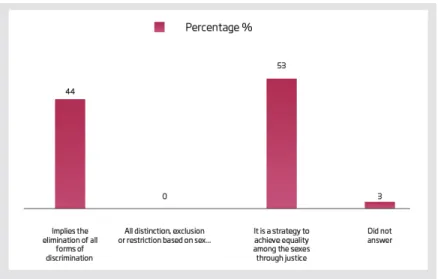
The results of the investigation, obtained through the use of the questionnaire for operating personnel trained in the course with respect to the variable of gender awareness, was that less than half of the people correctly identified the concept of equality in relation to equity, as reflected in the following graph:
Figure 1. Concept of equality
Figure 1 shows that there were fewer people who correctly identified the concept of equality. The correct notion is “implies the elimination of all forms of discrimination in any area of life that is generated by belonging to either sex,” according to Article 6 of the General Act on Equality between Women and Men. Also, the greater the number of people who identify equality with the concept of equity is conceptualized as follows: “It is a strategy for achieving gender equality through justice. Sets compensation mechanisms to ensure that women and men have the same opportunities, rights and responsibilities; equal access to resources, benefits and state services, and achieve a balanced distribution of power, “according to the General Coordination for Gender Equity Program of Judicial Power of the Federation. In addition, it was null the number of staff identifying equality with the definition of discrimination against women that refers to:
“Any distinction, exclusion or restriction based on sex which has the purpose or effect of impairing or nullifying the recognition, enjoyment or exercise by women “, based on Article 1 of the Convention on the Elimination of All Forms of Discrimination against Women, CEDAW 1979.
Strengthening the understanding of the concept of equality indicates an area of opportunity in training through the course
“Walking towards equality between women and men”, while the understanding of this concept relates to the identification of discrimination and violence against women as affectations and obstacles to achieving equity and equality.
In relation to the same variable (gender sensitization) The following chart explains that, according to the opinion of most people, Mexico as a member State to the Convention on the Elimination of All Forms of Discrimination against Women (CEDAW ), had carried out concrete measures to eliminate discrimination against women.
Figure 2. Opinion on measures to eliminate discrimination against women in Mexico
Furthermore, with respect to the variable: benefits in personal, work and social life, participants responded with their own words describing the following benefits: “I knew how it was before and how women are treated now”.
“Coexistence of respect among my peers,” “to come to agreements”, “share ideas and rights between men and women”,
“learn about laws and conventions in favor of women”, “before we
act, think or meditate” “education,” “better working environment”
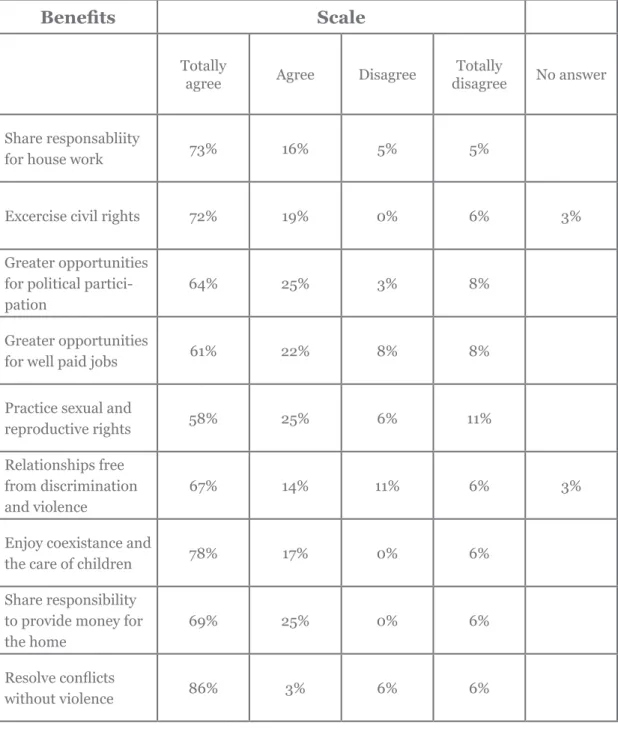
as the following graph reveals:
Table 2. Benefits in personal life, work and social, regarding equality and equity.
Benefits Scale
Totally
agree Agree Disagree Totally
disagree No answer
Share responsabliity
for house work 73% 16% 5% 5%
Excercise civil rights 72% 19% 0% 6% 3%
Greater opportunities for political partici- pation
64% 25% 3% 8%
Greater opportunities
for well paid jobs 61% 22% 8% 8%
Practice sexual and
reproductive rights 58% 25% 6% 11%
Relationships free from discrimination and violence
67% 14% 11% 6% 3%
Enjoy coexistance and
the care of children 78% 17% 0% 6%
Share responsibility to provide money for the home
69% 25% 0% 6%
Resolve conflicts
without violence 86% 3% 6% 6%
Figure 3. Benefits in personal, work and social life
Also, compared to the same variable, the benefits that participants selected are focused on the previous table.
Results show that they totally agree to share responsibility for domestic work, which repeats for the possibility of greater civil rights, bring greater opportunities for political participation and opportunities for well-paid jobs, exercising sexual and reproductive rights, relationships free of discrimination and violence, greater enjoyment in cohabitation, caring for children and sharing the responsibility of providing money for the home and resolve conflicts without using violence.
Regarding the variable related to the institutional conditions for completing the course, figure number 4 indicates that most participants received timely information.
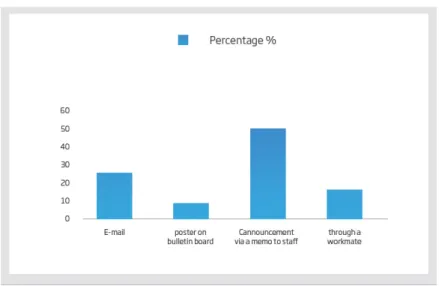
Here we can see the means used to disseminate the course
“Walking towards equality between women and men”, in descending order, were: statement by memo to staff, email, through a workmate and poster on a bulletin board.
Figure 4. Timing of course information
Figure 5. Means for the dissemination of the course
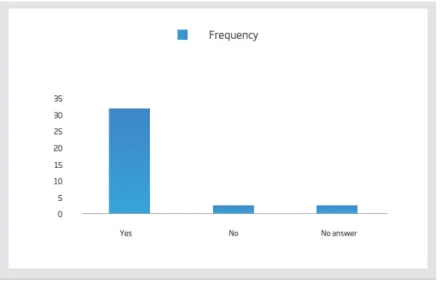
The chart below shows that most people recommend the course
“Walking towards equality between women and men”.
Therefore, the results of the variable related to the institutional conditions for the completion of the course were seen as positive.
Figure 6. Recommendation of the course
CONCLUSIONS
The course “Walking towards equality between women and men” contributed to different training units of the Ministry of Education, revealing the basic contents of gender sensitization and incorporating them as part of the training supply of human resources of Public Administration.
In addition, the dynamics of participation attended to sensitization as a tool to raise awareness through reflection and address hidden or naturalized aspects in the power relations between individuals and social groups (National Institute for Women, 2008) to recognize progress on equality between men and women, as well as the way ahead to follow.
Also, the course content is structured according to the regulatory framework that conceptualizes equality from the perspective of human rights as an autonomous human right that should not be understood as the similarity of skills, merits or physical qualities of human beings . It is a must , a set value to the recognition of human diversity. In this regard, the State
must guarantee it and promote it and be actively involved in the elimination of all forms of discrimination against women (OHCHR, 2013).
Operations were also conducted under the action plan of the 2009-2012 Institutional Culture Program of the strategy of the federal government, which ran the National Women’s Institute, and aims to transform the Mexican public institutions in fairer and equal workplaces with a human face, which will result in increased productivity, effectiveness and efficiency among public servants and will help to reduce the still persistent inequality between women and men (National Institute for Women, 2009).
The proliferation of courses via the internal network of facilitators and enablers for gender equality and nonviolence in the SEP, which was offered by the MOPAV, was a step towards equality between women and men. Of the most relevant results that we discussed in this article, we can see that although the participants were able to identify the concepts of equity, discrimination and violence against women, there was a deficiency regarding the concept of equality.
Also, the perception of most participants is that in Mexico concrete measures are undertaken to eliminate discrimination against women.
The benefits in personal, work and social life, regarding equality and equity, was where there was total agreement.
Those with a higher percentage are: resolving conflicts without using violence, greater enjoyment in living and care of the children and shared responsibility for domestic work and exercise citizen rights.
The above shows some of the progress made towards equality through MOPAV, as well as unmet needs and the pathway that we have yet to travel, and the amalgamated responsibility for education and collaboration to foster environments free from discrimination.
With the change of the presidency in Mexico, the MOPAV disappeared. This raises the relevance of the following questions:
how to improve what was done if it not longer exists as such? In other words, how to improve the public policy of the previous administration, if it no longer exists?
Regarding the training of the staff of the Secretariat of Public Education, both administrative staff as well as their support form an important part in the education sector. Because of its function, they maintain close contact with students and teachers, fathers and mothers, so it is essential to participate in training processes according to their profiles to develop skills, abilities and knowledge regarding gender equality. Therefore, it is essential that the training of teachers provides them with the skills, technques and methodological elements necessary to promote equality between women and men in the exercise of their professional practice at all educational levels.
REFERENCES
CAZES, D. (1990): La perspectiva de género. Guía para diseñar, poner en marcha, dar seguimiento y evaluar proyectos de investigación y acciones públicas y civiles. México: Consejo Nacional de Población.
DELGADO, G. (2003). “Educación y género”, en Volumen 3:
Educación, Derechos Sociales y Equidad. México: COMIE.
GARCÍA, E. (2008). Políticas de Igualdad, Equidad y Gender Mainstreaming ¿DE QUÉ ESTAMOS HABLANDO?: Marco Conceptual. San Salvador: PNUD.
Instituto Nacional de las Mujeres (2008 a): Guía metodológica para la sensibilización en género: Una herramienta didáctica para la capacitación en la administración pública.
La Sensibilización en género. Vol. 1. México: Autor.
———(2008 b): Guía metodológica para la sensibilización en género: Una herramienta didáctica para la capacitación en la administración pública. La Perspectiva de género.
Vol. 2. México: Autor.
———(2008 c): Guía metodológica para la sensibilización en género: Una herramienta didáctica para la capacitación en la administración pública. Los derechos de las mujeres.
Vol. 3. México: Autor.
———(2009). Programa de Cultura Institucional, Disponible en:http://cedoc.inmujeres.gob.mx/documentos_
download/101098.pdf
LAGARDE, M. (1996): Género y feminismo. Desarrollo humano y democracia. España: horas y HORAS.
Programa de las Naciones Unidas para el Desarrollo (PNUD) (2010). Legislación nacional sobre igualdad de género y no violencia contra las mujeres: Recomendaciones para su implementación en el sector educativo. Disponible en:
http://www.undp.org.mx/IMG/pdf/federacion-educacion.pdf
Oficina del Alto Comisionado para los Derechos Humanos (OACDH) (2013). Declaración Universal de Derechos Humanos, Disponible en: http://www.ohchr.
org/EN/UDHR/Documents/UDHR_Translations/spn.pdf Secretaría De Educación Pública, México: Diagnóstico.
Cuestionario de cultura institucional con perspectiva de género y no discriminación. Disponible en: http://www.
sep.gob.mx/work/models/sep1/Resource/
1440/1/images/diagnosticos.pdf
Secretaría De Educación Pública, México. Programa de Cultura Institucional. Disponible en: http://www.sep.gob.
mx/work/models/sep1/Resource
Instituto Nacional de las Mujeres (2008 a): Guía metodológica para la sensibilización en género: Una herramienta didáctica para la capacitación en la administración pública. La Sensibilización en género. Vol.
1. México: Autor.
———(2008 b): Guía metodológica para la sensibilización en género: Una herramienta didáctica para la capacitación en la administración pública. La Perspectiva de género.
Vol. 2. México: Autor.
———(2008 c): Guía metodológica para la sensibilización en género: Una herramienta didáctica para la capacitación en la administración pública. Los derechos de las mujeres.
Vol. 3. México: Autor.
———(2009). Programa de Cultura Institucional, Disponible en: http://cedoc.inmujeres.gob.mx/documentos_
download/101098.pdf
LAGARDE, M. (1996): Género y feminismo. Desarrollo humano y democracia. España: horas y HORAS.
Programa de las Naciones Unidas para el Desarrollo (PNUD) (2010). Legislación nacional sobre igualdad de género y no violencia contra las mujeres: Recomendaciones para su implementación en el sector educativo. Disponible en:
http://www.undp.org.mx/IMG/pdf/federacion-educacion.pdf Oficina del Alto Comisionado para los Derechos Humanos (OACDH) (2013). Declaración Universal de Derechos Humanos, Disponible en: http://www.ohchr.
org/EN/UDHR/Documents/UDHR_Translations/spn.pdf Secretaría De Educación Pública, México: Diagnóstico.
Cuestionario de cultura institucional con perspectiva de género y no discriminación. Disponible en: http://www.
sep.gob.mx/work/models/sep1/Resource/1440/1/images/
diagnosticos.pdf
Secretaría De Educación Pública, México. Programa de Cultura Institucional. Disponible en: http://www.sep.
gob.mx/work/models/sep1/Resource