
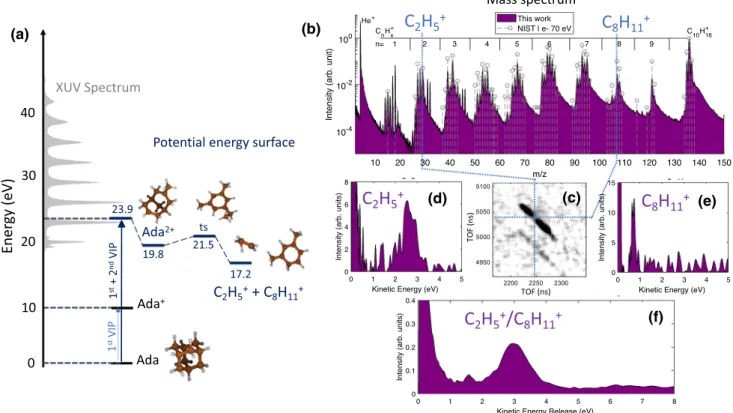
Covering all the intriguing research activities related to the dynamics of molecules and clusters in the gas phase is unfortunately beyond the scope of this guide. 1 aSelected points of the calculated potential energy surface (PES) of adamantane (DFT level) superimposed from the experimental XUV spectrum (grey).
Challenges and new directions
Thus, in recent years PECD has been exploited to study conformational effects from group isomerism and substitution, conformational populations, and aggregation.
Concluding remarks
5 Using electrospray ionization to study structure and dynamics of large
Status: description of the state of the art Investigating the interaction of light with biologically
Initially, studies of isolated biomolecules in the gas phase were limited to small molecules that are stable against thermal degradation because they were typically brought to the gas phase using ovens [44]. In the soft X-ray regime, near-edge X-ray absorption fine structure (NEXAFS) spectroscopy or near-edge X-ray absorption mass spectrometry (NEXAMS) probe transitions between nuclear core levels and orbitals in the molecular bonding states.
Challenges and new directions
Although the investigated systems are certainly not in their natural environment, experiments in the gas phase offer several advantages: the incoming projectile (photon, electron, ion) is well defined (energy, direction, charge, etc.), the target is well defined (chemical formula, structure, quantum state, temperature, mass, charge, etc.) and the interaction products are well defined (photoelectrons, ion fragments, scattered electrons, emitted photons, etc.) and can be efficiently analyzed. Electrospray ionization (ESI) [45] is a gentle, state-of-the-art technique for introducing intact, complex biomolecular ions from solution into the gas phase and into vacuum.
Concluding remarks
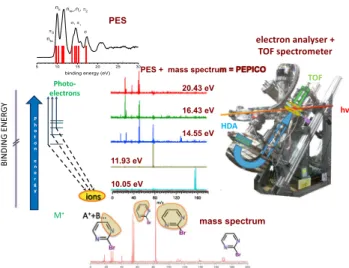
The target was the ubiqui-tin protein (10+ charge state), and the photoelectrons were obtained in coincidence with the ionized precursor detected downstream the interaction region. The measurements showed that besides a high-flux ESI source, highly focused photon and ion beams, ultrahigh vacuum conditions in the interaction region and an efficient PEPICO detection scheme are needed to perform such studies.
6 Simulating light-induced molecular dynamics in 2020: from the picosecond to
Status: description of the state of the art Photo-induced processes lie at the heart of numer-
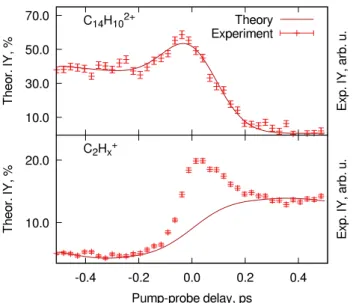
More recent experiments, combining isolated attosecond and femtosecond pulses, have demonstrated the existence of charge migration in amino acids in the sub-femtosecond range, showing how precursor light-induced electron dynamics dictate nuclear rearrangements and eventual fragmentation pathways [ 5,11. ,58]. Even in the simplest molecular targets, the complexity of the resulting spectra can only be revealed by strong theoretical data.
Challenges and new directions
This is the essence of multiscale approaches such as hybrid quantum mechanics/molecular mechanics (QM/MM) [74]. Identification of the appropriate coordinates is not straightforward, since there are many nuclear DOFs in large systems.
Concluding remarks
From the theoretical side, time-dependent scattering methods that provide an explicit evaluation of the electronic continuum wave function are currently under development. However, the proper description of the subsequent nuclear arrangements and fragmentation pathways requires further developments.
7 Experimental techniques for low-energy reactions of charged species
Status: description of the state of the art Low-energy ion–molecule reactions root from the very
These methods are only available within the approximation of fixed nuclei, which can already account for the ultrafast electronic processes accessible in recent attosecond experiments. One of the most popular and versatile is the selected ion flow tube (SIFT) technique, in which a stream of mass-selected ions driven by a carrier gas reacts with a neutral target added to the stream of lower.
Challenges and new directions
Low and ultralow collision energies/reaction temperatures One of the main experimental challenges in ion–. By coupling 22-pole traps to IR lasers, the effect of vibrational excitation of the molecular ion on the reactivity at low temperatures is possible, revealing unexpected behaviors such as reduction of the reaction rate due to ro-vibrational excitation [86].
Concluding remarks
Two of the most promising developments use an improved version of the collimated beam technique and the phenomenon of Coulomb crystallization of trapped ions. In the first case, ultralow collision energies in the range between 0 and 30 K·kB were obtained by using strongly excited Rydberg atoms or molecules instead of ions.
8 Interaction of keV ions with complex molecules and their clusters
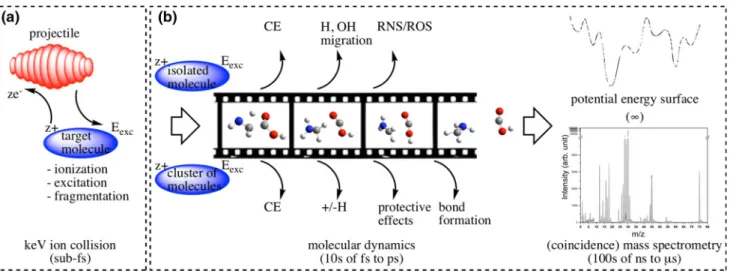
Status: description of the state of the art Fundamental processes During the interaction, the pro-
This is due to the fact that the weak intermolecular bonds between the cluster constituents preferentially break after the intramolecular covalent molecular bonds. There the initial step is the protonation of the clusters after ionization which stabilizes the clusters and enables further reactivity leading to the formation of peptide bonds between the cluster constituents.
Challenges and new directions
On the second hand, apart from being a buffer for energy, the cluster can also act as a reservoir of matter, and thus a reactivity within the cluster can be observed when a reactive fragment is produced within the cluster. In van der Waals groups of carbonaceous molecules such as fullerenes and polycyclic aromatic hydrocarbons (PAHs), a rich molecular growth has been observed due to the massive aspect of the projectile.
Concluding remarks
Interestingly, the weak interaction between cluster components can also lead to additional fragmentation channels involving atoms involved in H-bonding [119]. In the case of multi-charged clusters, the Coulomb repulsion between the fragments could also be partially converted into internal energy, so a more significant molecular dissociation is observed [104].
9 Modeling molecular fragmentation
Challenges and new directions
Delayed fragmentation Interaction of ionizing radiation with complex molecules can lead to time-delayed processes due to their energy storage capacity associated with a large number of nuclear degrees of freedom. In addition, fractional charges are also expected within Ehrenfest-TDDFT as the Ehrenfest dynamics develop the electronic and nuclear degrees of freedom at a mean potential.
Concluding remarks
Large Molecules A disadvantage of using AIMD-based approaches to elucidate fragmentation patterns is the need to perform a large number of lengthy calculations, which is not feasible for larger systems. It is well known that this level of theory can lead to unphysical partial charges.
10 Electron interactions with gas-phase molecules
Status: description of the state of the art Electron scattering on atoms and/or neutral molecules
Charge Distribution Most of the methodologies discussed earlier use DFT as the underlying quantum chemical method. To date, there is only one experimental gas phase study of the whole nucleotide, 2-deoxycytidine 5-monophosphate (dCMP) [142].
Challenges and new directions
The results showed that in dCMP, electron binding can lead to the breaking of the bond between the phosphate group and the sugar not only by the direct localization of electrons on the phosphate unit, but also indirectly by the initial localization of electrons on the nucleobase and the subsequent transfer of the excess electron to the sugar-phosphate backbone. After electron irradiation, the remaining intact oligonucleotides are visualized by atomic force microscopy with streptavidin, allowing quantitative analysis of electron-induced damage.
Concluding remarks
Most of the therapeutic agents used are derivatives of nucleosides substituted with electroffinic substituents and are relatively easily incorporated into the DNA structure. These are mainly related to the environmental impact and the urgent need to keep finding replacement feedstock gases for the semiconductor manufacturing industry, since the majority of the traditionally used and most effective chemical compounds have been banned due to their strong contribution to global warming and ozone depletion.
11 Interactions of low-energy electrons with clusters
Status: description of the state of the art In this section, low-energy electrons (LEE) are consid-
The current growing need for improved technologies capable of delivering faster and larger amounts of data, as well as a growing demand for efficient and reliable communications in various sectors of the global economy, requires a rapid response. from micro and nanotechnological industries. - tends to put a lot of pressure on the processing capabilities of such semiconductor plants. 8 Different approaches to study the interaction of free LEE with clusters such as electron affinity spectroscopy (EAS), mass spectrometry (MS), photoelectron spectroscopy (PES) or optical spectroscopy (OS) and methods for preparing molecular beams of neutral groups: groups of rare gases or selected molecules, such as water, collect sample molecules, which aggregate to form clusters; this method is useful for studies of surface and interface processes. size allows the acquisition of molecules with very low vapor pressures and the study of interactions at liquid He temperature.cThe expansion enables the study of heterogeneous groups of many components.dThe use of humidified gas as one of the co-expansion components enables the study of single molecules hydrated.e Aerosol transport in vacuum enables the study of fragile molecules that cannot be sublimated.
Challenges and new directions
Concluding remarks
12 Helium nanodroplets: a versatile medium for producing cold ions
Status: description of the state of the art Droplets of helium ( 4 He specifically will be discussed
In this study, net charge states up to 55+ were directly identified and their critical sizes were determined, with higher charge states being inferred indirectly.
Challenges and new directions
Concluding remarks
13 Electrostatic ion-beam storage rings
Challenges and new directions
In addition, ion mass selection devices with sufficient resolution to separate ions, especially heavy ions, of nearby masses should be combined with accumulation and precooling traps to form ion beams of sufficient intensity and duration for cyclic injection into the storage rings. In the next step, reactions between small internally cold molecular anions and atomic cations present in the interstellar medium will be performed with improved methods to control the overlap between the merged beams in DESIREE.
Concluding remarks
A very broad distribution of initial states in the experiment could obscure distinct state-sensitive phenomena through the need to average over many initial quantum states when evaluating the model. Likewise, the stability of molecular fusion products, especially fusions between fullerenes or between PAH molecules, will also be investigated for comparison with astronomical observations using the action spectroscopy method.
14 Studies of photo-induced dynamics in bio-chromophores using electrostatic
Challenges and new directions
In the ring, stored ions can be studied by time-resolved action spectroscopy after excitation by tunable fs laser pulses. A significant temperature dependence of the excited state lifetime reveals the role of energy barriers in the electronically excited states [209,210].
Concluding remarks
With an equilibrium temperature of ∼0.4 K, superfluid helium droplets can act as soft matrices to provide an isothermal environment at cryogenic temperature. Another challenge is to move from single isolated molecules to larger molecular complexes to study the electronic coupling between multiple chromophores, energy and charge transfer processes and the role of interactions with a host medium.
15 Electrostatic ion-beam traps
Status: description of the state of the art Electrostatic ion-beam traps (EIBTs) have been used
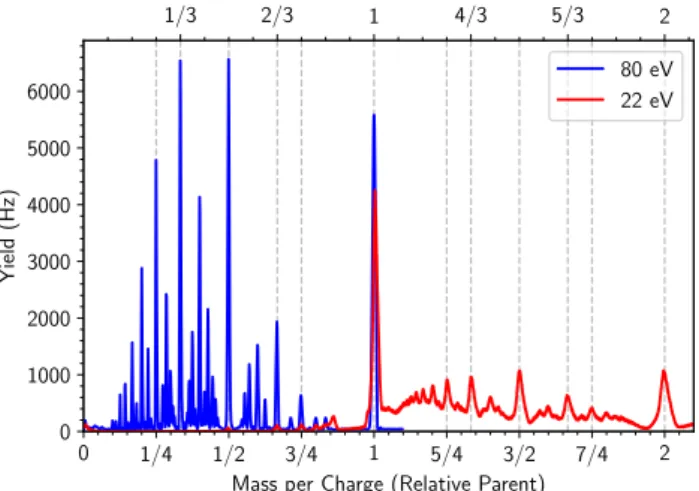
The inner circle (red–orange) is from Q transitions, while the outer disk (blue) is from P transitions. The left image is produced by electrons from molecules trapped for 0–100 ms, and the right one for a trapping time of 300–500 ms.
Challenges and new directions
Concluding remarks
16 Cooling dynamics of molecules and clusters
Status: description of the state of the art Molecules and clusters containing sufficient random-
The power law decomposition can be derived independently of the exact dependence of the rate constants on the excitation energy. Some results for this have been derived by Klots [227], surprisingly without knowledge of the power-law decomposition that simplifies the derivations.
![Fig. 15 Calculated emission rate constants for C − 4 for the processes indicated in the frame, published in [226]](https://thumb-us.123doks.com/thumbv2/123dok_es/5803731.5479018/35.892.82.429.739.963/fig-calculated-emission-constants-processes-indicated-frame-published.webp)
Challenges and new directions
Concluding remarks
17 Photo-fragment and photo-detachment spectroscopy in cryogenically cooled ion
Challenges and new directions
The assumption in the statistical fragmentation argument is that the molecule, when in the ground state, can explore the entire potential surface. Can the instantaneous method be applied to these molecular systems to pinpoint the origin of new fragmentation channels opened by a small change in energy.
Concluding remarks
Other experimental developments that promise to revolutionize the field include new analytical methods of mass spectrometry that combine mass with spectral fingerprinting for a complete diagnosis of the molecule and its fragments. Finally, the method of inhibition of laser-induced complex growth (LIICG) [244], in which the internal energy introduced into the molecule by the laser prevents it from forming clusters with atoms such as trapped helium, is a technique which is potentially universally available but has not yet been widely applied.
18 Gas-phase fluorescence spectroscopy of complex molecular ions
Status: description of the state of the art Action spectroscopy has for many years provided sig-
A Paul trap is often used as here the ions are centrally located after collisional cooling and act as a point source for light emission. The former operates near 77 K (liquid nitrogen temperature) while in the latter, ions are stored at an LQT at ambient to cryogenic temperatures.
Challenges and new directions
In a typical experiment, complex ions are formed in the gas phase by electrospray ionization (ESI) and transferred to an ion trap where they are stored, and the mass of interest is selected. Most experiments are done at room temperature, but it is worth mentioning two unique setups built by Kappes, Schooss and their collaborators [252] and Ferzoco and colleagues [253] where ions are cooled to low temperatures.
Concluding remarks
19 Action spectroscopy of isomer-selected molecules
Status: description of the state of the art Many gas-phase ions can exist in more than one iso-
The study was able to separate and identify the two glycan anomers from the ion arrival time distribution (ATD, Figure 18b). Cryogenically cooling each isomer in the trap and labeling the message allowed the acquisition of different isomer-specific IR spectra in the hydroxide stretching region (Figure 18c).
Challenges and new directions
18 Action spectroscopy with SLIM-IMS and cryogenic ion trapping: schematic illustration of the instrumentation, b arrival time distribution of two electrosprayed anomers (A and B), c IR spectra of mobility-selected and cryo-cooled anomer ions A and B. Several research groups have IMS- techniques coupled with tunable light sources to enable isomer-selected action spectroscopy.
Concluding remarks
While a lower buffer gas temperature improves the separation of isomers, it also allows the separation and isolation of isomers with low barriers to interconversion (eg, rotamers), which intercalate rapidly at elevated temperatures. Furthermore, the methodology can be adapted to multiple IMS and photophases, allowing the study of multistep photoreactions in the gas phase.
20 Deciphering the lifecycle of carbon macromolecules in space
Status: description of the state of the art Carbon is one of the most abundant elements in the
This may be particularly important for resolving specific interactions between biomolecules and photochemistry, for example, open versus π-stacked structures of DNA polynucleotides [275]. This strategy has enabled simultaneous monitoring of photoisomerization, photodissociation and photodetachment (for anions).
Challenges and new directions
With the advent of electrostatic storage rings (see Section 13), which allow for long storage times under ultrahigh vacuum conditions, experimental studies of the radiative cooling of increasingly larger species are becoming possible. At the same time, the field of excited state quantum dynamics is developing rapidly with the promise of being applied to carbon macromolecules in the very near future.
Concluding remarks
Finally, a deeper understanding of the ultrafast radiative and non-radiative processes that occur after photo-excitation is fundamental to assess the stability of molecules and correctly model their behavior.
Author contributions

![Fig. 5 Simplified schematic figure of the ubiquitin pro- pro-tein photoelectron spectroscopy experiment performed at PLEIADES beamline, SOLEIL [56]](https://thumb-us.123doks.com/thumbv2/123dok_es/5803731.5479018/13.892.465.807.99.385/simplified-schematic-ubiquitin-photoelectron-spectroscopy-experiment-performed-pleiades.webp)


![Fig. 10 Measured yields of C + 60 ions solvated in different numbers of He atoms as a function of the wavelength of the probing laser [167,177]](https://thumb-us.123doks.com/thumbv2/123dok_es/5803731.5479018/28.892.463.812.694.976/measured-yields-solvated-different-numbers-function-wavelength-probing.webp)
