This is due to the described high instability of the compound, including the use of the short-term high concentration bath. Based on the history of safe use information provided by the Applicant, it was concluded that the emergence of acquired reduced susceptibility to biocides and/or resistance to therapeutic antimicrobials following the use of PAA is unlikely. In addition to the safety of the substance, also a matter of concern is the possible emergence of reduced susceptibility to biocides and/or resistance to therapeutic antimicrobial agents and the impact of the substance or its by-products on the environment.
Introduction
- Parameters for treatment application
- Previous EFSA assessment in relation to PAA
- Approved uses of PAA
- Aim of this assessment
Evaluation of the effectiveness of peroxyacids as an antimicrobial applied to poultry carcasses was also carried out by EFSA in 2005 (EFSA, 2005). In particular, EFSA was asked to determine the effectiveness of the peroxyacids on the growth and/or occurrence of some microorganisms and pathogens on poultry carcasses. The information provided was not sufficient to determine the effectiveness of peroxyacids for several reasons.
The toxicological safety of the substance to humans
Evaluation
- Technical data
- Consumer exposure assessment
- Toxicological assessment
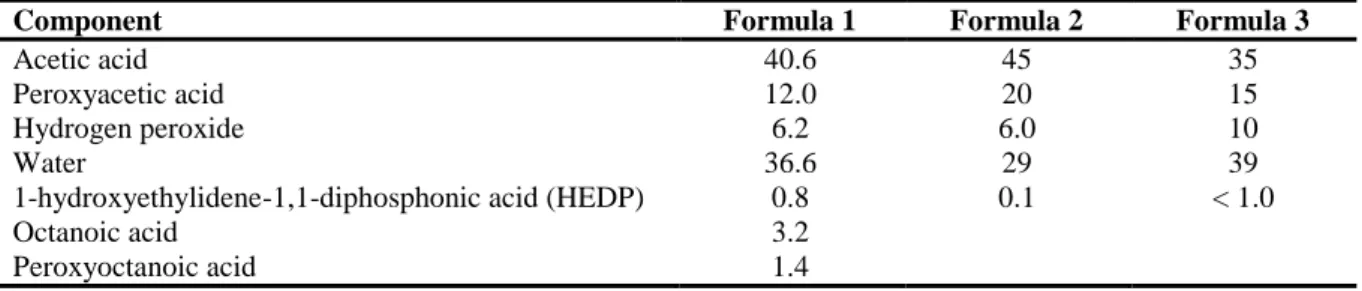
Stock solutions described in the application are made from acetic acid, hydrogen peroxide, octanoic acid and HEDP. Assuming that the NOAEL of 50 mg/kg/bw/day is found in adequate studies, this NOAEL will be used for the safety assessment of HEDP. For adults, estimates of the average and high (95th percentile) exposure of birds to HEDP from application use as described in this opinion are up to 1.16 µg/kg/bw/day and 4.18 µg/kg /bw/day, respectively.

Conclusions
One study in two generations of rats: no teratogenic effects at 50 or 250 mg/kg bw/day with NOAEL at 50 mg/kg bw/day (embryotoxicity found at 250 mg/kg bw/day). A chronic feeding study in rats provided a NOAEL of 105 mg/kg bw/day, but this study was not available for evaluation. For toddlers, mean and high (95th percentile) poultry HEDP exposure estimates are up to 4.76 µg/kg/bw/day and 14.62 µg/kg/bw/day, respectively.
Recommendations
The Panel noted that, given that the studies from which these NOAELs were derived were not available for evaluation, there was some uncertainty regarding the validity of the NOAEL used. Regarding the safety issue of possible reaction products of hydrogen peroxide and peroxyacids with lipids and proteins/amino acids of poultry carcasses, the low content of amino acids on the carcass surface is used as an argument for the previous conclusion of EFSA (2005) that there is no risk. was expected, still holds, including short-term treatment at higher peroxide concentrations. Based on this, the short-term high-concentration bath scenario included in this application is not expected to result in measurable lipid peroxidation.
The efficacy, i.e. does the use of the substance significantly reduce the level of contamination of
Introduction
Selection of studies for evaluation
- Criteria used for inclusion or exclusion of submitted studies
- Determination of the strength of evidence of selected for evaluation of studies
Efficacy evaluation will focus on PAA-treated samples versus water-treated samples, or versus untreated controls. Studies in which microorganisms were inoculated after PAA treatment were excluded from the evaluation as they were not considered to represent practical applications. If the pilot process is representative of the industrial process; otherwise, the evidence makes a "medium" contribution to the totality of the evidence.
Results of the selection of studies for evaluation
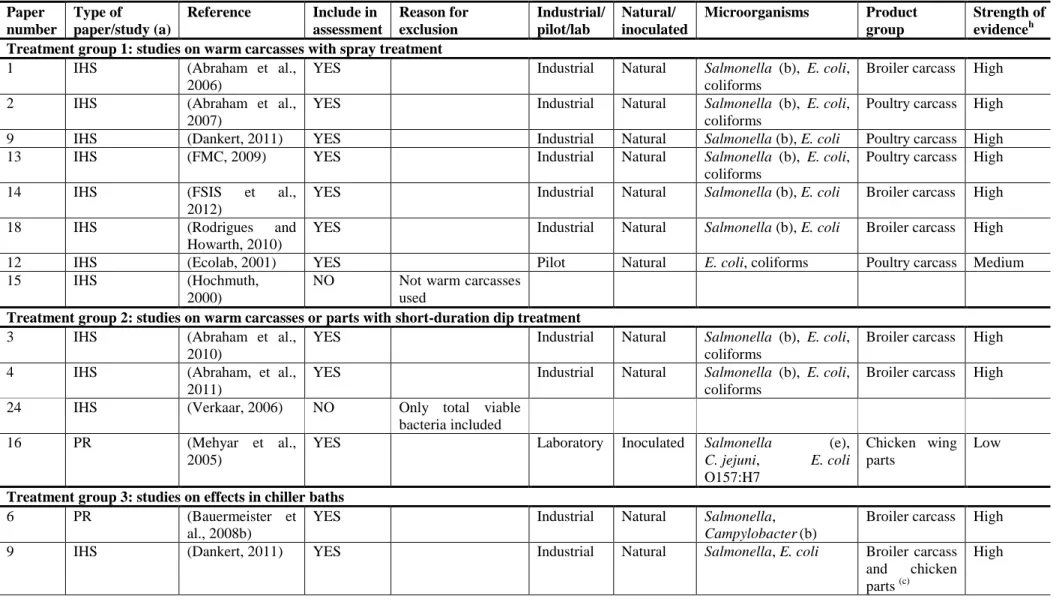
The body of evidence selected (see below) from the studies submitted in the dossier was evaluated taking into account whether the studies were carried out in the laboratory, under pilot plant conditions or on a slaughterhouse (industrial scale) and whether they were used inoculated or naturally contaminated poultry samples. Includes studies where the meat surface was inoculated with pathogens in pure culture prior to the decontamination treatment. Ten of the internal studies were classified with high strength of evidence, two with medium and three with low strength (Table 4).
Statistical significance and statistical methods used
Evaluation of studies
- Treatment group 1: studies on warm carcasses with spray treatment
- Treatment group 2: studies on warm carcasses or parts with dip treatment
- Treatment group 3: studies on effects in chiller baths
- Treatment group 4: studies on chilled carcasses or parts with dip treatment
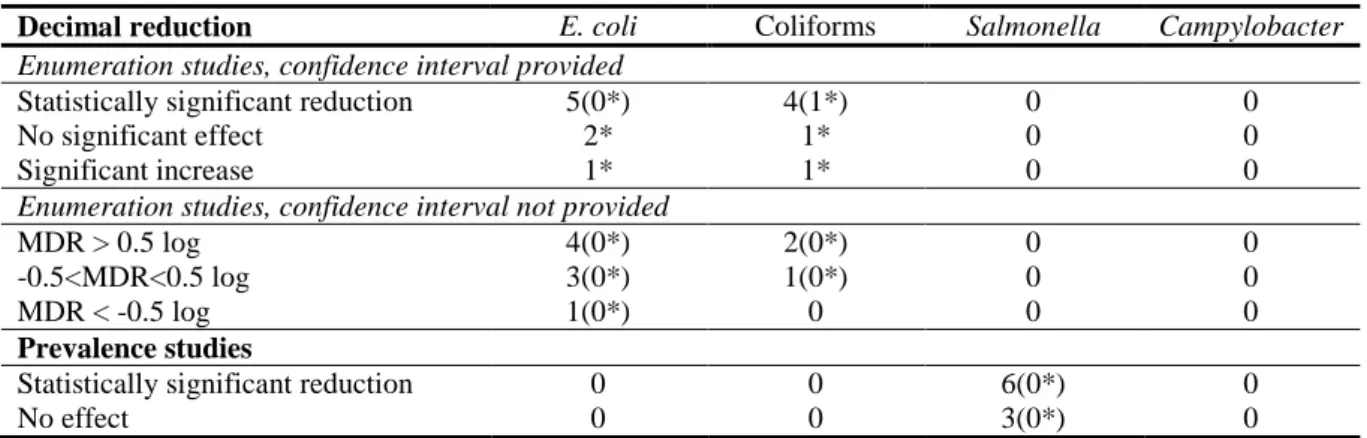
Coliforms in treated compared to untreated visually clean carcasses were reduced by 1.3, 0.1 and 1.0 log units in the three plants. For coliforms, there was a positive effect in 6/9 studies, with a median decimal reduction between 0.5 and 1.3 log-units. For coliforms, there was a positive effect in 8/8 studies with a decimal reduction between 1.12 and 3.25 log-units.
One low-strength study showed a mean decimal reduction of <0.5 log units in Salmonella and Campylobacter; in this study, E. 3 The results showed a reduction of coliforms (line 1/line 2) of 2.22 and 0.85 log units/g below the limit of detection and E. The improved efficiency of PAA compared to water was 0.67 log units for coliforms and 0.81 log units for E.
The improved efficacy of PAA compared to water was 0.53 log units for coliforms and 0.59 log units for E. For coliforms, there was a positive effect in 9/22 studies with decile reduction ranging between 0.3 and 2.4 log-unit. For Salmonella, positive effects were observed in 3/4 datasets with mean decile reduction ranging between 0.3 and 1.3 log-units.
For Campylobacter, positive effects were observed in 1/3 of the datasets, although all datasets showed median decimal reduction values ranging between 0.3 and 0.8 log-units. For Salmonella, positive effects were observed in 10/14 datasets with an average decimal reduction between 0.14 and 1.57 log-units. For Campylobacter, positive effects were observed in 7/8 datasets, with mean decimal reduction values between 0.30 and 3.00 log-units.

Conclusions
For coliforms, there was a positive effect in 3/4 of the studies with a decimal reduction ranging between 0.30 and 1.94 log-units, and for Enterobacteriaceae, 3/4 of the studies showed a positive effect ranging between 0.25 and 2.21 log-units. The reduction in Salmonella prevalence was statistically significant in 6/9 studies (relative prevalence reduction ranged from 28% to 87. There was evidence of a reduction in the number of Salmonella and Campylobacter and indicator organisms when cold carcasses or dips were treated; effects were considered significant for 30/41 data points.
The effects on coliform bacteria were less consistent; the effects were considered relevant for 9/22 data points. Data on the reduction of the number of Salmonella and Campylobacter after this treatment were limited; the effects were considered relevant for 5/7 data points. The incidence reduction of Salmonella and Campylobacter was statistically significant in 7/8 data points of studies of high strength of evidence (the relative incidence reduction ranged between 30 % to 99.
Further integration of data and evaluation of the effect of different processing parameters (PAA concentration, contact time, temperature, pH etc.) was therefore not possible. The effects of PAA treatment should be regularly evaluated in poultry processing plants that use PAA solutions as a decontaminant. Monitoring of the concentration of the decontaminating substance in the working PAA solution must be included in HACCP plans.
Possible occurrence of reduced susceptibility to biocides and/or resistance to therapeutic antimicrobials associated with use of the substance.
The potential emergence of reduced susceptibility to biocides and/or resistance to therapeutic
- Submission by the Applicant (1)
- Information provided in support of the above
- Submission by the Applicant (2)
- Information provided by the Applicant
- Evaluation from EFSA Biological Hazards (BIOHAZ) Panel (3)
- Development of resistance
- Post-market evaluations
- Conclusions
- Recommendations
Similarly, there are currently no published data to conclude that the application of chlorine dioxide, acidified sodium chloride, trisodium phosphate or peroxyacids to remove microbial contamination of poultry carcasses under the proposed conditions of use will lead to resistance to therapeutic antimicrobials. If the product is released into the environment without neutralization, a post-market monitoring and evaluation is recommended to determine the long-term effects of use of the formulated product on the selection and spread of acquired reduced susceptibility to biocides and/or resistance to therapeutic antimicrobials. . These results, although relevant to the repeated use of surface disinfectants on equipment, are not representative of or equivalent to the conditions under which PAA is used in carcass rinsing for meat safety. 2009) also studied whether PAA and other disinfectants caused resistance to therapeutic antimicrobials (ie, antibiotics).
This is important as the bacterial defense mechanisms exerted under these conditions are probably irrelevant to the development of intrinsic (genetic) mechanisms of bacterial resistance to antibiotics. 2012) examined whether bacteria that are resistant to antibiotics are also less susceptible to disinfectants such as PAA. If bacteria use similar mechanisms to develop resistance to an antibiotic and PAA, then the same resistant bacteria should have reduced susceptibility to both PAA and antibiotics. Even in human medicine, the development of antimicrobial resistance to disinfectants is still poor, especially for non-spore-forming bacteria. 2013) found that PAA is a viable alternative to chlorine bleach disinfection for disinfection in hospital settings, despite its already widespread PAA applications.
There is no evidence to support an increased risk or incidence of the development of antimicrobial resistance to PAA in the meat industry since the first patent was obtained in the 1950s. Although no direct experiments have been conducted to test the possible occurrence of acquired reduced susceptibility to biocides and/or resistance to therapeutic antimicrobials following PAA use, the evidence provided regarding the history of safe use of PAA is sufficient to meet the requirements of the 2010 EFSA Guidelines cited above, in that "the applicant may apply for approval based on a history of demonstrably safe use". Based on the information provided by the applicant, the occurrence of acquired reduced susceptibility to biocides and/or resistance to therapeutic antimicrobials after the use of PAA is considered unlikely.
Laboratory studies should be undertaken to confirm that reduced susceptibility to biocides and/or resistance to therapeutic antimicrobials does not occur after the use of PAA.
The risk related to the release of the processing plant effluents, linked to the use of the substance,
Conclusions
The risk associated with the release of the processing plant's effluents, linked to the use of the substance, into the environment. There was little data on reducing the number of Salmonella and Campylobacter for this treatment. Based on the safe use information provided by the Applicant, the emergence of acquired reduced susceptibility to biocides and/or resistance to therapeutic antimicrobials following the use of PAA is considered unlikely.
The risk associated with the release of waste water from the slaughterhouse and/or processing plant, associated with the use of the substance, into the environment. To control residues of HEDP on poultry carcasses, monitoring the concentration of HEDP in the working PAA solution should be considered in the HACCP plans. Monitoring the concentration of the fumigant in the working PAA solution should be considered in HACCP plans.
Opinion of the Scientific Panel on Biological Hazards (BIOHAZ) on "Evaluation of the effectiveness of peroxyacids for use as an antimicrobial agent applied to poultry carcasses". Scientific opinion of the panel on biological hazards (BIOHAZ) on the assessment of the possible effect of the four antimicrobial agents on the emergence of antimicrobial resistance. Scientific opinion evaluating the safety and efficacy of lactic acid for removing microbial surface contamination of beef carcasses, cuts and trimmings.
Scientific Opinion on the Evaluation of the Safety and Efficacy of Cecure® for the Removal of Microbial Surface Contamination from Raw Poultry Products.