BENEMÉRITA UNIVERSIDAD AUTÓNOMA DE PUEBLA
FACULTAD DE LENGUAS
Pre-Service teachers’ perceptions about the effects of a Public Speaking Course to develop oral skills
A thesis submitted to the Faculty of Languages
for the Degree of:
Maestría en la Enseñanza del Inglés
Presented by Florencia Goiz Santillan
Thesis director:
Dra. Rebeca Elena Tapia Carlín
Puebla, Pue. February, 2020
i
ABSTRACT ABSTRACT
Speaking skills are considered vital for future teachers of English as a foreign language (EFL) and whose diverse contexts require them to be fully competent. It is assumed that future EFL teachers, for example, need English exclusively for teaching in a classroom; however, their academic field is more extensive and demanding nowadays. They not only teach class in front of a group or participate in conferences but also take speaking proficiency tests or do dissertation presentations, among other scenarios. This emphasizes the fact that EFL teachers’
communication skills are of great importance to be academically successful. However, pre- service teachers have reduced opportunities to speak which, in turn, affect their oral
communicative skills development. It is a fact that there are different factors that play an important role whether to enhance or inhibit the progress of such oral communicative skills.
The present study attempts to explore the perceptions that 6 pre-service teachers from the Facultad de Lenguas, BUAP, hold after having taken an English course designed under a public speaking approach. The purpose is to identify the effects of this course on pre-service teachers’
oral communication skills. The results show that some insights can help redirect those English general courses to focus more on developing communication skills that contribute to the preparation of competent and proficient English speakers as well as those affective factors that could contribute to do effective oral presentations.
ii
DEDICATIONS
To my parents for their endless love and support Barbara and Otilio, you are my motivation and proud
To my beloved brothers and sisters for their patience, support and guidance My deepest respect to you all
To the whole Goiz family for being with me I love you
iii
ACKNOWLEDGEMENTS
I wish to acknowledge my gratitude to my friends who were essential in the making and
completion of this thesis. I am indebted to them for their help and incomparable support. that I cannot do justice to all their contributions. I thank Dra. Rebeca Elena Tapia Carlín, my advisor, for her support and encouragement along this demanding journey in writing this thesis. You are a great guide: my deep admiration. I should also like to thank my readers, Dr. Eliphelet Rivera Cuayahuitl, Dra. María del Carmen Castillo Salazar, and Mtra. Rosalba Leticia Olguín Díazfor their valuable observations and pertinent comments. Their feedback helped me enrich this thesis to successfully complete it. Finally, I must thank Ross and Norma for their guidance and
confidence, and mainly their trust., and Lupita whose support is surely unconditional. They are great women and great teachers whose experience deserves my respect and admiration.
iv TABLE OF CONTENTS
CHAPTER ONE: INTRODUCTION
1.1 General overview………..….1
1.2 Problem statement………...………..….2
1.3 Purpose of the study.……….….3
1.4 Justification………....4
1.5 Structure of the research………....5
CHAPTER TWO: LITERATURE REVIEW 2.0 General overview……….………..6
2.1 Teacher education………..………6
2.1.1 Second Language teacher education……….………….7
2.1.2 Pre-service teacher education and pre-service language teacher education………...9
2.2 English language teaching and learning……….…………...12
2.2.1 The role of teacher………...………..12
2.2.2 The role of learner……….…13
2.2.3 English language learning……….13
2.3 Oral communication……….14
2.3.1 Oral communication skills………15
2.3.1.1 Public speaking...………...………15
2.4 Studies on oral communication and oral communication skills……… 17
CHAPTER THREE: METHODOLOGY 3.1 Research design………...…20
3.2 Participants………..………21
3.3 Setting……….……….………22
3.4 Instrument………....……22
3.5 Data Collection………24
3.6 Ethical considerations……….……….………26
3.7 Drawing conclusions………27
v CHAPTER FOUR: ANALYSIS AND INTERPRETATION
4.0 General overview……….…28
4.1 Beginning of the course: challenges affecting the oral performance………28
4.1.1. Lack of confidence, anxiety and fear………28
4.1.2. Personal issues………..……30
4.1.3. Linguistic proficiency and communication skills……… 30
4.2. Throughout the course………..………...31
4.2.1. Learning process……….…...32
4.2.1.1. Teacher´s knowledge….………32
4.2.1.2. Peers’ contribution…….………...34
4.2.1.3. Self……….………...………36
4.2.2. Oral communication skills development………..38
4.3. After the course………...38
4.3.1. Perceived oral communication skills improvement………..39
4.3.2. Personal-social benefits………...……….40
4.3.3 Importance/awareness of oral communication skills training………41
4.4 Conclusions………..………42
CHAPTER V: CONCLUSIONS 5.0. General overview……….………..….44
5.1 Discussion of the research questions, findings and their significance……….44
5.2 Contributions to the field………..…...47
5.3 Limitations………...47
5.4 Further research…..……….48
REFERENCES………..49
APPENDIXES Appendix A. Consent form………53
Appendix B. General information format………..54
Appendix C. Group interview questions………....55
vi LIST OF TABLES AND FIGURES
Table 3.1 Participants profile………..21 Table 3.2 Categories of the group interview………...26 Table 4.1 Summary of the analysis……….42
1 CHAPTER ONE
INTRODUCTION 1.1 General Overview
Societies are more interconnected due to the impact and effects of globalization.
Globalization has been one of the major catalysts in the development of societies in term of how to better adapt to the requirements of such phenomenon. A globalized world provides
opportunities to share knowledge by means of the technology to facilitate communication and interaction among societies and to promote the collaboration among individuals and
communities. In order to respond to the demands of this globalized world, societies have made changes; one of these changes has been within education by creating new policies and
reorganizing the educational system to prepare individuals with the necessary skills. The most significant change seen in education has been the inclusion of the learning of a foreign language.
The most widely known and taught language used for this globalized world is English which has been, for many years, the language of communication worldwide.
In Mexico, the government has taken actions to reorganize the educational system to meet the requirements of a changing, globalized world. One of these actions was the
implementation of English in the national curricula; hence, English has become a compulsory subject in elementary, secondary and high school education, for example. This implementation follows the education reform instituted by the Mexican government through the established national educational plan by the Ministry of Education (SEP, 2017) which states that one of the axes of the plan is the development of languages: mother tongues (Spanish or any other native languages), second language (Spanish or any other native languages), and the learning of a foreign language.
2 In view of the above, learning a foreign language has become essential to meet the
educational system plan. This has called, of course, for competent language teachers to
contribute to the accomplishment of such challenge: the task of learning and teaching English as a foreign language in Mexico. For many years English has been considered the language to communicate -and connect- with others because of the benefits it may bring to those individuals who use it such as those related to job, social and cultural opportunities for the pursuit of better employment, academic opportunities or personal welfare.
1.2 Problem Statement
English language teachers need to be prepared to be capable of teaching the language and apply their communicative competence in order to help students develop both the linguistic competence as well as the communicative competence. In addition, English language teachers need to demonstrate their communicative competence in different contexts that involve communication skills; these scenarios can range from having to lecture classes, to give speeches at school events or do oral presentations at conferences to even defend a thesis or a dissertation.
However, even when most language courses offer the linguistic development of the four language skills (reading, writing, listening and speaking), there are few opportunities, in the classroom, for the development of those communicative skills necessary for English language teachers to perform in the aforementioned scenarios they may encounter in their teaching career.
For this reason, a big challenge in the instruction of a foreign language is the development of those oral communication skills that may, in turn, fulfil the communication requirements for an English language teacher.
At the Faculty of Languages, at the Benemérita Universidad Autónoma de Puebla (BUAP),
3 the future English language teachers are expected to exit their major with the expected communicative competence as it is established in the program. However, pre-service English teachers’ exposure to the practice of the foreign language is mostly limited to the classroom which affects students in their development and mastery of those communicative skills. This results in a poor development of the oral ability which may be linguistically developed, but not communicatively applied.
This may be due to the reduced exposure to language practice opportunities, but also to the lack of specific training regarding academic oral skills, necessary for future language teachers. A possible reason why students do not develop the speaking skill efficiently, in an EFL teaching context, may be the insufficient time allotted in class for speaking practice. Moreover, in most EFL contexts the language class involves large number of students which is another factor that limits the opportunities of students to practice the language. These limitations are visible when students struggle at having a conversation or doing an oral presentation. In addition to these constraints, students also face other difficulties, for instance, psychological difficulties such as lack of confidence, low self-esteem, and social difficulties such as age, and personality that contribute to the low performance when using the language communicatively.
1.3 Purpose of the study
The purpose of this study is to explore the perceptions of pre-service teachers regarding their Target Language V course in order to identify the effects their course had on the development of their oral communication skills through a public speaking training. Therefore, this investigation is guided by the following research questions:
4 1. What effects does a course on public speaking have on pre-service teachers’ oral
communication skills?
2. What are the participants perceptions about the development of their oral communication skills in their public speaking course?
1.4 Justification
The program of study of the Faculty of Languages has two programs: Cuatrimestral (four- month term) and Semestral (five-month term). The Cuatrimestral program places the Target Language V course (Lengua Meta V) as the last language course students take during the major and the syllabus establishes that students should be able to integrate the four skills by demonstrating a B2 language competence according to the Common European Framework for languages. At the Target Language V course students are expected to demonstrate their written and oral abilities to defend their opinion, to explain their point of view, to offer feedback, and to know how to organize a speech, among other academic oral skills. All of this it is carried out by the preparation and organization of oral presentations and public speaking tasks. The purpose of the course is to train pre-service teachers to attend and present at academic events and to promote their professional development.
This study intends to explore the perceptions of six pre-service English teachers about their Target Language V course in order to know how beneficial it was for them to be trained to develop their oral communication skills through public speaking tasks like oral presentations. Based on the results, this study may offer insights to be used for the design and implementation of a public speaking-oriented subject or an elective course for the training and assessment of academic communication skills. Moreover, such training could have an impact not only in students’ oral communication skills but also in their development of those strategies to design effective academic
5 presentations. Finally, this study may also help in-service teachers at the Faculty of Languages to recognize students’ weaknesses and strengths when presenting orally so they can guide their teaching towards those strategies needed to improve and develop the skills required for effective academic presentations.
1.5 Structure of the research
This document is organized in five chapters. Chapter one contains a general overview of the study, a brief background of English, the research questions and the justification for the study.
Chapter two presents the literature review focused on the study and the experts and authors’
contributions to the research topics. Chapter three corresponds to the methodology as it shows the type of research and study, the context, and the participants as well as the instrument and the data collection process. Chapter four presents the analysis and results of the study, that is, the answers from the instrument. Finally, chapter five presents the conclusions of this research and the research questions will be answered and discussed
6 CHAPTER II
LITERATURE REVIEW
2.0 General Overview
This chapter presents the theoretical foundations underlying the concepts teacher education, pre- service teacher education, language teaching and learning and oral communication.
2.1 Teacher education
Globalization has had impact not only in the societies’ economy, but also in the social and cultural areas of societies and an adverse consequence of this is the belief of what kind of economy is desirable and what education is for. Under this assumption education is directed “for economic productivity, for technological advancement, for greater competition and market-share, for institutional and learner performance measurement, and for regulation and accountability to ensure that performance-driven economies and pedagogies are not only achieved, but sustained” (Jansen, 2007, p. 25). This complex viewpoint leaves the perception that education must be adapted to the demands of globalization. Therefore, the role of the teacher has also to be adjusted to meet the requirements of the globalized world; for example, Townsend & Bates (2007) state that two influencing factors in the future teaching profession are that teacher will face the demands to be consistent, reflective and practitioner and that the teacher has to be able to rapidly adapt and cope with developing technologies to nurture high quality student learning for all students.
Consequently, in education, “how we teach, what we teach, where we teach, whom we teach – and even whether we teach” are led by globalization Townsend & Bates (2007, p.25). A clear example is the need of countries to include the learning and teaching of languages in their curricula. The necessity to speak other languages from which English has become the mediator because it has
7 become in the language of international trade and communication demands new language teaching policies, greater control of teaching and teacher education, and standards and other forms of accountability (Burns & Richards, 2009).
2.1.1 Second Language teacher education
In a country which is economically active in the world English language skills for most citizens are essential to belong in the new information society and to have knowledge, which ensures social and economic development. Thus, there is a need for effective approaches to the preparation and professional development of competent teachers who fulfill the increasing demand worldwide (Burns & Richards, 2009).
Burns & Richards (2009) point out that language teaching has become more professionalized and it is considered a specialization in the education field, with specialized knowledge provided by the academic study and the practical experience, and with the need to meet entry requirements and standards of the work field. To fulfill those requirements, language teachers need professional training and qualifications to develop English language teaching standards and English language teachers’ standards. Thus, it is necessary to promote the growth of professional journals, conferences, teacher magazines and professional organizations that help to demonstrate those standards. This need is focused on establishing ways to promote professional training that can demonstrate those standards; for example, nonnative speakers require a languages certification to demonstrate their -standardized- level of proficiency.
Smith (2007, cited in Katz & Snow, 2009) suggests four levels of standards for teachers (individual, group, school and profession) and 3 domains (behavioral, affective and cognitive).
According to this range, teachers must be, then, competent under different standards. The content
8 that students require from these standards are the standards that establish the content that teachers must comprehend and master. However, these standards vary according to the context and purpose which is reflected in how differently teachers articulate the core body of knowledge and skills required for teaching.
As it has been mentioned, the cognitive domain is a feature of standardization. In view of this, one of the most outstanding attributes of a language teacher is cognition. Teacher cognition refers to the comprehension of what teachers think, know and believe, according to Borg (2009).
Furthermore, from the perspective of teacher cognition, teaching goes beyond the knowledge application and the acquired skills, becoming a complex process due to the classroom setting,
“teachers general and specific instructional goals, the learners’ motivation and reactions to the lessons, and the teacher management of critical moments during the lesson” Borg (2009, p.5). So, as teachers have a personal reaction to these points of question, teaching makes evident that the personal and situated approaches teachers possess are related to the teacher cognition (Burns &
Richards, 2009) because they use their knowledge to frame their teaching practice since knowledge is based on prior knowledge and the context or situation of that prior knowledge Golombek (2009).
This refers to the concept of Personal Practical Knowledge (PPK) which is characterized as a
“moral, affective, and aesthetic way of knowing life’s educational situations” Clandinin &
Connelly (1987, 59, cited in Golombek, 155, 2009).
The concept of standardization has also brought about new trends in second language education that, in Johnson’s (2009) point of view, have been advantageous to reconceptualize how we think with respect to about second language teachers, second language teacher learning and second language teaching. Hence, he believes it is necessary to reconceptualize the knowledge base which she suggests as a professional self-definition. This knowledge base refers to “the wide
9 conceptualization of what people need to know and what are able to do to carry out the work of a particular profession” (p.21). In second language teaching education the knowledge base introduces 3 areas:
1) the content of L2 teacher education programs, or what L2 learners need to know; 2) the pedagogies that are taught in L2 teacher education program, or how L2 teachers should teach; 3) the institutional forms of delivery through which both the content pedagogies are learnt, or how L2 teachers learn to teach. (p.21)
This is considered the basis for decision-making of how to prepare L2 teachers to do the work of this profession.
2.1.2 Pre-service teacher education and pre-service language teacher education
Exist manifold factors that are outlining contemporary pre-service teacher education, such as standards, meeting the needs of diverse population, international comparison, among others Cochran-Smith & Villegas (2015, cited in Sthal, Sharplin & Kehrwald, 2018). These factors have brought about the need of new approaches as better ways to prepare pre-service teachers (PSTs).
Ryan (2007) mentions that pre-service teachers must adopt new approaches to learning from the beginning of their professional practice. That is, PSTs need not only follow the conventional approaches, but also to experience new learning propositions of teaching and learning such as the lifelong and lifewide learning (learning beyond the classroom). Ryan holds the position that these new approaches encourage learning that occurs in their teaching practice during their teaching experience rather than focusing on the technical assessments. The aim of new ways of learning approaches is to provoke a change in their conceptualization of learning and teaching. The reason
10 for these approaches is to allow students to adapt to the requirements of a changing world. Ryan (2007) mentions “new approaches aim “the development of intellectually stimulating, “rich” and
“real life” tasks, and a focus on skills such as independent learning and problem solving” (p. 193).
These previous statements exemplify the needs that the rapid changing world demands, where pre- service teachers must immerse and show competencies in adapting themselves to meet those needs.
The practice-based approaches main goal is to strengthen the relationship between theory and practice. Sthal et al. (2018) advocate the view problem-oriented approaches that link theory and practice are necessary for teachers to investigate their own context and to share it with other pre- service teachers to identify how to improve their progress and acquire other competencies. Under this basis, Sthal et al. (2018) underline that pre-service teachers require “purposeful learning activities, effective feedback on their skills acquisition, a sense of belonging to a community, opportunities to reflect on and discuss their reflective practice and experience with peer coaching/peer feedback” (p.8).
Borg (2006) suggested the concept of pre-service teachers (PSTs) situated at the beginning of their education programs lack formal language teaching experience. To exemplified this, he introduced different themes emerged from studies about pre-service cognition. Those are “the influence of prior language learning experience on pre-service teachers’ cognitions, pre-service teachers’
beliefs about language teaching, cognitions in relation to practicum experiences, and pre-service teachers’ instructional decision-making and practical knowledge” (p. 52).
Prior language learning experiences refers to the experience we obtain when we are learners is what influences teachers’ cognition. Bailey et al. (1996, cited in Borg, 2006) carried out a study on autobiographical writing and reflection of teachers’ language learning histories with the
11 purpose of finding out how they shaped their current teaching philosophies and practices. The findings recognized certain factors arisen from the pre-service teachers’ learning experiences that had a positive effect on their teaching and learning experiences. Those factors were methodology, established as a second priority after personality and style, caring and commitment, teacher-learner respect, motivation that helps students to regulate their teaching, and positive classroom environment. Borg (2006) presented findings of two different studies, that of Johnson (1994) and Numrich (1996). Borg (2006) emphasized that Johnson’s findings are related to a practicum where the pre-service teachers demonstrated the influence of teachers’ images, materials, activities and the organization of the classroom when they faced instructional decisions-making, while Numrich, Borg mentioned, maintained the fact that pre-service teachers avoid or promote their instructional strategies depending on their positive or negative previous experiences as learners. Borg (1996) highlighted that the basis of future teachers’ conceptual teaching was derived from prior learning experiences that determine cognitions about learning and language learning.
To emphasized the previous viewpoint, Kagan (1992, cited in Sthal et al., 2018) says that when pre-service teachers enter education programs, they bring along with them their personal beliefs, previous experiences with teachers, images of themselves as teacher, and memories of
themselves as students. For this reason, to find the best strategy to prepare pre-service teachers in teacher education programs is a continuous struggle for teachers’ educators.
Borg (2006) indicated that beliefs about language learning of pre-service teachers are closely connected with their first learning experience that shows inappropriate, unrealistic or naive understanding of teaching and learning concerning different topics such as curriculum conception, language learning, language teaching, teaching practice or practicum experience.
12 Instructional decision-making is also interconnected to the teaching experience. Borg (2006) explained that the decisions of pre-service teachers were shaped by the unexpected behavior of students and by the concern they had to maintain the flow of the class. Also, Borg (2006) explained: four overlapping categories that shaped teachers’ performance based on personal practical knowledge (PPK) are knowledge of self, of subject matter, of instruction and of context.
In addition, it was also indicated the relevance of contextual factor inside and outside the classroom have on teachers’ decisions.
2.2 English language teaching and learning
2.2.1 The role of teacher
In the last decades, the role of a language teacher has been seen in a broad sense as the one who promotes learning under the best conditions, to motivate student to arise interest and to engage them in their learning environment (Byrne, 1996). Nonetheless, in EFL settings, opportunities to use English do not abound. The challenges teacher face in providing learners opportunities to speak are eminent. By way of illustration, when the teacher possesses a common language to the learners’, teacher necessarily seek to provide learners opportunities to experience the English language (Savignon, 2001). However, those challenges are bidirectional with the learner because learners, as Lazarton (2001) emphasizes, should take responsibility for their own learning.
However, this responsibility cannot be taken without the guidance and supervision of a teacher (Bajrami, 2015). Hence, the role of teacher is vital to guide learners to independent and competent learner, or autonomous as the new trends in language education require.
13 2.2.2 The role of learner
The role of language learner is seen to be active and dynamic. As learning is no longer a unidirectional process, the role of learners has become more oriented to why they are learning, who they are learning from and where they are learning because they learn from the teacher, the classmates and the outside world providing more opportunities to the learner to use the language (Lazarton, 2001).
As for learners’ role, learner autonomy has become a trend to change from the teacher-centered to learners-centered approaches. Learner autonomy underlines learners’ ability to take responsibility of one’s own learning as well as the assessment of their work. In short, students must construct their own criteria, independence and awareness for judging the quality of their work and learning (Bajrami, 2015).
2.2.3 English language learning
Savignon (2001) remarked teachers are expected to be examples for learners. The role of teacher becomes in model for applying ways or methods for learning and teaching a language. For this reason, through the time, there have been different learning and teaching methods which have directed the way to teach English as a second or foreign language. The communicative language teaching has been one of the most embraced method for teaching since the goal is to develop communicative competence. In fact, this main goal of communicative competence for learning the English language is achieved when learners develop their ability to understand and express themselves in the foreign language. Accordingly, when learning a foreign language, it is imperative learners master the communication skills, writing, speaking, listening and reading.
However, according to other authors, this communicative competence concerns other
14 competences. For instance, four competences proposed by Savignon (1983) are grammatical competence, discourse competence, sociocultural competence and strategic competence. The assumption of these competences is that they help learners to expand their communicative competence through practice and experience because they are not isolated but interrelated.
Savignon (2001) observes that English language learning has a purpose which is that learners experience the language when they must use it for real and immediate communicative goals. This has been a principle to pursuit for long time as Byrne (1996) underlined the main concern of a teacher is the development of the ability to use the language for different communicative purposes.
Nevertheless, she affirmed it must be understood the difficulties encountered to develop the skills for communication, particularly, the oral ability of understanding and speaking.
2.3 Oral communication
Oral communication has been approached as a two-way process between the speaker and listener and involves the receptive skills, speaking and listening, and it is considered one of the most demanding skills to be developed. From Rothwell (2017) point of view “communication is a transactional process of sharing meaning with others” (p.4)
Lazaraton (2001) suggests that multiple skills should be taught, and oral skills teaching should involve reading and writing as basis or follow up for speaking activities. Another suggestion to be considered is the teaching of strategies. She considers that training learners to use the strategies might help learners to become competent. Because of this belief, teachers must structure their teaching practices based on the learners need. Savignon (2001) suggests that the communicative needs of the learners should be considered in order to select and sequence the teaching materials.
15 Lazarton (2001) states that oral skills classes are structured around functional uses of language;
however, in academic contexts for adults other practice activities are demanded such as giving report, in business, for example. Lazarton suggests various activities to promote oral skills, for example discussions, speeches, role plays, conversations.
EFL classrooms is a bigger challenge for teacher since the outside the classroom learners does not have opportunities to use English language. Nunan (1993, cited in Lazarton, 2001) found out that the biggest challenges in the EFL classrooms were lack of motivation, engaging students to speak and the use of the first language. Nunan also drew attention to the size of the class which limits the learners’ opportunities to talk and limits teachers’ opportunities to provide feedback.
Regarding this point of view, Lazarton (2001) suggests that in order to compensate these challenges, teachers should incorporate authentic, motivating and varied material for in-class and out-of-class activities.
2.3.1 Oral communication skills
In higher education it is essential to manage one of the most important soft skills, the oral presentation. This is ability is performed in different academic and professional contexts and most importantly it is delivered publicly, clearly and eloquently. Speeches as a simple activity involves the preparation of a talk which depends on the level of the student and the focus of the class 2.3.1.1 Public speaking
Alley (2003) mentions three advantages to presentations. These advantages are focused on the speaker in interaction with the audience: to answer questions for the audience which provides further information about the topic, to obtain immediate feedback from the audience and revise
16 the presentation in-site for the audience, to emphasize key points. Some other aspect advantageous to the presenter is the inclusion of visual aids to help the audience to engage in the presentation.
The last advantage, Alley (2003) claims, is of legal nature: a method to demonstrate the audience has witnessed the information.
Alley (2003) argues that in order to be successful in delivering a presentation is necessary to consider three aspects: to match what is said to the audience, purpose and occasion. To target the audience is with the purposeful idea of communicating one’s work, so it is imperative to present the information in a way the audience understands the work presented. The purpose is addressed to inform, to persuade or to inspire or a mixture of purposes. The occasion refers to considerations in terms of formality, time limit for the presentation, time of the presentation, logistics, location, number of attendees. It is then remarkably important to pay attention to the room and surroundings, oneself (attire, movements and voice), the audience or the time.
In addition, Alley (2003) remarks that when a presentation is analyzed four perspectives should be considered: speech (what you say and targeted to the audience), structure (organization), visual aids and delivery (interaction with the audience). The presentation structure relies on the organization of the points to be addressed, the transition from one to another point, the depth that the presenter achieves, and the highlight of the details. In the delivery phase, rehearsal, control, and combat of nervousness can be of great help to have successful presentation.
To sum up, “the essential ingredients for a strong presentation that not only delivers the information, but that truly engages the audience—three ingredients have to be present. First, the speaker must understand the subject. The speaker is not expected to know everything about the subject, but what the speaker imparts must be worth the audience’s time. A second essential
17 ingredient is that the speaker must have a keen awareness of the audience: what they know about the subject and why they have attended. The third essential ingredient is that the speaker shows a genuine enthusiasm for the subject” (Alley, 2003, p.206).
Another viewpoint is Rothwell’s (2017) who states public speaking is carried out by an
identified speaker whose act of communication is formal presented to an audience in an event to achieve a specific purpose. In this act, the presenter and his audience influence each other during the constantly, changing and dynamic process of sharing meaning. He claims that
communication competence model is a “well-deceived theoretical model” (p. 7). It is defined as
“engaging communication with others that is perceived to be both effective and appropriate in a given context” Spitzberg (2000, cited in Rothwell, 2017). To be effective is the process to achieve the goal whether persuade, inform, etc., that goes from deficiency to proficiency and oriented to the audience and following the rules that the context requires.
2.4 Studies on oral communication and oral communication skills
Al-majal & Al-majal (2014) studied the difficulties EFL Jordan undergraduates faced in speaking skills at the EFL context. They found out that students had a poor language performance which indicated linguistic competence, but not communicative competence. Various reasons were found such as little exposure to develop their oral communication performance, class size, lack of confidence in their speaking ability, and the use of L1, in addition to the remarkable finding of the feeling of need that participants expressed to have courses for teaching speaking.
Al-Nouh, Taqi, & Abdul-Kareem (2015) carried out a study to investigate the perceptions of EFL college students in Kuwait were when performing oral presentations to be assessed. Their study focused on three different categories: personal traits, oral presentation skills, and instructor and
18 audience. As their study was mixed method approach, quantitative and qualitative, the results pointed that students experience difficulties in a medium level. The category that highlighted was personal traits difficulties such as feat of evaluation, avoidance of instructor´s eyes and forgetting the information. Regarding presentation skills, the results emphasized on the need to see a presentation model and the need to have oral-skill courses.
Ikoma (2017) investigated Japanese EFL learners’ perceptions of peer feedback in oral presentations. She found out the opinions given by the classmates were objective, and she considered this as a sign that presenters value their peers feedback because they learned about their weaknesses and the aspects that needed improvement. Despite these good results, she found out that there were students that considered the feedback of their peers not useful and some had lack of confidence in using their peers’ opinions; the teacher’s point of view was more important, however. A key point in her study was that students learned more and improved their final presentation by giving feedback rather than receiving feedback from their classmates because giving feedback made realized their own weaknesses and this arose awareness.
Abid (2018) conducted a study to learn the challenges that pre-service teachers in the Province of Gorontalo, Indonesia perceived from their individual’s experiences in improving their English oral proficiency level. She revealed three challenges pre-service teachers had 1) linguistic proficiency difficulties, 2) socio-cultural challenges, and 3) English language engagement opportunity challenges.
Ka-kan-dee & Al-Shaibani (2018) investigation was focused on the anxiety level and feelings of Tourism students had when performing oral presentations in the English for tour guide course.
Their research was qualitative and quantitative and in the application of the different methods they
19 found that the levels of anxiety were from moderate to high in delivering oral presentation and in
all communication contexts. An effect of the presence of anxiety was to forget the information and fear due to the inadequate preparation.
20 CHAPTER THREE
METHODOLOGY
This chapter describes the methodology developed in this study describing the participants, the instruments, and the procedures that were followed based on the qualitative methodology in order to collect and analyze the data.
3.1 Research design
Qualitative research centers on the research problems of individuals or groups whose interpretation of the problem is associated to a social or human problem, and in order to be studied researchers make use of qualitative approach to collect data in a natural setting. The analysis of the data collected is inductive and frames the data into patterns or themes (Creswell, 2007).
As the purpose of this study is to explore the effects pre-service teachers perceived from their target language V course aimed to be developed by means of public speaking in academic contexts, and the perceptions the pre-service teachers have on the development of their communication skills, this study methodology entirely relies on qualitative research. The research method applicable to this study is the exploratory case study because “the case study research involves the study of an issue explored through one or more cases within a bounded system (e.g., a setting, a context), and it is a type of design in qualitative research, or an object of study, as well as a product of inquiry. The case study, then, allows the researcher to explore a bounded system (a case) or multiple bounded systems (cases). (Creswell, 2007, p.73). This project aims to interpret what pre-service teachers’ views of their world are in the specific
21 context which tends to be their target language V course. This is emphasized under the statement that if the objective is “to pay close attention to an interviewee’s personal rendition of an event, then the interviewee’s perceptions and own sense of meaning are the material to be understood (Yin, 2018, p. 163).
3.2 Participants
In order to collect data a single group interview was organized with six participants. They completed a format to obtain some personal information aspects (see Appendix B). The
participants were 6 pre-service teachers of Target Language V (Lengua Meta V) of the Faculty of languages at the Benemérita Universidad Autónoma de Puebla (BUAP). Their ages range between 21 and 28 years old. The group was mixed, 2 women and 4 men, from different semesters (table 3.1). The six participants are enrolled students at the faculty of languages studying the undergraduate program to become EFL language teachers.
Table. 3.1 Participants’ profile
AGE GENDER SEMESTER
1 Janet 26 F 6
2 Fernando 21 M 5
3 Nancy 21 F 6
4 Alberto 28 M 8
5 Marcos 23 M 6
6 Sergio 21 M 7
22 3.3 Setting
This study was carried out with students of the Licenciatura en la Enseñanza del Inglés (the undergraduate EFL teaching program) of the faculty of languages at BUAP. This program has been current since 2009 with the aim of preparing individuals with skills, abilities and
knowledge to teach English as a foreign language. There were two programs, the first one was cuatrimestral and the second one was semestral. The former consisted of three four-month courses and the latter considers two courses a year. Within the curricula of the four- month term, it is required for students to take 5 compulsory Target Language courses (English). Target Language V is offered in the third year of the program being this course the last English course required. The course is a communication course aimed to demonstrate comprehension of texts of different lengths, to speak fluently and spontaneously without hesitating much to find the correct expression, and write well defined coherent and organized texts, among other skills. All of this is expected to be developed through public speaking and writing preparation in academic contexts.
3.4 Instrument
Among the data approaches to carry out qualitative studies that may be suitable for this study were the focus group or a single group interview. From both perspectives, it was found more fitting the single group interview. Silverman (2005) points out that interviews elicit perceptions and give access to meanings attached to experiences: they also help to construct narratives and help to obtain external reality (facts, events) and/or internal reality (feelings and meanings, for example). Under another author similar perspective, the interview is seen as a method of data collection that suggests explanations of key events and obtain the perspectives of participants reflected by the insights (Yin, 2018). Yin also states three types of interviews: prolonged case
23 study interviews, shorter interview, and survey interviews. The second one was the one this study adapted better. The shorter interview is open-ended, and it is carried out in a
conversational manner. Yin suggests that, as it was mentioned previously in the research design section, if the researcher is interested in knowing the personal rendition of participants regarding an event, a single shorter interview is appropriate. He also mentions that focus group is a
matching method for the single group interview, but this gained popularity as a market research, which requires the researcher to recruit and convene a small group of people, in addition to moderate the discussion. For these reasons, the single group interview seemed better option to obtain the data in this study because the interviewer allowed participants to answer and interact, in a conversation manner, leading the questions smoothly using cues and prompts to encourage the interviewee to consider the question further, when necessary or when the interviewee has difficulties to answer a question (Hancock, 2002).
The interview was a semi-structured interview design considering five basic questions (see Appendix C). These questions were open-ended and during the interview a follow-up question emerged a follow-up question. The first question was about the obstacles that students faced at the beginning of the course regarding oral presentations. The second question was about the strategies that students used to feel more comfortable at the moment of speaking and at the moment of presenting. The third question was about how fruitful the feedback from the peers and teacher was and what was the effect. The fourth question was the emerging follow-up question to know the suggestions to handle better the feedback handouts/sheets provided in their course. The fifth question was about how the learning of the process and strategies used in the classroom for oral presentations had been visible in other areas outside the classroom such as personal, social or academic areas. The last question, the number six, was about the
24 recommendation the participants can make to whom want to develop the speaking skill through oral presentations as a public speaking method.
3.5 Data collection
In order to collect the data for this study, it was necessary to find a teacher who oversaw a group of target language V and who was willing to help asking students, pre-service teachers, to participate in this study. Once a teacher was found, she helped to kindly ask students who would like to participate in the group interview. Only six participants out of 20 (the number of students in the course) accepted and showed willingness to participate. Then, a first meeting was arranged to explain the purpose of the study and the dynamic of the interview. During the first meeting they were asked to sign a consent form to be able to use their information with academic purposes and protect the confidentiality of the information (see Appendix A). After that, the place and the time of the group interview was set, according to their schedule, and all participants agreed.
As it was mentioned before, six pre-service teachers participated in the group interview, and before the interview session participants were arranged in a circle to establish a more familiar- like context. Then, they were explained that the interview consisted between five or six questions (considering that one or more follow-up questions might emerge) and that the interview would be recorded. It was also emphasized that they could ask questions to clear up any doubts. At this point, two tape recorders were set to guarantee the fidelity of voices and to be able to confirm data that might seem incomprehensible or unclear in one of the tape recorders. After those technical arrangements, the first question was stated. The question was open to be answered giving freedom to participate when they were ready and willing. The same procedure came
25 afterwards with the following questions. That is, participants engaged in the interview randomly in each question. For this reason, the researcher participation was exclusively moderating the participations and at some moments during the interview to encourage participants to broaden their responses.
Once the interview was carried out, the first step to do was to transcribe the data and it were assigned the names of the participants to the corresponding extracts in order hto avoid mixing up the participants contributions. At this point, it is important to mention that they were given a different name to guarantee the privacy of the information.
Then, as the questions (see Appendix C) were meant to provide a general overview of target language V course, the transcription was organized in three parts, according to the questions’
objective: the first part, question one, addressed aspects before (the course) presentations, the second part, questions 2 and 3, made reference to aspects involved during the presentation event, and the third part, questions 4 and 5 addressed the aspects involved after the presentation event.
This the overall structure of the study that led to start the analysis.
Wilkinson (2004) mentioned that there are two approaches to analyze the data obtained from a focus group: content analysis and ethnographic analysis. To some extent, content analysis renders a systematic and comprehensive overview of the data as an entity. In narrative research, on the other hand, there is the categorical content perspective or content analysis which is used in the fields of psychology, sociology and education according to Manning and Cullum – Swam (1994 in Lieblich, Mashiach & Zilber 1998). The latter considers the following four steps:
selection of subtext, definition of the content categories, defining categories and drawing conclusions from the results. From Wilkinson’s point of view, content analysis of the data
26 focuses on the recurrent instances in the data which are identified, analyzed and coded
systematically. As the interview data was a simple orthographic transcription, among the
different types of data analysis, the content or thematic analysis was the most suitable to follow.
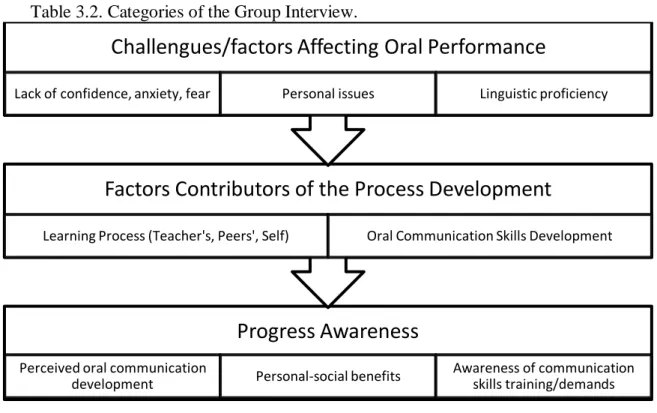
The data obtained from the group interview was analyzed bottom-up: first, recurrent words or units of information were found and organized on a table within rough categories.; second, the sentences or group of sentences corresponding to the rough categories were grouped into themes identified in the selection to define subcategories; and t, third, the subcategories help to find the major content categories. The result of the categorization (Table 3.2) has been represented as follows.
Table 3.2. Categories of the Group Interview.
3.6 Ethical Considerations
There were some considerations taken to handle the data obtain from the group interview: a) participants were informed the purpose of the study; b) participants names were changed to
Progress Awareness
Perceived oral communication
development Personal-social benefits Awareness of communication
skills training/demands
Factors Contributors of the Process Development
Learning Process (Teacher's, Peers', Self) Oral Communication Skills Development
Challengues/factors Affecting Oral Performance
Lack of confidence, anxiety, fear Personal issues Linguistic proficiency
27 guarantee anonymity and respect; c) they signed a consent format (see Appendix A) to maintain confidentiality and guarantee the ethical utilization of the information obtained.
3.7 Drawing conclusions
The information obtained following the procedure explain in this chapter are analyzed in the following chapter, Chapter IV, corresponding to the analysis and interpretation of the data collected.
28 CHAPTER FOUR
RESULTS 4.0. General Overview
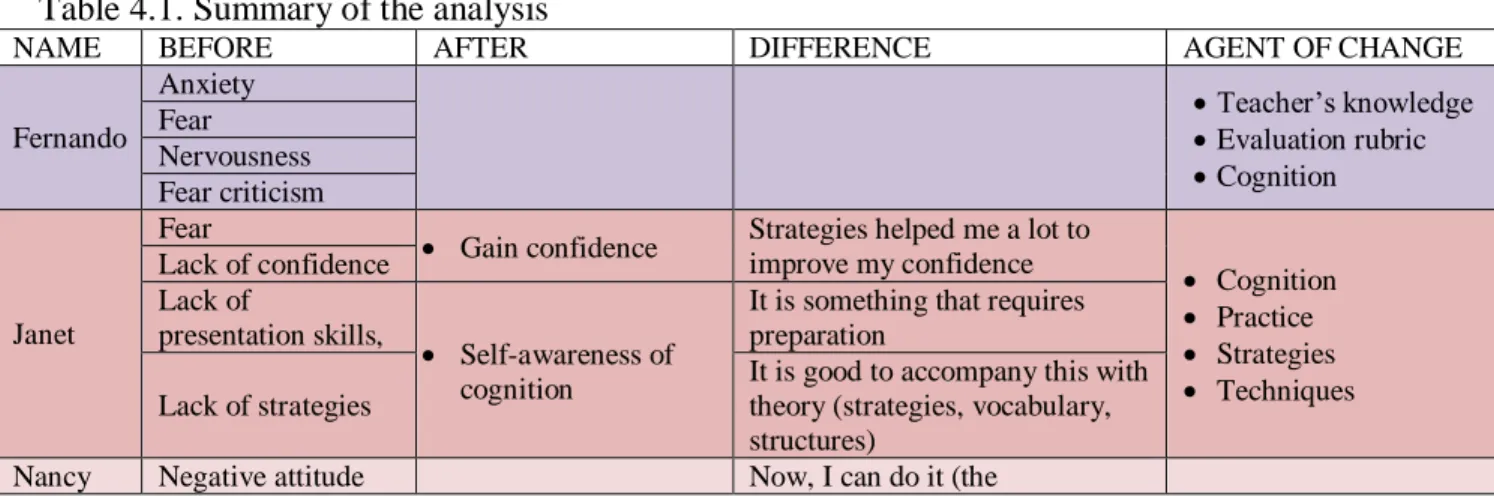
This following chapter presents the results after analyzing the data described in the chapter 3. The results are presented according to the emerging categories in the analysis. The analysis is divided in three sections. The first section is the challenges pre-service teachers encountered or faced at the beginning of their public speaking course to develop their oral skills. The second section considers subthemes corresponding to the learning process and the development pre-service teachers had during the course. The last section refers to the reflection pre-service teachers made after they finished the course.
4.1 Beginning of the course: challenges affecting the oral performance
This section shows three main categories that emerged: 1) Lack of confidence, anxiety and fear, which overlapped or have a strong tie, 2) Personal Issues, representing emerging topics such as personality, family and attitude, and 3) Linguistic proficiency.
4.1.1. Lack of confidence, anxiety and fear
Four pre-service teachers were consistent in perceiving anxiety as an obstacle in their oral communicative skills. It is perceived in the following excerpts. Conditional states like shyness, fear, and anxiety result in the lack of confidence and low self-esteem to deliver a speech or to do an oral presentation. Maleerat & Ghayth (2018), in their study of oral presentation anxiety in tourism students, state that “oral communication apprehension is also related to unwillingness, shyness, nervousness, and uneasiness to speak” (p. 274). The following verbatim quotations serve as illustration:
29
“The first obstacle I have always had is nervousness and to know that somebody… might criticize me, and, well, this always happens to me when speaking in public…In the past, however, it happened to me a lot that I was afraid of forgetting everything when presenting”. (Fernando)
Fernando expresses his fear and anxiety to present in public due to the idea of being criticized. He perceives that nervousness has a negative effect in his oral performance. Janet also describes feeling uneasy to do an oral presentation when she encountered herself in a new atmosphere. This is perceived as a trigger to experience nervousness which influence her negatively. The following excerpt illustrates this:
“In my case, when I showed up the first time (to class): it was the first week of the course. I think I did not know anybody in the audience. Well, I did not know many of them. Then, it was like a new group…sometimes it was more difficult to present before people you do not know, mainly because it was a shy group: it was not like a group you will get along with/spend time with later on. This made me nervous, and I remember, this made me to forget mi speech” (Janet)
Nancy was unwilling to participate and deliver a speech. It is perceived her lack of confidence and the low motivation to engage in the class which reflected in the fear to fail the subject.
As it is illustrated in the following example:
“I think my obstacle was that I did not want to participate and present and give a speech because from the moment I entered the course, my classmates, who had already taken the course, told me I had to present. I was like (anxiety sound) if I do not present, what happens? Do I fail?” (Nancy)
Alberto’s perception is that his speaking skills are connected to his personality, this influences his confidence and because of his low self-esteem he is worried what other classmates might think of him as a speaker.
“I have never been, like very talkative, mainly in public. Since I was a child, I have had this problem and it is difficult for me. Sometimes I feel that whatever I say is going to affect someone.” (Alberto)
30 4.1.2. Personal issues
There were significant comments considering issues close related to those affecting directly their oral communication skills. The most relevant were attitude, personality and family issues. This unveils that individual-social factors can have an impact and can influence students’ oral communication skills development. Marcos showed lack of interest. This negative attitude can be assumed to be caused by his previous experiences: when he expressed “it is just a class”, “it is one more class”. In addition, the perception is that he considered the course disadvantageous to offer learning opportunities. As exemplified in the following extract:
“My obstacle was apathy. I felt that participating was not going to be worth. I felt like
“it is just class; it doesn't matter if I do well or wrong. It is one more class. I may pass.
I do it well and that's it; I do it wrong and maybe the teacher gives me a six or seven [grade]” That was my obstacle, I felt [the class] was not going to be worth/useful at all.” (Marcos)
Alberto reveals his family difficulties played an important role in his performance since his concentration was affected. As presented in the below excerpt:
“In my house there are many problems and sometimes I am not very concentrated.”
(Alberto)
4.1.3. Linguistic proficiency and communication skills
The following excerpts show what it seems to be a lack of knowledge of strategies to demonstrate their communicative competence, and which clearly affects their academic performance. In addition, the lack of knowledge of oral communication skills seems to be the source for their lack of confidence and self-esteem. For example, Nancy struggled to select a topic and Sergio faced difficulties in expressing his ideas. Both established the need
31 of guidance (due to the lack of presentation skills) to develop their oral communication skills in public speaking. The following verbatim quotations serve as illustration:
“At the beginning, my major obstacle was to have the idea disorganized in my head, totally disorganized. Then, at the moment of passing to the front it was like taking anything coming from my head, and then it ended up having no sequence. It did not have logic at the moment of explaining it to my classmates.” (Sergio)
“A second obstacle was to choose the topic because it was for my audience because the first topic I saw was about films, but I wanted to talk about other topics and I told myself:
what if maybe they do not like what I am going to say and this affects my presentation.”
(Nancy)
Janet showed awareness of her lack of strategies to present a well-structured speech;
nevertheless, this was not an impediment to deliver her speech. Similarly, Alberto and Marcos showed awareness of their linguistic competence and the need to develop their communication skills.
“...despite it was not very good structured because I did not have enough strategies to be able to organize my speech adequately, I had practiced a lot, and then when I was at the front it was like ahhh... and I forgot [the speech]” (Janet)
“... I do not have much vocabulary, I had to look up words in my dictionary to be able to present well... because it is terrible to not know vocabulary, and I want to say this, but I said it with colloquial language. At the beginning of the course, it was not that the course was difficult for me, I took the course as an opportunity to develop that ability because I did not have it and it was like starting to build a new concept.” (Alberto)
“I have the problem that when I want to comment something with somebody, I want to feel comfortable with myself and with what I am saying. Then sometimes the ideas on my head do not flow properly…” (Marcos)
4.2. Throughout the course
When students take a language course, they are expected to learn theories and strategies, among other aspects, that will help them improve their oral competence and skills. In this section, it is
32 presented the findings arisen from the perceptions pre-service teachers had during their language course where the objective was to develop their oral communication skill. The most significant findings are related to their 1) learning process which has been influenced not only by the teacher, as it is expected, but also by the peers and by themselves, and 2) oral communication skills development.
4.2.1. Learning process
Learning, from a basic definition from the Cambridge online dictionary, is the process of getting knowledge or a new skill. In this process there are some aspects involved such as training, practice and experience.
4.2.1.1. Teacher´s knowledge
The role of a teacher is outstanding in the process of learning. It is the main guidance for learners to develop their knowledge and skills. Bajrami (2015) points out that teacher’ guidance and supervision are fundamental for students’ learning process efficiency despite students are the responsible ones for their own learning and autonomy. Bajrami (2015) also mentions that a teacher is a facilitator in an autonomous classroom: 1) he/she is responsible to guide the activities in the classroom and help students to plan their learning, 2) they have the role of counsellors guiding students to choose the appropriate learning strategies, and 3) an autonomous classroom permits a constructive interaction among learners and teacher learning from each other. For instance, Marcos expresses the influence of the teacher to create a social interaction in the class which is perceived in the apparent increase of his confidence. Sergio, on the other hand, expresses the teacher’s guidance for the use of strategies that helped him in situations outside the classroom. As shown in the following extracts:
33
“...thanks to the teacher, I could tackle my obstacles because she kept telling us that the course was going to be helpful, that it was going to be beneficial, and I realized that it was turning to be useful. I was starting to get along with my classmates because of the simple fact of preparing my speech and having to ask my classmates helped me to face my apathy of presenting a speech.” (Marcos)
“The teacher taught us a structure that is the PAB (position, action and benefit). This helped me a lot, quite a lot, because it was to present a product, to have exactly a position or an opinion of the product you are going to sell, and I had to be positive…”
(Sergio)
Alberto perceived the role of teacher as a model. This emphasizes the fact that students learn from the teacher. As mentioned in the following excerpt:
“...in class I also realized that when the teacher spoke, she demonstrated too much of what she taught us. It was like a good example…” (Alberto)
Findings also demonstrate the role of the teacher as core component in the learning process when feedback is provided. Feedback is considered a relevant aspect in effective communication skills. It seems pre-service teachers considered teacher’s feedback a contributing factor for their communication skills development. They perceived that teacher’s feedback was more valuable. This may rely on their assumption that a teacher is more knowledgeable, therefore, more reliable and acceptable. This assumption might depend on the pre-service teachers previous learning experience, for example, as stated by Fernando who expresses his previous experience working with the teacher.
However, the general perception of these pre-service teachers in that the act of giving feedback is by the exposure to the teacher’s knowledge in view of:
a) his/her experience
“Then, when it is from the teacher [feedback], like a figure that already has experience in this, it is when I can accept. Sometimes, I feel that the teacher’s feedback is very personal…”
34 (Fernando)
“I feel that the teacher’s feedback helped me a lot because she is going to be a figure who already has experience and she is teaching us the class of how to improve and when I saw how the teacher was sitting down analyzing how all our presentation were going, it was then when I did take into account what she said.” (Marcos)
b) proper guidance and objectivity
“...I agree with my classmate. The teacher’s feedback was always objective “you did well in this for this, you need to improve this…” (Sergio)
“The evaluation of the teacher, like Fernando mentions, I really took it into account because she has more experience and I told myself, she watches my movements, my posture… my PowerPoint presentation. She does all of that and she gives me a constructive criticism, because that is constructive…” (Nancy)
and c) behavior.
“Regarding the teacher’s feedback, oneself can notice when the teacher is paying attention.
As it is part of the evaluation, of course, she is going to pay attention. I have taken classes with the teacher and I know how she works. It gives me confidence when I see the results and even more because she uses an analytic rubric where you can see really where you can improve or what were your mistakes…” (Fernando)
4.2.1.2. Peers’ contribution
Pre-service teachers reveal that the presence of peers have contributed to their learning process as well as their gaining of confidence. For example, Marcos shows positiveness in working with his classmates which contributes to his interpersonal interaction. The following extract shows this:
“I was starting getting along with my classmates: only with the simple fact of preparing my speech and having to ask my classmates helped me to face off my apathy of presenting a speech.” (Marcos)
Another aspect that emerged is how pre-service teachers perceive peers’ feedback in their learning process. For example, Sergio considered the feedback beneficial and constructive when he judged
35 it objective as well as Nancy who hardly received comments, but the ones she thought objectives were considered. As commented by Sergio:
“In my case, in the feedback, I saw which ones were objective. Really, there are classmates that make the effort to write: you made a mistake for this reason. Another aspect I observed was, for example, that 10 comments were good and two were bad about the same thing.
Then, if the majority agreed, it was objective.” (Sergio)
“I was unlucky like my classmates say that as I did not receive any comments in my rubric, I didn’t know what was bad or what was good… “When the comments were objective, I took them into account...” (Nancy)
Another perspective is also from Nancy who found out the classroom environment more effective to obtain immediate feedback because at the moment of presenting she could visualize the posture of her classmates, their body language. As illustrated in the below excerpt:
“...Also, I watched the feedback when I was presenting, their expressions, how some of them were not paying attention [to my presentation] and for answering the rubric others would lose track of my presentation… this helped me more than what my classmates wrote on the rubrics.” (Nancy)
However, Marcos did not consider his peers’ feedback because of their position as students. This reveals his belief that the status in the classroom (be a student) implies not to have knowledge, experience or good judgement to give feedback; as a result, the comments were not beneficial. It can be then assumed that more than negative attitude towards his peers’ feedback, it is a personal belief or prejudice issues. As exemplified in the following extract:
“It is hard for me… to receive feedback from my peers because, I don’t know, I feel that, as I see them as my equals, I feel that their feedback does not help me much.”
“...then, I see another peer feedback that has the opposite, so seeing different opinions I voided them.” (Marcos)