Smartphone Communication
This book offers a unique model for understanding the cognitive underpinnings, interactions, and discursive effects of our evolving use of smartphones in everyday app-mediated communication, from text messages and GIFs to images, video, and social media apps.
Adopting a cyberpragmatics framework, grounded in cognitive pragmatics and relevance theory, it gives attention to how both the particular interfaces of different apps and users’ personal attributes influence the contexts and uses of smartphone communication. The communication of emotions – in addition to primarily linguistic content – is foregrounded as an essential element of the kinds of ever-present paralinguistic and phatic communication that characterises our exchange of memes, GIFs, “likes,” and image- and video-based content. Insights from related disciplines such as media studies and sociology are incorporated as the author unpacks the timeliest questions of our digitally mediated age.
Aimed primarily at scholars and graduate students of communication, linguistics, pragmatics, media studies, and sociology of mass media,
Smartphone Communication traffics in topics that will likewise engageupper-level undergraduate students.
Francisco Yus is Full Professor at the University of Alicante, Spain, and guest
professor at Fujian Normal University, Fuzhou, China. He is currently the
head of the Inter-university Research Institute of Applied Modern Languages
of the Valencian Community (IULMA) at the University of Alicante as well
as Head of the Research Group Professional and Academic English.
Routledge Studies in New Media and Cyberculture
Women and the Digitally-Mediated Revolution in the Middle East
Applying Digital Methods
Chiara Bernardi
The Discursive Power of Memes in Digital Culture
Ideology, Semiotics, and Intertextuality
Bradley E. Wiggins
Digital Media, Sharing and Everyday Life Jenny Kennedy
Digital Icons
Memes, Martyrs and Avatars
Yasmin IbrahimArtif cial Intelligence in Cultural Production
Critical Perspectives on Digital Platforms
Dal Yong JinLoving Fanf ction
Exploring the Role of Emotion in Online Fandoms
Brit KelleyPosthuman Capitalism
Dancing with Data in the Digital Economy
Yasmin IbrahimSmartphone Communication
Interactions in the App Ecosystem
Francisco YusFor more information about this series, please visit: www.routledge.com/
Routledge-Studies-in-New-Media-and-Cyberculture/book-series/RSINC
Smartphone Communication
Interactions in the App Ecosystem
Francisco Yus
First published 2022 by Routledge
2 Park Square, Milton Park, Abingdon, Oxon OX14 4RN and by Routledge
605 Third Avenue, New York, NY 10158
Routledge is an imprint of the Taylor & Francis Group, an informa business
© 2022 Francisco Yus
The right of Francisco Yus to be identified as author of this work has been asserted by him in accordance with sections 77 and 78 of the Copyright, Designs and Patents Act 1988.
All rights reserved. No part of this book may be reprinted or reproduced or utilised in any form or by any electronic, mechanical, or other means, now known or hereafter invented, including photocopying and recording, or in any information storage or retrieval system, without permission in writing from the publishers.
Trademark notice: Product or corporate names may be trademarks or registered trademarks, and are used only for identification and explanation without intent to infringe.
British Library Cataloguing-in-Publication Data
A catalogue record for this book is available from the British Library Library of Congress Cataloging-in-Publication Data
A catalog record for this book has been requested ISBN: 978-1-032-06066-8 (hbk)
ISBN: 978-1-032-06067-5 (pbk) ISBN: 978-1-003-20057-4 (ebk) DOI: 10.4324/9781003200574 Typeset in Sabon
by Apex CoVantage, LLC
To my supportive family: Pilar, Mónica and Javier
Contents
List of figures ix
List of tables xi
Acknowledgement xii
1 Introduction: the smartphone phenomenon 1
PART I
Pragmatics, cyberpragmatics, and smartphones 11 2 Relevance theory, internet pragmatics, and
cyberpragmatics 13
3 Contextual constraints and non-propositional effects 27 4 Smartphone communication and app usability 43
PART II
Smartphone-mediated discourse and communication 55
5 Texting: from SMS to smartphone messaging 57 6 Phone calls and video calls are (surprisingly)
also enabled 107
7 New narratives and storytelling on the smartphone 119
PART III
Media on the smartphone 141
8 Media on the smartphone: images 143
9 Media on the smartphone: video and animation
(GIF, sticker) 173
viii Contents
PART IVThe interplay between the physical and the virtual 193
10 Livestreaming: the case of Twitch 195 11 Location-based smartphone interaction 211 12 Towards online–offline congruence: social
networking apps 231
13 Concluding remarks and future projections 270
References 275
Index 307
1.1 The evolution of smartphones with some representative
devices per year. 3
3.1 A chart of extended cyberpragmatic research. 36 5.1 Pragmatic implications of contractive and expressive
textisms .
61
5.2 An example of misunderstanding in the use of emojis. 80 5.3 SM conversation in which emoji substitutes verbal
elements of the message. 90 5.4 A conversation including an instance of emoji without
function. 93
5.5 WhatsApp conversation made up of emojis. 94 6.1 Evolution of human interaction and socialisation
(adapted from Wellman 2001 ). 110 6.2 Overlapping mutual cognitive environments
(inspired in Schlote and Linke 2010 : 124). 116 7.1 Evolution of cybergenres ( Shepherd and Watters 1998 ). 122
7.2 Spanish Twitter thread by Noe T. 137 8.1 Visual explicature from a panel in the comic book
Exit. © Nabiel Kanan. 144
8.2
User–audience contiguity (through an image) on socialmedia. 154 8.3 A cyberpragmatics of the selfie. 161 8.4 Visual explicature and visual implicature in selfie-based
communication. 165 9.1 A cyberpragmatics of (first-order) video-related
communication. 174 9.2 The smartphone app Bilibili. 183
10.1 A cyberpragmatics of livestreaming on Twitch. 197 10.2 The T witch interface (desktop and smartphone). 200 10.3 Three sample chat box interactions on Twitch. 203 10.4 “Global” system
emotes on Twitch. 20411.1 Facebook check-ins. 225
Figures
12.1 Facebook app interface (left) and Messenger app for
interactions (right). 233 12.2 Stickers and emojis in replies to users’ posts on Facebook. 241 12.3 Some of the multimodal humorous discourses shared
on SNAs during the coronavirus pandemic. 244 12.4 Paralinguistic digital affordances on Facebook plus recent
coronavirus-related reactions. 250 12.5 Image-based
interactivity triggers .261 12.6 Dialogue cross-cutting the physical–virtual realm and
group-identity effects. 267
x Figures
8.1 Identity-related constraints–effects correlations mediated
by images. 159 10.1 Questions on Twitch (summarised from Ask et al. 2019 ). 196 10.2 Some popular Twitch
emotes described. 20611.1 User’s environmental orientations between physical and
virtual contexts ( Misra and Stokols 2012 ). 213
Tables
Acknowledgement
I would like to thank Bryn Moody for his stylistic suggestions on a draft of this book.
I would also like to thank the Routledge editorial team, Suzanne Rich-
ardson, Tanushree Baijal, and Emma Sherriff, for their outstanding job at
editing this book.
1 Introduction
The smartphone phenomenon
1.1 The ubiquity of smartphone communication
Nowadays it is almost impossible to walk on the street without coming across someone typing on their smartphone. These devices are ubiqui- tous, much more than first-generation mobile phones. Unlike those mobile phones, smartphones are small-sized computers that people use for myriad purposes, beyond the oral or video conversations that initially constituted the main point of mobile phones compared to today’s massive use of apps.
In the smartphone era, communication between humans has not decreased;
talk has, though. The
app ecosystem on smartphones, as labelled in the titleof the book, offers users a whole range of options for interaction beyond traditional phone calls.
Certainly, the number of options for interaction and communication that
we are currently offered through smartphone apps has soared in comparison
to previous devices: “persistently internet-connected smartphones afford
communication patterns as complex as those available on the personal com-
puter. Additionally, they offer possibilities for access to online information
as well as various forms of content consumption and production, including
multimedia and games” ( Bertel 2013 : 6). The smartphone can be considered
a metamedium, as proposed by Márquez (2017 ), a platform which houses
many old and new media. Similarly, Jansson (2013, in Pettegrew and Day
2015 : 124) proposed the term
mediatisation for a transformation broughtabout by technology that not only influences our communication but also
reflects how other social processes become inseparable from smartphone
technology and dependent on it across a broad variety of domains and at
different levels. Finally, such devices fit the label of polymedia ( Madianou
2014 , 2020 ), understood as an environment of communicative opportuni-
ties that functions as an “integrated structure” within which each individual
medium is defined in relation to all other media (thus fitting the label app
ecosystem proposed in this book). This kind of interrelated structure satisfiesthe need for imbrication and complementation between apps that we find on
smartphones nowadays. Indeed, in polymedia “the emphasis shifts from a
focus on the qualities of each particular medium as a discrete technology to
DOI: 10.4324/9781003200574-1
2 Introduction
an understanding of new media as an environment of affordances” ( Madi- anou and Miller 2012 : 170).
Framed within this app ecosystem, smartphones give people enhanced opportunities to strengthen personal relationships via more efficient rela- tional coordination. As Pettegrew and Day (2015 : 126) stressed, new technologies such as smartphone apps are reshaping various forms of com- munication and workplace relationships along with everyday forms of talk.
Such advances in the digital age form a collective dimension of interpersonal communication that fully centres technology on our day-to-day experiences.
Similarly, Wei and Lo (2006 ) proposed six gratifications arising from smart- phone use: information seeking, social utility, affection, fashion and status, mobility, and accessibility.
At the very heart of this new media ecosystem lies the app as the quintes- sential unit of smartphone management. Especially for younger generations, apps serve as the gate through which they conceptualise the world they live in. This ecosystem of smartphone apps entails that users can pursue a wide variety of goals with their devices and add new apps when new per- sonal needs turn up in the future: “Users decide what a smartphone is for themselves, rather than just adopting a given product” ( Jung 2014 : 300). As Gardner and Davis (2013 : 8) emphasised, whatever human beings might want should be provided by apps; and if the desired app still does not exist, it should be devised right away; and if no app can be imagined or devised, then the desire simply does not (or at least should not) matter.
The smartphone has invaded face-to-face interactions too. People often look at their smartphones for a substantial amount of time and dismiss those around them in their physical environment, often causing uncomfort- able situations. Reid (2018 : 5) states in this respect that we have normalised our techno-lives: “We have come to accept that smartphones lurk in the background of every conversation and interaction, and we rarely expect full attentiveness from one another. We excuse our smartphone habits as impor- tant and necessary, constantly making justifications for their presence.”
Two main aims underlie this book. On the one hand, it aims to describe the issues involved in the production, communication, and interpretation of discourses on smartphones, additionally providing a theoretical, (cyber) pragmatic account of the kinds of interaction that are sustained through these devices. On the other hand, the book ultimately aims to find an expla- nation to why people find smartphone communication so interesting, why users get so addicted to information and interactions on these devices even though they are often trivial, cues-filtered and lacking means of contextu- alisation; why users dismiss the rich face-to-face environments around them and prefer to remain glued to the smartphone screen, isolating themselves from the physical world and living their digital lives so intensely through these devices instead.
The smartphone, undoubtedly the most pervasive and influential 21st-
century invention, was born in 2007 when the first
iPhone appeared in the
Introduction
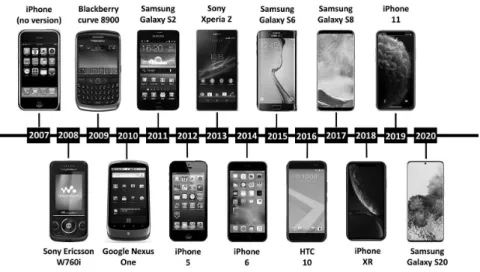
3 market with its app-mediated interface managed on a touchscreen and with the possibility to download apps. Since then, as shown in Figure 1.1 , many other companies have copied or developed this kind of interface; and the evolution of these devices has been amazing.
The smartphone is not just a mobile phone; it can actually be described in more accurate terms as a portable personal computer ( Masur 2019 : 187).
Indeed, smartphones offer apps for any user’s need (synchronous messaging communication, social networking, email, location-based services, camera, photo editing, video . . .) in a single device. This
app ecosystem, together withinternet connectivity and their capacity to track users’ location, stand out as the three key features of smartphones nowadays ( Bertel 2013 : 13).
With the countless apps that are available to download on smartphones, users can take advantage of these devices for entertainment, search for infor- mation, and/or use apps to maintain relationships. This device is also optimal to achieve hedonic goals, when users are bored and just want to “kill time.”
As such, smartphones have proved to be addictive in two realms. Firstly, addiction to the smartphone itself, with users carrying the device with them at all times as an extension of their bodies (a digital companion in the words of Carolus et al. 2019 ), and causing
nomophobia (fear of not having thesmartphone with them); and secondly, addiction to the apps installed, which causes fomo (fear of missing out, that is, fear of not accessing all the barrage of information provided by these apps, for instance, missing out on the latest news about the celebrities that the user follows).
Both addictions (to the device and to apps) can be easily understood given the range of interactive and communicative options that the smart-
phone ecosystem offers, which may include voice-based audio files, writtenFigure 1.1 The evolution of smartphones with some representative devices per year.
4 Introduction
messages (i.e. typed and often oralised using what will be labelled as
text alteration in Chapter 5 , in conjunction with visual aids such as emojis, stick-ers and GIFs), pictures, videos, and links or other digital content, to quote but a few. Depending on the app through which these types of communica- tions take place, the content can be extremely private and sensitive (e.g. in dyadic messaging conversations) or non-sensitive and public (for instance, when posting a publicly available picture on a photo-sharing platform such as Instagram for others to see and comment on).
1.2 Main objectives and underlying hypotheses
This book has as its objective to provide the first ever fully cyberpragmatic account of smartphone communication ( Yus 2011a ).
1If purely pragmatic analyses of internet-mediated communication are scarce (see Herring 2013b ), such pragmatic analysis applied to smartphone communication is certainly even more scarce. Therefore, the ultimate aim of this volume con- sists in filling this gap existing in (cyber)pragmatic research.
Its foundations can be identified in my theory of cyberpragmatics. Accord- ing to the premise underlying this book, all smartphone-mediated communi- cation can be explained by resorting to basic claims regarding a cognitive and inherently human search for relevance (also in their everyday smartphone interactions), paired with human reluctance to expend too much effort in these smartphone-mediated interactions. Broadly speaking, relevance theory (the theoretical foundation of cyberpragmatics) claims that, because our minds are relevance-oriented, we tend to focus our attention on what will most probably provide us with some interpretive reward, or expressed differently, on what is bound to be beneficial to us. Therefore, in smartphone communication users are also bound to show a biological tendency to pay attention to the most relevant stimuli on their smartphones, the ones that draw their attention more than other competing stimuli. At the same time, they will be discouraged if their smartphone interactions demand too much mental effort, for instance apps that demand too many taps on the screen to get to the desired informa- tion. However, as will be seen in the book, very often users are ready to spend additional effort in managing certain apps if they get some reward from these interactions that compensates for this extra effort.
Secondly, relevance theory claims that all utterances have a number of possible interpretations, though not all of them are equally likely (i.e. equally relevant). An addressee will inevitably tend to select the most relevant inter- pretation. But when it comes to smartphone communication, the hypothesis is that the mediation of smartphone interfaces, or the fact that much infor- mation on these devices is typed and hence devoid of adequate contextual information, may make this interpretive decision harder or may demand increased effort when working out the intended interpretation.
Thirdly, an underlying hypothesis suggests that studying smartphone com-
munication by focusing only on the interpretations and eventual relevance of
Introduction
5 the propositional information contained in the utterances exchanged between users appears as a seriously limited approach to this kind of communication.
Therefore, the book argues for the importance of completing and comple- menting the cyberpragmatic study of smartphone communication with two terms: contextual constraint and non-propositional effect (see Chapter 3 ).
In a nutshell, contextual constraints may be defined as aspects which underlie smartphone acts of communication and users’ interactions (i.e.
they exist prior to the act of communication) and determine their eventual (un)successful outcome. They
frame, as it were, communication and have animpact both on the quality of interpretation and on the willingness to engage in future interactions. Non-propositional effects, in turn, refer to feelings, emotions or impressions which may or may not be overtly intended by the sender user, but which are nevertheless triggered by the act of smartphone communication. These add (positively or negatively) to the effects obtained from utterance interpretation (propositional content). The addition of these terms becomes essential if we want to understand why users interact to such an extent on their smartphones, why they shy away from oral interactions in physical settings, or why they resort to typed text even though more con- textualised (and free) options, including phone and video calls, are available on the smartphone as well.
Finally, this book will also take into account the construction and man- agement of the relevance-theoretic notion of mutual manifestness – closer to more traditional terms such as mutual knowledge and shared knowl-
edge, albeit with a different cognitive approach. In short, this notion refersto the intersection of the interlocutors’ accessible information at a specific stage of the dialogue in which they are engaged ( Sperber and Wilson 1995 : 40). Speakers have to guess and predict not only the characteristics of their interlocutors’ accessible contextual information, but also which part of that information is shared (mutually manifest). Successful smartphone interac- tions are normally the ones where contextual information plays a major part in revealing the information that is mutual or shared by the interlocutors.
In sum, interlocutors often take for granted information to which neither of them has real access due to a lack of physical co-presence or miscalculated context accessibility in the addressee, and misunderstandings and miscom- munication may consequently arise. The wrong assumptions of mutuality may be focused on the physical–virtual interface; by way of example, to assume that the other user has similar access to the information surrounding the “sender user” from their physical environment or from assumptions of usage codes involved in certain communicative strategies such as the use of emojis or text alteration.
Some more specific objectives of the book are:
[1] To study how users manage their communicative strategies and intended
interpretations through smartphone messaging apps (WhatsApp, Snap-
chat, WeChat, Line, etc.).
6 Introduction
[2] To account for the implications of text alteration and the use of emojis when users inferentially fill the gap between what the other users type and what they really intend to communicate through messaging apps.
[3] To provide a description of contextualisation as well as presumption of information mutuality in oral communication through the smartphone.
[4] To assess the cyberpragmatic challenge posed by new narratives cre- ated on smartphones in terms of authorship, discourses, and varieties of readers.
[5] To analyse the interpretive outcomes that arise from discourses such as text, image, video, (animated) stickers, and GIFs, together with their multimodal combinations.
[6] To account for livestreaming on the smartphone, paying special atten- tion to the portal Twitch .
[7] To study the impact of the virtual–physical interface on how communi- cation is managed, context is selected, and mutuality of information is predicted and accomplished through location-aware smartphone apps.
[8] To account for the use of social networking apps on the smartphone.
1.3 Overview of this book
This volume is divided into four Parts. The first Part, Pragmatics, cyberprag-
matics, and smartphones, supplies the theoretical foundations of the bookand is made up of three chapters:
Chapter 2 addresses basic ideas of pragmatics (especially relevance the- ory), internet pragmatics, and cyberpragmatics, offering a description of the main tenets included in these theories. Relevance theory seeks to answer two main questions regarding human communication ( Carston 2009a ): (a) how does the hearer/reader of an utterance arrive at the correct interpretation?
and (b) on what basis does the speaker/writer choose a particular linguis- tic expression in order to communicate the meaning/thoughts they have in mind? These also become important for a cyberpragmatics of smartphone communication. This chapter likewise offers an introduction to internet pragmatics and cyberpragmatics.
In turn, Chapter 3 deals with the aforementioned notions of contextual
constraint and non-propositional effect, both of which will be present inevery chapter of the book as a complement to more proposition-oriented cyberpragmatic analyses.
Chapter 4 deals with the importance of app usability in today’s smart- phone communication. Usability affects users’ processing effort when using apps, which clearly plays a part in the eventual relevance of the information accessed or interactions carried out through these apps.
Part II ,
Smartphone-mediated discourse and communication, comprisesthree analyses of (mainly verbal) communication on smartphones.
Chapter 5 , which revolves around smartphone messaging, starts with an
analysis of SMS texting. After that, a detailed examination of smartphone
Introduction
7 messaging is offered, beginning with interface- and user-related constraints that determine the users’ communicative activity on those messaging apps.
The next sections address smartphone messaging discourse. The chapter ends with an account of non-propositional effects stemming from smart- phone messaging use.
Chapter 6 focuses on phone and video calls, one of the richest and most contextualised means of interaction on a smartphone, because the subtleties of the interlocutors’ voice and visual nonverbal behaviour (in the case of video calls) are available to lead users in the right inferential direction. The chapter also analyses smartphone use as one further step in the evolution of human communication and interaction from door-to-door communica- tion to today’s smartphone-mediated communication between physically scattered interlocutors. Besides, the chapter highlights a proposal of four different layers of mutuality (mutual manifestness in relevance-theoretical terminology) existing between interlocutors having a conversation in a face- to-face environment and phone calls intruding on this offline conversation.
Chapter 7 explains the specificity of new digital narratives on the internet, placing special emphasis on smartphone-mediated narratives compared to traditional printed narratives. After some insights into these narratives, sev- eral types of digital narrative on smartphones are analysed and contrasted with more traditional counterparts.
Part III , which revolves around Media on the smartphone, offers a pro- posal for a possible cyberpragmatic analysis of such discourses. Lack of space prevents an account of all the media involved in smartphone commu- nication, and therefore this section focuses on three types of media: image, video, and animated discourses (stickers, GIFs).
Chapter 8 centres the analysis on images and possible types of commu- nication sustained by means of these discourses. It starts with a proposal to equate inferential strategies typically suggested for utterances to the ones required to interpret images. The chapter continues, providing some histori- cal background on camera practices before moving on to an account of pos- sible contextual constraints influencing the use of images on smartphones.
The chapter comes to an end with a long section devoted to selfies, about which a cyberpragmatic chart of steps is proposed.
Chapter 9 in turn focuses on smartphone videos and their roles in smart-
phone-based acts of communication, together with an analysis of animated
discourses such as GIFs and stickers. The chapter firstly proposes an analysis
of online video, including the duality of
first-order and second-order video-centred interactions. While the former is the initial act of video communi-
cation, the latter takes place when users share or forward the video on a
different site, which entails different audiences, strategies of contextualiza-
tion, and eventual effects. Its next section deals with the specific qualities of
smartphone videos and their management through dedicated apps. Some
smartphone-specific apps such as Bilibili and TikTok are analysed, together
with some innovative multimodal discourses, for instance the overlay of
8 Introduction
video and text superimposed on the screen in the Chinese trend of danmu.
The final part of the chapter is devoted to animated discourses: GIFs and stickers and their respective roles in the interactions where they typically appear.
Finally, Part IV,
The interplay between the physical and the virtual, isdevoted to aspects that, one way or another, entail an interrelation between online and offline environments for communication and interaction purposes.
Chapter 10 addresses livestreaming on the smartphone, paying special attention to the platform Twitch . As such, livestreaming connects the physi- cal and the virtual, since users normally stream from a physical location for their audiences to watch online and frequently on their smartphones. Follow- ing an initial analysis of the contextual constraints involved in livestream- ing platforms, the chapter specifies possible streamer and audience reasons to engage in livestreaming and to watch it. The central part of the chap- ter focuses on the kinds of interactions that take place on the popular app Twitch , which exhibit different possibilities through different levels of con- textualisation, from rich video-mediated communication to plain typed text in a chat box, which have interesting pragmatic implications.
Chapter 11 covers one of the most intrinsic aspects of smartphone-medi- ated communication: the interface between the physical and the virtual, along with the growing importance of users’ location in today’s interactions and access to information, also important in relation to pragmatic issues such as the contextualisation of utterances exchanged through these devices.
The first pages of this chapter review the increasing relevance of location and explain how mobile devices have altered traditional forms of commu- nication in physical settings. Some possible labels that convey this idea of merging physical–virtual sources of information are subsequently listed. The chapter then shifts into more communicative issues associated with smart- phone location. Several sub-sections address topics such as contextual con- straints in communication through locative media, a more intention-centred account of manifestness when using locative media, and finally the analysis of non-propositional effects leaking from the use of locative media. To con- clude, the chapter mentions the trend of check-ins on social media (more specifically on Facebook).
Part IV ends with Chapter 12 , dedicated to social networking sites on
smartphones. This chapter was placed inside this Part about the interface
between online and offline environments because on social networking sites
the user is expected to remain the same unique person in both environments,
online and offline. Indeed, users regard their online self as an integral part of
their overall identity production and thus coordinate their online self-identity
with their offline self-performance. The chapter addresses interaction within
social networking sites, especially highlighting users’ reactions such as Likes
(labelled as paralinguistic digital affordances). Some specific comments
about the specificity of social networking sites on smartphones are also pro-
vided, together with an independent section devoted to the important issue
Introduction
9 of identity on social networking sites. It is argued that identity shaping, self- expression, social bonding, and search for audience validation stand out as the main reasons users engage so intensely in social networking.
The book ends with a short chapter of concluding remarks and future projections. Some future pragmatic research issues on smartphone commu- nication are proposed and briefly commented upon. Today’s uses of smart- phones are likely to continue in the near future, but new apps will become fashionable, and new ways of interaction on these apps will turn up and eventually become conventionalised among smartphone users.
1.4 The specificity of smartphone communication
This book, in its four Parts, aims to provide cyberpragmatic insights on a number of issues framed within interaction, communication, and context accessibility on smartphones. It shows ways in which the smartphone meets current needs for communication, interaction, retrieval of information, and identity shaping. As such, it also shows how specific smartphone communi- cation is in aspects such as the following:
1 Smartphone communication interfaces the physical and the virtual; it encompasses a whole range of communicative options ranging from cues-filtered text-based discourses to highly contextualised video.
2 The smartphone is an original communicative device holding an app
ecosystem, where users combine different apps for their communicativeneeds. This ecosystem is both appealing and challenging. The implica- tions of this multiplicity of apps in smartphone communication are one of the most interesting issues addressed in the book. In this sense, Madi- anou (2020 : 76–77) comments that “to understand a smartphone, it is not sufficient to list all platforms nested in a particular mobile device.
We need to understand how the assemblage of platforms and applica- tions produces a new dynamic that extends beyond the capabilities or affordances of individual platforms. Users define and use each platform in relation to all others within a composite environment.”
3 As a theory of how people rely on contextual information when inter- preting utterances, cyberpragmatics, with its anchorage in relevance theory, should be suited to account for the multiple acts of communica- tion taking place through smartphones on an ordinary basis.
Note
1 The book Cyberpragmatics (John Benjamins 2011) is now open access: https://
doi.org/10.1075/pbns.213.
References
Aharony, Noa. 2015. “What’s App: A Social Capital Perspective.” Online Information Review 39 (1): 26–42.
Albawardi, Areej. 2018. “The Translingual Digital Practices of Saudi Females on WhatsApp.”
Discourse, Context & Media 25: 68–77.
Albritton, Andrew. 2017. “Emotions in the Ether: Strategies for Effective Emotional
Expression in Text-Messages.” Online Journal of Communication and Media Technologies 7 (2): 50–58.
Alexander, Bryan. 2014. “Playing Stories on the Worldboard: How Game-Based Storytelling Changes in the World of Mobile Connectivity.” In The Mobile Story: Narrative Practices with Locative Technologies, edited by Jason Farman , 192–204. Abingdon: Routledge.
Al Rashdi, Fathiya. 2018. “Functions of Emojis in WhatsApp Interaction Among Omanis.”
Discourse, Context & Media 26: 117–126.
Al Rousan, Rafat , and Nour El Houda Remil . 2018. “Gender Differences in the Use of Emojis in Viber Communication among University Undergraduates.” In Proceedings of LILA
’18, 58–70. Istanbul: Dakam Yayinlari.
Androutsopoulos, Jannis. 2010. “Localizing the Global on the Participatory Web.” In The Handbook of Language and Globalization, edited by Nikolas Coupland , 203–231.
Chichester: Wiley-Blackwell.
Androutsopoulos, Jannis , and Janna Tereick . 2016. “YouTube. Language and Discourse Practices in Participatory Culture.” In The Routledge Handbook of Language and Digital Communication, edited by Alexandra Georgakopoulou and Tereza Spilioti , 354–370.
Abingdon: Routledge.
Appel, Markus , and Timo Gnambs . 2019. “Shyness and Social Media Use: A Meta-Analytic Summary of Moderating and Mediating Effects.” Computers in Human Behavior 98: 294–301.
Arminen, Ilkka. 2005. “Sequential Order and Sequence Structure – The Case of Incommensurable Studies on Mobile Phone Calls.” Discourse Studies 7 (6): 649–662.
Ask, Kristine , Hendrik Storstein Spilker , and Martin Hansen . 2019. “The Politics of User- Platform Relationships: Co-Scripting Live-Streaming on Twitch.tv.” First Monday 24 (7).
Aull, Bethany. 2019. “A Study of Phatic Emoji Use in Whatsapp Communication.” Internet Pragmatics 2 (2): 206–232.
Baik, Jeeyun. 2020. “The Geotagging Counterpublic: The Case of Facebook Remote Check- Ins to Standing Rock.” International Journal of Communication 14: 2057–2077.
276Bakare, Lanre. 2019. “Black, Solo and Female: YouTuber Breaks New Grounds with Travel Videos.” The Guardian, 14–19–2019, pp. 18–19.
Bañuelos, Jacob. 2013. “Claves de la fotografía digital contemporánea: Prácticas, competencias, socialización y tendencias [Keys to Contemporary Digital Photography:
Practices, Competences, Socialisation and Trends].” In Investigar las Redes Sociales.
Comunicación Total en la Sociedad de la Ubicuidad, edited by Octavio Islas and Paola Ricaurte , 9–17. México: Razón y Palabra.
Bárány, Tibor. 2019. “Pictorial (Conversational) Implicatures.” In Image and Metaphor in the New Century, edited by András Benedek and Kristóf Nyíri , 197–208. Budapest: Hungarian Academy of Sciences.
Barker, Valerie , and Nathian Shae Rodriguez . 2019. “This Is Who I Am: The Selfie as a Personal and Social Identity Marker.” International Journal of Communication 13: 1143–1166.
Barton, David. 2018. “The Roles of Tagging in the Online Curation of Photographs.”
Discourse, Context & Media 22: 39–45.
Barton, David , and Carmen Lee . 2013. Language Online: Investigating Digital Texts and Practices. London: Routledge.
Batty, Craig. 2014. “Smartphone Screenwriting: Creativity, Technology, and Screenplays-on- the-Go.” In Mobile Media Making in an Age of Smartphones, edited by Marsha Berry and Max Schleser , 104–114. Cham: Palgrave Macmillan.
Bengtsson, Emelie , Rebecka Källquist , and Malin Sveningsson . 2018. “Combining New and Old Viewing Practices. Uses and Experiences of the Transmedia Series ‘Skam’.” Nordicom Review 39 (2): 63–77.
Benson, Phil. 2015. “YouTube as Text: Spoken Interaction Analysis and Digital Discourse.” In Discourse and Digital Practices. Doing Discourse Analysis in the Digital Age, edited by Rodney H. Jones , Alice Chik , and Christoph A. Hafner , 81–96. Abingdon: Routledge.
Bernicot, Josie , Olga Volckaert-Legrier , Antonine Goumi , and Alain Bert-Erboulet . 2014.
“SMS Experience and Textisms in Young Adolescents. Presentation of a Longitudinally Collected Corpus.” In SMS Communication: A Linguistic Approach, edited by Louise-Amélie Cougnon and Cédrick Fairon , 29–45. Amsterdam: John Benjamins.
Berry, Marsha. 2016. “Out in the Open: Locating New Vernacular Practices with Smartphone Cameras.” Studies in Australasian Cinema 10 (1): 53–64.
Berry, Marsha. 2017. Creating with Mobile Media. Cham: Palgrave Macmillan.
Bertel, Troels F. 2013. Mobile Communication in the Age of Smartphones: Processes of Domestication and Re-Domestication. PhD Thesis. University of Copenhagen.
Bertel, Troels F. 2016. “‘Why Would You Want to Know?’: The Reluctant Use of Location Sharing Via Check-ins on Facebook among Danish Youth.” Convergence 22 (2): 162–176.
Bevan, Jennifer L. 2017. “Perceptions of Selfie Takers Versus Selfie Stick Users: Exploring Personality and Social Attraction Differences.” Computers in Human Behavior 75: 494–500.
Bhandari, Upasna , Tillmann Neben , Klarissa Chang , and Wen Yong Chua . 2017. “Effects of Interface Design Factors on Affective Responses and Quality Evaluations in Mobile Applications.” Computers in Human Behavior 72: 525–534.
Bieswanger, Markus. 2013. “Micro-Linguistic Structural Features of Computer-Mediated Communication.” In Pragmatics of Computer-Mediated Communication, 277edited by Susan Herring , Dieter Stein , and Tuija Virtanen , 463–485. Berlin: Mouton de Gruyter.
Bilandzic, Mark , and Marcus Foth . 2012. “A Review of Locative Media, Mobile and
Embodied Spatial Interaction.” International Journal of Human-Computer Studies 70: 66–71.
Birnholtz, Jeremy. 2010. “Adopt, Adapt, Abandon: Understanding Why Some Young Adults Start, and Then Stop, Using Instant Messaging.” Computers in Human Behavior 26:
1427–1433.
Bolander, Brook. 2017. “Language and Identity on Facebook.” In Language, Education and Technology, edited by Steven Thorne and Stephen May , 143–154. Berlin: Springer.
Bolander, Brook , and Miriam A. Locher . 2015. “‘Peter Is a Dumb Nut’: Status Updates and Reactions to them as ‘Acts of Positioning’ in Facebook.” Pragmatics 25 (1): 99–122.
Bou-Franch, Patricia , and Pilar Garcés-Conejos Blitvich . 2014. “Conflict Management in Massive Polylogues: A Case Study from YouTube.” Journal of Pragmatics 73: 19–36.
Bou-Franch, Patricia , Nuria Lorenzo-Dus , and Pilar Garcés-Conejos Blitvich . 2012. “Social Interaction in YouTube Text-Based Polylogues: A Study of Coherence.” Journal of Computer- Mediated Communication 17: 501–521.
boyd, danah . 2006. “Identity Production in a Networked Culture: Why Youth Heart MySpace .” Paper delivered at the American Association for the Advancement of Science . St. Louis, USA.
boyd, danah . 2011. “Social Network Sites as Networked Publics: Affordances, Dynamics and Implications.” In A Networked Self: Identity, Community, and Culture on Social Network Sites, edited by Zizi Papacharissi , 39–58. Abingdon: Routledge.
Boyd, Michael S. 2014. “(New) Participatory Framework on YouTube? Commenter Interaction in US Political Speeches.” Journal of Pragmatics 72: 46–58.
Bromberek-Dyzman, Katarzyna. 2012. “Affective Twist in Irony Processing.” Humana Mente 23: 83–111.
Brown, Penelope , and Stephen C. Levinson . 1987. Politeness: Some Universals in Language Use. Cambridge: Cambridge University Press.
Bucher, Taina. 2013. “The Friendship Assemblage Investigating Programmed Sociality on Facebook.” Television & New Media 14 (6): 479–493.
Burgess, Jean , and Joshua Green . 2009. YouTube: Online Video and Participatory Culture.
Cambridge: Polity Press.
Caffi, Claudia , and Richard W. Janney . 1994. “Toward a Pragmatics of Emotive Communication.” Journal of Pragmatics 22: 325–373.
Calero Vaquera, María Luisa. 2014. “El discurso del Whatsapp: Entre el Messenger y el SMS [WhatsApp Discourse: Between Messenger and SMS].” Oralia 17: 85–114.
Campbell, Scott W. 2020a. “Cutting the Cord: Social and Scholarly Revolutions as CMC Goes Mobile.” Journal of Computer-Mediated Communication 25: 101–110.
Campbell, Scott W. 2020b. “Mobiles and the Self: A Trajectory of Paradigmatic Change.” In The Oxford Handbook of Mobile Communication and Society, edited by Rich Ling ,
Leopoldina Fortunati , Gerard Goggin , Sun Sun Lim , and Yuling Li , 42–53. Oxford: Oxford University Press.
278 Campbell, Scott W. , and Nojin Kwak . 2012. “Mobile Communication and Strong Network Ties: Shrinking or Expanding Spheres of Public Discourse?” New Media & Society 14 (2): 262–280.
Cantamutto, Lucía. 2017. Estrategias pragmáticas de la comunicación por SMS en español bonaerense [Pragmatic Strategies of SMS Communication in Buenos Aires Spanish]. PhD Thesis. Universidad Nacional del Sur (Argentina).
Cantamutto, Lucía , and Cristina Vela Delfa . 2019. “Interpretación de emojis en
interacciones digitales en español [Interpretation of Emojis in Digital Interactions in Spanish].”
Lenguas Modernas 54: 29–47.
Carolus, Astrid , Jens F. Binder , Ricardo Muench , Catharina Schmidt , Florian Schneider , and Sarah L. Buglass . 2019. “Smartphones as Digital Companions: Characterizing the Relationship Between Users and Their Phones.” New Media & Society 21 (4): 914–938.
Carr, Caleb T. , Yvette Wohn , and Rebecca A. Hayes . 2016. “[Like] as Social Support:
Relational Closeness, Automaticity, and Interpreting Social Support from Paralinguistic Digital Affordances in Social Media.” Computers in Human Behavior 62: 385–393.
Carston, Robyn. 2009a. “Pragmatics: Communication and Comprehension in Context.” Paper delivered at Hong Kong Institute of Education, 17–9–2009.
Carston, Robyn. 2009b. “The Explicit/implicit Distinction in Pragmatics and the Limits of Explicit Communication.” International Review of Pragmatics 1 (1): 35–62.
Ceccucci, Wendy , Alan Peslak , S.E. Kruck , and Patricia Sendall . 2013. “Does Gender Play a Role in Text Messaging?” Issues in Information Systems 14 (2): 186–194.
Cha, Yoonjeong , Jongwon Kim , Sangkeun Park , Mun Yong Yi , and Uichin Lee . 2018.
“Complex and Ambiguous: Understanding Sticker Misinterpretations in Instant Messaging.” In Proceedings of the ACM on Human-Computer Interaction, Vol. 2, CSCW, Article 30, 22. New York, NY: ACM.
Chae, Jiyoung. 2017. “Virtual Makeover: Selfie-Taking and Social Media Use Increase Selfie- Editing Frequency Through Social Comparison.” Computers in Human Behavior 66:
370–376.
Chalfen, Richard. 1987. Snapshot Versions of Life. Bowling Green: Bowling Green State University Popular Press.
Chang, Chen-Wei , and Gina Masullo Chen . 2014. “College Students’ Disclosure of Location-Related Information on Facebook.” Computers in Human Behavior 35: 33–38.
Chin, Alvin. 2014. “Ephemeral Social Networks.” In Mobile Social Networking: An Innovative Approach, edited by Alvin Chin and Daqing Zhang , 25–64. Dordrecht: Springer.
Choi, Mina , and Catalina L. Toma . 2014. “Social Sharing Through Interpersonal Media:
Patterns and Effects on Emotional Well-Being.” Computers in Human Behavior 36: 530–541.
Choi, Sujeong. 2019. “The Roles of Media Capabilities of Smartphone-Based SNS in Developing Social Capital.” Behaviour & Information Technology 38 (6): 609–620.
Chorley, Martin , Roger M. Whitaker , and Stuart M. Allen . 2015. “Personality and Location- Based Social Networks.” Computers in Human Behavior 46: 45–56.
Church, Karen , and de Rodrigo Oliveira . 2013. “What’s up with WhatsApp? Comparing Mobile Instant Messaging Behaviors with Traditional SMS.” In Proceedings of MobileHCI’
2013, 352–361.Munich: ACM.
Clark, Billy. 2013. Relevance Theory. Cambridge: Cambridge University Press.
279 Clark, Herbert H. , and Susan E. Brennan . 1990. “Grounding in Communication.” In Perspectives on Socially Shared Cognition, edited by L.B. Resnick , J.M. Levine , and S.D.
Teasley , 127–149. Washington, DC: APA Books.
Cohen, Rachel , Toby Newton-John , and Amy Slater . 2018. “‘Selfie’-Objectification: The Role of Selfies in Self-Objectification and Disordered Eating in Young Women.” Computers in Human Behavior 79: 68–74.
Cohn, Neil , Jan Engelen , and Joost Schilperoord . 2019. “The Grammar of Emoji?
Constraints on Communicative Pictorial Sequencing.” Cognitive Research: Principles and Implications 4 (33).
Collister, Lauren. 2017. “There’s a Linguistic Reason Why Using a Period in a Text Message Makes You Sound Like a Jerk.” Business Insider, 12–12–2017.
Cougnon, Louise-Amélie , and Jean-Léon Bouraoui . 2017. “Orality and Literacy of Telephony and SMS.” In Manual of Romance Languages in the Media, edited by Kristina Bedijs and Christiane Maaß , 154–175. Berlin: De Gruyter.
Coulthard, Naomi , and Jane Ogden . 2018. “The Impact of Posting Selfies and Gaining Feedback (‘Likes’) on the Psychological Wellbeing of 16–25 Year Olds: An Experimental Study.” Cyberpsychology 12 (2).
Cramer, Henriette , Mattias Rost , and Lars Erik Holmquist . 2011. “Performing a Check-in:
Emerging Practices, Norms and ‘Conflicts’ in Location-Sharing Using Foursquare.” In Proceedings of MobileHCI 2011, 57–66. Stockholm: ACM.
Crawford, Kate. 2009. “These Foolish Things: On Intimacy and Insignificance in Mobile Media.” In Mobile Technologies: From Telecommunications to Media, edited by Gerard Goggin and Larissa Hjorth , 252–265. Abingdon: Routledge.
Cui, Di , and Xueqing Li . 2020. “Mobile Messaging Apps and Relationship Management: The Case of WeChat in China.” In The Oxford Handbook of Mobile Communication and Society, edited by Rich Ling , Leopoldina Fortunati , Gerard Goggin , Sun Sun Lim , and Yuling Li , 175–186. Oxford: Oxford University Press.
Dabek, Meretidth. 2017. “Replies, Retweets, and Reblogs: Modes of Participation in The Lizzie Bennet Diaries .” Paradoxa 29: 263–286.
Dainas, Ashley R. , and Susan C. Herring . 2021. “Interpreting Emoji Pragmatics.” In Approaches to Internet Pragmatics: Theory and Practice, edited by Chaoqun Xie , Francisco Yus , and Hartmut Haberland 107–144. Amsterdam: John Benjamins.
Danesi, Marcel. 2017. The Semiotics of Emoji: The Rise of Visual Language in the Age of the Internet. London: Bloomsbury.
Darics, Erika. 2013. “Non-Verbal Signalling in Digital Discourse: The Case of Letter Repetition.” Discourse, Context and Media 2: 141–148.
Darics, Erika. 2014. “The Blurring Boundaries Between Synchronicity and Asynchronicity:
New Communicative Situations in Work-Related Instant Messaging.” Journal of Business Communication 51 (4): 337–358.
Davies, Bronwyn , and Rom Harre . 1990. “Positioning: The Discursive Production of Selves.”
Journal of the Theory of Social Behavior 20: 43–63.
Davies, Julia. 2015. “Facebook Narratives.” In The Routledge Handbook of Literacy Studies, edited by Jennifer Rowsell and Kate Pahl , 396–409. Abingdon: Routledge.
Dayter, Daria. 2015. “Small Stories and Extended Narratives on Twitter.” Discourse, Context and Media 10: 19–26.
Dayter, Daria. 2016. Discursive Self in Microblogging: Speech Acts, Stories and Self-Praise.
Amsterdam: John Benjamins.
DeAndrea, David C. 2012. “Participatory Social Media and the Evaluation of Online Behavior.” Human Communication Research 38: 510–528.
280 de Fina, Anna . 2016. “Storytelling and Audience Reactions in Social Media.” Language in Society 45: 473–498.
de Fina, Anna , and Alexandra Georgakopoulou . 2012. Analyzing Narrative: Discourse and Sociolinguistic Perspectives. Cambridge: Cambridge University Press.
de Fina, Anna , and Brittany Toscano Gore . 2017. “Online Retellings and the Viral Transformation of a Twitter Breakup Story.” Narrative Inquiry 27 (2): 235–261.
Degges-White, Suzanne. 2020. “Dealing with Zoom Anxiety.” Psychology Today, 13–4–2020.
de Oliveira, Rodrigo , Christopher Pentoney , and Mika Pritchard-Berman . 2018. “You-Tube Needs: Understanding User’s Motivations to Watch Videos on Mobile Devices.” In
Proceedings of MobileHCI’18. New York: Association for Computing Machinery.
DeSanctis, Gerardine , and Marshall Scott Poole . 1994. “Capturing the Complexity in Advanced Technology Use: Adaptive Structuration Theory.” Organization Science 5 (2):
121–148.
de Saussure, Louis , and Tim Wharton . 2020. “Relevance, Effects and Affect.” International Review of Pragmatics 12: 183–205.
de Seta, Gabriele. 2018. “Biaoqing: The Circulation of Emoticons, Emoji, Stickers, and Custom Images on Chinese Digital Media Platforms.” Fist Monday 23 (9).
de Souza e Silva, Adriana. 2006. “From Cyber to Hybrid.” Space and Culture 9 (3): 261–278.
de Souza e Silva, Adriana. 2013. “Location-Aware Mobile Technologies: Historical, Social and Spatial Approaches.” Mobile Media & Communication 1 (1): 116–121.
de Souza e Silva, Adriana , and Jordan Frith . 2014. “Re-Narrating the City Through the Presentation of Location.” In The Mobile Story: Narrative Practices with Locative Technologies, edited by Jason Farman , 34–49. Abingdon: Routledge.
de Vaate, Anna J.D. Bij , Jolanda Veldhuis , Jessica M. Alleva , Elly A. Konijna , and Charlotte H.M. van Hugten . 2018. “Show Your Best Self(ie): An Exploratory Study on Selfie- Related Motivations and Behavior in Emerging Adulthood.” Telematics and Informatics 35:
1392–1407.
de Vicente, José Luis. 2017. “Foursquare and the Rich Annotated Topology of Citizen- Generated Hyperlocal Data.” Architectural Design 87 (1): 118–125.
Dhir, Amandeep. 2017. “Why Do Young People Avoid Photo Tagging? A New Service Avoidance Scale.” Social Science Computer Review 35 (4): 480–497.
Dhir, Amandeep , Gina M. Chen , and Sufen Chen . 2015. “Why Do We Tag Photographs on Facebook? Proposing a New Gratifications Scale.” New Media & Society 19 (4): 502–521.
Dhir, Amandeep , Puneet Kaur , Kirsti Lonka , and Marko Nieminen . 2016b. “Why Do Adolescents Untag Photos on Facebook?” Computers in Human Behavior 55: 1106–1115.
Dhir, Amandeep , Ståle Pallesen , Torbjørn Torsheim , and Cecilie Schou Andreassen . 2016a. “Do Age and Gender Differences Exist in Selfie-Related Behaviours?” Computers in Human Behavior 63: 549–555.
dos Reis , Julio Casar , Rodrigo Bonacin , Heiko Horst Hornung , and M. Cecília C.
Baranauskas . 2018. “Intenticons: Participatory Selection of Emoticons for Communication of Intentions.” Computers in Human Behavior 85: 146–162.
Dresner, Eli , and Susan C. Herring . 2010. “Functions of the Nonverbal in CMC: Emoticons and Illocutionary Force.” Communication Theory 20: 249–268.
Dresner, Eli , and Susan C. Herring . 2012. “Emoticons and Illocutionary Force.” In Philosophical Dialogue: Writings in Honor of Marcelo Dascal, ed. by D. Riesenfel and G.
Scarafile , 59–70. London: College Publication.
281 Durante, Carey B . 2016. Adapting Nonverbal Coding Theory to Mobile Mediated Communication: An Analysis of Emoji and Other Digital Nonverbals. MA Thesis. Lynchburg, VA: Liberty University.
Dynel, Marta. 2014. “Participation Framework Underlying YouTube Interaction.” Journal of Pragmatics 73: 37–52.
Eisenhart, Margaret , and Erin Allaman . 2017. “Text Messaging in the School Lives of American High School Girls.” Ethnography and Education 13 (2): 235–253.
Eisenlauer, Volker. 2017. “Social Network Sites/Facebook.” In Pragmatics of Social Media, edited by Christian R. Hoffmann and Wolfram Bublitz , 225–242. Berlin: De Gruyter Mouton.
Ekman, Paul. 1992. “An Argument for Basic Emotions.” Cognition and Emotion 6: 169–200.
Ekman, Paul , and Wallace V. Friesen . 1969. “The Repertoire of Nonverbal Behavior:
Categories, Origins, Usage, and Coding.” Semiotica 1 (1): 49–98.
Ellison, Nicole B. , and Danah M. boyd . 2013. “Sociality through Social Network Sites.” In The Oxford Handbook of Internet Studies, edited by William H. Dutton , 151–172. Oxford:
Oxford University Press.
Evans, Leighton. 2015. Locative Social Media: Place in the Digital Age. Basingstoke:
Palgrave Macmillan.
Evans, Leighton , and Michael Saker . 2017. Location-Based Social Media: Space, Time and Identity. Cham: Palgrave Macmillan.
Farci, Manolo , and Mario Orefice . 2015. “Hybrid Content Analysis of the Most Popular Politicians’ Selfies on Twitter.” Networking Knowledge 8 (6).
Farman, Jason , and Jordan Frith . 2017. “Location-Based Media.” In Dialogues on Mobile Communication, edited by Adriana de Souza e Silva , 139–155. Abingdon: Routledge.
Felczak, Mateusz. 2019. “Live Streaming Platforms and the Critical Discourse about Video Games.” Replay. The Polish Journal of Game Studies 4 (1): 19–37.
Fernández Robin , Cristóbal , Scott McCoy , and Diego Yáñez . 2017. “WhatsApp.” In Social Computing and Social Media: Applications and Analytics, edited by Gabriele Meiselwitz , 82–89. Berlin: Springer.
Figeac, Julien , and Johann Chaulet . 2018. “Video-Ethnography of Social Media Apps’
Connection Cues in Public Settings.” Mobile Media & Communication 6 (3): 407–427.
Filik, Ruth , Alexandra Turcan , Dominic Thompson , Nicole Harvey , Harriet Davies , and Amelia Turner . 2016. “Sarcasm and Emoticons: Comprehension and Emotional Impact.”
Quarterly Journal of Experimental Psychology 69 (11): 2130–2146.
Fodor, Jerry. 1983. The Modularity of Mind. Cambridge, MA: The MIT Press.
Fontcuberta, Joan. 2016. “Danza sélfica [Selfie Dance].” El País, 28–5–2016, Babelia, pp.
2–3.
Forceville, Charles. 2014. “Relevance Theory as Model for Analyzing Visual and Multimodal Communication.” In Visual Communication, edited by David Machin , 51–70. Berlin: Mouton de Gruyter.
Forceville, Charles. 2020. Visual and Multimodal Communication: Applying the Relevance Principle. Oxford: Oxford University Press.
Forceville, Charles , and Billy Clark . 2014. “Can Pictures Have Explicatures?” Linguagem em (Dis)curso (Special Issue on Relevance Theory) 14 (3): 451–472.
Ford, Colin , A.M. Tsaasan , Dan Gardner , Bonnie Nardi , Leah Elaine Horgan , Jordan Rickman , and Calvin Liu . 2017. “Chat Speed OP: Practices of Coherence in Massive Twitch Chat.” In Proceedings of CHI 2017, 858–869. Denver.
282 Fortunati, Leopoldina . 2002. “The Mobile Phone: Towards New Categories and Social Relations.” Information, Communication Society 5 (4): 513–528.
Fortunati, Leopoldina. 2005. “Mobile Telephone and the Presentation of Self.” In Mobile Communications: Re-Negotiation of the Social Sphere, edited by Rich Ling and Per E.
Pedersen , 203–218. Berlin: Springer.
Fortunati, Leopoldina , and Naomi S. Baron . 2017. “Evolving Patterns of Mobile Calls Openings and Closings.” In Between the Public and Private in Mobile Communication, edited by Ana Serrano Tellería , 37–59. Abingdon: Routledge.
Fortunati, Leopoldina , and Jane Vincent . 2009. “Introduction.” In Electronic Emotion: The Mediation of Emotion via Information and Communication Technologies, edited by Jane Vincent and Leopoldina Fortunati , 1–31.
Frankfurt Peter Lang . Freedman, Alisa . 2018. “Cultural Literacy in the Empire of Emoji Signs: Who Is Crying with Joy?” First Monday 23 (9).
Frith, Jordan. 2014. “Communicating Through Location: The Understood Meaning of the Foursquare Check-in.” Journal of Computer-Mediated Communication 19: 890–905.
Frizzera, Luciano. 2015. “Mobile Media as New Forms of Spatialization.” Interdisciplinary Science Reviews 40 (1): 29–43.
Fu, JenRuei , and Chiung Wen Hsu . 2019. “Viewers’ Consumption Intentions in the Live Game Streaming Context.” Paper delivered at the Twenty-Third Pacific Asia Conference on Information Systems. Xi’an, China.
García-Gómez, Antonio. 2018. “Managing Conflict on WhatsApp. A Contrastive Study of British and Spanish Family Disputes.” Journal of Language Aggression and Conflict 6 (2):
320–343.
Garde-Hansen, Joanne , and Kristyn Gorton . 2013. Emotion Online: Theorizing Affect on the Internet. London: Palgrave Macmillan.
Gardner, Howard , and Katie Davis . 2013. The App Generation: How Today’s Youth Navigate Identity, Intimacy, and Imagination in a Digital World. New Haven: Yale University Press.
Garett, Renee , Jason Chiu , Ly Zhang , and Sean D. Young . 2016. “A Literature Review:
Website Design and User Engagement.” Online Journal of Communication and Media Technologies 6 (3).
Ge, Jing , and Ulrike Gretzel . 2018. “Emoji Rhetoric: A Social Media Influencer Perspective.”
Journal of Marketing Management 34 (15–16): 1272–1295.
Ge, Jing , and Susan C. Herring . 2018. “Communicative Functions of Emoji Sequences on Sina Weibo.” First Monday 23 (11).
Georgakopoulou, Alexandra. 2007. Small Stories, Interaction and Identities. Amsterdam:
John Benjamins.
Georgakopoulou, Alexandra. 2013. “Narrative Analysis and Computer-Mediated
Communication.” In Pragmatics of Computer-Mediated Communication, edited by Susan Herring , Dieter Stein , and Tuija Virtanen , 695–715. Berlin: Mouton de Gruyter.
Georgakopoulou, Alexandra . 2015. “Sharing as Rescripting: Place Manipulations on YouTube between Narrative and Social Media Affordances.” Discourse, Context and Media 9: 64–72.
Georgakopoulou, Alexandra. 2016a. “Small Stories Research: A Narrative Paradigm for the Analysis of Social Media.” In The SAGE Handbook of Social Media Research Methods, edited by Luke Sloan and Anabel Quan-Haase , 266–281. London: Sage.
Georgakopoulou, Alexandra. 2016b. “From Narrating the Self to Posting Self(ies): A Small Stories Approach to Selfies.” Open Linguistics 2: 300–317.
283 Georgakopoulou, Alexandra . 2017a. “Sharing the Moment as Small Stories. The Interplay between Practices & Affordances in the Social Media-Curation of Lives.” Narrative Inquiry 27 (2): 311–333.
Georgakopoulou, Alexandra. 2017b. “‘Friendly’ Comments. Interactional Displays of Alignment on Facebook and YouTube.” In Social Media Discourse, (Dis)identifications and Diversities, edited by S. Leppänen , E. Westinen , and S. Kytölä , 179–207. Abingdon:
Routledge.
Georgalou, Mariza. 2015. “Placemaking and Place Identity in Social Media. Snapshots from Facebook.” In Hybrid City 2015: Data to the People, edited by Iouliani Theona and Dimitris Charitos , 361–370. Athens: University Research Institute of Applied Communication.
Georgalou, Mariza. 2017. Discourse and Identity on Facebook. London: Bloomsbury.
Gergen, Kenneth J. 2003. “Self and Community in the New Floating Worlds.” In Mobile Democracy: Essays on Society, Self, and Politics, edited by K. Nyiri , 103–114. Vienna:
Passagen Verlag.
Gesselman, Amanda N. , Vivian P. Ta , and Justin R. Garcia . 2019. “Worth a Thousand Interpersonal Words: Emoji as Affective Signals for Relationship-Oriented Digital Communication.” PLoS ONE 14 (8).
Gheorghiu, Alina. 2008. “Building One’s Self in the Context of Online Interactions.” In Teenagers’ Actions and Interactions Online in Central and Eastern Europe: Potentials and Empowerment, Risks and Victimization, edited by M. Barbovschi and M. Diaconescu , 55–72.
Cluj-Napoca: Cluj University Press.
Gibson, Will , Pingping Huang , and Qianyun Yu . 2018. “Emoji and Communicative Action:
The Semiotics, Sequence and Gestural Actions of ‘Face Covering Hand’.” Discourse, Context
& Media 26: 91–99.
Gn, Joel. 2018. “Emoji as a ‘Language’ of Cuteness.” First Monday 23 (9).
Goffman, Erving . 1959. The Presentation of Self in Everyday Life. New York: Anchor Books.
Goggin, Gerard. 2006. Cell Phone Culture. Abingdon: Routledge.
Goggin, Gerard. 2014. “Facebook’s Mobile Career.” New Media & Society 16 (7): 1068–1086.
Goggin, Gerard , and Caroline Hamilton . 2014. “Narrative Fiction and Mobile Media after the Text-Message Novel.” In The Mobile Story: Narrative Practices with Locative Technologies, edited by Jason Farman , 223–237. Abingdon: Routledge.
Gómez Cabranes, Leonor. 2013. “Las emociones del internauta [The emotions of the Internet user].” In Emociones y estilos de vida: Radiografía de nuestro tiempo, edited by L.
Flamarique and M. D’Oliveira-Martins , 211–243. Madrid: Biblioteca Nueva.
Gordon, Eric , and Adriana de Souza e Silva . 2011. Net Locality: Why Location Matters in a Networked World. Malden, MA: Wiley Blackwell.
Gordon, Eric , and Adriana de Souza e Silva . 2012. “The Urban Dynamics of Net Localities:
How Mobile and Location-Aware Technologies are Transforming Places.” In Mobile Technology and Place, edited by Rowan Wilken and Gerard Goggin , 89–103. Abingdon:
Routledge.
Grace, Abbie , and Nenagh Kemp . 2015. “Text Messaging Language: A Comparison of Undergraduates’ Naturalistic Textism Use in Four Consecutive Cohorts.” Writing Systems
Research 7 (2): 220–234.
Grace, Abbie-Amanda Sarah. 2013. Mobile Phone Text Messaging Language: How and Why Undergraduates Use Textisms. PhD Thesis. University of Tasmania.
Graham, Sage L . 2019. “A Wink and a Nod: The Role of Emojis in Forming Digital Communities.” Multilingua 38 (4): 377–400.
284 Gretzel, Ulrike . 2017. “#travelselfie. A Netnographic Study of Travel Identity
Communicated Via Instagram.” In Performing Cultural Tourism: Communities, Tourists and Creative Practices, edited by Susan Carson and Mark Pennings , 115–126. Abingdon:
Routledge.
Grieve, Rachel , Michaelle Indian , Kate Witteveen , G. Anne Tolan , and Jessica Marrington . 2013. “Face-to-Face or Facebook: Can Social Connectedness Be Derived Online?”
Computers in Human Behavior 29: 604–609.
Grogan, Sarah , Leonie Rothery , Jennifer Cole , and Matthew Hall . 2018. “Posting Selfies and Body Image in Young Adult Women: The Selfie Paradox.” Journal of Social Media in Society 7 (1): 15–36.
Guerrero-Pico, Mar , Maria-Jose Masanet , and Carlos A. Scolari . 2019. “Toward a Typology of Young Produsers: Teenagers’ Transmedia Skills, Media Production, and Narrative and Aesthetic Appreciation.” New Media & Society 21 (2): 336–353.
Gumperz, John J. 1982. Discourse Strategies. Cambridge: Cambridge University Press.
Gunraj, Danielle N. , April M. Drumm-Hewitt , Erica M. Dashow , Sri Siddhi N. Upadhyay , and Celia M. Klin . 2016. “Texting Insincerely: The Role of the Period in Text Messaging.”
Computers in Human Behavior 55: 1067–1075.
Haimson, Oliver L. , and John C. Tang . 2017. “What Makes Live Events Engaging on Facebook Live, Periscope, and Snapchat.” In Proceedings of CHI 2017, 48–60. Denver, USA.
Hall, Jeffrey A. , and Nancy K. Baym . 2012. “Calling and Texting (Too Much): Mobile Maintenance Expectations, (Over)dependence, Entrapment, and Friendship Satisfaction.”
New Media & Society 14 (2): 316–331.
Halpern, Daniel , and James E. Katz . 2017. “Texting’s Consequences for Romantic
Relationships: A Cross-Lagged Analysis Highlights Its Risks.” Computers in Human Behavior 71: 386–394.
Hamilton, William A. , Oliver Garretson , and Andruid Kerne . 2014. “Streaming on Twitch:
Fostering Participatory Communities of Play Within Live Mixed Media.” In Proceedings of the SIGCHI Conference on Human Factors in Computing Systems (CHI ’14), 1315–1324.
Toronto, Canada.
Hand, Martin. 2020. “Photography Meets Social Media. Image Making and Sharing in a Continually Networked Present.” In The Handbook of Photography Studies, edited by Gil Pasternak , 310–326. London: Bloomsbury.
Harley, Dave , Julie Morgan , and Hannah Frith . 2018. Cyberpsychology as Everyday Digital Experience Across the Lifespan. Cham: Palgrave Macmillan.
Harrison, Rachel , Derek Flood , and David Duce . 2013. “Usability of Mobile Applications:
Literature Review and Rationale for a New Usability Model.” Journal of Interaction Science 1 (1).
Hayes, Rebecca A. , Caleb T. Carr , and Donghee Yvette Wohn . 2016. “One Click, Many Meanings: Interpreting Paralinguistic Digital Affordances in Social Media.” Journal of Broadcasting & Electronic Media 60 (1): 171–187.
Hermida, Alfred. 2010. “Twittering the News: The Emergence of Ambient Journalism.
Journalism Practice 4(3): 297–308.
Herring, Susan C. 2013a. “Discourse in Web 2.0: Familiar, Reconfigured, and Emergent.” In Discourse 2.0: Language and New Media, edited by Deborah Tannen and Anna Marie Tester , 1–25. Washington, DC: Georgetown University Press.
Herring, Susan C. 2013b. “Relevance in Computer-Mediated Conversation.” In Pragmatics of Computer-Mediated Communication, edited by Susan Herring , Dieter Stein , and Tuija Virtanen , 245–268. Berlin: Mouton de Gruyter.
285 Herring, Susan C. 2017. “Emergent Forms of Computer-Mediated Communication and Their Global Implications.” Linguapax Review 5: 90–129.
Herring, Susan C. , and Jannis Androutsopoulos . 2015. “Computer-Mediated Discourse 2.0.”
In The Handbook of Discourse Analysis (2nd ed.), edited by Deborah Tannen , Heidi E.
Hamilton , and Deborah Schiffrin , 127–151. Oxford: Wiley Blackwell.
Herring, Susan C. , and Ashley R. Dainas . 2018. “Receiver Interpretations of Emoji
Functions: A Gender Perspective.” In Proceedings of the 1st International Workshop on Emoji Understanding and Applications in Social Media (Emoji2018), edited by Sanjana Wijeratne , Emre Kiciman , Horacio Saggion , and Amit Sheth . Stanford: CEUR.
Herring, Susan C. , and Ashley R. Dainas . 2020. “Gender and Age Influences on Interpretation of Emoji Functions.” ACM Transactions on Social Computing 3 (2).
Hertzum, Morten. 2010. “Images of Usability.” International. Journal of Human-Computer Interaction 26 (6): 567–600.
Hess, Aaron. 2015. “The Selfie Assemblage.” International Journal of Communication 9:
1629–1646.
Hilvert-Bruce, Zorah , James T. Neill , Max Sjöblom , and Juho Hamari . 2018. “Social Motivations of Live-Streaming Viewer Engagement on Twitch.” Computers in Human Behavior 84: 58–67.
Hinton, Sam , and Larissa Hjorth . 2013. Understanding Social Media. Thousand Oaks, CA:
Sage.
Hjorth, Larissa. 2014. “Location-Based Status Updates and Camera Phone Apps in Social Networks.” In Encyclopedia of Social Network Analysis and Mining, edited by Reda Alhajj and Jon Rokne , 833–843. New York: Springer.
Hjorth, Larissa , and Jean Burgess . 2017. “Intimate Banalities. The Emotional Currency of Shared Camera Phone Images During the Queensland Flood Disaster.” In The Routledge Companion to Mobile Media, edited by Gerard Goggin and Larissa Hjorth , 499–513.
Abingdon: Routledge.
Hjorth, Larissa , and Kyoung-Hwa Yonnie Kim . 2016. “Good Grief: The Role of Social Mobile Media in the 3.11 Earthquake Disaster in Japan.” In The Post-Mobile Society: From the Smart/Mobile to Second Offline, edited by Hidenori Tomita , 119–134. Abingdon: Routledge.
Hjorth, Larissa , and Sun Sun Lim . 2012. “Mobile Intimacy in an Age of Affective Mobile Media.” Feminist Media Studies 12 (4): 477–484.
Hofstede, Geert. 2001. Culture’s Consequences: Comparing Values, Behaviours, Institutions, and Organizations Across Nations (2nd ed.). Thousand Oaks: Sage.
Hong, Jon-Chao , Kai-Hsin Tai , Ming-Yueh Hwang , Yen-Chun Kuo , and Jhih-Siang Chen . 2017. “Internet Cognitive Failure Relevant to Users’ Satisfaction with Content and Interface Design to Reflect Continuance Intention to Use a Government e-Learning System.”
Computers in Human Behavior 66: 353–362.
Hope, Henrik. 2019. “Hello [Streamer] PogChamp”: The Language Variety on Twitch. MA Thesis. University of Stavanger, Norway.
Hsiao, Chun-Hua , Lillian J. Chang , and Kai-Yu Tang . 2016. “Exploring the Influential Factors in Continuance Usage of Mobile Social Apps: Satisfaction, Habit, and Customer Value Perspectives.” Telematics and Informatics 33 (2): 342–355.
Hsiao, Kuo-Lun. 2017. “What Drives Continuance Intention to Share Location-Based Information?” International Journal of Mobile Communications 15 (2): 210–233.
286 Hsieh, Sara H. , and Crystal T. Lee . 2020. “Traces of Mobility: Examining Location Disclosure on Social Networks with Mobile Location Tagging.” Telematics and Informatics 49.
Hsieh, Sara H. , and Timmy H. Tseng . 2017. “Playfulness in Mobile Instant Messaging:
Examining the Influence of Emoticons and Text Messaging on Social Interaction.” Computers in Human Behavior 69: 405–414.
Hu, Mu , Mingli Zhang , and Nuan Luo . 2016. “Understanding Participation on Video Sharing Communities: The Role of Self-Construal and Community Interactivity.” Computers in Human Behavior 62: 105–115.
Hu, Mu , Mingli Zhang , and Yu Wang . 2017. “Why Do Audiences Choose to Keep Watching on Live Video Streaming Platforms? An Exp