EFECTO DEL NIVEL DE PROTEÍNAS SOBRE EL CRECIMIENTO Y EL USO DE PROTEÍNAS EN JÓVENES ALIMENTADOS CON UNA DIETA SEMIPURIFICADA. EFECTOS DE LA TEMPERATURA Y DENSIDAD SOBRE EL CRECIMIENTO DE JUVENILES DE ARENA CABRILLA, Paralabrax maculatofasciatus, CULTIVADOS EN LABORATORIO.
ÍNDICE DE TABLAS
Análisis ANOVA de dos factores para el porcentaje de supervivencia con un nivel de significancia de 0,05 a 99 Tabla 2b.
RESUMEN
El consumo diario del alimento mostró una relación inversa con el nivel de proteína en la dieta. Se requieren más estudios con dietas prácticas y varios niveles de proteína y energía para demostrar requisitos nutricionales más bajos en los juveniles de pez rey oscuro.
GENERAL ABSTRACT
A final feeding trial was conducted to determine the effects of different dietary protein and energy levels on the growth and feeding efficiency of juvenile spotted sand bass. Further studies using practical diets containing different protein and energy levels may demonstrate lower nutritional requirements for juvenile spotted sand bass.
PREAMBULO
- INTRODUCCIÓN
- ANTECEDENTES
- DESARROLLO ONTOGENETICO
- CAMBIO DE ALIMENTACIÓN O INICIACIÓN (DESTETE)
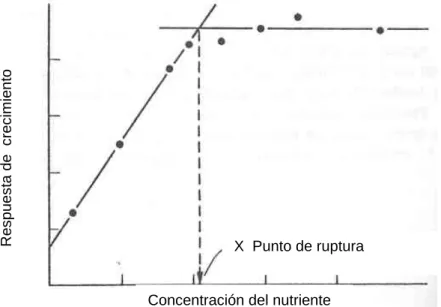
- PRINCIPALES FACTORES DEL CRECIMIENTO EN PECES CULTIVADOS Aunque de fácil observación y medición, el crecimiento es una de las actividades más complejas
- REQUERIMIENTOS DE PROTEÍNA Y ENERGÍA EN PECES CULTIVADOS El desarrollo de un régimen de alimentación para los peces requiere del entendimiento básico de
- REQUERIMIENTOS NUTRICIONALES DE LOS PECES E HIPOTESIS DE TRABAJO
- OBJETIVOS
- GENERAL
- ESPECIFICOS
Ma = aumento de la tasa metabólica (por encima de Mr) debido a la actividad, SDA = aumento de la tasa metabólica debido a una acción dinámica específica, F + U = pérdida de desechos a través de la gestación (heces) y la excreción (orina), . Evaluar la influencia de los niveles de proteína y energía de la dieta sobre el crecimiento y la utilización de proteínas en juveniles de pez rey oscuro.

MATERIAL Y MÉTODOS GENERALES
- Organismos de experimentación
- Sistemas de cultivo
- Ensayos de crecimiento
- Dietas experimentales
- Análisis bioquímicos
Sólo en el experimento de digestibilidad se retiraron los juveniles del medio ambiente y se los acondicionó al sistema en el laboratorio durante una semana. En el experimento de digestibilidad no se midió la edad de los peces recolectados en el medio natural. Acuarios experimentales del sistema de aguas abiertas utilizados en el CIBNOR para el experimento del efecto de diferentes temperaturas y densidades.
Calidad del agua del sistema experimental durante el experimento para evaluar los efectos de la temperatura y la densidad de peces en el crecimiento y supervivencia de los juveniles de pez rey.

ESTUDIO PRELIMINAR SOBRE DESTETE DE LAS LARVAS DE Paralabrax maculatofasciatus,
CON UNA DIETA COMPUESTA
EFECTOS EN EL CRECIMIENTO Y SUPERVIVENCIA
ARTICULO PUBLICADO
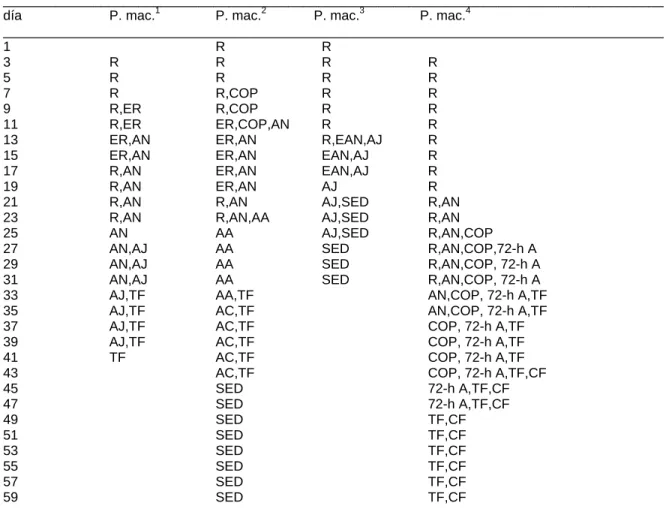
A preliminary feeding trial was made to determine the age (size) at which spotted sand bass, Paralabrax maculatofasciatus, larvae can be weaned on a prepared diet, using survival and growth performance as evaluation criteria. There was clearly an effect of the feeding strategy on the final growth of the spotted sand bass. Standard mean length, wet weight and specific growth rate of larvae fed live food were significantly (P = 0.05) higher than larvae weaned on the prepared diet.
It appears that those larvae fed for a longer period on live food are better adapted to the switch to the non-live diet.
INTRODUCTION
MATERIALS AND METHODS Experimental Organisms
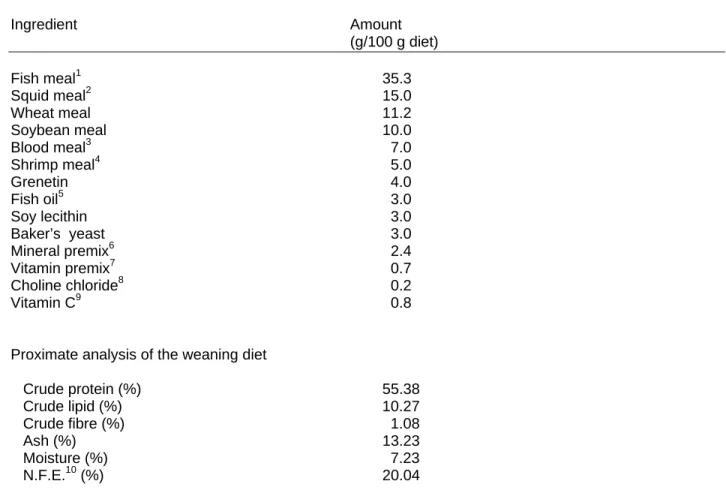
Weaning of CG was done on day 33 with raw triggerfish, Balistes polylepis, fillets, chopped and screened, and the supply of brine shrimp was reduced accordingly from days 33 to 39. Shirota (1970) and Hunter (1980) who are It is recommended that the food particle size should not be outside the range of 40-70% of the mouth opening of the larva to ensure food ingestion. Proximate analyzes of PD (Table 4) were made according to the Association of Official Analytical Chemists (1980).
At least five larvae per tank were sampled every five days for growth and mouth measurements, except at the end of the experiment, when all organisms were measured.
RESULTS
DISCUSSION
Unfortunately, the digestibility of the artificial diet was not determined in this study and no conclusions can be drawn. Moreover, we do not ignore that the lack of maturation of the enzymes of the digestive tract can be another possible cause of mortality, as observed by Zambonino-Infante et al. Therefore, when larvae ingest food artificially, the maturation of the digestive tract is delayed and there is lower survival (Cahu and.
As early studies have shown, one of the most important factors affecting the nutritional value of live prey for marine fish is their low essential fatty acid (EFA) content (Bengtson et al. 1991; Lavens et al. 1995).
Artificial propagation of grouper, Epinephelus suillus in a finfish hatchery in Tanjong Demong, Terengganu, Malaysia. Effects of dietary phospholipids on growth of larval red sea bream and foot jaws. Nutritional effect of three microalgae and one cyanobacterium on the culture of the ringworm Brachionus plicatilis MÜLLER: 1786.
The effects of experimental starter diets with different levels of soybean or menhaden oil on red drum (Sciaenops ocellatus).
EFECTO DE LA TEMPERATURA Y LA DENSIDAD SOBRE EL
CRECIMIENTO DE JUVENILES DE LA CABRILLA ARENERA, Paralabrax maculatofasciatus, CULTIVADOS EN EL LABORATORIO ♦
INTRODUCCIÓN
MATERIALES Y MÉTODOS
Resultados y Discusión
El peso final promedio (5,7 g) de los machos jóvenes, correspondiente a la mayor densidad a la temperatura de 30 °C (T30D12), fue significativamente menor que el de cualquier otro tratamiento. Efecto de la temperatura del agua y la densidad de peces sobre el crecimiento de juveniles de pez rey oscuro. El valor CAD para la densidad de 8 peces/tanque fue significativamente mayor (443-464) que el valor CAD para la densidad más alta dentro de cada temperatura.
Los parámetros de crecimiento y eficiencia alimenticia (TECy TCA) mostraron una interacción significativa (P < 0.05), lo que significa que el efecto combinado de temperatura y densidad no es aditivo.

DETERMINACIÓN DE LOS REQUERIMIENTOS EN PROTEÍNA Y
ENERGÍA DE LOS JUVENILES DE CABRILLA ARENERA, Paralabrax maculatofasciatus
DETERMINACIÓN DEL REQUERIMIENTO EN PROTEÍNA
EFECTO DEL NIVEL DE PROTEINA DEL ALIMENTO SOBRE EL CRECIMIENTO Y LA EFICIENCIA PROTEICA DE JUVENILES ALIMENTADOS CON DIETAS
SEMIPURIFICADAS
Abstract
Introduction
Materials and Methods Experimental diets and design
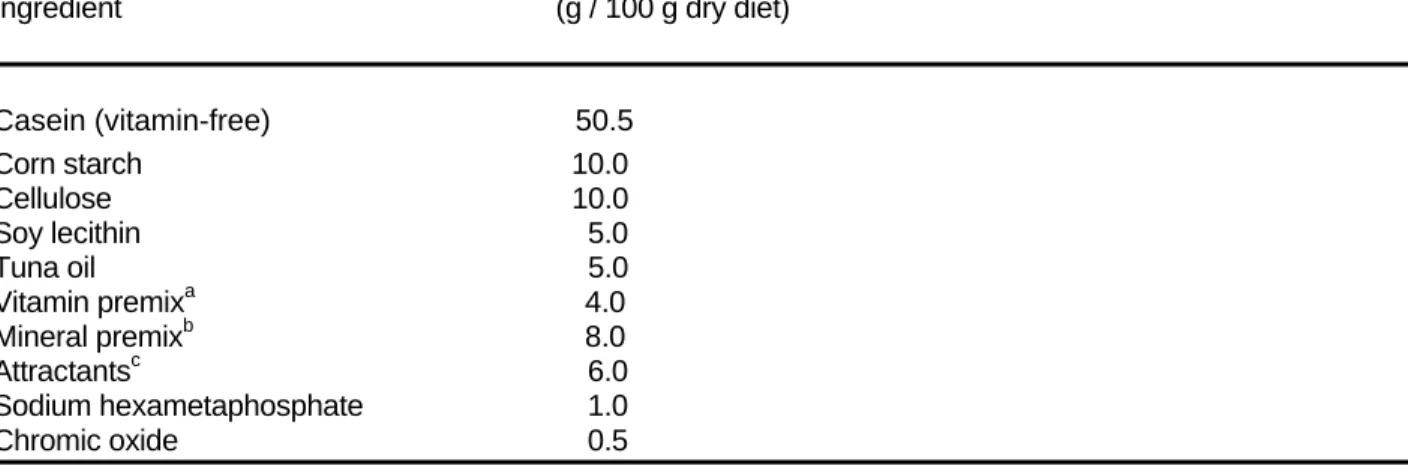
Composition of the semi-purified diet used to determine the apparent digestibility coefficients of protein, lipids, energy and dry matter in juvenile spotted sand bass (test I). Randomly selected groups of 12 fish with an average weight of g were then distributed among six tanks of the experimental system. All fish were weighed individually at the beginning of the trial and at 21 and 42 days of the trial.
At the end of the experimental period, 4 randomly selected fish from each tank (12 fish/diet) were freeze-dried for subsequent compositional analysis.
Results
Discussion Trial I
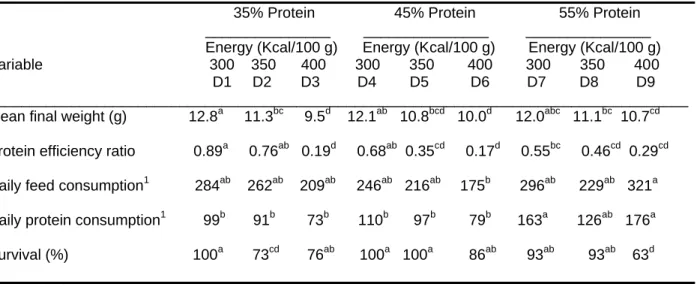
This is now a known effect related to the protein/energy (P/E) ratio in the diet (Guillaume 1994;). In the present study, the inverse relationship between dietary protein level and feed intake was observed. It is possible that if a more balanced diet in amino acids had been used, the protein requirement for spotted sand bass would have been lower than 55% in the diet.
A plausible explanation for the lack of significant differences in the present study may be the short duration of the growth trial (6 weeks).
Literature cited
EFECTO DE DIFERENTES NIVELES DE PROTEÍNA Y ENERGÍA DEL ALIMENTO SOBRE EL CRECIMIENTO Y EFICIENCIA
ALIMENTICIA DE JUVENILES DE CABRILLA ARENERA, Paralabrax maculatofasciatus ∗
ABSTRACT
It is known that excess dietary protein will be used for energy and lead to an increase in ammonia excretion. Therefore, more research is needed to determine at what level of available energy protein is best maintained by juvenile spotted bass. The objective of this work was to determine the influence of different dietary protein and energy levels on the growth and food utilization of juvenile spotted bass.
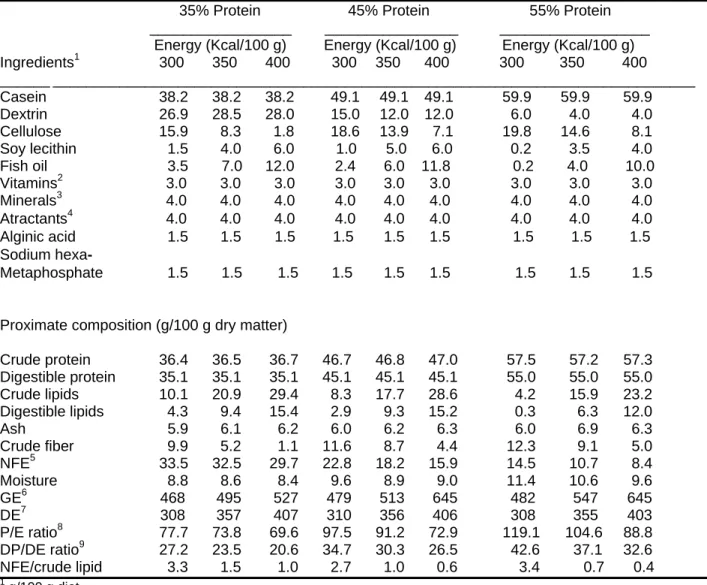
MATERIALS AND METHODS Experimental diets and design
Juvenile spotted sand bass were obtained from laboratory-reared eggs naturally spawned on April 13, 1998, at the Experimental Biology Laboratory (EBL) of the Centro Interdisciplinario de Ciencias. At the beginning of the experiment, a representative sample of the fish was collected for an initial analysis of muscle composition. And at the end of the experiment, four randomly sampled fish from each tank were liophyllized for subsequent compositional analysis.
Data from the mentioned growth factors were analyzed by Two-Way Analysis of Variance to determine the main effects of protein and energy level and the effects of interaction between the two factors.
RESULTS Growth perfomance and feed utilization
Growth performance and feed utilization of spotted bass fed diets with different protein and energy levels. Effect of dietary protein and energy content on feed conversion ratio of spotted bass. Some biological parameters of diets containing different protein and energy levels fed to spotted bass.
Different letters abc and xy in each row indicate significant (P < 0.05) differences within protein and energy effects, respectively.
DISCUSSION Fish growth and diet utilization
Thus, the balance of protein and energy in the 35% and 45% protein diets may not have been within the optimal ratio for juvenile spotted sand bass, with the exception of the 55% protein diets. Redness of the fins, observed from week 4 onwards, may be due to insufficient lipid intake (Corraze 1999), vitamin deficiency (Tacon 1989) or a septicemic condition caused by Vibrio-like bacteria (Sanders and Fryer, 1988). Samples of fish from all treatments were analyzed at the end of the experimental period and no pathogenic bacteria were found (Martínez-Díaz, 1998, pers. obs.).
The present results require further studies to evaluate the effects of the P/E ratio on growth and feed efficiency.
DISCUSIÓN GENERAL Período de iniciación
Se realizó un ensayo preliminar para determinar la digestibilidad de una dieta semipurificada a base de caseína antes de evaluar los efectos de diferentes niveles de proteína en el alimento (25 a 55%) sobre el crecimiento y la utilización de proteínas en cabras jóvenes. Los valores absolutos de crecimiento (AC) para juveniles de 2,1 a 2,5 g de piel blanca oscura encontrados en el presente estudio (g/d, respectivamente) son más bajos que los encontrados en estudios anteriores con la misma especie. Aunque la mejor combinación de proteína y energía para lograr la máxima ganancia de peso (39,5%) y el mejor factor de conversión alimenticia (3,3) en polluelos de martín pescador oscuro fue 35% de proteína y 3,0 kcal DE/kg (dieta 1).
Así como desarrollar dietas prácticas, con ingredientes de la región, que incrementen la tasa de crecimiento de las crías de pez rey oscuro.
CONCLUSIONES GENERALES
PERSPECTIVAS Y RECOMENDACIONES
BIBLIOGRAFIA GENERAL
Effect of dietary protein to energy ratios on growth, survival and body composition of juvenile Asian sea bass, Lates calcarifer. Effects of different levels of dietary protein on growth, feed conversion and body composition of juvenile tilapia (Sarotherodon mossambicus). Interactive effects of dietary protein and lipids on growth and protein utilization of age-0 striped bass.
Effect of dietary lipids and carbohydrates on the growth, feed conversion and body composition of juvenile yellowtail.
Estudio preliminar sobre el crecimiento de larvas de la cabrilla arenera alimentadas con una dieta de iniciación
Estudio preliminar sobre el crecimiento de larvas de pez muga alimentadas con una dieta inicial. ESTUDIO PRELIMINAR SOBRE EL CRECIMIENTO DE LARVAS DE Paralabrax maculatofasciatus (Stein.) ALIMENTADAS CON DIETA RESTRINGIDA. ESTUDIO PRELIMINAR SOBRE EL CRECIMIENTO DE DIVERSAS LARVAS DE SAND BASS, Paralabrax maculatofasciatus (Stein.) ALIMENTANDO UNA DIETA INICIAL.
PRELIMINARY STUDY ON THE GROWTH OF THE SPOTTED SAND BASS, Paralabrax maculatofasciatus (Stein.) LARVAE FED AN STARTER DIET
TABLAS DE ANÁLISIS DE VARIANZA DEL CRECIMIENTO DE LOS PECES USADOS EN EL EXPERIMENTO DE TEMPERATURA Y DENSIDAD (Capítulo
Análisis de ANDEVA de la tasa de crecimiento específico con un nivel de confianza de 0,05. Análisis ANDEVA del consumo diario de alimentos con un nivel de confianza de 0,05.