The aim of this study is to explore, describe and classify ELT English teachers' views on storytelling and ICT in primary school classrooms. Data showed that ELT teachers have different views on storytelling and ICT in primary school classrooms. These were analyzed and classified into categories to be presented. The findings of this study indicate that teachers believe that the use of storytelling in primary school classrooms is very useful because it improves a) listening and speaking, b) pronunciation, c) writing, d) vocabulary and e) develops the imagination.
The findings of this study may be useful for ELT teachers working in primary schools.
INTRODUCTION
- Project Rationale
- Significance of the Study
- Theoretical Context of the Research
- Location of the Research
- Aims
- Research Questions
- Chapter summary and thesis overview
When teaching English, it is important to explore teachers' beliefs that underlie teachers' actions in the classroom. Teachers' beliefs are extremely important in understanding how these teachers see and understand their environment and profession through the use of storytelling. The aims of this research are to explore, describe and classify English primary teachers' beliefs about storytelling and ICT with children in the classroom (see Chapter II for more details).
The main aims of this research were therefore to explore, describe and classify ELT English teachers' beliefs about storytelling and ICT in primary school classrooms.
LITERATURE REVIEW
- Storytelling
- Reasons to Use Storytelling with Children in English Classes
- Choosing a Story
- Storytelling – Based Activities
- Storytelling Materials: Visual Aids
- Benefits of Storytelling
- Beliefs
- Teachers’ Beliefs
- The Role of Teachers’ Beliefs in the Classroom
- Information and Communication Technologies (ICT)
- Information and Communication Technologies (ICT) in Teacher Education
- Benefits of Information and Communication Technologies (ICT) in Education
- Previous Studies on Storytelling and ICT
- Conclusion
This section presents background information about definitions of beliefs, teachers' beliefs, and their role in the classroom. Teacher beliefs are related to what teachers expect from their teaching, their students, learning and education. The aim of the research was to examine teachers' current beliefs and attitudes towards information and communication technologies (ICT) in education.
Furthermore, these studies are relevant to this study of ELT teachers' views on storytelling and ICT in primary school classrooms. Finally, previous studies on teachers' beliefs about storytelling and ICT that relate to this study were explained. The research based on these theoretical and contextual frameworks continues in the next chapter by examining primary English teachers' views on storytelling and ICT with children in the classroom.
METHODOLOGY
- Setting
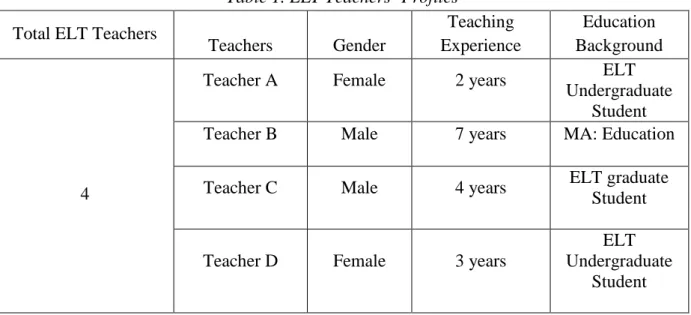
- Participants
- Research Methodology
- Instruments
- Interview
- Questionnaire
- Data Collection Procedure
- Data Analysis
- Conclusion
Therefore, this research is a case study because it purports to examine beliefs through a group of participants. The interview aims to explore what ELT English teachers think about storytelling in primary school classrooms. This author has classified the interview into three types: 1) the informal conversational interview, 2) the general interview guide approach, 3) the open-ended standardized interview (p. 278).
According to Patton (1990) “The standardized open-ended interview consists of a set of carefully worded and arranged questions with the intention of each respondent going through them in the same sequence and asking each respondent the same questions as essentially the same words” (p. 280). The interview for this research had twelve open-ended questions, which were asked in the same way to broadly explore what teachers believe about storytelling (see Appendix A). In this study, a questionnaire was designed and then uploaded to Google Forms, which purports to explore ELT teachers' beliefs about ICT and to tell a story in the classroom (see Appendix C).
In the first phase, the audio recordings of the interviews were reviewed individually in order to transcribe the interview responses. The data collected were categorized to reflect ELT teachers' beliefs about storytelling in primary school classrooms. In a second phase, data from the questionnaires were analyzed to identify the beliefs these ELT teachers held about ICT in primary school classrooms.
Data procedure and data analysis were explained to collect and analyze the data. All data collected have been essential to explore ELT teachers' beliefs about storytelling and ICT in primary school classrooms.
FINDINGS
- Research Questions
- ELT Teachers’ Beliefs about Storytelling in Primary School Classrooms
- Listening and Speaking
- Pronunciation
- Writing
- Vocabulary
- Language in Context
- Imagination
- The Use of Storytelling in Primary School Classrooms
- Choosing a story
- Storytelling Activities
- Storytelling Materials
- ELT Teachers’ Beliefs about ICT in Primary School Classrooms
- ICT in Primary School Classrooms
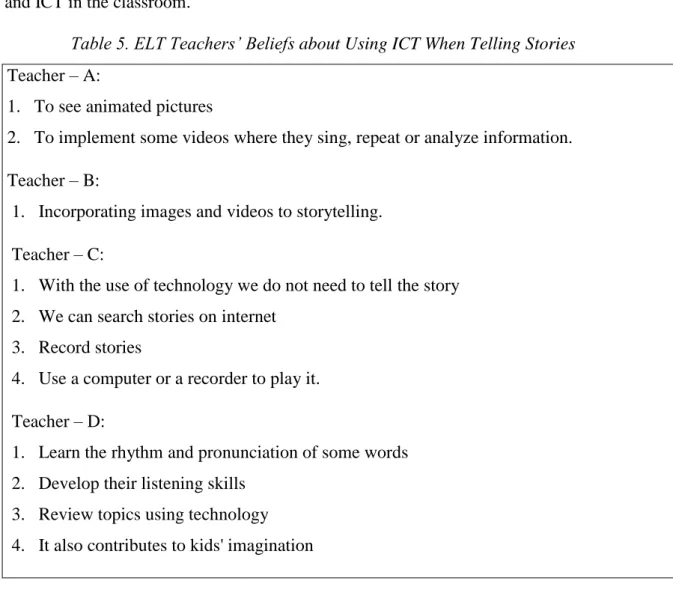
- ELT Teachers’ Beliefs about Using ICT When Telling Stories
- Conclusion
The stories have to be fun because children need something to grab their attention, so if the story is not fun and interesting, they get bored right away. The teachers argued that they choose the story based on the topics they teach. Teacher D: I also use the story to reinforce or review some topics that I taught before, for example colors, prepositions, animals, time, it does I to reinforce the subjects.
Based on the findings, Teacher C and D argued that they also choose a story according to students' level because they are children and the story should be easy to follow so that they can understand basic vocabulary, basic phrases. It's really effective because you can change the story based on what you're teaching. Teacher A: Sometimes I use brainstorming to guide students to get the basic ideas or the most important and the main characters in the story.
I tell the story and they try to figure out what happens first, during and at the end of the story. Another aspect mentioned and related to storytelling is asking questions before and after telling the story. Teacher A: I tell the stories and then I let them create their own story according to what they listened to, they make drawings or sometimes they make some comics according to the story.
Teacher D: After they tell the story, I ask them to draw a picture about what they understood from the story. Teacher A: When I tell the story I make my characters into puppets and have a conversation between these puppets. I create a whole story like a thriller, make my own scenery and use puppets to tell the story.
Teacher D: I use puppets and I use them to represent the main characters of the story, and also to present the environment where the story will be developed.

CONCLUSIONS
Summary
Third, the findings point to the materials these teachers use to tell stories in English lessons: a) puppets, b) pictures, c) worksheets. The ELT teachers mentioned that ICT is: a) essential, b) useful, c) ICT facilitates teaching and learning, d) ICT helps to obtain information and materials, and e) ICT helps to understand English lessons. There are different opinions about how ELT teachers should use storytelling and ICT. Some of the activities and materials are: a) watching animated pictures, b) using some videos where they sing, repeat or analyze information, c) search for stories on the Internet, d) record the stories, e) use the computer to present the stories, d) learn rhythm and pronunciation of some words.
Limitations of the study
Directions for Further Research
Personal Reflection
I started looking for techniques to make my students feel comfortable in class and engage them in the new language, and I started using storytelling. During my professional practice, I noticed that my students enjoyed the way I used storytelling with any English topic, and I continued this in the classroom. During my research assignment, it was difficult at the beginning because I was focused on some perspectives of storytelling, but at the same time I was interested in the use of ICT in this research, which meant that choosing the topic was not easy, but with the help of my research seminar teacher I made this study easier.
I focused this study on what I presented as ELT teachers' beliefs about storytelling and ICT in Primary School classrooms: implications for teacher education. I had the habit of reading so reading this was not a problem to develop my project. It was a bit difficult to organize my ideas and follow the instructions to start writing Chapter II.
After that, I had to read and read to remove the useless information and organize the right one. Then through the chapter I wasn't that hard, I just stated my general ideas of what I wanted to do. Some of these chapters were more difficult for me than others, but my Research Seminar II professor gave me outlines and sample theses which helped me develop good chapters.
Finally, I realized that I will consider the findings of my research project to improve my teaching as an English teacher.
Conclusion
Interviewer: okay, so now what type of storytelling activities do you do or do in your English classes. Teacher A: for me it's important, first of all, they pay attention to my story, because if they lost in the way, then they can't understand the story, so first of all, please guys, pay attention and I will tell you the story of, for example, the Little Red Riding Hood and then I use a puppet or if it's not a. Teacher A: yes, all the time, it's like that, no one is nervous, makes a joke about their classmates, everything is really respectful and they pay attention, they listen, then they are understanding and finally they are developed ( 9:26).
Interviewer: this is boring, really boring, okay mmm, just to end this interview, did your childhood influence you to use storytelling in your English classes. Teacher A: it's really boring and I don't like the kind, but yeah, and for example, my students like, they love my stories because when I tell, it's like for example, one of my students' names is Orlando. Yes or no and why Teacher B: yes, it is essential because the language is a tool to create art.
Interviewer: yes, that's a good answer, so now, what types of storytelling activities do you do in your English classes. Teacher B: okay, yes, it has a creative activity, it puts knowledge in context, it is a simple strategy, also when they tell their story to think about their metacognitive, what is their story in class. It's a bit of entertainment, it's a change of pace, a reflective change of pace when you're in the classroom, so storytelling is always a good way to change the pace of the teaching-learning process (27:06).
Interviewer: what material, so now, what material do you use when you tell a story. Teacher C: I do when they work in teams, for example the try to create their own stories by then as a group, as a team and it's just a final project (5:17) Interviewer: okay, you mean you give them the images and they have to create a story according to the images, that's what you mean (5:29). Secondly, after telling the story, I ask them to draw a picture of what they understood from the story and finally I prepare a worksheet where there are many pictures and the children have to choose what happened first , what happened second and what happened at the end, it is like a sequence activity, order activity (6:24).
Teacher D: materials, I use flashcards, most times I also use puppets, I. Interviewer: okay, can you explain to me how you use these materials. 6:53).