Álvarez-Rojo, Víctor; Romero, Soledad; Gil-Flores, Javier; Rodríguez-Santero, Javier; Clares, José; Asensio, Inmacu- lada; del-Frago, Rakel; García-Lupión, Beatriz; García-García, Mercedes; González-González, Daniel; Guardia, Sole- dad; Ibarra, Marisol; López-Fuentes, Rafael; Rodríguez-Gómez, Gregorio, Salmeron-Vilchez, Purificación. (2011).
Teachers’ needs for teaching in the European Higher Education Area (EHEA). RELIEVE, v. 17, n. 1, art. 1, 1-22.
http://www.uv.es/RELIEVE/v17n1/RELIEVEv17n1_1eng.htm
e-J
ournal ofE
ducationalR
esearch,A
ssessment andE
valuationR
evistaEL
ectrónica deI
nvestigación yEV
aluaciónE
ducativaTEACHERS’ NEEDS FOR TEACHING IN THE EUROPEAN HIGHER EDUCATION AREA (EHEA)
[ Necesidades de formación del profesorado universitario para la adapta- ción de su docencia al Espacio Europeo de Educación Superior
(EEES) ]
by/por
Article record About authors HTML format
Álvarez-Rojo, Víctor ([email protected]); Romero, Soledad; Gil- Flores, Javier; Rodríguez-Santero, Javier; Clares, José;
Asensio, Inmaculada; del-Frago, Rakel; García-Lupión, Beatriz; García-García, Mercedes; González-González, Daniel; Guardia, Soledad; Ibarra, Marisol; López-Fuentes,
Rafael; Rodríguez-Gómez, Gregorio, Salmeron-Vilchez, Purificación
Ficha del artículo Sobre los autores Formato HTML
Abstract
This paper presents some findings of a research study conducted in five Spanish universities about teachers needs for teaching in the European Higher Education Area (EHEA). A survey procedure has been applied to a sample of teachers in the five university scientific areas. Aimed to establish teaching needs, data analysis of this research has poured a big amount of specific topics referring to six teaching blocks of competences: planning and developing teaching and conducting evaluation and tutoring, besides organizing teaching and lifelong learning. We have com- pared the result from the five scientific areas, and different teachers’ categories.
Resumen
En este trabajo se presentan los resultados de una investi- gación llevada a cabo en cinco universidades españolas para diagnosticar las necesidades de formación en compe- tencias del profesorado universitario. Utilizando técnicas de encuesta, aplicadas a una amplia muestra d profesorado de las cinco áreas de conocimiento, se han detectado nece- sidades de formación en seis bloques de competencias: a) la Planificación de la Docencia; b) el Desarrollo de la Docencia; c) la Evaluación; d) la Tutoría; e) la Gestión;
f) la Formación Continua. Se han hallado diferencias sig- nificativas en las necesidades en función del área de cono- cimiento y las categorías profesionales.
Keywords
Needs assessment, competences, teacher training, compe- tence-bases teaching, European Higher Education Area, EHEA.
Descriptores
Evaluación de necesidades, competencias, formación del profesorado, formación basada en competencias, Espacio Europeo de Educación Superior, EEES.
Introduction
The implementation of the EHEA involves a series of profound changes at different lev-
els of the university teaching practice: setting the curricula around professional profiles, education planning based on competencies derived from these profiles , the use of dif-
Álvarez-Rojo, Víctor; Romero, Soledad; Gil-Flores, Javier; Rodríguez-Santero, Javier; Clares, José; Asensio, Inmacu- lada; del-Frago, Rakel; García-Lupión, Beatriz; García-García, Mercedes; González-González, Daniel; Guardia, Sole- dad; Ibarra, Marisol; López-Fuentes, Rafael; Rodríguez-Gómez, Gregorio, Salmeron-Vilchez, Purificación. (2011).
Teachers’ needs for teaching in the European Higher Education Area (EHEA). RELIEVE, v. 17, n. 1, art. 1, 1-22.
http://www.uv.es/RELIEVE/v17n1/RELIEVEv17n1_1eng.htm
ferent teaching methodologies and diversi- fied competencies-bassed assessment sys- tems , the development of a monitoring sys- tem to support the student in the teaching- learning process in order that he / she be- comes the main learning actor/actress (Alva- rez et al, 2004). The faculty is a key factor for the development of this methodological change in teaching.And so you can carry out this qualitative leap, the implementation by the faculty of a set of new professional teach- ing competencies is required.
Implementation of changes arising from the European Teaching Convergence policy implies, therefore, a shift in the conception of the role of teachers, what generates a sense of uncertainty (Michavila, 2005).This transformation mainly means implementing changes in teaching strategies (López, 2005;
Caballero, 2007, Calderon and Ladder, 2008, Martinez and Echeverria, 2009), with the difficulty that it must be developed in teach- ing contexts that do not quite fit to these new approaches (Tagel et al. 2004; Raventos, 2005, Alvarez et al., 2009).
For the new intended teaching pattern, it is not enough for teachers to master a subject content, because it is understood that a qual- ity teaching requires that teachers have de- veloped a set of professional-action compe- tencies (‘know’ content-knowledge, ‘know- how’, ’ know-to-be’) of their own profes- sional profile. There is no a divorce between content-knowledge and competences, as it has been stressed by some objections raised from the academic world on regarding com- petency-based education. There is no a gap between professional training and the scien- tific-academic education. The concept of competence alludes to a ”collection” of knowledge, skills and attitudes that allows the practice of a profession in a social con- text, solving problems and flexible profes- sional action.
Training and profesional development of the teaching staff forms a key element of quality university teaching. Nevertheless, for the effectiveness of professional devel- opment of the teaching staff, it is necessary to combine the opportunities that the institu- tion offers with the personal demands of the teachers. It is required, therefore, to identify on one side the professional competencies involved in the teacher’s profile, and on the other side identify the training needs felt and perceived by each faculty member. Among the freshly studies and proposals performed to identify teacher’s professional competen- cies could be stressed thouse conducted by Smith and Simpson (1995); González y Wagenaar (2003); Zabalza (2003); Tigelaar y otros (2004); Gillis et al. (2008); Perrenoud (2008) o Yániz (2008). As a sample, we can mention core teaching competencies identi- fied by Zabalza (2003), which are related with planning a process of teaching and learning; choosing and menaging discipli- nary content; supplying information by means of understandable and well-organized explanations; using of ITC for educational purposes; implementing teaching methods;
interacting with the students; supporting and tutoring students learning processes; assess- ing the learning outcomes; conducting a sys- tematic inquiry on their own teaching prac- tice; improving group work, and students integration in the university institution.
Despite the value of these studies, it is still necessary to search what are the teaching competencies that teachers themselves per- ceive as ‘core teaching competencies’, in order to reorient their teaching practices in the new university landscape. They have already been developed some work trying to identify what these competences could be, and also aimed to set up university faculty training needs, such as those of Margalef and Alvarez (2005), Murillo et al. (2005), Gonza- lez Sanmamed (2006), De Pablos et al.
(2006); Meroño and Ruiz (2006), Troiano, Elijah and Amengual (2006), Alvarez et al.
Álvarez-Rojo, Víctor; Romero, Soledad; Gil-Flores, Javier; Rodríguez-Santero, Javier; Clares, José; Asensio, Inmacu- lada; del-Frago, Rakel; García-Lupión, Beatriz; García-García, Mercedes; González-González, Daniel; Guardia, Sole- dad; Ibarra, Marisol; López-Fuentes, Rafael; Rodríguez-Gómez, Gregorio, Salmeron-Vilchez, Purificación. (2011).
Teachers’ needs for teaching in the European Higher Education Area (EHEA). RELIEVE, v. 17, n. 1, art. 1, 1-22.
http://www.uv.es/RELIEVE/v17n1/RELIEVEv17n1_1eng.htm
(2007), More and Ruiz (2007), Roelof and Sanders (2007); Valcárcel (2007), Gonzalez Sanmamed and Raposo, (2008, 2009); Sara- via Gallardo (2008); Bozu and Song (2009) and Delgado (2010 ).
Actually in this paper we present an evaluation of faculty training needs related with teaching competences; this inquiry has been conducted within the framework of an institutional research -lated entitled "Profiles for the EHEA teachers: design of a virtual resource to help university professors for the development of teaching competences.” The main objective of this research was the analysis of the teaching competences of uni- versity teachers, required by the EHEA, and, secondly the development and empirical validation of a computer resource that helps the faculty to improve those competences.
As part of the first objective, it had been un- dertaken a process of identifying faculty training needs, whose phases and main re- sults are presented in this work
Method Objectives
In the first phase of the project Profiles for the EHEA teachers: design of a virtual re- source to help faculty to develop teaching competences (SEJ2007-67 526 - MEC/FEDER) on had been carried out a series of research activities aimed at deter- mining two basic results: a) The teachers’
profiles perceived by the same teachers as required to fulfil the EHEA requirements in Spanish universities; b) The set of key teach- ing competences should be developed by teachers to address the task of implementing the European Space requirements in higher education
Once these profiles and competencies de- fined, in the second phase of the project it has been conducted an analysis of training needs, as perceived by teachers, in order to master key teaching competences properly defined at the first stage of the research pro- ject.
The objectives pursued by the need analy- sis were as follows:
1. Describe competences training needs as expressed by teachers.
2. Analyze the differences observed in terms of training needs, depending on the area of knowledge or teaching, and of current faculty professional levels.
Variables
The variables considered in the study were those that were identified and validated in the first phase of research, referred to above, i.e., training-related needs with the compe- tences to give: a) Teaching Planning; b ) Development of Teaching, c) Learnings’
Evaluation, d) Tutoring Learning Processes e), Management, and f) Life-long Learning Management.
Participants and procedures for data collection and data analysis.
Obtaining teacher perceptions about their own training needs carried out by applying the Needs Assessment Protocol: Teachers’
Training Needs for Adapting Teaching to the EHEA, which was accessible on the website of the University of Sevilla and completed on-line at the following address:
http://portalapps.us.es/opina/c/1809. The protocol consisted of 45 items relating to the six variables under study, as stated in the following table.
Álvarez-Rojo, Víctor; Romero, Soledad; Gil-Flores, Javier; Rodríguez-Santero, Javier; Clares, José; Asensio, Inmacu- lada; del-Frago, Rakel; García-Lupión, Beatriz; García-García, Mercedes; González-González, Daniel; Guardia, Sole- dad; Ibarra, Marisol; López-Fuentes, Rafael; Rodríguez-Gómez, Gregorio, Salmeron-Vilchez, Purificación. (2011).
Teachers’ needs for teaching in the European Higher Education Area (EHEA). RELIEVE, v. 17, n. 1, art. 1, 1-22.
http://www.uv.es/RELIEVE/v17n1/RELIEVEv17n1_1eng.htm TEACHING PLANING
Master the content of the subject matter Select core matter content
Structure and relate content matter
Skills to matchknowledge to competencies to be developed Designing teaching-learning activities
Planning learning practices to approach students to the professions Fitting learning activities to competences targeted by a subject matter
Transforming teacher´s delivery of subject matter content into students learning activities Schedule learning activities that encourage students self-learning
Design learning activities to promote learners’ responsibility and autonomy DEVELOPMENT OF TEACHING
Deliver update and meaningful scientific knowledge Provide professional content, processes and resources
Perform presentations of solving practical professional cases or problems Apply scientific or subject matter knowledge to daily life situations
Mastering the accurate technology to deal with specific cases or professional problems Coordinate practical and theoretical teaching
Get in a collaborative teaching team with workplace-tutors Share professional skills with other teachers and students.
Develop student's critical ability.
Teaching group work competencies Use student motivation strategies
Improve the students ability to take responsibility for their own learning Adapt scientific language to students’ academic level
Use ITC for educational purposes LEARNINGS’ EVALUATION
Establish and widespread among the students the evaluation criteria
Fit the assessment systems to the specific competences taught in the subject course
Use a wide range of assessment techniques, also suitable for a specific teaching methodology Track students work
Provide students with feed-back on their learning Self-inquire into teaching practice
Use students’ learning outcomes for teaching review purposes Use evaluation outcomes to improve teaching and learning.
TUTORING LEARNING PROCESSES
Planning tutorial systems fitted to students learning needs Provide educational and academic guidance
Provide personal counselling and guidance Provide professional guidance
MANAGEMENT
Establish relationships with other universities.
Interact with other teams or research groups.
Participate in multidisciplinary teams or groups.
Work in departmental teams.
LIFE-LONG LEARNING MENAGEMENT Organize your own life-long learning.
Keeping updated teaching methodologies.
Improve your current knowledge of research methodology. Publish research findings.
Use ITC for educational and research purposes
Each item was measured on a 6-point scale (1: I do not need training; 6: I need a lot of training)
The recruitment process of teachers was as follows. A first appeal was sent to 700 teach- ers for fulfil the protocol, who were distrib- uted among the five universities (Seville, Granada, Cádiz, Complutense of Madrid and
Álvarez-Rojo, Víctor; Romero, Soledad; Gil-Flores, Javier; Rodríguez-Santero, Javier; Clares, José; Asensio, Inmaculada;
del-Frago, Rakel; García-Lupión, Beatriz; García-García, Mercedes; González-González, Daniel; Guardia, Soledad; Ibarra, Marisol; López-Fuentes, Rafael; Rodríguez-Gómez, Gregorio, Salmeron-Vilchez, Purificación. (2011). Teachers’ needs for teaching in the European Higher Education Area (EHEA). RELIEVE, v. 17, n. 1, art. 1, 1-22.
http://www.uv.es/RELIEVE/v17n1/RELIEVEv17n1_1eng.htm
País Vasco universities) sponsoring the re- search project. The teachers’ proposed sample was conformed taking into account the follow- ing criteria: a) all the 5 major Knowledge Ar- eas for university degrees (Health Sciences, Social Sciences & Law, Natural Sciences, En- gineering, Humanities) should be represented in it; b) the 7 types of current faculty profes- sional levels should be represented as far as possible in the teachers sample of each area (Professors, Lecturers, PhD Assistants, PhD Hired Teachers, Faculty Partners, Associate
Lecturers, Assistants); c) the staff that par- ticipated in the first phase of the research (as members of the Discussion Groups or DACUM workshops) should not be invited because they already had provided their training needs as research data.
Taking into account these criteria, 10 fac- ulty appeals were assigned to each type of staff member (7); so the theoretical sample for the 5 sponsor universities was as shown in table 1.
Table 1. Sample size for every university
KNOWLEDGE AREAS US UGR UCM UCA UPV
Natural Sciences 70 70
Humanities 70 70
Social Sciences & Law 70 70
Health Sciences 70 70
Engineering 70 70
TOTAL (N=700) 210 140 140 140 70
In a few cases, the appeal was made person- ally (by phone call or e-mail). Most teachers, however, were contacted through the OPINA Platform, which is the survey management service of the University of Seville (http://www.us.es/servicios/sic/servusus/opina?searchterm=OPINA).
Subsequently, regarding the number of actually fulfilled protocols, a second appeal-reminder was sent through the same procedure. Table 2 shows the distribution of the teaching staff actually taken part in the research.
Table 2. Faculty members’ replies to the Scale/Protocol
Professional Category n %
Lecturer 260 45.69
Chairman 51 8.96
PhD Hired Teacher 54 9.49
PhD Assistant 21 3.69
Assistant 17 2.98
Associate Lecturer 47 8.26
Faculty Partner 27 4.74
Research Fellow 13 2.28
Senior Assistant 3 0.52
No Permanent Teacher 12 2.1
Lost 64 11.24
Total 569 100
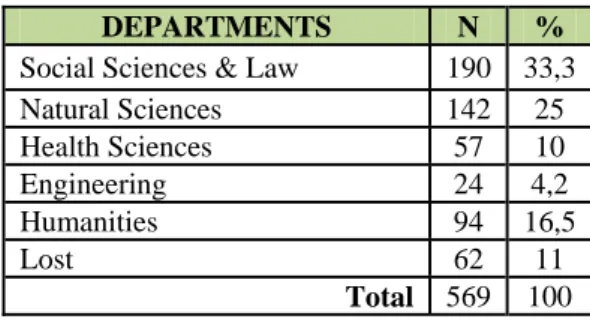
Faculty distribution by Areas of Knowl- edge appears in table 3.
Table 3. Replies Distribution by Knowledge Areas
DEPARTMENTS N %
Social Sciences & Law 190 33,3 Natural Sciences 142 25
Health Sciences 57 10
Engineering 24 4,2
Humanities 94 16,5
Lost 62 11
Total 569 100
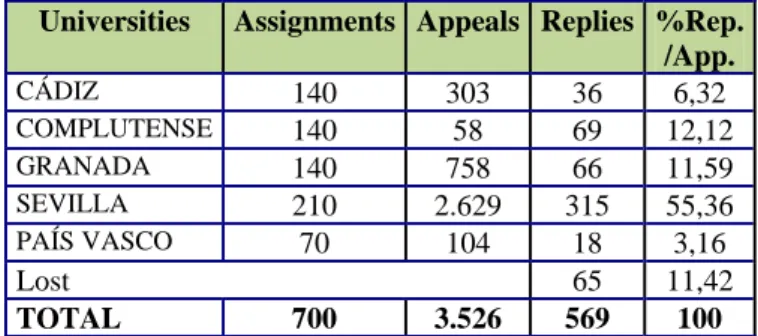
Difficulties opposed locating appropriate fac- ulty to appeal to participate in the research, was the reason of differences between the proposed, and the actual samples inside every university.
In Table 4 you can see both, the invited sam- ple and the sample of actually respondents.
Table 4. Distribution of invited sample and sample of respondents
Álvarez-Rojo, Víctor; Romero, Soledad; Gil-Flores, Javier; Rodríguez-Santero, Javier; Clares, José; Asensio, Inmaculada; del- Frago, Rakel; García-Lupión, Beatriz; García-García, Mercedes; González-González, Daniel; Guardia, Soledad; Ibarra, Mari- sol; López-Fuentes, Rafael; Rodríguez-Gómez, Gregorio, Salmeron-Vilchez, Purificación. (2011). Teachers’ needs for teach- ing in the European Higher Education Area (EHEA). RELIEVE, v. 17, n. 1, art. 1, 1-22.
http://www.uv.es/RELIEVE/v17n1/RELIEVEv17n1_1eng.htm Universities Assignments Appeals Replies %Rep.
/App.
CÁDIZ 140 303 36 6,32
COMPLUTENSE 140 58 69 12,12
GRANADA 140 758 66 11,59
SEVILLA 210 2.629 315 55,36
PAÍS VASCO 70 104 18 3,16
Lost 65 11,42
TOTAL 700 3.526 569 100
Research outcomes presented in this article are those obtained from the 504 faculty replies to the Protocol of Assessment (total of replies, minus lost cases) in the 5 universities sponsor- ing the research project. To fulfil the research objectives previously outlined, data analysis has been conducted by means of descriptive statistics (percents, mean and standard devia- tion), and applying techniques like the analysis of variance, in order to analyze any significant differences due to Knowledge Areas or faculty professional levels.
Outcomes Replies’ outline
Faculty answered the questions by means of a scale from 1 to 6, and rated the need of further
training in every block of content. As you can observe in Table 5, the average value of need expressed by faculty ranged approximately from 2.48 for the highest (competence for management) to 2.02 for the lowest (the devel- opment of teaching). Not one of the average values even reached the mid-point of the 1 to 6 scale.
Table 5. Means and standard deviations obtained for every block of the scale
Mean
Standard deviation Management Skills 2,4764 1,36086 Competence for lifelong learning
management 2,3084 1,23573
Competence for tutoring 2,2965 1,29665 Competence for teaching plan-
ning 2,1253 1,18328
Competence for learnings’
evaluation 2,0593 1,23991
Competence for development of
teaching 2,0205 1,11030
So, it seems that teachers perceived to have no great training need in every of the six teach- ing functions being asked about. This can be clearly seen in Figure 1.
Figure 1. Means obtained for every content block of the scale
Training needs data related with Knowledge Areas (Figures 2 to 7), show that faculty in most need of training is located in Social Sciences and Law area (planning, develop- ment, management and life-long learning)
while lower levels of need are found in the areas of Humanities (development, evalua- tion, life-long learning) and Engineering (planning, management and life-long learn- ing). The Engineering’ are the ones manifest-
Álvarez-Rojo, Víctor; Romero, Soledad; Gil-Flores, Javier; Rodríguez-Santero, Javier; Clares, José; Asensio, Inmacu- lada; del-Frago, Rakel; García-Lupión, Beatriz; García-García, Mercedes; González-González, Daniel; Guardia, Sole- dad; Ibarra, Marisol; López-Fuentes, Rafael; Rodríguez-Gómez, Gregorio, Salmeron-Vilchez, Purificación. (2011).
Teachers’ needs for teaching in the European Higher Education Area (EHEA). RELIEVE, v. 17, n. 1, art. 1, 1-22.
http://www.uv.es/RELIEVE/v17n1/RELIEVEv17n1_1eng.htm
ing the greatest demand of competences for tutoring, while the Health Sciences area are this that reach the upper half in the demand for assessment competences.
In short, and taking into account that the maximum mean value obtained is 2.79, on a scale of 1 to 6, main training needs in every
Knowledge Area would be so:
- Humanities: Management, tutoring and life-long learning.
- Natural Sciences:Tutoring, management and development of teaching
- Engineering: Tutoring, management and life-long learning
- Health Sciences: Management, life-long learning and evaluation
- Social Sciences and Law, management, life-long learning and tutoring.
According to data, faculty seems to have better control of competencies related to tra- ditional teaching functions (teaching and assessment), while demanding far more training in those related to "new" functions implying greater levels of accountability (management, tutoring and openness to life- long learning).
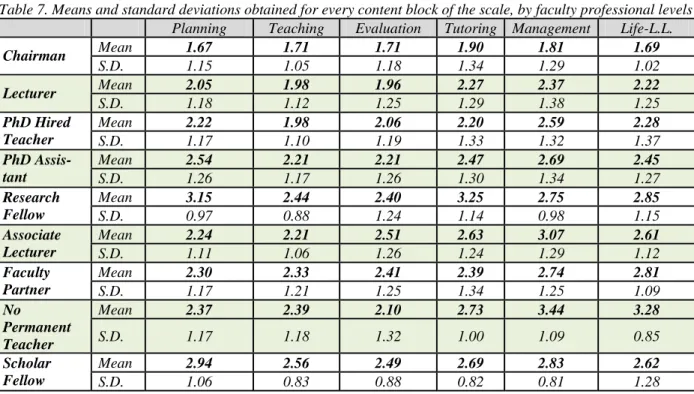
Let us now analyze the demands in training on competences, taking into account the various types of teachers who are actually teaching in the universities where the study was performed; we have found outcomes shown in Table 7.
Figures 2 to 7 Means obtained for every content block of the scale, in every knowledge area
Álvarez-Rojo, Víctor; Romero, Soledad; Gil-Flores, Javier; Rodríguez-Santero, Javier; Clares, José; Asensio, Inmacu- lada; del-Frago, Rakel; García-Lupión, Beatriz; García-García, Mercedes; González-González, Daniel; Guardia, Sole- dad; Ibarra, Marisol; López-Fuentes, Rafael; Rodríguez-Gómez, Gregorio, Salmeron-Vilchez, Purificación. (2011).
Teachers’ needs for teaching in the European Higher Education Area (EHEA). RELIEVE, v. 17, n. 1, art. 1, 1-22.
http://www.uv.es/RELIEVE/v17n1/RELIEVEv17n1_1eng.htm
Table 7. Means and standard deviations obtained for every content block of the scale, by faculty professional levels Planning Teaching Evaluation Tutoring Management Life-L.L.
Mean 1.67 1.71 1.71 1.90 1.81 1.69
Chairman
S.D. 1.15 1.05 1.18 1.34 1.29 1.02
Mean 2.05 1.98 1.96 2.27 2.37 2.22
Lecturer
S.D. 1.18 1.12 1.25 1.29 1.38 1.25
Mean 2.22 1.98 2.06 2.20 2.59 2.28
PhD Hired
Teacher S.D. 1.17 1.10 1.19 1.33 1.32 1.37
Mean 2.54 2.21 2.21 2.47 2.69 2.45
PhD Assis-
tant S.D. 1.26 1.17 1.26 1.30 1.34 1.27
Mean 3.15 2.44 2.40 3.25 2.75 2.85
Research
Fellow S.D. 0.97 0.88 1.24 1.14 0.98 1.15
Mean 2.24 2.21 2.51 2.63 3.07 2.61
Associate
Lecturer S.D. 1.11 1.06 1.26 1.24 1.29 1.12
Mean 2.30 2.33 2.41 2.39 2.74 2.81
Faculty
Partner S.D. 1.17 1.21 1.25 1.34 1.25 1.09
Mean 2.37 2.39 2.10 2.73 3.44 3.28
No Permanent
Teacher S.D. 1.17 1.18 1.32 1.00 1.09 0.85
Mean 2.94 2.56 2.49 2.69 2.83 2.62
Scholar
Fellow S.D. 1.06 0.83 0.88 0.82 0.81 1.28
By comparing the averages obtained for the first four teachers’ categories (Professor, Lec- turer, PhD Hired Teacher and PhD Assistant), we can see that there is an increase in the de- mand for training courses as the level of teaching experience decreases. Therefore, teaching experience and professional stability seem to be elements that help teachers feel
more prepared and confident in order to meet the specific demands of their role as teachers.
Competences for teaching planning
The distribution of replies to the 10 items of this content block is reflected in table 8. Data are presented in descending order of achieved average.
Table 8. Replies distribution to the items of the Teaching Planning content block.
Competences
Mean S.D.
Global - Teaching Planning 2.13 1.18
Block Items
10. Design teaching activities to promote learners responsibility and autonomy. 2.67 1.49 9. Schedule learning activities that encourage student self-learning 2.61 1.50 8. Transforming teacher delivery of subject matter content into student learning activities 2.43 1.49
5. Design teaching-learning activities 2.41 1.44
7. Fitting learning activities to the competences targeted by a subject matter 2.33 1.41 6. Planning learning practices to approach students to the professions. 2.32 1.54
4.Skills to match knowledge to competencies to be developed 2.21 1.45
3. Structure and relate the content matter 1.65 1.40
2. Select core matter content 1.30 1.27
1. Master the content of the subject matter 1.30 1.34
As shown in table 8, training needs on competences required at the moment of teach- ing planning, show the lowest values (1.30) when they deal with content-related aspects of the subject matter (control- item 1-, selec-
tion- item 2- and structure –item 3). Other- wise, the highest values were found over the tasks of designing learning activities to pro- mote responsibility (2.67) and self-learning (2.61). Those data mean teachers perceive
Álvarez-Rojo, Víctor; Romero, Soledad; Gil-Flores, Javier; Rodríguez-Santero, Javier; Clares, José; Asensio, Inmacula- da; del-Frago, Rakel; García-Lupión, Beatriz; García-García, Mercedes; González-González, Daniel; Guardia, Soledad;
Ibarra, Marisol; López-Fuentes, Rafael; Rodríguez-Gómez, Gregorio, Salmeron-Vilchez, Purificación. (2011). Teachers’
needs for teaching in the European Higher Education Area (EHEA). RELIEVE, v. 17, n. 1, art. 1, 1-22.
http://www.uv.es/RELIEVE/v17n1/RELIEVEv17n1_1eng.htm
they accurately dominate disciplinary content – as it have been acquired alongside their university studies -; however, they feel them- selves more lacking of those competences that require specific training for the exercise of their profession: teaching. Moreover, the competence perceived gap is even greater when it comes to competences that have to do with specific methodological demands of the EHEA, as for example, planning and develop a teaching-learning student-centered process – no more in subject matter content -, or pro- mote student independent learning
Competences for development of teaching The competences for the development of teaching most in demand are, again, those relating to the promotion of independent learning of students, and the development of cross competences: how to make the students take responsibility for their learning, how to motivate them, how to develop critical skills and teamwork among the learners ... The lowest averages are found in those items (1, 2, 4, 13) which relate to knowledge contents, its adaptation and delivery to students (see Table 9), i.e., the tasks being traditionally developed by faculty.
Table 9. Replies distribution for the Development of Teaching content block Competences
Mean S.D.
Global – Development of teaching 2.02 1.11
Block Items
12. Improve the students ability to take responsibility for their own learning 2.72 1.49
11. Use students motivation strategies 2.61 1.49
10. Teaching group work comptencies 2.28 1.46
9. Develop student's critical ability 2.25 1.48
5.Mastering the accurate technology to deal with specific cases or professional
problems 2.14 1.41
14. Use ITC for educational purposes 2.14 1.41
8. Share professional skills with other teachers and students. 1.98 1.45 3. Perform presentations of solving practical professional cases or problems 1.89 1.40
7. Get in a collaborative teaching team with workplace-tutors 1.87 1.54
6. Coordinate practical and theoretical teaching 1.80 1.56
2. Provide professional content, processes and resources 1.77 1.35 4. Apply scientific or subject matter knowledge to daily life situations 1.76 1.40
13. Adapt scientific language to students’ academic level 1.57 1.37
1. Deliver update and meaningful scientific knowledge 1.50 1.36
Competences for learnings’ evaluation The issues of concern to teachers in relation to the competencies for evaluation (Table 10) are especially focused on the assessment of their own teaching, or in the search of different tech- niques that are consistent with new teaching methodologies (or its implementation). Teach- ers’ interest highlights some priorities as the review of their teaching, the analysis of teaching practice, and improvement of teaching and
learning. They refer, again, to functions that have not been generally carried out by teachers, who have been more concerned with the as- sessment of student learning in terms of knowl- edge acquisition. The lowest averages are found in areas that somehow are more "clearly legislated": establish evaluation criteria, moni- toring of student progress and information de- livery about the students performance, i.e., functions traditionally being performed by fac- ulty.
Álvarez-Rojo, Víctor; Romero, Soledad; Gil-Flores, Javier; Rodríguez-Santero, Javier; Clares, José; Asensio, Inmacula- da; del-Frago, Rakel; García-Lupión, Beatriz; García-García, Mercedes; González-González, Daniel; Guardia, Soledad;
Ibarra, Marisol; López-Fuentes, Rafael; Rodríguez-Gómez, Gregorio, Salmeron-Vilchez, Purificación. (2011). Teachers’
needs for teaching in the European Higher Education Area (EHEA). RELIEVE, v. 17, n. 1, art. 1, 1-22.
http://www.uv.es/RELIEVE/v17n1/RELIEVEv17n1_1eng.htm
Table 10. Replies Distribution for Learnings’ Evaluation content block Competences
Mean S.D.
Global- Learnings’ Evaluation 2.05 1.23
Block Items
7 Use evaluation outcomes to improve teaching and learning. 2.44 1.42
6 Self-inquire into teaching practice 2.38 1.42
8 Use the assessment to improve the teaching and learning. 2.34 1.44 3 Use a wide range of assessment techniques, also suitable for a specific teaching
methodology. 2.07 1.49
2 Fit the assessment systems to the specific competences taught in the subject course 1.93 1.46
5 Provide students with feed-back on their learning 1.93 1.47
4 Track students work 1.90 1.40
1 Establish and widespread among the students the evaluation criteria 1.51 1.37
Competences for tutoring learning proc- esses
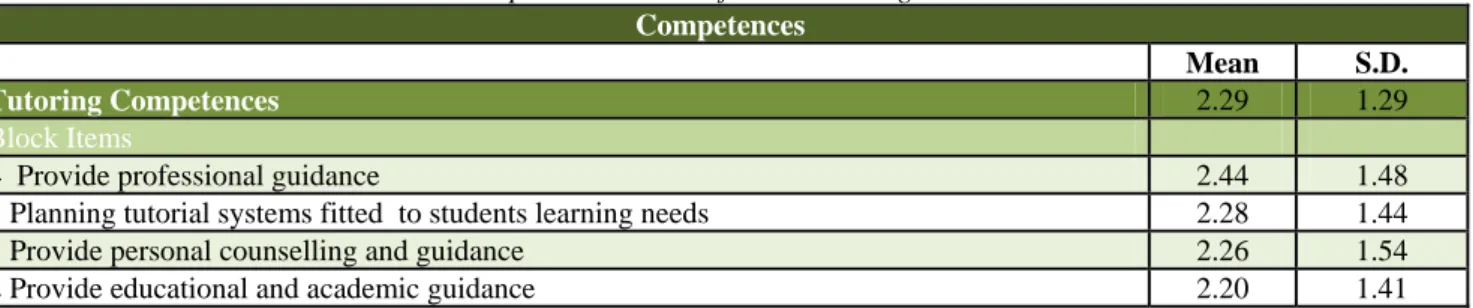
Four competencies have been analyzed in the section on tutoring (table 11). The only one that requires the most training is that which refers to the field of professional de- velopment, with an average of 2.44. It should
be noted firstly that the requirements of train- ing on competences for the block of Tutoring present the highest average values of demand (2.29), followed by the requirements relating to the block of Management, as well as the block of Life-long Learning, both with similar values.
Table 11. Replies distribution for the Tutoring content block Competences
Mean S.D.
Tutoring Competences 2.29 1.29
Block Items
4 Provide professional guidance 2.44 1.48
1 Planning tutorial systems fitted to students learning needs 2.28 1.44
3 Provide personal counselling and guidance 2.26 1.54
2 Provide educational and academic guidance 2.20 1.41
These competences are directly related to the teaching functions that deal with the practice of teaching focused on students needs, and with their personal development. The compe- tences that require less training, as in the pre- viously mentioned blocks, are those related to aspects that teaching staff is more accustomed to perform, in this case the academic advising of student work.
Management competences
This is the block of competences on which the teaching staff perceives ownself to have higher training needs. Taking into account all the aspects of this block, included in the ques-
tionnaire, much training is demanded for ‘the establishment of relationships with other uni- versities’ (3.01). We can find (see table 12) a pattern of ‘decreasing training need’ in this block, related to the more o r less proximity of relationships on attention — ranged from Uni- versity level, through other research teams, and their own research team, till their own de- partment level. But EHEA specifically de- mands faculty to be implied in a complex and increasingly ample web of relationships. Again and not surprisingly, faculty needs of training are more related to new or unpracticed teach- ing patterns.
Álvarez-Rojo, Víctor; Romero, Soledad; Gil-Flores, Javier; Rodríguez-Santero, Javier; Clares, José; Asensio, Inmacula- da; del-Frago, Rakel; García-Lupión, Beatriz; García-García, Mercedes; González-González, Daniel; Guardia, Soledad;
Ibarra, Marisol; López-Fuentes, Rafael; Rodríguez-Gómez, Gregorio, Salmeron-Vilchez, Purificación. (2011). Teachers’
needs for teaching in the European Higher Education Area (EHEA). RELIEVE, v. 17, n. 1, art. 1, 1-22.
http://www.uv.es/RELIEVE/v17n1/RELIEVEv17n1_1eng.htm
Table 12. Replies distribution for the Management content block.
Competences
Mean S.D.
Management competences 2.47 1.36
Block Items
1 Establish relationships with other universities 3.01 1.511
2 Interact with other teams or research groups. 2.49 1.614
3 Participate in multidisciplinary teams or groups 2.41 1.590
4 Work in departmental teams 2.00 1.540
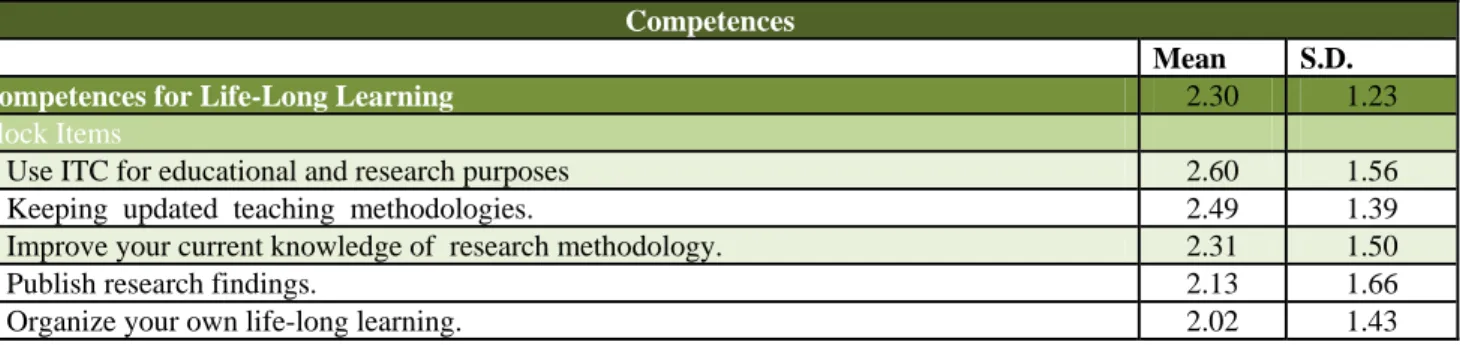
Competences for life-long learning manage- ment
In-service training (table 13) is another subject of concern (2.30) for faculty. As we have been observing, teachers are conscious of the new teaching demands and subse- quently express their interest in a permanent
updating of teaching methods (2.49), and above all, on the use of TIC (2.60) in teach- ing settings. Given the importance of their research function, they also call for training on areas related to it (research methodolo- gies, publish research findings). Otherwise, they feel themselves accurated for life-long learning planning.
Table 13. Replies distribution Life- Learning content block Competences
Mean S.D.
Competences for Life-Long Learning 2.30 1.23
Block Items
5. Use ITC for educational and research purposes 2.60 1.56
2. Keeping updated teaching methodologies. 2.49 1.39
3. Improve your current knowledge of research methodology. 2.31 1.50
4. Publish research findings. 2.13 1.66
1. Organize your own life-long learning. 2.02 1.43
Inferential analysis of replies.
Analysis of data collected was carried out taking into account two variables, Knowledge Areas and Types of current Faculty Profes- sional Levels. We looked for differences be- tween groups through one-way ANOVA test and post hoc contrasts, performed by Tukey's HSD test.
Comparisons based on the Knowledge Ar- eas
As shown in Table 14, the area of Humani- ties is the one with lower training needs means in four of the six blocks of competences (plan- ning, development, evaluation and tutoring).
Related to competences for management and training, faculty of Natural Sciences express higher needs. By contrast, teachers of Social Sciences and Law area on one side, and of Health Sciences, on the other, are the least concerned with training needs.
Álvarez-Rojo, Víctor; Romero, Soledad; Gil-Flores, Javier; Rodríguez-Santero, Javier; Clares, José; Asensio, Inmacu- lada; del-Frago, Rakel; García-Lupión, Beatriz; García-García, Mercedes; González-González, Daniel; Guardia, Sole- dad; Ibarra, Marisol; López-Fuentes, Rafael; Rodríguez-Gómez, Gregorio, Salmeron-Vilchez, Purificación. (2011).
Teachers’ needs for teaching in the European Higher Education Area (EHEA). RELIEVE, v. 17, n. 1, art. 1, 1-22.
http://www.uv.es/RELIEVE/v17n1/RELIEVEv17n1_1eng.htm
Table 14. Means and standard deviations of block, by Knowledge Areas
Competences for teaching planning Mean S.D.
Humanities 1,77 1,29
Natural Sciences 2,09 1,19
Engineering 2,18 1,09
Health Sciences 2,24 1,23
Social Sciences and Law 2,26 1,11
Competences for development of teaching
Humanities 1,63 1,11
Natural Sciences 1,95 1,17
Ingenierías Engineering 2,15 1,12
Health Sciences 2,14 1,12
Social Sciences and Law 2,19 1,05
Competences for learnings’ evaluation
Humanities 1,70 1,30
Natural Sciences 1,89 1,22
Engineering 2,10 1,21
Health Sciences 2,41 1,25
Social Sciences and Law 2,19 1,19
Competences for tutoring
Humanities 1,98 1,45
Natural Sciences 2,27 1,31
Engineering 2,55 1,17
Health Sciences 2,40 1,33
Social Sciences and Law 2,36 1,21
Competences for Management
Humanities 2,25 1,41
Natural Sciences 2,15 1,37
Engineering 2,23 1,41
Health Sciences 2,68 1,36
Social Sciences and Law 2,79 1,26
Competences for Life long Learning Humanities
Natural Sciences Engineering Health Sciences
Social Sciences and Law
ANOVA outcomes (Table 15) lead us to see significant differences in all fields of competence, except that of to tutoring.
Table 15. ANOVA outcomes on differences in replies to blocks, by Knowledge Areas
F Sig.
Competences for teaching planning 2,901 ,022
Competences for development of teaching 4,507 ,001
Competences for learnings’ evaluation 4,466 ,001
Competences for tutoring 2,189 ,069
Competences for Management 5,559 ,000
Competences for Life-long Learning 9,011 ,000
Álvarez-Rojo, Víctor; Romero, Soledad; Gil-Flores, Javier; Rodríguez-Santero, Javier; Clares, José; Asensio, Inmacu- lada; del-Frago, Rakel; García-Lupión, Beatriz; García-García, Mercedes; González-González, Daniel; Guardia, Sole- dad; Ibarra, Marisol; López-Fuentes, Rafael; Rodríguez-Gómez, Gregorio, Salmeron-Vilchez, Purificación. (2011).
Teachers’ needs for teaching in the European Higher Education Area (EHEA). RELIEVE, v. 17, n. 1, art. 1, 1-22.
http://www.uv.es/RELIEVE/v17n1/RELIEVEv17n1_1eng.htm
Post hoc contrasts (table 16) have revealed significant differences for all blocks between the area of Humanities and the area of Social Sciences and Law, as well as with the area of Health Sciences, in three blocks of content - development of the teaching, evaluation and training. In every block the needs expressed by the faculty of Humanities are lower than
those of other areas’ teachers. Faculty needs of Natural Sciences area are significantly higher in some blocks than those outlined, respectively, by teachers of Health Sciences (evaluation, life-long learning) and Social Sciences and Law (evaluation, management, and life-long learning).
Table 16. Post hoc outcomes of ANOVA contrast on block, by Knowledge Areas
(I) Area of Knowledge (J) Area of Knowledge
Mean Differences (I-J) Sig.
Competences for teaching planning
Humanities Social Sciences and Law -,48381(*) ,011
Competences for development of teaching
Humanities Health Sciences -,51788(*) ,023
Social Sciences and Law -,55824(*) ,001 Competences for learnings’ evaluation
Humanities Health Sciences -,71008(*) ,002
Social Sciences and Law -,48571(*) ,017
Natural Sciences Health Sciences -,52208(*) ,048
Competences for Management
Humanities Social Sciences and Law -,54725(*) ,012
Natural Sciences Social Sciences and Law -,64025(*) ,002
Competences for Life long Learning
Humanities Health Sciences -,55446(*) ,026
Social Sciences and Law -,67704(*) ,000
Natural Sciences Health Sciences -,62323(*) ,008
Social Sciences and Law -,74580(*) ,000
Comparisons related to Types of current Faculty Professional Levels
Taking into account faculty professional levels, comparisons have been established between 9 groups. Nevertheless, It must be noted that although the mean values reflected
are about nine groups, only 6 groups have been taken into account for the inferential analysis, because the size of the remaining 3 groups’ samples is very limited (table 17).
Álvarez-Rojo, Víctor; Romero, Soledad; Gil-Flores, Javier; Rodríguez-Santero, Javier; Clares, José; Asensio, Inmacu- lada; del-Frago, Rakel; García-Lupión, Beatriz; García-García, Mercedes; González-González, Daniel; Guardia, Sole- dad; Ibarra, Marisol; López-Fuentes, Rafael; Rodríguez-Gómez, Gregorio, Salmeron-Vilchez, Purificación. (2011).
Teachers’ needs for teaching in the European Higher Education Area (EHEA). RELIEVE, v. 17, n. 1, art. 1, 1-22.
http://www.uv.es/RELIEVE/v17n1/RELIEVEv17n1_1eng.htm
Table 17. Blocks’ Means, by faculty professional levels
Mean S. Desv.
Chairman 1,6669 1,15221
Lecturer 2,0541 1,18056
PhD Hired Teacher 2,2236 1,16903
PhD Assistant 2,5384 1,25656
Research Fellow 3,1500 0,96782
Associate Lecturer 2,2412 1,11244
Faculty Partner 2,3044 1,17248
No Permanente Teacher 2,3708 1,16745 Competences for teaching planning
Scholar Fellow 2,9444 1,06549
Chairman 1,7059 1,04995
Lecturer 1,9767 1,12349
PhD Hired Teacher 1,9846 1,10027
PhD Assistant 2,2101 1,16921
Research Fellow 2,4435 0,87532
Associate Lecturer 2,2090 1,05736
Faculty Partner 2,3285 1,20563
No Permanet Teacher 2,3869 1,17624 Competences for development of teaching
Scholar Fellow 2,5635 0,83410
Chairman 1,7076 1,17518
Lecturer 1,9583 1,25310
PhD Hired Teacher 2,0642 1,19366
PhD Assistant 2,2083 1,25748
Research Fellow 2,4018 1,23739
Associate Lecturer 2,5063 1,26458
Faculty Partner 2,4107 1,24530
No Permanet Teacher 2,1042 1,32484 Competences for learnings’ evaluation
Scholar Fellow 2,4861 ,87599
Chairman 1,8971 1,33527
Lecturer 2,2663 1,28578
PhD Hired Teacher 2,2028 1,33198
PhD Assistant 2,4653 1,29718
Research Fellow 3,2500 1,13652
Associate Lecturer 2,6324 1,23830
Faculty Partner 2,3889 1,34331
No Permanet Teacher 2,7292 1,00260 Competences for tutoring
Scholar Fellow 2,6852 ,82367
Chairman 1,8137 1,28826
Lecturer 2,3703 1,38291
PhD Hired Teacher 2,5880 1,31945
PhD Assistant 2,6857 1,34403
Research Fellow 2,7500 ,97895
Associate Lecturer 3,0700 1,28675
Faculty Partner 2,7411 1,24811
No Permanet Teacher 3,4375 1,09298 Competences for Management
Scholar Fellow 2,8333 ,81009
Chairman 1,6931 1,02176
Lecturer 2,2204 1,24624
PhD Hired Teacher 2,2815 1,36563
PhD Assistant 2,4472 1,26592
Research Fellow 2,8500 1,14746
Associate Lecturer 2,6092 1,11833
Faculty Partner 2,8071 1,09203
No Permanet Teacher 3,2833 ,85475
Competences for Life-long Learning
Scholar Fellow 2,6222 1,27845
Álvarez-Rojo, Víctor; Romero, Soledad; Gil-Flores, Javier; Rodríguez-Santero, Javier; Clares, José; Asensio, Inmacu- lada; del-Frago, Rakel; García-Lupión, Beatriz; García-García, Mercedes; González-González, Daniel; Guardia, Sole- dad; Ibarra, Marisol; López-Fuentes, Rafael; Rodríguez-Gómez, Gregorio, Salmeron-Vilchez, Purificación. (2011).
Teachers’ needs for teaching in the European Higher Education Area (EHEA). RELIEVE, v. 17, n. 1, art. 1, 1-22.
http://www.uv.es/RELIEVE/v17n1/RELIEVEv17n1_1eng.htm
ANOVA outcomes show that significant differences have not been encountered, nei- ther in competences for the development of
teaching, nor in the competences for tutoring (tables 18 and 19)
Table 18. ANOVA outcomes on blocks, by faculty professional levels
F Sig.
Competences for teaching planning 2,855 ,004 Competences for development of teaching 1,646 ,109 Competences for learnings’ evaluation 2,085 ,036
Competences for tutoring 1,751 ,085
Competences for Management 4,197 ,000
Competences for Life-long Learning 4,000
Notice that Professors express significantly less need of training in four blocks of com- petences than PhD Assistant (teaching plan- ning), Associate Lecturers (evaluation, man- agement, life-long learning,) and Faculty Partners (life-long learning). Lecturers show,
too, significantly less needs for training on management than the Associate Lecturers. It seems again, that the more teachers’ teaching experience and professional stability, the less needs for training.
Table 19. Post hoc test outcomes of blocks, by faculty professional levels
(I) Professional Level (J) Professional Level Mean Difference(I-J) Sig.
Competences for planning teaching
Chairman PhD Assistant -,87155(*) ,018
Competences for Learnings’ Evaluation
Chairman Associate Lecturer -,79867(*) ,032
Competences for Management
Chairman Associate Lecturer -1,25627(*) ,000
Lecturer Associate Lecturer -,69974(*) ,021
Competences for Life-long Learning
Chairman Associate Lecturer -,91601(*) ,005
Faculty Partner -1,11401(*) ,003
Conclusions and discussion
The development of the EHEA demands faculty put into practice new teaching skills. Some pro- files of teaching competences in EHEA context have been stated by a previous research (Alvarez Rojo et al., 2009); these profiles were the starting point we have used to establish, in this second research, faculty´s training needs on teaching competencies. Research outcomes point out, that faculty perceives a greater need for training on teaching competences that have to do with most innovative elements of the EHEA; teaching staff presents more shortcomings on competencies to facilitate the development and evaluation of a teaching-learning process ‘focused on the stu-
dent’ (students development of generic compe- tencies, using teaching methodologies to facili- tate students independent learning, tutoring learning processes, assessment of the teaching- learning process) - instead of on the content of a subject matter. Otherwise, it seems that teach- ers have less training needs in areas that have traditionally been regarded as specific teaching functions (control, selection and transmission of subject matter content, summative assessment of students’ learnings). Those findings are con- sistent with outcomes obtained by Troiano, Elias and Amengual (2006), pointing out that, teaching methodologies focused on subject matter content, are mostly used in university
Álvarez-Rojo, Víctor; Romero, Soledad; Gil-Flores, Javier; Rodríguez-Santero, Javier; Clares, José; Asensio, Inma; del-Frago, Rakel;
García-Lupión, Beatriz; García-García, Mercedes; González-González, Daniel; Guardia, Soledad; Ibarra, Marisol; López-Fuentes, Rafael; Rodríguez-Gómez, Gregorio, Salmeron-Vilchez, Purificación. (2011). Teachers’ needs for teaching in the european higher education area (EHEA). RELIEVE, v. 17, n. 1, art. 1, 1-22. http://www.uv.es/RELIEVE/v17n1/RELIEVEv17n1_1eng.htm
sittings, instead of active teaching-learning meth- odologies.
Matching the principles of the EHEA new cul- ture, tutoring learning processes, and personal and professional guidance competences, are per- ceived by faculty as one of the competency blocks on which is require more training.
Otherwise, faculty shows his openness to life- long learning; teachers realise they must acquire specific competencies to adapt themselves to the new teaching demands, with regard to the use of ITC for educational purposes, and the implemen- tation of new teaching methodologies.
Quality teaching management and accreditation, and openness to interdisciplinary and collabora- tive work with other teams and universities, are becoming requirements increasingly important in university settings. It seems faculty is far more concerned to that demand, for management com- petences block has showed the highest level of training needs. The larger the operational range of institutional relationships demanded (from rela- tionships with other universities to those gener- ated in teaching departments), the larger the train- ing needs expressed by faculty.
Self-assessment of teaching, in order to improve it, is also a main requirement of quality teaching.
Research findings show faculty consciousness of this matter, because teachers subsequently stated training needs about it.
Research outcomes above quoted, are coinci- dent with those findings of Murillo et al. (2005) and of Delgado (2010), related to training needs of fresh faculty; as well as with those of Gonzalez Sanmamed and Raposo Rivas (2008), related to training needs of faculty as a whole.
It had yet been stated by Mas and Ruiz (2007), among others, that every knowledge area has a set of specifities, and so, every one shows different levels on competences for teaching. Findings of our research confirm this diversity, and point out that faculty of Social Sciences and Law, and Health Sciences areas have the highest set of
training needs; lowest levels of needs are found among teachers of Humanities and Natural Sci- ences areas. Further research is needed to estab- lish the causes of this difference among areas.
Getting into glimpse faculty professional lev- els, it seems that teaching experience is backing the lesser amounts of training needs on teaching competencies outlined by senior faculty.
Finally, we can sum up stating that faculty call for training, to put into practice a new teaching paradigm, and new teaching functions.
Our research findings point out the same direc- tion as those of Saravia Gallardo (2008), as well as those of Bozu y Canto (2009), to look for an institutional concern about faculty teach- ing competences, as well as on their scientific competencies. Times are gone when only sub- ject matter competences were mainly required for one teacher to teach a university course.
Degrees and life-long learning trainings must be on professional teaching competencies, too.
Findings above quoted, have been taken into account to design FORCOM (http://www.proyectoforcom.org),faculty life-
long learning Website; teachers can there find and share teaching procedures, teaching devices and didactic tools, theoretical teaching models, practical cases of teaching with new method- ologies, and so on. It is intended to be a useful tool to aid faculty on planning, and developing teaching processes, in any university teaching settings.
References
Álvarez, V., García, E.; Gil, J.; Romero, S.
(2004). La enseñanza universitaria. Planifica- ción y desarrollo de la docencia. Madrid: EOS.
Álvarez, V., Gil, J.; Rodríguez, J. & Romero, S.
(2007). Necesidades del profesorado de la Universidad de Sevilla respecto a las metodo- logías de enseñanza de cara a la adaptación al EEES. Propuesta de plan de mejora. Sevilla:
ICE – Vicerrectorado de Docencia.
Álvarez-Rojo, Víctor; Asensio-Muñoz Inmacu- lada; Clares, José; del-Frago, Rakel; García-