Tensor Networks for Statistical Mechanics
Part I. 17:00 PM (Kobe), 22 Feb. 2021
Tomotoshi. Nishino (Kobe Universty)
Part II. 17:00 PM (Kobe), 24 Feb. 2021
Tensor network structure in statistical systems — [ Ising Model ]
Elementary algorithms for the calculation of partition functions (from Baxter)
Application examples (if there is some time)
ANNNI models (effect of frustration)
to higher dimension PEPS/TePS and TRG
Fractal lattices / Hyperbolic lattices
0 1 1 0 0 0 1 1 1 1 0 0 1 0 0 1
… HaPPY … Exotic systems:
Random-bond Ising model
why do I have to (?) speak about statistical mechanics?
to confirm that Quantum Mechanics is only a part of physics
“Strong correlation’’ also exists in statistical mechanics and other fields.
… but it is difficult of earn billions with the title “statistical …”
Tensor Network Structure is naturally contained in statistical systems.
(Path Integral representation of quantum systems)
Variational Formulation for a QM system “produces” a Statistical system.
(Most of the descriptions on TN are actually statistical.) just I love statistical physics,
from the time I had rich hair.
RE &' IT"KS OF MODERN PHYSIC& VOLUME 39, NUMBER 4 OCTOB F.R & &)ei 7
. .
—., istory o): tIze . en' —. . sag .
V.. oc. e. .
STEPHEN G. BRIJSH
DePartment ofI'hysi cs and DePartment ofHistory ofScience, Harvard University, Cambridge, Massachusetts
Many physico-chemical systems can be represented more or less accurately by alattice arrangement of molecules with nearest-neighbor interactions. The simplest and most popular version of this theory is the so-called "Ising model,
"
dis-cussed by Krnst Ising in 1925 but suggested earlier (1920) by Wilhelm Lenz.
Major events in the subsequent history of the Lenz—Ising model are reviewed, including early approximate methods of solution, Onsager's exact result for the two-dimensional model, the use of the mathematically equivalent "lattice gas"
model to study gas—liquid and liquid —solid phase transitions, and recent progress in determining the singularities of thermodynamic and magnetic properties at the critical point. Not only is there awide range ofpossible physical applica- tions of the model, there is also an urgent need for the application of advanced mathematical techniques in order to establish its exact properties, especially in the neighborhood of phase transitions where approximate methods are un- reliable.
After many years of being scorned or ignored by most scientists, the so-called "Ising model" has recently enjoyed increased popularity and may, if present trends continue, take its place as the preferred basic theory of all cooperative phenomena. Whereas previously it
appeared that the greatly over-simplified representation of intermolecular forces on which this model is based would make it inapplicable to any real systems, it is now being claimed that the essential features of co- operative phenomena (especially at the critical point) depend not on the details of intermolecular forces but on the mechanism of propagation of long-range order, and the Ising model is the only one which offers much hope of an accurate study of this mechanism. Whether or not it does eventually turn out that gas—liquid critical phenomena, magnetic Curie points, order—disorder transitions in alloys, and phase separation in liquid mixtures can all be described, to a good first approxima- tion, by the same model, the problem of a generalized description of cooperative phenomena now deserves serious attention. We are just beginning to realize some of the implications of such a generalized descrip- tion: specialists in the properties of gases and liquids could not afford to ignore progress being made in research on phase transitions in solids, and conversely.
While some scientists might not appreciate the burden imposed by the need for keeping up with the literature in unfamiliar fields which now suddenly appear to be related to their own, students should benefit by the prospective unification of different subjects. No longer would it be necessary to learn a different theory for
each kind of cooperative phenomenon.
The historical development of the "Ising model"
also shows the same disregard for traditional boundaries between disciplines. Physics, chemistry, metallurgy, and mathematics have all been involved, and some of the most recent applications have been in biology.
The most striking success in the history of the Ising model
—
the exact solution of the two-dimensional problem—
involved such difficult mathematics that it stumped all the physicists who attempted it, and was8
finally accomplished by.
.
.a chemist. (Just as ironicalis the fact that the supposed inventor of the model, Krnst Ising, gave up research in physics after thinking he had proved that his model had no physical useful- ness, and only discovered twenty years later that he had become famous as a result of work on his model by other scientists. )
THE MODEL
We assume that the physical system can be repre- sented by a regular lattice arrangement of molecules in space. We are interested in three kinds of physical systems: (1) magnets, in which each molecule has a
"spin" that can be oriented either up or down relative to the direction of an externally applied field; (2) mix-
tures of two kinds of molecules; (3) mixtures of mole-
cules and "holes" (empty spaces)
.
All three kinds can be represented abstractly by the same model, if we simply say that each node of a regular space lattice is assigned a two-valued variable. Depending on whether this variable has the value+1
or—
1, we say that the molecule at that node (1) has spin up or down, or (2)belongs to one or the other of two species, (3) is present
or absent. Usually the two-valued variable is called the spiri o., associated with node i of the lattice.
A coegggraiioe of the lattice is a particular set of values of all the spins; if there are
X
nodes, there willbe 2~ different configurations. A typical configuration is shown in Fig. 1.
We assume that the molecules exert only short-range forces on each other; in particular, we assume that the interaction energy depends only on the configurations of neighboring nodes of the lattice. For example, we could say that the forces are such that when two neigh- boring spins are the same (both
+1
or both—
1) theenergy is
—
U, and when two neighboring spins are different (one is+1,
the other—
1) the energy is+U.
In other words, the interaction tends to make neigh- boring spins the same. In the three types of physical systems mentioned above, such an interaction could lead to (1) spontaneous magnetization, with all or
83
a century? of the Ising Model
W. Lenz, Phys. Z. 21, 613 (1920):
E. Ising, Z. 31, 253 (1925):
See Rev. Mod. Phys. 39, 883 (1967):
253
Beitrag zur Theorie des F e r r o m a g n e t i s m u s D.
Von Ernst Ising in Hamburg.
(Eingegangen am 9. Dezember 1924.)
Es wird im wesentlichen das thermische Verhalten eines linearen, aus Elementar- magneten bestehendea KSrpers untersueht, wobei im Gegensatz zur Weissschen Theorie des Ferromagaetismus keia molekulares Feld, somlern nur eine (nicht magnetisehe) Wechse[wirkung benachbarter Elemcatarmagnete aagenommeu wird.
Es wird gezeigt, dull tin sotehes Modell noch keine ferromagnetisehen Eigenschaften hcsitzt und diese Aussage auch auf das dreidimensionate )[odetl ausgedehnt.
1. A n n a h m e n . Die Erklarung, die P. W e i s s ~) ftir den Ferro- magneti~mus geg'eben hat, ist zwar formal befriedigend, doch Ial]t sie besanders die Frage nach einer physikalischen Erklarung der Hypothese des molekularen Fehles o[fen. Nach dieser Theorie wirkt au~ jeden E]ementarmagneten, abgesehen yon dem ~iul~eren 3[agnetfeld, ein inneres Fehl, das der ieweiligenMagne~isierungsinteasiti~t proportional ist. Es lieg't nahe. fiir die Wirkungen der einzelnen Elemente ( ~ Elementarmagnete) elektrische Dipolwirkungen anzuset, zen. Dann ergiiben sieh aber durch Summation der sehr langsam abnehmenden Dipolfelder sehr betrachtliche elektrische Feldst~rken, die dureh die Leitf~higkeit des Materials zerstSrt wCirden. Im Gegensatz zu P. W e i s s nehmen wir daher an, daft die Kr~ifte, die die Elemente atdeinander ausiiben, mit tier Entfernung raseh abklingen, so dal3 in erster N~herung sich nur benaehbarte Atome be-
einflussen.
Zweitens setzen wir an, dal~ die Elemente nur wenige der Kristall- , t r u k t u r entsprechende, energetiseh ausgezeichnete Orientierungen ein- nehmen. Infolge der W~rmebeweg'ung gehen die Elemente aus einer mggliehen Lage in eine andere tiber. W i r setzen an. dal~ die inhere Energie am kleins~en ist, wenn alle Elemente gleiehgerichtet sind. Diese Annahmen sind im wesentliehen zuerst yon W. L e n z s) aufgestellt und
n~her begrtindet worden.
2. D i e e i n f a c h e l i n e a r e K e t t e . Die gemaehtenVoraussetzungen wollen M r aM ein miiglichst einfaches Modell anwenden. W i t bereehnen das mittlere 3~oment $ e i n e s linearen 3lagneten, bestehend aus n Elemen~en.
.ledes dieser n Elemente soll nur die zwei Stellungen einnehmen ktinnen,
1) Auszug aus der Hamburger Dissertation.
'~) P. Weiss, Journ. de phys. (4) 6, 661, 1907, und Phys. ZS. 9, 358. 1908.
:~) W. Lenz, Phys. ZS. 21, 613, [920.
iSing and uSing
** Partition Function of 1D Ising Model is obtained as the trace of the products among transfer matrices T.
! e
βJe
−βJe
−βJe
βJ" !
1
− 1
"
= 2 sinh βJ
! 1
− 1
"
. (2.18)
区別のために,式
(2.14)
の固有値をλ
0= 2 cosh βJ ,
式(2.18)
の固有値をλ
1= 2 sinh β J
で表す.常にλ
0> λ
1 が満たされている.さて,関係式! 1
0
"
= 1 2
! 1
1
"
+ 1 2
! 1
− 1
"
(2.19)
を式
(2.17)
に代入すると,分配関数Z
" がZ
"= 1
2
# 2 cosh βJ $
N−1+ 1 2
# 2 sinh βJ $
N−1(2.20)
と求められることの確認は宿題にしておこう.
σ
1 とσ
N が隣り合う周期境界条件では,式(2.8)
にT (σ
N| σ
1)
を付け加えZ
""= %
σ1···σN
T ( σ
1| σ
2) T ( σ
2| σ
3) · · · T ( σ
N−1| σ
N) T ( σ
N| σ
1) (2.21)
と分配関数を表せる.ダイアグラムに描いておこう.
1 2 N
式
(2.21)
は,転送行列T
のN
乗のトレースになっていてZ
""= Tr T
N= #
2 cosh βJ $
N+ #
2 sinh βJ $
N(2.22)
と分配関数を求められる.
こうして,自由端条件の
Z
,固定端条件のZ
",周期境界条件のZ
"" が,それ ぞれ「微妙に異なる」数式で表されることがわかった.この差異は,N
が大き な極限では,あまり重要ではない.常にcosh βJ > sinh βJ
が成立するのでN
lim
→∞1 N
# − kT ln Z $
= lim
N→∞
1 N
# − kT ln Z
"$
= lim
N→∞
1 N
# − kT ln Z
""$
(2.23)
という具合に,スピン
1
個あたり(サイトあたり)の自由エネルギーが,境界 条件に依存しないからである.•
転送行列の最大固有値が,系の熱力学的な性質を決定するというポイントを押さえておこう.少しだけ補足すると,最大固有値
λ
0 と,その次に大きな固有値
λ
1 の比λ
1/λ
0 が,スピン相関関数" σ
iσ
j#
の距離| i − j |
に対する減衰を決定する.一般に,短距離の相互作用だけで記述される
1
次元 の統計力学模型の場合,相関関数の減衰は常に指数関数的であって,相転移が 起きることはない.ともかくも,大きい方から幾つかの転送行列固有値は,物 理量に顔を出すという意味で,重要なものである.2.2
転送行列の固有値13
! e
βJe
−βJe
−βJe
βJ" !
1
− 1
"
= 2 sinh βJ
! 1
− 1
"
. (2.18)
区別のために,式
(2.14)
の固有値をλ
0= 2 cosh βJ ,
式(2.18)
の固有値をλ
1= 2 sinh β J
で表す.常にλ
0> λ
1 が満たされている.さて,関係式! 1
0
"
= 1 2
! 1
1
"
+ 1 2
! 1
− 1
"
(2.19)
を式
(2.17)
に代入すると,分配関数Z
" がZ
"= 1
2
# 2 cosh βJ $
N−1+ 1 2
# 2 sinh βJ $
N−1(2.20)
と求められることの確認は宿題にしておこう.
σ
1 とσ
N が隣り合う周期境界条件では,式(2.8)
にT (σ
N| σ
1)
を付け加えZ
""= %
σ1···σN
T (σ
1| σ
2) T (σ
2| σ
3) · · · T (σ
N−1| σ
N) T (σ
N| σ
1) (2.21)
と分配関数を表せる.ダイアグラムに描いておこう.
1 2 N
式
(2.21)
は,転送行列T
のN
乗のトレースになっていてZ
""= Tr T
N= #
2 cosh βJ $
N+ #
2 sinh βJ $
N(2.22)
と分配関数を求められる.
こうして,自由端条件の
Z
,固定端条件のZ
",周期境界条件のZ
"" が,それ ぞれ「微妙に異なる」数式で表されることがわかった.この差異は,N
が大き な極限では,あまり重要ではない.常にcosh βJ > sinh βJ
が成立するのでN
lim
→∞1 N
# − kT ln Z $ = lim
N→∞
1 N
# − kT ln Z
"$ = lim
N→∞
1 N
# − kT ln Z
""$ (2.23)
という具合に,スピン
1
個あたり(サイトあたり)の自由エネルギーが,境界 条件に依存しないからである.•
転送行列の最大固有値が,系の熱力学的な性質を決定するというポイントを押さえておこう.少しだけ補足すると,最大固有値
λ
0 と,そ の次に大きな固有値λ
1 の比λ
1/λ
0 が,スピン相関関数" σ
iσ
j#
の距離| i − j |
に対する減衰を決定する.一般に,短距離の相互作用だけで記述される
1
次元 の統計力学模型の場合,相関関数の減衰は常に指数関数的であって,相転移が 起きることはない.ともかくも,大きい方から幾つかの転送行列固有値は,物 理量に顔を出すという意味で,重要なものである.2.2
転送行列の固有値13
corresponding diagram (under periodic boundary condition)
Z = !
!
e
−βE!(2.2)
は分配関数と呼ばれる.ここまで暗記すれば,統計力学は免許皆伝である.
【磁性体と相転移】
物質が関係する熱的な物理現象で,よく知られているものが氷の融解や水 の沸騰などの相転移現象である.鉄の玉を引きつけた磁石を,ゆっくり加熱 すると,ある温度でポロリと玉が落ちる.温度が上がると,磁石ではなくな るのだ.磁石を構成する物質(磁性体)は,低温では磁力を持った強磁性状 態(強磁性相)にあり,相転移温度
T
c を境に,それよりも高温では磁力を 失った常磁性状態(常磁性相)となる.このような変化を磁性相転移と呼ぶ.磁性体では,原子がそれぞれ小さな磁石としての働きを受け持っている∗1). この原子磁石が,どうして同じ向きにそろっているの
?
という素朴な疑問を,モデル化して簡単な数式に落としたものがイジング模型である.原子磁石が並 んだ状態を思い浮かべて,(
N
極が)上向きの状態をσ = 1
で,下向きの状態 をσ = − 1
で表現する.単純化するのが目的なので,それ以外の向きは考えな い∗2).原子磁石の向きは,原子が持つスピン角運動量に起因しているので,こ のσ
をイジングスピン,あるいは単にスピンと呼ぶ習慣がある.図 2.1 上向きが σi = 1,下向きが σi = −1
図
2.1
のように原子磁石を表すスピンN
個が一列に並んだ系を考えよう.小さな白丸で示したスピンに番号を振って,左からそれぞれ
σ
1, σ
2, · · · , σ
N で表すことにする.i
番目のスピンはσ
i だ.原子磁石間に,量子力学的な過 程に起因する相互作用が働いて,隣り合う原子磁石が同じ向きの場合にエネル ギーが低くなる場合を考える(逆向きであれば,エネルギーは高くなる).隣 り合うスピンσ
i とσ
i+1 の間の相互作用エネルギーを− J σ
iσ
i+1 と表すと,この状況を記述できる.
J > 0
は相互作用の強さを表すパラメターだ.相互作 用を合計したものが,1
次元イジング模型のハミルトニアンH = − J "
σ
1σ
2+ σ
2σ
3+ · · · + σ
N−1σ
N#
= − J
N
!
−1 i=1σ
iσ
i+1(2.3)
である.スピンが全て上向き
σ
i= 1
ならばH = − (N − 1)J
で,これがエネ ルギーの最小値である.一方,最大値はH = (N − 1)J
で,これはスピンが*1) こういういい加減な説明をすると,磁性の研究者から沢山の突っ込みを受ける.物質 が磁石になる理由は様々あって,ここで紹介したのはホンの入り口に過ぎない.後は専 門家に任せよう.
*2) 用語としての向きと方向は,高校物理では区別して使われているらしい.
2.1 1 次元イジング模型と転送行列 9
Ising Spin: up (1) and down (-1) Hamiltonian
Z = !
!
e
−βE!(2.2)
は分配関数と呼ばれる.ここまで暗記すれば,統計力学は免許皆伝である.
【磁性体と相転移】
物質が関係する熱的な物理現象で,よく知られているものが氷の融解や水 の沸騰などの相転移現象である.鉄の玉を引きつけた磁石を,ゆっくり加熱 すると,ある温度でポロリと玉が落ちる.温度が上がると,磁石ではなくな るのだ.磁石を構成する物質(磁性体)は,低温では磁力を持った強磁性状 態(強磁性相)にあり,相転移温度
T
c を境に,それよりも高温では磁力を 失った常磁性状態(常磁性相)となる.このような変化を磁性相転移と呼ぶ.磁性体では,原子がそれぞれ小さな磁石としての働きを受け持っている∗1). この原子磁石が,どうして同じ向きにそろっているの
?
という素朴な疑問を,モデル化して簡単な数式に落としたものがイジング模型である.原子磁石が並 んだ状態を思い浮かべて,(
N
極が)上向きの状態をσ = 1
で,下向きの状態 をσ = − 1
で表現する.単純化するのが目的なので,それ以外の向きは考えな い∗2).原子磁石の向きは,原子が持つスピン角運動量に起因しているので,こ のσ
をイジングスピン,あるいは単にスピンと呼ぶ習慣がある.図
2.1
上向きがσ
i= 1
,下向きがσ
i= − 1
図
2.1
のように原子磁石を表すスピンN
個が一列に並んだ系を考えよう.小さな白丸で示したスピンに番号を振って,左からそれぞれ
σ
1, σ
2, · · · , σ
Nで表すことにする.
i
番目のスピンはσ
i だ.原子磁石間に,量子力学的な過 程に起因する相互作用が働いて,隣り合う原子磁石が同じ向きの場合にエネル ギーが低くなる場合を考える(逆向きであれば,エネルギーは高くなる).隣 り合うスピンσ
i とσ
i+1 の間の相互作用エネルギーを− J σ
iσ
i+1 と表すと,この状況を記述できる.
J > 0
は相互作用の強さを表すパラメターだ.相互作 用を合計したものが,1
次元イジング模型のハミルトニアンH = − J "
σ
1σ
2+ σ
2σ
3+ · · · + σ
N−1σ
N# = − J
N
!
−1 i=1σ
iσ
i+1(2.3)
である.スピンが全て上向き
σ
i= 1
ならばH = − ( N − 1) J
で,これがエネ ルギーの最小値である.一方,最大値はH = (N − 1)J
で,これはスピンが*1) こういういい加減な説明をすると,磁性の研究者から沢山の突っ込みを受ける.物質 が磁石になる理由は様々あって,ここで紹介したのはホンの入り口に過ぎない.後は専 門家に任せよう.
*2) 用語としての向きと方向は,高校物理では区別して使われているらしい.
2.1 1
次元イジング模型と転送行列9
this is an example of tensor network, which is formed by
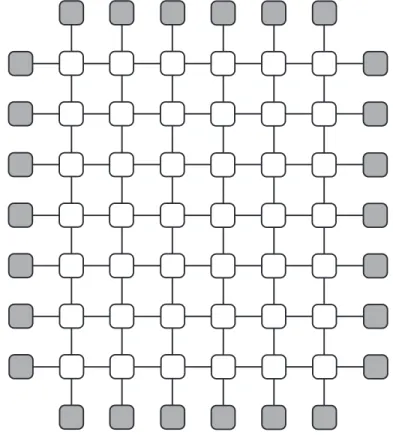
the contraction among two-leg tensors, the transfer matrices T.
2D Ising model on Diagonal Lattice
2.3 2 次元イジング模型のテンソルネットワーク表現
今度はスピンが 2 次元的に並んだ
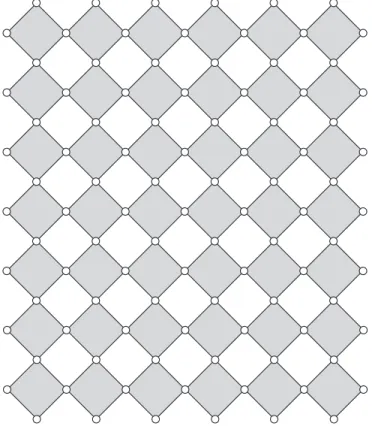
正方格子イジング模型を例に取ろう.碁 盤や障子のような格子を考えるのだけれども,後に続く数式などを単純にする ため,図 2.2 に描いたような格子 — 対角格子 (diagonal lattice) — を考え る.小さな白い丸が ± 1 の値を取るスピンを表し,斜めの実線で結ばれたスピ ン間には,イジング相互作用 − J σσ
!が働いている.説明の都合で, 4 つのス ピンが囲む正方形を「一つおき」に薄く灰色に塗っておく.灰色の正方形が横 に並ぶ数を N ,縦に積み重なる数(段数)を M としよう.スピンの総数は N (M + 1) + (N + 1)M 個である.図には N = 6, M = 7 の場合を示してあ る.分配関数を表していこう.
図
2.2
横にN = 6
個,縦にM = 7
個,灰色の正方形を並べたものスピンに
位置のラベルを付けよう.まず,最下部に並ぶ N 個を
σ
1(0), σ
2(0), · · · , σ
N(0)−1, σ
N(0)(2.24)
で表す. σ
i(0)の肩に置いた
(0)は “0 段目 ” であることを示している.最下 段に並ぶ灰色の正方形と,「一つ上の段」に並ぶ灰色の正方形が共有している N 個のスピンは σ
1(1), σ
2(1), · · · , σ
N(1)で表し,段ごとに肩文字を増やしていく.
縦に M 段,灰色の正方形を積んであるので,いちばん上に並ぶ N 個のスピ
ンは σ
1(M), σ
2(M), · · · , σ
N(M)となる.まだ,ラベル付けされていないスピンが
(N + 1)M 個,残っている.最下段に並ぶ灰色の正方形について,それぞれの
左右に位置するスピンを,左から
s
(1)0, s
(1)1, s
(1)2, · · · , s
(1)N−1, s
(1)N(2.25)
と表そう.今度は肩文字を
(1)から始め,段ごとに肩文字を増やし,最上段に 並ぶ正方形の左右に位置するスピンは s
(M0 ), s
(M1 ), s
(M2 ), · · · , s
(MN )と表す.こ のように 2 種類の文字を導入した理由は, σ
i(j)が縦に積み重なる正方形の接続 部分にあり, s
(j)iが横に並ぶ正方形の間にあって,働きが異なるからである.
14
第2
章 統計力学とテンソルネットワーク式
(2.26)
に示した,灰色の正方形のエネルギーに対応する,局所的なボルツマン重率
W
i(j)= exp ! J kT
"
σ
i(j−1)s
(j)i−1+ s
(j)i−1σ
i(j)+ σ
i(j)s
(j)i+ s
(j)iσ
i(j−1)#$
(2.29)
を導入しよう.その値が次のとおりであることを,地道に確認しておくとよい.
• 4
つのスピンが同じ向き(同じ値)の場合にはe
4J/kT• 1
つだけ逆向き(異なる値)の場合にはe
0/kT= 1
• σ
i(j−1)= σ
i(j) 及びs
(j)i−1= s
(j)i で,σ
i(j)! = s
(j)i の場合にはe
−4J/kTW
i(j) は,4
つのスピン—
左右にs
(j)i−1 とs
(j)i ,上下にσ
i(j) とσ
i(j−1)—
を 脚に持つテンソルとみなせる.ダイアグラムで表しておこう.j-1 j
i-1 i
テンソルの脚を表す「突き出た線」の先に,何を添え書きするかは,場合によ りけりで,何も書かないこともあれば,脚に対応する変数を書き込むこともあ る.ここでは,縦横の位置を書き込んだ.この図形を使って式
(2.28)
の分配 関数を表すダイアグラムを描くと,次のような図形になる.図 2.3 分配関数を表すダイアグラム.灰色の 1 脚テンソルは自由境界条件を示す.
テンソルの縮約が網目を作って,ようやくテンソルネ
˙
ッ˙
ト˙
ワ˙
ー˙
クらしくなっ˙
てきた.1
次元イジング模型の場合と同じように,境界のスピンについての和 は,値が常に1
である1
脚テンソルとの縮約と解釈して,灰色の図形で示し た.具体的には,左側に縦に並ぶL "
σ
0(j)#
,右側の
R "
σ
(j)N#
,下側の
D %
σ
i(0)&
, 上側の
U %
σ
i(M)&
が,境界での縮約を記述する(これら,境界に並ぶテンソル の値を変更すると,異なる境界条件を課すことができる).
16 第 2 章 統計力学とテンソルネットワーク
i-1 i i
j-1 j j
今度は灰色の正方形それぞれに着目しよう.下から j 段目(j = 1,2,· · ·, M)
左から i 番目(i = 1,2,· · ·, N)に位置する灰色の正方形は,4 つのスピン
σi(j)
s(j)i−1 s(j)i σi(j−1)
に囲まれている(上図参照).上下左右の順でスピン
を並べると,σi(j), σi(j−1) と s(j)i−1, s(ji ) となる.イジング模型では,隣り合う スピンが同じ値(同じ向き)であれば相互作用エネルギーが −J に,異なる値
(逆向き)であれば J になるのであった.従って,いま着目している 4 つのス ピン間のイジング相互作用は 4 項の和
−J σi(j−1)s(j)i−1− J s(j)i−1σi(j) −J σi(j)s(j)i −J s(j)i σi(j−1) (2.26) になる.これを,格子全体にわたって足し合わせたものが,この章の主役であ る 2 次元イジング模型のハミルトニアンである.
H =
!N i=1
!M j=1
"
−J#
σi(j−1)s(j)i−1+s(j)i−1σi(j)+σi(j)s(ji )+s(j)i σi(j−1)$%
.(2.27) これに対応するボルツマン重率は exp&
H kT
'
であり,式 (2.7) と同様に,あら ゆるスピン配列について和を取ると,温度 T での分配関数を表す式
Z = !
{σ}
!
{s}
exp&
H kT
' (2.28)
となる.全ての σi(j) を {σ} と,全ての s(j)i を{s} と略記して総和記号 ( の 下に置いた.境界に位置する 2N + 2M 個のスピンについても和を取っている ので,自由境界条件を設定したことになっている.
【熱力学極限】
水や磁石など,十分に多数の原子を含む物質の巨視的な性質を説明するた めには,構成要素である原子の数や物質の体積などが十分に大きな場合を取 り扱わなければならない.これは熱力学極限と呼ばれる,統計物理学で重要 な概念だ.式 (2.28) に書き下した分配関数では,N や M が十分に大きな 場合を取り扱うこと,つまり N → ∞, M → ∞ の極限を意味する.物質 の相転移現象を議論する際には,熱力学極限を取った上で解析する必要があ る.境界の効果が見えなくなるまで大きくする,と考えても良いだろう.対 象となる物理系を支配する相互作用が短距離のものであれば,比較的小さな 系でも熱力学極限と同じ性質を示す.
2.3 2 次元イジング模型のテンソルネットワーク表現 15
式 (2.26) に示した,灰色の正方形のエネルギーに対応する,局所的なボル
ツマン重率
Wi(j) = exp! J kT
"
σi(j−1)s(j)i−1 +s(j)i−1σi(j) +σi(j)s(j)i +s(j)i σi(j−1)#$
(2.29)
を導入しよう.その値が次のとおりであることを,地道に確認しておくとよい.
•4 つのスピンが同じ向き(同じ値)の場合には e4J/kT
•1 つだけ逆向き(異なる値)の場合には e0/kT = 1
•σi(j−1) = σi(j) 及び s(j)i−1 = s(j)i で,σ(j)i != s(j)i の場合には e−4J/kT
Wi(j) は,4 つのスピン — 左右に s(j)i−1 と s(j)i ,上下に σi(j) と σi(j−1) — を 脚に持つテンソルとみなせる.ダイアグラムで表しておこう.
j-1 j
i-1 i
テンソルの脚を表す「突き出た線」の先に,何を添え書きするかは,場合によ りけりで,何も書かないこともあれば,脚に対応する変数を書き込むこともあ る.ここでは,縦横の位置を書き込んだ.この図形を使って式 (2.28) の分配 関数を表すダイアグラムを描くと,次のような図形になる.
図 2.3 分配関数を表すダイアグラム.灰色の 1 脚テンソルは自由境界条件を示す.
テンソルの縮約が網目を作って,ようやくテンソルネ˙ ッ˙ ト˙ ワ˙ ー˙ クらしくなっ˙ てきた.1 次元イジング模型の場合と同じように,境界のスピンについての和 は,値が常に 1 である 1 脚テンソルとの縮約と解釈して,灰色の図形で示し た.具体的には,左側に縦に並ぶ L"
σ0(j)#
,右側の R"
σN(j)#
,下側の D%
σi(0)&
, 上側の U%
σi(M)&
が,境界での縮約を記述する(これら,境界に並ぶテンソル の値を変更すると,異なる境界条件を課すことができる).
16 第 2 章 統計力学とテンソルネットワーク
式 (2.26) に示した,灰色の正方形のエネルギーに対応する,局所的なボル
ツマン重率
Wi(j) = exp! J kT
"
σi(j−1)s(j)i−1+s(j)i−1σ(j)i +σi(j)s(j)i +s(j)i σi(j−1)#$
(2.29)
を導入しよう.その値が次のとおりであることを,地道に確認しておくとよい.
•4 つのスピンが同じ向き(同じ値)の場合には e4J/kT
•1 つだけ逆向き(異なる値)の場合には e0/kT = 1
•σ(j−1)i = σi(j) 及び s(j)i−1 = s(j)i で,σ(j)i != s(j)i の場合には e−4J/kT Wi(j) は,4 つのスピン — 左右に s(j)i−1 と s(j)i ,上下に σi(j) と σi(j−1) — を 脚に持つテンソルとみなせる.ダイアグラムで表しておこう.
j-1 j
i-1 i
テンソルの脚を表す「突き出た線」の先に,何を添え書きするかは,場合によ りけりで,何も書かないこともあれば,脚に対応する変数を書き込むこともあ る.ここでは,縦横の位置を書き込んだ.この図形を使って式 (2.28) の分配 関数を表すダイアグラムを描くと,次のような図形になる.
図2.3 分配関数を表すダイアグラム.灰色の 1 脚テンソルは自由境界条件を示す.
テンソルの縮約が網目を作って,ようやくテンソルネ˙ ッ˙ ト˙ ワ˙ ー˙ クらしくなっ˙ てきた.1 次元イジング模型の場合と同じように,境界のスピンについての和 は,値が常に 1 である 1 脚テンソルとの縮約と解釈して,灰色の図形で示し た.具体的には,左側に縦に並ぶL"
σ0(j)#
,右側の R"
σN(j)#
,下側の D% σi(0)&
, 上側の U%
σ(Mi )&
が,境界での縮約を記述する(これら,境界に並ぶテンソル の値を変更すると,異なる境界条件を課すことができる).
16 第2章 統計力学とテンソルネットワーク
shaded square: interaction among 4 spins
corresponding Boltzmann weight
Partition Function: 2D Tensor Network
one-leg tensors represent the boundary conditions.
Putting Ising spins on the diagonal lattice, and
putting local Boltzmann weights for shaded squares.
Tensor Network structure naturally emerges from the lattice statistical models.
表現することは難しいので,数式を書く人ごとに,それどころかページ毎に,
省略の方法が変わるような事例にもよく接する.式
(2.30)
を更に!
s(j)i
W
i(j)W
i+1(j)= X
とか,単にW
i(j)W
i+1(j)= X (2.33)
と略記することも可能だし,このような記述もよく使われる(以下でバンバン 使う
!
).結局のところ,数式に頼る限り誤解を避けることは難しいので,ダイ アグラムという共通語の利用が一般的となっている.図 2.4 転送行列を表すダイアグラム:左端は L
"
s(0j)
#
,右端は R
"
s(Nj)
#
図
2.4
のように,j
段目のテンソルW
1(j), · · · , W
N(j) と,自由端条件を表す テンソルL "
s
(j)0#
= 1, R "
s
(jN)#
= 1
の間で,s
(j)0, s
(j)1, · · · s
(jN) について縮約 を取ったものを考えよう.略記した形の数式で表すとT
(j)= !
{s(j)}
L W
1(j)W
2(j)· · · W
N(j)R (2.34)
となる.横一列に並ぶスピンの列を示す目的で,和記号の下に
{ s
(j)}
という「まとめ書き」を使った∗5).
T
(j) は,2
次元イジング模型の転送行列で,T
(j) の要素を省略せずに表すと∗6)T
$ % σ
(j)&
% σ
(j−1)&
'
= T
$ σ
1(j)σ
2(j)· · · σ
N(j)σ
1(j−1)σ
2(j−1)· · · σ
(jN−1)'
(2.35)
となる左辺では,
T
(j) の上下に並ぶスピンの列を「まとめ書き」してある.転 送行列T
(j) は2
N 次元の行列で,その基本的な働きは前節の式(2.6)
で考え た1
次元イジング模型の転送行列と同じである.転送行列T
(j+1) とT
(j) の 積をダイアグラムで表すと,次のように縦に並べて,間にある
{ σ
(j)}
について縮約を取ったものとなる.数式で表すとQ
$ % σ
(j+1)&
% σ
(j−1)&
'
= !
{σ(j)}
T
$ % σ
(j+1)&
% σ
(j)&
' T
$ % σ
(j)&
% σ
(j−1)&
'
(2.36)
*5) L や R をベクトルと,Wi(j) を行列とみなし,右辺の総和記号を省略する表記もよく 見かける.本書では,可能な限り,総和記号の省略を避けるつもりだ.
*6) 用語として,テンソルとテンソルの要素は,あまりハッキリと区別されない場合が多 い.これは行列でも同じで,「単位行列 Iij = δij」などという記述も稀ではない.
18 第 2 章 統計力学とテンソルネットワーク
To obtain the largest eigenvalue of the transfer matrix (precisely), when the system width N is large enough, is a main purpose of numerical
calculation. Variational estimation is often considered.
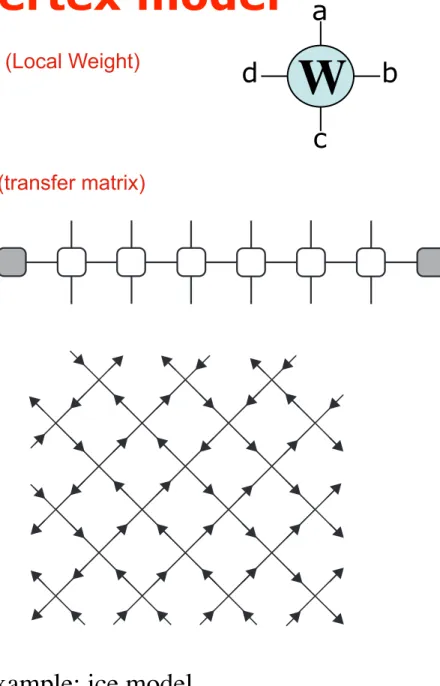
Vertex model a
b c
d W
example: ice model
Lieb, Phys. Rev. 162, 162 (1967)
(Local Weight)
2^N-dimensional real (symmetric)
(transfer matrix)
PHYSI CAL REVIEW VOLUME 113, NUMBER 4 FEBRUARY 15, 1959
Transformations of Ising Models
MxcHAEx. K. FxsHKR
Wheatstone Physics Laboratory, Zing's College, London, England (Received August 29, 1958)
The "star-triangle" and "decoration" transformations are generalized soas toapply toarbitrary mechani- cal systems coupled to the spins ofastandard Ising net. This leads to exact solutions for further plane Ising nets and also forlattices in which the spins on alternate sites have amagnitude greater than S=—,.A general
class of antiferromagnetic Ising models is constructed; exact closed expressions can be derived for all the thermodynamic and magnetic properties of these models in an arbitrary magnetic field.
The magnetizations and susceptibilities of Ising nets in which different spins have different magnetic moments are investigated and a valuable relation between the susceptibilities of the honeycomb and tri- angular lattices is derived. It<