Foreword © 2009 by Graciela Chichilnisky Introduction, Acknowledgments, Chapters 1–5, Conclusions, Notes © 2009 by Joseph Henry Vogel Filmography © 2009 by Janny Robles. Library of Congress Cataloging in Publication Records A catalog record for this book has been requested.
Index 105
PROLOGUE Ethics and the Economics
The Economics of the Yasuní Initiative debuts on the eve of a world summit in Copenhagen, the fifteenth Conference of the Parties to the United Nations Framework Convention on Climate Change. Hopefully, humanity will reach agreement and implement a variety of solutions – including the Initiative – that will meet the expectations implied in the poignant commitment "to the people of the 22nd century".
The initiative is an innovative response from Latin America to the postponement of the global negotiations. Equity is at the heart of this argument and of the arguments in The Economics of the Yasuní Initiative.
INTRODUCTION
My position is that economic theory, cited on the front page of The Stern Review (ie, "Climate Change - Our Approach"), has been a "driver" of climate change. The Yasuní-ITT initiative is one of the many non-technical solutions to be verified.
ACKNOWLEDGEMENTS
Like the serialized stories in the newspapers of old, The Economics of the Yasuní Initiative appeared chapter by chapter. She scanned the room and, in the name of the 'desaparecidos', summoned their presence.
THERMODYNAMICS
The Language Chosen Defines the Debate
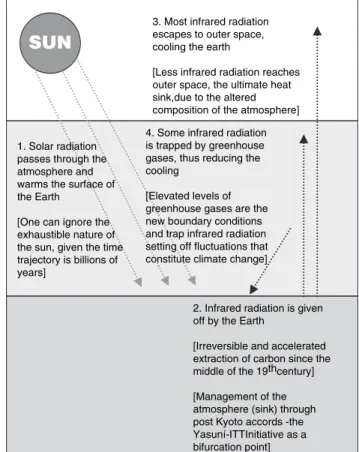
Politicians of the time responded to rising public sentiment and popularized science. Atmospheric (sink) management through post-Kyoto agreements - the Yasuní-ITTI initiative as a bifurcation point].

THE TRAGEDY OF THE COMMONS
A Class of Problems that has no Technical Solution
- Laudably, it recognizes the existence value of biodiversity and the right of the Tagaere and Taromenane communities to live
- Laudably, it requires that “the international community”
- Laudably, it sets an amount, “half the resources that would have been forthcoming from petroleum extraction.”
- Laudably, it recognizes that development requires capital investment. Regrettably it does not tell us how much capital
Even critics of the "Tragedy of Property" must begrudgingly acknowledge the powerful role of the populace, or they quickly lose their credibility. Such a meaning attributed to the word "sink" is new in the biological literature and could be conveyed by characterizing the established term "carbon stock" with the words "potential increase", i.e. First, the South would like to be compensated for the appropriation of an atmospheric sink into which the North "has invested something in . . . [namely] dangerous vapors." The Kyoto Protocol shifted the debate.
Pay us not to take us both into the greenhouse world.”[38]The argument extends to standing forests and underground petroleum reserves. As Hardin quotes from Situation Ethics "the morality of an action is a function of the state of the system at the time it is performed."[40]. Nevertheless, the widespread poverty in Ecuador softens the charges of human rights abuse because "the morality of an action is a function of the state of the system at the time it is carried out."[44]
The answer must come from a post-Kyoto agreement in which Ecuador is compensated for avoiding CO2 emissions in year five and beyond. The important point is this: any moment Ecuador reopens bidding on the ITT oil fields, the carrot is suddenly pulled back and the stick is swung. The sentence above seems to imply that Ecuador will receive payments ad infinitum as long as it does not drill.
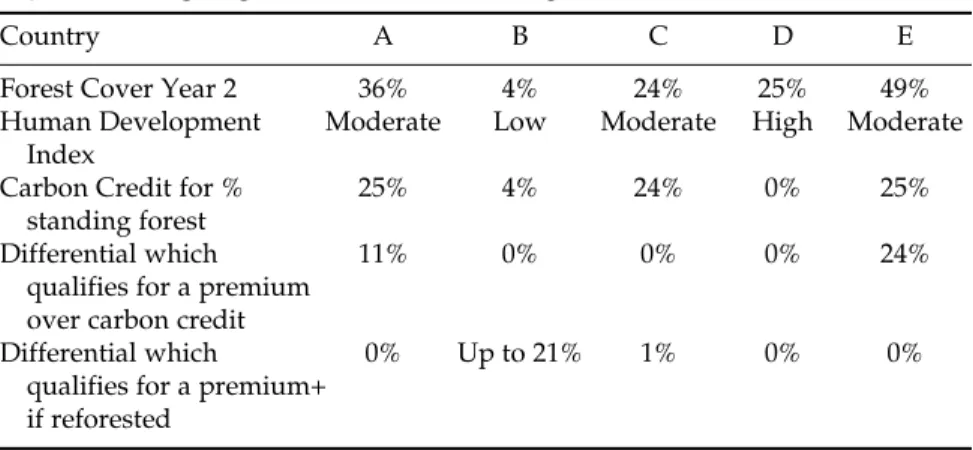
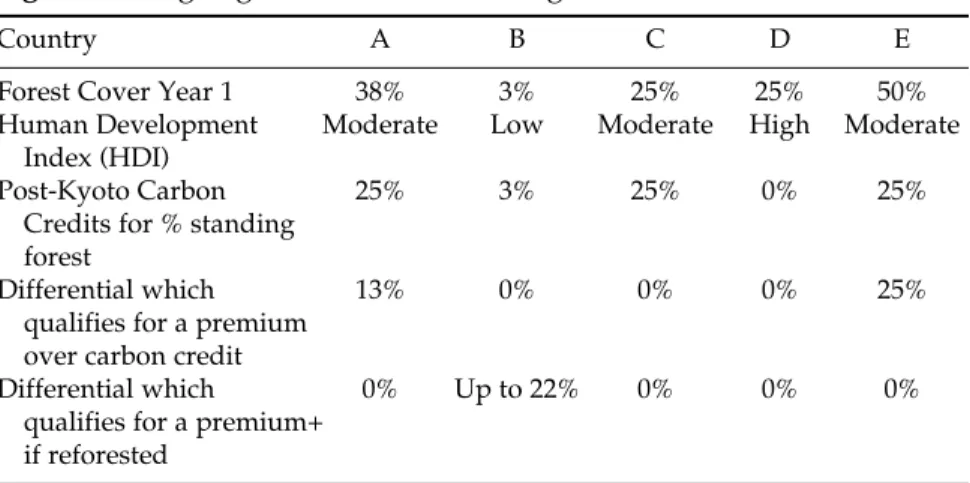
At some point, Ecuador will have passed through Wilson's bottleneck, and the rationale for the claim will no longer hold. Even without having achieved a truly sustainable economy, Costa Rica renounced the possibility of oil extraction in 2001. Costa Rica stood firm and the case was dropped.[50]When Ecuador boasts the status of "High Human Development" in UNDP Human Development Index as Costa Rica since 2002,[51].
THE WILLFUL IGNORANCE OF
Market Failure or Cost-Shifting Success?
If pollution policies are reformed in the light of the concept of "market failure", with carbon taxes and/or. Joan Martinez-Alier did just that in response to The Economist regarding their coverage of the Yasuní-ITT initiative. Acknowledging the realpolitik of climate change means changing the culture of the audience.
Significantly, An Inconvenient Truth is not mentioned once in The Stern Review, even though it debuted to great acclaim five months prior to the first printing of The Stern Review. Because seeing is believing, Cooney's highlighted passage from The New York Times to the president appears in the bottom corner of the page. Should their claim fall on deaf ears, the carbon-rich nations of the South will, rightly or wrongly, have the same dirty little qualms about industrial development as the North.
THE GENERAL THEORY OF
A Rigorous Justification for an Intuitively Just Proposal
Through the lens of the second best, manumission is a necessary distortion to make the slave system efficient, given the distortion of no self-interest on the part of the slaves. I will apply the theory of second best to current events from my corner of the world (Puerto Rico). Everything depends on context, which ties into the overarching theme of second-best theory: economies are complex systems subject to multiple perturbations.
It was about the theory of second best, the Clean Development Mechanism from the UNFCCC and agricultural land use. The first (the whimsically named Bombolí) preserved the entire forest cover on the hillsides, about 30% of the land. Greater CO2e through reforestation is one of the many unintended consequences of piecemeal political reform that is explicable and predictable from the theory of second best.
THROUGH THE BOTTLENECK OF A
Financing Shovel-Ready Projects
Amazingly, Stern quotes Hardin only once in The Stern Review: a text box titled "Tragedy of the Commons?". The rebuttal I think Hardin would make to the critic of cap-and-trade issues is. the logical consequence would be absurd. Bolivia's position in preparation for COPXV at the UNFCCC captures the logic of. compensating the developing countries for the damage done by the industrialization of the developed countries.
Ecuador's position on the UNFCCC can accommodate both the theoretical skeleton of the “Tragedy of Assets” for climate governance and the details that emerge from a close reading of Hardin's life's work. About five billion dollars will be lost in new oil extraction infrastructure in the first four years after the conclusion of any international Yasuní-ITT initiative agreement. We should not see billions flowing through time as some species Figure 5.1 Timeline of the Yasuní-ITT initiative.
CONCLUSIONS
Reason for Hope and Despair
Let other species—for example, the amoebas—who have no spiritual ambitions inherit an earth still bathed in plenty of sunshine.[4] Since 1994, the evidence from the European Space Agency on Venus has shown how prescient Sagan was.[10] The update from. They face the banner THE LONDON SUMMIT 2009 and a few have their eyes focused on Figure C.1 "Family Photograph", London Summit 2009.
Given French philosopher Jacques Ellul's treatise, the summit was unequivocally a "propaganda operation."[18] The G-20 wanted to drum three messages into our globalized heads "STABILITY, GROWTH, JOBS" and the ethereal teleprompter would minimize any deviation from the script . Shortly after the publication of Hardin's "The Tragedy of the Commons" in 1968, the Club of Rome commissioned systems scientists and computer modelers to simulate the consequences of a rapidly populating Earth and the possibilities of sustainable feedback loops.[19] In 1972, Donella H. A despondent will be on the level of the man "either you follow the full regimen or don't bother taking anything." The dishonest one says “those side effects aren't that bad.
Appendix
ANNOTATED YOUTUBE
A Collaborative Effort
Janny Robles
- Thermodynamics
- The Tragedy of the Commons
- The Willful Ignorance of Realpolitik
- The General Theory of Second Best:”
- Through the Bottleneck of a Cowboy Economy
And please consider the people of Linfen on your next trip to the mall or...voting booth. The longest roller coaster ride is the 2008 crises (imagine the 2009 update?). America, love it or leave it,” the video concludes with “America, love it and fix it”.
We hear first-hand accounts of the horrors caused by the coal that runs Chinese factories. Various commentators explore the reality that the heavens are an "open sewer." The former is no less than a four-star US Air Force general. Through such conversations, people will determine their position regarding the correctness of the Yasuní-ITT Initiative and its potential for sustainable development.
NOTES
Introduction
I was director of the Congressional Budget Office at the time and testified extensively on the Reagan budget. Hacker, The Great Risk Shift: The New Insecurity and the Decline of the American Dream (New York: Oxford University Press, 2006); Carmen DeNavas-Wait, Bernadette D. Slavery ended in the US with the ratification of the Thirteenth Amendment on December 18, 1865.
With Keynesian-type price rigidity (another distortion), academic salaries do not adjust downward. Although aware of The Stern Review, the market failure did not penetrate the consciousness of that jury. 45] Joseph Henry Vogel, "The Tragedy of the Commons": A Museum of Bioresearch, Intellectual Property Rights, and the Public Domain," in The Connection of Law and Biology: New Ethical Challenges, Barbara A.
Conclusions
57] The loaches in Canada do not touch the forests bordering the highways, thus deceiving passing cars of destruction beyond sight. Andre Carothers, "Northern Brazil: How British Columbia Timber Company Macmillan-Bloedel Escapes Responsibility for Destruction of Ancient Forests." Statistics calculated from the table "Average Faculty Salaries by Field and Grade at 4-Year Colleges and Universities, 2008–9." The Fulbright program tries to head off criticism by disclosing in recent Internet FAQs that "Fulbright grants are not intended to approach salaries." Online: http://www.cies.org/us_scholars/us_awards/.
15] Referring to the first of the trilogy: "...'stability' another useful term for political discourse which can be translated as 'Whatever serves the interests of power'." Referring to the latter: "It is perhaps worth mentioning that the word 'profits' has largely disappeared from respectable discourse. 17] "Thunderous" was the adjective Donald Mann used to describe the oxymoron of "sustainable economic growth", like Obama's 4] Camilo Gomides, “Putting a New Definition of Ecocriticism to the Test: The Case of the Burning Season, a Film (Mal)Adaptation.” Interdisciplinary Studies in Literature and the Environment 13 No.
INDEX
Narodni park Yasuní xx, xxiv, 68 Komisija Yasuní-ITT xxiii Pobuda Yasuní-ITT xi, xv–xvii,.