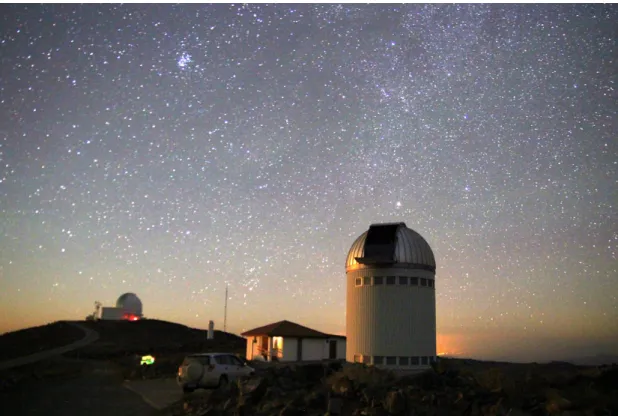
Its main goals are the detection and classification of variable stars, the detection of microlensing events, dwarf novae, and studies of the structure of the Galaxy and the Magellanic Clouds. 14 2.3 Collection area of the MAGIC telescopes after the upgrade at the trigger level. dashed lines) and after all cuts (solid lines). Astroparticle physics aims to study the elementary particles of the universe and their interaction with fields.
One of them is the Major Atmospheric Gamma Imaging Cherenkov Telescope (MAGIC) located at the Roque de los Muchachos Observatory on La Palma (28.8°N, 17.9°W), one of the Canary Islands. In this thesis, we studied the hypothetical Planet 9 (P9) as a Primordial Black Hole (PBH) to search for dark matter through indirect observation with the MAGIC telescopes. In this section, we will show the theoretical basis for Dark Matter (DM), Primordial Black Holes (PBHs) and the hypothesis of Planet 9 (P9) as an introduction to the work done in the thesis.
Dark Matter
- Discovery and Confirmation
- Gravitational Lensing
- Candidate Particles
- Primordial Black Holes
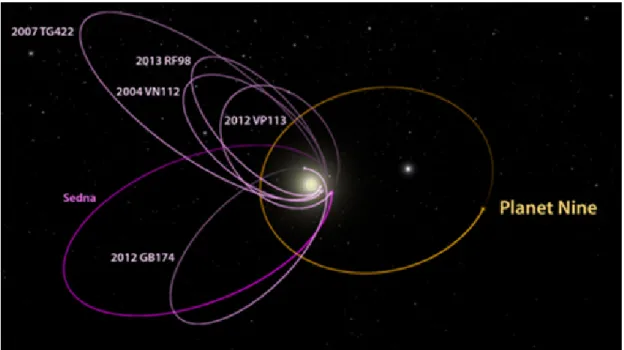
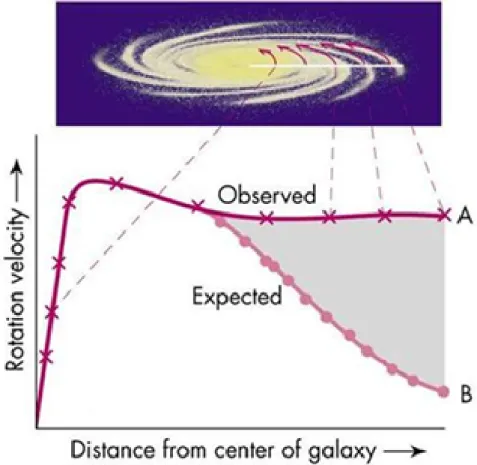
This can be explained by the presence of a massive body beyond Neptune's orbit, which we will analyze in the next chapter. Furthermore, primordial black holes are candidates for DM, we show why in the next section. PBHs form in the early universe (less than one second after the Big Bang), when high densities and heterogeneous conditions could lead to the gravitational collapse of sufficiently dense regions, resulting in metric fluctuations.
The simplest way to describe first-order phase transitions with bubble creation in the early universe is based on a scalar field theory with two non-degenerate vacuum states. The expectation for the beam spectrum is that there are two components, the first coming directly from Hawking radiation so that it peaks around the PBH mass; and the last one, arising from the decay of hadrons produced by the fragmentation of primary quarks and gluons, peaks at lower energies. 7most of the energy was in the form of radiation, and this radiation had a dominant effect on the expansion of the universe.
Planet 9
Planet 9 Hypothesis
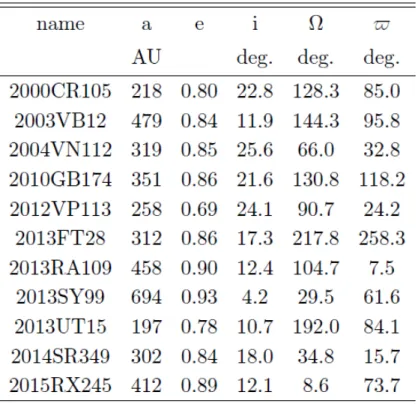
The recent discovery of a Sedna-like body (2012VP11312), a potential additional member of the inner Oort cloud, pointed to a set of KBOs that exhibit unexplained clustering in orbital elements. The existence of a massive, inclined and eccentric planet has been shown to be able to cause several dynamic effects, including a clustering of the longitude of perihelion ˜ω and of pole position (a combination of longitude increasing noteΩ and inclinationi). The Imaging Atmospheric Cherenkov Telescopes (IACT) technique is a method for detecting very high energy (VHE) gamma-ray photons in the energy range from ~50 GeV to ~50 TeV.
IACT uses one or more optical telescopes that image the plumes of cosmic gamma rays in the atmosphere through the Cherenkov radiation produced by the ultrarelativistic charged particles. The light, produced by Cherenkov radiation from the charged particles of the atmospheric shower, travels faster than light in air. Above a few TeV, Cherenkov light from electromagnetic showers brightens significantly, while the gamma-ray flux decreases with energy, so to detect a sufficient number of these high-energy events, a large surface area of Earth must be covered.
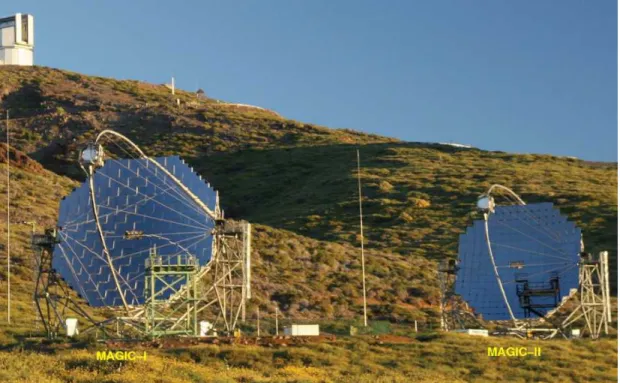
MAGIC telescopes are a system of two 17 m diameter imaging atmospheric Cherenkov telescopes located at the Roque de los Muchachos Observatory (La Palma, Canary Islands) at an altitude of 2200 a.s.l. They achieve the best performance for VHE gamma-ray observation in the absence of moonlight. The two MAGIC telescopes can be operated independently or in stereoscopic mode, the second allowing a more precise reconstruction.
MAGIC telescopes are a stereoscopic system of two IACTs, see Figures it is one of the most sensitive instruments currently operating. It is possible to identify the nature of the primary particle and reconstruct its original energy and incoming direction. Therefore, the cameras of the MAGIC telescopes were designed from the beginning to enable observation during moderate moonlight [9].
MAGIC is sensitive to cosmic gamma rays with photon energies between 50 GeV and 30 TeV, other ground-based gamma ray telescopes typically observe gamma energies above 200-300 GeV.
Performance
On the left, MAGIC-I is active since 2004, on the right, MAGIC-II is active since 2009 to significantly increase the sensitivity of stereo observations. 2.1) where Q is the quality factor (the efficiency of the analysis of order unit as low energy), T is the actual recording time and the R's represent the rates. One definition of an energy threshold is the peak energy of such a plot for a hypothetical source with a spectral index of -2.6.
For large arrays, the collecting area well above the energy threshold for observation at a low zenith angle is approximately equal to the physical size of the array, while for a single telescope (or small arrays) such as the MAGIC telescopes, the collecting area is mainly determined by the size of the Cherenkov light source. This is the collection area as a function of energy. E,N0(E) is the number of events simulated, rmax is the maximum simulated storm impact, and N(E) is the number of events that survive the trigger condition. Thick lines show the collection area for observations with a low zenith angle, while thin lines correspond to a medium zenith angle.
The distribution is well described by a Gaussian function in the central region, but not at the edges, where non-Gaussian tails can be appreciated. Figure [2.4] shows the energy resolution and bias of the MAGIC telescopes as a function of the true energy. At low energies, the energy resolution deteriorates due to poorer precision in the image reconstruction and higher internal relative fluctuations in the shower.
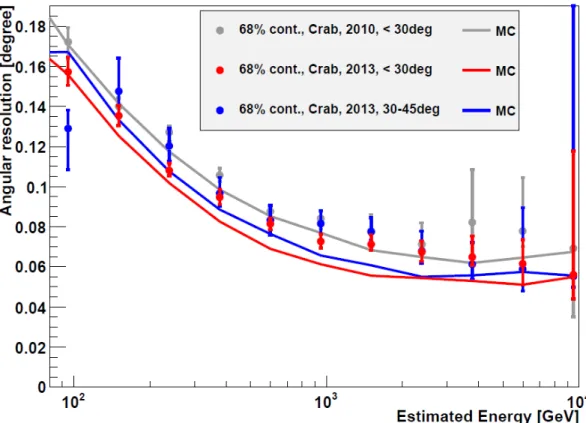
For comparison, the low zenith angle before the upgrade angle resolution is shown as gray points. Following the commonly used definition, we calculate the sensitivity in narrow energy bins. The sensitivity clearly depends on the observation time that can be spent observing a given source.
Another way to calculate the sensitivity is by using the Li-Ma [2.1], the standard method in VHE gamma-ray astronomy for calculating the significances.

Observability with MAGIC
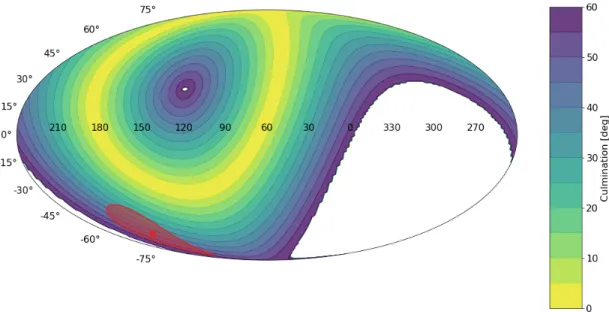
The area we want to observe is the red one, in line with the hypothesis. It is the reference direction for measuring the zenith angle, the angle between that direction and the local zenith. All objects in the sky can be projected onto the inner surface of the celestial sphere, the red dot is the "higher point" on P9's celestial sphere.
Radius of uncertainty is 20 degrees and the radius of MAGIC telescopes is ~2 degrees, we have a circular region in the sky with P9 as the center and 22 degrees as the radius (sum of uncertainty radius and magic one). These events correspond to objects of the same mass that we assumed for P9 and they can be interpreted as a PBH. Simulation and analytical arguments suggest that these observations can explain both anomalies in the predicted dynamics assuming the existence of a giant planet.
Formed during radiation dominance via a strong first-order phase transition around the electroweak scale, they are expected to have masses on the order of MBH ~ 125 GeVT 2. They would not emit any radiation at any wavelength and would therefore not be seen in conventional observational searches. . There can only be one object in the volume of the Oort cloud, so there can be as many as 1015 such objects in our galaxy.
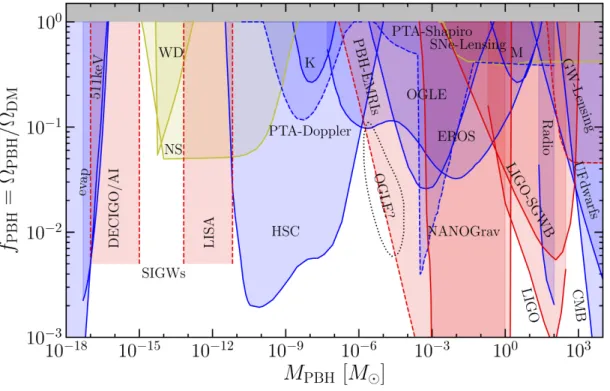
The gamma-ray flux produced by DM annihilation in a given region of the sky (∆Ω) and observed on Earth is given by. OGLE indicates fPBH ≪1, PBHs build dense DM microhaloes, in the rest is taken up by the DM component. In the absence of DM, it would be impossible to detect a PBH of this mass.
In this radius, there is DM mass equal to PBH mass, DM profile in case of MPBH≥M⊕andm≥100 GeV.
Probability Distribution Function
Limits
Both depend on the mass and branched annihilation channel of the DM candidate and can be determined. We can assume that MAGIC has a better chance of observing this unknown object, which may be a PBH, because it has the best sensitivity at the lowest energies. From these it is possible to find celestial coordinates which are right ascension ~45 degrees and declination ~12 degrees (see images and examine the area of the celestial sphere with a radius of ~22 degrees around this point.
We know the temperature is too low to be detected - 0.0003 K and it hasn't evaporated yet because the evaporation time has. The only way to detect it is through DM microhalo annihilation signals formed around the PBH. We note that in [24]'s work they used the all-sky Fermi-LAT observations, while we confined MAGIC observations to a smaller region of the sky, resulting in a loss of sensitivity.
Future work will be to actually search for unexpected sources in the field of view of MAGIC observations matching these locations using the grid search shown in Figs. 2] A.A Abdo et al.Milagro Limits and HAWC Sensitivity for Velocity-Density Vaporization Primordial Black Holes. Aleksic et al. Major upgrade of the MAGIC telescopes, Part II: A performance study using observations of the Crab Nebula.
Corcella et al. PPPC 4 DM ID: The Particle Physicist's Bad Cookbook for Indirect Dark Matter Detection. Ahnen et al. Constraints on the dark matter annihilation cross section from a combined analysis of MAGIC and Fermi-LAT observations of dwarf satellite galaxies. Doro et al. Prospects for observing the evaporation of a primordial black hole with the Southern Wide Field of View Gamma-ray Observatory.
Kühnel et al. New constraints on dark matter mixed scenarios of primordial black holes and WIMPs.