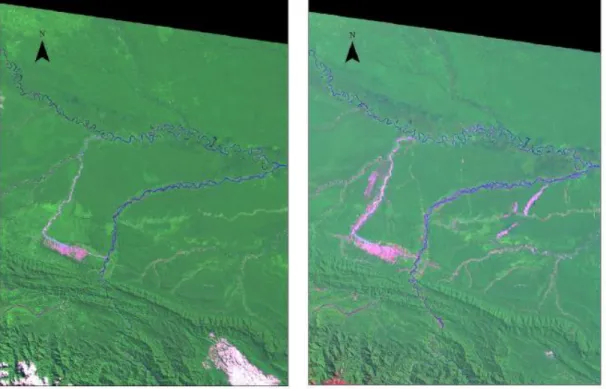
Further copies (by any process) of copies made in accordance with these instructions may not be made without permission (in writing) from the author. State-civil society relations in Madre de Dios have been challenged by the weakness of national political parties. Decentralization, biodiversity conservation, Peru, Madre de Dios, Tambopata National Reserve, governance, polycentricity, gold mining, indigenous rights.
CONAP Confederación de Nacionalidades Amazónicas del Perú ENCB Estrategia Nacional para la Conservación de la Biodiversidad FADEMAD Federación Agropecuaria de Madre de Dios. FENAMAD Federación Indígena del Río Madre de Dios Federación Indígena del Río Madre de Dios y sus afluentes GOREMAD Gobierno Regional de Madre de Dios.
INTRODUCTION
- Background
- Research question
- Methodology
- Limitations
How the decentralization process that has been going on in Peru since 2002 has affected the management of the Tambopata National Reserve. In what way has the process of decentralization been beneficial for those actors who are in favor of preserving the NRT (or not). Who are the main stakeholders (international/national/local) influencing the decentralization process of natural resource management in Madre de Dios.
How have the interactions of key stakeholders shaped the management of the Tambopata National Reserve and its buffer zone? The Madre de Dios basin is part of the Madeira sub-basin (Brazil) and covers an area of over 85,300 square kilometers.

Theoretical framework: discussing the relation between
- Development and Nature: a brief archaeology of Poverty Reduction and
- The link between BC and PR
- The link between Poverty Reduction and Decentralization: the Governance
- Proposals for connecting BC and Decentralization
- Theoretical framework - adopting a polycentric lens for understanding
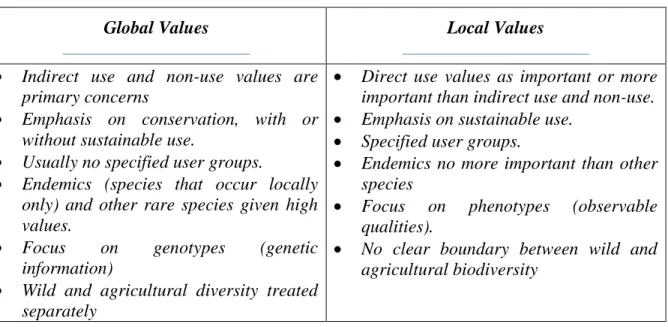
In this regard, one of the objectives of involving local communities would be to strengthen these capacities while preparing them for ongoing modernization processes. Without denying the merits of the CBC approach, critics have voiced its dual objectives. The last two of the five main criticisms of the CBC approach are closely linked to the observation of Roe (et al. 2010) and are of particular importance for how the relationship between decentralization and biodiversity conservation can be conceptualized .
This is partly due to an oversimplification of the idea of "local community", which in some cases is depicted as a. Such differences increase the complexity of interventions and may limit the impact of BC programs. The last of the five points mentioned above, the institutional dimension, has gained more attention and will be the subject of analysis in the next section.
As mentioned above, poverty reduction has been one of the overarching goals of the so-called developing countries since the 1950s. The debate focused on the conceptualization of institutions as the "rules of the game" as per North (1990). Like poverty, the initiatives were vulnerable to the same criticisms leveled against the CBD in the previous section, namely oversimplification of the idea of "local community" and an ignorance of the power dynamics, and heterogeneous qualities such as knowledge and practices that targeted communities.
Four main criticisms of the decentralization agenda have important implications for linking with and intersecting with the Biodiversity Conservation Agenda. Finally, the paper turns to the central critique of the Biodiversity Conservation – Decentralization nexus, which is the divergent definitions and priorities on Biodiversity conservation goals and how these divergences intersect with the decentralization agenda. As noted by Andersson and Ostrom (2008), there is a variety of results in the decentralization experiences and most of the studies focus on specific levels of.
Such a view goes beyond a simple examination of the "technical capacity and financial resources" of local governments to explain environmental management outcomes. Both informal and formal, the 'rules of the game' are informed by norms, practices and belief systems within the context.
DECENTRALIZATION AND BIODIVERSITY POLICIES IN PERU
- Decentralization in Peru: 2000 - 2011
- The management of natural resources and decentralization
- Biodiversity Conservation Policies and Decentralization
- Conclusions
This can help us understand what was decentralized and what remained under the control of the national government. In Article 6, the LBD sets three environmental objectives to be pursued by regional authorities: a) territorial and ecological planning (“Ordenamiento Territorial y del entorno ambiental”) with a sustainable development approach; b) Sustainable management of natural resources and improvement of the quality of the environment; and c) Interinstitutional coordination and citizen participation at every level of the National System for Environmental Management (Sistema Nacional de Gestion Ambiental, hereinafter SNGA). 6 In Peru, the term Civil Protection is associated with the response of the National Institute of Civil Protection in providing humanitarian assistance after natural disasters.
Indeed, the main national policy guiding efforts for Biodiversity Conservation until 2021 – the National Biodiversity Conservation Strategy (ENCB) – is part of the commitments made by the Peruvian state as a signatory to the Convention on Biological Diversity (CONAM 2001). For example, the design of the ENCB has been participatory (including the input of NGOs and civil society actors) and one of its seven strategic commitments promotes the "participation and engagement of Peruvian society" with the goals of Biodiversity Conservation (CONAM 2001, 73). . For example, in 2001 the National Institute of Natural Resources (INRENA) – a separate institution, but functionally dependent on the Minister of Agriculture – issued the “Regulations that regulate.
The main purpose of MK is "ensuring the proper functioning of protected natural areas, monitoring implementation." As a result, the national government – at least formally – has a relatively high degree of influence over the constitution of most boards in the country. 2006: Regulations on the operation of committees for the management of natural protected areas and regional protected areas.
McNulty's (2011) analysis serves as an explanatory framework to reveal how decentralization in Peru was strongly influenced by a) the process of democratization that took place after the collapse of the authoritarian Fujimori's regime and b) by the bargaining process among national elites and few subgroups. -national elites amid weak national political parties. This situation led to a poor articulation of the participatory spaces created within the biodiversity conservation sphere to the local. The next chapter will use this insight to analyze how such aspects influence the management of the National Reserve of Tambopata and its buffer zone.
CASE ANALYSIS
- Main stakeholders on the management of the National Reserve of Tambopata (NRT)
- The configuration of the political scenario of Madre de Dios and its influences in the
- Conflicts around the management of natural resources and the co-constitution of
- Gold rush: an incentive for institutional coordination
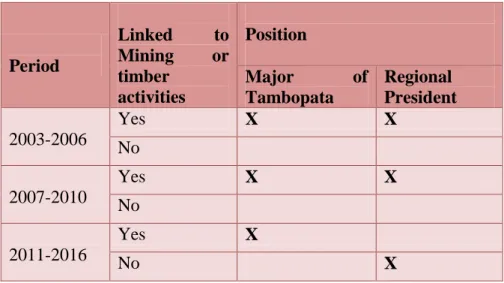
In the case of the Regional Government of Madre de Dios (GOREMAD), only one regional president had a public connection to the logging sector (see Table C below). 12 The Tambopata National Reserve is under the jurisdiction of the Tambopata Province. The next section analyzes the nature of the main Madre de Dios civil society organizations that have an important voice in the governance of the NRT.
Finally, a relevant civil society actor directly related to the management of the RRT has been the Management Committee of the RRT itself. Since 2002, the region of Madre de Dios has for years been characterized by the appearance of spontaneous social mobilizations, mobilizations which have attracted the attention of The result of these events has influenced the trajectory of the decentralization process in the region.
With the aforementioned actors in mind, the next section analyzes the development of the decentralization process in Madre de Dios and its intersection with the management of the NRT. That is to say, Madre de Dios is an exemplary case of co-constitution of the socio-political and natural domains. The social protests contributed greatly to the political instability of the first regional government of Madre de Dios.
Most of the interviewees agreed that this alliance was based on the perception that the national. This is the case with the conflicting objectives of the Regional Biodiversity Conservation Plan and the Regional Mining Plan. The institutionalization of these conditions of instability has influenced the consolidation of the decentralization process.
Conclusions
Further, this chapter explored some of the main criticisms of these agendas, particularly the analytical limitations and problematic assumptions underlying the agendas. Based on the findings of researchers such as McNulty (2011), key variables that determined the configuration of the Peruvian political system were carefully extrapolated to aspects of the Madre de Dios case, especially the variables used by McNulty to explain conditions, that informed the decentralization process in Peru. The local elites vary to explain the rise and fall of the economic elites in Madre de Dios, and therefore their unstable position is related to two factors: a) their historical dependence on economic booms since the 19th century and b) their limited capacity for capital accumulation , linked to the economic growth of Lima since the 1950s at the expense of the regional elites (FitzGerald 1979, 144).
We also took into account how, under such circumstances, the first ten years of decentralization in the region were marked by constant political instability. However, returning to the idea of polycentricity, we also described how various actors with an environmental agenda in the region slowly formed alliances to form an environmental front that included the defense of the national reserve. The year 2010 with the leadership of the regional government is perhaps the first example of an emerging self-organized resource management system in the region, a place where the authorities are.
Finally, understanding the institutional forms that governed socio-economic and socio-environmental relations was not only important, but also the relative disconnection or disconnection between individual institutions developed in the local region. In this way, nested institutional relations served as an alternative explanation for certain outcomes and behaviors in the Madre de Dios region. This does not mean that mining activities will stop because of the relative nestedness of institutional arrangements related to biodiversity conservation, but that this plan will be more coherent.
While the gold rush in Madre de Dios remains closely linked to rising gold prices on the international market, what these public and private institutions do, this knowledge can serve as a basis for understanding the complexities of the local environment and for designing solutions. relevant and powerful to mitigate. the impacts of a global phenomenon (Recavarren 2011, 86). Presented at VII Foro Descentralista: la reforma del estado: experiencias latinoamericanas sobre decentralization y participation, Lima, Peru, March Decentralization and Democracy in Indonesia: A Critique of Neo-Institutionalist Perspectives. Regulations governing the operation of the Management Committees of Natural Protected Areas and Regional Conservation Areas.