This study aims to explore the teaching strategies that novice and experienced teachers use to improve students' speaking skills in the classroom. The research questions that have guided this study are 1) What strategies do novice teachers use most to improve students' speaking skills?
INTRODUCTION
- Problem
- Purpose of the Study
- Research questions
- Significance of the Study
- Summary
To identify the teaching strategies teachers need to use and consider the most appropriate to improve students' speaking ability. This study aims to explore the strategies that novice and experienced teachers use to improve students' speaking skills in and out of the language classroom.
LITERATURE REVIEW
The importance of English
Teaching English as a foreign language
- Novice and Experienced English teachers
It can therefore be assumed that teachers with more than three years of experience can be considered experienced teachers. From this definition, a novice teacher is someone who has between one and five years of experience in a real teaching context.
English Language Skills
Before defining speaking and what it entails, it is important to identify some differences between the four language skills: listening, speaking, reading and writing.
Defining speaking
Kürüm (2016) states that function refers to the knowledge of negotiating the meaning of the message by knowing when the information must be accurate and when it is not. Teachers and students need to know these in order to consolidate speech because oral skills have to do with social and cultural factors that influence human interactions.
Components of speaking
- Fluency
- Vocabulary
- Grammar
- Pronunciation
Vocabulary is a sub-skill and an essential component of speaking as people need to know words to be able to produce meaningful sentences. Therefore, grammar is fundamental to be able to speak, as grammar provides knowledge to create coherent sentences to be understood in the communication process.
The Importance of Speaking
Nunan (1989) states that the development of speaking is essential in foreign language learning and argues that these skills are measured in relation to the students' ability to maintain a conversation. Furthermore, speaking is essential in foreign language learning and teaching because students use these skills to share ideas orally in the foreign language.
Teaching speaking
In addition, Richards (2008) asserts that proficiency in speaking a foreign language (eg, English) has numerous advantages such as further education and professional promotion. In a foreign language context, it is difficult for students to practice their language skills outside the classroom; therefore, teaching strategies should provide students with the opportunity to practice their speaking skills during and after class activities.
Approach, Technique, Method or Strategy?
Teaching and learning to speak is demanding for both students and teachers; However, with the use of strategies, teachers can help students practice speaking. Furthermore, a technique is a tactic used by teachers to implement teaching and learning activities in anticipation of optimal results.
Strategies to Enhance Speaking Skills
- Role-play
- Storytelling
- Information gap
- Small-group discussion
- Small talk
- Discussion
- Dialogue
- Descriptions
- Interviews
- Debates
- Oral presentations
Harmer (2001) suggests some speaking strategies to encourage students to overcome their fear and shyness when speaking in the target language. Deacon and Murphey (2001) state that storytelling is a useful strategy because, in addition to asking students to express themselves in the target language, it provides students with vocabulary and grammar.
The role of the teacher in developing speaking
Teachers can also encourage students to practice their English not only in the classroom but also in their daily lives with teachers, classmates and native speakers. Teachers play more than one role in the classroom, and such roles depend on several factors;. Makovec (2018) claims that the role of teachers is complex to determine and is influenced by many factors, and Harmer (2001) describes the roles of teachers through metaphors.
As previously mentioned, teachers must know how to act depending on different conditions during the lessons as they play a significant role in the teaching-learning process. The first role refers to the knowledge that teachers share during the lessons and the second one refers to the conditions that teachers create to carry out the learning process. Each role that teachers play during the learning process is influenced by different internal and external factors.
On the other hand, Harmer (2001) emphasizes that teachers must play three fundamental roles to promote classroom speaking. In the classroom, teachers' roles change before, during and after lessons as teachers play different roles to achieve the goals of all students and create an environment for effective teaching and learning.
Summary
However, teachers must be careful when giving prompts, as their purpose is to encourage students to continue with speaking practice. The participant role occurs when teachers interact with students as if they were the students' peers. As participants, teachers have the opportunity to understand students' difficulties with the target language and to confirm that students are participating in speaking activities.
Finally, the role of the teacher as a feedback provider develops when teachers give feedback after oral activities, and teachers should avoid overcorrection because it can affect students' motivation.
METHODOLOGY
- Research design
- Participants
- Data Collection Procedure
- Instrument
- Data analysis procedure
- Summary
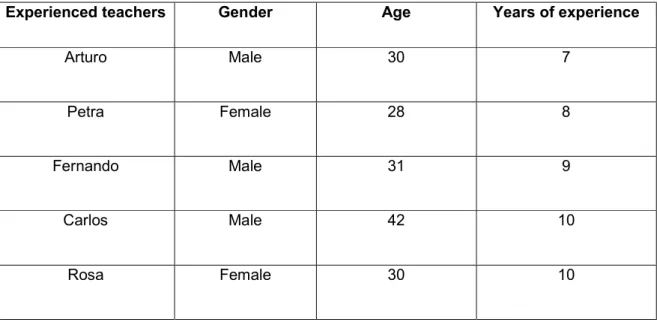
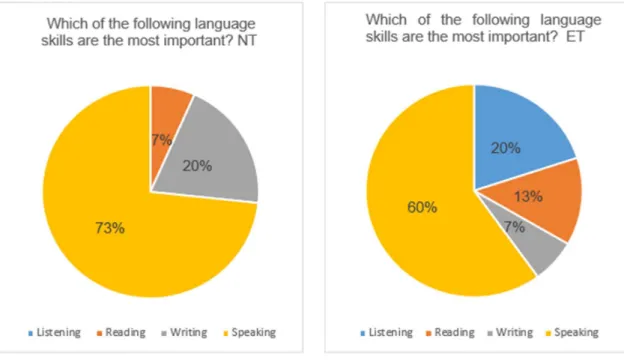
The first section is designed to collect information about teachers' background in teaching English. This section contains two multiple-choice questions and a ranked item to gather teacher backgrounds and categorize beginning and experienced teachers. The first question in this section is a multiple-choice question that examines teachers' opinions about which language skills are most important to develop.
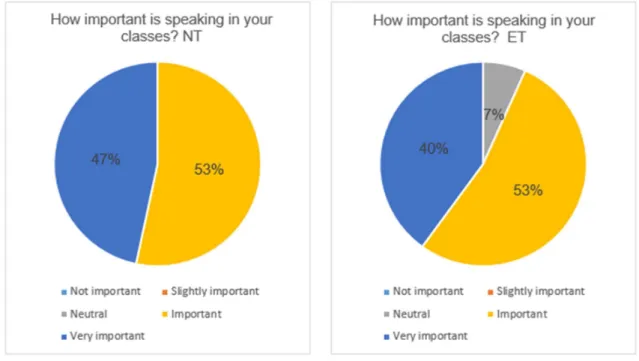
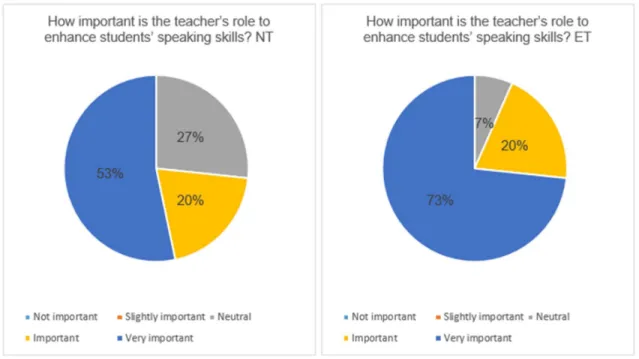
The second item is a Likert scale question that probes teachers' beliefs about the importance of speaking in their English lessons. The fifth question of this section is a Likert scale item that explores teachers' opinions about the importance of their role in enhancing students' speaking skills. Finally, the sixth item is a multiple-choice question that gathers teachers' opinions about components of speaking such as fluency, grammar and pronunciation.
The fifth part of the questionnaire examines teachers' views on the importance of speaking skills in today's world and the importance of the role of teachers in developing students' oral skills. The data collected covered teachers' backgrounds, strategies to promote speaking, and their perceptions of the importance of speaking skills.
RESULTS
Quantitative results
- Section one: Experienced and novice teachers’ general features
- Language proficiency levels: Tertiary education
- Section two: The importance of speaking skills in the classroom
- The four basic language skills
- English language importance
- Frequency of English language practice
- Teachers’ challenges when searching strategies
- Components of speaking: Level of importance
- The role of the teacher in developing speaking
- Section three: Experienced and novice teachers’ strategies to enhance students
- Teaching strategies for increasing students’ confidence in speaking
- ICT (information and communication technology) in speaking
- Common teaching strategies for enhancing speaking skill
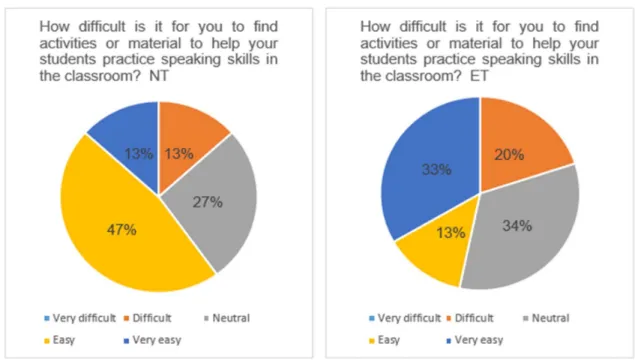
In addition, 18 percent of novice and 20 percent of experienced teachers work with higher intermediate levels. Finally, only 6 percent of novice and 7 percent of experienced teachers work with advanced students. In addition, 13 percent of novice and 20 percent of experienced teachers have problems when looking for teaching strategies.
13 percent of novice teachers and 20 percent of experienced teachers have a neutral opinion on this issue. Finally, 25 percent of novice teachers report using computers in their lessons, compared to 20 percent of experienced teachers. According to the results, 11 percent of novice teachers and 10 percent of experienced teachers decide on debates.
Additionally, 12 percent of novice teachers use role-playing, as opposed to 16 percent of experienced teachers. In addition, the results show that 18 percent of novice teachers and 15 percent of experienced teachers use short conversations.

Qualitative results
- Most effective teaching strategies to develop speaking
- Section 4: Self-study abilities to develop speaking
- Teaching strategies to promote self-study abilities
- Students’ motivation in speaking
- Section 5: Novice and experienced teachers’ beliefs about the development of
- Teachers’ assumptions about speaking
- Role of teachers in teaching speaking
The strategies that novice and experienced teachers use in their teaching practice appear to be different from the strategies they consider efficient. Chapter four examines specific teaching strategies that novice and experienced teachers use to improve student speaking outside the classroom. Novice and experienced teachers use ICT to encourage students to practice their speaking skills using applications such as WhatsApp, Zoom, Flipgrid, Vocaroo and YouTube to develop students' autonomous learning outside the classroom.
Beginning and experienced teachers encourage students to practice their oral skills outside of the classroom, mostly because students do not have many opportunities to practice their language outside of the classroom. Beginning and experienced teachers have different opinions on how to motivate their students to practice their speaking. Beginning and experienced teachers believe that developing and promoting speaking in the classroom will lead students to have better opportunities in the future.
Question 16, the final open-ended question, explores novice and experienced teachers' views on the role they play in the classroom. Novice and experienced teachers recognized that, as motivators, they encourage students to feel confident and get involved in speaking activities.
Summary
CONCLUSIONS
Summary of findings
- Teaching strategies that novice teachers use the most to enhance students’ speaking skill
- Differences between novice and experienced teachers' teaching strategies to enhance students’
Finally, experienced teachers believe in creating a conducive environment for students to interact, participate and practice. Experienced teachers design their teaching strategies taking into account the students' goals for their target language learning: communication. Regardless of years of experience, beginning and experienced teachers center their teaching strategies around student needs.
In addition, novice and experienced teachers' views on their role in the classroom confirm this belief. This is evident in the importance that novice and experienced teachers give to students' level of English when choosing teaching strategies to improve speaking. Novice and experienced teachers expect that the strategies they choose can match their students' language level, needs and interests.
This is related to their conception of the role of English globally, as both novice and experienced teachers claim that students need to develop their speaking for communication. Both novice and experienced teachers believe that students need to develop their speaking ability to communicate.
Limitations of the study
Experienced teachers expect their students to feel confident using their target language in the classroom with limited teacher intervention as a way to promote autonomous learning. Although novice and experienced teachers' strategies differ in some way in terms of use and frequency, such strategies undeniably promote students' communication skills, and autonomy, and aim to build their confidence in the target language.
Contributions of the study
Directions for further research
It could be essential to analyze whether the strategies that teachers consider to be effective in practice match the students' opinions. As found, teachers play an important role in the classroom that can determine students' success in the language learning process. They believe that teachers are responsible for selecting and integrating strategies during instruction that they believe could meet the expectations of students in the classroom.
Beginning and experienced teachers use teaching strategies to improve students' oral skills and promote real communication. The use of pair work technique to increase the students' speaking comprehension at Grade Eight of SMPN 17 BURU. Teacher cognition in language teaching: A review of research on what language teachers think, know, believe and do.
Brown (ed.). Research in language teaching and learning. 2010) Doing Action Research in English Language Teaching. The effect of using the Small Group Technique on students' speaking skills in grade XI by MAS KEPENUHAN.