Analysis of the participants' scores shows the lexical units most commonly used to represent the meaning of the given words. Research results show that (a) the reading-while-listening activity and the self-designed rubric were useful to assess participants' vocabulary knowledge, (b) that phrases and sentences are the most commonly used lexical units to express the meaning of unknown words and (c ) that participants tend to use cognitive strategies to express the meaning of words.
INTRODUCTION
- Introduction to the research
- Significance of the study
- Theoretical context of the research
- Purpose of the study
- Research questions
- Conclusion
The assessment of vocabulary breadth and depth can be useful for students to become aware of their language management. Using self-designed task-specific rubrics to assess breadth and depth of vocabulary in CELE students.
LITERATURE REVIEW
What is vocabulary?
Based on the lexical items used by students to express the meaning of words, which aspect of vocabulary knowledge describes CELE students' performance, vocabulary breadth or vocabulary depth. Based on this definition we can conclude that a single word, or multiple words such as sentences or definitions can be all lexical units since their function is to represent the meaning of words.
Vocabulary acquisition vs. vocabulary learning
2009) states that implicit learning proceeds without making demands on central attentional resources, this means that learning is naturally developed to communicate, according to that definition it can be said that implicit learning is equivalent to what Schmitt (2000) calls incidental learning. We also have Ellis's definition of explicit learning, it typically involves memorizing a series of sequential facts and places great demands on working memory, it takes place consciously, this can be the case of learning a second language because it ' a process of study required to use.
Vocabulary breadth and vocabulary depth
We can conclude that accidental learning or implicit learning, as Schmitt calls it, refers to the acquisition of the language, which implies the acquisition of vocabulary, because it is naturally developed through its use in communication, and therefore it can come to mind, when it is necessary. The importance of lexical knowledge is also supported by Alqahtani (2015), who states that lexical knowledge is central to communicative competence and to the acquisition of a second language, and that lack of vocabulary knowledge is an obstacle to learning.
Vocabulary knowledge in foreign language learning
Qian (2002) introduces the term Measure of Depth of Vocabulary Knowledge (DVK) and he states that it mainly measures two aspects of depth of vocabulary knowledge, comprehension and collocation. Despite the fact that communication can occur, the lack of vocabulary may represent a lack of information required to complete the meaning or purpose of the idea.
Vocabulary learning strategies
- Vocabulary learning strategies in ESL
- Vocabulary learning strategies in EFL
- Vocabulary learning strategies in students of L2 either as a second or foreign
- Strategies for finding the meaning of unknown words
He also mentions that the use of learning strategies can affect the completion of simple tasks such as vocabulary learning or more complex tasks such as comprehension. Therefore, vocabulary learning strategies cover the same aspects as mentioned, but are aimed at learning vocabulary. Third, vocabulary learning strategies can be considered as the actions that students take to study the meaning of new words.
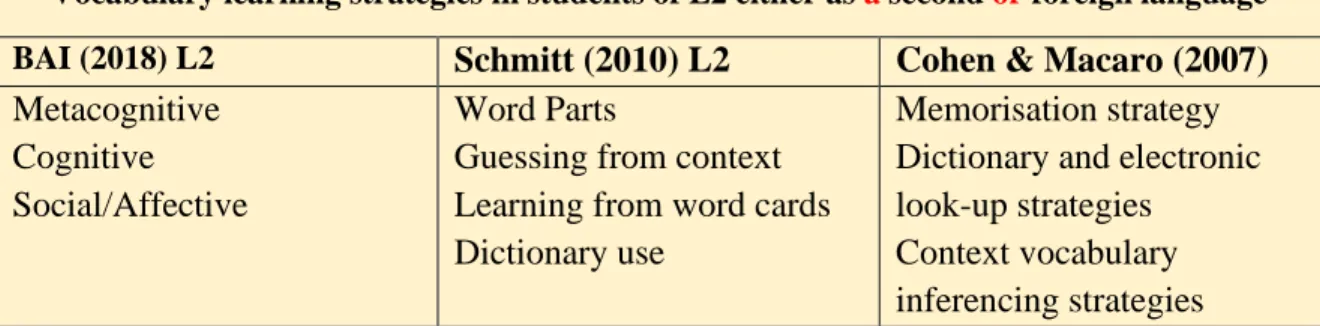
Bai (2018) describes three different vocabulary learning strategies; social/affective strategies, metacognitive strategies and cognitive strategies. Vocabulary learning strategies of L2 learners either as a second or foreign language BAI (2018) L2 Schmitt (2010) L2 Cohen & Macaro (2007) Metacognitive. Based on the characteristics that each author has indicated about learning strategies, I can conclude that the cognitive strategy is the one observed in the participants of this research.

Teaching vocabulary in EFL context
- Vocabulary learning tasks
- Matching vocabulary with its meaning
- Vocabulary teaching strategies
- Reading while listening to learn vocabulary
For example, activating memory to find different ways to express the meaning of a word may be a good task to implement as it may provide information about students' ability to correctly match words to meanings. her, that is exactly what this research will study. In a vocabulary activity, give and take L2 definitions, synonyms or sentences may be more appropriate for teaching English students because it keeps them involved in the target language. Considering the objective of CELE courses it can be concluded that the matching technique can be used in the EFL context of this research.
This practice can be useful in learning a foreign language because it gives students different opportunities to acquire vocabulary by using different sources that complement each other by supporting the reading material with its writing, depending on what each student perceives as easier to understand . It can be said that the students receive the same information in two different forms, covering the possibilities of listening or reading a previously known word, as well as relating new words to the context in order to form an idea of their meaning. In the study done by Chang (2009), she points out that it can be quite difficult for students to distribute their attention equally to both skills.
Formative and summative assessment in EFL
- Placement and diagnostic tests in the EFL context
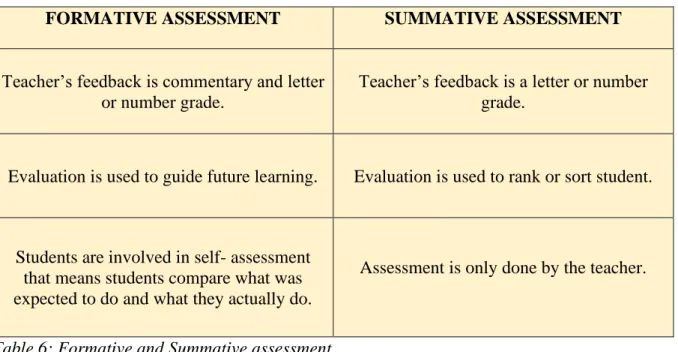
As mentioned before, reading material can support listening, but it is important to consider the purpose of this instructional practice to be selective in the topic or length of the material. She also mentions that students need to understand whether their purpose is to understand specific messages or to learn language elements, that is indeed the purpose of this practice in this study. The author mentions that any assessment can be formative depending on how the results of the assessment are used.
For example, a passage where students have to identify 10 adjectives can be formative and summative; while students can identify 7/10 adjectives, which is summative, he can also be assessed to identify a pattern in the position of adjectives before a noun, which is formative. The test to be obtained depends on the purpose of using the test, as it can be functional for the teacher or the institution. According to the definitions given, placement tests can be related to the institution and diagnostic tests to teachers, this relationship can be observed in the previously mentioned CELE curses, the institution offers students the opportunity to be enrolled at the very basic level of English, but it also has the opportunity to take a placement exam for students who already know the language, this test is done before starting the courses.
Rubrics
- General and task-specific rubrics
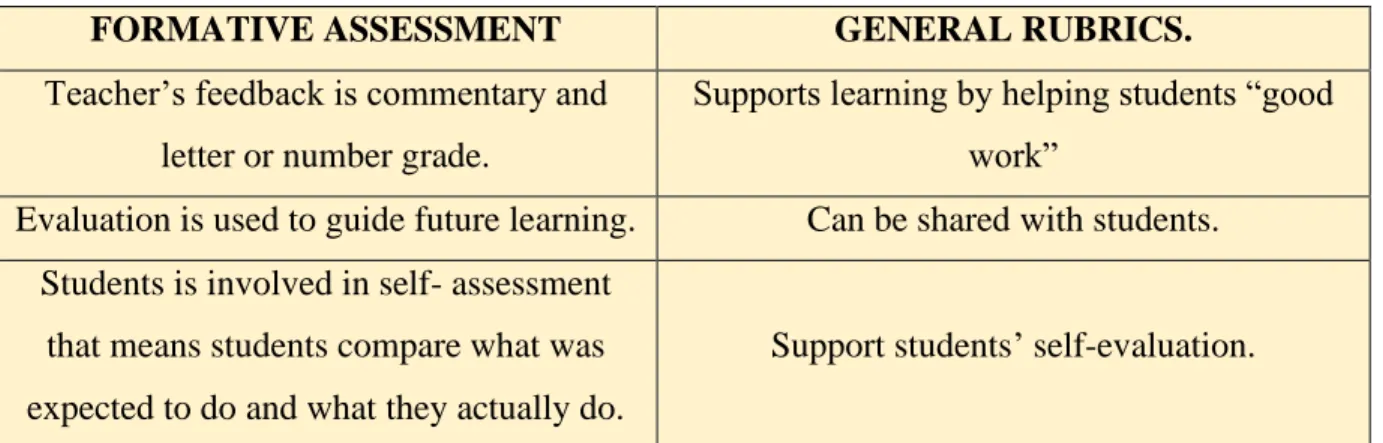
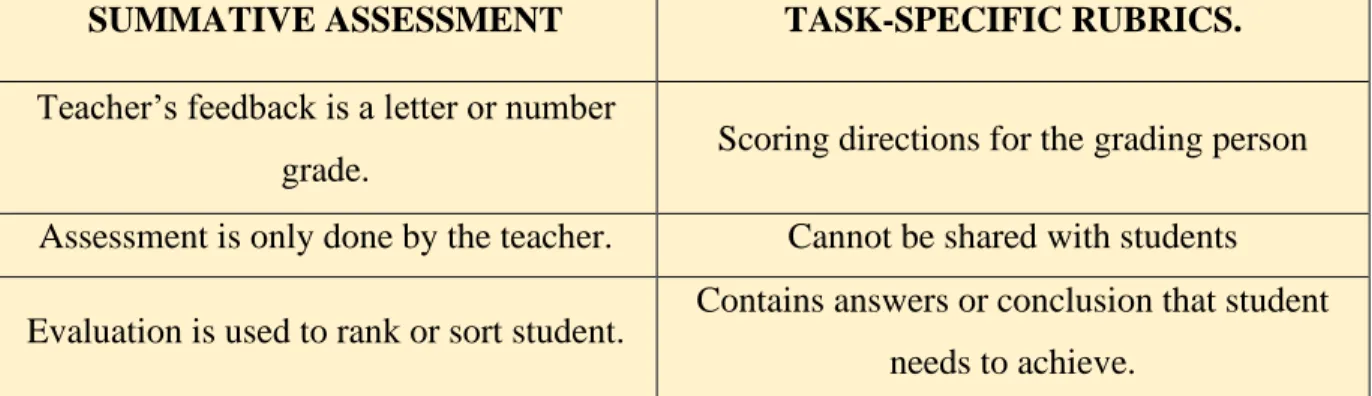
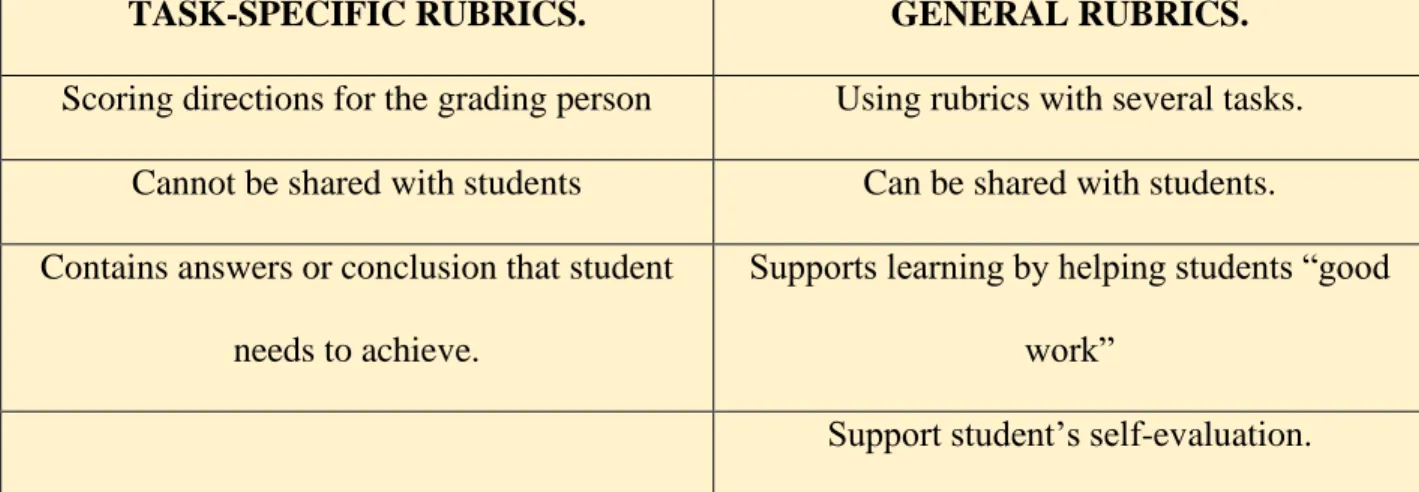
First, she argues that general rubrics use criteria and descriptions of performance that generalize across or can be used across tasks. These can be shared with students at the beginning of the assignment. General rubrics can be shared with students as they can use them to know what is expected in their final work. Regarding task-specific rubrics, Brookhart (2013) says that they contain the answer to a problem, or explain the rationale that students are expected to use, or list facts and concepts that students are expected to mention.
Brookhart (2013) concludes that task-specific rubrics act as scoring guides for the person assessing the work because they detail the elements to look for in a student's response to a particular task. In short, general rubrics are those that provide students with information about what is expected of them, as well as feedback on their work and several features that describe the purpose of formative assessment. Task-specific rubrics are useful to the person using the rubric because they provide results for assessing and ranking students, which is the purpose of summative assessment.
Conclusion
This system can be applied to this study by using the answer key to see how strong or partial participants' knowledge and understanding of meaning is regarding the vocabulary presented in the story. A comparison was then made between vocabulary learning strategies in ESL and EFL, with an emphasis on the latter. The last part on learning strategies focused on finding the meaning of unknown words.
This section described instructional practices such as matching vocabulary to its meaning and reading while listening. The application of these practices was aimed at students of English as a foreign language, particularly CELE students. A comparison was offered between formative and summative assessment, and placement and diagnostic tests were also included. The literature concluded with a description of the types of rubrics that may be appropriate for assessing vocabulary knowledge.
METHODOLOGY
- Context
- Participants
- Pedagogical intervention
- Method of collecting data
- Instruments
- Data gathering procedures
- Conclusion
These results were compared at the end of the activity using a self-designed task-specific rubric to describe participants' performance. The experiment was divided into two phases, the first was the application of the activity, which was divided into three steps: (1) before reading while listening, (2) reading while listening, and (3) after reading while listening. Here, participants had time to complete the first column of the worksheet (Appendix B) with the given instructions.
In the second step, reading while listening, the story script was displayed on the screen and the recording was played (Appendix C). This graph corresponds to the pre-reading-listening column, each column having a description of the qualitative equivalence of the expected results in relation to the research objectives. The second part of the task-specific rubric is a table listing the vocabulary used in the story and its definitions taken from a Cambridge dictionary.
RESULTS
- Scores before and after the reading while listening activity
- Evaluation of the results obtained
- Analysis of participants’ answers
- Individual participants’ evaluation
- Evidence of language learning strategies used by participants
- Conclusion
According to the task-specific rubric, all these scores are in the range that describes an excellent understanding of the meaning of the words before the activity. Each of the four aspects contained in the rubric has a range of points that describe the meaning of the words that have meaning before and after the reading while listening activity. Both results describe an excellent understanding of the meaning of the words, this was expressed using definitions before and after the activity.
The final score from Participant 2 was 45 points before reading during listening activity, this score describes an excellent understanding of the meaning of the words. Both scores describe an excellent understanding of the meaning of the words, which was expressed by using sentences before and after the activity. Then, a summary of the results obtained from each participant was offered at the end of the reading while the listening activity was offered.

CONCLUSIONS
- Main findings
- Implications
- Limitations of the study
- Recommendations for further research
I can conclude that sentences defined as an item that functions as a single unit of meaning regardless of the number of words it contains (Schmitt, 2000) are the lexical units most commonly used by CELE students to express the meaning of words . This was observed in the participants' responses as there were similarities between the sentences used by the participants and the sentences used in the story. Therefore, the cognitive strategy, especially guessing from the context, is the one that better describes the participants' behavior to find the meaning of the sentence. vocabulary. As we mentioned earlier, the meaning of words can be expressed using a lexical unit that Schmitt (2000) defines as an item that functions as a single unit of meaning regardless of the number of words it contains.
The quality of students' explanation (Li & Kirby, 2014) or vocabulary depth can also be observed in the description that participants gave to prove their understanding of the words' meaning. The implications of the fact that most of the students constructed sentences to express the meaning of words can be twofold. Due to the reduced number of participants, it was not possible to use a classroom where.