Top and ElectroWeak physics Part II: experimental results
Marcel Vos (IFIC, CSIC/UV, Valencia, Spain)
Taller de Altas Energías Septiembre 2013,
Centro de Ciencias Pedro Pascual,
TAE2013
2
I'll assume you're familiar with the basics.
You'll need some background on:
the Standard Model,
the Large Hadron Collider,
the ATLAS and CMS experiments
(please, ask whenever I go too fast)
The scope of this lecture is limited to:
The physics of top quarks and weak gauge bosons
(roughly everything to come out of the top and SM-electroweak groups in CMS and ATLAS)
Background and scope
Intersparsed with intermezzos on important experimental techniques
Discussing lepton collider prospects along with LHC status
Recommended literature
Bernreuther on LHC top quark physics (before the start of the LHC) http://arxiv.org/abs/arXiv:0805.1333
An experimentalist's review of the first two years at the LHC:
http://arxiv.org/abs/arXiv:0805.1333
TAE2013
Outline
Motivation (that should mostly be covered in Juan Antonio's talk) Top quark reconstruction (with a bias towards new techniques) Some key measurements with top quarks:
– Top quark pair production cross-section – Top quark charge asymmetry
– Top quark couplings to electro-weak gauge bosons – Top quark mass
– Top quark decay: W helicity Searches involving top quarks
– Top and Higgs
– Top and new physics Electroweak physics
– W/Z + jets production
– Gauge boson pair production
Not a complete review. No mention of top quark polarization, single top, and
many other interesting subjects.
Searches vs. SM measurements
A large fraction of ATLAS and CMS papers report the result of
searches :
Define a signal region, predict the background, count events
Typical outcome: limit on a (more or less plausible) benchmark scenario for the physics that might lie beyond the Standard Model (BSM physics)
Leave no stone unturned, but expect few searches are successful...
(discussed extensively in other lectures)
Derive bounds on excited quarks from characteristics of di-jet production, or on SUSY
TAE2013
Searches vs. SM measurements
A different approach to study the same data:
SM measurements
No prejudice on what new physics should be like
Assume the Standard Model describes kinematics adequately Produce numbers that can be compared to predictions
(i.e. apply corrections for acceptance, detector response)
Expose the result to the entire community to interpret the result
Unfolded di-jet mass spectrum and ratio of three-jet to two-jet events
The top quark
The heaviest particle in the Standard Model
We don't know why the SM fermions have the masses they have. The top quark has a mass of ~173 GeV. What does that number come from? In the SM it's the result of the Yukawa coupling of the top quark to the Higgs boson. But what does the number come
TAE2013
The top quark
A single top quark is as heavy as a Gold atom.
Gold atoms are composite (quite so, indeed: 79
protons, 118 neutrons) and of finite size (so large we
can “see” them).
The top quark: structure
Searches for contact interaction or exicted states of quarks and leptons
What do we really know about the internal structure of the top quark?
observable Compositeness scale reached [TeV]
L (eeee) O(10) (LEP) L (eeqq) O(10) (LEP)
L (qqqq) 2.9 (D0) 3.4 (ATLAS) 5.6 (CMS) e* → e 1 (CMS)
TAE2013
Tops, gauge bosons and loops
The top quark loves loops and loops love the top quark. Our
favourite Higgs decay wouldn't work without heavy objects,
nor would the dominant production mode.
ttt: strong interaction
Top quark production at hadron colliders
Electroweak pair production is present, but not accessible as it's rate is several orders of magnitude below QCD pair production
Relation between gluon gluon-initiated and
TAE2013
Intermezzo: sea quark, valence quark, gluon
Parton density function: probability to find a quark or gluon with a fraction x of the proton momentum
Higher center-of-mass energy allows to take advantage of relatively low-x
partons. Parton luminosity increases very strongly from Tevatron to LHC.
Intermezzo: ½ LHC → LHC
That begs the question:
what can we expect with 14 TeV (or 13) running
Another big leap!
TAE2013
single t: weak interaction
Top quark production at hadron colliders
1 million top quarks from single-top production
Top decay
The top quark decays to quickly to hadronize
(no top jets in the true sense of the word, but wait and see)
t → Wb and little else
(Juan Antonio told you all about this)
TAE2013
Top decay
5% di-lepton
20% e, + jets
44% six jets
Top quark pairs: final states and background
TAE2013
Intermezzo experimental tools: b-tagging
B-hadrons are relatively long-lived
Vertices are displaced by c , where c ~450 m
Intermezzo experimental tools: p
Tbalance
Construct four vector sum of all reconstructed objects
pz is not balanced (qq or gg initial state is not at rest in the detector)
pT imbalance can be identified with the pT of an object escaping detection There must be only one such ghost particles!
A photon recoiling against a ghost particle ( dark matter questions after the lecture )
TAE2013
Top quark pairs: reconstruction
A puzzle with 6 pieces: combine two b-jets, a charged lepton, a neutrino and two “light jets” into two top
candidates using the following information:
Two non b-jets must yield W mass
Top and anti-top candidate must have equal mass
...
Main ambiguities; swapped b-jets,
gluon jet mistaken for W-daughter
(Can you think of a method to
distinguish b-jets from b-jets. Will it work at the LHC?)
Top quark pairs: reconstruction
B-tagging distinguishes
b-jets from W-decay jets and gluon radiation
The neutrino: pT = - pTmiss, pz from W-mass constraint, resolve 2-fold ambiguity in some ad hoc way
Pick the two with highest pT among the remaining jets
TAE2013
An old
example
from CDF
????
Now apply the strategy to this (real) event.
What's going on here?
What information is no longer resolved?
What bit of information didn't we use?
Answers in an hour...
t → ℓℓbbνν with veto on extra jets t Gap fraction
• fraction of events without an additional jet above threshold
Result
• reasonable description of data, except for MC@NLO in central region; helps reducing allowed radiation variation
|y| 2.4
PAS TOP-12-023
EPJ C72 (2012) 2043
tt + no jets
TAE2013
Intermezzo on HEPDATA/RIVET
The gap fraction measurement enables other measurements, as it yields an improved understanding of the limitations of NLO MC (MC@NLO,
POWHEG) and allows to sharpen the ISR/FSR prescriptions (which then benefit the x-sec and mass measurement)
We need some way to make the corrected results public, so that they can be compared to generators and tunes efficiently
http://arxiv.org/pdf/1003.0694.pdf
http://hepdata.cedar.ac.uk/view/ins1094568
Useful things to look up:
HEPDATA, RIVET
Allows to check modeling at high #jets at top quark scale
• important for top, Higgs, BSM
• unfold spectrum in visible experimental phase space
• High #jets is not well modeled by MC@NLO
PAS TOP-12-018
CONF-2012-155
PAS TOP-12-023
Tt + extra jets
TAE2013
Cross-section
Cross-section
30
TAE2013
Theory intermezzo: calculability
Theory milestone:
full NNLO and NNLL result for top quark pair production at hadron colliders
K-factor (NLO → NNLO) ~ 10%
Scale stability ~ 5 %
Luminosity & beam energy
The luminosity at the LHC is measured to approximately 3%
Determined from:
- number of particles in the bunches (beam current) - revolution frequency (precisely known)
- beam size (Vandermeer scan)
The beam energy must be accurately known: a few % error translates into a cross-section that is similar to the current uncertainty on the tt production rate
TAE2013
Test of pQCD in dσ/dx ℓ+jets, dilepton @ 7 and 8 TeV
• check dependence on QCD scales, ME-PS matching, generators
• enhance sensitivity to new physics
Differential in pT, η (and m) for ℓ, ℓℓ, b, bℓ, t, tt
Kidonakis
PR D82 (2010) 114030
Differential cross-section
Provide results that can be compared to predictions “directly”
Differential in pT, η (and m) for ℓ, ℓℓ, b, bℓ, t, tt
EPJ C73 (2013) 2261
arXiv:1211.2220
Good description in general
aNNLO describes softer pT(top)
Differential cross-section
TAE2013
Intermezzo: pseudo-top & fiducial regions
The measurement of the cross-section is prone to modeling uncertainties
Example:
- result depends on lepton pT spectrum (acceptance correction) - this uncertainty is estimated by comparing different generators
A more precise comparison of data and theory is possible by “getting closer to the measurement”:
- define the cross-section for a fiducial region
- in our example, the tt production with pT (l) > 25 GeV - requires theory work: top decay must be included
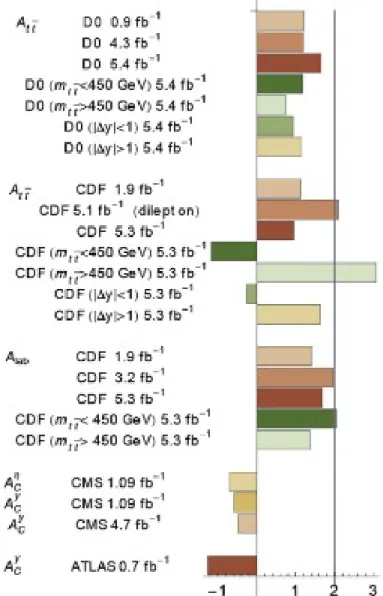
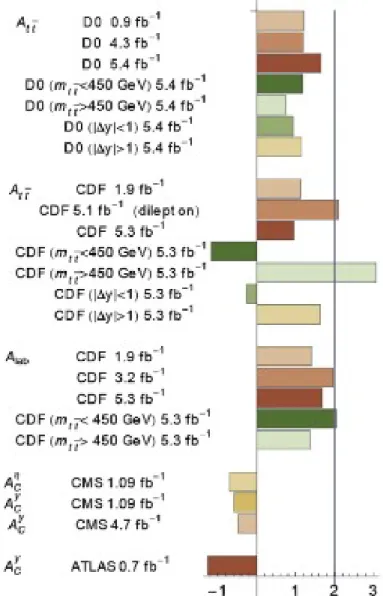
Tevatron charge asymmetry
Tevatron legacy: evidence for larger charge asymmetry than predicted by Standard Model, especially at large tt invariant mass
Papers with “evidence” in the title, followed by something not predicted by the SM are rare http://arxiv.org/abs/arXiv:0910.5472
Figure by German Rodrigo
See also: http://ific.uv.es/~rodrigo/talks/
2012_03_rodrigo_top_Moriond.pdf
TAE2013
Tevatron charge asymmetry
Tevatron legacy: evidence for larger charge asymmetry than predicted by Standard Model, especially at large tt invariant mass
Papers with “evidence” in the title, followed by something not predicted by the SM are rare http://arxiv.org/abs/arXiv:0910.5472
Figure by German Rodrigo
See also: http://ific.uv.es/~rodrigo/talks/
2012_03_rodrigo_top_Moriond.pdf
Charge asymmetry
Unfolding → correction for acceptance & migrations due to limited resolution Reconstruced distr. x acceptance correction x migration matrix-1 = corrected result
38
TAE2013 [email protected]
Charge asymmetry
Inclusive measurement and two mass bins <450 GeV,
>450 GeV
Impact on model zoo inclusive
mtt > 450 GeV (Tevatron and LHC)
Mtt > 800 GeV (LHC only)
JA Aguilar AC vs. mass for Z' model
(V. Sanchez, A. Hyaya)
• Production rate sensitive to tt-photon vertex
→ pair production measures tt-gluon
→ top decay and single top production probe tWb
• Require pT(γ) > 8 GeV, SM σtttγ = 2.1±0.4 pb
Associated production: Top quark pair + photon
TAE2013
• also important background to SUSY and BSM searches
• analysis also designed to measure t W (not coupling) t
• same-sign dilepton (t V) or trilepton events (t Z) t t
• now with updated generator unc. (Powheg-BOX, +50% syst.)
3.3σ 3.0σ NLO:
NLO:
Garzelli et al., JHEP 11 (2012) 056 Campbell, Ellis, JHEP 07 (2012) 052
Associated production: Top quark pair + Z boson
CMS establishes ttV signal at 4.7 (V=W,Z)
(ttZ) = 0.28 +0.14 -0.11 (stat) +0.06 -0.03 (syst) PRL 110 (2013) 172002
Candidate event (eµµ) ETmiss = 78 GeV mll= 91 GeV
mT(l,ETmiss) = 67 GeV 4 jets (2 b-tagged)
CONF-2012-126
TAE2013
Top quark pair production in the continuum
tt production at ILC:
~0.6 pb at √s = 500 GeV
~0.2 pb
at √s = 1000 GeV
300.000 tt events in 4 years @ 500 GeV 300.000 tt events in 4 years @ 500 GeV
Unique features of e+e- colliders: calculability and control over initial state
●
Per-mil level uncertainty on inclusive cross-section
●
Luminosity measured to similar level
●
Beam energy to 10
-4Compare to 5% uncertainty in the cross-section prediction at the LHC
Variation in predicted x-section
due to scale variations
Phys.Rev. D71 (2005) 054013
LHC expected to reach ~10% precision on form factors governing tt-photon and tt-Z vertices
Long-term LHC prospects by Baur, Juste et al.
(Snowmass 2005)
Top Couplings: pre-Snowmass Energy Frontier 2013 Overview
Electroweak couplings
TAE2013
/γ
The current at the ttX vertex:
Electroweak couplings
See talk by Nacho García
LC-REP-2013-007 σ(+) AFB(+) λhel(+) (+ =eR−)
σ(−) AFB(−) λhel(−) (− =eL−)
⇒ F1Vγ * F2Vγ F1VZ F1AZ F2VZ
Measure 6 observables, extract 5 form factors
500/fb at 500 GeV yields 1-2 orders of magnitude better sensitivity than the LHC (300/fb at 14 TeV) Adding to previous studies in TESLA TDR:
- simultaneous extraction of photon and Z form factors The cross section can be measured to 0.5% (stat. + lumi) The forward-backward asymmetry to 2% (stat. + syst.) The slope of helicity distribution to ~4% (stat. + syst.)
Electroweak couplings at LC
46
TAE2013
Top quark mass: motivation
Precision test of the SM
- SM EW fit yields relations between m
H, m
tand m
W- Currently limited by m
W, must improve also
s, sin
2, m
ZFate of the universe
- Depending on the value of the top quark mass the Higgs potential may go negative somewhere between EW and Planck scale (in the SM)
Degrassi, Di Vita, Elias-Miro, Espinosa, Giudice et al. ‘12; Alekhin, Djouadi, S.M. ‘12; Masina ‘12
Top quark mass
A “philosophical” question: how can we measure a quark mass?
48
TAE2013
Top quark mass
Quark mass is not an observable.
Extract mass from an analysis that counts events:
– Total rate vs. differential – Inclusive vs. Exclusive Differential, exclusive
→ invariant mass distribution of top decay products Total, inclusive
→ extract mass from inclusive cross-section
CMS: ideogram method
• JES correction evaluated from the method
ATLAS: template fit
• uses reco mt and mW as input to fit
• JSF impact evaluated in situ from mW
• 3D fit → b-jet JES fixed on data
Top quark mass from l+jets events
TAE2013
ATLAS top mass summary
Experimental intermezzo: jet energy scale
Many analyses are limited by the uncertainty on the Jet Energy Scale? What is it?
An estimate of the uncertainty on the calibration of jets.
Could the jet energy be 3% lower than we think?
How can we estimate/measure this uncertainty? How can we reduce it?
MC-based: variations in response when we vary:
– Hadronic shower model (swap nominal with one that's not too far off) – Material budget (within conservative, but reasonable range)
– …
Data-driven methods take over:
– Calorimeter/tracker ratio – photon + jet events
Constrain in data/kinematic fit
52
TAE2013 [email protected]
JES
Typical uncertainty between 1 and 2% for intermediate energy Jets close to others are typically more uncertain
Flavour-dependence (quark vs. gluon, c-jets, b-jets)
• top quark is a colored object, final state is color neutral
• Can estimate colour reconnection uncertainty from MC studies
• Many (precise) measurements in different kinematic regimes give confidence that this is under control
Theory uncertainties
TAE2013
Interpretation
Measured mass (~MC mass) is identified with pole mass This introduces an uncertainty of XXXX MeV
A long debate follows...
Top quark mass
Alternative methods:
Endpoint measurement
(CMS, arXiv:1304.5783, currently 2 GeV uncertainty) Extraction from J/psi spectra, m
blExtracted from total cross section
– m/m ~ 0.2 (currently > 5 GeV uncertainty)
ttg cross-section (arXiv:1303.6415)
56
TAE2013
Threshold scan at a future lepton collider
A scan of the beam energy through the tt production threshold (nominally: 10 points of 10/fb each)
Threshold scan at the LC
Luminosity spectrum changes shape (ILC & CLIC)
Full simulation & reconstruction, including background Evaluation/discussion of systematics
5 7
ILC350 CLIC350
58
TAE2013
Top quark mass at an LC
5 8
Martinez, Miquel, EPJ C27, 49 (2003)
A precise measurement ( m
t< 100 MeV) can be achieved + s < 0.001 (+
t< 30 MeV) (+ y
t/y
t~ 35% *)
Seidel, Simon, Tesar, Poss
Stat. error
~ 20 MeV
No dependence on location of scan energy 5% uncertainty non-tt bkg → 18 MeV
10-4 precision on s → 30 MeV
20% uncertainty on lumi-spectrum → 75 MeV
Top quark mass: a program for 3 decades
Tevatron: discovery (1995) and develop full characterization
– legacy mt = 173.18 ± 0.56 ± 0.75 GeV
LHC: continue conventional approach
– Statistical error no longer an issue
– Jet Energy Scale (and b-JES) are tough, but can be treated*
– Major drawback: theory interpretation (see JA this morning)
LHC: extract top mass from measured cross-section
– Achieved 3% precision, with a rigorous interpretation – Refine to increase sensitivity*
LHC: new methods based on kinematical observables
– B hadron decay length – lepton pT
– J/ψ+lepton from W
60
TAE2013 [email protected]
W polarization in top quark decays
Juan Antonio certainly explained how W
polarization (helicity
fractions) can be extracted from the distribution
of cos *
W polarization in top quark decays
http://inspirehep.net/record/1114314
Important background to t H(→b ) channel t b Interested in fraction of events with b-flavour
• in σ(t b )/σ(t jj) many systematics cancel t b t
Theory
• Madgraph 1.2%, Powheg 1.3%
• NLO calculations predict 4.7%
(parton level, can’t be compared)
PAS TOP-12-024
Associated produciton with bottom quarks
TAE2013
Can access top-Higgs Yukawa coupling
• given enough luminosity
In 2011 looked at t H (H→bb) t
• divide sample in categories #jets #b-jets
• construct likelihood (ATLAS) or neural network (CMS)
CONF-2012-135 PAS HIG-12-025
Not yet sensitive
• analysing 2012 data Limits for mH=125GeV
• CMS 4.6 x SM (3.8)
• ATLAS 13.1 x SM (10.5)
Associated production with Higgs bosons
The H boson
Direct determination of
couplings to 3rd-generation quarks; a crucial piece of the puzzle
Difficult...
http://arxiv.org/abs/arXiv:0910.5472
A process that is going to be very important in phase II of the LHC
TAE2013
Further searches with (boosted) top quarks
68
TAE2013 [email protected]
The “boosted production” threshold
Enough to discover the top quark, no boosted production
Expected number of tt events in three different kinematical remies
Tevatron run II
10 fb-1 @ 1.96 TeV
LHC 2012
20 fb-1 @ 8 TeV
LHC design
300 fb-1 @ 13 TeV
Very LHC
300 fb-1 @ 33 TeV
Inclusive tt production 57.000 2.600.000 155.000.000 1.000.000.000
Boosted production: Mtt > 1 TeV 25 30.000 3.000.000 46.000.000
Highly boosted: Mtt > 2 TeV 0 300 47.000 2.300.000
A top factory, our first sample of boosted top quarks
Millions of boosted top quarks, 50.000 extremely boosted events
M.V., Boosting sensitivity to new physics, CERN Courier, Oct 2012
Results obtained with MCFM, J. M. Campbell and R. K. Ellis, arXiv:1204.1513 [hep-ph] MSTW2008NLO PDFs
s >> E
EWEven the heaviest SM particles often acquire p
T> m
→ abundant production of “boosted objects”
The boosted regime
Now apply the classical strategy to this event.
It won't work
What's going on here?
Top quark p
T>> m
tWhat information is no longer resolved?
Jets merge
Lepton not isolated What bit of information didn't we use?
Back-to-back t and t
70
TAE2013 [email protected]
Boosted top quarks
Classical algorithm is great for top quarks at rest, but is not adequate for boosted top quarks
Problem: merging jets, lepton isolation, missing pT resolution
Missed opportunity: reconstruction of top quark is easier in boosted regime
arXiv:1207.5644
Boosting BSM sensitivity
Let's define “boosted object” by comparing the standard approach
(reconstruct components and combine) to Mike Seymour's alternative (find composite object and decompose).
Rules of thumb for maximum jet radius parameter for 2-body decay:
R < 2m/p
T(always resolve two jets)
R > 3m/p
T(capture full decay in a single jet 75% of cases)
W boson at rest → use resolved approach p
T~ 240 GeV → coexisting algorithms,
Boosted objects: A Probe of beyond the Standard Model physics.
TAE2013 [email protected]
Boosted objects and fat jets
Boosted objects must be caught in fat jets
(arXiv:1012.5412 [hep-ph] ) Fat jet, according to Colin G.
Tools & Technniques: reconstruction
– Anti-kt is infra-red safe and with nearly circular footprint – kt yields clustering that is intrinsically ordered in pT scale – C/A clustering sequence is ordered by angle
Anti-k
t= default jet algorithm for ATLAS/CMS is anti-k
t“clustering” jet algorithms use a distance or metric:
d
ij= min(p
Ti2p,p
Tj2p) * R
ij2/R
2
d
iB= min(p
Ti2p, p
Tj2p)
p=0 → Cambridge Aachen (C/A) p=1 → k
tp=-1 → anti-k
t74
TAE2013 [email protected]
Jet mass
Top jet → m
j~ m
tBackground → m
j
sp
TR
Jet grooming improves performance:
– resolution
– background rejection – Pile-up resilience
Pythia: 500 < pT < 600 GeV
Anti kT (R=1.0) particle-level SM tt
QCD incl. jets
Jet substructure
76
TAE2013 [email protected]
Detector response
Can we measure jet substructure precisely and reliably?
Tools and Techniques: grooming
Jet substructure is often hidden:
Soft emissions inside the jet
Underlying event
Pile-up* (identified by associating jets/clusters to tracks/vertices)
Jet grooming techniques to remove the “softest” parts (at large angle) of the jet:
Filtering: break jet into subjets on angular scale Rfilt , take nfilt hardest subjets Butterworth, Davison, Rubin & Salam
’08
Trimming: break jet into subjets on angular scale Rtrim, take all subjets with pT,sub > trimpT,jjet Krohn, Thaler & Wang ’09
Pruning: as you build up the jet, if the two subjets about to be recombined have R > Rprune and min(pt1, pt2) < prune (pT1
+ pT2), discard the softer one. Ellis, Vermilion & Walsh ’09
Now, after seeing with our own eyes what pile-up can do to jet, is a good time to convince your experiment to support these
Revisit/reoptimize based on experience on data
David Krohn
78
TAE2013 [email protected]
Measuring jet mass
Simulation: jet mass scale for boosted top quarks verus
number of pile-up vertices
Combination of grooming and pile-up subtraction restores the scale
OK! This works for foreseeable future
Boosted top quarks (II)
First boosted top quark Mtt ~ 800 GeV
ATLAS-CONF-2011-073
mtt > 1 TeV
ATLAS-CONF-2011-083 Early “l+jets” candidate
ATLAS-CONF-2010-063
mtt > 1 TeV
ATLAS-CONF-2011-083
80
TAE2013 [email protected]
Boosted top quarks (III)
2010 data: the first five events of an excellent
control sample ATLAS certified tt
events with mtt >
700 GeV
Recluster @ R=1 First observation of a
“boosted object”
High-mass (> 700 GeV) pairs in the standard selection → when reclustered with R = 1.0 the three jets merge into a single jet with:
mj = 197 GeV (expected: mt) sqrt(d12) = 110 GeV (expected ~mW) sqrt(d23) = 40 GeV (expected …)
The world's first “boosted object” → BOOST2011.
Boosted top quarks
82
TAE2013 [email protected]
tt resonances
Depending on what you're looking for, the differential) cross-section, the charge asymmetry, same-sign top quark search, tt + missing energy, .... may be more relevant
If you're still here on Saturday, come to the BSM new phenomena discussion Full Signal Region
Expect 80% SM population of the Signal Region is due to tt pair production
tt system reconstruction 10% mass resolution
ATLAS resonance searches
Final state di-lepton lepton+jets boosted
l+jets Boosted
fully had combined l+jets
Preprint/publication EPJC72 EPJC72 JHEP1209 2012-102 2012-136
Data set 2 fb-1 2 fb-1 2 fb-1 4.7 fb-1 4.7 fb-1
Better (more specialized) algorithms allow us to achieve better sensitivity on the same data set!
This is only possible with a
sufficiently granular detector system
Summary post-ICHEP2012: Classical and boosted algorithms have complementary low and high mass sensitivity.
TAE2013 [email protected]
Resonance searches
Use Z' limits as a benchmark to monitor progress
l+jets analyses only. Searches in fully hadronic events are close behind!
Electro-weak physics
Study of W and Z production:
- test of the Standard Model predictions
- related to Higgs boson production through vector-boson fusion - important backgrounds for searches with leptons
- access to Parton Density Functions (strange)
- vector-boson scattering
86
TAE2013
Grand summary
An even grander summary
88
TAE2013
Z+jets
A very good laboratory to study the emission of additional jets
Vector boson + N jets
definitely requires specialized tools (multi-leg Monte Carlo) beyond N=1,2
http://arxiv.org/abs/1304.7098
Z+jet ratios
Measuring ratios some of the uncertainties come down considerably
http://benasque.org/2012imfp /talks_contr/319_Mangano.pdf Measurements are also
available for W+b, W+c production
90
TAE2013
W production is asymmetric
W production has a distinctive charge asymmetry
Used, for instance, to determine the background level in studies of top pair production
Proof of the sensitivity to the proton make-up
WW cross-section
Pairs of vector bosons: SM production + possible BSM contributions
92
TAE2013
No new physics, so far!
Vector boson scattering
94
TAE2013
Vector-boson scattering
Vector boson scattering amplitude expectedt to go crazy at ~ 1 TeV if there were no Higgs boson Study might shed some light on the exact nature of the electro-weak symmetry breaking mechanism Requires very large integrated luminosity... a good benchmark for a hi-lumi LHC
The end
I hope you enjoyed this tour of the LHC ...