
Towards a New Theory of the Firm / edited by Joan Enric Ricart, Josep Maria Rosanas; Rafael Andreu Civit. One may, of course, ask whether there is anything that can properly be called a theory of the firm.
How the life of the CEO has changed
In a free-enterprise, private-property system, a corporate executive is an employee of the business owners. As part of the shift in governance norms (especially after the late 1980s), boards were expected to be much more systematic and inclusive in selecting new CEOs.
What has agency theory wrought?
Because of changes in the underlying business environment, today's CEOs are significantly more narcissistic than their predecessors, and far more than can be explained by personality changes in the general population. The same can be said for the values of individualism and materialism among CEOs; in the other direction, today's CEOs have far less psychological identification with their companies than their predecessors.
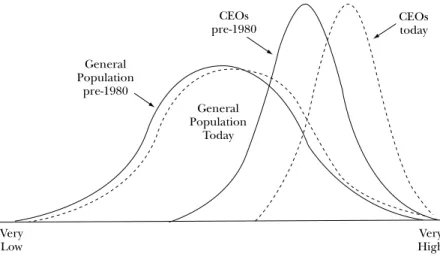
The causal logic
However, this literature has been relatively silent on the dynamic processes that occur when changes occur in the conditions associated with an occupation or job category—. As such, we must be somewhat speculative and tentative in depicting the dynamic process by which changes in the CEO position over the past 30 years or so have brought about changes in the type of person found in that office.
Changes in the CEO population
As a result of changes in the business environment, today's CEOs differ from their predecessors in another value dimension: they are more materialistic. Therefore, it is reasonable to imagine that contextual conditions have led to a more narcissistic population of CEOs than in the past.
Stewardship theory and “the good old days”
If agency theory brought us aggressive, ambitious, self-centered, whiny CEOs, we can easily imagine that adopting the stewardship framework would produce its own skewed population of top managers: risk-averse, conformist, rule-following, and incrementalists.5 While we think of the many managers we have studied or observed and the variety of personality profiles we have seen, we question whether the archetype advocated by stewardship theory will produce a cadre of CEOs capable of bold or innovative leadership in dynamic environments. Whether CEOs of the 1950–1980 era were less holy or more holy than the CEOs of today cannot be reliably said.
Some proposals
Under this approach, CEOs will be monitored and incentivized to take a long-term perspective. Our second idea, more of a long-term proposition than the first, would be to allow for a number of different models at the same time—which over time would lead to greater diversity in the CEO population.
Summary
By institutionalizing certain types of corporate charters and especially drawing attention to their existence and their differences, this system would encourage stakeholders - and society as a whole - to carry out their ongoing evaluations of the pros and cons of different models. We have proposed several alternative ways forward that might better accommodate the new breed of CEOs and, ultimately, create greater diversity in the CEO population.
Expanded thoughts about a Theory Y economic model economic model
In summary, we can say at this point that Theory X and Y economic models, in our opinion, easily build on McGregor's Theory X and Y management models. It should be quickly noted that in the world of both Theory
Supporting evidence
An enlightened, expanded Theory Y economic model, however, could envision a much richer use of human wealth-creating capacity in the service of higher visions of global society's well-being. Thus, a green, sustainable, just world economy would become a proof of the wealth of all its members. Thus, companies and economies operating in a global economy driven by Y-type economic assumptions and wealth creation recipes would ensure the long-term prosperity of global society.
A further benefit
We have argued that such a community could only exist through what we now see as an approximation of Theory Y economic philosophy, which includes expectations of trustworthy behavior among firms and a common effort to treat everyone equally. Indeed, we argued earlier, without reference to its compatibility with Y-type values, that the voluntary pursuit of cooperative interaction would eventually prove increasingly satisfying, both economically and socially. Although we often observe that existing economic views and processes within and between firms are an inhibiting factor, we have not offered a broad economic vision to support collaborative enterprise behavior.
Related theorizing
All of this would, of course, be subject to the limitation that none of these tendencies reduce the long-term economic viability of the company. We hypothesize that generally beneficial efforts could become part of a company's strategic plan to help realize all stakeholders. Wouldn't such a plan actually become an appropriate Theory Y company operating in a national Theory Y economy, perhaps even a global Theory Y economy.
Y economic policy for the national and global economyeconomy
As such, the company's achievements for society would be based on goals built from discussions at all departments and levels, thereby bringing satisfaction to all members of the company and all its external stakeholders. Glimpses of potential returns can be seen in at least some major economies. Expressed in this way, the alternative visions X and Y of the world economy begin to clearly come into focus.
Conclusion
While Paul Samuelson noted in a 1937 article that his measurements and assumptions of "the marginal utility of money income" should have "no bearing on ethical judgments of economic policy," the reality is that judgments of purpose and value im - embedded in virtually all business and economic models. Bad for Practice: A Critique of the Transaction Cost Theory,” The Academy of Management Review 21 no. In practice, the firm is already on a path to humanization, but theories of the firm have lagged behind.
Propositions
- Proposition 1: Conceiving of the firm as a social institution is a buffer against uncertainty and change
- Proposition 2: An emphasis on the firm as a social institution generates a longer-term perspective
- Proposition 3: Articulation and transmission of institutional values can evoke positive emotions,
- Proposition 4: The need for cross-border
- Proposition 5: When institutions internalize society, actions to produce societal value are undertaken
- Proposition 6: People can be treated
Sometimes this is justified in terms of risk reduction, but it is a signal that the institution's long-term interests outweigh short-term transactions. An institutional logic makes the regular articulation of the values core to the company's work on a regular basis. Procter & Gamble's PVP (Purpose, Values and Principles) also proved to be central to the turnaround of the business in Brazil, which had fallen behind its competitors.
Toward joint logics
Examples have been drawn from the field and the concepts derived from them have a normative flavour, reflecting a sense of possibility to govern organizations in ways that increase engagement, both internally in terms of the behavior of organizational members and externally in terms of contributions. to social progress. This article does not attempt to address the issue of the appropriate role of business in society. They would lack the normative elements that drive action to improve the nature of the business.
Introduction
The proponents of the currently dominant practices claim that, despite the crisis, we are enjoying a previously unheard of level of well-being, even in the underdeveloped world that is slowly beginning to develop, and that this is a consequence of that. Concepts like these have contributed significantly to the material and intangible progress of the human species. Events have stubbornly reminded us that this supposed progress was nothing of the sort, or at least far less than it could have been.
Management: Basic concepts
- Firms
- The concept of management
Take steps to ensure that the process facilitates learning— . in the broad sense - for the people involved, including moral improvement, which requires the development of virtues. Thus, compensation for a personal effort is considered in the same aseptic way as, say, a contribution of financial resources. Consequently, as we will argue in more detail below, management is of capital importance in the functioning and development of society.
The importance of management
- Creating economic value
- Creating models for society
- Other impacts on society
What happens in one of the two is partly the cause and partly the consequence of what happens in the other. For that reason, in this paper, entrepreneurs are not considered to be covered by the concept of shareholders. Likewise, there are times when the lives of a company's employees are seriously affected due to extraordinary circumstances, which will of course be reflected in the company's results.
The ills of today’s management
Banks that made loans to people who were unable to borrow, aggressively encouraged the financially incompetent to borrow, against conventional and traditional standards of industry prudence, saying it was the "modern" thing to do; in some cases exploiting the ignorance of people who have been honestly duped. As a result, a large part of the population is dissatisfied with their jobs and distrusts their bosses. Mintzberg, Pfeffer, Hambrick, Ross and Gapper were equally critical of the state we were in.
The conceptual bases of the problems
15 The complete quote: “The strange and disturbing thing about economism is that it reduces us to seeking possession of the only goods that we cannot possess: material goods. This is another of the reasons that have led to the erroneous but unfortunately widely accepted conclusion. In accordance with the concept of person-as-instrument, the possibility of learning is not considered.
Some practical implications of these problems
Foundations for a renewed conception of management of management
- Which way ahead for management practice?
- Which way ahead for management theory?
For all these reasons, it is important to understand that corporate purpose is not a direct and exclusive consequence of environmental forces or the “nature of things” that inevitably determines predetermined institutional behaviors. Rather, that purpose is the result of the actions of specific, boundedly rational people who have a sense of purpose and intent. By organized complexity we mean complexity that is not simply the result of the number of variables or the mathematical complexity of the relationships between them, but complexity that arises from the fact that the context includes the actions of people with their implicit and explicit intentions.
Conclusion
This lack of social control and the resulting "anomie" is clearly harmful in itself but also because of the impact it has on the company. Below are some of the counterproductive beliefs referred to in general terms in the text. Any connection between the problem and a view of the company and its strategy as a whole is conspicuous by its absence.
Acknowledgments
Property rights theory
- What are property rights?
The present paper argues that considerations of property rights provide an economic basis for stakeholder theory. The theory of property rights (and transaction costs) can be useful for analyzing the economic value of resources. Property rights theory thus complements research on resource-based and dynamic capabilities (Mahoney and Pandian 1992; Teece, Pisano, and Shuen 1997).
Linking property rights—and resource-based—
Two property rights perspectives
- The firm as a nexus of explicit contracts
First, the theory of the firm as a nexus of explicit (and complete) contracts is analyzed. Second, the theory of the firm as a nexus of explicit and implicit contacts (and incomplete contracting) is developed. The current article argues that modern property rights theory (initiated by Grossman and Hart, 1986; Hart and Moore, 1990) will lead to a revitalization of a stakeholder theory of the firm.
Suggestions for possible research agendas
- Other avenues of research
However, Blair and Stout (1999) provide an efficiency explanation where the independence of the board encourages firm-specific investments essential for team production. In this mediating hierarchy model of the modern corporation, the firm is often not so much a "nexus of contracts" as a "nexus of firm-specific investments" (Blair and Stout 1999; Lan and Heracleous 2010). Can the extra agency costs of the stakeholder approach still be better when the underinvestment in firm-specific human capital is large.
Conclusions
This paper argues that the modern property rights perspective of incomplete outsourcing and implicit outsourcing provides an economic basis for a revival of a stakeholder theory of the firm in strategic management. Indeed, the resource-based view of imperfect factor markets in combination with the incomplete and implicit contracting approach outlined here will provide an economic basis for a stakeholder theory of the firm in strategic management. . Corporate Purposes and Accountability in Contemporary Society: Corporate Governance at the Crossroads'.
Introduction
Without a viable theory of the firm and of its place in our capitalist democracy, how are we to know whether, or how, to analyze or act on these matters. In this sense, many of the discussion trends on corporate governance run towards the end of the spectrum. Regardless of whether they are right or not, all inevitably appeal to some theory of the firm (ToF) that relates the firm's inputs to its outputs - and wider impacts - and shows where interventions are possible.
Is it all politics?
At the macro level, the newly humanized theory of the firm simply implies new legislation and regulatory tools. At the lower or third level, at the level of citizens, there are similar political issues. Only then can we engage with the main discourse of the humanizing project—the response to the neoclassical theory of the firm.
Theories of the firm
