El objetivo central de la tesis fue cuantificar el impacto ambiental y económico de la huella de carbono e hídrica como indicadores de la sostenibilidad de los sistemas de producción de rumiantes en la región Lagunera de México. Lo anterior está sustentado en trabajos que han sido publicados y/o aceptados durante el desarrollo de esta tesis.
List of abbreviations
INEGI Instituto Nacional de Estadística, Geografía e Informatica - National Institute for Statistics, Geography and Informatics INDC Intended Nationally Determined Contributions. SCN United Nations System Standing Committee on Nutrition SCOPE The Scientific Committee on Environmental Problems.
Dedicated to
Acknowledgements
Alessandro Priolo from the University of Catania, Italy for their participation in this thesis as international referees. To my partners and colleagues, all friends, with whom I was fortunate to be part of the 2016-2019 generation, M.C.
Biographical data
Personal information
Academic development
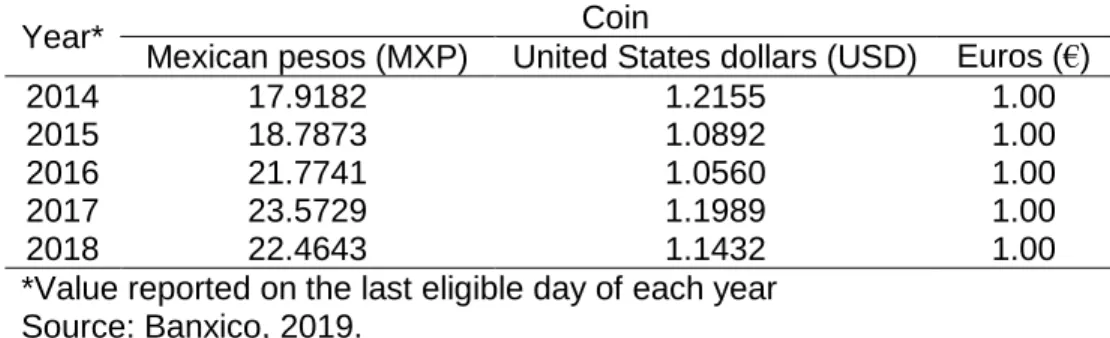
The quantification of EI in WP considered only the calculation of blue water use (BWF). The economic value (EV) calculation of BWF took into account the average international price of water, while CP took into account the international average price of carbon credits.
UNIVERSIDAD AUTÓNOMA CHAPINGO
UNIVERSIDAD DE CÓRDOBA
INTRODUCTION
This analysis should be based on the quantification of the ecological footprint (EF), which should be evaluated considering more than one indicator, instead of a family of indicators (Ridoutt & Pfister, 2013). Given the above, it is essential to quantify the CF and WF of ruminant production systems in CL, Mexico.

OBJETIVES
- Specific objetives
To quantify the carbon and water footprint of ruminant production systems in Comarca Lagunera, Mexico. To determine the environmental impact of the main ruminant production systems in Comarca Lagunera, Mexico.
HYPOTHESIS
The environmental impact, evaluated as the economic cost of the carbon and water footprint created by dairy-meat beef farming systems, is greater than the economic value, while such environmental impact in a dairy-meat goat farming system will be smaller compared to its economic value in Comarca Lagunera, Mexico.
THEORETICAL - CONCEPTUAL FRAMEWORK
- Global climate change (GCC)
- Ecological footprint
- Carbon footprint
- Carbon footprint from the livestock industry
- Water footprint (WF)
- Water footprint from the livestock industry
- Water footprint from the ruminant production
- Livestock production
- Livestock production in the world
- Livestock production in Mexico
- Livestock production in the Comarca Lagunera
The type of GHG and the limits are also defined according to the methodology adopted and the objective of the calculation of the CF (Pandey et al., 2011). 20 Various investigations have reported that the concentration of GHG in the atmosphere has increased markedly during the last 250 years, since the beginning of the industrial revolution and the increase in the use of fossil fuels (Chukwuocha et al., 2011). Considering only the agricultural sector, livestock represents 80% of total emissions (Cardoso, 2012); this sector covers 30% of the tundra-free land surface (Steinfeld et al., 2006).
This emission is part of the natural process of digestion and gas is produced in the rumen of cattle due to methanogenesis carried out in the reticulum-rumen and large intestine of cattle (Alemu et al., 2011). Water covers approximately three-quarters of the earth's surface, however, less than 2.5% is fresh water accessible to meet human needs (Liu et al., 2015). One of the main reasons why water is withdrawn from reservoirs is food production (Konar et al., 2011).
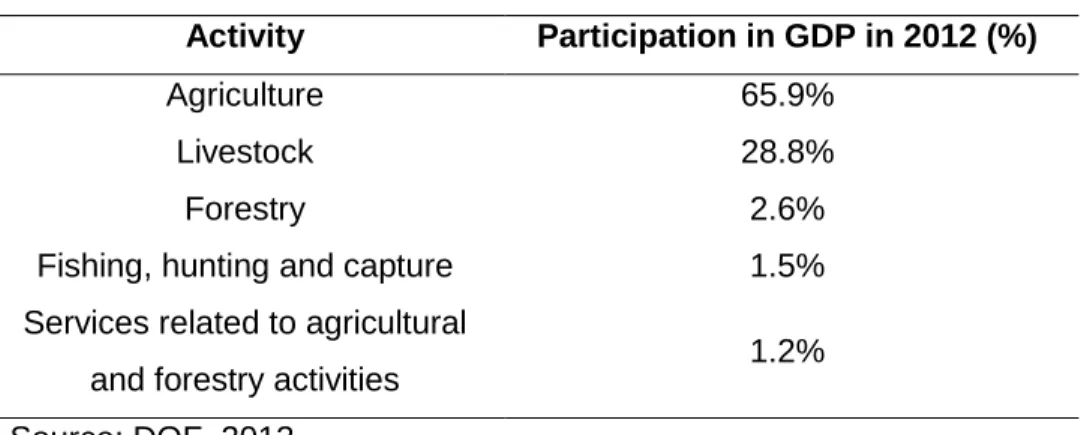
According to FAO (2019), in 2012, 37% of grains produced in the world were intended for animal feed. This could be a consequence of the exclusion of green and gray water and the exclusion of blue water based on the local water shortage with the LCA approach (Legesse, et al., 2017). RTEV Respect for the total economic value of the livestock sector in 2018 Source: Prepared with information from the SIAP, 2019.

ARTICLES
Economic assessment of the environmental impact of an intensive production group of dairy cattle in dry land conditions intensive production group in dry land conditions. Economic evaluation of the environmental impact of an intensive dairy cattle production group in drylands. To Beef or Not to Beef: Uncovering the Economic Environmental Impact of an Intensive Beef Cattle Industry in an Arid Region Created by an Intensive Beef Cattle Industry in an Arid Region.
To beef or not to beef: Uncovering the environmental economic impacts generated by the intensive beef industry in an arid region. Not all ruminants are created equal: ecological and socio-economic sustainability of goats under marginal-extensive production; economic sustainability of goats under a marginal-extensive production system. Not all ruminants are created equal: ecological and socio-economic sustainability of goats under a marginal-extensive production system.
POTENTIAL STRATEGIES TO MITIGATE THE ECOLOGICAL FOOTPRINT OF
RUMINANT PRODUCTION SYSTEMS IN THE COMARCA LAGUNERA, MEXICO
Carbon footprint
In the case of CL, it is suggested to include the use of balanced foods of better quality, in such a way that they help reduce EGHG at the intestinal level and at the manure management level (Herrero et al., 2012; Gerber et al., 2013 ; Moate et al., 2016). Previously, it would help to strengthen CF mitigation efforts in ruminants in CL (Gerber et al., 2013). Microbial technologies for vaccine development, methanotrophic microorganisms, rumen depletion, bacteriophages and the use of probiotics to improve reproductive efficiency are medium-term options to expand mitigation programs (Smith et al., 2014).
Genomic selection aligned with direct measurements of methane emissions, as well as food conversion efficiency, would favor reductions relative to methane emission intensity (Herrero et al., 2012; Moate et al., 2016). Furthermore, to reduce ruminant N2O emissions in CL, the strategies proposed by Smith et al. 2014), which include nutritional manipulations to reduce faecal nitrogen, dietary nitrification inhibitors, urease inhibitors, best fertilizer selection and use of best manure management practices incorporated into the soil. In addition, policy makers and professionals involved in the agricultural management sector need to be able to implement different strategies to mitigate the impact on ecosystem services (De Groot et al., 2002).
85 to mitigate EGHG from ruminant production systems, bioenergy is an interesting alternative, however, it is important to consider various issues such as the implementation of practices to improve the sustainability as well as the efficiency of bioenergy systems (Smith et al. , 2014).
Water footprint
Special attention should be paid to the biological cleaning of the microbial population and, consequently, the C/N ratio, which will help to improve wastewater treatment, reduce wear and tear and function of the biodigester membrane, as shown by Sepehri and Sarrafzadeh (2018). 86 It is of utmost importance to stop the environmental degradation of the Durango Mountains by proposing a healthy, efficient and reasonable management of the upper Nazas River basin, because it is the main source of liquid and groundwater supply, for the development of agricultural activities in CL. The aforementioned WF mitigation strategy should prioritize management practices to promote the supply of more water to the downstream basin located in the CL.
For environmental services to the inhabitants of the upper basin, not only to stop the degradation of the forest, but also to support its conservation and improve the collection of water and carbon sequestration, which will not only mitigate the WF, but in parallel the CF. Another suggestion for mitigation of WF, applicable to CL, is the use of other animal genotypes, which are more efficient in terms of energy and water use with reasonably favorable results for the dairy and meat industry. Without a doubt, such potential mitigation proposals will only be viable with the participation and commitment of the various entities involved in these complex production systems, especially the producers themselves.
Admittedly, both methods and logistics must be carefully planned to achieve these goals in order to mitigate the impact of the animal industry on both the environment and natural resources.
CONCLUSIONS
88 In order to homogenize the analysis periods, the necessary calculations to determine the EI of the dairy cattle production system in CL were economically quantified in the period from 1994 to 2018 (Appendix 1). The highest environmental and economic cost of the bovine milk production system in CL is due to the water footprint. Regarding beef cattle, our study demonstrates a clear and long-term information base that the EI and EcI of WF and CF generated by the intensive cattle rearing system in CL is significantly greater than the EV generated by this activity in the region.
On the other hand, the results obtained in the case of the goat meat-milk production system in the CL clearly show that its long-term economic benefit exceeds its EI. By adding the EV of the EI of the systems analyzed here and contrasting it with the EV they generate in the CL, it is clearly shown that the economic benefit in the years studied of these systems is smaller than their EI. However, by adding the values obtained, the EV of ruminant cattle in the CL represents only 4.85% compared to the EV of its EI.
Future studies are required complementary to quantify the social and economic benefit of ruminant production systems in CL, evaluating different mitigation strategies.
The impact of the intensification of beef production in Brazil on greenhouse gas emissions and land use. Contribution of Working Group I to the Fourth Assessment Report of the Intergovernmental Panel on Climate Change. Contribution of Working Group II to the Fifth Assessment Report of the Intergovernmental Panel on Climate Change.
Contribution of Working Group I to the Fifth Assessment Report of the Intergovernmental Panel on Climate Change. Contribution of Working Group II to the Fourth Assessment Report of the Intergovernmental Panel on Climate Change. Economic costs of greenhouse gas emissions and water footprint of intensive dairy production system in drylands of northern Mexico.
Contribution of Working Group III to the Fifth Assessment Report of the Intergovernmental Panel on Climate Change.
APPENDIX